



Abstract
This article investigates the impact of pan-European candidates in European Parliament election campaigns. It focusses on the two 2019 nominees for the European Greens, who were Dutch and German, respectively. We conducted a pre-registered experiment in the Netherlands and Germany in early April 2019 to test the effects of (non-)personalized campaign posters on (a) turnout intention and (b) vote intention for the Greens alongside possible mediating effects of campaign and candidate evaluations. Our results suggest that while personalized campaigns as opposed to non-personalized campaigns may not matter per se for turnout and vote intention, individual candidates can make a difference in European elections, particularly with respect to vote intention. As such, the results have important implications for our understanding of European Parliament election campaigns.
Introduction
With the introduction of the Spitzenkandidaten procedure during the 2014 European Parliament (EP) elections, by which major European party families put forward pan-European lead candidates for the Presidency of the European Commission (EC), the EP sought to raise voter awareness and participation. 1 Five years later, the EP appeared even more enthusiastic, considering ‘that in 2014 the “Spitzenkandidaten” process proved to be a success’ and arguing that the personalization of the election campaign would enhance transparency and foster ‘political awareness of European citizens’. 2 For the 2019 EP elections, seven Spitzenkandidaten alongside a team of lead candidates were put forward. Ursula von der Leyen’s later election as EC president challenged the Spitzenkandidaten procedure, as she had not been standing in the elections. Yet, the question remains whether the personalization of the campaigns succeeded in influencing European voters.
Personalization is defined as a process by which the focus increasingly shifts onto individual politicians at the expense of political parties. This shift may become apparent in politics itself, campaigning, voting behaviour or media coverage (e.g., Garzia, 2014; Kriesi, 2012; Rahat and Sheafer, 2007). According to political scientists, personalization has emerged in response to declining voter turnout, partisan dealignment and an increase in electoral volatility in developed countries since the Second World War (e.g., Dalton and Wattenberg, 2000; Garzia, 2014). Research on the 2014 EP elections found a positive correlation between Spitzenkandidaten’s campaign intensity and voter turnout in European Union (EU) member states (Schmitt et al., 2015). However, awareness of the Spitzenkandidaten was low (Popa et al., 2020; Schmitt et al., 2015), which may, for example, be attributable to the lacklustre campaigns of national parties (Braun and Schwarzbözl, 2019) and considerable cross-country variation in media coverage about the candidates (Schulze, 2016). We aim to shed light on the alleged impact of the Spitzenkandidaten in EP elections and ask: What are the effects of personalized EP election campaigns centred on Spitzenkandidaten on (a) turnout intention and (b) vote intention?
Despite the growing literature on the effects of candidate and leader evaluations on electoral behaviour (e.g., Garzia, 2014; Lobo and Curtice, 2014; Silva, 2018), we know little about the effects of personalized campaign efforts. Personalization can be manifest in various campaign tools, including constituency campaign style (e.g., Gschwend and Zittel, 2015), door-to-door canvassing (e.g., Giebler and Wüst, 2011), election posters (e.g., Vliegenthart, 2012), campaign websites (e.g., Kruikemeier et al., 2013) and social media activities (e.g., Kruikemeier, 2014). In this article, we focus on election posters. We define a personalized campaign as visual poster content focussing on the individual candidate and a non-personalized campaign as advertising the (pan-European) political party on election posters. Despite the increasing diversification of campaign tools, election posters are still a significant medium for political campaigning (e.g., Dumitrescu, 2012). In EP elections, posters are considered part of classic campaign activities that play an important complementary role alongside newer campaign tools (Giebler and Wüst, 2011). Studies have shown that election posters have become increasingly personalized over time in the Netherlands (Vliegenthart, 2012), Germany (Steffan and Venema, 2019) and during EP elections (Gattermann and Vliegenthart, 2019), which renders them a suitable tool to assess the effects of personalized campaigns in European elections. Moreover, election posters allow us to methodologically distinguish between personalized and non-personalized campaigns by manipulating visual content. Our contribution to the extant literature is thus twofold: First, we assess the causal mechanisms underlying potential effects of personalized campaigns versus non-personalized campaigns on electoral behaviour, which is relevant for the general personalization literature. Second, we shed light on the effectiveness of Spitzenkandidaten campaigns in the EU election context.
We consider two important aspects of personalized campaign effects: voter mobilization in terms of election turnout (e.g., Schmitt et al., 2015; Silva, 2018) and voter support for the respective party of a Spitzenkandidat (e.g., see Garzia and De Angelis, 2016; Gattermann and de Vreese, 2017; Ohr and Oscarsson, 2011). We focus on the European Greens and their two Spitzenkandidaten, the Dutchman Bas Eickhout and the German Ska Keller, as a least-likely case: The Greens are strong issue owners of environment and climate policies (e.g., Abou-Chadi, 2016). However, the personalization of politics contrasts with a focus on policy issues (Adam and Maier, 2010). Moreover, Green parties tend to organize themselves as collectives at the expense of individuals, which also influences their campaigns (De Winter and Baudewyns, 2015: 303).
We set up a pre-registered experiment in both Germany and the Netherlands that allows us to compare the potential effects of foreign versus national Spitzenkandidaten in the domestic context and to control for candidate gender by adding other domestic candidates. We investigate the effects of personalized versus non-personalized election posters on (a) turnout intention and (b) vote intention for the Greens and test possible mediating effects of campaign and candidate evaluations. Our results suggest that while personalized campaigns as opposed to non-personalized campaigns may not matter per se for turnout and vote intention, individual candidates can make a difference in European elections, particularly with respect to vote intention. This has important implications for our understanding of EP election campaigns.
The potential effectiveness of personalized EP election campaigns
We ask whether pan-European Spitzenkandidaten are able to encourage European voters to (a) participate in EU elections and (b) vote for the party (family) they represent. We distinguish between these two outcomes and base our assumptions on the multidisciplinary literature on personalization effects on political attitudes and behaviour.
Spitzenkandidaten influence on turnout intention
When trying to explain variation in turnout for EP elections, the literature distinguishes between contextual, structural and campaign factors. Contextual factors include, for example, the electoral system (e.g., Karp and Banducci, 2008) or Eurozone membership (Schäfer and Debus, 2018), while structural factors refer to generational effects (Bhatti and Hansen, 2012) or habitual voting (Franklin and Hobolt, 2011), among other things. Specific campaign effects in EU elections may stem from exposure to general campaigns (e.g., Lefevere and Van Aelst, 2014) and conflict framing in campaign news (e.g., Schuck et al., 2016). With respect to personalization, existing research has also investigated the extent to which recognition of the Spitzenkandidaten and their campaign activity is related to turnout (Schmitt et al., 2015) and what role leader evaluations play for participation in national elections (e.g., Silva, 2018). Yet, we know little about the potential mobilizing effects of individual candidates’ campaigns versus party campaigns and the underlying mechanisms for this alleged personalization effect, particularly at the EU level.
Two different considerations play a role here. First, scholars argue that partisan dealignment in Western Europe – as opposed to the United States – is responsible not only for the increasing importance of leaders for vote choice but also for voters’ decision to turn out in the first place. Since electoral participation is no longer rooted in social cleavages, voters have become more sensible to short-term factors that may influence their electoral participation (e.g., Silva, 2018: 62), and exposure to (personalized) electoral campaigns may constitute one such influential short-term factor. Second, personalization has been conceptualized as a mechanism in itself: Schmitt et al. (2015) argue that Spitzenkandidaten make competition at the EU level more salient and thereby raise voters’ interest to participate in EP elections.
If we extend these arguments to the distinction of mobilizing effects of individual politicians versus political parties, we need to enquire what it is that candidates have (and parties do not) that could potentially raise the interest of European voters to turn out on election day. European party families represent a collection of ideologically close national parties, but this organization at the EU level may not immediately be comprehendible for voters. The EU party system is also rather abstract in the sense that it serves to structure legislative work inside the EP but is hardly tangible beyond EU institutions (see Føllesdal and Hix, 2006). Individual politicians can make EU politics more accessible by providing a human face to it. Similarly, the Spitzenkandidaten procedure was intended to ‘personalise the distant Brussels bureaucracy’ (Hobolt, 2019: 19). Accordingly, compared to a campaign that only focuses on a party, a personalized campaign featuring a Spitzenkandidat is likely to be evaluated more positively. It is then precisely because of this positive evaluation that we expect that personalized as opposed to non-personalized campaigns are better able to mobilize European voters to turn out on election day (Figure 1). In other words, we expect that any direct and positive effect of personalized campaigns on turnout intention (H1a) is mediated by campaign evaluation (H1b): 3
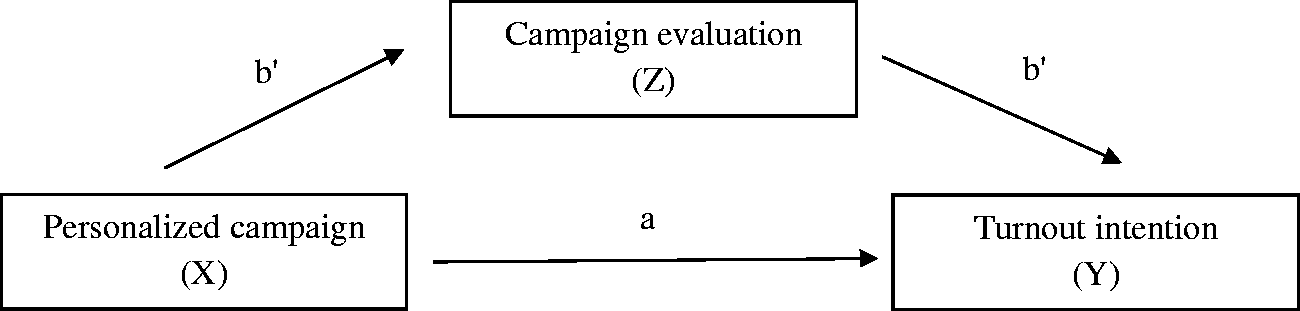
Mediation model of personalized campaigns on turnout intention in EP elections.
H1a: Exposure to a personalized campaign increases citizens’ turnout intention compared to exposure to a non-personalized campaign.
H1b: The positive effect of exposure to a personalized campaign on turnout intention (H1a) is mediated by campaign evaluation.
Extending the argument of making politics more accessible through personalization, Langer (2007: 373) contends that political leaders can offer a source of identification for people. However, one defining aspect of the pan-European Spitzenkandidaten system is that lead candidates may hold other nationalities than their voters, which is unique in the global comparative politics literature. Hence, research on the role of candidate nationality is scarce. Voters may find it difficult to connect to a politician from another country, and identification with the Spitzenkandidaten is presumably easier when candidates and voters share the same nationality. For example, Czech voters may feel that a Czech candidate is better able to represent their interests in the EP or the Commission.
In fact, voters are more likely to recognize a Spitzenkandidat from their own country than other European candidates (Gattermann and de Vreese, 2020), and Spitzenkandidaten recognition positively relates to turnout (Schmitt et al., 2015). Furthermore, research from Britain and the United States indicates that candidate ethnicity can affect vote choice in such way that voters who have the same ethnicity as candidates are more likely to vote for them (e.g., Fisher et al., 2015; McConnaughy et al., 2010). Likewise, politicians living in the same constituency as their voters receive better evaluations than candidates from another constituency (Campbell and Cowley, 2014). Resting on the assumption that identification with a candidate from one’s own country offers similarly suitable heuristics, voters should be mobilized by Spitzenkandidaten who share their nationality. We thus expect (mediated) personalization effects to be strongest for a candidate from one’s own country compared to a Spitzenkandidat from a different country (Figure 2).
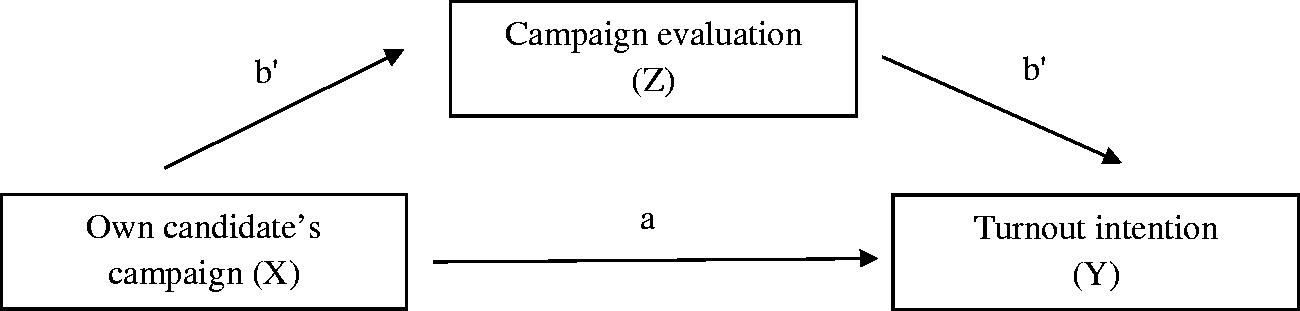
Mediation model of own candidate’s campaign on turnout intention in EP elections.
H2a: Turnout intention will be higher after exposure to a personalized campaign from a candidate of one’s own country compared to a personalized campaign from a candidate of another country.
H2b: The positive effect of exposure to a personalized campaign from a candidate of one’s own country on turnout intention (H2a) is mediated by campaign evaluation.
Spitzenkandidaten and vote intention
Since political parties also want to win votes on election day, we further ask whether pan-European Spitzenkandidaten are able to persuade European voters to vote for the party (family) they represent. We know from the campaigning literature that individual candidates have an effect, but not what the scope of this effect is compared to that of parties. For example, Kleinnijenhuis et al. (2001: 356) conclude that ‘[a] party with a popular candidate who is frequently in the news increases its chances of being voted for’. Similarly, Bos et al. (2011) show that exposure to prominent media coverage of a party leader positively affects the perceived effectiveness and legitimacy of the respective leader. Moreover, Aaldering et al. (2018) find an empirical link between exposure to positive images of leaders’ character traits in the media and a higher propensity to vote for the leader’s party.
Partisan attachment has long been considered the most important factor for voting decisions (e.g., Campbell et al., 1960), but given partisan dealignment in post-modern democracies, candidates have become crucial for voters when deciding whom to vote for (e.g., Dalton and Wattenberg, 2000; Garzia, 2014). The question is whether Spitzenkandidaten matter for vote choice at the EU level as well. On the one hand, Spitzenkandidaten are likely to be less well known in the EU context (e.g., Popa et al., 2020). Despite considerable campaign efforts (Schmitt et al., 2015), media attention for pan-European candidates is limited to the domestic context (Schulze, 2016), and pan-European debates have little audience reach (Maier et al., 2016: 57). This implies that voters have less information at hand that would help them formulate opinions about the candidates and ultimately guide their voting decision. Hence, parties are likely to provide better cues than relatively unknown candidates, and we would expect that non-personalized campaigns lead to higher vote intentions compared to personalized campaigns.
On the other hand, and in line with our above argumentation that personalization could make EU politics more accessible to voters, candidates are able to give a party a face. Since voters may be familiar with the party from domestic politics, Spitzenkandidaten may provide additional cues that help voters decide whether to vote for the party (see Lodge et al., 1995). Since EU issues are generally considered rather abstract and difficult to understand, Adam and Maier (2010: 239) hypothesize that individual politicians provide information short cuts to make sense of EU politics.
4
H3: Exposure to a personalized campaign compared to a non-personalized campaign increases the likelihood to vote for the advertising party in the 2019 EP elections. H4: Candidate evaluations mediate the effect of personalized campaigns on the likelihood to vote for the advertising party.
Data and methods
Research design
The 2019 EP elections provided an excellent opportunity to study personalization effects against the background of an existing campaign and real candidates. The European Green Party put forward two Spitzenkandidaten: the Dutch member of the EP (MEP) Bas Eickhout (male) and the German MEP Ska Keller (female). Both Spitzenkandidaten were relatively unknown: A pre-election survey fielded inter alia in the Netherlands and Germany in April 2019 (Gattermann and de Vreese, 2020) revealed that only 9% and 2% of Dutch voters had been aware of Eickhout and Keller, respectively. Among German voters, the figures are 6% (Eickhout) and 12% (Keller). For our study, this lack of awareness has the advantage that respondents are unlikely to hold predisposed attitudes towards the candidates. We collected experimental data in the Netherlands (NL) and Germany (DE) and account for candidates’ nationality as a potential influencing factor. We add another candidate of different gender in each country (see below) to rule out confounding effects attributed to candidate gender because voters tend to evaluate male and female politicians differently (e.g., Bauer, 2014). 6
We set up an experiment in both countries in early April 2019, before the final phase of the EP election campaigns had begun. The experiment was designed in Qualtrics and executed by the survey company Dynata by inviting members of their online databases to participate in this study. An a priori power analysis determined a necessary minimum sample size of n = 489 in each country (four groups, 80% power, 5% α-error probability, effect size f = .15; based on results by Kruikemeier et al., 2013 and Otto and Maier, 2016). We pre-registered our study on aspredicted.org 7 and obtained ethical approval from the Amsterdam School of Communication Research’s Ethical Review Board prior to data collection.
Stimulus material
Respondents were randomly assigned to one out of four experimental conditions. In each condition, respondents were exposed to a group of three fictional election posters in random order to simulate a coherent campaign. Respondents were asked to rate each poster to engage them with the content. The content of the posters differed between conditions in the following way: Respondents in Condition 1 were exposed to three posters showing the national Spitzenkandidat; posters in Condition 2 featured the other European Spitzenkandidat; Condition 3 showed another national Green candidate (Jeroni Vergeer (NL) or Sven Giegold (DE)) 8 and Condition 4 was provided with posters mentioning the party only. The stimulus material was identical in both countries except for the third condition (national candidate). We made use of the candidates’ real photographs that are available online. The slogans were based on the online communication of the European Greens and respective national parties and are comparable in terms of substance. All conditions featured the European party logo to allow for comparability across countries, but we provided respondents with the names of the respective national party in the preceding survey questions. 9
Sample
Both surveys were released at the same time in each country (10 April 2019). Initially, the sample consisted of 570 Dutch and 569 German respondents (see the Online appendix). As stated in our pre-registration plan, we excluded 12 Dutch and 10 German respondents who completed the surveys in less than 33% of the median time. In addition, we decided to cut the maximum duration at 20 minutes because we deem it likely that respondents may have taken a break while participating in the survey, which could undermine any effects. We therefore additionally excluded 12 Dutch and nine German respondents. The final sample sizes comprise 546 Dutch and 550 German respondents. Table 1 shows their distributions across conditions.
Distributions across conditions.
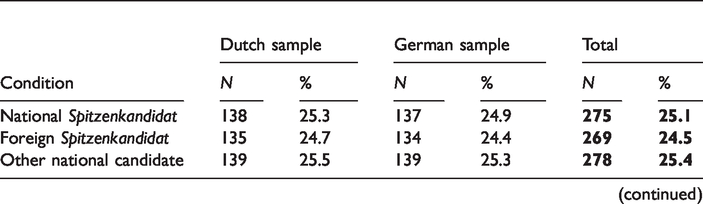
Each sample is comparable to the population in terms of age and gender combined as well as region (see the Online appendix). There are slightly fewer women above the age of 65 in the German sample compared to the population, while men in this category are slightly overrepresented, but there are no differences of age or gender across the four German experimental conditions.
Measures
To test the hypotheses, we derive two central independent variables from the experimental design. The first is a dummy that distinguishes between a personalized (conditions 1 to 3) and a non-personalized campaign and addresses H1a, H1b and H3. The second variable (H2a and H2b) is also a dummy, indicating whether a candidate has the same nationality as the respondent; it disregards the non-personalized condition, similar to the test of H4.
Before exposing respondents to the experimental manipulation, we asked a number of control questions (see the Online appendix), including political interest, left-right position and support for EU integration (e.g., van Egmond et al., 2013). We also asked respondents which party they had voted for in the last general elections: 10.2% of Dutch respondents stated that they had voted for GroenLinks in March 2017 (excluding non-voters and invalid votes), compared to 9.1% of actual votes; 10.2% of German respondents indicated that they had voted for Bündnis 90/Die Grünen in September 2017, compared to 8.9% of votes on the second ballot. Hence, Green voters are slightly overrepresented.
We report the operationalization of the two mediators and two dependent variables in order of appearance in the survey (for further details, see the Online appendix). After showing them all three political posters, we asked respondents about their evaluation of the campaign (mediator 1, seven statements, 7-point scale, randomized, e.g., ‘The campaign is informative’, ‘The posters have an attractive design’). Some of these items were adapted from the concept of message involvement in advertising research (Cox and Cox, 2001). In both samples, exploratory rotated principal components factor analysis with oblique rotation (direct oblimin) reveals that all seven items loaded into one single factor, explaining 73.64% (NL) and 80.71% of the variance (DE). The reliability of the items is very high (Cronbach’s αNL=.939; Cronbach’s αDE=.960).
Our first dependent variable, turnout intention, was measured by a single item on a 7-point scale asking respondents how certain they are to participate in the upcoming EP elections. Next, we asked those respondents who were exposed to a personalized campaign to rate the candidate. As a reminder, we provided them with a small picture of all three posters combined. This second mediator, candidate evaluation, was measured by five statements to which respondents had to agree or disagree (7-point scale, randomized, e.g., ‘He/she is inspiring’, ‘He/she seems competent’). These were adapted from studies on candidate or leader evaluations in electoral research (e.g., Dumitrescu et al., 2015; Ohr and Oscarsson, 2011). In both samples, exploratory rotated principal components factor analysis with oblique rotation (direct oblimin) reveals that all five items loaded into one single factor, explaining 82.56% (NL) and 87.69% of the variance (DE). The reliability of the items is very high (Cronbach’s αNL = .947; Cronbach’s αDE = .965). Our second dependent variable, vote intention for the Green party, was measured by a single item asking all respondents, including those in the party condition, how likely they were going to vote for the Greens in the EP elections (11-point scale). The Online appendix provides the descriptive statistics of the main variables.
Data analysis procedure
Randomization was successful for all except two pre-exposure variables: In the Dutch sample, educational levels were not randomly distributed across experimental conditions, while Green voters were more common in one condition compared to the others in the German sample. We add these variables as covariates in our analyses (dummy variables Green vote and Higher Education).
As detailed in our pre-registration plan, we computed analyses of variance (ANOVAs) to test H1a, H2a and H3 (see the Online appendix for further details) and rely on PROCESS (Hayes, 2013) to test H1b, H2b and H4. PROCESS is an SPSS macro for mediation analyses, which allows researchers to investigate how variables affect each other through inclusion of a mediator and enables us to test direct and indirect effects simultaneously. We additionally provide ordinary least squares (OLS) regressions on a single, pooled sample that includes all control variables alongside a country dummy to assess the direct effects of our stimuli.
Results
Table 2 shows the OLS regression results with turnout intention as dependent variable. Model 1 is the main model including only the covariates Higher Education and past vote for the Greens alongside our main independent variable (personalized versus party condition). Model 2 includes additional control variables. Models 3 and 4 include only those respondents who were exposed to personalized posters. A dummy indicates that a candidate has the same nationality as the voter. All controls provide plausible effects: Past Green voters and respondents who are highly educated, politically interested, pro-EU, female or older reported higher turnout intentions. Dutch respondents were less willing to turn out than German respondents. The left-right position only matters in the full sample: Here, more right-leaning voters are more likely to turn out.
OLS regressions explaining turnout intention.
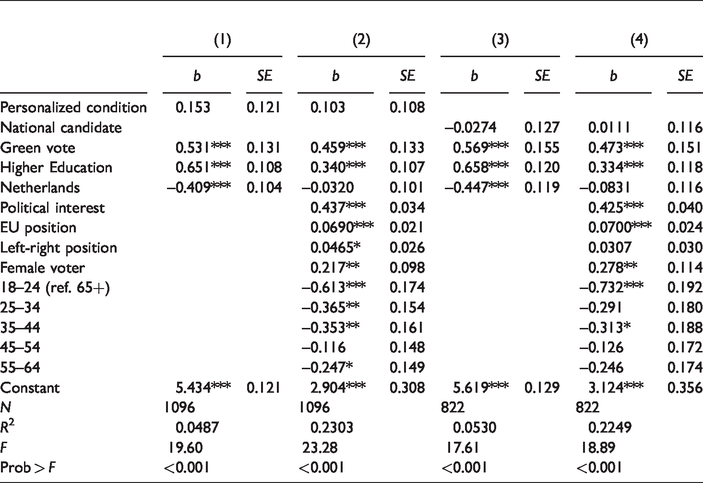
Note: EU: European Union. Standard errors are robust. *p < .1, **p < .05, ***p < .01.
Our first hypothesis (H1a) assumed that exposure to a personalized campaign increases citizens’ turnout intention compared to a non-personalized campaign. The results reported in Models 1 and 2 show that there is no difference in the turnout intention of Dutch and German respondents exposed to either the personalized or the non-personalized campaign posters. The results from the separate ANOVAs for the Dutch and German samples are similar (reported fully in the Online appendix). H1a is therefore rejected.
Hypothesis 1b assumed that campaign evaluation mediates the effect of exposure to a personalized campaign on turnout intention. To test this, we ran mediation analyses using PROCESS (Model 4; Hayes, 2013; the Online appendix includes the full table). Our main independent variable is dichotomous, indicating whether respondents were exposed to a personalized (n = 822) or non-personalized campaign (n = 274). We add the same covariates as in the full models in Table 2. Figure 3 visualizes the direct and indirect effects, showing that, contrary to our expectation, campaign evaluation is negatively affected by a personalized campaign as opposed to party-only posters (b = –1.91). Campaign evaluations significantly increased turnout intention (b = 0.020), while personalization did not directly affect turnout intention. The overall indirect effect of exposure to a personalized campaign on turnout intention via campaign evaluation is small but significant and negative due to the strong negative effect of personalized campaigns on evaluations (b = –0.039, 95% confidence intervals (CI) [–0.076, –0.009], 5000 bootstrap samples). H1b is not supported because the mediated effect of campaign evaluation is not positive as hypothesized.
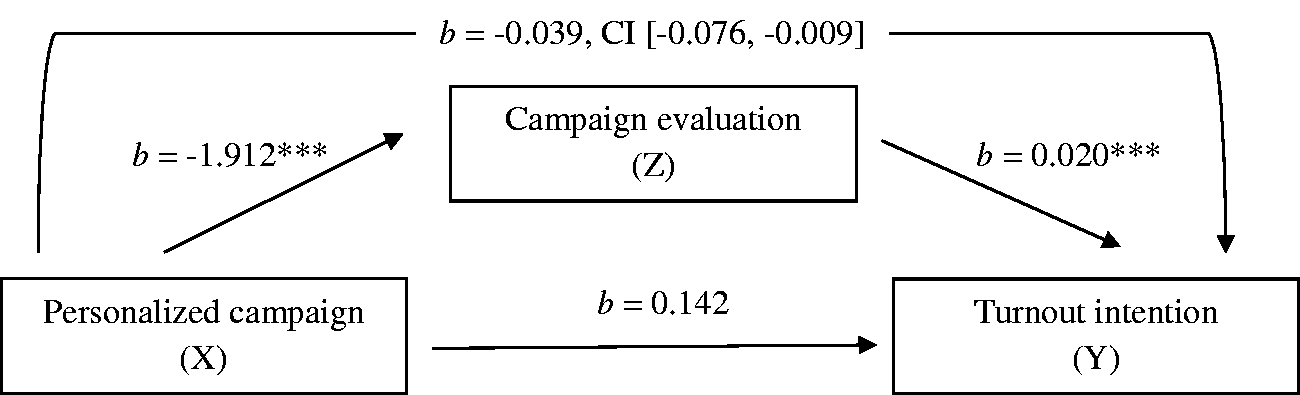
Results of the mediation model testing H1b.
H2a stipulated that turnout intention will be higher after exposure to a personalized campaign from a candidate of one’s own country compared to a personalized campaign from a candidate of another country. The results from Models 3 and 4 in Table 2, however, show that voters exposed to a candidate from their own country are not more likely to turn out than those who were exposed to a foreign Spitzenkandidat. H2a is thus rejected. Likewise, candidate gender does not play a role for the proposed effects of personalized campaigns on turnout intention in the 2019 EP elections. ANOVAs suggest that exposure to the posters of Ska Keller results in the highest turnout intentions in both samples, but these findings are not statistically significant. We report the details in the Online appendix.
To test H2b, we ran another mediation analysis using PROCESS, excluding those respondents in the non-personalized campaign conditions. Our independent variable is exposure to a candidate from one’s own country (n = 553) versus a Spitzenkandidat from the respective other country (n = 269), and we test the indirect effect of candidate nationality on turnout intention through campaign evaluation. Again, all analyses include the covariates specified above, including an additional control for candidate gender (see the Online appendix). Figure 4 visualizes the direct and indirect effects, showing that campaign evaluations do not increase when respondents are exposed to a candidate who shares their nationality, nor does shared nationality increase turnout intention. 10 The positive effect of campaign evaluations on turnout remains stable (b = 0.018), but we detect no indirect effect of candidate nationality on turnout intention in the 2019 EP election via campaign evaluation (b = 0.004, CI [–0.023, 0.034]). H2b is therefore rejected.
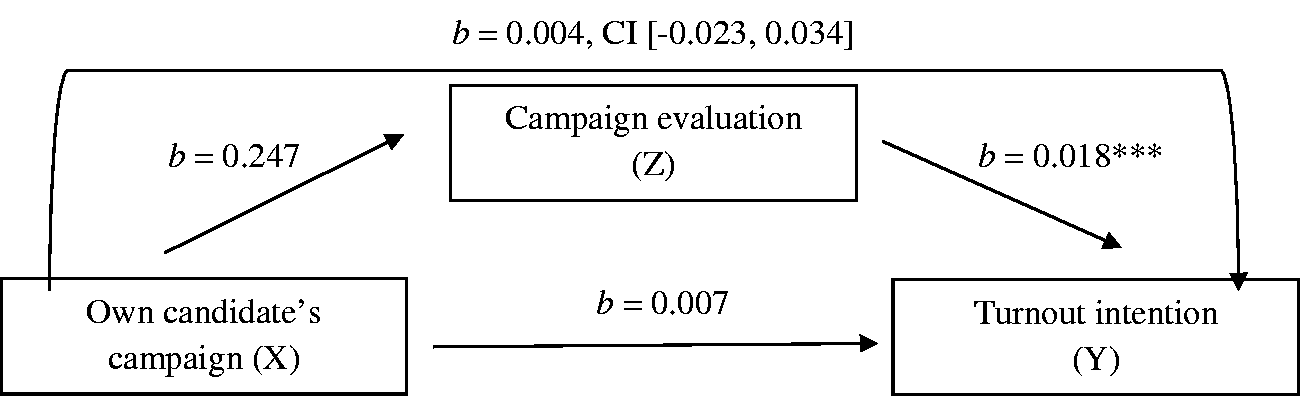
Results of the mediation model testing H2b.
Turning to our second dependent variable, vote intention for the Greens, H3 stipulated that exposure to a personalized campaign compared to a non-personalized campaign increases the likelihood to vote for the Greens in the upcoming EP elections. Table 3 reports the results from the OLS regression analysis with vote intention for the Greens as dependent variable. As above, Model 1 is restricted; Model 2 includes additional control variables. Past Green voters and respondents who are politically interested, pro-EU, ideologically left-leaning, female and younger are more likely to vote for the Greens. Green support is lower in the Netherlands. However, there are no significant differences between the personalized and non-personalized campaigns on voting intention. ANOVAs reported in the Online appendix show that, albeit not statistically significant, vote intention for the Greens is higher for those respondents exposed to the personalized campaigns (MNL = 4.456; MDE = 4.726) compared to the non-personalized campaigns (MNL = 4.359; MDE = 5.817). H3 is rejected.
OLS regressions explaining vote intention for the Greens.
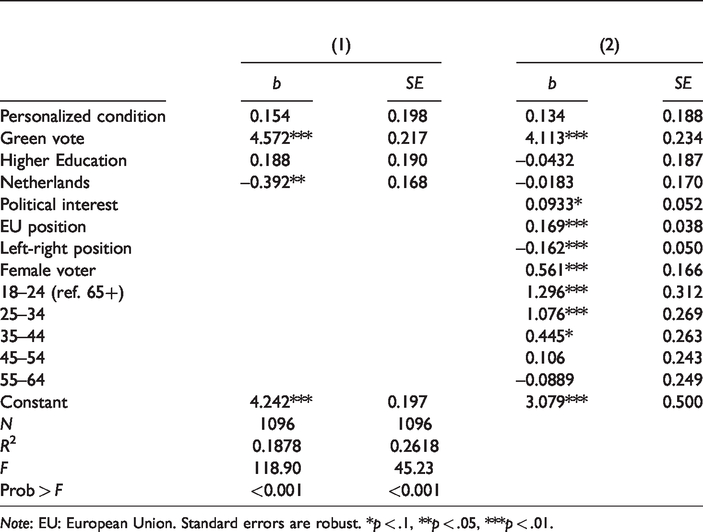
Note: EU: European Union. Standard errors are robust. *p < .1, **p < .05, ***p < .01.
Finally, we test whether candidate evaluations mediate the effect of personalized campaigns on the likelihood to vote for the advertising party (H4). Once again, we rely on mediation analyses with PROCESS, accounting for the same covariates as before, and only assess the indirect effects on vote intention for the personalized conditions. We distinguish between candidate nationality and gender, candidate evaluation is the mediator and the dependent variable measures the likelihood that respondents will vote for the Greens in the upcoming 2019 EP elections. Table 4 shows that respondents rated female candidates more positively than male politicians (b = 1.887), but a candidate’s nationality does not affect evaluations. Generally, Dutch respondents rate politicians more favourably than German respondents, as do women and Green supporters. Political interest also exerts a positive effect on candidate evaluations, as do favourable attitudes towards the EU and a more left-leaning position.
Regression results for candidate evaluation and Green party vote.
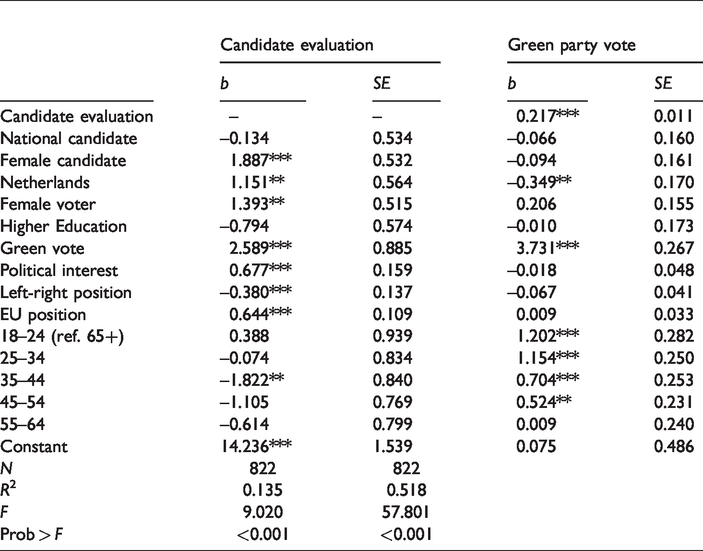
Note: EU: European Union. *p < .1, **p < .05, ***p < .01.
When looking at the effects on voting intention, candidate evaluations positively affect support for the Greens (b = 0.217). It does not matter whether respondents were exposed to a personalized campaign of a candidate from their own country or a female politician. In line with the non-significant effect of our manipulation on respondents’ rating of the politicians, there is no overall indirect effect of exposure to a personalized campaign featuring a candidate from ones’ own country on Green support trough candidate evaluations (b = –0.029, CI [–0.258, 0.204]). Notably, candidate gender has a positive indirect effect on Green voting intention through candidate evaluation because female politicians are evaluated more positively than their male counterparts (b = 3.951, CI [0.174, 0.620]). As expected in H4, candidate evaluations matter for the likelihood that voters will cast their vote for the Greens, but candidate nationality does not play a role.
Discussion and conclusion
In this study, we investigated whether the Spitzenkandidaten procedure at the European level has the potential to influence European citizens to (a) participate in the upcoming EU elections and (b) vote for the advertising party. We set up a novel experiment to investigate the direct and mediated effects of personalized poster campaigns among Dutch and German voters. We relied on the Spitzenkandidaten of the European Green Party, Bas Eickhout (NL) and Ska Keller (DE), which allowed us to tease out potential nationality effects. Additionally, we controlled for gender effects by adding another Green candidate with a different gender from each country. Comparing the effects of personalized and non-personalized campaigns on turnout intention and vote intention for the Greens enabled us to assess whether Spitzenkandidaten make a difference to European voters.
Our results show that there are no direct effects of exposure to a personalized campaign on turnout intention and vote intention for the Greens, respectively. The European Greens are a special case because they exhibit strong issue ownership on environmental issues and do not represent catch-all parties. Candidates may be less important than issues. Similarly, voters may already hold clear positions towards Green parties and their electoral programmes, which may be why it makes no difference for electoral behaviour whether the campaign focusses on candidates or parties.
However, personalized campaigns were evaluated less favourably than non-personalized campaigns, which in turn made voters less likely to participate in the 2019 EP elections. Unless these findings pertain to our stimulus material (see below), they may again relate to the assumption that voters already hold predispositions towards the Green Party and their candidates. Party posters may elicit a stronger focus on the message, while personalized posters could be perceived as prioritizing candidates over issues, which could potentially explain why the latter are evaluated less positively compared to party posters if personalization is considered a negative campaign strategy. Moreover, we argued that Spitzenkandidaten can serve as additional cues that voters consider when deciding whether to vote for the Greens. Thus, if candidates do not match voters’ expectations, the latter are less likely to be mobilized by them. In other words, a personalization effect is still present, but it is driven by negative rather than positive campaign evaluations (see also Garzia and Silva, 2020).
Furthermore, we find that respondents did not favour their own Spitzenkandidat over a politician from a different country. These findings paint a mixed picture of the success of the Spitzenkandidaten procedure: Voters are not per se mobilized by pan-European parties’ personalized campaigning, but if Spitzenkandidaten are put forward, voters do not necessarily favour candidates with the same national background. This speaks to a more general openness towards pan-European politicians. While this openness may be specific to the Greens and their supporters, it suggests that nationality is of less importance for European voters. However, one possible explanation for the absence of nationality effects is that voters were not aware of the candidates. None of them held a significant domestic office (e.g., Minister or party leader) which would allow voters to recognize them and take their past political performance into account. Thus, it appears to be the absence of additional cues rather than nationality that guides voters’ evaluations and behaviour. In other words, the lack of mobilization may not be due to personalized campaigns but connected to the above-mentioned problem that European Spitzenkandidaten are relatively unknown (e.g., Popa et al., 2020). Our results thereby substantiate previous findings regarding the relationship between candidate recognition and turnout (Schmitt et al., 2015). They also imply that for personalization effects to work, additional campaign efforts are required (see Gschwend and Zittel, 2015) alongside comprehensive media coverage, since media exposure positively affects Spitzenkandidaten recognition (Gattermann and de Vreese, 2020).
We showed that respondents who evaluated a candidate more positively were more likely to vote for the Greens. While voters did not distinguish between candidates’ nationality, female candidates – particularly Ska Keller – received better evaluations and were responsible for a higher voting intention for the Greens. Hence, while personalized campaigns may not matter per se in comparison to party campaigns, individual candidates can make a difference in EP elections. Put differently, it was not the procedure itself that influenced voters to vote for the Greens, but individual candidates who raised their interest. At the same time, this suggests that, although candidates may not be very prominent, voters are able to assess them based on visual cues (e.g., Laustsen and Petersen, 2016), which positively affects vote intentions. We thus recommend to further explore the opportunities of personalized campaigns in EP elections with carefully chosen individual candidates – for instance, as part of a revised Spitzenkandidaten procedure as discussed during the investiture of Ursula von der Leyen.
The reader may ask whether certain respondent characteristics moderate personalization effects. We conducted multiple regressions in each sample with turnout and vote intention as the respective dependent variables (see the Online appendix for details). The independent variables included the covariates resulting from the randomization checks and interactions of the experimental conditions with low, average and high levels of political interest and support for EU integration as well as past vote for the Greens, respectively. For both dependent variables and samples, we found no differences between various levels of political interest and prior Green vote for the proposed effect of personalized versus non-personalized campaigns. There are no significant differences across personalized conditions either. Yet, Dutch respondents who are less supportive of EU integration are more likely to be mobilized by Ska Keller’s campaign to turn out.
Our study comes with some limitations. We did not ask respondents whether they knew any of the candidates. As the campaigns had just begun at the time of the data collection and the first European Spitzenkandidaten debate only took place on 29 April 2019, we assume that the majority of respondents was not familiar with the candidates (see also Gattermann and de Vreese, 2020). This may be an advantage over more prominent candidates, as the effects of candidates and parties are often difficult to disentangle (e.g., Garzia and De Angelis, 2016). Furthermore, randomization was successful with respect to political interest, a key determinant of recognizing Spitzenkandidaten (Popa et al., 2020), which means that potential recognition effects are controlled for across experimental conditions.
The fact that we relied on real candidates allowed us to provide a realistic setting for our experiment, but it impedes comparability, especially with respect to the photographs used in the stimulus material. The images differ with regard to candidates’ postures and the situations they are pictured in, which may also partially explain variation in campaign and candidate evaluations. Furthermore, Dutch and German voters tend to be familiar with the concept of lead candidates in elections (e.g., Gattermann and de Vreese, 2017; Schoen, 2011). However, such campaigns may have different effects in countries without own Spitzenkandidaten or with different political cultures (e.g., regarding male and female candidates), and we strongly encourage further research into these aspects. Likewise, our results are not generalizable to other candidates or parties standing in EP elections (e.g., the Spitzenkandidaten duo of the European Left, Violeta Tomič and Nico Cué).
Candidates and parties rely on a plethora of campaign tools in their effort to mobilize and rally voters behind them in EP elections, including, among others, social media activities (Nulty et al., 2016) and televised debates (Maier et al., 2016). We argued that political posters still play an important role in election campaigns across Europe but acknowledge that their impact within a larger campaign can be additive at best, in the sense that they work as ‘visual reminders’ of the upcoming election day. Thus, our conclusions are limited to the forced exposure to these posters. We sought to provide a thorough test of personalization effects, and our results show that personalized campaigns can affect campaign and candidate evaluations, which in turn influence motivations to turn out and the intention to vote for the advertising party, albeit to a differentiated degree. We recommend that future research builds on these findings and tests the effects of other personalized campaigning strategies of pan-European Spitzenkandidaten in additional countries.
Supplemental Material
sj-pdf-1-eup-10.1177_1465116520938148 - Supplemental material for Do Spitzenkandidaten really make a difference? An experiment on the effectiveness of personalized European Parliament election campaigns
Supplemental material, sj-pdf-1-eup-10.1177_1465116520938148 for Do Spitzenkandidaten really make a difference? An experiment on the effectiveness of personalized European Parliament election campaigns by Katjana Gattermann and Franziska Marquart in European Union Politics
Supplemental Material
sj-pdf-2-eup-10.1177_1465116520938148 - Supplemental material for Do Spitzenkandidaten really make a difference? An experiment on the effectiveness of personalized European Parliament election campaigns
Supplemental material, sj-pdf-2-eup-10.1177_1465116520938148 for Do Spitzenkandidaten really make a difference? An experiment on the effectiveness of personalized European Parliament election campaigns by Katjana Gattermann and Franziska Marquart in European Union Politics
Supplemental Material
sj-zip-3-eup-10.1177_1465116520938148 - Supplemental material for Do Spitzenkandidaten really make a difference? An experiment on the effectiveness of personalized European Parliament election campaigns
Supplemental material, sj-zip-3-eup-10.1177_1465116520938148 for Do Spitzenkandidaten really make a difference? An experiment on the effectiveness of personalized European Parliament election campaigns by Katjana Gattermann and Franziska Marquart in European Union Politics
Footnotes
Acknowledgements
We presented previous versions of this article at workshops at the Universities of Montreal, York, and Amsterdam, and at the 2019 European Consortium for Political Research General Conference and the 2019 European Communication Research and Education Association Political Communication Section Interim Conference. We would like to thank all organizers and participants, particularly Laurie Beaudonnet, Ruth Dassonneville, Jérémy Dodeigne, Alberto Lopez Ortega, Johannes Müller Gómez, Sebastian Popa, Agnieszka Stępińska, and Sofia Vasilopoulou, as well as the three anonymous reviewers at European Union Politics for their valuable comments.
Funding
The author(s) disclosed receipt of the following financial support for the research, authorship, and/or publication of this article: The data collection was funded by an internal grant of the Amsterdam School of Communication Research and by Katjana Gattermann’s personal grant from the Nederlandse Organisatie voor Wetenschappelijk Onderzoek (NWO Veni Grant, Project No. 451-15-003). Part of the time invested in this research was further funded by a grant by the European Research Council, grant number 647316 (principal investigator: Claes H. de Vreese).

Supplemental Material
Supplemental material is available for this article online.
Notes
References
Supplementary Material
Please find the following supplemental material available below.
For Open Access articles published under a Creative Commons License, all supplemental material carries the same license as the article it is associated with.
For non-Open Access articles published, all supplemental material carries a non-exclusive license, and permission requests for re-use of supplemental material or any part of supplemental material shall be sent directly to the copyright owner as specified in the copyright notice associated with the article.
