




Abstract
Parliamentary speech is a prominent avenue that political elites can use in parliament to communicate with the electorate. However, we have little understanding of how exactly Members of Parliament craft their speeches to communicate with the districts they represent. We expect that Members of Parliament adapt the comprehensibility of their speeches to their constituents’ linguistic skills since doing so facilitates effective communication. Using parliamentary speeches from the German Bundestag, we reveal that Members of Parliament tend to make their speeches less complicated when their constituents are relatively poor, less educated, and come from an immigration background. Our findings have important implications for the study of political representation and communication strategies.
Introduction
Making speeches is one of the major activities in which Members of Parliament (MPs) engage in parliament. Through participating in a floor debate, MPs can communicate with their target audiences, particularly the electorate. In essence, parliamentary speeches create a public forum where MPs can speak on issues of their choice and, most importantly, sustain the representative-constituency linkage by taking positions, claiming credits, and advertising their own brands (Martin and Vanberg, 2008; Mayhew, 1974; Proksch and Slapin, 2014). Motivated by this electoral connection and its core role in political representation, scholars frequently investigate patterns of MPs’ speech-making behavior by assessing a wide range of variables, including whether an MP takes the floor, speech length, number of speeches one makes in a legislative term, type of issues a speech addresses, and whether MPs deviate from the party line in their speeches (Alemán et al., 2017; Bäck and Debus, 2016; Bäck et al., 2014; Giannetti and Pedrazzani, 2016; Maltzman and Sigelman 1996; Proksch and Slapin 2012; Quinn et al., 2010). One prominent result of this literature suggests that MPs strategically respond to electoral considerations by adjusting the way they engage in parliamentary debate.
Naturally, MPs would want to participate in plenary speeches when they know their supporters might be watching. Yet, parliamentary speeches may carry technical terms and complicated expressions associated with policy and representation outcomes. Since average citizens may find understanding these messages difficult, merely taking part in a floor debate or making speeches frequently do not guarantee the delivery of the core message an MP attempts to convey. Parliamentary speeches could become nothing but cheap talk if the target audience does not receive designed signals (e.g. policy information) from MPs. As a result, one of the fundamental concerns for MPs is how they can effectively communicate with their audience. After all, ensuring that citizens understand the core values political elites stand for is a critical aspect of political communication (Page, 1976) and also a key caveat to the function of a representative democracy (Powell, 2000). However, this aspect – effective communication – has surprisingly been understudied in the literature even though answering the question as to how and under what conditions MPs facilitate effective communication is vital in understanding political representation and communication.
In this article, we answer this question by examining the relationship between constituency characteristics and the comprehensibility of parliamentary speeches. Building on Spirling (2016), we consider parliamentary speeches a tool for reputation building and highlight simple expression as an effective way to communicate. We focus on the representative-constituency linkage and investigate under what conditions MPs reduce the linguistic complexity of their parliamentary speeches to facilitate effective communication with their constituents. Our core theoretical conjecture suggests that MPs have an incentive to craft simple statements when their constituents are not linguistically sophisticated enough to comprehend their parliamentary speeches. Less complicated speeches help these voters to understand better whether an MP is acting in their interests and presumably tighten the representative-constituency linkage.
We examine our hypothesis with a unique data set consisting of about 79,000 parliamentary speeches made in the German Bundestag between 2002 and 2009. With the speech data and socio-economic information at the constituency-level as a proxy for the average level of linguistic skills in the district, our empirical results reveal robust evidence that German MPs indeed customize their speech complexities in response to the need of their respective constituency: MPs tend to make more accessible (i.e. linguistically less complicated) speeches when their districts are relatively poor and less educated and when the districts have more citizens with a migration background. In what follows, we first illustrate our theoretical rationale and then move to our research design and results. We conclude this paper by discussing our contribution to the literature as well as potential implications for future research.
Theory and hypothesis
Much like governing behavior (Cox and McCubbins, 1993) and campaign manifestos (Budge et al., 2001), parliamentary speeches provide the electorate with a useful source of information from which citizens may learn about the ‘brand’ of politicians and political parties. For instance, party leaders and MPs can craft specific speeches to explain their policy intentions or to clarify their ideological profiles to voters (Martin and Vanberg, 2008; Proksch and Slapin, 2012). Importantly, MPs would not waste the chance of convincing their target audiences when they take the stage. Since the connection between MPs and constituents can only be established or strengthened when voters fully understand the intention of MPs, these MPs have a natural incentive to make sure their messages are delivered clearly to their audience. As a result, different from the current focus of the literature, which largely concentrates on other things such as the frequency of speeches and expressed ideological positions, we argue that making informative and accessible speeches that can help voters learn a political elite’s profile plays a critical role in the representative-constituency communication process.
How should MPs enhance the accessibility of their parliamentary speeches? Two recent studies have provided a potential answer: by making their speeches less complicated. In his recent work, Spirling (2016) examines the legislative consequences of the Second Reform Act, which doubled the size of the British electorate in 1868. He finds that the reform altered British MPs’ speech-making behavior, particularly the behavior of cabinet members, by reducing the linguistic complexity of their speeches. According to Spirling, the voting reform introduced a significant number of new voters who were generally less educated and lacked linguistic skills. To appeal to these voters, party leaders were incentivized to use simple linguistic expressions since they could help voters better understand what the party had been doing. In line with Spirling’s argument, Bischof and Senninger (2018) reveal robust evidence that voters are more capable of locating political parties on the left-right ideological spectrum when a party’s campaign manifesto is simpler and more accessible. In other words, simple statements enhance voters’ understanding of what political elites stand for.
Since in most advanced democracies education is no longer a luxury and the literacy rate is high on average, one might argue that MPs no longer need to use simple statements to appeal to voters. However, as there is still a great within-country variation in linguistic skills among citizens, we contend that this variation motivates MPs to employ simple statements in their speeches to facilitate effective communication for reputation building. 1 This motivation is similar to the one created by the British voting reform in the 19th century.
Following Spirling’s (2016) work, we argue that MPs are motivated to appeal to voters with less sophisticated linguistic skills by using simple linguistic expressions. 2 Yet, rather than focusing on the variation caused by an institutional reform, our interest is pointed to the representative-constituency linkage, and we argue that the variation in linguistic skills across constituencies structures the way MPs tailor their parliamentary speeches. More specifically, we expect MPs to reduce the linguistic complexity in their speeches when their constituents do not possess sophisticated linguistic skills. 3 The strategy of using simple language then makes sure that voters can understand MPs’ messages, from which they can ultimately learn the policy intentions and goals of MPs, such as specific policies MPs attempt to deliver and all the good fights they have been and will be fighting.
In sum, our main theoretical expectation can be summarized as the following hypothesis:
Data and methods
To empirically examine our hypothesis, we assembled a unique data set by merging parliamentary speeches made by MPs in the 15th and the 16th German Bundestag (2002–2009) with constituency information and with individual information about Bundestag members. We obtained these speeches from Rauh (2015) and collected the constituency-level and the individual-level data from the Federal Statistical Office and the official website of the Bundestag, respectively. The final data set contains about 79,000 floor speeches made by a total number of 750 MPs. In the data set, each MP enters the data
We focus on Germany to evaluate our hypothesis for several reasons. First, electoral constituencies in Germany exhibit a significant variation in the socio-economic composition of voters. For instance, the unemployment rate in German districts ranges from 26% (i.e. Mansfelder Land in Saxony-Anhalt) to 4.8% (i.e. Erding – Ebersberg in Bavaria). 4 Second, focusing on the German Bundestag allows us to isolate the impact of district characteristics on MPs’ speech-making behavior since other factors such as institutional arrangements are held constant. 5 Finally, the relatively large number of members of the Bundestag facilitates quantitative analysis.
To measure our dependent variable Speech Comprehensibility, we follow previous work in political science (Cann, Goelzhauser and Johnson, 2014; Spirling, 2016) by using the Flesch Reading Ease (FRE) statistic (also known as the Flesch-Kincaid readability test, Flesch 1948) to capture the linguistic complexity of parliamentary speeches. Although the FRE score was first developed for English, it has been adapted to the German language by Amstad (1978) and applied in other disciplines (e.g. Meyer et al., 2014). Thus, we can comfortably apply the measure to our data. 6 The equation for the FRE score can be formulated as follows:

As the equation illustrates, the linguistic complexity of a text is positively correlated with the number of words per sentence. In addition, complexity increases with the number of syllables per word. In a nutshell, the higher the score, the more comprehensible or more readable the text. When applied to our data, we get a scale that ranges from −114 to 120, with a mean score of about 55.2 and a standard error of 18.2.
Moreover, to ensure that our estimated results are not artificial due to our selection of the dependent variable, we also include the LIX readability score (Björnsson, 1983) as an alternative measure of speech comprehensibility. This measure has also been employed in political science (e.g. Bischof and Senninger, 2018). In theory, the LIX score is negatively correlated with the FRE score. To facilitate the comparability of our estimated results, we reverse the LIX score so that greater numbers indicate more comprehensible speeches. In our data, the reversed LIX score ranges from 1 to 151.7, with a mean of 108.2 and a standard error of 13.9. 7 The correlation of the FRE score and the reversed LIX score is 0.80. The original LIX score is defined as follows:

Figure 1 presents the distribution of the two dependent variables. Clearly, although there is variation in linguistic comprehensibility across speeches, most of the speeches made in the Bundestag seem to be difficult to understand, particularly when compared to fairy tales such as Peter Pan (with an FRE score of 80; see Cann, Goelzhauser and Johnson, 2014) and Cinderella (with a reversed LIX score of 118; see Bischof and Senninger, 2018).

Distribution of Speech Comprehensibility in Bundestag, 2002–2009.
Our main hypothesis concerns the level of linguistic skills at the district level. However, to our knowledge, there is no measure that directly captures our theoretical concept. Yet, according to the Organization for Economic Cooperation and Development Programme for the International Assessment of Adult Competencies (PIAAC), which measures adult competencies across countries, education level, employment status, and migration background are correlated with an individual’s linguistic skills (Rammstedt, 2013). 8 An individual who is less educated, unemployed, and comes from a migration background tends to possess lower linguistic skills. Therefore, we rely on three constituency characteristics – unemployment rate, education level, and population with migration background – as proxies for the average level of a particular district’s linguistic skills. We collected the data on these three variables from the Federal Statistical Office of Germany.
Our variable Unemployment Rate measures the percentage of unemployed citizens at the district level. We expect this indicator to capture the general economic status of voters in the district. Second, we employ the share of students that leave school with a university entrance qualification (i.e. Allgemeine Hochschulreife) to approximate the average Education Level of the district. To measure Population with Migration Background, ideally, we need information on the percentage of German citizens with a migration background in the district. However, this information is not publicly available. As an alternative, we approximated it by using the percentage of residents without German citizenship in the district. 9
We then linked these constituency features to MPs who participated in district elections. This includes MPs who only campaigned in district elections and MPs who ran simultaneously for district elections and party lists. For MPs who only ran for party lists, we connected them with the features of a Land (i.e. state) where they were nominated. 10 We expect overall that in districts with a higher unemployment rate, less highly educated citizens, and more immigrants, MPs tend to use more accessible language in their speeches. On the contrary, the incentive for MPs to make simple statements is reduced in districts with a lower unemployment rate, more better-educated voters, and fewer immigrants because voters in those districts are, on average, capable of understanding complicated parliamentary speeches.
In addition to the variables of interest, we controled for several variables at the individual level that potentially shape MPs’ linguistic skills (and therefore the comprehensibility of speeches). First, as suggested by Spirling (2016), frontbenchers and party leaders tend to play a more important role than backbenchers in electoral competitions, and they have a stronger incentive to adjust their language. As a result, we included Seniority, which measures the number of years an MP has served in the Bundestag before his or her current term. Along with seniority, we also generated an indicator variable capturing whether an MP is a Party Leader. We expect senior MPs and party leaders to employ more accessible language in their speeches than their junior counterparts.
Second, gender has been shown to be a critical determinant of legislative behavior, in particular for debate participation (Bäck, Debus and Müller, 2014). Regarding linguistic expressions, previous research reveals how gender contributes to the way people use language (see Coates, 2015; Holmes and Meyerhoff, 2003). A robust finding from that literature suggests that women tend to use more accessible language than men, which makes their communication more explicit and clearer. As a result, we expect that female MPs make simpler speeches than their male colleagues. To capture the effect of gender, we created the variable Female MPs, in which female MPs are coded as ‘1’ and male MPs are coded as ‘0’.
Moreover, MPs’ Age, education, occupation, and migration background are taken into account in our model. We controled for three indicator variables: PhD Degree captures MPs who possess a doctorate, High Job indicates MPs with jobs that require sophisticated linguistic skills (e.g. doctors, college professors), and Migration Background marks those MPs with a migration background (Blätte and Wüst, 2017). We suspect that MPs who are older, possess a PhD or have a high-status job that requires higher linguistic skills tend to use more sophisticated language than other colleagues in the parliament. In addition, MPs with a migration background are expected to use simpler language. Finally, we also controled for Speech Length, which measures the total number of words in a speech, as speech length is a good approximation of speech type (e.g. short statement versus keynote address). Descriptive statistics are reported in Table 1.
Summary statistics.
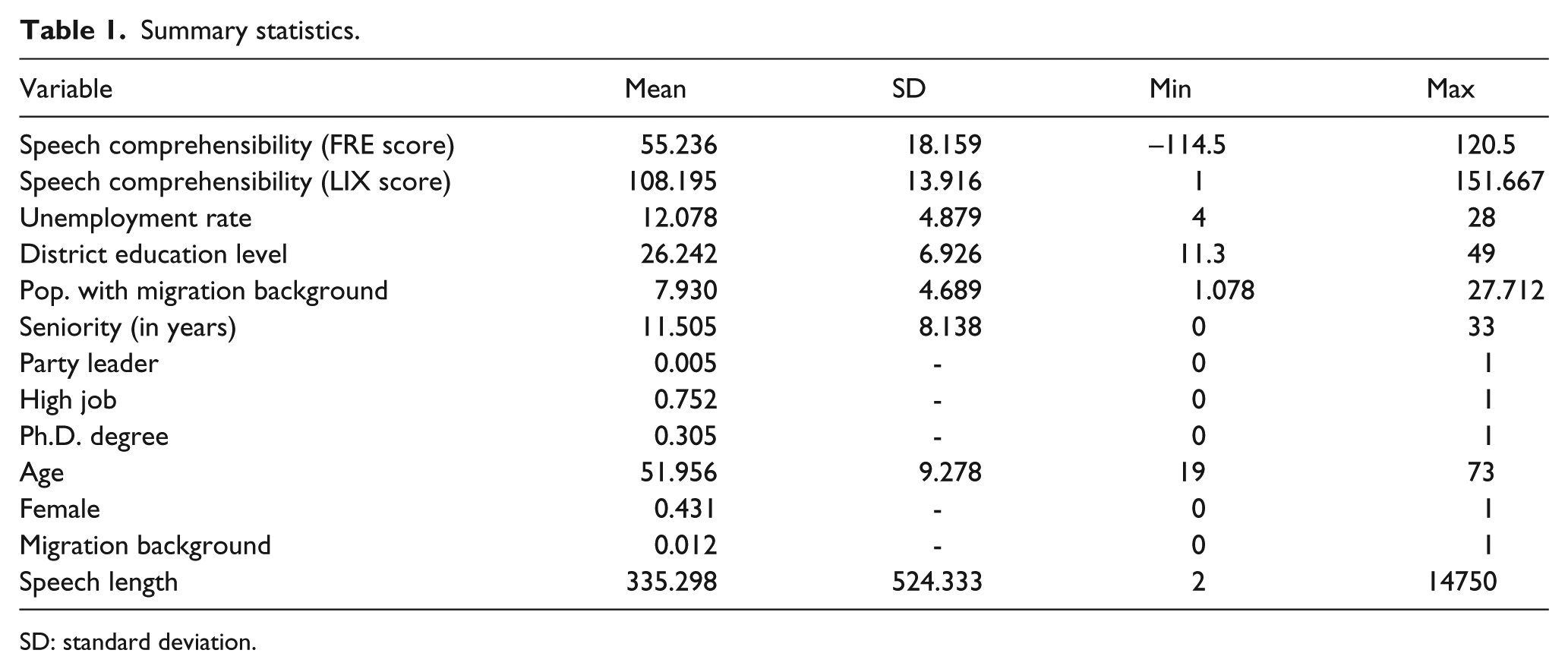
SD: standard deviation.
Empirical results
The results of our statistical analysis are presented in Table 2. Recall that, in our data, each MP enters the data set as many times as the number of speeches the MP makes. Consequently, to account for unobserved heterogeneity at the MP level, we performed several mixed-effect models with random intercepts at the MP level. 11 We began by examining the effects of the three constituency variables on speech comprehensibility without considering the control variables. This simple model is estimated using the FRE score and the reversed LIX score, and the results are summarized in Model 1 and Model 3, respectively. We then estimated the full model by including all the control variables, and the results are shown in Model 2 and Model 4, respectively.
Analysis of linguistic comprehensibility in parliamentary speeches.

p < 0.05.
p < 0.01.
The findings in Model 1 suggest that both Unemployment Rate and Population with Migration Background are positively correlated with speech comprehensibility, with statistically significant effects. More precisely, when there are more voters with a migration background and when the unemployment rate is high, MPs associated with these districts tend to make their speeches simpler to ensure that their voters can comprehend their messages. Moreover, the variable District Education Level is found to be negatively correlated with speech simplicity and statistically significant. This finding suggests that MPs tend to use more sophisticated language in their speeches when constituents in the district they represent are well educated.
Table 2 shows that the estimated results are robust across models and are not sensitive to the measure of linguistic complexity. Together, the findings lend empirical support to our theoretical conjecture. MPs in the German Bundestag tend to tailor the linguistic complexity of their speeches based on their constituents’ needs. When voters in a district do not possess sophisticated linguistic skills, the MP who represents the district tends to reduce the complexity of his or her parliamentary speeches to help constituents better comprehend the messages he or she is attempting to convey.
In addition to our major interests, it is worth discussing two of our major control variables. We find that senior MPs and those MPs serving as party leaders do indeed make their speeches significantly more comprehensible than junior parliamentary members. In our view, this seems to be consistent with Spirling’s recent work, in which he argues that frontbenchers play the main role in communicating with the public and that the use of simple language is an effective way to achieve this goal. This finding is also in line with Dewan and Myatt (2012), who consider the ability to speak simply a fundamental rhetorical skill of political leaders. As for other control variables, the coefficient of speech length is negative and statistically significant, which is also consistent with our expectation since longer speeches are usually more difficult to understand than shorter ones.
Conclusion and discussion
To build a durable connection with voters, political elites have good reasons to explain to voters their policy intentions, what they have been working on, and what they have achieved. While floor speeches constitute one of the major tools legislators may employ to communicate with their constituents (Mayhew, 1974), it is surprising that we still know so little about whether and to what extent MPs tailor the language of their speeches in response to their constituents’ needs. In this article, we investigate under what conditions MPs structure their speeches with different levels of linguistic complexity in order to communicate with their constituents more effectively.
Following recent literature on political communication (Bischof and Senninger, 2018; Spirling, 2016), we theorize that MPs reduce the complexity of their speeches when their constituents do not possess sophisticated linguistic skills. More precisely, we expect that the average level of linguistic skills in a district and the linguistic complexity of the relevant MP’s parliamentary speeches are inversely correlated. With a unique data set that contains almost 79,000 parliamentary speeches made in the German Bundestag between 2002 and 2009, we reveal supportive evidence for our argument. MPs from constituencies with a higher unemployment rate, less educated citizens, and more immigrants tend to make their speeches more accessible.
This paper contributes to the literature on political communication and democratic representation by advancing our understanding of how district characteristics shape the way MPs craft their speeches. In particular, while scholarly attention largely focuses on how electoral institutions structure MPs’ parliamentary activities (e.g. Proksch and Slapin, 2012), we demonstrate that constituency features also play a key role in determining MPs’ speech-making behavior. Also, simple statements can be an effective tool that helps MPs tighten up the connection with their constituencies by enhancing voters’ understanding of MPs’ policy intentions and goals.
Moreover, our work may provide an interesting starting point for future research. Theoretically, we derive our hypothesis in a generalizable way and expect it to travel across countries without much alteration. Yet, our empirical examination is limited to Germany. Future work that involves multiple countries is needed, and it will undoubtedly provide a better understanding of how MPs communicate with their constituents. In addition, we believe that novel tools developed in computer science and natural language processing may further advance the scholarly understanding of the representative–constituency relationship. Finally, this paper has implications for research on the rise of populist parties, which are ‘often associated with the idea of an oversimplification of policy challenges’ (Müller, 2016: 19). Our findings imply that populist parties may simplify their statements because they target different audiences than established parties.
Supplemental Material
LinOsnabruegge_OnlineAppendix – Supplemental material for Making comprehensible speeches when your constituents need it
Supplemental material, LinOsnabruegge_OnlineAppendix for Making comprehensible speeches when your constituents need it by Nick Lin and Moritz Osnabrügge in Research & Politics
Footnotes
Acknowledgements
For helpful comments and suggestions, we thank two anonymous reviewers, Elliott Ash, Jason Eichorst, Thomas Gschwend and Philip Habel. A previous version of the manuscript was presented at the Annual Meeting of the European Political Science Association, Milan, Italy, 22–24 June 2017. We also thank Christian Rauh for providing us with the German speech data and Andreas Wüst for sharing data on the migration background of MPs.
Declaration of Conflicting Interests
The author(s) declared no potential conflicts of interest with respect to the research, authorship, and/or publication of this article.
Funding
The author(s) disclosed receipt of the following financial support for the research, authorship, and/or publication of this article: This work was supported by the Collaborative Research Center 884 (Project C1) at the University of Mannheim and the European Research Council (advanced grant 694583).
Supplemental materials
The supplemental files are available at http://journals.sagepub.com/doi/suppl/10.1177/2053168018795598 The replication files are available at 
Notes
Carnegie Corporation of New York Grant
This publication was made possible (in part) by a grant from the Carnegie Corporation of New York. The statements made and views expressed are solely the responsibility of the author.
References
Supplementary Material
Please find the following supplemental material available below.
For Open Access articles published under a Creative Commons License, all supplemental material carries the same license as the article it is associated with.
For non-Open Access articles published, all supplemental material carries a non-exclusive license, and permission requests for re-use of supplemental material or any part of supplemental material shall be sent directly to the copyright owner as specified in the copyright notice associated with the article.
