




Abstract
Legislative speeches are an important instrument for parties and members of parliament (MPs) to signal their positions and priorities. This raises the question of who speaks when. We evaluate whether a MP’s presence on the floor depends on his or her gender. We hypothesize that female MPs give in general less speeches in parliament and that this pattern results from debates dealing with “harder” policy issues. Our expectations are supported when analyzing a new data set containing information on the number and content of speeches given in the Swedish Riksdag between 2002 and 2010.
Introduction
The analysis of legislative decision-making and behavior is a core element of comparative politics and government (e.g., Cox 2006; Döring 1995). There are several ways of studying the legislative activity of parliaments and governments. One branch of research focuses on the determinants of introducing and deciding on law proposals, and on the length of time law proposals are in the legislative process, while another prominent line of research directs attention to the determinants and consequences of parliamentary voting behavior in modern democracies by referring to recorded votes (e.g., Bräuninger, Brunner, and Däubler 2012; Bräuninger and Debus 2009; Carey 2007; Hansen 2009; L. W. Martin 2004; Poole and Rosenthal 1997). All of these analyses of the legislative process promote relaxing the “unitary actor” assumption and studying origins of cultivating a “personal parliamentary behavior” that might deviate from the party line. More recent research focuses, therefore, on the theory and empirics of the number of speeches given by members of parliament (MPs) in a legislature (e.g., Giannetti and Pedrazzani 2013; Proksch and Slapin 2010, 2012), which allows us to analyze the weight of specific policy issues and the positions expressed within these speeches (e.g., Bernauer and Bräuninger 2009; Giannetti and Laver 2009; Laver and Benoit 2002).
What is, however, surprisingly missing in the literature is—despite its prominent role in the analysis of, for instance, social and political participation (e.g., Coffé and Bolzendahl 2010; Schlozman, Burns, and Verba 1999)—an analysis of legislative activity and behavior in light of MPs’ personal characteristics such as gender (see for notable exceptions Carroll 2001; Escobar-Lemmon and Taylor-Robinson 2005, 2009). While a number of studies highlight the increasing share of women in parliaments and cabinets (e.g., Siaroff 2000), discuss the effect of electoral systems and gender quotas (e.g., Rosen 2011) or of institutional change in general (Waylen 2013), and stress the impact of women’s presence in parliaments and cabinets on policy outputs (e.g., Atchison and Down 2009; Hogan 2008; Poggione 2004; Wängnerud 2000; see Mazur and Pollack 2009 for an overview), there are only few studies that discuss this so-called “qualitative dimension” of gender equality in the process of legislative decision-making. On the basis of comparative studies on portfolio allocation in cabinets, which show that male politicians receive more “prestigious” positions that deal with “harder” policy areas, such as economics, foreign affairs or defense (e.g., Reynolds 1999), and on the basis of theories that stress the effect of social roles and identity on the behavior of (political) actors (e.g., Searing 1994), we argue that similar patterns should be observable when looking at other stages of the process of political decision-making.
In this paper, we focus on the number of speeches given in parliament and ask which factors determine how often and in which policy areas MPs deliver legislative speeches. More specifically, we shed light on a feature that has been mostly neglected in the previous literature on parliamentary speeches: the role of gender. While some policy areas can be of more or less relevance for political parties because of their ideological origins (Budge and Keman 1990), some policy issues are also associated with female or male politicians, respectively. Issues that belong to youth, moral, or family policy are often seen as the key area of women’s political expertise because of their specific “values, priorities and legislative roles” (Norris and Lovenduski 1995). We here draw on the previous literature on gender representation and suggest that—despite all approaches of gender mainstreaming—differences still exist between men and women in their parliamentary behavior. We therefore hypothesize that women will speak less often in parliamentary debates, and that they will be highly underrepresented when “harder” policy issues are debated.
We base our analysis on a unique data set that covers various characteristics of all speeches given in the Swedish parliament in the legislative periods from 2002 until 2006 and from 2006 until 2010. The selection of the Swedish parliament allows for a crucial test whether gender mainstreaming has also taken place in a parliament that has one of the highest shares of female MPs, with over 40 percent women, placing Sweden well above the European average of about 25 percent female MPs (see Inter-Parliamentary Union 2013; Wängnerud 2009). 1 Our findings show that female MPs give significantly fewer speeches in the Swedish Riksdag. Furthermore and in line with our expectations, the only policy areas where differences between male and female members of the Swedish Riksdag are not pronounced are typically “softer” policy areas. At the same time, female MPs of the Swedish Riksdag deliver significantly less speeches than their male colleagues in debates in “harder” policy areas. Hence, we show that gender has an effect on legislative speech-making that is conditional on the policy area a parliamentary debate belongs to.
The paper is structured as follows. To derive our hypotheses, we present a review of the literature on legislative behavior of parliamentary party groups and their members, and on the effects of personal characteristics on legislative activity and political decision-making. Building on this comprehensive understanding of legislative behavior, we then develop several expectations that structure our empirical analysis. Before presenting the results of our regression models, we introduce the data set analyzed here and describe the coding of the dependent and independent variables included in our analyses. We then present the results of our study in a descriptive and analytical manner. The final section concludes and discusses further incentives for the analysis of parliamentary debates.
Theoretical Framework
The General Incentives of Parties and MPs in Legislative Debates
The available literature on legislative behavior largely focuses on explaining party unity and voting within legislatures. Even though we are interested in speech-making within legislatures, we draw on this literature here. We do so not because research on legislative speeches in parliamentary systems is still rather limited (see, however, Bächtiger et al. 2008; Proksch and Slapin 2010, 2012; Steiner et al. 2004). Rather, we argue that some of the findings regarding legislative voting can be transferred to questions concerning the mechanisms behind legislative speeches and debates. An important assumption in the literature on party unity and legislative behavior is the idea that we can distinguish three sources of voting unity within legislative parties: cohesion, discipline, and agenda control (e.g., Cox and McCubbins 2005; Kam 2009). Thus, one reason why MPs belonging to the same party vote as a bloc is that they have similar preferences. Another reason why MPs of the same party vote together is that party leaders use a “combination of carrots and sticks [ . . . ] to reward voting loyalty and deter or punish breaches in discipline” (Carey 2007, 93). Last, party leaders may use their ability to steer the agenda, to avoid that proposals that would divide the party come to a vote in the legislature. Hence, when aiming to explain speech-making and legislative behavior in general, we should keep in mind that we need to consider both the preferences and incentives of individual MPs, as well as the party leadership’s incentives and ability to steer the agenda and punish and reward MPs (see also Proksch and Slapin 2012).
Giving speeches in parliament implies that MPs have to take positions on one or several policy issues in front of a broader audience. While speakers in parliament can follow the party line, there are, of course, also incentives for them to adopt positions in their speeches that deviate from the position of their party because they have to address the interests and preferences of some other “competing principal” (Carey 2007) like voters and party supporters in the respective MP’s constituency or organized intra-party groups (e.g., Bowler 2010). In deriving hypotheses about speech-making, we should thus pay attention to the goals that are likely to drive MPs and parties. In this regard, we assume that MPs “are strategic actors concerned with policy-making, career advancement, and re-election” (Kam 2009, 17). Or, as it is expressed in the literature on political parties, actors can be understood as being policy-, office-, and vote-seeking. As argued by Strøm and Müller (1999, 9), parties face trade-offs between different goals, for example, “policy pursuit may conflict with a party’s ability to capture office,” since bargaining often requires some sacrifice in policy preferences. Similarly, MPs may face trade-offs, for example, between policy-seeking and career advancement (e.g., Crisp et al. 2004). They might see themselves being forced to “toe the party line” when casting votes or holding speeches, since only “loyal” members are likely to be rewarded with posts, that is, individual policy-seeking motivations may be overridden by career motivations in some cases. In systems where some kind of preferential vote can be cast, MPs might also have incentives to cultivate a “personal platform” since this may give them a better chance of being reelected (e.g., S. Martin 2011; Sieberer 2010).
We know that plenary time is scarce so that usually only a small share of the MPs can take the parliamentary floor. It is therefore important to consider whether the party leadership is likely to allow a MP to speak in a debate when explaining floor time of individual MPs. Proksch and Slapin (2012) argue that in systems where parties play an important role (e.g., in Germany or Sweden), party groups have established rules providing their leaders with means to prevent certain MPs from taking the floor. Thus, we should expect parties to strategically decide who is “allowed” to take the floor, even though MPs have some sort of “freedom of speech,” and should in general be allowed to participate in debates. There is, unfortunately, little systematic research that empirically investigates how the debate agenda is organized and whether the party leadership tries to and is able to influence speech-making in legislatures: this may not only vary across systems but also between parties and even types of debates. Consequently, we do not attempt to judge which factors ultimately determine the patterns we find when looking at who takes the floor in which debates. Individual incentives of MPs as well as the party leadership’s preferences and ability to control the floor agenda could account for them. In the following sections we derive specific hypotheses about parties’ and MPs’ characteristics that are important to consider when we want to explain the patterns of parliamentary speech-making.
The Role of Gender in Speech-making
The previous literature has suggested that some personal characteristics of MPs should matter when it comes to the allocation of floor time in parliaments. Recent research analyzing the decisions of individual MPs has shown that their legislative behavior is not only shaped by incentives arising from the constituency and their party but also influenced by their own personal background (e.g., Saalfeld 2011). This line of reasoning can be traced back to the early 1960s (Matthews 1960; Woshinsky 1973) and has been restated by Searing (1994) with respect to parliamentary roles played by MPs. Searing’s motivational conception differs from the approach described in the previous section mainly in the determinants of MPs’ preferences (Blomgren and Rozenberg 2012). In contrast to the strategic approach by Strøm (1997, 2012), these preferences are not exclusively career goals but may also rest in “emotional incentives” (Searing 1994, 19) that have their origins in the social identity and social role individuals adopt during their socialization (Mead 1934; Simon 1985). While Searing’s restatement focuses on explaining differing patterns of MPs’ behavior, that is, parliamentary roles played by MPs, Burden (2007) used a similar line of reasoning to explain legislative behavior of U.S. Congressmen and Senators. He argues that “political scientists have largely ignored the fact that politicians are people too” (see also Jones 2009) and that personal backgrounds and experiences are of importance in the formation of parliamentarians’ preferences. By focusing on a small set of issues, he shows that legislators’ personal experiences as well as their ethnicity, gender, and further personal characteristics influence their legislative behavior (see also Saalfeld 2011).
If we look at speech-making in parliament, we think that there is one feature that is important to consider but has been mostly neglected in the previous literature, namely, the gender of the MP. 2 One of the most important findings of the literature on representation is that women tend to be underrepresented in higher positions. Raaum (1995) shows, for instance, that there is a sort of “hierarchic marginalization” of women and that underrepresentation increases the higher up in the hierarchy we get. Studies that analyze ministerial portfolio allocation in a comparative perspective come to a similar conclusion: women are less likely to obtain a ministerial post, and when they do reach cabinet, they are likely to be found in less prestigious ministerial posts (see, for example, Reynolds 1999).
Even though the previous literature on gender and representation has mainly focused on the impact of candidates’ gender on voting behavior (e.g., Dunaway et al. 2013; King and Matland 2003; Matland 2005; McElroy and Marsh 2010; Stegmaier, Tosun, and Vlachova 2013) and the effect of political institutions on the allocation of posts (e.g., Rosen 2011; Siaroff 2000; Waylen 2013), we argue that we can draw on this literature when analyzing parliamentary debates since speech-making and “taking a lot of time” on the floor can in some sense be compared with reaching an important post—in important debates, parties are likely to control the floor agenda (see, for example, Proksch and Slapin 2012). We therefore expect that women are in general less likely to be seen on the floor, at least partly because of their “marginalization” within the parties. However, seeing fewer women on the floor may of course also be due to a number of other reasons: one reason would be related to norms in society, having to do with gender stereotypes and whether women are seen as “competent” representatives. Another, related reason has to do with “cultures of masculinity” within political organizations (see, for example, Lovenduski 2005). Previous research in psychology has also hypothesized that women are “less voluble,” or likely to speak less, in organizations, “because they are less likely to engage in behaviors that are dominant or aggressive, which may include talking more than others in a group setting” (Brescoll 2011, 625). Drawing on this very diverse set of previous research, we thus hypothesize the following:
The literature on female representation, however, suggests that there is not only a “vertical division of labor” between women and men but also a “horizontal division of labor” (see, for example, Raaum 1995), where women are often seen in specific posts, dealing with policy issues that have been described as being “softer.” 3 For example, Wängnerud (1996, 1998) studies how Swedish MPs are placed in different committees and finds that women are relatively well represented in cultural and social committees whereas they are heavily underrepresented in finance, traffic, defense, and tax committees (see also Thomas 1994). Henry Bäck (2000) studies how well different groups are represented in different committees at the local level and finds that women are not especially underrepresented in so-called “soft” committees, such as health, social, education, culture, and sports committees, whereas women are heavily underrepresented in the “harder,” technical committees (see also Hanna Bäck and Öhrvall 2004). Similarly, Reynolds (1999, 564) finds that “one sees a worldwide tendency to place women in the softer sociocultural ministerial positions rather than in the harder and politically more prestigious positions of economic planning, national security . . .” In line with classical sociological theories on social roles and social identity (e.g., Mead 1934) on the one hand and theories from political psychology that emphasize the role of inherited norms and values, which can also be created in the early childhood (e.g., Alford, Funk, and Hibbing 2005; Winter 2003) on the other hand, we may think of female MPs as a social group that is strongly interested in and—due to inherited norms—affected by specific policy issues, so that female MPs should be more likely to speak in debates that deal with issues related to “women’s interests” (see also Searing 1994). Drawing on this literature, we present a “conditional” hypothesis, which has not been evaluated in the previous literature on speech-making, distinguishing between “harder” and “softer” policy debates when analyzing the role of gender:
It is important to note that several mechanisms may explain such an allocation of women of men into different policy debates. Here we can also draw on the previous literature on the allocation of posts. For example, Wängnerud (1996) suggests that there are two potential explanations for a “horizontal distribution of labor” when it comes to MPs’ assignment to different committees: first, there may be a sort of “stereotyping” of what is seen as male and female, and second, there may be differences in interests between women and men. The latter also relates to arguments put forward by theoretical accounts that stress the role “bounded rationality” in the behavior and decision-making processes of political actors (Simon 1985): preferences and decisions of MPs should also depend on social group membership and on the experiences they have made during their life. In other words, MPs refer, consciously or unconsciously, to their biography when developing their preferences.
Because traditional roles for men and women still exist and were more important several decades ago when current MPs grew up, we expect that these inherited norms may still structure the behavior of MPs in current parliaments to a significant degree. When analyzing the Swedish MP surveys (performed in 1985, 1988, 1994), Wängnerud (2000, 81) finds that “there is a connection between the gender of politicians and the extent to which they pursue social welfare policy issues.” She finds that female MPs are more likely to address issues of social policy, family policy, elder care, or health care in their election campaigns (when asked about this in the survey) and that they are also more likely to stress that welfare issues are within their own areas of interest. Her main conclusion is that “female politicians have consistently been the group that has pursued social welfare policy issues to the greatest extent in their parliamentary work” (Wängnerud 2000, 82).
Hence, if we find that women speak more on “softer” issues and men speak more on “harder” issues, we cannot be sure whether this effect is due to (a) choices made by the MPs based on personal interests, (b) some norms or stereotypes in society and the parties, or (c) some strategies, hierarchies, or networks within the parties. One potential mechanism that relies on the assumption that the party leadership has strong incentives and ability to steer the floor agenda is that the party leadership strategically selects female MPs to represent the party when “softer” issues are debated, whereas men are selected to be “spokespersons” when “harder” issues are debated. An incentive for the party leadership to enforce such a pattern in parliamentary debates would be that the electorate has certain norms of whether certain issues are “female” or “male” and that the party would risk losing votes if they do not follow such societal norms, whereas such norms may, of course, also be “internalized” by the party leaders and the MPs themselves.
Alternative Explanations to Speech-making
As described above, parliamentary parties cannot allow every member to speak in parliament since plenary time is scarce. Proksch and Slapin (2012) argue that in systems where the party groups have established rules providing the party leaders with means to prevent certain MPs from taking the floor, we should expect that the party leaders that support the government have incentives to allocate less floor time to MPs that are not in line with the position of the respective government. Instead, the leaders of parliamentary party groups should allocate floor time to members of the government that concurrently hold cabinet posts because these representatives are very unlikely to criticize the policy program of the government (see also Kam et al. 2010). We, therefore, expect that MPs of the government parties that have no office in the cabinet are less likely to give speeches in parliament.
Following a similar line of argument, we would also expect that MPs holding leading positions within (and for) the party (e.g., party leaders, parliamentary party group leaders, members of the party executive or committee chairs) should be allowed to speak more than other MPs. This relationship should be observable for several reasons. For one thing, MPs holding leadership positions tend to have greater influence on the party line than backbenchers, and all else equal, MPs holding leading positions should stick to the party line for the reason that it is likely to represent their own preferences. Also, the rule of reciprocity (Fenno 1973, 95; Weingast 1987) should work better at higher levels of hierarchy. In contrast to a backbencher, a committee chair, for instance, has her own turf to defend. Thus, MPs in leadership positions may gain more practical use from reciprocity than other MPs. Finally, MPs in leading positions tend to have more to lose from potential punishment as they may be withdrawn from such positions or see their term not being renewed (Damgaard 1995). All in all, we expect that MPs in leading positions are more likely to “toe” the party line, and that they are, therefore, allowed more “floor space.” In addition, these individuals are “representing” the party from the voters’ point of view and should, therefore, also speak more often in parliamentary debates.
Last, we would also expect that parliamentary experience influences speech-making in parliament. Here, we can, for example, draw on the literature on political socialization, which suggests that the more acquainted MPs get with their parliamentary roles, the more they will support established patterns of power (e.g., Dawson, Prewitt, and Dawson 1977). This leads to the expectation that MPs with longer parliamentary careers are more often allowed speaking in parliament. Yet, this relationship might be reinforced by a better understanding of the rules of the game and the MPs learning how to shape the party line: long careers are proof of the ability to survive politically (see also Dowding and Dumont 2009). This may be due to a strong independent base of power (such as holding a seat in one of the party’s core constituencies, local entrenchment, etc.), but it may also be due to accommodation with the party leadership.
Case Selection, Data, and Method
The Case of the Swedish Riksdag
We test our expectations on the basis of a novel data set on the number and content of speeches given in the Swedish Riksdag and the characteristics of its members. Focusing on the Swedish parliament has a number of advantages: First, and most importantly, Sweden can be seen as a critical case when analyzing gender representation. As described above, the Swedish parliament has one of the highest shares of female MPs in the world (see Inter-Parliamentary Union 2013; Wängnerud 2009). Hence, in terms of “descriptive representation,” the Swedish parliament is highly gender equal. In terms of “substantive representation” or when looking at the effects of women’s presence in parliament, some differences between men and women have, however, been identified in previous research, for example, with regard to MPs’ parliamentary work (e.g., Wängnerud 2000). Looking at Swedish MPs’ attitudes and policy priorities, Wängnerud (2010) shows that the differences between men and women have actually declined over time, again suggesting that we are dealing with a “least likely case” of finding any important gender differences in speech-making.
Also, some other features make Sweden an ideal case: MPs generally stick with their parliamentary party so that we only see few MPs switching their partisan affiliation during a legislative period, which makes it more straightforward to analyze parliamentary behavior of MPs. Also, the Swedish political parties are the dominant actors in the nomination process of parliamentary candidates, whereas the preferences of the local parties and voters in the constituencies only play a minor role. We, therefore, can identify the parties as the MPs’ main principal. To give some additional basic information of the Swedish case: we are here dealing with an electoral system of proportional representation, with a 4 percent electoral threshold to enter parliament. The electoral system was up until 1994 a completely closed list system, with very limited possibilities for the voters to influence which individual candidates were elected. A preferential vote system was introduced in the 1998 Swedish parliamentary elections, allowing voters to cast a preferential vote for one candidate on the party list. According to Oscarsson and Holmberg (2013, 268), the effects of this electoral reform have been small, even though about 25 percent of the voters used the opportunity to vote for an individual candidate in the 2010 election. 4 This reform gives (at least some) incentives for Swedish MPs to create and foster a “personal electoral platform,” and giving speeches in parliament can be one way to come up with such a platform. The Swedish party system has been rather stable over time, and it is very straightforward to assign them to traditional party families—Socialists/Social Democrats, Greens, Liberals, Agrarians, Conservatives, and Christian Democrats (see, for example, Bergman 2000 for an overview). 5
Before turning to describe our data, we should say something about the specific institutional setting of the Swedish parliament and the rules that guide the selection of speakers. As institutional rules may influence who is selected or allowed to speak on the floor (see, for example, Cox and McCubbins 2005; Giannetti and Pedrazzani 2013; Proksch and Slapin 2012), this is, of course, important for the conclusions that we can draw from the results found here. As mentioned above, very little systematic research exist describing formal and informal rules on parliamentary debates in a comparative perspective and on the Swedish case. The general rules guiding speech-making in the Swedish Riksdag give MPs a sort of “freedom of speech” and the rules are hence “open access,” giving the parties little direct influence over the debate agenda. 6 However, one type of debate is clearly distinguished from other types of debates in the Riksdag Act (Riksdagsordningen), the so-called “interpellation debate,” which is distinguished by the fact that it results from a written question asked by a member of the Riksdag. Within two weeks after the question has been asked, the minister has to reply—also orally in front of the chamber. Following the minister’s answer, there is a debate between him and the MP who was responsible for the question. Whether other MPs might join or not is—as in case of speaking time—restricted. Hence, the rules organizing interpellation debates are clear, and access to the floor is to some extent restricted, even though the party’s ability to control the agenda is not completely clear since MPs are free to ask such written questions. We may expect that these types of debates are important for the parties as they for example constitute an important instrument for the opposition to control the cabinet. 7 We should, however, note that even though MPs are formally free to take the floor in most debates, there are, of course, also opportunities for parties to informally and indirectly influence who takes the floor, as the party leadership may have set up informal rules guiding speaker selection and may, of course, “punish” and “reward” MPs for their behavior on or off the floor. In a system like the Swedish one, where parties play an important role for career advancement and reelection, we would expect that the party leadership’s indirect or direct influence plays an important role in speech-making and, thus, in deciding who takes the parliamentary floor. Hence, if women are found to speak less than their male counterparts, and if they are found to speak more or less in certain debates, this suggests that the party leadership has played an important role in “producing” this result.
Data, Variables, and Statistical Model
The data set applied here includes, on the one hand, variables referring to the speeches held in the Riksdag between the Swedish general elections of 2002 and 2010, covering two legislative periods that were characterized by a different partisan composition of government and opposition: from 2002 until 2006, Sweden was governed by a minority government that consisted only of the Social Democrats (SAP), though it was supported by the Greens (MP) and the Left Party (V). In the following legislative period from 2006 until 2010, the Conservative Party (M), the Liberal Party (FP), the Christian Democrats (KD), and the agrarian Centre Party (C) formed a coalition government.
The variables covering information on the parliamentary debates were generated with the support of the administration of the Riksdag. They kindly provided us with a database of 110,929 oral contributions delivered in the parliament that contained not only the names of the speakers but also characteristics of the corresponding debate such as its title or the date on which it took place as well as information on the type of speeches, that is, whether it was a primary speech or a reply. We coded the characteristics of those politicians who were at one point in time member of the Riksdag for the two legislative terms between 2002 and 2010. The coding was done on the basis of the documentation by the Swedish parliament (“Fakta om folkvalda”). This second part of the data set captures stable characteristics such as the date of the first entry to parliament, gender, or previous (pre-parliamentary) employment as well as time-dependent characteristics like committee membership or party posts help by the respective MP.
To test our expectations regarding the presence of MPs on the floor, we identified the number of speeches held by an MP during a legislative term. In doing so, we only included verbal contributions of MPs that were part of debates. 8 Moreover, we excluded replies, which are typically part of a back and forth between two speakers and whose occurrence, therefore, follows a different logic. A similar problem applies to speeches given by members of the government who we also excluded because it is not possible to distinguish between speeches they hold in their role as MPs and speeches held as representatives of the government (for a similar coding procedure, see Proksch and Slapin 2012). Finally, we excluded three MPs who left their faction during one of the legislative periods under review. This leaves us with speech counts for 538 members of the Swedish parliament. Given our interest in whether men and women participate in debates dealing with different policy areas, we rearranged the data structure in a way that each observation refers to the speeches held by an MP in a policy area (i.e., the number of observations is a function of MPs, legislative terms and policy areas).
The dependent variable provides information on the number of speeches given by an MP per legislative term for one of the a priori identified policy areas. The independent variables capture either characteristics of the respective MP or MP-specific characteristics of policy areas. The policy area of a debate is identified and hand-coded mainly on the basis of the titles of the debates as recorded by the Riksdag. 9 In developing our coding scheme, we referred to the coding of policy areas by the Comparative Agendas Project (CAP; see http://www.comparativeagendas.info). In doing so, we only include the main categories that capture policy areas as general as “Macroeconomics,” “Civil Rights, Minority Issues, and Civil Liberties,” or “Health” (see also Table 1). 10
Number and Share of Legislative Speeches by Policy Area in the Swedish Riksdag, 2002–2010.
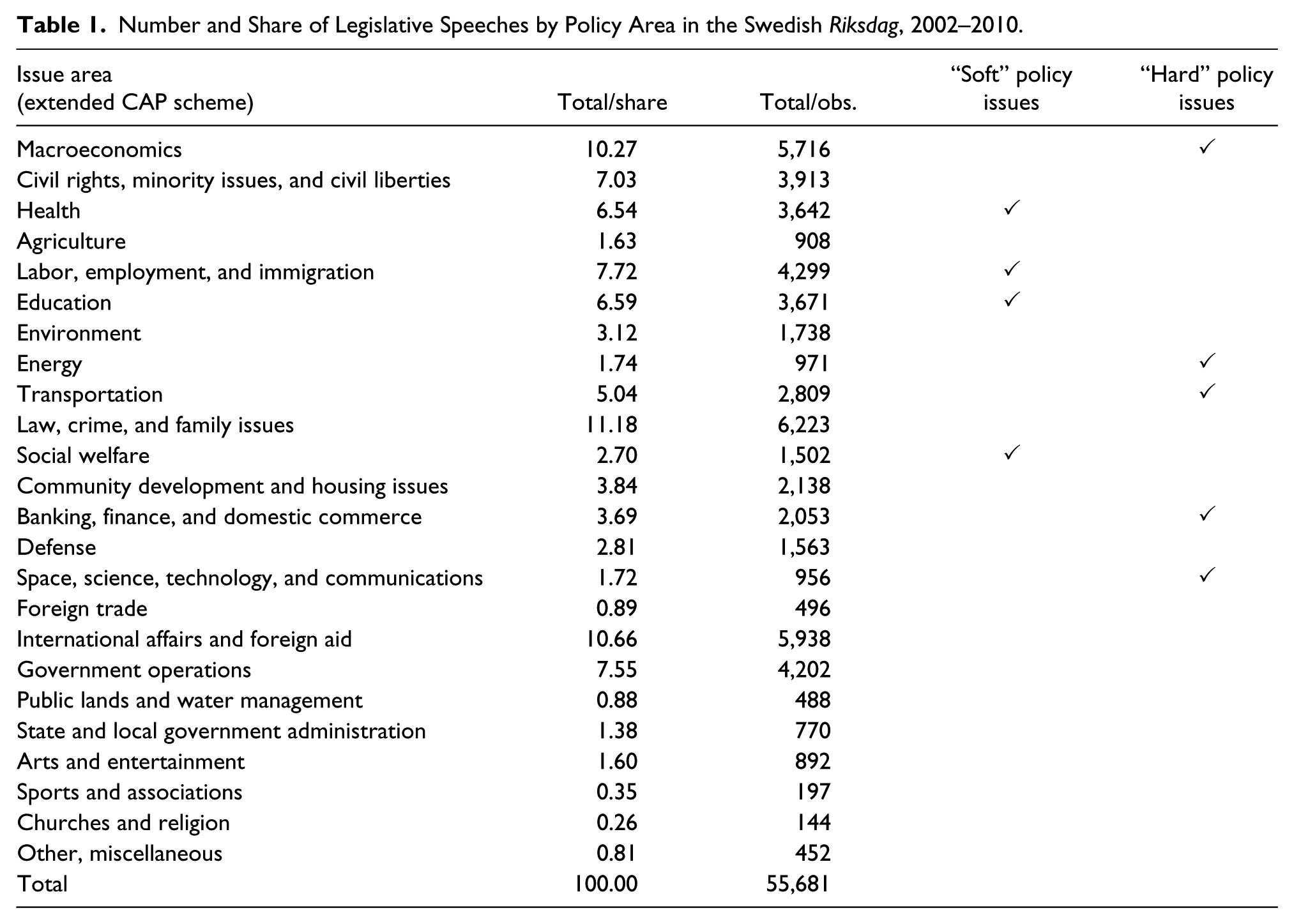
The explanatory variables we take into account can be grouped as follows. First, we include a dummy variable describing the gender of an MP (to evaluate Hypothesis 1). Further, we created a variable that identifies “soft,” “hard,” and “neutral” policy areas, respectively (to evaluate Hypothesis 2). We base our coding of “hard” and “soft” policy areas on the studies by Wängnerud (1996, 1998), who identifies the following committees as “male” (or what we label as “hard”): Macroeconomics, Energy, Transportation, Banking, Finance and Domestic Commerce, Space, Science and Technology, and Communications. Health, Labor, Employment and Immigration, Education, and Social Welfare are, by contrast, identified as “soft” policy areas (see Table 1). 11 The remaining policy areas are labeled “neutral.” To test whether there is some sort of division of labor between female and male MPs, variables reflecting whether a parliamentary debate focused on “hard” or “neutral” policy areas are included in the regression models in the form of interaction terms. This approach allows us not only to assess if there are gender-based differences in terms of the number of speeches given by MPs, but also to evaluate whether these differences are contingent on the respective policy area.
The second set of independent variables captures information on an MP’s expertise, that is, for how long an MP already served in parliament (“parliamentary experience”) and whether he or she belongs to a committee that is in charge of the respective policy area. We also include a variable that refers to the posts held by an MP in his or her political party during the respective legislative term. This variable indicates whether a member of parliament was leader of her parliamentary party group during the legislative period in which she gave the respective speech in parliament. As control variables, our regression models include information on the number of MPs that belong to a parliamentary party and whether an MP was a member of a party that formed the government or not. Furthermore, we take account of the fact that not all MPs are part of the legislature for the whole term and include a variable that indicates for how many days a politician was a member of parliament in the respective term (“mandate length”). We also include a dummy variable that distinguishes the two legislative terms. Finally, and related to our basic argument, we take into account that some policy areas are more important for specific parties than others since parties often represent social groups that have specific political interests (Budge and Keman 1990; Hanna Bäck, Debus, and Dumont 2011). We thus constructed a variable that indicates whether the subject of a speech is salient for the party an MP belongs to. The variable takes a value of “1” if the policy area is regarded as salient for the MPs party and “0” otherwise (e.g., an MP from the Greens is given a “1” when the debate focuses on environmental issues).
Our dependent variable reflects the number of speeches held by MPs as part of debates that belong to specific policy areas. It can only take non-negative integer values, and the data reveal a right-skewed distribution. As Figure 1 shows, most MPs deliver only a handful of speeches in the course of a legislative term while few MPs hold many speeches (concerning particular issues). Thus, we apply negative binomial regression models with robust standard errors clustered by MP-legislative term (see also Proksch and Slapin 2012). 12
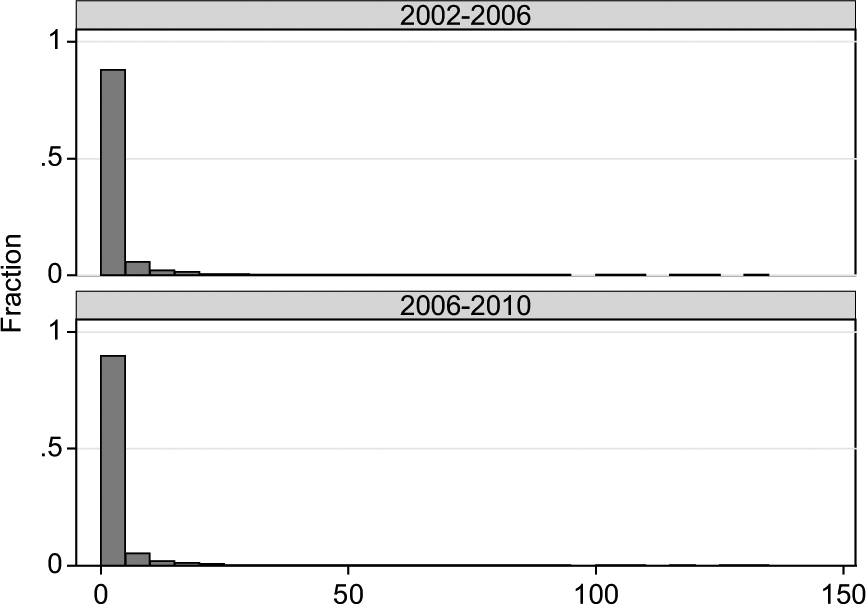
Number of speeches held by individual MPs.
Empirical Analyses
Our data set comprises more than forty-seven thousand speeches that we allocated to twenty-four policy categories. More than 10 percent of the speeches can be assigned to the policy areas of “law, crime and family issues,” 13 “macroeconomics,” and “international affairs and foreign aid”, respectively. Figure 2 shows the share of female and male MPs among the two legislative periods of the Swedish Riksdag. In addition, it provides information on the share of speeches delivered by male and female MPs. While almost half of the Riksdag members are women, the share of speeches held by men is clearly higher than the share of speeches held by women in the time period from 2002 until 2010. There are quite remarkable differences when differentiating between parliamentary party groups: the share of speeches held by female MPs is always smaller than the share of female members in the parliamentary party groups. The only exception are the Christian Democrats, where the share of speeches held by women is as high as the share of female MPs among the parliamentary group of the party.
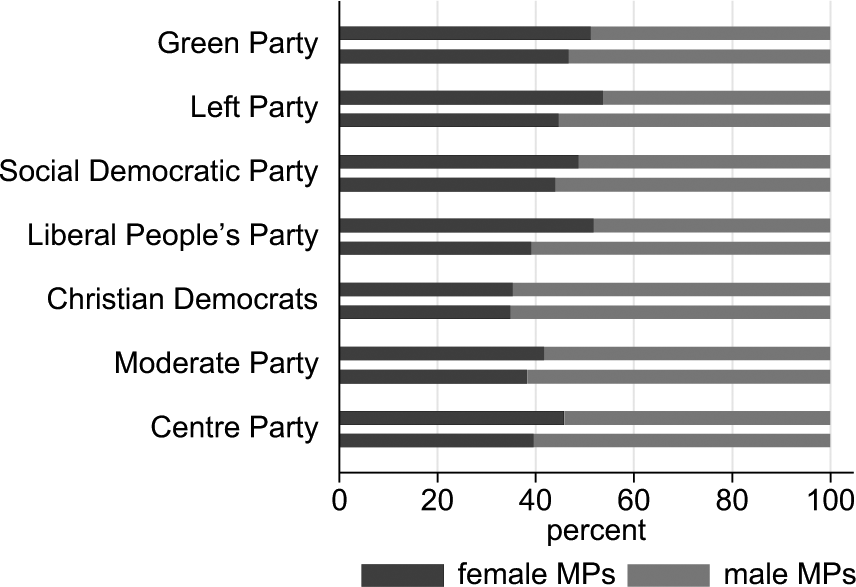
Share of female and male MPs in the Swedish parliament by party and by delivered speeches.
To evaluate our hypotheses in a systematic manner, we perform a set of regression analyses, so that we can check whether the effect of our main explanatory variables remains stable and statistically significant when including the other theoretically derived variables and the controls. While the first model includes the variable identifying the gender of an MP and the control variables such as party-specific issue salience, model 2 is restricted to control variables and factors reflecting MP expertise and the positions of representatives within the respective parliamentary party. Model 3 combines all variables that we included in models 1 and 2. The final model 4 covers all theoretically derived variables and incorporates interaction terms that allow for testing our second hypothesis by identifying the number of speeches held by female MPs in debates that refer to a “neutral” or “hard” issue area (debates on “soft” policy areas serve as our reference category). This stepwise procedure allows not only for testing our two hypotheses but also for evaluating whether the incorporation of gender helps us to better understand legislative behavior of MPs. Our dependent variable is in all models the number of speeches an MP gave in one of the twenty-four policy categories.
The results in Table 2 support our main hypothesis, namely, that female MPs give significantly fewer speeches in parliament than their fellow male colleagues. The effect of gender is negative and significant in model 1 and still has the—statistically highly significant—expected direction in model 3, which includes information on MPs’ expertise such as committee membership, position within the parliamentary party, and experience. Hence, despite the fact that the share of female MPs in the Swedish parliament is one of the highest in modern democracies, female MPs are less likely to participate in parliamentary debates. In addition, the estimated coefficients of the interaction terms in the fourth model support our second argument that the gender of MPs has an effect on the number of speeches held in different debates of the Swedish parliament: female MPs speak in particular less often than their male colleagues in debates that deal with policy issues that can be characterized as “hard.” Furthermore, the effect of the interaction term between the gender variable, which identifies female MPs, and parliamentary debates from “neutral” policy areas indicates that female MPs tend to deliver fewer speeches than their male colleagues also in parliamentary debates on these policy areas. Moreover, female MPs can—in terms of the number of delivered speeches—“close the gap” to their fellow male colleagues if a parliamentary debate focuses on “soft” policy areas.
Determinants of the Number of Speeches Held.
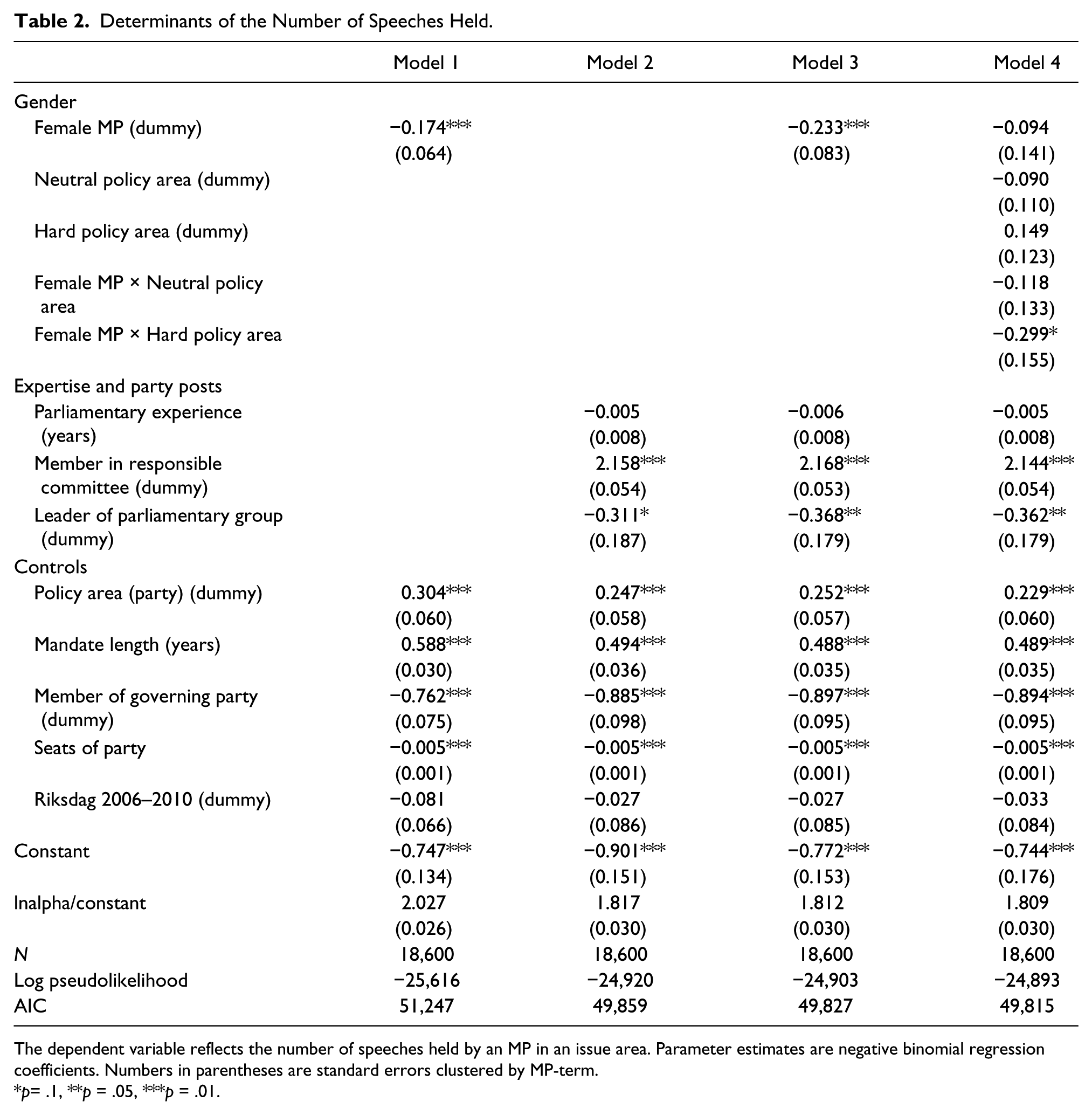
The dependent variable reflects the number of speeches held by an MP in an issue area. Parameter estimates are negative binomial regression coefficients. Numbers in parentheses are standard errors clustered by MP-term.
p= .1, **p = .05, ***p = .01.
Since the interpretation of interaction terms and their substantive effects on the basis of the respective coefficients significance levels can be misleading (see, for example, Brambor, Clark, and Golder 2006; Mitchell 2012), we present the two interactions from model 4 also in a graphical manner. Figure 3 below shows that female MPs give significantly less speeches than their male colleagues if the topic of a debate belongs to a “hard” issue area. There is also a clear difference between the number of oral contributions between male and female MPs in case of debates referring to “neutral” policy areas. If, however, the parliamentary debate is focused on a “soft” policy issue area, then we find no difference between the number of speeches held by male and female members of the Swedish Riksdag.
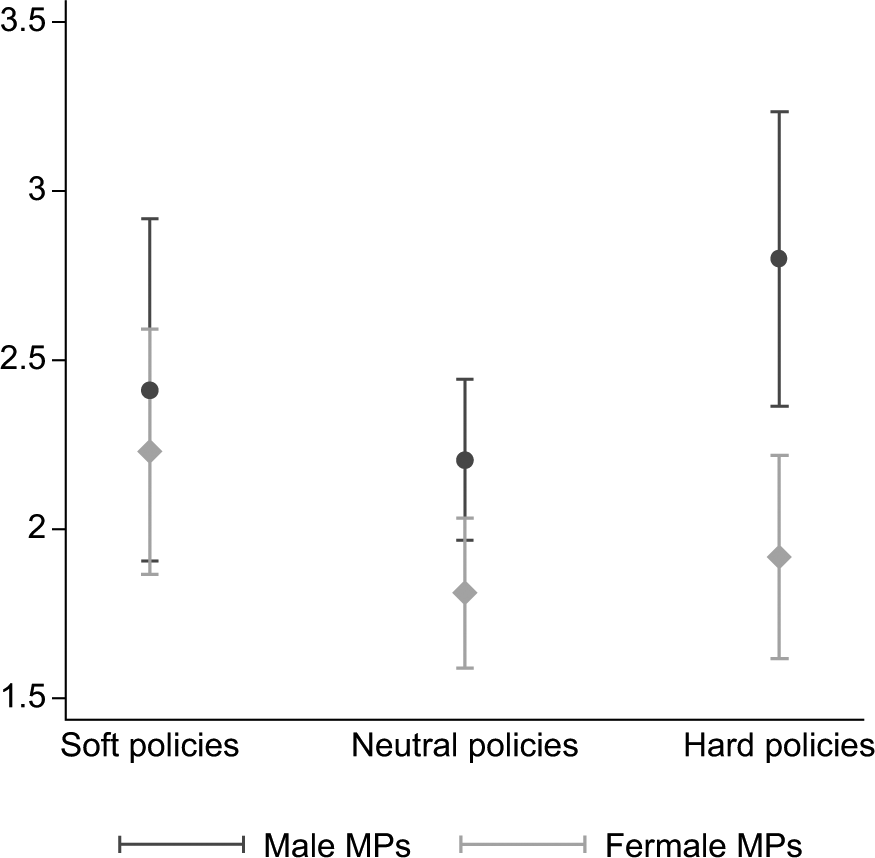
Marginal effect of gender on the number of delivered speeches in the Swedish parliament by policy areas.
Regarding our alternative explanatory variables, we find that MPs give fewer speeches in parliament if they lead a parliamentary party group. This finding could indicate that the leadership of Swedish parties is not restricting the speaking time of MPs by taking their place. However, it might be the case that the leaders of parties and party groups feature more prominently in important debates. In addition, we find support for our expectation that the expertise of MPs matters for the number of given speeches: membership in a committee that deals with the debated issue area significantly increases a MPs legislative activity in terms of the number of speeches delivered in the legislative arena. Members of the government parties give, as expected, fewer speeches, indicating the prominent role of members of government in parliamentary debates. In addition, party-specific issue salience plays a decisive role for the number of speeches given by MPs in the Swedish Riksdag, which indicates that parliamentary parties use legislative debates to signal their voters how competent and interested they are in party-specific key policy areas.
Across all models, our key independent variables that refer to our two hypotheses have the expected effect. Even if we control for factors that reflect the institutional and political context, we find that female MPs give significantly less speeches than male members of the Swedish parliament. One reason for this underrepresentation of female MPs can be found in the topic of the respective legislative debate: only in debates that refer to “soft” policy areas, male and female MPs deliver a similar number of speeches in parliament, whereas legislative debates on “hard” policy areas are clearly dominated by male speakers. Furthermore, comparing model 2, which covers our control variables only, with the other models shows that adding our gender variables helps us gaining a better understanding of legislative speech-making: the scores of the log-pseudolikelihood and Akaike’s Information Criteria (AIC) are lower for models 3 and 4 when compared with models 1 and 2.
To sum up, we find support for our expectations: the results suggest that the gender of MPs in combination with the topic of a parliamentary debate matters when it comes to legislative speeches, which is particularly striking given that we focus on a country where gender mainstreaming in politics is generally regarded as being quite pronounced. When looking at speeches in the Swedish parliament, women deliver fewer speeches in parliament, regardless of their partisan affiliation, expertise or party posts. In addition, we find statistically significant evidence that there is a “gender gap” when looking at the topic of parliamentary debates: male MPs deliver more speeches in debates on “hard” policy issues, while women in parliament can “close the gap” in the number of delivered speeches when “soft” topics are on the plenary agenda in the Swedish Riksdag. Furthermore, the number of parliamentary speeches is not only determined by expertise and positions within the party but also by the topic of a debate and whether it belongs to a policy area that is traditionally “owned” or “occupied” by a party from a specific ideological family. Hence, this result could support the idea that the party “sends” their MPs to the floor to give legislative speeches in debates that are important for the party, that is, when policies that are salient to the party are debated.
Conclusion
The aim of this paper was to contribute to answering the question of “Who takes the parliamentary floor?” On the basis of theoretical accounts that focus on gender representation, we derived two hypotheses about the role of gender in speech-making, which we evaluated on the basis of a data set that covers all speeches given in the Swedish parliament during two legislative periods. Our findings show gender matters in parliamentary debates: surprisingly, women speak less often than men, which contradicts the “Scandinavian effect” (Siaroff 2000) of high representation of woman in the political process. In addition, there is evidence that female MPs give fewer speeches in “harder” policy areas than male MPs. Thus, there is, even in a country such as Sweden where women are well represented in parliament, a qualitative difference in the legislative behavior between men and women. While this result could imply patterns of discrimination, it could also mean that social roles and social identities of women still have an impact on their legislative activity, which might change in the next decades when younger generations with a different socialization and a different view of the role of women enter political office.
Our findings set incentives for further research on speech-making in legislatures. One of the main results of recent studies on legislative speeches is that the frequency with which MPs appear on the floor depends on the different type of parliamentary debates and the MP’s ideological position (Proksch and Slapin 2012). The more a MP deviates from the party line, the more often will other members of the party (leadership) speak instead. It should, therefore, be the next step to include information on the MPs’ ideological positions in our study of speeches held in the Swedish Riksdag. The particular attraction of including this information results from the existence of Swedish MP survey data (see, for example, Wängnerud 2000), which include information on the self-placement of MPs on an ideological left-right dimension. Combining the information on the number of legislative speeches held in parliament with biographical characteristics and attitudes of Swedish MPs might also help to investigate whether female representatives are less interested in “harder” policy areas than male MPs so that they give more speeches in debates related to the respective policy fields, or whether male and female MPs are more or less “forced” by the party leadership to participate more in debates on “typical,” gender-related policy areas.
Furthermore, there is little systematic research that investigates how the debate agenda is organized and whether the party leadership tries to and is able to influence speech-making in legislatures, even though some authors do look at the formal rules organizing parliamentary debate (see, for example, Giannetti and Pedrazzani 2013). We argue that both factors, the incentives and the ability of the party leadership to control the debate agenda, are likely to vary substantially across countries, parties and types of debates and that informal rules and “norms” or “praxis” should be highly important. We suggest that future studies should further analyze the procedures of how debates are organized and should more systematically investigate the intra-party procedures for speech-making. Also, there may not only be important variation across countries and parties but also across debate types. The party leadership might be more influential when it comes to allocating speeches in certain types of debates and that this matters for gender representation, and we, therefore, suggest that future research should investigate whether rules and procedures for speech allocation varies across debate types. Furthermore, parties might also strategically select male and female MPs as speakers in parliamentary debates that are related to a specific topic. If voters have a specific perception of the roles of male and female MPs, it might increase the chances for parties to receive a “competent” image if they select female speakers in debates related to “soft” policy areas and male MPs in debates that focus on “hard” issues.
We have here argued that Sweden constitutes a sort of least likely case, and that one would expect that women are even less well represented on the floor in systems where women are fewer in number. So-called “critical mass theory” suggests that women are unlikely to have an impact on political outcomes until they grow into a considerable minority, a so-called “critical mass” (see, for example, Childs and Krook 2008 for an overview). If we believe this argument, we would expect women to be even less represented in legislative debates in other systems since very few modern democracies have so many female representatives in their parliaments as the Swedish one. Our research clearly suggests that gender plays a role in parliamentary speech-making and the selection of the MPs who take the parliamentary floor, which calls for further comparative research on the role of gender in legislative debates in different institutional contexts and with varying degrees of descriptive representation.
Footnotes
Acknowledgements
We are grateful for the excellent research assistance provided by Alvina Erman, Carl Gahnberg, and Sofie Sjöborg. We also wish to thank Markus Baumann, Matt Golder, Wolfgang C. Müller, Florence So, Lena Wängnerud, and the PRQ anonymous reviewers for very helpful comments on previous versions of this article.
Declaration of Conflicting Interests
The author(s) declared no potential conflicts of interest with respect to the research, authorship, and/or publication of this article.
Funding
The author(s) disclosed receipt of the following financial support for the research, authorship, and/or publication of this article: Research funding has kindly been provided by Riksbankens Jubileumsfond (RRD10-1427:1) and the German Research Foundation (DE 1667/2-1).