




Abstract
This study investigates how elected representatives make promises to the electorate as part of their routine, everyday parliamentary discourse. Departing from the dominant focus on pre-election pledges in existing scholarship, we examine how representatives’ practices of making promises vary systematically over time (before/after elections/mid-term), by government role (government/opposition), party membership (catch-all/identity-based parties), and addressed electorate (inclusive/exclusive). Drawing upon research in speech acts, political discourse, and corpus pragmatics, we employ manual and computational text analysis on session transcripts from the Israeli parliament to identify variations in representatives’ use of direct or indirect action promises (N = 709), expressing different orientations of commitment. Documenting that promises continue to be prevalent after elections (especially among coalition members), we argue that the practices of making promises fulfill a critical role in representation that extends far beyond the election campaign, maintaining continuous accountability throughout the electoral cycle.
Introduction
Promises constitute one well-known part of elected representatives’ efforts at maintaining a positive relationship with their electorate. Promises enable representatives to inform the electorate about actions and plans that they intend to carry out in the future, and empower voters to select between candidates and assess their performance (Mansbridge, 2003). While the existing literature that discusses promises in the context of political representation is vast, most work has focused on election pledges –that is, promises performed by political parties during election campaigns, announcing policies to be implemented after the elections (Royed, 1996; Thomson et al., 2017; for extended review see Pétry and Collette, 2009). This focus on election pledges has dominated political scientists’ understanding of political promises. In this paper, we recognize that promises are not performed only on special occasions (e.g., election campaigns, prime ministerial addresses) but are routine practices performed on a daily basis. Accordingly, we offer a comparative account of pledges, following the call by Zubek and Klüver (2015) to study pledges throughout the electoral cycle. 1 Specifically, we focus on direct and indirect action promises, which are performed continually as part of representatives’ routine communications, and which likewise play an important, yet distinct role in the process of political representation.
Elected representatives do not stop issuing promises on election day, quite to the contrary. Over the entire duration of their tenure, new promises are added as different issues gain salience. Unlike parties’ pre-election pledges, however, such promises are made mostly as part of routine political communication; they concern not only, or not even primarily those wider policy projects that stand in focus in election pledges, and are not necessarily intended for retrospective factual scrutiny (Kostadinova, 2017). Instead, such promises cover a wide variety of issues that cross the fast-shifting agenda of day-to-day politics, and serve primarily to maintain representatives’ ongoing relationship with the electorate. By continuously making new promises, representatives assure their constituents of their persistent dedication to representing their needs and demands. Accordingly, this study assumes a broad view upon political promises, investigating how promising practices vary across time and between different groups of representatives. Considering the important role of public communication in the process of political representation, we argue that representatives’ routine promises constitute a key aspect of political representation that deserves further attention.
To do so, we follow an inclusive approach to identifying promises in parliamentary discourse. In place of conventional strategies, which rely on a set of lexical commitment indicators (Royed 1996; Thomson et al., 2017), we understand promises as a kind of speech act, which constitutes a communicative relationship between speakers and audiences. Drawing upon Searle’s (1976) famous typology, we study promises as commissive speech acts, 2 wherein a speaker expresses her or his commitment to actualizing some specific future (Searle, 1969). Our methodological approach draws upon research in speech acts, political discourse, and corpus pragmatics to introduce additional nuance to the study of promises in parliamentary discourse.
This work contributes to the existing literature by zooming in on elected representatives’ ongoing relationship with their voters, which extends all across the electoral cycle and involves rich communication activities well beyond the formal pledges issued in parties’ manifestos. We begin by discussing the foundations of promissory representation theory, moving from the standard election pledge approach to a more dynamic approach. Following that, we clarify our expectations regarding usage variations of routine promises between different parties’ types and roles. We then introduce our revised conceptual perspective upon promises and offer operational avenues for studying routine promises in high resolution. Employing manual and computational text analysis to explore important variations in promises performed by elected representatives in everyday parliamentary discourse in Israel, we discuss implications for future research.
Theory
Promissory representation
Promissory representation occupies a fundamental role in the political representation process (Mansbridge, 2003). Through the presentation of promises, political actors aim to establish a relationship between themselves as representatives (agent) and the represented (principle), enabling both the assumption of a mandate and accountability (Przeworski et al., 1999). With regard to the mandate, representatives inform voters before elections how they prospectively intend to act (if chosen), which issues will get their attention, and generally, what will differentiate them from other candidates. On this basis, the voters can then select candidates according to their preferences and authorize them to act as promised. Regarding accountability, representatives can be held accountable by their constituents, who assess retrospectively whether given promises have been fulfilled and reward or sanction them in the next elections. Either way, representatives need both to communicate desirable plans (to be elected) and to be reliable in fulfilling them (to be elected next time). Accordingly, promissory representation in essence describes a recursive process that plays out over time (Aragonès et al., 2007).
To date, most work on promissory representation has focused on the study of election pledges, which explores how pledges are performed by political parties before elections and examines whether these were fulfilled after elections (Royed, 1996; Thomson et al., 2017): According to the standard definition, an election pledge is “a statement committing a party to one specific action or outcome that can be clearly determined to have occurred or not” (Thomson et al., 2017: 532). Election pledge studies have devoted much attention to the “pledge puzzle”, which refers to the lack of agreement among scholars, but also between scholars and voters on what counts as a pledge (Naurin, 2011). Notably, political scholars tend to apply relatively strict and formal notions of election pledges, focusing on party-controlled communications (e.g., manifestoes, convention speeches) that expressly commit to specified objectives; by comparison, voters appear to adhere to a more inclusive understanding (Dupont et al., 2019; Krishnarajan and Jensen, 2021), rooted in the often colloquial and informal modes of communication between representatives and represented (e.g., interviews, social media; Ceron & d’Adda, 2016).
Of course, adopting a more generous notion of promises raises important questions in the context of conventional research on election pledges: If a promise was issued by an individual and not the party, does this offer sufficient grounds for a mandate – and can the party be held accountable for the fulfillment of the promise? Likewise, how can voters mandate representation or sanction performance if it is less than clear what exactly has been promised – be that because the promise is overly broad and in need of further interpretation (e.g., “We will make America great again”), fails to specify an outcome (e.g., “I will fight for your interests”), or is otherwise qualified (e.g., “I will do all that I can…”)? What remains of the promise if it can be debated whether a promise has been given at all (e.g., “We should protect the needs of…”)?
At the same time, a shift of perspective enables us to appreciate also the important communicative functions served by less formal, possibly vague promises. Unlike formal and goal-focused promises, which often depend on complex prior negotiations within and beyond the political party, enable close scrutiny and may cause major embarrassment if unfulfilled, other promises are more flexible in numerous ways. For instance, representatives may be rarely at liberty (or credible!) to promise specific outcomes – however, they may more readily promise to behave in certain ways, or influence reality in a certain, broadly-defined direction. Less formal promises can be given at frequent rates, adjusting to meandering political agendas or varied audiences, and be embedded in representatives’ day-to-day routine communication (Krishnarajan and Jensen, 2021).
Regardless of whether promises are eventually fulfilled, the mere act of promising constructs a relationship between the maker and the recipient of promises. For this relationship to sustain representation, it is not strictly necessary that there is consensus on what exactly has been promised: To the extent that voters perceive a promise to be given (and of course, not every voter is aware of every promise), they are enabled to decide whether they are willing to support the maker, and what observations they will recognize as fulfillment of that promise (Pétry and Collette, 2009). For representatives to communicate, and for the represented to sanction the actions of political actors, the making of promises, and any variations therein, conveys rich and significant information (Bonilla, 2022).
In the present article, we thus conceptualize promissory representation as a dynamic, ongoing, and reflexive process. We view political representation not so much as a static fact manifested in periodic elections and the fulfilment of mandated promises, but a communicative relationship centered upon the making of representative claims and their reception and use among the electorate (Saward, 2010). In this view, representation is not solely, and not even primarily achieved in elections, but relies on an ongoing discursive process wherein representatives need to continuously seek the consent of those whom they claim to represent. Both the representative and the represented are thus inherently constituted through the process of representation (Disch, 2015), which is manifested through the interdependent communicative actions of both sides. While this perspective does not deny the importance of externally defined interests and positive standards of successful representation (Fossen, 2019), it maintains that the mediation of both demands and political actions takes place as an ongoing struggle over the meaning of promised and sanctioned actions and outcomes (Stokke and Selboe, 2009).
Variations of pledges
Over time, scholars have distinguished several varieties of election pledges by evaluating their content or assessing the language form they encompass (Naurin et al., 2019). Formally, the primary distinction concerns the degree of commitment that a speaker expresses toward a promised future. Most famously, Royed (1996) originally differentiated between hard pledges, which express an explicit commitment to a stated objective, and soft pledges, wherein that commitment is mitigated. With regard to the content, scholars have argued that a promise must be specific, allowing to test whether it will be fulfilled (Thomson et al., 2017). Furthermore, scholars agree that it is useful to distinguish between action pledges, outcome pledges, and output pledges (Naurin, 2011). The latter two refer to promised future legislative achievements (outputs) and their societal impacts (outcomes), which primarily belong into the domain of parties’ classic election pledges. By contrast, action pledges merely commit the speaker to future efforts and activities, and thereby offer plentiful opportunities for political representatives to make promises as part of their routine communications.
In recent research, especially the attempt to operationalize the distinction between hard and soft pledges (Royed, 1996) has raised important challenges. While hard pledges are typically recognized relying on a short list of “strong” verbs ('promise’ or 'will’) that can be used to make promises (Mansergh and Thomson, 2007), they miss considerable parts of the promises found in political discourse. By contrast, soft pledges are typically identified based on lists of “weak” verbs that communicate intent more than commitment (‘support’ or ‘want’; Dupont et al., 2019). In practice, this operational distinction is often fuzzy (e.g., ‘I will support’ contains both a strong and a weak verb). Moreover, especially weak verbs often catch statements that do not constitute promises, as there is no commitment expressed by these indicators (Bonilla, 2022; e.g., ‘should create’ or ‘want to improve’ likely do express promises, but ‘should resign’ or ‘want a place at the table’ do not). 3 In addition, the implied degree of commitment is often undercut by formulations that diminish “hard” pledges (e.g., ‘we will try’, ‘I hope we will’) or bolster “soft” ones (‘should definitely be completed within the present legislature’). Additional variation arises from what exactly is promised: “We guarantee that everybody’s pensions will be safe” (outcome pledge) arguably commits a higher commitment than “we will pass a pensions reform” (output pledge), which in turn expresses more commitment than “we will work toward a new pensions deal” (action pledge); and not even this distinction is fully unambiguous, as the second example technically also includes an action pledge (“pass”) alongside the promised outcome. To avoid the operational blurriness, some researchers focus narrowly on unambiguous, hard pledges (McCluskey, 2008), while those who include both variants do so at the cost of retaining numerous debatable cases (Artés, 2013; Håkansson and Naurin, 2016). While we agree on the importance of variable degrees of commitment, we believe that a different strategy is needed to validly capture these differences.
Specifically, speech act theory recognizes that promises as commissive speech acts are not primarily defined by the linguistic expression employed, but by the communicative relationship that they establish between speaker and audience. To constitute a ‘commissive’ speech act (Searle, 1976), a speaker needs to signal her intention to perform some specified action in a way that is recognized by the audience. While speech acts can in principle be formulated in infinite ways (Searle, 1975), they can be divided into ‘direct’ speech acts, wherein the act of commitment is explicated, and ‘indirect’ speech acts, wherein it is not. While this definition closely mirrors Royed’s original distinction, its reliance on the recognition of the expressed commitment by an imagined audience enables a crisper operational distinction: We define as direct commissive speech act any statement that explicates the act of committing oneself to a presented future, and thus cannot be understood in any way other than as a promise (e.g., ‘I promise’). By contrast, for indirect speech acts, the commissive interpretation is not exclusive. In such statements, the lack of explication leaves open whether the speaker indeed commits herself or merely claims to know that a certain future will come to pass.
Promises in parliamentary discourse
Elected representatives make promises to the electorate in countless ways (Fetzer, 2002), varying both the content and degree of commitment. With regard to the content of promises, arguably, most variation will arise from representatives’ different ideological stances and party affiliations, as well as the evolving political agenda, limiting the utility of formulating general expectations. By contrast, there are several theoretical reasons for expecting systematic variation in the degree of commitment expressed in promises.
The promising practices of individual representatives in parliamentary discourse are somewhat different from parties’ promises in election manifestos. Election manifestos are presented on behalf of the whole party, so promises are not linked to individual responsibility, and there is no exact addressee to blame in case of failure to deliver (e.g., “The party is committed to the peace process”; “With us, there will be economic growth again”; “Israel will be at the forefront of science”). Contrarily, individual representatives get the opportunity (and responsibility) to speak for themselves in parliament. When the commitment is linked to their names, representatives might credibly promise actions that advance goals, rather than promise the goals themselves. Hence, we hereunder focus on action promises, including actions with an orientation toward achieving outcomes or producing outputs. While obviously related to outcome and output promises as known from the existing literature, such action promises focus on individual action intended to help achieve the specified outputs or outcomes, but stop short of directly promising that these will indeed materialize.
Specifically, elected representatives’ usage patterns of direct and indirect action promises in parliament should vary over time across the electoral cycle; they should reflect representatives’ position as either part of government or the opposition; and they might respond to important variations in whom a speaker aims to represent.
Generally, both direct and indirect promises serve discernible purposes in representatives public communication. On the one hand, political actors are incentivized to make direct, explicit promises in order to claim competence and ownership of specific issues, to communicate specific objectives, or more broadly to enhance their positive public face by exposing themselves to possible scrutiny (Kampf, 2009). On the other hand, representatives also have incentives to avoid overly specific commitments, which might alienate voter groups (Page, 1976), and bear the risk of being held to specific promises in the future in case of a failure to deliver. Accordingly, representatives’ use of promises should reflect to what extent either the build-up of public standing, or the maintenance of flexibility and mitigation of accountability are the more pressing need.
Notably, representatives should be incentivized to rely heavily on direct promises during election campaigns (Vukovic, 2014), when the urgency of communicating concrete reasons for voting one way or another exceeds the desire to mitigate accountability. By issuing firm commitments, candidates can hope to persuade voters of their competence and efficacy (Johansson, 2008). By contrast, representatives might rely more strongly on indirect promises during the other parts of the legislative cycle, maintaining flexibility for political negotiations and avoiding all-too-specific commitments to objectives where strategic compromises may be required. Accordingly, representatives are expected to make notably more direct promises before elections compared to periods when the electoral incentives are reduced.
H1: Elected representatives rely more on direct action promises during election campaigns, compared to other periods throughout the electoral cycle. Moreover, once a government is formed, the degree of commitment in promises should differ systematically between representatives from government and opposition parties in two complementary, though opposing ways. On the one hand, incumbent parties are exposed to more intense public scrutiny, as numerous stakeholders continuously evaluate whether their promises are actually implemented. Opposition parties face lesser pressure to deliver on their promises. Accordingly, members of incumbent parties may seek to mitigate public pressure by relying less on direct, fully transparent promises (Maravall, 1999). By contrast, opposition members may be freer to express themselves forcefully, positioning themselves as a viable alternative while seeking to call out the government for shortfalls in performance (Dolezal et al., 2018). This pattern should apply especially outside of election periods, when governing parties can focus on advancing policy, rather than bold promises, to demonstrate commitment. Variations of action promises in parliamentary discourse. Note: Dark shades – higher commitment; light shades – lower commitment.
H2: Outside of election campaigns, elected representatives from governing parties rely more on indirect action promises than representatives from opposition parties.
H3: Elected representatives from governing parties rely more on promising actions with an orientation toward outcomes/outputs, while elected representatives from opposition parties rely more on promising actions without such orientations. Promises may also vary depending on which parts of the electorate they address. Given the vast heterogeneity of the electorate, representatives addressing inclusive audiences may be incentivized to remain ambiguous and avoid strong commitment to not alienate dissenting voter groups (Page, 1976). By contrast, promises addressing specific voter groups – especially those defined by shared demands – may be more easily formulated in a direct fashion. In practice, this logic suggests that parties with narrower clienteles (e.g., identity-based parties) should resort more to making direct promises to exclusive groups, while catch-all parties should make indirect promises to inclusive electorates. For the analysis, we classify identity-based parties as parties that cater to groups that define themselves in difference to mainstream society, based on distinct ethnic (e.g., in the Israeli party system, the Arab parties), religious (e.g., the Ultra-Orthodox parties), or ideological identities (e.g., the settlers’ parties), while other parties try to reach out across diverse groups.
H4: Elected representatives affiliated with catch-all parties rely more on making indirect action promises toward an inclusively defined electorate, while representatives from identity-based parties rely more on making direct action promises addressing exclusive groups.
Methods
Measuring direct and indirect action promises in parliamentary discourse
In order to examine representatives’ varying uses of promises beyond the narrow confines of electoral campaigns, it is necessary to recognize any commissive speech acts that express, either directly or indirectly, the speaker’s commitment to future actions, including such actions that refer to attaining specific policy projects or outcomes. By re-interpreting Royed’s (1996) distinction between hard and soft pledges in terms of direct versus indirect promises, we remain faithful to the spirit of the original distinction, while aiming to overcome some of its operational shortcomings. Recognizing the nature of promises as commissive speech acts, our operationalization distinguishes between two critical aspects of communicating commitment: On the one hand, it appraises (a) the degree of commitment with which the act of promising is explicated (i.e., using direct vs indirect speech acts); and on the other hand, it considers (b) the degree of commitment that is expressed by the use of different action verbs (i.e., promising concrete outcomes or outputs, as opposed to mere efforts or loyalty to a certain cause).
Speech act theory acknowledges that the specific communicative act achieved by an utterance is not primarily defined by its linguistic form, but by its recognizability on part of an audience. It thereby underscores that promises are not necessarily limited to statements that use specific explicit markers but include other, indirect expressions as well. To count as a commissive speech act, any relevant statement needs to include a reference to the promising actor (e.g., a pronoun), a promised object (for action promises, a verb that express the promised action), and some verbal form that indicates future orientation and commitment (Searle, 1975).
Importantly, the commitment can be directly explicated or indirectly implied through the promising actors’ association with the future action (Kampf, 2013). Direct promises rely on a semantic group of performative verbs that explicate the speaker’s commitment to his words (Wierzbicka, 1987) – in English, notably, the verbs promise, pledge, vow, guarantee, swear, and vouch for (Valkonen, 2008). To express a direct action promise, these transitive verbs must be used in the present tense, while the attached object specifies the action to which the speaker commits herself (Valkonen, 2008). In our study, we are only interested in performative verbs that are used in a self-referenced fashion (e.g., ‘I/We guarantee’), while promises attributed to alters (e.g., ‘You promised’) are disregarded.
Inversely, indirect action promises are defined by the absence of such performative verbs, as the speaker’s commitment to future actions is only implied (Bonilla, 2022). While there are numerous ways of indirectly expressing a speaker’s commitment to future actions, we propose here that the most common way of doing such is by using self-referencing pronouns together with any other verb put in the future tense. Among such expressions, especially action verbs play a key role in promissory representation (Bonilla, 2022). Action verbs are verbs that denote “events that involve an agent” (Jackendoff in Allen, 1981: 79) that causes or permits “some change of state as the result of an action” (Gao et al., 2016: p.1814). 4 Used as promises, self-referenced action verbs commit the speaker to specific future behavior (e.g., “We will work for you”) and thus constitute a natural focus of future-oriented commitment.
For the purpose of the present paper, we only consider actions that address public policy objectives, ranging from symbolic, to regulatory and institutional, to (re)distributory politics. Specifically, we assessed, for each promise, whether the promised action substantively addresses the public (Stokke and Selboe, 2009), and if so, whether it addresses specific parts of it or the electorate as a whole. 5 This procedure essentially serves to remove irrelevant promises, such as promises addressing interpersonal communication (e.g., “I will answer you in a second”), technical procedures (“I will file my petition”), or other promises that are not really part of a representative’s communication addressing the electorate (for more information, see the Appendix).
Based on the existing scholarship, we distinguish ten types of action verbs that indicate different orientations of action promises (for the full rationale, justifications, and indicators of action verbs, see the Appendix). Each type focuses on a different kind of political action, distinguished not only by the context of applicability (e.g., to different policy fields), but also by the degree of commitment attached to a given promise: While some action verbs refer to ways for directly affecting policy (outputs) or policy implications (outcomes), others do not imply a commitment beyond the promised action.
At the top of the list, verbs with outcome, change, or institutional orientation commit the speaker to specific policy outcomes and thus express a relatively high degree of commitment; in the middle, verbs with planning, practical, or assistive orientation mitigate this commitment, but still maintain a connection to intended outputs; at the bottom, verbs with struggle, preserve, voice and allegiance promise no more than efforts and loyalty, and thus express a lesser degree commitment. While there are of course many more action verbs that might be of interest, those ten groups offer a broad gaze at different kinds of indirect promises that are issued by political representatives as part of their communication activities. Based on this operational distinction between direct or indirect promises and ten action orientations, we now proceed to introduce our case study.
Case study
To empirically investigate which types of direct and indirect action promises elected representatives perform for the electorate on a daily basis, we use the case study of the Israeli parliament ('Knesset’). The Israeli case of a complex multiparty system (Sheafer et al., 2011), fluid party landscape (Lijphart et al., 1999), and extreme proportional electoral system (Farrell, 2001) offers a particularly suitable case to study promissory representation: Given a diminished weight of party identities among both political actors and the electorate and the resulting strong role of personal branding strategies, the Israeli case offers ample incentives for representatives to position themselves as the champions of various social groups. To study the presentation of direct and indirect action promises, we rely on transcripts from plenary sessions of the Knesset as primary data, obtained from its online archive. While plenary speeches are of course only one venue where promissory representation takes place, they occupy a central place in political discourse. Importantly, plenary speeches facilitate a systematic comparison that is relatively unbiased by representatives’ varying self-mediation repertoires. At the same time, the parliamentary plenum allows representatives to get into details (De Wilde, 2020) and provide the electorate with speeches that are subsequently mediated via journalistic mass media, web publications, as well as representatives’ own social media activities (Ilie, 2015).
Variants of selected governments.
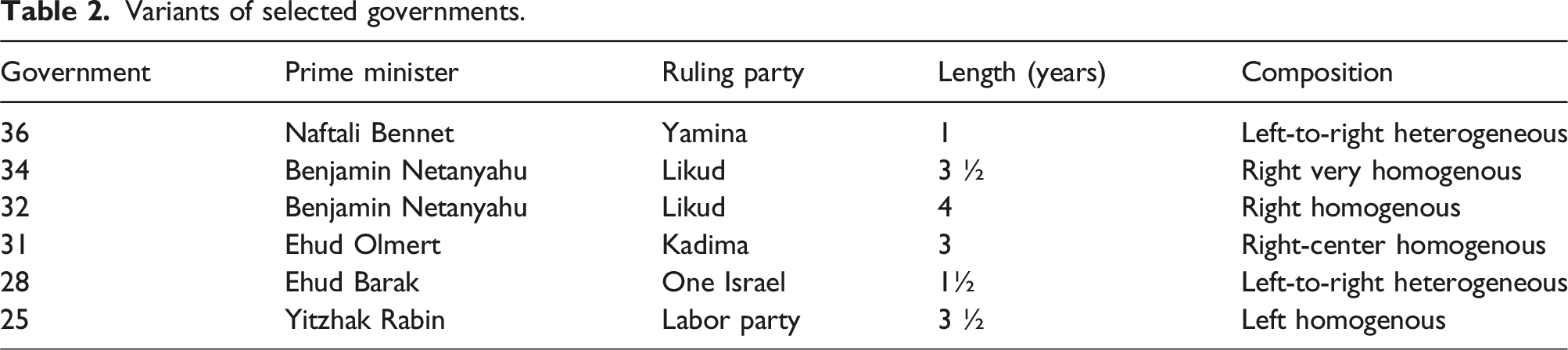
From each of the six legislatures, we sampled ten plenary sessions that took place before the elections, ten plenary sessions after the elections, and ten sessions from roughly halfway through the legislature.
Analysis
Using the JAmCAT infrastructure for automated text analysis (Baden, 2023), we built a dictionary that indicates potential direct or indirect promises in favor of inclusive or exclusive groups. All verbs were translated into Hebrew, the official language of parliamentary discourse in Israel. As Hebrew encodes both tense and person directly into the verb’s morphology, all verbs were included in their (both male and female) first-person future forms. 6 In addition, our algorithm identifies which Knesset member (MK) performs each promise, enabling the speakers’ classification by party membership, position (coalition/opposition), and affiliation (catch-all/identity-based).
We first used the algorithm to pre-code the entire sampled Knesset sessions, detecting potential cases for the analysis. The algorithm output was then subjected to manual classification in order to build the finalized data corpus and validate the automatic dictionary-based classification. Through the process, two human coders were trained on a codebook (represented in the appendix) to classify any instances as a) action promise or not (only cases which are action promise included in the data analyzed), b) direct or indirect, and c) the orientation of the promised action. An inter-coder reliability test to statistically measure the coders’ agreement on these questions conducted on 60 randomly chosen cases yielded Krippendorff’s alpha values between 0.78 to 1.00. 7 Any instances flagged by the algorithm as potentially relevant but classified as irrelevant by the human coders were carefully examined to yield additional insights into the boundaries and limitations of the concept, but were not included in the data for this study.
Findings
Descriptive statistics.
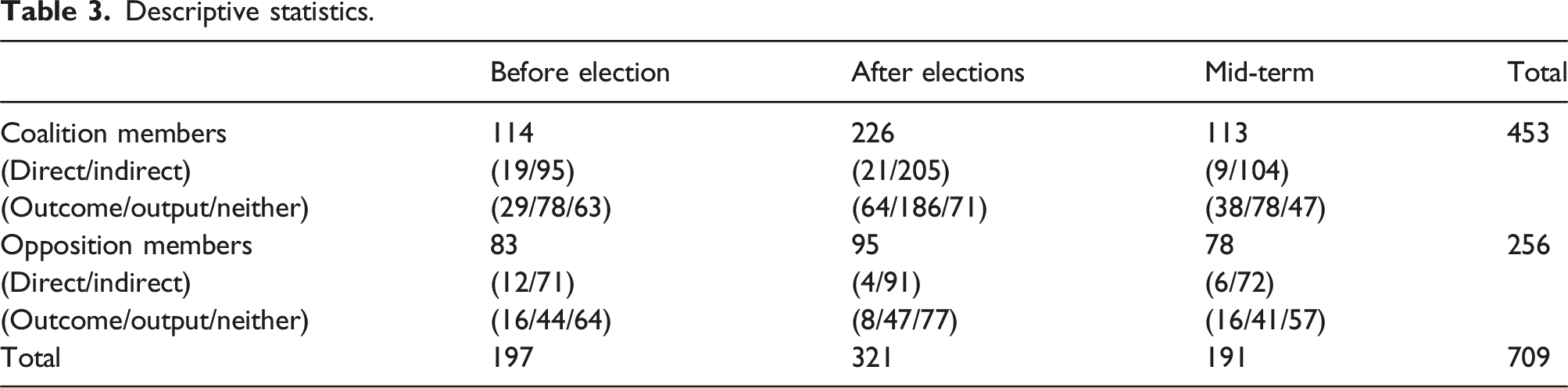
Before turning to the presented hypotheses, it is important to note that MKs performed more promises in their parliamentary speeches in those sessions sampled soon after the elections than in those before the elections. Toward the mid-term sessions, however, this activity diminishes to a level well below the one found prior to the elections. However, different dynamics are found among coalition and opposition MKs. Prior to the elections there are less differences between both groups. However, after the elections, MKs who are part of coalition parties promise more than members of opposition parties, followed by a sharp drop in promises toward half tenure. By comparison, opposition members make promises at more stable rates, with only a mild drop toward the mid-term sessions.
With regard to the first hypothesis, we expected a relatively higher reliance on direct promises prior to elections compared to after the elections. In line with our expectation, Figure 1 below shows that MKs make direct promises in 15.7% of all cases before the elections (31 out of 197), while the share drops to around 7-8% afterward (25 out of 321 shortly after the elections, and 15 out of 191 around the mid-term). Prevalence of direct promises by period.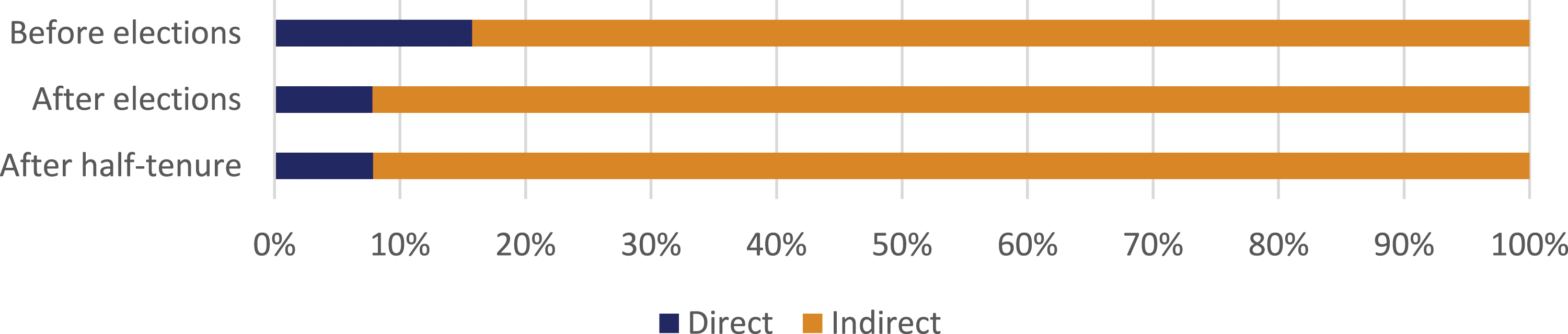
ANOVA test was conducted to analyze the variance in the type of promises by period, indicating a significant effect (p < .01). Specifically, a post-hoc test was conducted to measure variance between pairs of periods, indicating that Mks made direct promises before the election (M = 0.157, SD = 0.026) significantly more (p < .05) than after the election (M = 0.077, SD = 0.014) and mid-term (M = 0.078, SD = 0.019).
H1 is thus confirmed (see appendix for the ANOVA test results).
With regard to H2, which expected a lower propensity to make direct promises among coalition members, we specifically consider only those periods after the elections when a coalition has been established (after elections and around mid-term). In these periods, however, coalition members performed 8.8% of their promises in direct form (30 out of 338 promises), while opposition members performed 5.7% of their promises in direct form (10 out of 174 promises) – contrary to our expectations (presented in Figure 2). Prevalence of direct promises (only periods after the elections) by government role.
A logistic regression indicated that this difference is insignificant (p > .05).
H2 is thus not confirmed (see appendix for the logistic regression results).
Meanwhile, looking at the specific action orientations of promises performed by coalition members compared to opposition members (H3) yields informative differences. A logistic regression model shows that the speaker’s position significantly predicted seven of the ten action orientations (p < .01). At large, coalition members perform action promises with an orientation toward an outcome or output significantly more than opposition members. Thereby, coalition members are predicted to perform expected (B) of 3.1 Outcome-oriented, 4.3 Planning-oriented, and 1.7 Practical-oriented action promises for one time that opposition members performed those action promises with a relatively high degree of commitment. Contrarily, opposition members are predicted to perform action promises without outcome or output orientation, with expected (B) of 1.5 Preserve-oriented,1.4 Struggle-oriented, 1.3 Voice-oriented, and 1.3 Allegiance-oriented action promises for one time that coalition members performed those action promises with a relatively low degree of commitment (see appendix for the regression results).
H3 is thus confirmed (a summary of the results is presented below in Figure 3). Action orientation of promises by government role.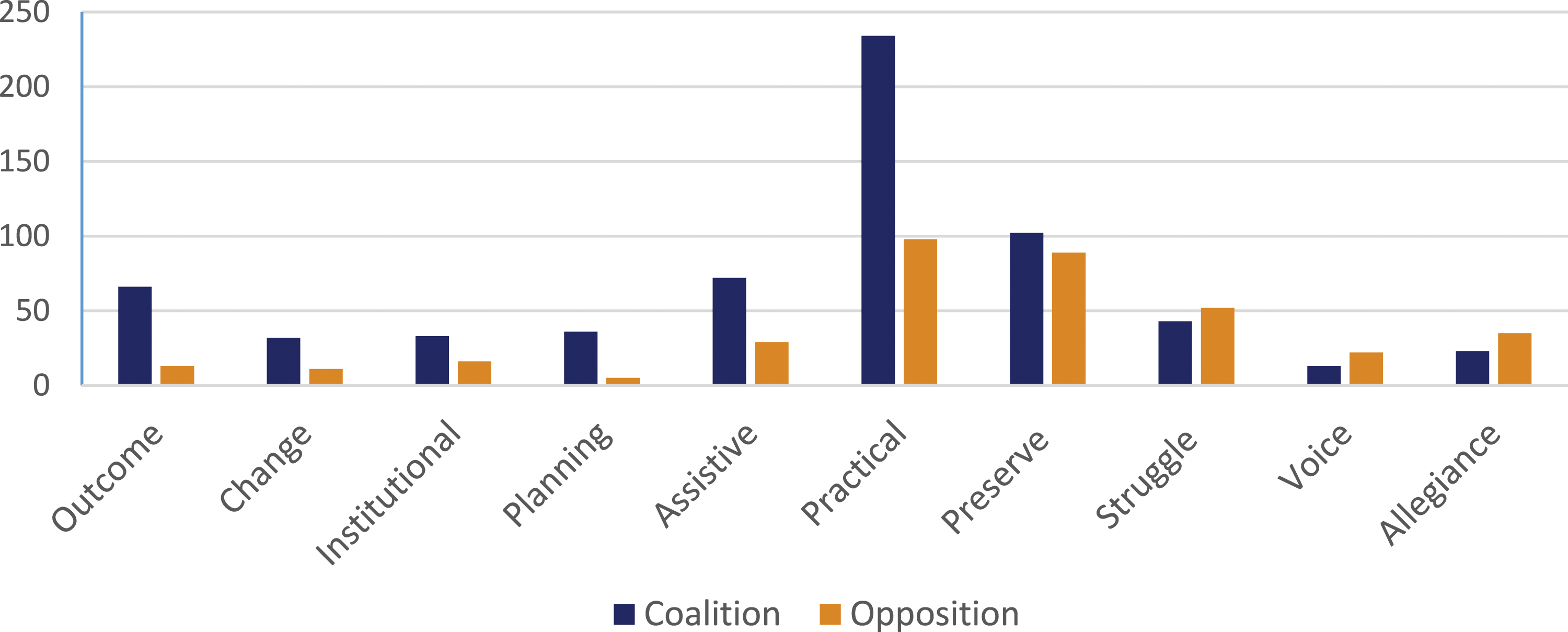
For example, coalition members make more use of promises with action verbs that refer to specific outcomes (e.g., “We will ease the state of the self-employed”; N.Bennett, primer minister in the 24th Knesset, Yamina party); as well as the intermediate category of actions oriented toward outputs (e.g., “I will promote this to bring about an improvement in the salary and service conditions of the police officers”; Y.Aharonovitch, Minister of public security in the 18th Knesset, Yisrael Beitenu); also the strong focus on practical actions among coalition members reflects the superior opportunities for action (e.g., “we will do everything so that evil and terrorist organizations will disappear from the world”; M.Wahabi, Mk in the 17th Knesset, Kadima).
By comparison, opposition members still make most promises by referring to practical actions, but make notably more use than coalition members of the least demanding orientations, notably struggle (e.g., “We will fight by law against displacing every tree, against canceling contracts to build houses in Judea and Samaria and against harming the residents”, R.Nachman, Mk for Likud party in the 13th Knesset); preserve and voice (e.g., “I will continue to do what you built - to tell this story, to tell the voice of the Jews of Iraq”; O.Katz, Mk for Likud party in the 24th Knesset); and allegiance: e.g., “Why not respond to the demands of thousands of prisoners? We will continue to support their demands”; A.Tibi, Mk for the Joint List in the 21st Knesset).
Finally, regarding our last hypothesis (H4), we found that representatives from catch-all parties performed more action promises to an inclusive electorate than those from identity-based parties, while the latter addressed exclusive groups to a greater extent. A chi-test shows a significant difference of 17% between the prevalence of addressing inclusive or exclusive groups by catch-all or identity-based parties (p < .01). While catch-all parties (e.g., Likud, Yesh Atid) perform 47.6 % out of their promises to inclusive electorate and 52.4% to exclusive groups, identity-based parties (e.g., Yisrael Beiteinu; United Arab List) perform 34.6% of out their promises to inclusive electorate and 65.4% to exclusive groups (as presented in Figure 4 below). Also a logistic regression model confirms the significance of this difference (represented in the appendix). Prevalence of addressed electorate by party affiliation.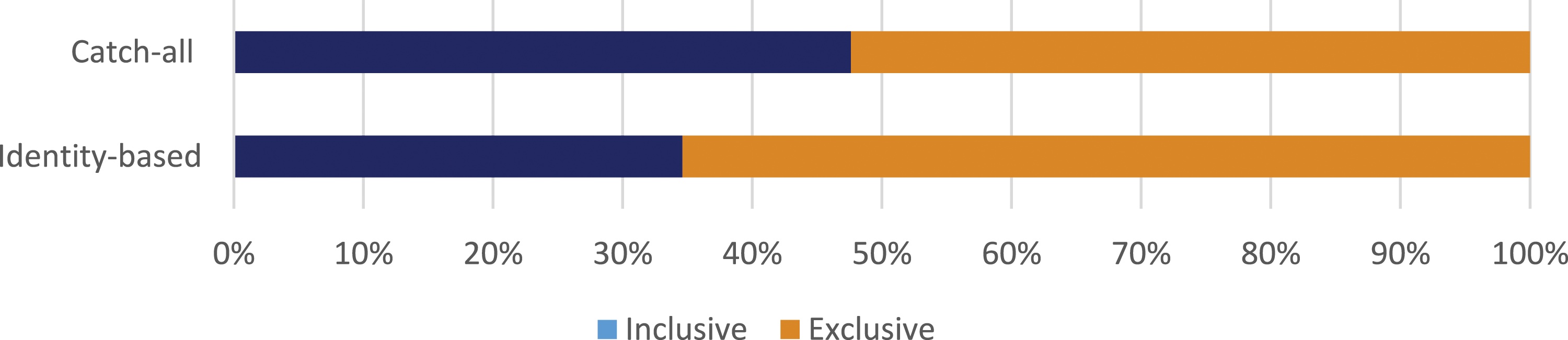
However, no significant differences were found with regard to their uses of direct versus indirect action promises. Hence, our expectations are only partially confirmed: Catch-all parties address an inclusive electorate more than identity-based parties (which focus more on addressing exclusive groups), however, catch-all parties’ promises addressing an inclusive electorate do not systematically express less commitment than the promises of identity-based parties addressing exclusive groups.
Discussion
This study investigated how elected representatives make promises to the electorate as part of their routine, everyday parliamentary discourse. Departing from a dominant focus on pre-election pledges, we look at promises from a broader perspective to examine how representatives’ practices of making promises vary systematically over time, by government role, party affiliation and electoral groups. What interested us is not what was promised but how it was promised over the course of the legislative cycle. To this end, we focused on the way in which promises are expressed directly, explicating the performed speech act of committing oneself to future objectives, or indirectly, without such explication. In addition, we have suggested ten orientations of action verbs, which bear important implications for the commitment expressed by representatives, and thus for the process of promissory representation.
In doing so, we broaden the scope of studying promises in the context of democratic representation in two important ways. First, recognizing that promises continue to fulfil their critical role in promissory representation far beyond the election campaign, we expand the time range under consideration to examine how promises are performed through the entire electoral cycle. Second, addressing the ongoing controversy over the conceptual distinction and operational measurement of “hard” and “soft” pledges in the scholarly literature, we have proposed a distinction between direct and indirect promises, which offers superior conceptual clarity and lends itself better to operational measurement. Applying our approach to parliamentary discourse in Israel, we have demonstrated the utility of our approach to the study of promissory representation.
We show that promises are broader and performed on a much more continuous basis than usually assumed – even rising in prominence after elections, at least among members of the governing coalition. Especially elected officials affiliated with government parties not only continue to reiterate their pre-election pledges, but offer updates, concretizations, and additional promises that respond to their newly-gained opportunities for action. One central setting in which such opportunities arise occurs immediately after the elections when coalition members set out the details of the coalition agreement, within which they are involved with many commitments to action. While not all of the promises make it into the final published agreement, the negotiation period enables them to communicate promises to the public (if only) to later insist on these in front of their potential partners.
Accordingly, we argue that promises play an essential role not only for convincing voters to mandate political representation, but also in maintaining continuous accountability throughout the electoral cycle. Unlike existing studies, which primarily conceptualize accountability as a mechanism reliant on sanctioning representatives based on their delivery on key pre-election promises (Przeworski et al., 1999), we suggest a different understanding. Besides the sanctioning based on delivered outcomes, answerability refers to representatives’ ongoing commitment to performing actions (Bovens, 2014), which maintains a communicative relationship between representatives and the electorate even if it may often remain unclear what exactly has been promised, or whether a specific promise has been kept. As such, accountability is illuminated as a process of information flow carried out across time that allows agents to mix facts and projections to get an image of doing by saying they are doing or will do (Maravall, 1999).
In this view, representatives promising practices during routine times offer a valuable lens into representatives’ ongoing efforts to construct and maintain a relationship with voters that both continues to seek their approval of intended actions, and enables a negotiation of adequate representation below the level of definite policy projects – a key capacity especially for representatives whose opposition role or lack of seniority prevents them from claiming responsibility for larger achievements: In our view, also the promise to opposing government policies or to work toward objectives whose attainment depends on other, more powerful actors, can constitute sufficient grounds for meaningful representation, which can mandate political action and result in holding representatives accountable where voters regard perceived commitments as kept or violated.
In addition, our broadened perspective credits representatives’ known tendency to strategically express different levels of commitment in order to maintain some necessary flexibility for political negotiations and compromises (Aragonès and Neeman, 2000). Representatives may express high commitment levels regarding issues that they want to be associated with, and express low levels of commitment to objectives they deem difficult to implement. Importantly, our approach opens up the possibility that promising practices may vary over time, owing to changes in the political opportunity structure. Thus, this study also offers new insights into understanding representatives context-dependent perceptions of competing pressures and needs, necessitating varying degrees of publicly displayed commitment (Bonilla, 2022).
In the same vein, the specific action orientations used by representatives to express promises offers insights into the role that representatives assign to themselves within the legislative process and political theater. As representatives construct their own roles in terms of achieving definite outcomes, committing efforts, or merely maintaining positions, also the quality of their representative relationship with their constituents changes (Mansergh and Thomson, 2007) – with potentially far-reaching implications: We can ask how the represented may respond to their representatives promising outcomes well beyond their control, or failing to promise definite outcomes altogether. Beyond addressing the operational challenges in the measurement of promises, thus, our approach also facilitates an investigation of qualitative differences in the nature of promises that are consequential with regard to both the form and content of made promises. Thus avoiding the operational challenges associated with the sole focus on linguistic form, while obtaining meaningful insights without the constraint of heavily context-dependent content-focused approaches, we hope that our perspective help advance the study of political promises, promissory representation, and representative claims more generally.
One additional validation of our approach to routine, direct and indirect action promises refers to question whether voters indeed recognize the identified instances as promises, and perceive the differences in the degree of commitment expressed therein (Bonilla, 2022). However, if we wish to better understand how and when voters perceive and potentially credit political promises, we first need to know what population of commissive statements they choose from, which is what we aimed to investigate in the present paper. The question, of course, links back to existing work on voters’ awareness of political promises, and the role of the voters in promissory representation as an interactive process that involves both the makers and the addresses of political promises (Duval and Pétry, 2023). Future research should thus investigate voters’ engagements with representatives’ routine promises, relying on social media channels or experimental settings, to examine their effects on the perceived quality of the representation process.
Limitations
As any research, also this study is subject to several limitations. First, indirect promises can be realized under infinite possibilities that are all but exhausted by our focus on ten orientations of action verbs. Beyond the inclusion of additional action orientations (e.g., scrutiny-oriented verbs: ‘scrutinize’, ‘track’, ‘assess’; leadership-oriented verbs: ‘lead’, ‘take responsibility’), also the expression of future orientation can take many more forms than grammatical tense that might need to be considered. Additional challenges may be raised by other languages that encode future orientation in different ways (Baden et al., 2021). Also conceptually, our distinction between direct and indirect speech acts may mitigate the fuzziness of delimiting promises from non-promises, but it does not eliminate it, as there are numerous expressions that may or may not be read as promises in ways that are not readily resolved by either theory or operational rules (e.g., “we are required to protect X”, “it is our right to fight for X”). Also, directness and action orientation may express conflicting degrees of commitment, an important interaction that we did not systematically address in this paper: Indirect promises may still communicate considerable commitment due to their concrete action orientation, just as direct promises may still communicate only limited commitment if the promised action is sufficiently vague (e.g., I promise I will try to…).
Our findings are furthermore particular to our choice of Israel as a case study, whose very fluid and complex multiparty system may induce promising practices that do not translate into other political contexts. While we are confident that representatives do not cease promising after the elections in other countries, either, different parliamentary processes and political cultures may severely affect how such promises will be formulated. Likewise, additional variables may help deepen our understanding of when, how, and why representatives make promises in distinct ways – be that concerning the identities of both speakers and constituents, the presentation of promises, or their relation to ongoing legislative processes. While our findings suggest that novel insights may be gleaned from following our proposed change in perspective, they cannot purport to be more than a first glance at a process that requires focused empirical attention.
To conclude, in this article, we have argued that promises performed by elected representatives on a day-to-day basis play an important and distinctive role for generating and maintaining mutual relations with the electorate. Through their promises, elected representatives continuously, publicly negotiate the acceptability of their actions as part of their mandated role as representatives. This process is in no way tarnished, but in fact to a large extent enabled by the fact that many such promises remain vague, exhibit limited degrees of commitment, and remain subject to interpretation: Exactly through its ambiguity and transience, the ongoing negotiation what actions are deemed necessary and sufficient to satisfy constituents’ sense of being adequately represented occupies a key location in the democratic process that has hitherto evaded systematic scholarly attention.
Supplemental Material
Supplemental Material - The future is (ever) promising: Elected representatives’ promises in routine parliamentary discourse
Supplemental Material for The future is (ever) promising: Elected representatives’ promises in routine parliamentary discourse by Avital Zalik and Christian Baden in Party Politics.
Footnotes
Acknowledgment
We are indebted to the anonymous reviewers for their valuable comments. We also thank Yoav Agami (The Hebrew University of Jerusalem) for participating in the inter-coder reliability tests.
Declaration of conflicting interests
The author(s) declared no potential conflicts of interest with respect to the research, authorship, and/or publication of this article.
Funding
The author(s) received no financial support for the research, authorship, and/or publication of this article.

Supplemental Material
Supplemental material for this article is available online.
Notes
Author biographies
References
Supplementary Material
Please find the following supplemental material available below.
For Open Access articles published under a Creative Commons License, all supplemental material carries the same license as the article it is associated with.
For non-Open Access articles published, all supplemental material carries a non-exclusive license, and permission requests for re-use of supplemental material or any part of supplemental material shall be sent directly to the copyright owner as specified in the copyright notice associated with the article.
