




Abstract
What characterizes the dynamics of presidential popularity? Research based on the United States of America finds popularity exhibits an almost law-like cyclicality over a president’s term: high post-election “honeymoon” approval rates deteriorate before experiencing an end-of-term boost as new elections approach. We contend that cyclical approval dynamics are not specific to the USA, but rather characteristic of presidential systems more generally, despite heterogeneity in their socio-economic and political contexts. Testing this proposition requires overcoming a key empirical problem: lack of comparable data. We do so by employing time-series inputs from 324 opinion surveys from a new publicly available database—the Executive Approval Database 1.0—to craft quarterly measures of popularity across 18 Latin American contemporary presidential democracies. Our analysis strongly confirms the cyclical approval model for the region. The conclusion identifies avenues for future research on the relationships across approval, presidentialism, and electoral, institutional, and socio-economic factors afforded by the new data resource we present here.
What are the dynamics of presidential approval? This question is central to US politics, where presidents leverage their popularity to achieve policy goals (Canes-Wrone and De Marchi, 2002; Rivers and Rose, 1985), and to debates about democratic consolidation, in which presidentialism is considered potentially unstable since even unpopular leaders serve fixed terms (Linz, 1990; Stepan and Skach, 1993). Dramatic presidential impeachments and removals or forced early departures, most recently in Peru (2018), South Korea (2017), and Brazil (2016), indicate unpopular executives can be unseated without democracy collapsing (Pérez-Liñán 2007). Yet some Latin American presidents have leveraged their popularity to alter term limits and/or increase their formal powers (Corrales, forthcoming).
Despite their centrality to presidential politics, our knowledge of approval dynamics is based mostly on a dozen US presidents, whose popularity typically follows a cyclical pattern: post-election honeymoon highs gradually deteriorate before recovering slightly at the end of the term. In this article, we contend that cyclical dynamics are not idiosyncratic to US politics but rather a fundamental characteristic of presidential regimes, despite important contextual differences across countries. 1 To date, however, lack of high-quality comparable data has hampered examination of this basic expectation.
We test this argument with original quarterly measures of presidential popularity in 140 presidential administrations across 18 Latin American countries from the Executive Approval Database 1.0 (EAD), a new publicly available resource. Results indicate the popularity dynamics found in the USA—honeymoons, decay, and end-of-term boosts—largely generalize to Latin American presidential systems. Our analysis broadens our understanding of presidential approval dynamics and demonstrates the utility of the EAD.
Presidential approval dynamics in the USA and Latin America
Research on US presidential approval dynamics began with Mueller’s (1973) seminal work and has largely stood the test of time (Gronke and Newman, 2003; Supplemental Figure S1). Mueller argues that as presidents govern, their policies inevitably alienate more and more original supporters, decreasing approval linearly over their term. Stimson (1976: 10) posits a psychological mechanism for this decay: “early naïve expectations turn to later cynicism.” Yet he models popularity as a quadratic function that bottoms out in year three or four and moves up (but not to honeymoon levels) as presidential elections near (see also Brace and Hinckley, 1992). This occurs either because presidents seeking reelection stage symbolic events and manipulate the political business cycle, or because presidents who forgo reelection become lame ducks whose motives the public judges less cynically.
Few studies have examined presidential approval dynamics in Latin America. Cuzán and Bundrick (1997) study comparable survey series for five Central American republics. Although their results resonate with Stimson’s (1976) cyclical model, low survey frequency impedes them from distinguishing honeymoons from end-of-term bumps or estimating their size and duration. Updating Cuzán and Bundrick’s data, Johnson and Schwindt-Bayer (2009) make modeling choices that obscure nuanced temporal dynamics. Indeed, their results suggest approval increases over a president’s term, in stark contrast with Stimson’s quadratic popularity cycle. These studies are therefore inconclusive as to the dynamics of approval beyond the USA. Carlin, Martínez-Gallardo and Hartlyn (2012) analyze 18 Latin American presidential democracies plus the USA and the Philippines. They uncover logarithmic decay processes and estimate initial and ending approval levels and overall highs and lows. They do not, however, indicate when popularity bottoms out or whether it rebounds at the end of term. Moreover, the short length and temporal gaps in their country approval series limit their findings’ external validity.
Though lack of high-quality comparable data has hindered our ability to test the generalizability of the cyclical approval dynamics found in the USA to Latin America, some scholars may have rejected it due to contextual differences. Latin American presidents confront socio-economic and political crises under conditions that sharply contrast with those of their US counterparts, including weak formal institutions, limited checks and balances, a less robust civil society, and fragmented and weakly institutionalized party systems. Additionally, they govern with frequent changes to electoral laws and other basic rules of the game. Without diminishing these differences, we note that the cyclical approval pattern in the USA is largely unchanged since the 1940s—despite substantial socio-economic and demographic shifts, dramatic changes in access to the ballot box, growing partisan polarization, and declines in political trust.
We expect to see similar cyclical approval dynamics in Latin American presidential systems for several reasons. A hallmark of presidentialism is the direct election of a chief executive. This encourages parties to concentrate resources on presidential campaigns, shifts media focus to presidential contenders and trains the public’s attention on personal—rather than party—reputation (Samuels, 2002). These factors bolster voter identifiability and create “an aura, a self-image, and a set of popular expectations” (Linz, 1990: 53) which should help any president enjoy a honeymoon period. US and Latin American presidents also grapple with similar factors that raise their “costs of ruling” and, thus, fuel secular declines in support. These include unmet expectations, an expanding coalition of disappointed opposition minorities, “grievance asymmetry” as voters focus disproportionally on negative developments, and policy divergence from the public’s wishes (e.g. Wlezien, 2017). 2 Latin American presidents’ approval should also partially rebound as elections near because, like US presidents, they serve fixed terms and thus face the challenges (or temptations) of reelection or lame-duck status.
Additionally, the classic drivers of presidential approval in the USA, particularly regarding the economy, impact approval in Latin America too. Comparative work on contemporary Latin America generally finds approval tracks the economy (e.g. Carlin, Love and Martínez-Gallardo, 2015a, b; Singer and Carlin, 2013), with mixed evidence on the importance of political-electoral budget cycles (Nieto-Parra and Santiso, 2012; Kaplan and Thomsson, 2017). Convergence across predictors of approval in the USA and Latin America grants us greater confidence that the dynamics of approval will be similar across these contexts as well. This rationale aligns with research showing classic voting theories developed in the USA travel fairly well to Latin America (Carlin, Singer and Zechmeister, 2015; Nadeau et al., 2017).
In sum, the aforementioned institutional similarities and studies lead us to expect dynamics of approval across contemporary Latin American presidential democracies to behave much as Stimson’s (1976) cyclical model predicts. Below we test this proposition by examining approval dynamics overall, by controlling for economic conditions, and by stratifying on theoretically plausible contextual differences based on the “costs of ruling” and party systems literatures. We find strong evidence for quadratic cyclical approval dynamics in the region.
The EAD 1.0
Systematic analysis of approval dynamics across Latin America requires comparable presidential approval data. Yet such was uncommon in the region until the 1980s or later. Although many pollsters throughout Latin America now gauge presidential popularity, several problems complicate comparison. Question wording varies across countries and within them over time. Firms sample with distinct frames and frequencies. Some firms exit the market and new ones enter. And so on. Thus, establishing comparable measures of presidential approval across multiple administrations within Latin American countries is challenging.
The Executive Approval Database (EAD) 1.0 (Carlin et al., 2016) overcomes these problems by using Stimson’s (1991) dyads-ratio algorithm to harness survey series compiled by multiple firms and methods but which reflect an underlying latent construct: presidential approval. This factor-analytic algorithm reliably and consistently combines numerous disparate popularity series into a single, unidimensional approval series by modeling their common variance while controlling for tendencies specific to each data source (Stimson, 2018 offers a detailed description). 3 The EAD 1.0 combines 11,246 survey marginals from 324 separate input time-serial indicators of presidential “approval,” “favorability,” and “ratings” of the president’s “management,” “job/work,” “performance,” or “image” 4 into quarterly time series that are comparable, within countries, across administrations, and over time for 18 Latin American countries. The resulting dataset includes approval ratings for 140 Latin American presidential administrations spanning the decades following each country’s “third-wave” turn to political democracy through the second quarter of 2016. The EAD’s website (www.executiveapproval.org) provides regional quarterly and monthly versions of the EAD, a visualization tool, and an aggregation tool to create customized measures with the dyads-ratio algorithm.
Figure 1 depicts quarterly presidential approval measures by country. Vertical bars mark presidential elections and highlight their effects on executive approval. Standard deviations in approval levels range considerably across the 18 countries, from lows of 7.79 (Mexico) and 8.22 (Venezuela) to highs of 18.30 (Dominican Republic) and 15.33 (Brazil; see descriptive statistics in Supplemental Table S1). The approval dynamics observed in Latin American democracies over the past decades nicely approximate those found throughout 77 years in the archetypal US case (Supplemental Figure S1), warranting a more systematic analysis.

Presidential approval and elections in Latin America.
We employ these data to test our argument that the cyclical model developed in the USA represents a more general phenomenon. Doing so first requires adjusting for differential presidential term lengths. Along with presidents who completed 4-, 5-, and 6-year constitutional terms, our sample includes several presidents who did not complete their terms and the interim presidents who replaced them. We account for this variation by standardizing the length of a president’s term 0-1. Excluding shortened administrations has no effect on the results reported below (see Supplemental Figure S2 and Table S3).
Figure 2 provides an initial test of our expectations. It juxtaposes smoothed plots of approval over time for all US administrations from Harry S. Truman to Donald J. Trump (provided by James Stimson) and all Latin American administrations in the EAD 1.0. Since we do not expect a linear function, we use a semi-parametric approach—kernel-weighted local polynomial regression. Approval is on the y-axis; the x-axis represents the proportion of the term completed.
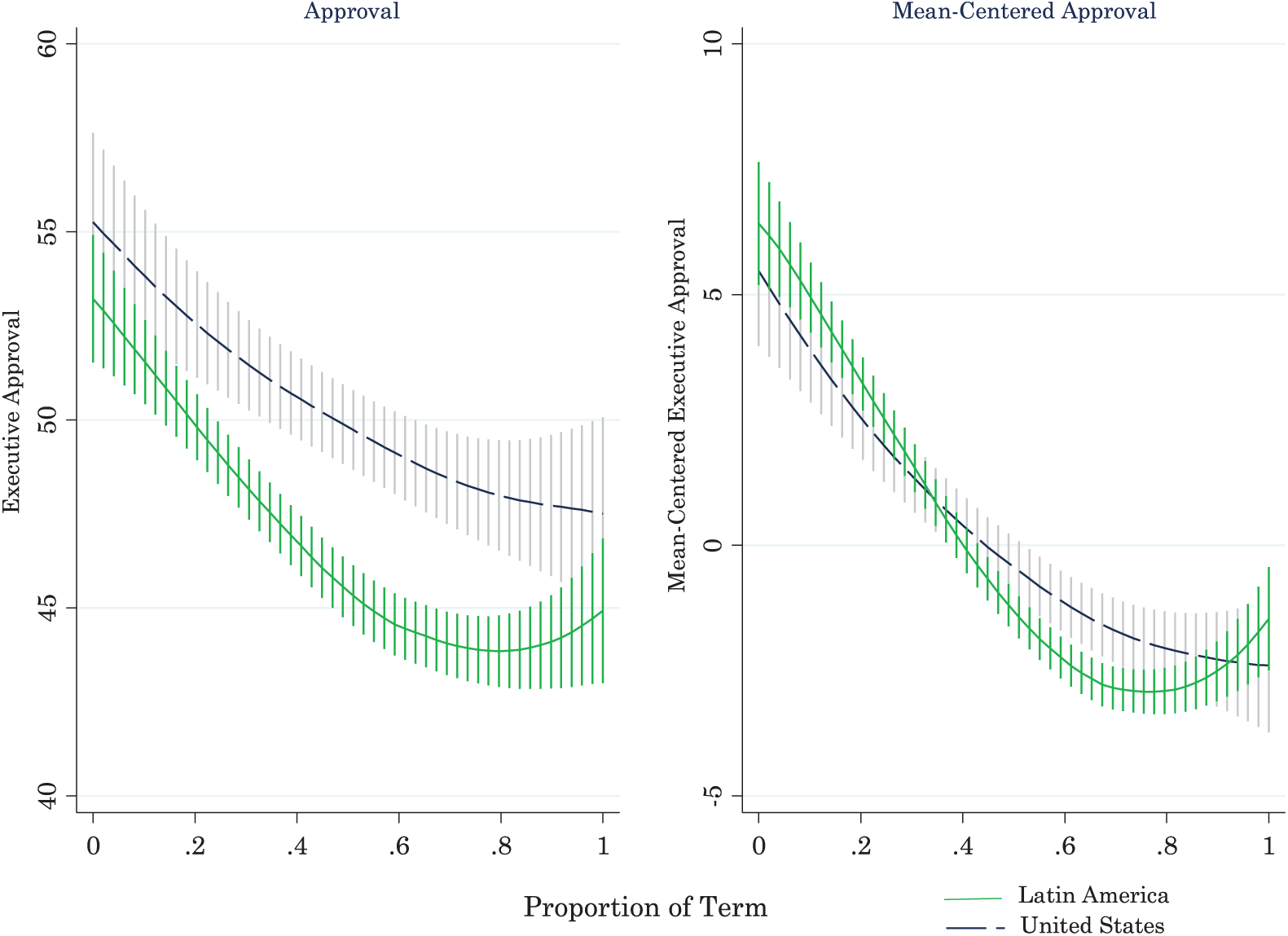
Dynamics of presidential approval in 18 Latin American countries and in the USA, 95% confidence intervals.
In the left panel of Figure 2 we first observe a strong honeymoon effect for Latin American and US presidents alike. Compared to mean levels of approval for all quarters, at the six-month mark of their terms Latin American presidents are, on average, 5 percentage points more popular. We also observe a slight (statistically insignificant) end-of-term bounce above the all-quarter mean. Presidents’ public standing generally bottoms out about 70% of the way into their terms with approval ratings averaging in the mid-40s.
The left panel in Figure 2, however, does not control for baseline support levels, which tend to vary across countries and presidents; it simply combines approval values from Figure 1 and, thus, may mask dynamics or create spurious inferences. To account for this, the right panel of Figure 2 presents mean-centered approval ratings by administration. Mean centering is comparable to adding administration-specific fixed effects which purge the series of differences in average levels of support across administrations. These results fit the cyclical model even more clearly for both Latin America and the USA. For the Latin American countries, the right panel shows, on average, smaller confidence intervals, a honeymoon period about 6.5 points higher than the baseline, a slightly sharper drop-off from the honeymoon period to about 3 points below the baseline, and a larger, now significant, end-of-term bounce, averaging around the baseline. The general dynamics of approval for Latin American presidents are strikingly similar to those of US presidents, but with more dramatic honeymoons and end-of-term bumps.
Figure 3 applies the same approach as Figure 2 to each Latin American country in our sample. While some have relatively few administrations (e.g. Paraguay), limited survey inputs (e.g. Honduras), or both (e.g. Dominican Republic; see Figure 1 and Supplemental Table S1), most have enough data to assess honeymoon patterns with confidence. As Figure 3 illustrates, most Latin American presidential regimes exhibit fairly dramatic honeymoon effects and many feature end-of-term bumps. Panama displays the largest average honeymoon effect—a 21-percentage point differential between approval levels at the start of a typical presidential term and the lowest point during the average term. Uruguayan presidents enjoy the largest end-of-term bumps, averaging 7 percentage points more popularity in their last quarter than the country baseline level of approval.
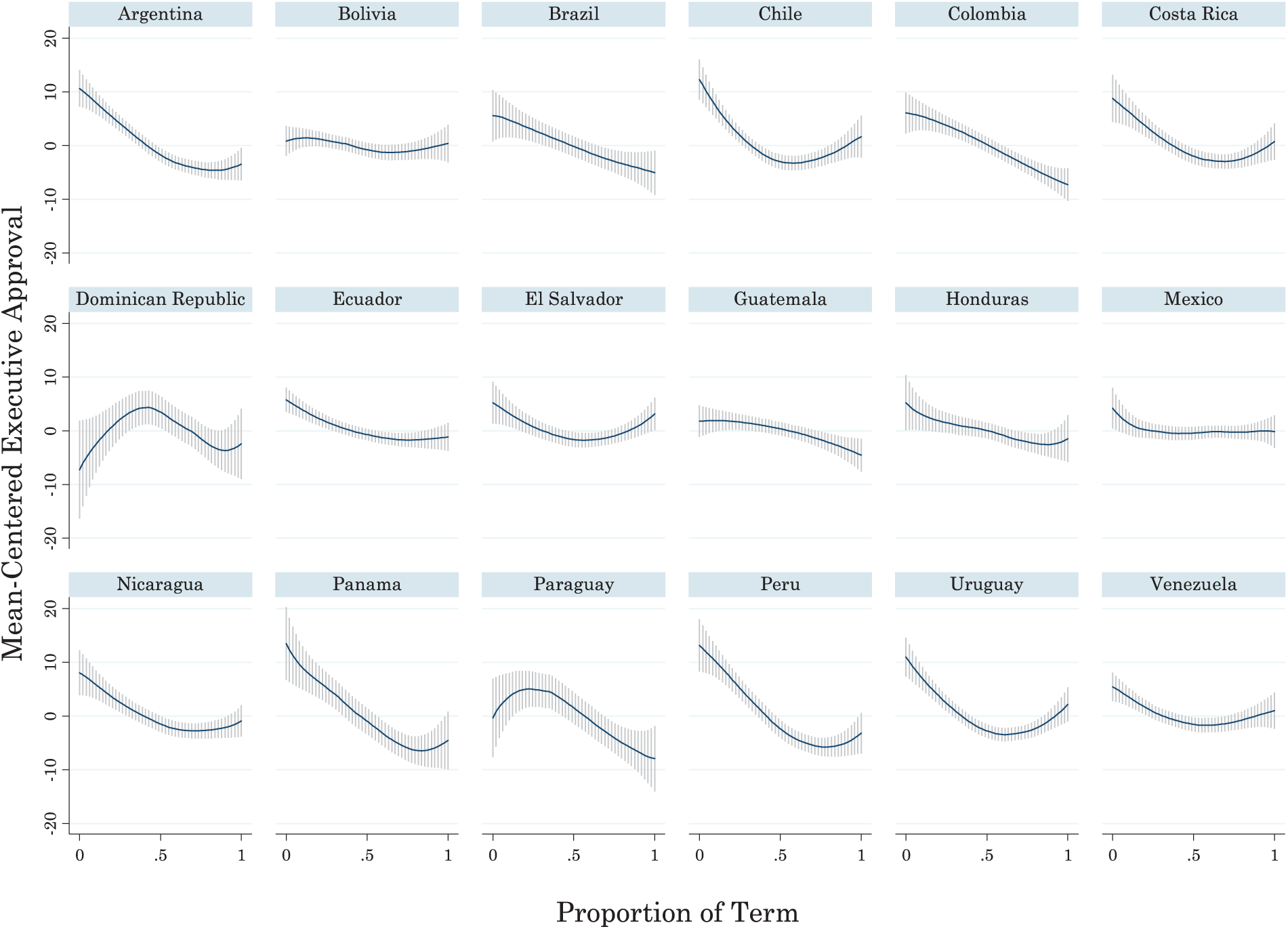
Dynamics of presidential approval in Latin America by country, 95% confidence intervals.
The general pattern in Figure 3 reveals more similarity than divergence. Yet we might wonder whether diverging cases are simply outliers or systematically reflect political contexts at variance with the USA. For example, “costs of ruling” theories link decaying executive support to the executive’s policy control (Wlezien, 2017). Approval may therefore erode more sharply under majority government. Weakly institutionalized or clientelist party systems may also endow leaders with less initial support or blunt voters’ capacity to associate presidents with policy successes or failures. Hence, one might expect that honeymoon effects may be weaker in volatile party systems and approval may decay less aggressively where clientelistic appeals, not policy outputs, prop up presidents.
To assess whether these factors account for cross-case differences, in the supplemental materials we graph the mean-centered dynamics stratified by majority vs. minority government (Camerlo and Martínez-Gallardo, 2017; Martínez-Gallardo, 2014), party system volatility (Mainwaring, 2018), and clientelistic linkages in the party system (Coppedge et al., 2017). Results do not alter our conclusions substantively (see Supplemental Figures S3-S5). Cyclical effects—initially high support decaying until the next election nears—appear to be general features of presidential regimes, contextual differences notwithstanding. At the same time, “on-average” inferences downplay the importance of some specific outlier administrations which could be theoretically fruitful to explore, as we note in the conclusion.
The displays in Figures 2 and 3 lack standard economic controls and cannot gauge the length of honeymoons or the extent of end-of-term bumps. To do this, we estimate an autoregressive distributed lag (ADL) model which captures dynamic processes using lags for the dependent and independent variables. The model controls for inflation and economic (gross domestic product (GDP)/capita) growth, which impact approval in Latin America (Singer 2013). 5 We use dummy variables indicating if a presidential election occurred in the current quarter, the previous quarter, or two quarters prior. Additional quarter dummies are not statistically significant. To capture the end-of-term popularity rebounds, we include dummy variables indicating whether the election takes place one and two quarters into the future. Country fixed-effects account for unmeasured sources of country-level heterogeneity; random-effects, robust clustered standard errors, and panel-corrected standard errors specifications return similar results (see Supplemental Table S4). 6
Model estimates in Table 1 demonstrate a strong honeymoon effect: Latin American presidents tend to be significantly more popular in the first three quarters of their term. Because of the autoregressive nature of the model, the average cumulative benefit of the three-quarter honeymoon boost for presidents over their entire term of office is substantial, with most experienced in the first two years with gradual decay (see Supplemental Figure S6).
Honeymoon and end-of-term dynamics of presidential approval in Latin America.

DV: dependent variable; GDP: gross domestic product
Standard errors in parentheses.
p<0.01, **p<0.05, *p<0.1, two-tailed.
As with honeymoon effects, we find a significant end-of-term boost of a couple percentage points confined to the quarter immediately preceding an election. Our overall results for Latin American presidential democracies fit the quadratic cyclical pattern observed in the USA: elections grant presidents a substantial honeymoon period, which deteriorates gradually before flattening or partially rebounding when the campaign season recommences.
Conclusion
Once limited in scope, research on the mass behavior of Latin American electorates has flourished recently. Scholarship on presidential approval dynamics beyond the USA, however, remains scant. While this partially reflects skepticism that countries with socio-political contexts that differ greatly from the USA could exhibit similar patterns of presidential approval, the greatest hurdle facing comparative research on presidential approval has been a scarcity of high quality comparable data.
The EAD 1.0 helps scholars clear that hurdle by overcoming many of the thorny measurement problems that have plagued research in this area. The current study is a first step in what promises to be a larger research agenda. It shows, as we argued should be the case, that approval patterns for Latin America’s presidents are not fundamentally different from their US counterparts: the cyclical model’s key expectations of honeymoons, decaying support, and end-of-term boosts occur regularly within our Latin American sample. A key next step is to understand why some cases buck these tendencies. For example, some Latin American presidents (e.g., Rafael Correa, Néstor Kirchner, Alvaro Uribe) have managed, like Dwight Eisenhower (Mueller, 1973), to stave off declining approval. In some countries cyclical effects are weak (e.g. Bolivia, Mexico) or slightly misshapen (e.g. Dominican Republic, Paraguay). The EAD will continue to provide more data points, allowing scholars to leverage this variation to develop and test theories that explain why presidents conform (or not) to these basic cyclical dynamics.
More generally, the cyclical dynamics of presidential popularity we uncover can serve as a foundation for new theorizing and, in turn, new insights into the politics of executive approval in presidential countries throughout the world. As the focus of inquiry, scholars can theorize why initial levels of approval, length of honeymoon, decay rates, and end-of-term bounces vary. Despite the prevalence of the economy (cf. Lewis-Beck and Stegmaier, 2013) and rally-round-flag effects (cf. Baker and Oneal, 2001) in the study of executive approval in established democracies, we lack both a basic popularity function and a systematic collection of rally events for Latin America.
And there are many research questions in which approval dynamics serve as a key explanatory factor. A raft of research indicates approval ratings enter US presidents’ domestic and international policy calculations (see Gronke and Newman, 2003). A case study of Argentina argues that low popularity can impinge on the executive’s ability to pass legislation (Calvo, 2007). Regional Latin American analyses find popular presidents are more likely to use unilateral decree powers (Shair-Rosenfield, Stoyan and Sagarzazu, 2017), succeed in inter-branch bargaining (Martínez-Gallardo, 2012), finish their terms (Pérez-Liñán, 2007), and amend constitutions to permit reelection (Corrales, forthcoming). This scholarship underscores the importance of presidential approval for domestic outcomes, and the EAD will allow future work to extend and contextualize these findings. Presently, we also know little about how popularity ratings influence presidents’ foreign policy decisions beyond the US case.
Building on this study’s findings, use of the EAD can facilitate a comparative research agenda on the popular bases of effective governance in presidential systems. It can also weigh in on theoretical and normative questions such as the relative merits of presidential, parliamentary, and semi-presidential models of democracy for achieving stability, representation, and accountability (Hellwig and Samuels, 2008; Lijphart, 1991; Linz 1990). Better grasp of these questions will deepen our understanding of democracy in general.
Supplemental Material
Supplemental_Material – Supplemental material for Public support for Latin American presidents: The cyclical model in comparative perspective
Supplemental material, Supplemental_Material for Public support for Latin American presidents: The cyclical model in comparative perspective by Ryan E. Carlin, Jonathan Hartlyn, Timothy Hellwig, Gregory J. Love, Cecilia Martínez-Gallardo and Matthew M. Singer in Research & Politics
Footnotes
Acknowledgements
The authors thank Michael Lewis-Beck, Elizabeth J. Zechmeister, and James A. Stimson for comments on previous drafts and/or feedback on the data collection efforts.
Declaration of conflicting interests
The author(s) declared no potential conflicts of interest with respect to the research, authorship, and/or publication of this article.
Funding
The author(s) received no financial support for the research, authorship, and/or publication of this article.
Supplemental materials

The replication files are available at: https://dataverse.harvard.edu/dataset.xhtml?persistentId=doi%3A10.7910%2FDVN%2FMKOBET&version=DRAFT
Notes
Carnegie Corporation of New York Grant
This publication was made possible (in part) by a grant from the Carnegie Corporation of New York. The statements made and views expressed are solely the responsibility of the author.
References
Supplementary Material
Please find the following supplemental material available below.
For Open Access articles published under a Creative Commons License, all supplemental material carries the same license as the article it is associated with.
For non-Open Access articles published, all supplemental material carries a non-exclusive license, and permission requests for re-use of supplemental material or any part of supplemental material shall be sent directly to the copyright owner as specified in the copyright notice associated with the article.
