




Abstract
Does the type of democratic regime matter for public evaluations of leaders? We argue two characteristics intrinsic to presidential and parliamentary regimes lead to divergent patterns of executive approval. For presidents, direct elections foster more personal leader-voter linkages; for prime ministers, dependence on the legislature for survival contributes to more institutionalized party systems. These two mechanisms should generate higher approval at the outset of a term—larger honeymoons— for presidents than for prime ministers, but also more rapid decline. Analyses of data from 40 countries produce evidence consistent with these constitutionally-based distinctions. Yet we uncover important within-regime differences. Within presidential systems, approval patterns vary along with paths to power—first-election versus re-election, and elected versus unelected. Within parliamentarism, honeymoons are greater for prime ministers overseeing single-party majoritarian governments. Study findings advance long-standing debates about the relative merits of presidential and parliamentary systems—particularly the tradeoff between democratic responsiveness and stability.
Keywords
Does democratic regime type shape citizens’ evaluations of political executives? In his famous article regarding the “perils of presidentialism,” Linz (1990) expressed concern that the “plebiscitarian” nature of presidential elections can ultimately put democratic stability at risk. The image or “aura” presidential candidates cultivate during electoral campaigns, he argued, can lead voters to over-estimate the winners’ ability to accomplish their goals once in office and, inevitably, to become disappointed when they fail. The potential disconnect between the public’s expectations and the reality of governing is further magnified by the winner-take-all nature of majoritarian elections which tempts presidents to conflate victory—however narrow—with a mandate to represent “the people as a whole” (Linz, 1990, pp. 60–61).
Parliamentary systems, Linz posited, are different. Expectations for prime ministers tend to be modest given the nature of their ascent to power and institutional position. Most obviously, they lack an independent popular mandate. Despite the rise of personalized politics in many parliamentary countries (Rahat & Kenig, 2018), prime ministers are typically members of parliament, selected to head the government as agents of their political party, and dependent on legislative majorities to stay in power. Moreover, as heads of government, prime ministers lack the symbolic premium of representing the state. These institutional and symbolic constraints limit parties’ incentives to cultivate direct links between prime ministerial candidates and voters, tempering popular expectations of government performance.
One implication of these arguments is that popular evaluations of presidents should differ from those of prime ministers. But the massive literature comparing presidential and parliamentary regimes largely ignores this implication despite its potential importance for politics in praxis. Executive popularity is a key source of political power. Honeymoons grant presidents and prime ministers the political cover to introduce major, and often costly, reforms (e.g., König & Wenzelburger, 2017; Stokes, 2001). Highly popular presidents more easily afford the often steep “cost of ruling” (Nannestad & Paldam, 2002; Wlezien, 2017), fare better in inter-branch bargaining (Becher & Christiansen, 2015; Martínez-Gallardo, 2014), and pass their agendas more efficiently (Calvo, 2007; Cheibub et al., 2004; Raile et al., 2011). Falling approval may trigger cabinet shuffles (Kam & Indriðason 2005; Martínez-Gallardo, 2014) and even risk the survival of presidents and prime ministers (Laver & Shepsle, 1998; Pérez-Liñán, 2007). But leaders can also leverage their public standing to extend their stay in office (Corrales, 2016; Schleiter & Tavits, 2016). And by forestalling corrective policies, extreme leader popularity may even precipitate financial crises (Herrera et al., 2020). In short, approval dynamics condition what prime ministers and presidents can achieve–overall and relative to each other.
Against this backdrop, we argue that two intrinsic characteristics can lead to divergent patterns of executive approval across regime types. First, echoing Linz (1990, 1994), we expect the incentives to conduct
We test our expectations using time series data on executive popularity for 271 leaders in 40 countries: 19 parliamentary and 21 presidential. Results show that presidents, on average, enjoy greater honeymoons than prime ministers but incur higher costs of ruling and greater volatility in public support. As expected, these differences reflect, to some extent, how incentives to focus electoral campaigns more on individuals than on parties boost initial expectations for incoming leaders. While first-time executives in both regimes generally enjoy a post-election honeymoon, the phenomenon is more pronounced under presidentialism. Under parliamentarism, honeymoons are most substantial for first-time prime ministers who oversee single-party majorities. By contrast, reelected presidents and prime ministers do not enjoy significant honeymoons, suggesting personalism has one-off effects.
In line with our expectations, regime differences in approval ratings also reflect distinct patterns of party system institutionalization. The volatile nature of party competition characteristic of presidentialism is associated with more volatile approval ratings throughout the electoral cycle. Accounting for electoral volatility—our indicator of party system institutionalization—reveals patterns of approval that more closely approximate each other across the two regimes. Ancillary tests of these mechanisms within parliamentary and presidential regimes bolster these claims.
Study findings contribute to long-standing debates about the relative merits of presidential and parliamentary systems. First, the nature of elections shape approval dynamics in ways that Linz’s work implies (1990; 1994). Larger honeymoons stem in part from the incentives in presidentialism to run highly personalized campaigns, inflating popular expectations – especially when presidents win office for the first time. But our findings add important nuance to Linz’s claims by showing how re-election and variation across executives’ terms moderates what at first appear as regime-specific differences. Second, findings on party system stability are consistent with work arguing that many effects of regime choice are indirect (e.g., Cheibub et al., 2014; Mainwaring & Shugart, 1997). Third, our work sheds new light on the tradeoff between democratic responsiveness and stability. Presidents’ higher levels of initial political capital tend to erode quickly as performance fails to meet expectations and “costs of ruling” accrue, whereas prime ministers’ approval is less volatile. Hence, relative to parliamentarism, public opinion dynamics under presidentialism are more unstable but also allow for greater accountability between elections. Finally, our finding that personalism and volatility matter more for executives’ public standing in parliamentary systems further contextualizes debates about the scope for, and possible impact of, the “presidentialization” of politics in parliamentary regimes.
Executive Approval Patterns and Dynamics
Executive approval tends to follow a predictable cycle: it begins well above average but deteriorates over time before experiencing a slight end-of-term boost as new elections approach. These dynamics are evident across numerous presidential regimes over time despite, important differences in the strength of formal institutions, the presence of checks and balances, and the vigor of civil society and media independence. Indeed, this cyclical pattern has been well established in the United States (Gronke & Newman, 2003; Mueller, 1973; Stimson, 1976) and more recently across contemporary Latin America (Carlin et al., 2018), with some exceptions (Carlin & Martínez-Gallardo, 2019; Mueller, 1970). Re-elected presidents, however, rarely enjoy much of a second honeymoon (Brace & Hinckley, 1992).
Similar cyclical patterns exist in parliamentary systems. Müller and Louwerse (2020) find vote intentions for government parties fit the familiar, partially U-shaped pattern in a broad cross-section of parliamentary democracies. 1 Electoral support for government parties tends to start out high, decrease over the first half of the electoral cycle, and recover slightly as elections near. Employing either vote intention or approval data, several case studies find cyclical dynamics, including in Japan (Krauss & Nyblade, 2005), Canada (Johnston, 1999), Italy (Bellucci & Memoli, 2023), and the UK (Anderson, 1995a; Yantek, 1985). Evidence is mixed, however, for Denmark, Germany, the Netherlands (Anderson, 1995a, 1995b), and Spain (Romero-Vidal, Orriols, & Riera, 2023).
Despite the theoretical and political implications, few studies compare patterns of approval across constitutional regimes. One exception is Carlin et al. (2012), on which we build. Although it establishes some key cross-regime differences in cyclical dynamics, it does not assess why these differences exist or control for rival explanations. Relying on a more limited and unbalanced sample available at the time, the set of countries it employs is also overweighted toward presidentialism and excludes most parliamentary systems of Central and Eastern Europe, the Nordic countries, as well as Japan. With the Philippines as the only Asian case, their cross-regime comparisons are almost exclusively between developed parliamentary democracies in Western Europe and developing presidential systems in the Americas, limiting the external validity of their conclusions. 2 And, as their dataset ends in 2009, it excludes more than a decade of politics which may be consequential to electoral-cycle dynamics, especially as party systems and campaign dynamics in many parliamentary regimes become more volatile and personalized (see Müller & Louwerse, 2020).
Lack of research comparing approval dynamics is puzzling—especially in light of a venerable literature on comparative constitutional regimes that implies regime type should lead to divergent patterns of executive approval. We overcome previous theoretical and empirical limitations by connecting two key features of presidential and parliamentary regimes to executive approval and testing our expectations on a more comprehensive and balanced sample.
Constitutional Regimes and Executive Approval
We expect two regime particularities to generate different patterns of executive approval. First, as Linz (1990) noted, the direct popular election of the executive in presidential systems creates a “plebiscitarian” link between voters and leaders that is substantively different from the one established between voters in parliamentary systems and the prime minister. Second, the combination of direct/indirect elections with the mutual independence/dependence of the executive and legislative branches shape parties’ organizational strength, discipline, and centrality to the fate of executives (Samuels & Shugart, 2010). In parliamentary systems parties are strengthened by the requirement that prime ministers are supported—or at least not opposed—by a majority of the assembly to survive in office. In contrast, direct popular elections and fixed terms in presidential systems fuel political dynamics that weaken party institutionalization and boost electoral volatility.
Below we theorize how these parliamentary and presidential institutions shape the strategic environments in which leaders campaign, attain office, relate to their parties and voters, and govern—in short, the larger context in which citizens evaluate political executives.
Executive Selection, Personalism, and Executive Approval
Modes of executive selection generate distinct incentives for political actors. In presidential systems with popular elections, electoral campaigns typically center around the attributes of a single candidate. Conversely, indirect elections in parliamentary systems encourage campaigns focused on the platforms of political parties (Rahat & Sheafer, 2007). The resulting levels of electoral personalism—the degree to which individual actors, including the chief executive, are more prominent in the political process than parties or collectives—could be expected to translate into different patterns of executive approval. This should be especially clear at the beginning of a leader’s first term, when the election still looms large and hopes remain high.
In presidential systems, the direct election of a chief executive encourages parties to concentrate resources on presidential campaigns, shifts media focus to presidential contenders, and trains the public’s attention on candidates’ personal reputations rather than their parties’ platforms (Carey & Shugart, 1995; Samuels, 2002). Presidential campaigns are thus designed to highlight not only candidates’ policy agendas but also their unique personal attributes and political qualities. As a result, presidents rely more heavily on their personal charisma and ability to connect with voters to reach public office rather than working their way through traditional legislative and party hierarchies (Samuels & Shugart, 2010).
Candidate-centric campaigns are likely to create, in Linz’s words (1990, p. 53), “an aura, a self-image, and a set of popular expectations” that fuel higher-than-average levels of approval at the outset of a presidential term. According to Stimson (1976), this honeymoon is propelled by a public largely uninformed about public policy and, thus, prone to believe candidates’ campaign promises, regardless of their feasibility. The approval boost is fleeting, however. By expecting from leaders “more than can possibly be achieved under the best of circumstances,” the public “is always prone to great disappointment over what is actually achieved by merely mortal Presidents acting under less-than-ideal conditions” (Stimson, 1976, pp. 9–10). These early “naïve expectations” explain why new presidents pick up the support of a wide swath of voters, including many who did not vote for them (or did not vote at all) but are willing to jump on—and eventually off—the bandwagon (Stimson, 1976, p. 10; see also Brace & Hinckley, 1992; Castro Cornejo et al., 2022). This should be particularly true following elections that first bring presidents to office and less so for re-elections, in which the incumbent is a known commodity and expectations are more realistic.
By contrast, prime ministerial candidates do not run as individuals in a direct popular election but compete for the post indirectly from within their party. We expect this mode of executive selection to translate into lower levels of initial approval—honeymoons—for prime ministers compared to presidents for at least two reasons. First, indirect elections reduce the incentives of prime ministerial candidates to cultivate direct ties with voters. General election campaigns, in turn, tend to emphasize party links and platforms over the attributes of individual candidates (Kriesi, 2012). Second, citizens cannot split their ticket and vote for a prime ministerial candidate while voting against their party and, thus, are less likely to give initial approval to an executive from a party or coalition for which they did not vote (Samuels & Shugart, 2010). 3
Beyond indirect elections, parliamentary systems produce less personalism than presidential systems in other ways. As heads of government and heads of state, presidents are imbued with a degree of national symbolism that prime ministers, mere heads of government, lack. Expectations for prime ministers are also more tempered: their government’s survival rests on maintaining the confidence of parliament, often requiring complex politics of coalition maintenance and granting them less room for maneuver than presidents, who serve fixed terms. Finally, turnout skews higher in parliamentary systems (Fumagalli & Narciso, 2012; Tavits, 2009), undermining prime ministers’ ability to leverage their personal appeal into initial support from non-voters.
Recent research, however, cautions against deterministic connections between constitutional regime and elite behavior, highlighting institutional variation both within and across presidential and parliamentary regimes (e.g., Cheibub et al., 2014). Intra-regime variation may be large enough to mitigate the incentives generated by different modes of executive selection. With respect to parliamentary systems, the office of the prime minister has grown more personalized as media-driven campaigns have become ubiquitous, often featuring televised leader debates and intensive social media campaigns (Poguntke & Webb, 2005; Webb & Poguntke, 2013). In turn, parties in parliamentary regimes face incentives to shift towards selecting candidates who can succeed in campaigns focused increasingly on individual personalities. Declining partisan attachments across parliamentary democracies contribute to this trend by reducing voters’ reliance on party cues and increasing their reliance on candidates’ personal traits (McAllister, 2007). In sum, although evidence of personalization in parliamentary regimes is mixed (Campus & Pasquino, 2006; Dowding, 2013; Kriesi, 2012; McAllister, 2007), we can expect approval dynamics in parliamentary regimes with high levels of personalism to approximate those of presidential regimes.
This discussion leads to a pair of testable claims: H1: On average, presidents in presidential systems begin their terms in office with higher levels of approval (stronger honeymoons) than prime ministers in parliamentary systems. H2: Differences in executives’ initial approval levels (honeymoons) between presidential and parliamentary systems diminish once we account for the extent of electoral personalism.
Executive-Legislative Survival, Party System Institutionalization, and Executive Approval
The first set of hypotheses focus on how presidents and prime ministers are selected. Variation in patterns of approval across constitutional systems also stems from the nature of executive-legislative dynamics and their effects on the party system. Whereas the executive and legislature are elected independently in presidential systems, in parliamentary systems their fates are linked. In parliamentary systems, the executive’s Prime ministers’ duration in office is endogenous to their public standing, a feature which may delay approval decline. Prime ministers must be supported, or at least not opposed, by a legislative majority—and if the government falls, members of parliament must face voters in new elections. 4 The need to consolidate support around the prime minister creates incentives for party building and leads, on average, to more institutionalized parties in parliamentary regimes. These parties are typically characterized by strong ideological and programmatic linkages, ties to organized interest groups, the presence of leaders with extensive party experience, and strong organizational structures (see Mainwaring, 2018, p. 92). Dependence on their party further limits prime ministers’ incentives and ability to cultivate independent bases of support. For voters, party institutionalization strengthens partisan attachments and raises the psychic cost of withdrawing support from the prime minister.
Lacking a majority requirement for survival, presidential party systems tend to be less institutionalized, and legislative parties less cohesive and disciplined (Linz, 1994; Samuels & Shugart, 2010). Moreover, the direct election of presidents means popular candidates can win without the support of strong parties, making it more likely that outsiders will run in, and win, elections (Linz, 1994). Split-ticket voting, possible in most presidential systems, further allows presidents and legislatures to run on different platforms and cultivate unique bases of support (Samuels & Shugart, 2010). In short, presidential regimes tend to have weaker, less institutionalized party systems.
This has implications for executive approval. Weak parties, typical of presidential systems, create a bloc of floating voters (political independents and weak partisans) that can jump onto the executive’s bandwagon at the start of the term, contributing to larger honeymoons. An additional implication of weak party identification is that voters are more likely to switch party allegiances in the face of crises or shocks (Kayser & Wlezien, 2011; Lupu, 2015; Mainwaring, 2018), making job approval ratings volatile and potentially leading to rapid declines that can erase initial popularity advantages over prime ministers. In contrast, strong parties and durable partisan bonds, more common in parliamentary democracies, limit the magnitude of any honeymoon, but contribute to a stable minimum core of support throughout a leader’s term.
The consideration of the relationship of executives with their party and with the assembly motivates two additional hypotheses: H3: On average, approval for presidents declines more precipitously over their terms compared to approval for prime ministers. H4: Differences in approval dynamics between presidential and parliamentary systems diminish once we account for party system institutionalization.
Our discussion to this point has largely focused on initial approval ratings and their subsequent decline. Yet approval levels often rebound as executive terms wind down, either due to the prospects of a new term or their lame-duck status (Stimson, 1976). Indeed, Müller and Louwerse (2020) reveal a modest end-of-term rebound in parliamentary systems, especially under single-party government or when prime ministers control cabinet dissolution. Carlin et al. (2018) also identify a small end-of-term boost in approval for presidential systems. To the extent that the rebound is influenced by the nature of campaigns ahead of the next election, or by unanchored voters amidst weakly institutionalized parties, we should expect it to be larger for presidents than for prime ministers. This implies a final hypothesis: H5: On average, approval for presidents rebounds more strongly at the end of the term of the executive compared to approval for prime ministers.
To be clear, these differences across regimes are indirect features of institutional incentives, and exceptions exist. Parliamentary regimes can feature weak parties and exhibit different degrees of personalism; personalism also varies across presidential regimes as does the degree to which durable and institutionalized parties shape elections and governing. This suggests that there should not only be differences across regimes but variation within them and, further, that presidential and parliamentary regimes should converge when personalism or their party systems are similar. 5
Baseline Executive Approval Dynamics in Presidential and Parliamentary Systems
Our main analytic goals are to establish systematic differences in approval dynamics between presidentialism and parliamentarism and to identify factors characteristic of each regime type that help explain these differences. In this section we focus on the first goal: comparing patterns of executive approval across regime types. 5
While scholars have studied executive approval for over a half-century, lack of comparable data has impeded their ability to test expectations about patterns of approval across constitutional regimes. Conceptually, there is the question of who forms the executive. While in parliamentary systems the head of state (a president or monarch) and head of the government (a prime minister) are separate, in presidential systems these two functions are unified. Moreover, although our focus is on comparing parliamentary heads of government with individual presidents, in some parliamentary regimes the government is viewed as collective (that is, as including the cabinet, not just the prime minister). In practice, this means that while polls in presidential regimes seek evaluations of individual presidents, in parliamentary regimes surveys might assess leadership performance by tapping views about the prime minister and/or the government as a collective entity.
Fortunately, a worldwide explosion in the number of firms gauging executive approval in the past decades has enabled the Executive Approval Project to construct the Executive Approval Database (EAD). The EAD 2.01, released in 2019, includes quarterly executive approval measures for 19 parliamentary and 21 presidential regimes. 6 The EAD employs Stimson’s (1991) dyads-ratio algorithm to construct a continuous latent executive approval time series based on input series collected from a variety of academic and commercial pollsters in each country. Key advantages of this approach include its ability to handle differing survey timing and frequency, missingness, and distinct question wordings. Additionally, the dyads-ratio algorithm estimates and helps correct house and sampling frame effects. Research suggests EAD estimates are comparable and reliable across a range of cases and time periods (Carlin et al., 2018; Carlin et al., 2023).
To compare levels and dynamics of executive approval across regime types, we first code every case in the dataset as presidential or parliamentary. 7 We follow Elgie (2011) in labeling systems presidential if the head of government is directly elected. Overall coding decisions are relatively straightforward, with two exceptions. The first is Peru. At times scholars have viewed the Peruvian system as semi-presidential because the office of President of the Council of Ministers is sometimes referred to as primer(a) ministro(a). However, the political discourse and locus of executive power in Peru are clearly in the president’s hands. Similarly, South Korea has an office of Prime Minister for State Affairs. But, as in Peru, the holder is clearly subservient to the president. Both countries are coded as presidential.
Systems in which the head of state is not popularly elected are coded as parliamentary. These include countries with monarchs (e.g., Canada, Denmark) or indirectly elected presidents (e.g., Germany, Italy). We also label parliamentary those cases in which a directly elected head of state’s powers are constitutionally weak or not used in practice: Austria, Iceland, Ireland, North Macedonia, and Slovenia. Presidents in these cases are rarely involved in day-to-day politics, and elections to this office often go uncontested.
We begin our analysis by comparing overall executive approval dynamics across regime types. As a first cut, we use a semi-parametric approach—kernel-weighted local regression with 95% confidence intervals—to generate smoothed estimates of local average percent-positive approval rating (y-axis) for prime ministers and presidents between elections (x-axis) (Figure 1(a)). Approval dynamics by regime type. (a) Smoothed approval dynamics across regimes, 95% c.i. (b) Smoothed mean-centered approval dynamics across regimes, 95% c.i.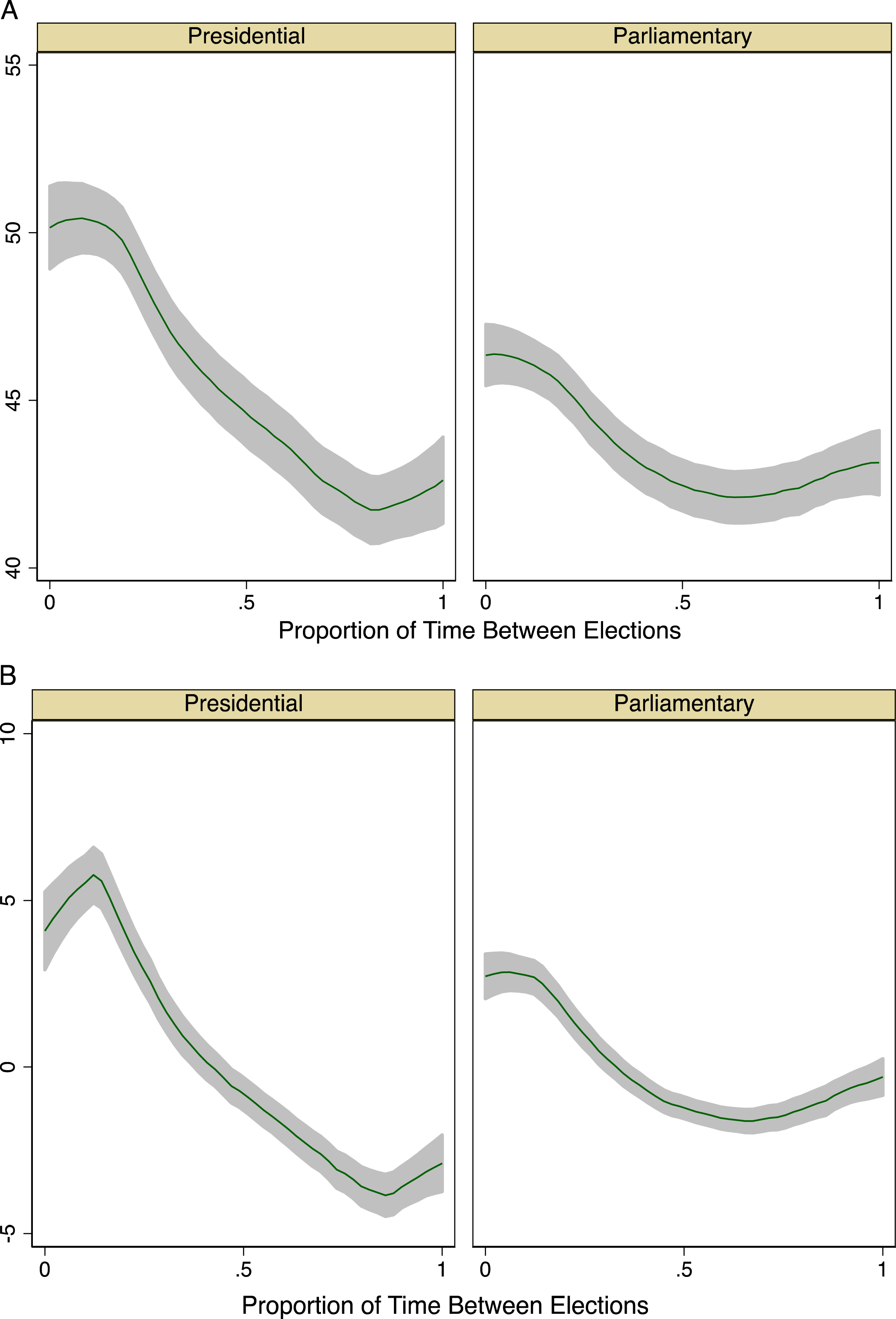
Consistent with our argument that approval dynamics vary by regime, Figure 1(a) displays stark differences in how citizens in parliamentary and presidential regimes evaluate their leaders. Presidents on average enjoy much higher approval ratings following an election—greater honeymoons—than prime ministers. Afterwards, they experience a more substantial drop in approval than parliamentary leaders. As the next election nears, presidents and prime ministers end their terms with roughly similar levels of approval. Cross-regime differences appear in sharper relief in Figure 1(b), which centers the series around the mean level of approval between elections. This controls for baseline support levels and is comparable to adding fixed effects by executive term. 8
We must be careful, however, not to assume that these differences in executive approval dynamics are based on the presidential-parliamentary distinction without controlling for factors deemed to influence popular support which may also vary by regime type. Accordingly, we examine the robustness of these differences by regressing Approval on several additional factors. 9 First, since the economy often influences executives’ job evaluations (Hellwig & Singer, 2023), we include Growth and Inflation, measured annually using the World Development Indicators. Second, to ensure our results are not driven by the degree of political democracy rather than the type of democratic regime, we use the annual Polyarchy score from the Varieties of Democracy dataset (V-Dem).10,11 Since studies link presidents’ gender to approval levels (Carlin et al., 2020; Reyes-Housholder, 2020), and we have no evidence if the same is true for prime ministers, we add a Male leader dummy variable.
Models include a set of indicators to assess electoral cycles. 12 To capture honeymoon dynamics, we include dummy variables for the quarter when an executive election occurs (Election t ) as well as for the two subsequent quarters after the honeymoon (Election t-1 and Election t-2 ) to evaluate the decay of the direct honeymoon effect (Carlin et al., 2018). We also include dummy variables for the two quarters preceding an election (Election t+1 and Election t+2 ) to estimate any end-of-term election campaign effects.
We fit a series of parametric autoregressive distributed lag (ADL) models with random country-level intercepts to address panel heteroskedasticity. Panel unit-root tests reject consistent non-stationarity in the approval, growth, or inflation series. Thus, a panel ADL, equivalent to a general error correction model, is an appropriate specification and we report below mixed-effects models, estimated using OLS with country-level random intercepts. Models using estimators with panel-corrected standard errors or feasible generalized least squares with heteroskedastic consistent errors produce substantially identical results (see Table A3 in the appendix).
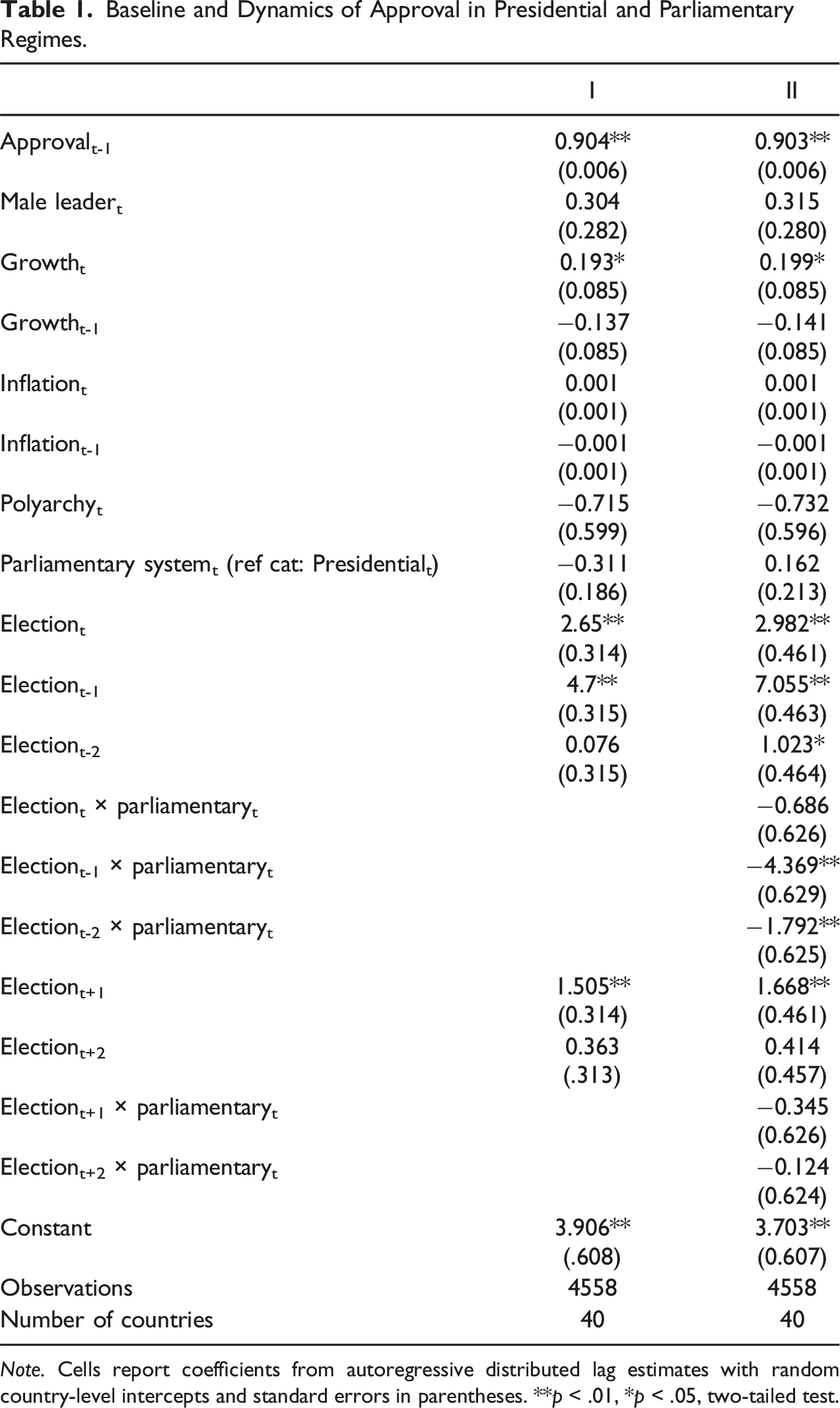
Baseline and Dynamics of Approval in Presidential and Parliamentary Regimes.
Note. Cells report coefficients from autoregressive distributed lag estimates with random country-level intercepts and standard errors in parentheses. **p < .01, *p < .05, two-tailed test.
While the popularity of presidents and prime ministers does not differ on average, H1 and H3 focus, respectively, on starting approval levels and subsequent rates of decay. To test those hypotheses, the model in Column II parametrically evaluates how honeymoons differ between presidential and parliamentary regimes by interacting the election dummies with regime type. Results are consistent with our argument. Parameter estimates on the interaction terms Election t-1 × Parliamentary and Election t-2 × Parliamentary show that executives in presidential regimes tend to enjoy significantly larger honeymoons than their counterparts in parliamentary regimes. Presidents start out more popular than prime ministers, but the coefficient Parliamentary System t is indistinguishable from zero, indicating no difference across regimes in average approval levels over the long run. Presidents thus lose their initial advantage over prime ministers as their support decays more quickly. Finally, with this model we can also test H5. The coefficients on Election t+1 , Election t+2 and their interaction with regime type indicate that leaders in both regimes see their popularity rebound to roughly the same extent, but only in the final quarter of their terms. The null effects on their interaction with regime type suggests their rebounds do not mediffer.
In sum, Table I highlights both similar overall approval patterns for presidential and parliamentary systems and key differences in the ways that leaders experience them. We find strong evidence for two of our hypotheses, as presidents more consistently begin their terms in office with higher levels of approval than prime ministers (H1), and their approval declines more precipitously (H3). However, while we observe modest end-of-term bounces, contrary to (H5) we find no evidence that presidents experience a greater end-of-term bounce than prime ministers.
Unpacking Regime Effects: Personalism, Party Institutionalization, and Alternative Explanations
We now test theoretical expectations regarding two factors that we expect to be responsible for intra-regime differences in approval dynamics: personalism and party system institutionalization.
Personalism
We expect higher levels of personalism lead to more marked honeymoons in presidential compared to parliamentary systems (H2). Measuring electoral personalism within and across regimes is complicated. Certain characteristics of political campaigns (e.g., length, access to televised debates, financing regulations, etc.) may cause personalism to vary across regimes. Unfortunately, there are no comparable over-time measures of campaign characteristics across multiple countries and regime types, inhibiting empirical tests. 13 We therefore evaluate the potential importance of personalist elections by leveraging two related features: the role of first-time relative to re-elected executives, and the role of government type.
First, we argue personalism is higher when electoral institutions incentivize campaigns centered on individual candidates. Such campaigns can give candidates an aura of invincibility, extending their appeal beyond their party supporters and cultivating a sense of hope and expectation that translates into higher initial approval rates. But this exercise in “myth building,” to paraphrase public opinion pioneer Burns Roper (1969; quoted in Mueller, 1970, p. 20), is likely only possible when candidates run for, and win, office the first time. Incumbents running for re-election are known commodities: voters now have a clear sense of their (often tarnished) record and calibrate expectations accordingly. So, if the association between regime type and honeymoon size does indeed stem from a close personal connection between candidates and voters—the kind that facilitates an executive’s initial acclamation as a “providential figure” (O’Donnell, 1994 cited in Linz, 1994, p. 29)—then this effect should be larger for executives who are elected for the first time.
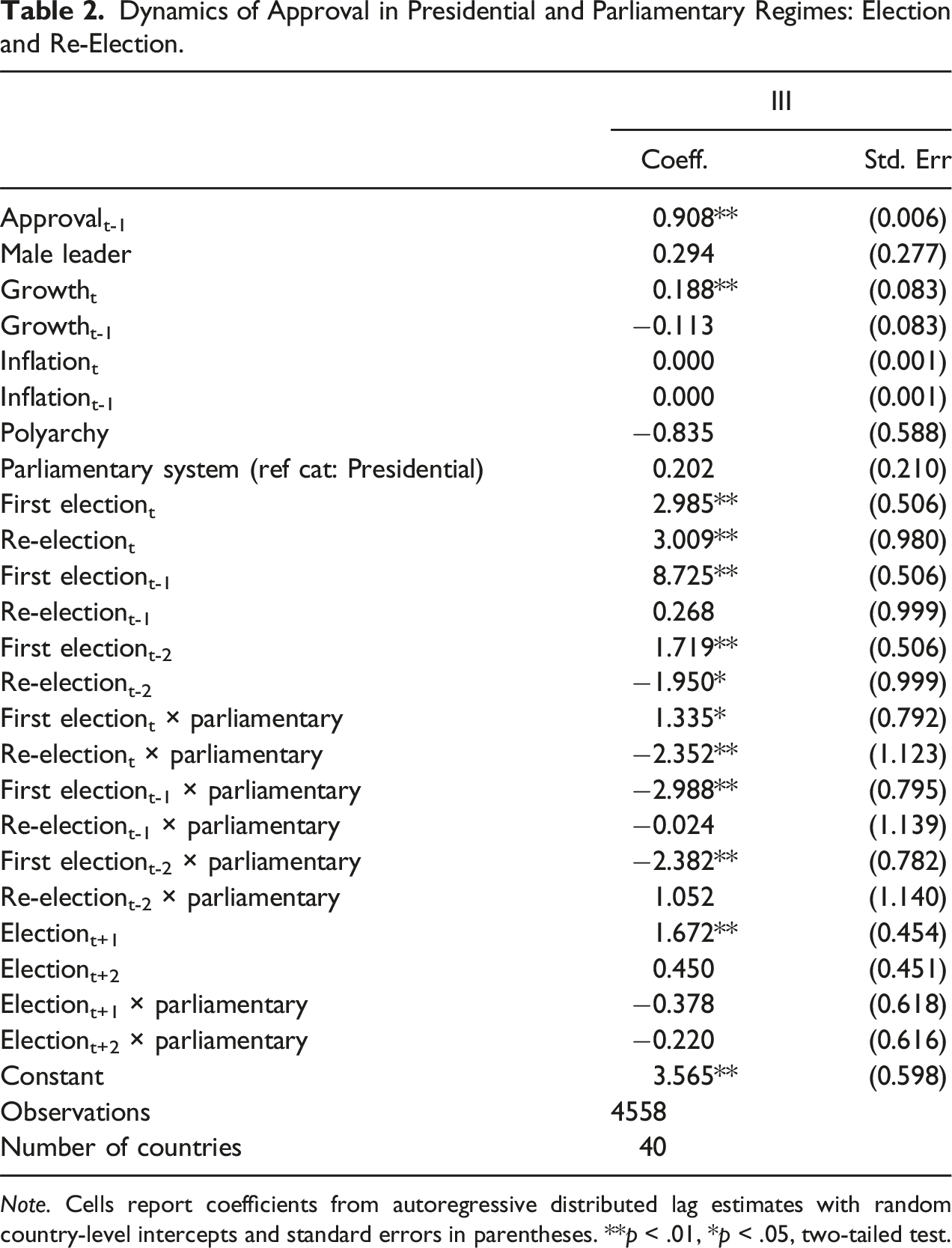
To test the contention that honeymoon effects differ depending on whether the leader is new to the office (or has been out of office for at least one term) or is continuing in office after a successful reelection, we estimate models similar to the ones in Column II in Table 1 but disaggregate election variables into First election and Re-election. 14
Dynamics of Approval in Presidential and Parliamentary Regimes: Election and Re-Election.
Note. Cells report coefficients from autoregressive distributed lag estimates with random country-level intercepts and standard errors in parentheses. **p < .01, *p < .05, two-tailed test.
Because the timing between election and inauguration can differ across countries or within countries across time, as can the length of coalition formation negotiations across governments, it can be misleading to infer substantive differences across regimes from the effect sizes of specific quarters after an election. Thus, Figure 2 displays the total direct effect (total marginal effect) of an election on the executive’s honeymoon by regime and election-type.
16
The findings are generally supportive of H2. For executives elected for the first time, average honeymoon approval, i.e., during the nine months post-election, is significantly higher than average baseline approval, i.e., excluding the honeymoon and two pre-election quarters. Presidents average approximately 13 percentage points higher approval following their first election, whereas prime ministers average about 9 points above the baseline. This four-point gap provides some evidence of the higher cost of ruling facing executives under presidentialism (c.f., Wlezien, 2017). Following a successful reelection, however, neither presidents nor prime ministers can reliably expect to enjoy a honeymoon of any substance. Approval dynamics by regime type and reelection. Note. Panels display model-based mean Approval (total marginal effect) of the election quarter and subsequent two quarters following an election (“honeymoon”) for first Elections and for Reelections versus the rest of each respective term (Baseline). Based on estimates from Table 2, with 90% c.i.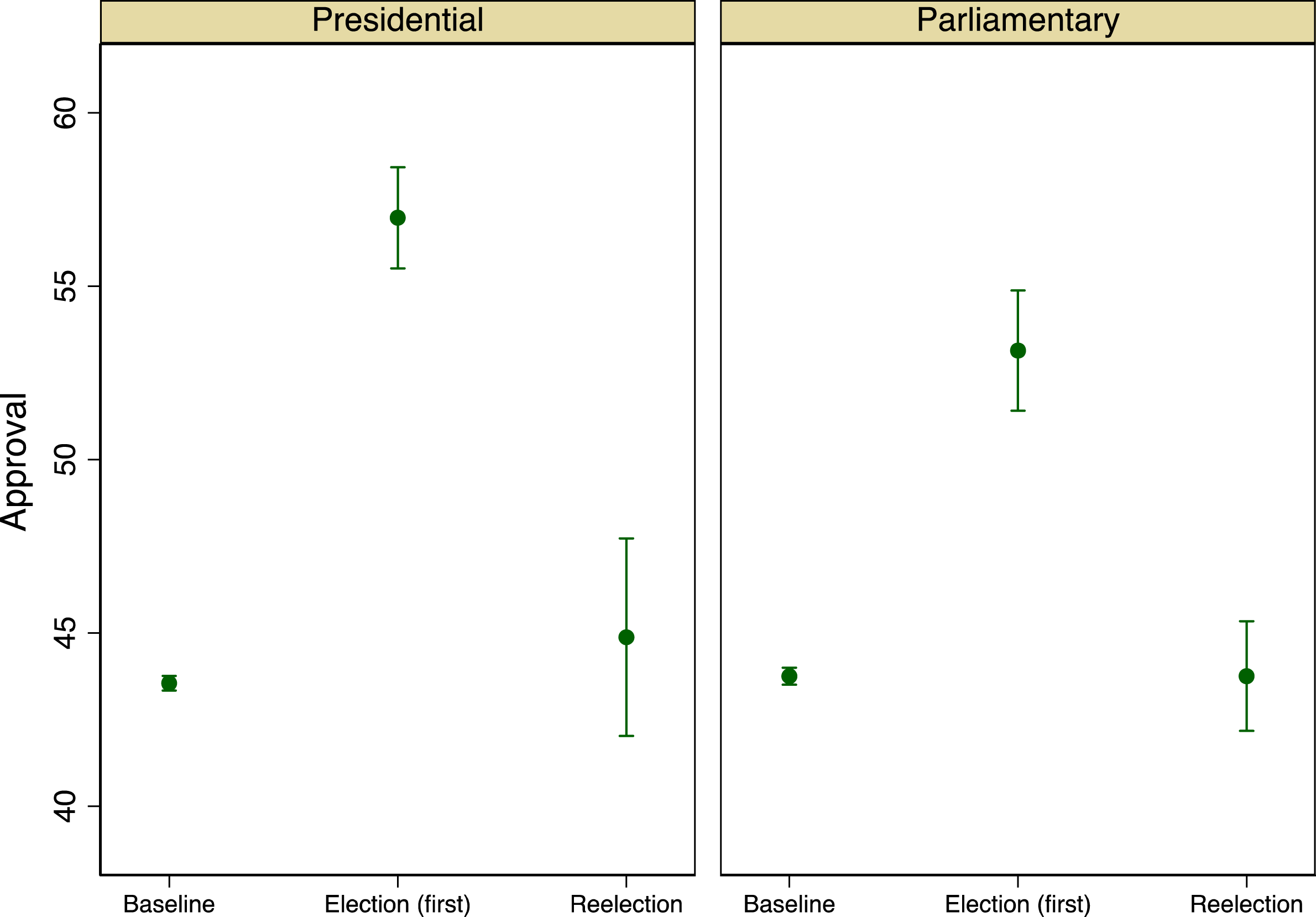
To further probe the relationship between personalism and approval dynamics, we compare single-party majorities to other governments within parliamentary systems. 17 There are good reasons to expect higher electoral personalism in the former and, thus, larger honeymoons for the prime ministers who lead them. Where single-party majority governments are common, parties play a smaller role in government formation, and electoral campaigns tend to center on the candidate for prime minister (see Cross & Young, 2015). By contrast, where single-party majorities are less common, parties must build coalitions. Thus, attention during elections shifts from the attributes of individual candidates for prime minister to the party leaders involved in coalition negotiations (Langer & Sagarzazu, 2018). Elections in such contexts tend to be comparatively less personalized, as campaign messages do not revolve around candidates to head the government (e.g., Holtz-Bacha et al., 2014 comparing the United Kingdom and Germany). 18
Figure 3 reports the total direct effect of first and subsequent elections for single-party majority and other government types across our parliamentary cases. As expected, the effect of elections on PM approval during the nine-month honeymoon period is substantially larger under majority governments than under all other types of parliamentary government. Again, this is true only for first elections. Strikingly, honeymoons for prime ministers leading single-party majority governments are essentially equal in magnitude to the average president’s honeymoon in Figure 2. When parliamentary elections are personalized, the post-election boost in approval ratings approximates approval for a directly-elected first-term president. Moreover, as with presidents, those high ratings quickly revert to baseline levels of popularity, indistinguishable from approval levels under other government types. Approval dynamics by majority and government status: Prime Ministers Only. Note. Panels display model-based mean of Approval (total marginal effect) for executives in parliamentary regimes for the election quarter and subsequent two quarters following an election (by type) and the mean for all but the final two quarters of the term (Baseline). Panels are separated by majority/minority status (rows) and single-party/coalition status (columns). Vertical bars report 90% confidence intervals. Based on models in Table A11 in the online appendix.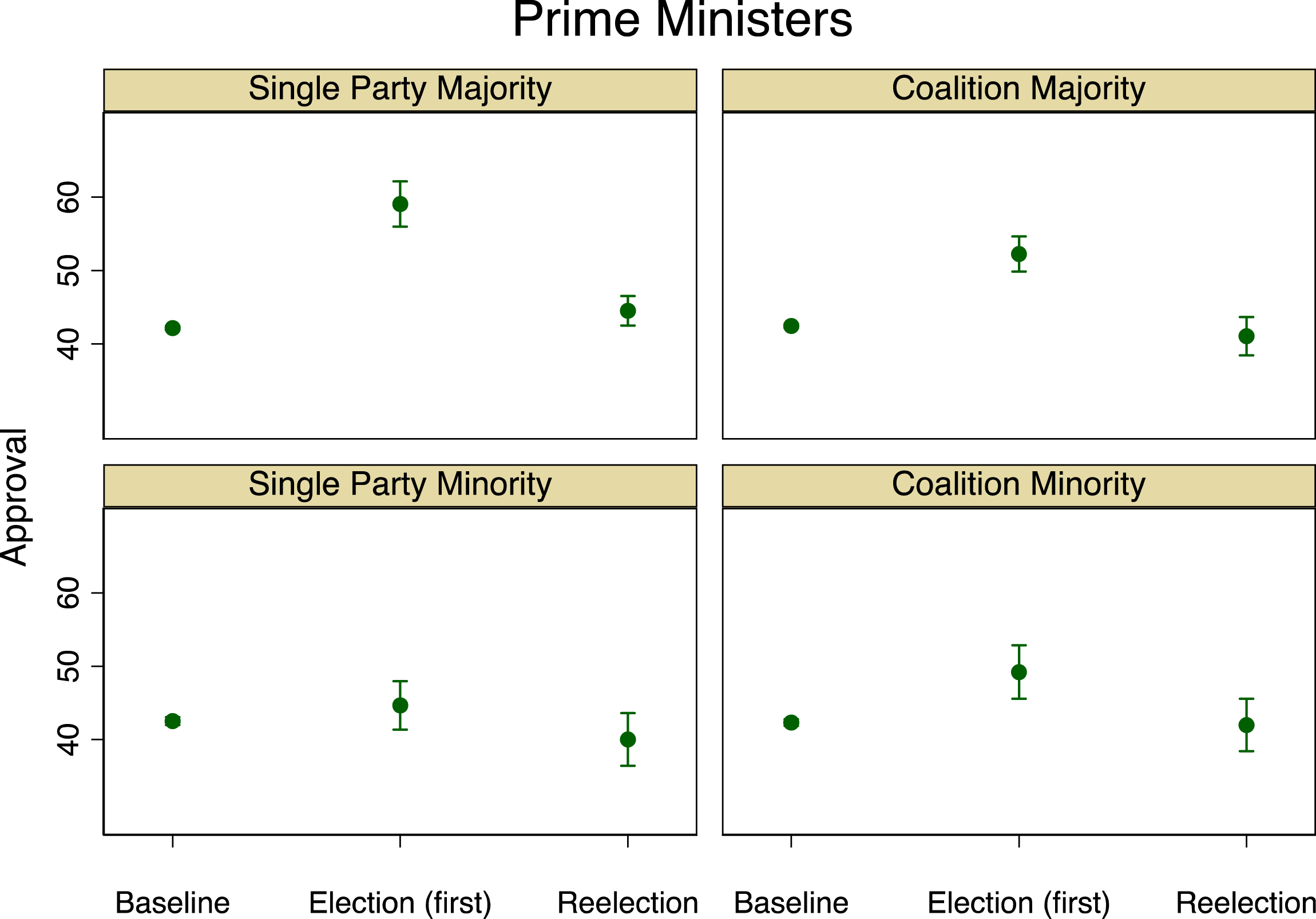
In summary, these results demonstrate how personalism drives executive approval dynamics in two ways. First, executive approval tends to rise most dramatically following the most personalized—first—elections in both presidential and parliamentary regimes. Second, differences between majority and other government types suggest personalization of elections magnifies these dynamics within parliamentary regimes. Although we are limited to testing our argument indirectly, the evidence presented here suggests that honeymoons are at least partially a function of the personalized relationships that direct elections cultivate. Unpacking the effects of first and subsequent elections also provides insight into why we find no support for H5—which draws on research on the cyclical dynamics of approval to posit an end-of-term bump. Namely, any cyclical effects, either across or within regimes, are dwarfed by these “re-election” effects.
Party System Strength
Our second argument is that lower levels of party system institutionalization in presidential systems contribute to greater initial honeymoons and, subsequently, to sharper declines in approval as the executive’s term progresses. If this is the case, we should find (per H4) that differences in approval dynamics between regimes diminish once we account for variations in institutionalization. To assess this proposition, we use a common operational measure of party system institutionalization, electoral volatility. We adopt and update Mainwaring et al.’s (2017) measure of total volatility in votes for parties between national legislative elections. Though distinct, presidential and legislative electoral volatility are linked (Mainwaring et al., 2017), and legislative volatility allows us to compare countries with and without direct elections of the executive. As expected, on average, presidential systems in our sample have substantially higher volatility (mean = 35.43) than parliamentary systems (mean = 14.15), indicating lower party system institutionalization in the former. Overall, parliamentary cases have low volatility with few countries displaying levels of volatility similar to the mean presidential system (see Figure A7 in appendix for histograms of volatility by regime type). 19
To test the claim that cross-regime differences in executive approval dynamics are, in part, a function of electoral volatility, we again turn to a parametric model. To test whether honeymoon bumps are larger in more volatile party systems, we interact electoral volatility and dummy variables for the first three quarters that leaders are in office. We also interact regime type and the post-electoral quarters for first elections and re-elections to see if including party-system institutionalization reduces the unexplained gap between presidential and prime ministerial approval early in the term observed in Figure 2. For efficiency and clarity, we only include one-quarter lags of growth and inflation and exclude interactions between regime type and the pre-election, end-of term dummies (statistically insignificant in Table 1 and in Table A3).
Approval, Elections, and Electoral Volatility in Presidential and Parliamentary Regimes.
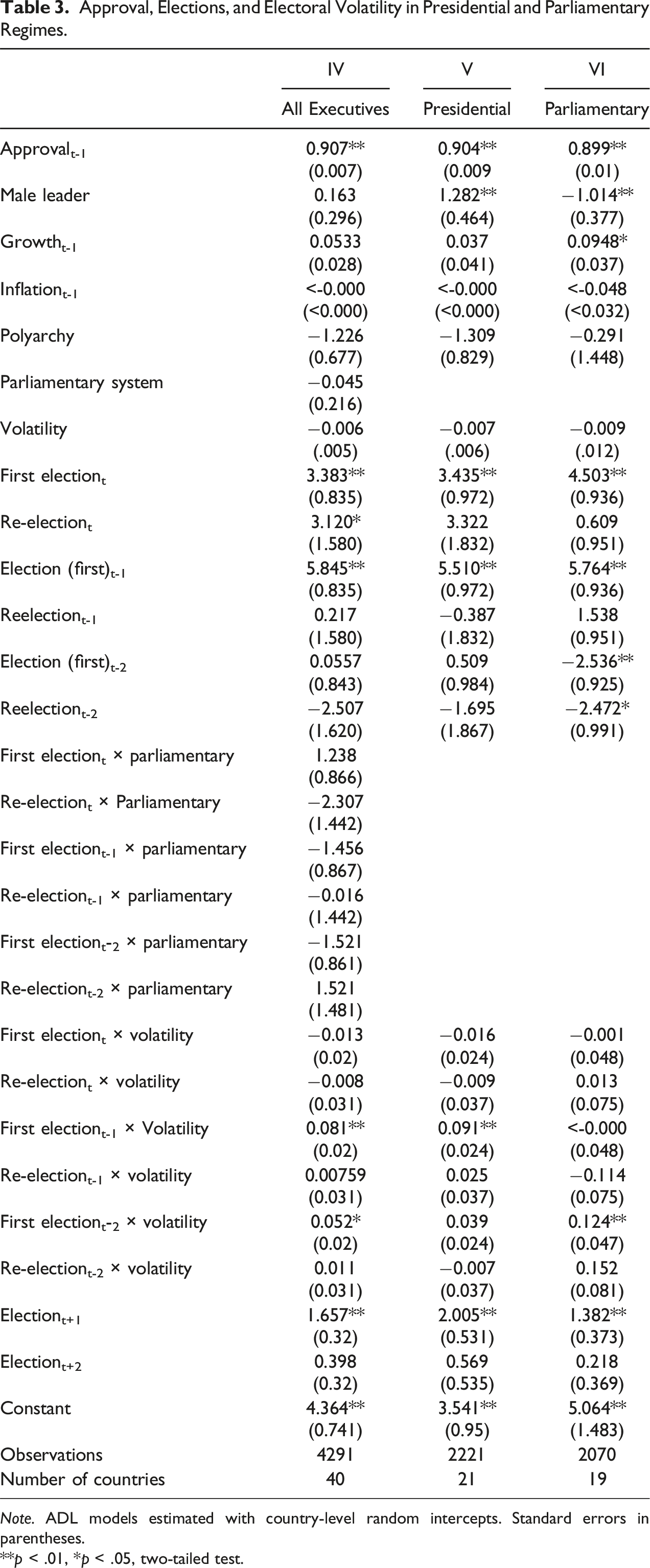
Note. ADL models estimated with country-level random intercepts. Standard errors in parentheses.
**p < .01, *p < .05, two-tailed test.
The role of party system institutionalization is summarized in Figure 4. Comparing average honeymoon effect size across regime types, the discrepancy in honeymoons between first-term presidents and first-term prime ministers observed in Figure 2 disappears when we introduce the interaction with volatility (based on Table 3, Column IV). Again, consistent with our expectations (H4), these results provide evidence that, overall, the differences in approval dynamics in Figure 1(a) and (b) are at least in part a function of party system institutionalization. Once we consider the effects of both volatility and reelection, approval dynamics across presidential and parliamentary systems look similar. Approval dynamics by regime-type and reelection, accounting for volatility. Note. Panels display model-based mean of Approval (total marginal effect) of the election quarter and subsequent two quarters following for first Elections and for Reelections compared to the mean level for the rest of the term (Baseline). Based on estimates from Table 3, Column VI, with 90% c.i. Using the natural log of volatility has no substantive effect, see Figure A5 in the appendix.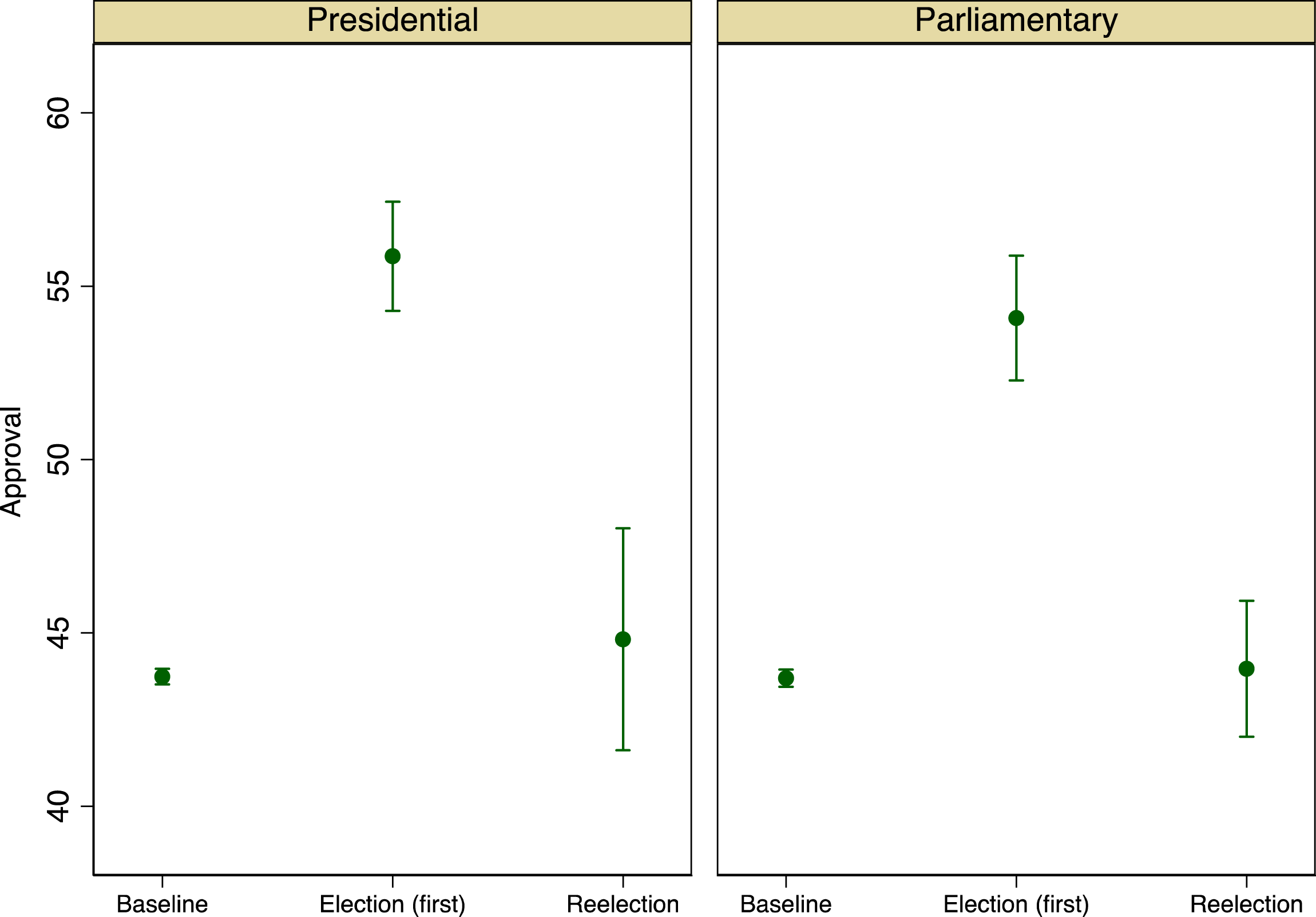
Not all presidential regimes and parliamentary regimes are equal, however, and if party systems shape the public’s reaction to new leaders, we should see differences within regime types as well. Models V and VI examine approval dynamics separately for presidents and prime ministers. Results in Model V confirm that weaker party systems grant presidents greater honeymoons. Results for prime ministers in Model VI show similar effects of volatility, though its conditioning effect attains statistical significance on the second election lag (First election t - 2 × Volatility). Overall, honeymoons for presidents with strong party systems are very similar to those for the average prime minister, while honeymoons for prime ministers with weaker party systems more closely approximate those of the average president.
These results also clarify the implications of the analysis in the previous sections. Table 2 and Figure 3 show approval tends to start higher and fall more following personalist elections. However, once we also consider party system strength, in the form of electoral volatility, we can largely account for the stark approval dynamics observed in Figure 1. Hence, personalism and party system institutionalization go a long way towards understanding the different approval dynamics that presidents and prime ministers enjoy.
Alternative Explanations: Age of Democracy and Unelected Leaders
We assess the strength of our results in several ways. First, since party system institutionalization increases with the age of democracy, we run models including this variable (Mainwaring & Torcal, 2006; Mainwaring & Zoco, 2007). This also allows us to consider Cheibub’s (2007) argument that differences in democratic survival between regime types are not primarily linked to institutions (Linz, 1994) but to the fact that presidentialism occurs in challenging political environments, such as Latin America during the Cold War. Further, if newer democracies are less compatible with democratic survival and less conducive to party building, we should see higher levels of approval and less fluctuation in more established democracies. Our measure is the number of years since a democratic regime change, as indicated by a three-point change in the Polity score. Regression results reveal no evidence that leaders in older democracies reap consistently higher support from the public or enjoy larger or smaller honeymoons (see Table A6 in the appendix). Age of democracy neither conditions the level or dynamics of public support for the executive nor does it alter the differences between presidential and parliamentary regimes.
We also consider whether differences across regime types dissipate when we compare elected and non-elected chief executives. We have argued that differences in approval dynamics between presidential and parliamentary regime are shaped by the ties voters and leaders cultivate during the selection of the chief executive. If this is the case, we might expect distinct approval patterns for executives who reach power via elections and those who do not—whether presidents who assume the office after the death, resignation, or impeachment of their predecessor or prime ministers who follow a resignation or a change in party leadership.
Once again, our expectations differ by regime type. If indirect elections reduce personalism, then approval patterns for prime ministers should vary based on whether they came to power through elections or not. In fact, non-electoral changes in leadership are quite common in parliamentary systems and considered fairly routine by voters. By contrast, high levels of personalism in presidential systems should make differences between directly elected and non-elected presidents more acute. Moreover, given fixed terms, removing a president from office prior to the end of his or her term is rare and can lead to a political or national crisis, facilitating bandwagoning. Indeed, while 16% of parliamentary governments in our sample are headed by leaders not selected following an election, in presidential systems the rate is only 6%.
To assess these implications, we plot local regression curves for presidents and prime minister, separating them by how they came to power. Note that, unlike previous plots, the x-axis here is not time between elections, since non-elected leaders do not arrive in office following elections, but rather marks the time between taking office and leaving it. Results displayed in Figure 5 are consistent with our expectations. In parliamentary regimes, prime ministers whose ascent to power does not follow a general election have approval patterns similar to those who do. Near the end of the term, however, unelected prime ministers seem to maintain slightly higher approval ratings. This might reflect redoubled campaign efforts to legitimize and maintain their power in the upcoming election. Mean-centered approval dynamics by regime type and path to power. Note. Solid lines display report mean-centered approval with 95% confidence intervals for elected executives; dashed lines represent the same for unelected executives. Horizontal axes display proportion of time between executive enters and exists office.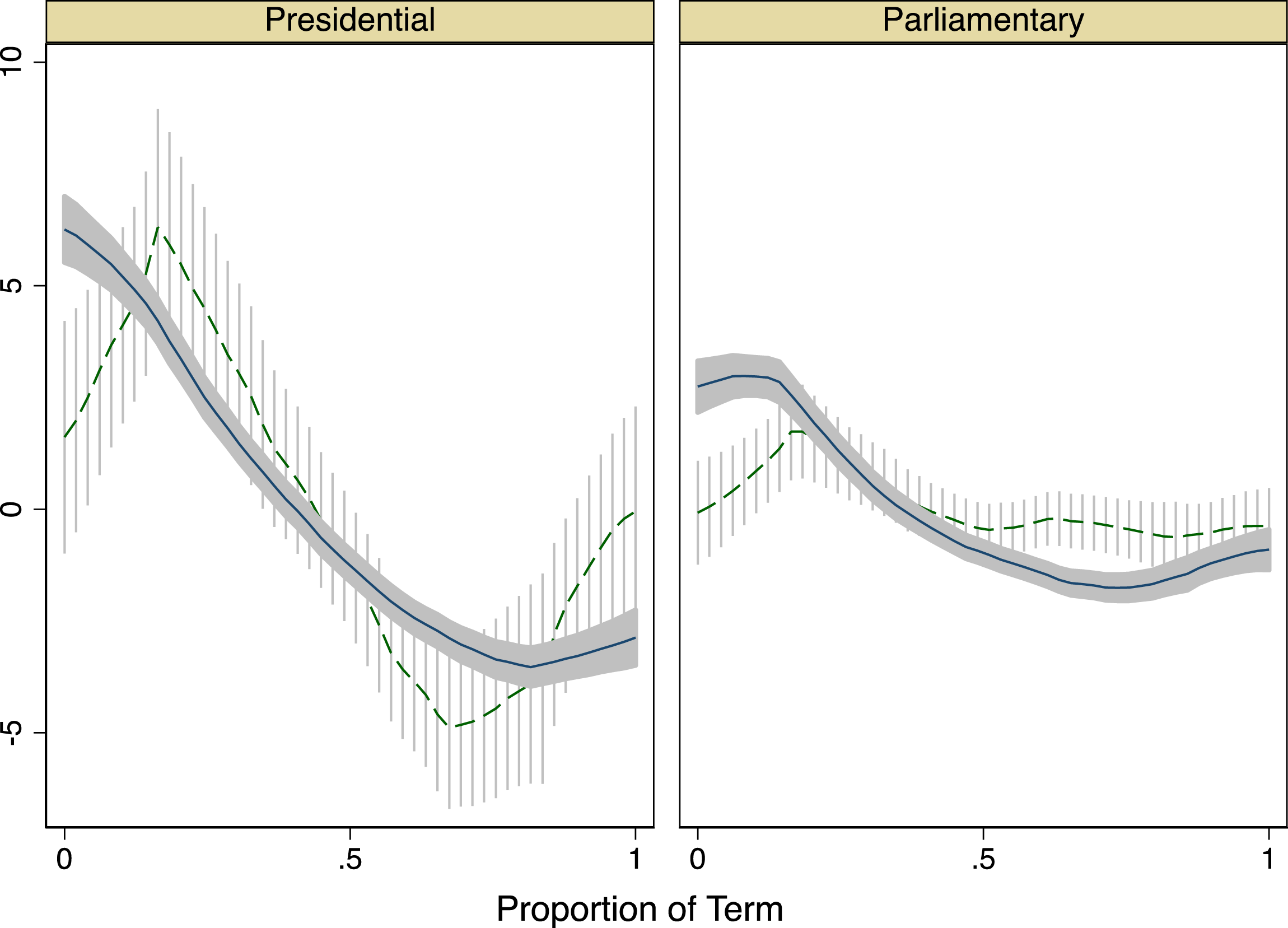
In contrast, differences in approval patterns between elected and unelected presidents are stark. Unelected presidents experience a large honeymoon bounce and a quick collapse before a modest pre-election bounce. The even higher degree of volatility in these cases further suggests that the dynamics of presidential approval are unconstrained by the institutional buffers of parliamentarism. A sharp difference in how unelected leaders in presidential and parliamentary systems are evaluated provides additional evidence that the plebiscitarian link to voters and less intimate leader-party relations encourage the larger honeymoons, more precipitous declines, and the overall greater levels of approval volatility we find in presidential countries.
Conclusion
Over three decades ago, Juan Linz pondered how the choice of constitutional regimes might make the wave of new democracies more sustainable. Numerous studies have assessed many of his arguments, but until now none have rigorously examined Linz’s intuitions regarding executive approval—a proxy for political capital and a leading indicator for instability. Our study illuminates how regime type structures politics by developing and testing theoretical arguments linking differences in executive approval patterns to distinguishing features of presidential and parliamentary regimes.
Our findings underscore the indirect effects of regime type via the incentive structure that characterizes each set of institutions. Direct elections that bring new leaders to power—more frequent under presidentialism lead to greater personalism; the dependence of prime ministers on partisan majorities—a signature of parliamentarism—contributes to party system institutionalization. Notably, these features of political competition have downstream effects on executive approval: presidential approval tends to be higher at the outset of a term but also more volatile, declining more steeply than approval for prime ministers. Personalism and party system institutionalization remain robust predictors of cross-regime differences even after controlling for a range of potential confounders. In short, patterns of public approval are closely linked to differences in methods for selecting and maintaining the executive.
By underlining the importance of these fundamental, regime-defining differences, our findings contribute to long-standing debates about the relative merits of presidential and parliamentary systems—particularly the tradeoff between democratic responsiveness and stability. Presidentialism’s critics decry its poor record of democratic stability (Linz, 1994; disputed, among others, by Hicken et al., 2022); its defenders argue it bolsters responsiveness by endowing an easily identifiable political executive with a mandate (Mainwaring & Shugart, 1997). Parliamentarism, by contrast, is less responsive but compensates with greater stability (Powell, 2000). Our results reflect this tradeoff. Although direct elections grant robust honeymoons for presidents, weaker partisan attachments make public support more fleeting. Conversely, prime ministers have more modest honeymoons, but their support shrinks more gradually over time. Overall, we provide new evidence that, relative to parliamentarism, executive approval dynamics under presidentialism at once reflect greater instability and provide for greater inter-election accountability.
We also demonstrate that as parliamentary regimes assume key characteristics of presidentialism, their approval dynamics approximate those of presidential regimes. Though high levels of personalism and electoral volatility are not typical of parliamentary systems, prime minister approval dynamics in such contexts begin to resemble those under presidentialism. Thus, if the trends that encourage personalism across all democracies continue or accelerate (Frantz et al., 2021; Mezey, 2013; Poguntke & Webb, 2018), we can expect even more candidate-centric campaigns and less-institutionalized party systems in parliamentary democracies and, with these changes, more presidential-like approval patterns. Although we identify factors that make approval dynamics in parliamentary regimes look more “presidential,” we do not uncover factors that make approval in presidential regimes look more “parliamentarian.” Therefore, our findings imply that basic institutional differences across regimes should limit the convergence of approval patterns.
Additionally, our study reveals new insights into what drives approval dynamics. For instance, while honeymoons differ across regimes as expected, the differential is dwarfed by the gap between first-time and re-elected executives in either regime. We, similarly, identify an end-of-term bounce for executives (Carlin et al., 2018; Müller & Louwerse, 2020; Stimson, 1976) but detect no regime differences. We do, however, reveal major regime differences for leaders who assume office outside the “normal” electoral process. The transfer of power to a new prime minister between elections, which happens for around 1 in 6 of the prime ministers in our sample, rarely precipitates a break with “normal” approval dynamics. In contrast, presidents assume office outside elections infrequently (around 1 in 17 in our sample) and typically do so in times of crisis; their initial approval tends to be higher but also declines more sharply, probably because they lack a strong electoral or partisan mandate. So, while we do not dispute the centrality of elections in shaping approval dynamics, our analyses suggest areas open to further theoretical refinement.
Finally, our study points to some important questions for future research. Does greater approval volatility in presidential systems reflect a stronger transmission between events and executive responsiveness (Hellwig & Samuels, 2008)? Can less volatile approval patterns help explain why parliamentarism operates as more of a coordination device, improving a variety of political and socio-economic outcomes (Gerring et al., 2009; see also McManus & Ozkan, 2018)? Answers to these questions can further inform our broader understanding of regime types and governance.
Supplemental Material
Supplemental Material - Executive Approval Dynamics in Presidential and Parliamentary Democratic Regimes
Supplemental Material for Executive Approval Dynamics in Presidential and Parliamentary Democratic Regimes by Cecilia Martínez-Gallardo, Gregory J. Love, Jonathan Hartlyn, Ryan E. Carlin, Timothy Hellwig, and Matthew M. Singer in Comparative Political Studies
Footnotes
Acknowledgments
The authors would like to thank Juan Bogliaccini, Aníbal Pérez-Liñan, Rosario Queirolo, Sarah Shair-Rosenfeld, Mariano Torcal and participants at the Universidad Nacional de San Martín, Universidad de la República, APSA, and WAPOR-LATAM for their comments.
Declaration of Conflicting Interests
The author(s) declared no potential conflicts of interest with respect to the research, authorship, and/or publication of this article.
Funding
The author(s) disclosed receipt of the following financial support for the research, authorship, and/or publication of this article: This work was supported by the Center for Human Rigths and democracy at Georgia State University (Seed Grant), Reckford Professorship at UNC-Chapel Hill.
ORCID iDs

Data Availability Statement
Authors will deposit research data in a data repository that issues a persistent identifier (DOI) and provide link(s) in the final manuscript. Replication data and code (Love et al. (2024)) is deposited in the Comparative Political Studies Dataverse at the Harvard Dataverse Repository. DOI: 10.7910/DVN/VNOSXU.
Supplemental Material
Supplemental material for this article is available online.
Notes
Author Biographies
References
Supplementary Material
Please find the following supplemental material available below.
For Open Access articles published under a Creative Commons License, all supplemental material carries the same license as the article it is associated with.
For non-Open Access articles published, all supplemental material carries a non-exclusive license, and permission requests for re-use of supplemental material or any part of supplemental material shall be sent directly to the copyright owner as specified in the copyright notice associated with the article.
