




Abstract
Recent debates over the relative importance of democracy and state capacity for human development have led to the prevailing view that a strong state must be built before the introduction of democracy. Our research challenges this “sequencing approach” in international development. Using a global panel of countries over 50 years, we document that democracy has a substantial, positive causal effect on state capacity with identification strategies that adjust for pre-treatment dynamics. The state-enhancing effect of democracy is robust to alternative measures of key variables, a large set of time-varying confounders and an instrumental variable design that leverages variation in regional democratic diffusions. Subsequent analysis suggests contestation, rather than participation, as a potential causal mechanism. Our findings contribute to the burgeoning literature on sources of state capacity in the developing world and yield practical implications for democracy assistance.
Introduction
This paper presents evidence from a global panel of countries over 50 years that democracy has a positive and large effect on state capacity, defined as a state’s ability to implement public policies. We also highlight contestation, not participation, as a key mechanism. Our contributions are threefold. First, we establish a state-enhancing role of democracy, which has not received adequate attention from holders of the”sequencing” view in international development (Fukuyama, 2014; Kaplan, 1997). The “sequencing” view prioritizes state-building over democratization as a recipe for human development. Some variants of this view argue that “democratization must wait until there exists not merely an adequate but a well-functioning state – one with capable, impartial institutions and a solid capacity to develop, legislate, and implement effective policies.”(Carothers, 2007: 19) Others are milder, emphasizing the potential “trade-off” and need for “balance” between a strong state and democratic institutions (Fukuyama, 2014). The goal of this study is not to dispute the importance of state capacity for development or quality of democracy. Rather, we empirically document that “democracy can offer a solution to state-related problems,” an effect often overlooked or less emphasized in the “sequencing” claims (Mazzuca and Munck, 2014).
Second, we contribute to an emerging body of research on the sources of state capacity. Extant studies point to many prominent factors, such as interstate rivalry (Tilly, 1990), contentious politics (Slater, 2010) and colonial legacies (Kohli, 2004). In uncovering the essential yet often overlooked importance of democracy for state capacity, we integrate and bring to this literature insights from various strands of research linking institutional reform to political contestation. Studies demonstrate that uncertainty about remaining in office, induced by heightened contestation, often leads to the introduction of institutional changes that reduce opportunities for malfeasance (Geddes, 1994; Grzymala-Busse, 2007; Ramseyer, 1994). In the context of “separation of politics from administration,” a process known as conducive to state-building (Grzymala-Busse, 2007): “They do this not because they are uninterested in controlling the bureaucracy. On the contrary, they would desperately like to. They do it because they do not want ‘their’ agencies to fall under the control of opponents” (Moe, 1990: 125). As a result of “robust competition,” various apolitical state organs or policy reforms aimed at enhancing government efficiency were implemented in Hungary, Lithuania, Poland and Slovenia after their democratic transitions (Grzymala-Busse, 2007). These measures include the introduction of ombudsmen, civil service reforms, securities and exchanges commissions and national accounting offices. Recent studies also trace the political origins of transparency reforms to uncertainty as a byproduct of contestation (Berliner, 2014). Besides creating uncertainty, the sheer intensity of competition among political actors under democracy may help deter official misconducts by moderating incumbent behaviors. Rent seeking opportunities are difficult to exploit in settings with multiple political actors bargaining with each other (Rose-Ackerman, 1999).
Third, we improve upon previous empirical research by utilizing new data and methods to bear on the state–democracy nexus. The only two existing studies that directly examine the effect of democracy on state capacity rely on relatively short panels:
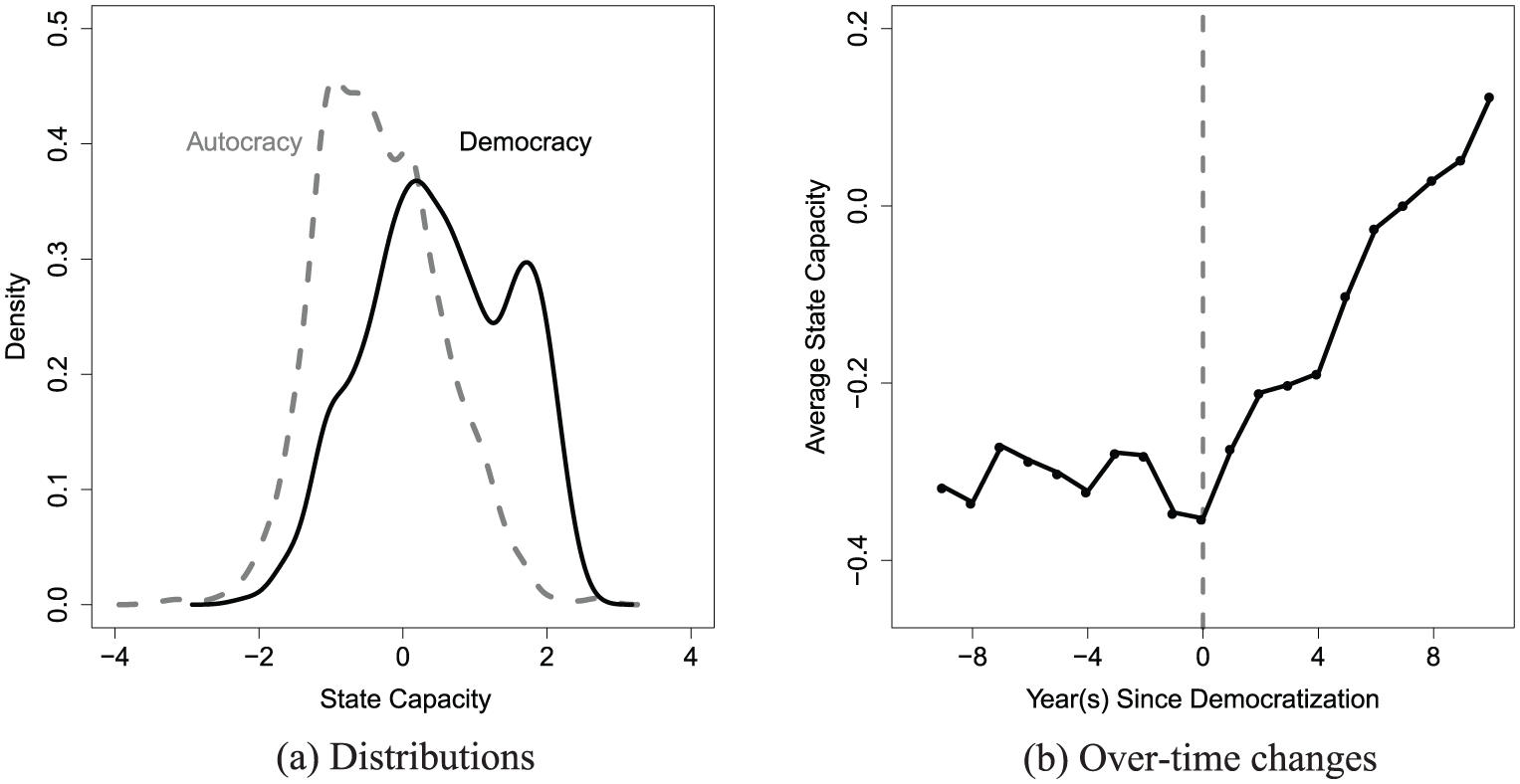
State capacity of autocracies and democracies.
Data
We recognize state capacity as a multi-dimensional concept. As noted in Cingolani et al. (2015), for example, one can consider state capacity as having the following three attributes: extractive; administrative; and coercive. To operationalize state capacity, our empirical analysis adopts both aggregate and disaggregate measures. Our main measure is a composite index developed by Hanson and Sigman (2013). The authors first decompose the concept of state capacity into extractive, administrative and coercive dimensions, similar to the discussion in Cingolani et al. (2015). They then collect 24 existing cross-national indexes that measure any one of these dimensions. When scrutinizing existing indexes, the authors take efforts to ensure that those selected do not “overlap with concepts such as good governance, institutional quality and state autonomy…” (Hanson and Sigman: 2). Online Appendix Table A2 lists the selected indexes. A single, latent variable is then derived from these indexes using Bayesian Markov-chain Monte Carlo analysis. A main advantage of this latent, aggregate measure is that it does justice to the fact that logical functions of the state can be “mutually supportive” (Ottervik, 2013: 10). 2 For example, a state’s administrative capacity often depends upon its fiscal capacity, because it takes stable revenues to support an efficient and professionalized bureaucracy (Schumpeter, 1991; Wang and Hu, 2015). High fiscal capacity, in turn, entails a security apparatus that monopolizes the use of force to maintain compliance of the citizenry. Put simply, these three dimensions work to enhance one another. The resulting measure, Capacity, covers up to 174 countries for a period from 1960 to 2009. Such broad spatial and temporal coverage allows us to exploit variations across countries and over time when identifying democracy’s effect.
To verify our results at a more disaggregated level, we utilize three additional measures with similarly broad coverages, each of which corresponds with one of the three dimensions of state capacity. These three measures are: Relative Political Capacity (RPC); public sector corruption; and logged personnel per capita. Developed by Kugler and Tammen (2012), RPC computes the ratio between actual level and expected level of taxation as a function of several ecnonomic variables for each country-year. It thus captures the extractive dimension of state capacity. Public sector corruption taken from the V-Dem database (Coppedge et al., 2016) is a measure based on country experts’ coding of corruption among public servants. We use it to measure administrative capacity. Logged military personnel per capita in the Correlates of War database proxies coercive capacity. We employ the binary measure of democracy developed by Boix, Miller and Rosato (Boix et al., 2013) (hereafter, BMR). 3
In Figure 1 we present descriptive evidence across countries and over time for democracy’s state-enhancing role. The density plot in the left panel shows that democracies on average have higher state capacity than autocracies, pooling across country-years. The time-series plot in the right panel displays an over-time increase in state capacity after democratization. Interestingly, state capacity also appears to decline prior to democratization. This pre-transition dip in state capacity demands more explicit solutions, which we do below.
Identification strategies and results
Our main estimation takes the following form:

where for each country
Main results
Figure 2 reports the point estimates and 95% confidence intervals from Models 1–7, each of which uses a different combination of control variables in

Effect of democracy on state capacity.
Robustness checks
We obtain consistent results in an extensive set of robustness checks, such as alternative democracy measures (Online Appendix Table A6), 7 alternative number of lagged terms for the dependent variable (Online Appendix Table A5), generalized methods of moment estimations (Online Appendix Table A7), controlling for historical “stocks” of state capacity or democracy (Online Appendix Table A13), alternative ways of capturing long-term effects (Online Appendix Table A12), etc. We also examine the dynamic effect of democratization in a “leads-and-lags” fasion, where the coefficients on the “leads” are used as placebo results. In other words, we check if democracy’s “effect” was already present before democratization. Such presence would imply the existence of omitted variables that are driving our results. As shown in Online Appendix Figure A5, there is no effect of democracy before democratization and democracy’s effect only takes place after democratization, thus further validating our identification strategy. The results are also similar when we exclude from our sample countries that have always been democracies throughout the time period and/or countries that were democratized after 1991 in our analysis (Online Appendix Table A11).
Alternative measures
We employ three alternative measures of state capacity discussed previously and report the results in Table 1. The first two measures are standardized within the sample. Democracy appears to significantly enhance the extractive and administrative dimensions of state capacity via a positive effect on RPC and a negative effect on public sector corruption. These results are in line with our theoretical expectation based on the link between political contestation and institutional reforms (Grzymala-Busse, 2007). As this mechanism mainly improves government efficiency, democracy’s effect is more likely to show up in the extractive and administrative dimensions. Later we will examine this mechanism more closely. On the other hand, democracy seems to decrease logged military personnel per capita in columns (3) and (6) of Table 1. This result confirms the argument in Fukuyama (2007) that democratization might reduce coercive capacity at least in the short run. 8
Alternative state capacity measures.

Note: standard errors are in parentheses. They are produced by block (country-level) bootstrap of 1,000 times. Country and year fixed effects, as well as two lag terms of the outcome variable, are controlled for in all the regressions. *** and ** represent statistical significance at the 1% and 5% levels, respectively.
Instrumental variable
Next, we exploit regional democratic diffusion in an instrumental variable (IV) analysis. Empirical studies have identified democratic diffusion as an important and robust source of domestic democratization (Brinks and Coppedge, 2006). Scholars have recently begun to use regional democratic diffusions to instrument for democracy when examining democracy’s effect on developmental outcomes (Acemoglu et al., in press; Miller, 2015a; Stasavage, 2005), whose footsteps we follow in this section. For each country-year in our dataset, we use the share of democracies in that country’s region (the country itself excluded) to instrument for the country’s democracy. The IV is likely to be valid because state capacity of one country should have little direct relationship with other countries’ regime type in the same region. Its neighbors’ regime type may only affect the country’s state capacity indirectly by inducing regime change in that country as well. Furthermore, since our IV is spatially-motivated, we also include a “spatial lag” as a robustness check, which are defined as weighted averages of state capacity at
Results from two-stage-leaset-squares.

Note: robust standard error clustered at the country level are in parentheses. Two lags of the outcome variable, as well as country and year fixed effects, are controlled for in all four regressions. *** and ** represent statistical significance at the 1% and 5% levels, respectively.
Potential mechanisms
Finally, we explore two possible mechanisms underlying democracy’s effect on state capacity. In the left panel of Figure 3, we plot our main measure of state capacity against a political contestation index developed in Miller (2015b), with triangles and circles denoting democratic and autocratic country-years, respectively. The clustered pattern shows that democracy is associated with higher political contestation and the LOESS line indicates that political contestation is in turn postively associated with state capacity. On the right panel, we plot state capacity against a political participation index from the same source. We see that the state capacity measure starts to increase after the participation index surpasses 0.5. However, the political participation variable cannot fully separate democracies and autocracies – there are plenty of autocratic country-year observations that show high level of political participation as democracies – which indicates that increasing political participation may not be the channel through which democratic institutions enhance state capacity. 11

Contestation, participation and state capacity: (a) contestation and state capacity; and (b) participation and state capacity.
Conclusion
With identification strategies that adjust for past outcomes and exploit IV designs, we document that democracy may have a substantial, positive causal effect on state capacity. Subsequent analysis provides suggestive evidence that heightened political contestation following democratization may be a potential mechanism driving this effect. These findings have implications for practitioners of democracy assistance as they challenge the “sequencing” view in international development. By “bringing democratic politics back in,” they also shed new empirical light on the forces underpinning competent states in the developing world.
Supplemental Material
rp_submission_anonymized_appendix_(1) – Supplemental material for Awakening Leviathan: The effect of democracy on state capacity
Supplemental material, rp_submission_anonymized_appendix_(1) for Awakening Leviathan: The effect of democracy on state capacity by Erik H. Wang and Yiqing Xu in Research and Politics
Footnotes
Acknowledgements
The authors are deeply grateful to Jonathan Hanson and Rachel Sigman for sharing with us their data. We also thank Faisal Ahmed, Meir Alkon, Carles Boix, Shuo Chen, Orlandrew Danzell, Christian Fong, Jason Q. Guo, Nan Li, Hanzhang Liu, Michael Miller, Stephen Monroe, Grigore Pop-eleches, Maryna Povitkina, Xander Slaski, Diana Stanescu, Shiping Tang, Daniel Treisman, Rory Truex, Leonard Wantchekon, Jon Whooley, Matthew Wilson, Juana Xu, Changdong Zhang, Brigitte Zimmerman, and Xufeng Zhu for comments and feedback. The paper was previously presented at the Southern Political Science Association Annual Meeting, Princeton Pizza and Politics Seminar, Midwest Political Science Association Annual Meeting, Research Seminar at Tsinghua University School of Public Policy and Management, and Fudan University Political Science and Economics Joint Workshop.
Declaration of Conflicting Interests
The author(s) declared no potential conflicts of interest with respect to the research, authorship, and/or publication of this article.
Funding
The author(s) received no financial support for the research, authorship, and/or publication of this article.
Supplementary Material
The supplementary files are available at http://journals.sagepub.com/doi/suppl/10.1177/2053168018772398. The replication files are available at: 
Notes
Carnegie Corporation of New York Grant
This publication was made possible (in part) by a grant from Carnegie Corporation of New York. The statements made and views expressed are solely the responsibility of the author.
References
Supplementary Material
Please find the following supplemental material available below.
For Open Access articles published under a Creative Commons License, all supplemental material carries the same license as the article it is associated with.
For non-Open Access articles published, all supplemental material carries a non-exclusive license, and permission requests for re-use of supplemental material or any part of supplemental material shall be sent directly to the copyright owner as specified in the copyright notice associated with the article.
