




Abstract
How does information about the presence of foreign financing in a development project change people’s perceptions of that project? Using an informational experiment in Bangladesh, we find that information about US financing of a specific development intervention sends a positive signal about project quality; this effect is concentrated among individuals who are the least likely to have been exposed to the information ex ante. The information does not change the already high demand for foreign aid but does help citizens target their demands toward the existing donor. That foreign funding can be a signal of project quality helps explain an existing finding in the literature that individuals prefer foreign aid projects to government projects.
Foreign-funded development projects are common in many developing countries. Governments use money obtained from bilateral or multilateral donors to build roads, schools, or irrigation systems. International non-governmental organizations (INGOs) use donor funds or privately-raised funds to train health workers or provide microloans. Local non-governmental organizations (NGOs) receive external funding from foreign governments or INGOs to undertake livelihood training or manage local water sources.
Increasingly, foreign aid donors undertake aggressive branding strategies to spread information about their role in local development projects (see the discussion in Dietrich et al., Forthcoming). It is not obvious, however, that citizens absorb this information (Baldwin and Winters, 2016; Cruz and Schneider, 2017; Dietrich et al., Forthcoming; Guiteras and Mobarak, 2014); nor is it clear how this information influences how citizens perceive and choose to interact with development projects. A recent set of studies is helping to build up our knowledge base (Baldwin and Winters, 2016; Dietrich et al., Forthcoming; Dietrich and Winters, 2015; Dolan, 2016; Findley et al., 2017; Findley et al., Forthcoming; Milner et al., 2016).
Milner et al. (2016) and Findley et al. (2017) use data from a nationally-representative survey in Uganda to show that Ugandan citizens prefer foreign-funded development projects over projects that the authors assume citizens identify as government-funded. 1 They find that this preference is particularly pronounced among individuals who do not support the national ruling party and who perceive corruption to be significant within the government. Based on these findings, the authors claim that citizens support foreign-funded projects because they view them as likely to perform better as they are more impartially implemented (see also Baldwin and Winters, 2016).
We conduct an information experiment in which we describe an existing development intervention to a nationally-representative sample of Bangladeshi citizens. For a random subset of our respondents, we provided information – through visual cues, direct information, and questions related to the information – that the intervention was supported with US funding. The treatment did not contain any reference to better performance. When comparing how respondents assessed performance across the treatment and control groups, we can be confident that any differences in perceived project quality result from respondents evaluating information about foreign funding.
If information about foreign funding has a positive effect on perceptions of project performance, this might tell us that individuals, in general, perceive foreign aid as more effective than government programs (as argued by Milner et al., 2016). It might also suggest that donor branding has positive externalities insofar as branding encourages individuals to engage with development interventions.
In line with the existing literature, we find that respondents who have received information about foreign funding believed the project was performing better. These treatment effects are concentrated among individuals who do not have previous experience with the project. The treatment did not encourage respondents to say that Bangladesh should seek foreign aid for expansion of the intervention. Indeed, the vast majority of respondents in both treatment and control conditions supported the government’s pursuit of foreign aid. The information, however, did help respondents focus on the existing donor when identifying a foreign source from which Bangladesh should seek financing.
Research design
In September 2014, we conducted a nationally-representative, face-to-face household survey of 2294 Bangladeshis recruited from 55 sub-districts (upazila) across the seven divisions of Bangladesh. 2 After two initial questions about important policy issues and the current state of affairs in Bangladesh, all respondents watched a one-minute video about the Smiling Sun Clinics, a nationwide network of health clinics that have been partially funded by the US Agency for International Development (USAID) since the late 1990s. Before beginning the video, we asked respondents if they were familiar with the clinics and if they, a family member, or a close friend had ever been to one of the clinics.
In the control version of the survey, the video featured a strip at the bottom with the Smiling Sun logo and name. In the treatment version of the survey, this strip was replaced with one featuring the USAID/Bangladesh logo and the conventional USAID tagline (written in Bangla), “On behalf of the American people.” Immediately following the videos, we asked respondents an open-ended question about where “most of the financial assistance for the Smiling Sun Clinics” had come from. Among the treatment group that had seen the USAID-branded video, one quarter of respondents said that the United States had provided the funding, while another 3% stated generically that it was foreign aid. The modal response – provided by 69% of respondents – was that they did not know where the funding came from. In the control group, 1 out of 10 respondents said that the United States provided the funding. Among previous users in the control group, this proportion was as high as one in four. Like the treatment group, 4% of control-group respondents named generic “foreign aid” as the source of funding, and the modal response – 81% of the control group – was that they did not know. In both groups, only 3% of respondents attributed the program to the government.
Assuming that not everyone in the treatment group would observe or correctly interpret the USAID banner on the video, we structured the intervention such that, after showing the video to the respondents, our enumerators directly told respondents that the Smiling Sun Clinics are partially funded by the United States:
Since 2007, the United States has been giving assistance to build Smiling Sun Clinics in Bangladesh. The funds have been provided through USAID. The United States has provided more than 4,500 million taka [US$57 million] in support of the Smiling Sun Clinics.
The respondents who received this information were then asked if they knew why the United States was providing the funding and whether they thought it was a good idea for Bangladesh to accept money from the United States. We did not ask an additional question to see if those respondents who had not observed the USAID banner in the video had updated their beliefs about the origins of Smiling Sun Clinic funding after the direct information. Table 1 depicts the three stages of the treatment in the context of the survey.
Schematic of Survey with Informational Treatments. SSC = Smiling Sun Clinic.

For our main outcome variable, we asked respondents in both the control and treatment conditions, “Do you think that the Smiling Sun Clinics have been successful in providing health care to the poorest people in Bangladesh?” Answers were recorded as simple yes or no responses.
Subsequently, we asked all respondents, “If the government wants to expand the Smiling Sun Clinics, in your opinion, what is the best way for the government to finance this expansion?” Respondents could choose from the following responses: that the government should (1) impose new taxes and fees, (2) get money from foreign countries, (3) inspire NGOs to open clinics, or (4) not increase the number of Smiling Sun Clinics.
Regardless of a respondent’s answer to the question above, we then asked, “If the government invites a foreign donor or international organization to support the Smiling Sun Clinics, which of the following would you most prefer?” Respondents could choose from the Asian Development Bank, China, India, Japan, the United Kingdom, the United States, and the World Bank.
Results
As Table A1 in the appendix shows, there were no statistically significant differences on basic socio-demographic variables or background experience variables between respondents exposed to the two versions of the survey. Almost half of the sample said that they were familiar with the Smiling Sun Clinics, and a substantial proportion of respondents – just above 15% – said that they or someone in their family had used a Smiling Sun Clinic. As we described above, about 10% of the control group correctly said that the United States had provided funding for the clinics. Within the control group, therefore, we know that there is “non-compliance” that might bias against observing effects. We report intention-to-treat results.
In Table 2, we present the results for the perceptions of project success variable. The first column reveals that respondents in the treatment group (i.e., those who watched the US-branded video and who were told about and asked to consider US funding for the Smiling Sun Clinics) were 10 percentage points more likely to say that the project was successful in fulfilling its anti-poverty mission. This is a remarkable result. By virtue of random assignment, respondents in the control and treatment conditions were equally likely to have previously used the clinics (16% of our respondents) or to say that they were previously aware of the clinics (48% of our respondents, including those who said that they were previous users). They both watched a one-minute video with the same content about the clinics. The difference between the two groups was that the treatment group saw the USAID branding during the video and was given information about US funding flows to the clinics. Yet respondents in this group expressed significantly more confidence that the Smiling Sun Clinics were performing well.
Perceptions of project success. p-values from difference-in-proportions tests.

In the next two columns of Table 2, we compare the results for those who had previously used the clinics and those who have not (but who may have been aware of them). Among previous users, there were very strong beliefs that the Smiling Sun Clinics were performing well: 96% of these respondents said that was the case. Insofar as we see a difference between the treatment and control conditions, it is in the same direction as in the overall sample, with those in the treatment condition being additionally likely to have said that the clinics are successful. Given the small treatment effect, this difference is not statistically significant at conventional levels. Among respondents who have not previously used the clinics, we see a statistically significant 12 percentage-point difference in perceptions of project success. In the final two columns, we show the treatment effects for respondents who were previously aware of the clinics but did not report using them as well as for respondents who were not at all previously aware. We find the largest treatment effect – 14 percentage points – among respondents who said that they were not previously familiar with the clinics. But even among those who had some awareness of – but no personal interactions with – the clinics, the treatment had a relatively large 9 percentage-point effect on perceptions of performance.
That the results vary by the respondents’ prior levels of awareness of the clinics is not surprising. Those who had personal experience with the clinics appear to have had very positive perceptions of the clinics: as compared to non-previous users, this group was 22 percentage points more likely in the control condition to say that the clinics were successful (p < 0.01). It would have been hard for the information about US funding to have improved their perceptions further (although the point estimate is positive). Those who were aware of the clinics but had not previously used them also expressed generally positive attitudes about the clinics in the control group but significantly more positive attitudes in the treatment condition. And those who had neither previous experience with nor awareness of the clinics expressed the lowest levels of confidence in the clinics in the control condition (63%), such that we find the largest treatment effect among this group.
The information about US funding did not drive respondents to believe that the Bangladeshi government should seek foreign funding if it wished to expand the clinics. As Table 3 shows, in the overall sample, slightly more than three-quarters of respondents in both the treatment and control conditions believed that the government should pursue foreign aid to finance an expansion of the clinic program. This generally positive attitude toward foreign aid is in line with the findings in the work of Milner et al. (2016) in Uganda.
Desire to use foreign aid to finance program expansion. p-values from difference-in-proportions tests.
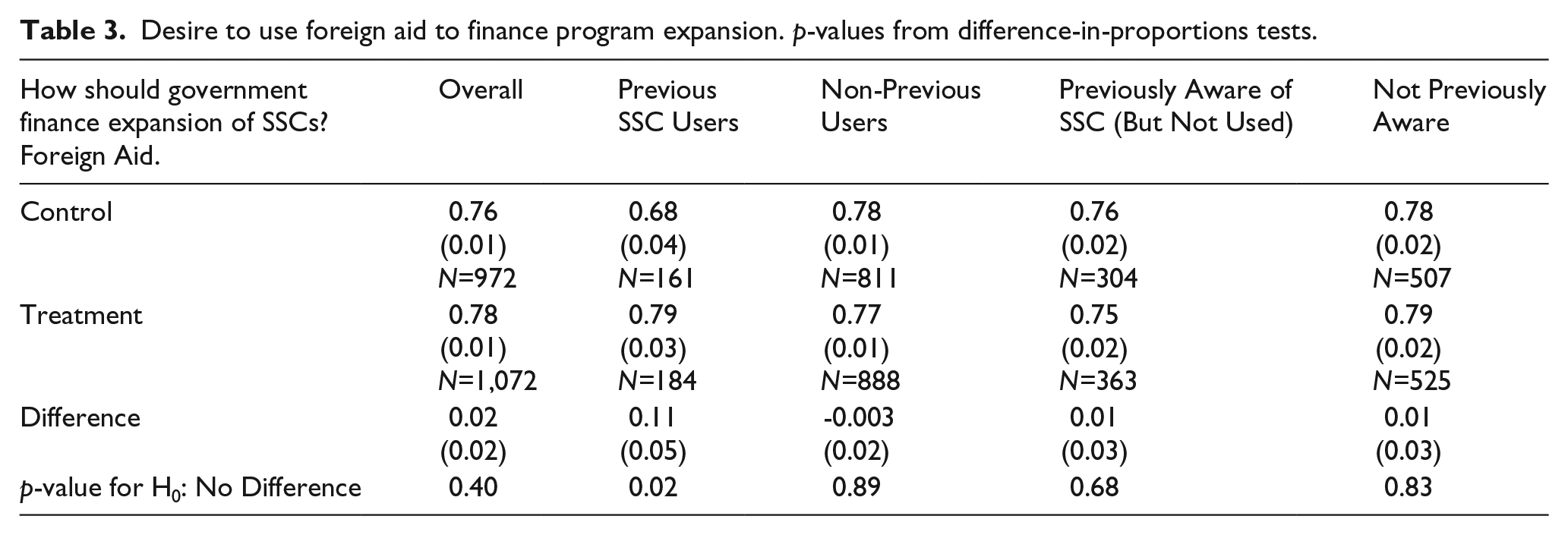
We note one exception to this result: previous users in the control group were 9 percentage points less likely than non-previous users in the control group to believe that foreign aid should be used to finance the expansion of the Smiling Sun Clinics (p < 0.02). These respondents were more likely than other respondents to say that the clinics should be expanded using tax and fee revenue (14% versus 7%, p < 0.01). This may be because they thought of the Smiling Sun Clinics as a government program. When informed about US funding, the preferences of previous users in the treatment group fell in line with the rest of the sample: more than three-quarters said that the government should pursue foreign aid to finance expansion. The treatment effect is statistically significant.
Although the information about US financing did not make Bangladeshis more likely on average to say that the government should pursue foreign funding for the Smiling Sun Clinics, it did help them coordinate their expectations on asking the existing donor. As can be seen in Table 4, in both the overall data and across the various subgroups at which we have looked, the treatment made respondents more likely to say that the Bangladeshi government should appeal to the United States if it was going to appeal to a foreign donor. In both the treatment and control conditions, after the United States, the most popular sources of foreign aid were the World Bank, the Asian Development Bank, Japan, India, China, and the United Kingdom.
Desire to seek additional financing from United States. p-values from difference-in-proportions tests.

Discussion
We showed a one-minute video about the Smiling Sun Clinics, a nationwide system of health clinics that provide services to women and children from impoverished households, to a representative sample of Bangladeshi citizens. For a random subset of respondents, the video was branded with the USAID/Bangladesh logo. We additionally informed these respondents about US funding for the network of health clinics and asked them to consider why the United States was giving money to Bangladesh and whether it was a good or a bad thing. We did not, however, give these individuals direct information about the performance of the clinics. Nonetheless, relative to a control group that we did not inform about US funding, we find that those respondents who received information about the US role in the project described the Smiling Sun Clinics as more successful. These effects are particularly concentrated among individuals who either were not previously aware of the clinics or who were aware of them but had not previously used them.
That information about foreign funding serves as such a powerful cue of project quality is remarkable. While our survey lacks the diagnostic questions to understand exactly what the presence of foreign funding signaled to these respondents (e.g., freedom from corruption, higher quality supplies, better-trained staff), the evidence shows that people are updating their overall opinions of the project in response to our informational intervention.
As Milner et al. (2016) suggest about their results in Uganda, we can read our findings as evidence that individuals in Bangladesh generally perceive US foreign aid to be effective. If the opposite were true (i.e., that Bangladeshis perceived US foreign aid to be ineffective), we would expect people to reduce their expectations of Smiling Sun Clinic performance when hearing about the US role in financing the intervention. Whether these perceptions are based on empirical experience with and comparisons between accurately-identified US-funded and government-funded projects or rather a vaguer perception of foreign things being good is a question worthy of further exploration.
Likewise, whether or not we would see similar results for projects funded by other donors or occurring in other sectors also remains an open question. For instance, it is possible to imagine that some foreign donors in some contexts might develop a reputation for low-quality projects, in which case we would not expect to identify the same effects. Or it might be the case that citizens are less likely to draw inferences about quality from information about foreign funding in some sectors (e.g., if the United States were to fund police training, it might not be the case that citizens automatically viewed the police as higher quality).
We can perhaps gain some insight into this by looking at the 80% of our respondents who described health care as a “very important” issue. Among this subset of respondents, we observe a 12 percentage-point difference between the treatment and control conditions in the probability of saying the Smiling Sun Clinics were successful. For other respondents – those who said that health care was “unimportant” or “somewhat important” – the treatment effect is half as large and not statistically significant. This might suggest that our results are driven by public concerns about the government-run healthcare system. 3
If our finding is representative of what we might expect of foreign aid from different donors in a variety of sectors, our results can be taken as indicating a possible benefit of foreign aid branding. Although Dietrich et al. (Forthcoming) argue that relatively few individuals receive the message being sent by the USAID brand, our results suggest that when people do receive this information, they might be more likely to actively engage with development interventions that will theoretically benefit them. 4 If this is the case, then donor branding – even if its goal is to realize diplomatic outcomes (as argued in Dietrich et al., Forthcoming) – might actually help development projects meet their development goals. On those grounds, the practice perhaps should perhaps be encouraged, although we worry about the implications for long-term sustainability (i.e., ideally, local services will be provided by domestic governments in the long-term and people will embrace using them even though they are coming from domestic governments).
As most of the respondents in our sample already are quite positive about foreign aid – three-quarters of them support the government seeking out foreign aid if it wants to expand the Smiling Sun Clinics program – we do not find overall effects of the informational treatment on demand for foreign aid, although we do find effects among previous users of the clinics. We find that the information about US funding helps respondents to coordinate their expectations about which donor the government should ask, being more likely to name the United States in the treatment condition, even though they also name a number of other major donors, such as the World Bank, the Asian Development Bank, and Japan.
There remains much to be learned about how individuals in aid-receiving countries perceive foreign aid. As the discussion in Brass (2016) makes clear, certain common assumptions about how foreign aid and non-governmental service delivery will be perceived do not play out on the ground. Our study suggests that foreign funding signals something to citizens about the quality of a development project. What exactly it signals and why are questions for future investigation.
Footnotes
Appendix
Balance checks. p-values from difference-in-means tests.

| Variable | Control Group Mean (SE) | Treatment Group Mean (SE) | Difference (SE) | p-value for H0: No Difference |
|---|---|---|---|---|
| Female (0/1) | 0.54 (0.02) N=1,076 |
0.51 (0.01) N=1,167 |
0.03 (0.02) |
0.13 |
| Age | 37.6 (0.42) N=1,086 |
37.9 (0.41) N=1,177 |
–0.29 (0.59) |
0.62 |
| Education (7-point scale) | 3.82 (0.06) N=1,086 |
3.92 (0.06) N=1,177 |
–0.10 (0.09) |
0.25 |
| Minority Group (0/1) | 0.17 (0.01) N=1,086 |
0.15 (0.01) N=1,177 |
0.02 (0.02) |
0.27 |
| Importance of Health Care as a Policy Issue (4-point scale) | 3.80 (0.01) N=1,082 |
3.81 (0.01) N=1,174 |
–0.02 (0.02) |
0.30 |
| Previously Used Smiling Sun Clinic (0/1) | 0.16 (0.01) N=1,086 |
0.17 (0.01) N=1,177 |
–0.01 (0.02) |
0.37 |
| Previously Aware of Smiling Sun Clinics (0/1) | 0.46 (0.02) N=1,086 |
0.49 (0.01) N=1,177 |
–0.03 (0.02) |
0.19 |
Acknowledgements
Thanks to Kim Yi Dionne and Susan Hyde for useful discussions related to this research. Thanks to Saumil Dharia for excellent research assistance. We are grateful for financial support from the University of Missouri Research Board and the International Studies Association. This research was reviewed and approved by institutional review boards at the University of Illinois (Protocol Number 14168) and the University of Missouri (Project Number 1213794).
Correction (June 2025):

Declaration of conflicting interest
The authors declare that there is no conflict of interest.
Funding
This research received no specific grant from any funding agency in the public, commercial, or not-for-profit sectors.
Notes
Carnegie Corporation of New York grant
This publication was made possible (in part) by a grant from Carnegie Corporation of New York. The statements made and views expressed are solely the responsibility of the author.