




Abstract
In a highly interdependent world, wealthy industrialized countries are directly affected by economic and social conditions elsewhere by way of “spillovers” such as migration. In response, these countries target development and humanitarian assistance efforts, focusing on countries from which these spillovers originate. In this paper, I extend existing scholarship on targeted development by investigating the specificity of donor aid allocation strategies. I ask whether donors vary the type of aid they allocate in response to the type of spillover they experience. Using dyadic aid and migration data on 30 donors and 126 recipient countries from 2007 to 2023, I construct proxy measures of two donor strategies for migration deterrence: an indirect root causes strategy and a direct migration management strategy. I then assess their relationship with permanent-type immigration and asylum-seeker inflows, and find that donors respond to these two types of immigration with increased allocation of both types of aid. However, they do so with different emphases, stressing the root causes approach in response to permanent-type immigration and the migration management approach in response to asylum-seeker inflows. These findings show that donors use official development assistance to simultaneously pursue multiple strategies of migration control, but are responsive to the type of immigration they experience. At a broader level, this paper demonstrates how donors vary development and humanitarian aid composition and not just quantity in response to different types of international spillovers.
Keywords
In 2015, the European Union established the Emergency Trust Fund for Africa, aiming to “support all aspects of stability and contribute to better migration management as well as addressing the root causes of destabilisation, forced displacement and irregular migration” (European Commission 2015, 8; emphasis added). The Trust Fund is an exemplar of foreign aid policy employed by wealthy industrialized states to control migration. The instrumentalization of aid for self-interested foreign policy purposes is not a new phenomenon. Yet in the eyes of donors, migration is a central case of transnational “spillovers from underdevelopment” — consequences of conditions abroad that directly affect donor countries (Bermeo 2017, 2018). In the face of such spillovers, donors increasingly employ a strategy of “targeted development” that undermines the long-held understanding that donor motivations are driven by either donor self-interest or recipient need (Bermeo 2017, 2018). Donors selectively allocate aid where and when they believe it may most effectively resolve these spillovers, addressing the recipient needs that adhere the most to donor self-interest. In this paper, I further investigate the specificity of donor aid allocation strategies by asking whether donors vary the type of aid they allocate in response to the type of spillover they experience.
To explore this question, I identify two key “foreign aid as migration control” approaches: (1) an indirect root causes strategy focusing on addressing the underlying social and economic drivers of migration, and (2) a direct migration management strategy that oversees mobility and migrants themselves. Using project-level aid data from 2007 to 2023 with flows involving 30 donor countries and 126 recipient countries, I quantify aid associated with these approaches and separately assess their relationships with both permanent-type immigration and asylum-seeker inflows. Based on the variation I find in the shifts in aid allocation corresponding to different types of migration as international “spillovers,” I argue that aid is more targeted than previously understood in the literature. A key implication here is that aid composition — attention to distinct types of aid — should occupy a more central place in research on aid allocation. Further, this paper's novel measurement and analysis of foreign aid as migration control offers a complementary perspective to existing qualitative case studies on policy making, such as those examining the Trust Fund mentioned above.
Theoretical Framework
A longstanding approach to the study of foreign aid allocation quantitatively assesses the relationship between a collection of determinants — such as recipient country income and population size — and donors’ aid disbursements or commitments to recipient countries. Scholars classically consider a range of motives within the categories of recipient need, recipient merit or capacity, and donor interest (Dreher, Lang, and Reinsberg 2024; Hoeffler and Outram 2011). However, Bermeo's (2017, 2018) theory of targeted development moves past this categorization, identifying development itself as a self-interested goal for donors. In this framework, development is the means to “prevent problems such as conflict, mass migration, climate change, and others from having an impact on the donor” (Bermeo 2017, 736). Donors view foreign aid that promotes development as beneficial in places and at times that are most likely to reduce unwanted transborder spillovers. However, the spillovers that donors seek to address through targeted development are varied, and may be resolved — or perceived to be resolved — more directly via specific types of aid. Bermeo’s (2017, 2018) work begins to examine aid composition within targeted development by analyzing funds allocated to sectors with more recipient government involvement, and climate adaptation and mitigation aid. Building upon this work, my paper presents a panel analysis that assesses the association of different direct spillovers with different types of aid within a dyad. Specifically, I focus on aid composition in relation to international migration.
Research on the contested incorporation of migration control narratives and mandates into foreign aid policy highlights two alternative approaches with different assumptions about what type of aid would be most beneficial for preventing migration. The first is often called the “root causes” approach to migration control, and suggests that international development assistance can improve social and economic conditions in migrant-sending countries such that people choose not to leave (Clemens and Postel 2018; de Haas 2007; Engberg-Pedersen, Savio Vammen, and Lucht 2024; Simon, Schwartz, and Hudson 2024). A second approach to migration control, focusing on “migration management,” prescribes the use of development and humanitarian assistance to improve migration governance as one component of border externalization and the remote control of migration (see Andersson 2014; FitzGerald 2019; Norman and Micinski 2023). While the root causes strategy is indirect, focusing on changing country conditions prior to individuals becoming migrants, the migration management strategy is direct, focusing on overseeing mobility and migrants themselves.
In practice, the implementation of indirect root causes and direct migration management strategies can be difficult to distinguish. Qualitative work has found that both have been incorporated into many Western donors’ international development policies — often in overlapping ways (Boswell 2003; de la Torre, Peralta, and Rivas 2025). In a recent analysis, Kent, Norman, and Tennis (2020) find that policies billed as addressing migration's developmental root causes may end up dedicated to border control measures that seek to restrict people's capacity to move. Similarly, Zaun and Nantermoz (2023) show how the European Union intentionally mixed projects aimed at migration's root causes and migration management in order to depoliticize migration control policy and take advantage of the root causes narrative's positive image — even as these projects risk increasing the repression of migrants in aid recipient countries (Norman and Micinski 2023).
This body of literature shows that migration deterrence is a clear motive for many donor countries. Nevertheless, case studies of specific policies provide an incomplete picture of how donors distribute aid and why. Previous quantitative work showing that immigration is a motivating factor for aggregate aid allocation has been able to identify average effects but does not distinguish aid associated with different migration control strategies (e.g., Bermeo 2017; Bermeo and Leblang 2015; Czaika 2009; Lahiri and Raimondos-Møller 2000; Vázquez and Sobrao 2016). The literature leaves unclear whether the positive overall relationship between immigration and aggregate aid masks sectoral heterogeneity, or if that heterogeneity can be tied to migration control motivations. This paper contributes to this literature by quantifying the aid linked to two donor strategies for deterring migration, and examining how each relates to different types of migration. Within the targeted development framework, this work associates aid composition with different transnational “spillovers,” and demonstrates the degree of specificity in strategic aid distribution. I argue that even within the specific domain of foreign aid as migration control, donors allocate the type of aid they see as most effective for addressing different forms of migration.
I hypothesize that irregular migration is associated more closely with migration management-related aid than root causes-related aid because of donors’ desire to target displaced or mobile populations during perceived migration “crises.” 1 Irregular migrants are guaranteed the right to request asylum upon arrival in many countries in the Global North, and are targeted by border externalization measures for that very reason (FitzGerald 2019). Even as root causes rhetoric is present in donors’ emergency measures during such crises, it is understood in the academic literature as well as by some politicians and policymakers to be unable to reduce migration in the short term (Clemens and Postel 2018; de la Torre, Peralta, and Rivas 2025; Zaun and Nantermoz 2022). I also expect that long-term regular migration is more strongly associated with aid related to root causes, as this migration category, for the most part, does not include the people already on the move that direct migration management would target. Under the expectation that aid targeting the social and economic drivers of migration can be effective in deterring migration aspirations, aid related to root causes may plausibly affect permanent-type regular migration in the long run (Clemens and Postel 2018; de Haas 2007).
In this paper, I apply an aid composition perspective to the study of foreign aid as migration control, studying the associations of different types of aid with different types of migration. This approach reveals how donors selectively incorporate migration control strategies into foreign aid allocation as a means of highly targeted development.
Data
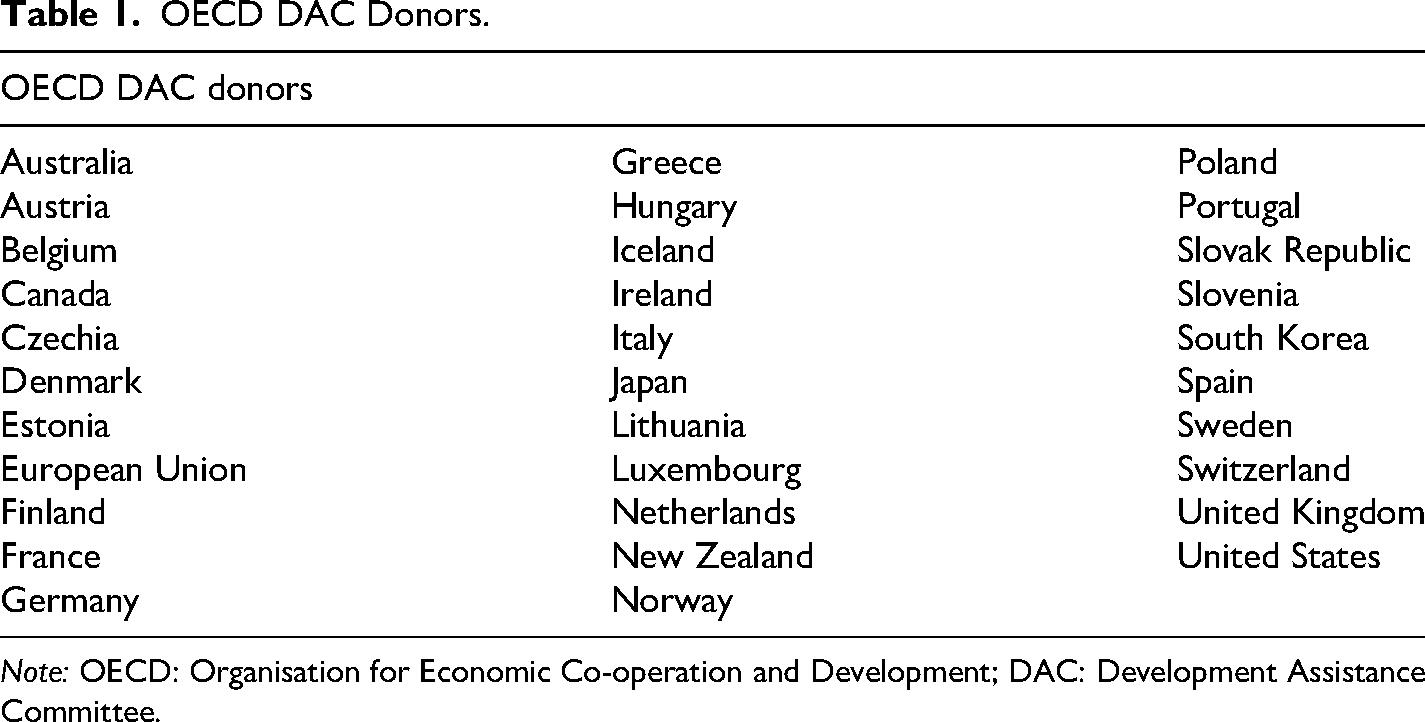
I combine data on aid and migration flows, along with additional recipient country and recipient country–donor country (dyadic) measures. As I am focused on Western aid donors, I use aid data from the Organisation for Economic Co-operation and Development's (OECD) Development Assistance Committee (DAC). This group has 32 members (see Table 1), although I omit Ireland because of a lack of migration data. I additionally remove and separately analyze EU observations because it is a multilateral donor, and its migration measures would necessarily be the sum of the measures for each member state.
OECD DAC Donors.
Note: OECD: Organisation for Economic Co-operation and Development; DAC: Development Assistance Committee.
In order to study the relationship between migration and different sectors of aid, I use the OECD Creditor Reporting System (CRS) project-level aid dataset from 2007 to 2023 (OECD 2025a). 2 In this period, the DAC allocated aid to 147 recipient countries. However, the number of countries receiving aid from each donor in a given year varies, and only 126 countries are included in the analysis due to data limitations.
To create my outcome variables of interest, I aggregate gross project-level official development assistance (ODA) disbursements according to different criteria. 3 My dataset only includes aid allocated by a country to a country, so any aid disbursed to or by a multilateral organization is not included, and neither is aid disbursed to regional projects or unspecified recipients. I calculate the total bilateral aid disbursed by the aid-donor/migrant-destination to the aid-recipient/migrant-origin in a given year. I then use three sets of criteria to estimate the aid allocated with migration-related intentions.
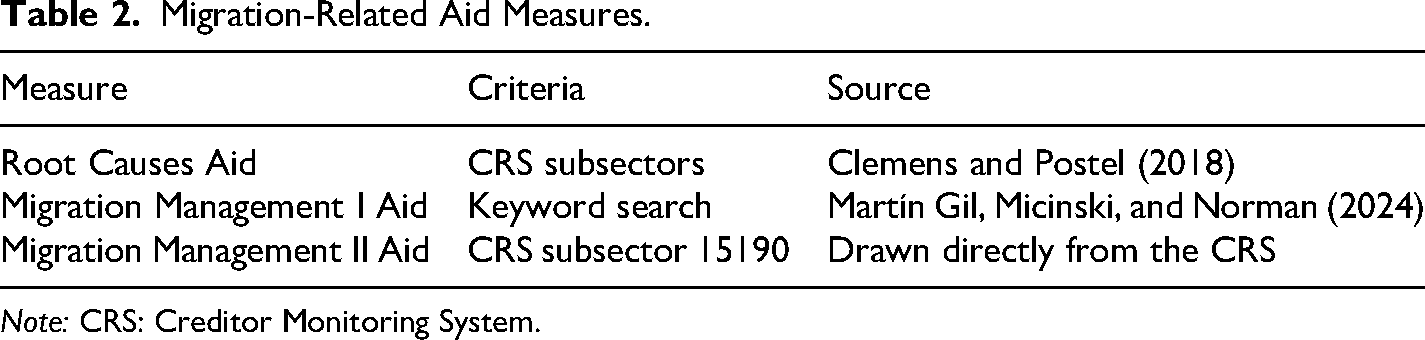
For the first variable, I aggregate specific subsectors in the CRS identified by Clemens and Postel (2018, 670), who aimed to identify sectors that donors consider most relevant to addressing the underlying social and economic causes of migration. Therefore, I call this measure “Root Causes Aid” as it approximates aid allocated to the indirect root causes strategy of migration control (see Table 2).
Migration-Related Aid Measures.
Note: CRS: Creditor Monitoring System.
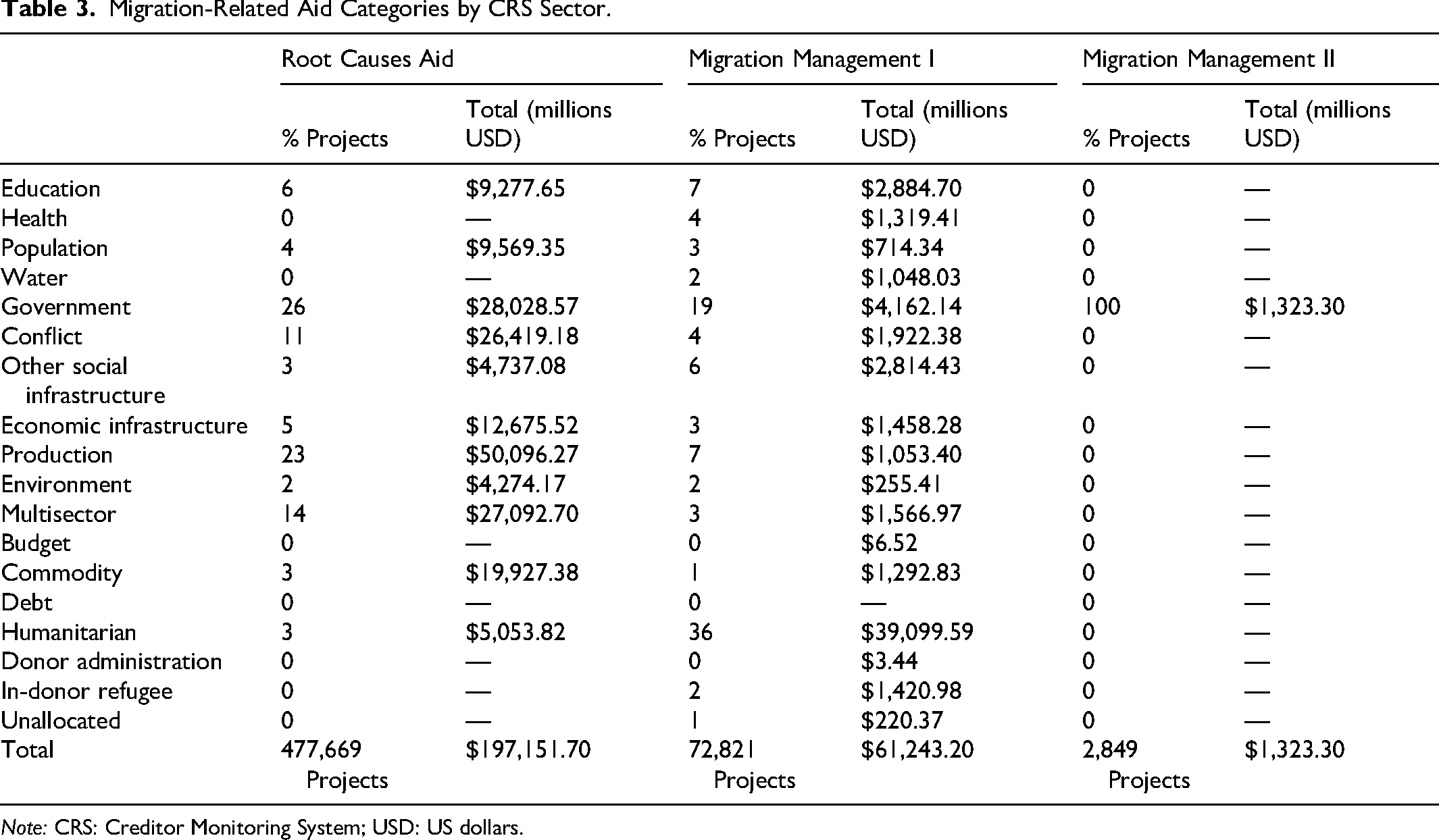
The next two variables use different criteria to identify projects explicitly associated with migration, and in doing so, correspond more closely to the direct migration management strategy. I aggregate the disbursements that contain any migration or asylum-related keywords in their project titles or descriptions to construct a measure called “Migration Management I Aid” (Martín Gil, Micinski, and Norman 2024). 4 I also aggregate flows in the CRS government aid subsector, referring to the facilitation of orderly, safe, regular, and responsible migration and mobility, constructing a measure I call “Migration Management II Aid.” There are only a few projects in this category because it is highly specific and only recently created (Martín Gil, Micinski, and Norman 2024). As the first projects were reported in 2017, I restrict all analyses using this type of aid to the 2017–2023 period. Table 3 shows the CRS sector breakdown of each of these variables, and Supplemental Appendix I includes more detailed information about their measurement, including project examples in each category. These three measures can be mapped onto a spectrum with Root Causes Aid at the indirect root causes pole, Migration Management I Aid towards the direct migration management pole, and Migration Management II Aid at the extreme of the direct migration management pole.
Migration-Related Aid Categories by CRS Sector.
Note: CRS: Creditor Monitoring System; USD: US dollars.
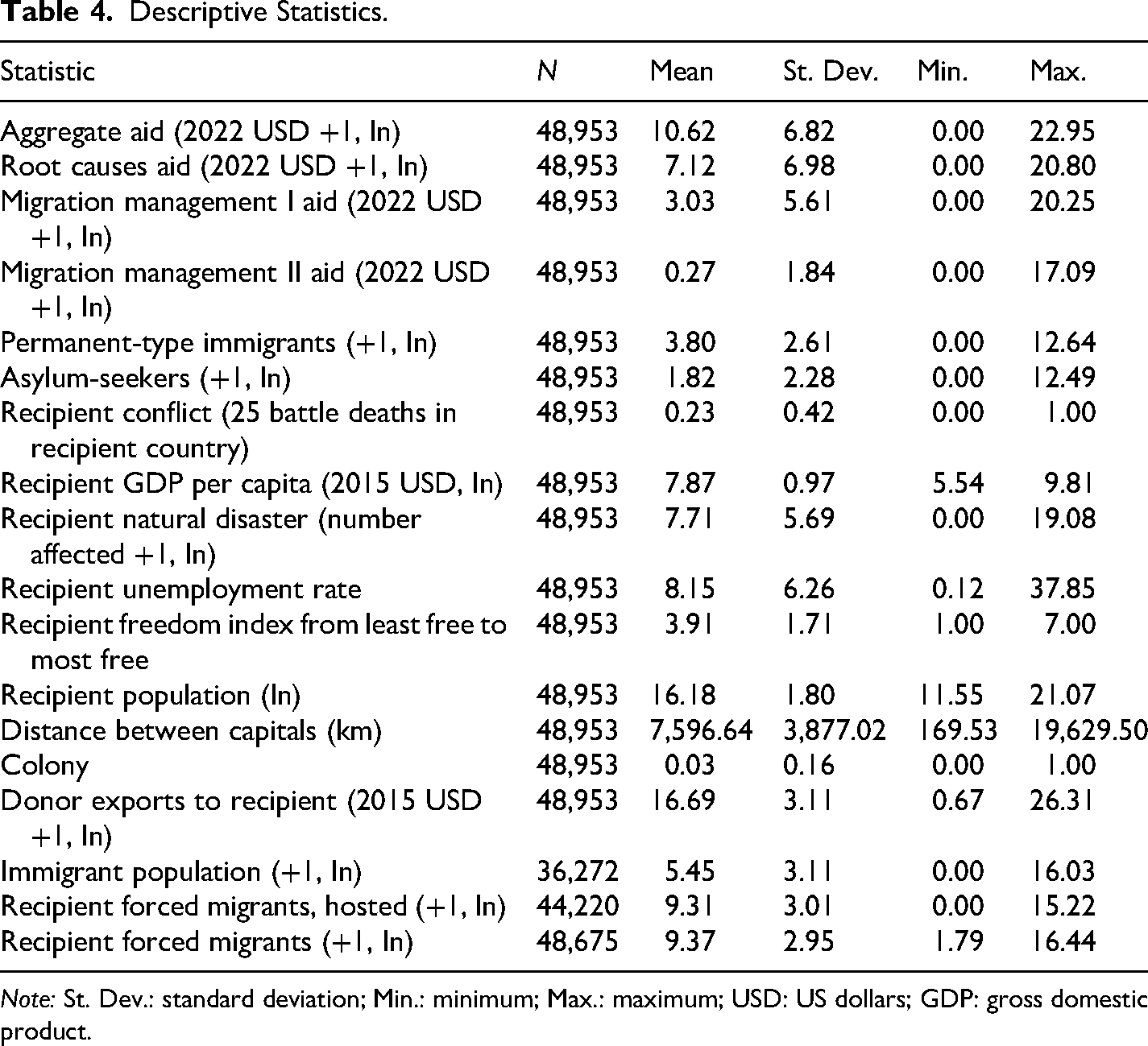
For my independent variables of interest, I use the OECD (2025b) International Migration Database. I use two dyadic variables to approximate long-term regular migration and irregular migration: (1) permanent-type immigrants by nationality and (2) asylum-seekers by nationality, respectively. 5 I use controls common in the aid allocation literature (e.g., Bermeo 2017; Bermeo and Leblang 2015; Czaika and Mayer 2011). These include the recipient-level variables conflict, gross domestic product (GDP) per capita, population, unemployment rate, number of people affected by natural disasters, and a freedom index representing the recipient country's civil liberties and political rights (EM-DAT 2025; Freedom House 2024; UCDP/PRIO 2024; World Bank 2025). I also include the dyadic variables donor exports to the recipient country, colonial relationship, and distance between capitals (CEPII 2023; IMF 2024). For a set of subsidiary analyses, I use three additional migration variables. First, I use dyadic immigrant population — also called a “stock” variable — which captures the total immigrant population from an origin country in a year, regardless of status (OECD 2025b). I also calculate recipient-level measures of forced migrants, both those hosted by the aid recipient (including refugees, asylum-seekers, and stateless individuals) and those originally from the aid recipient (including refugees, asylum-seekers, and internally displaced persons) (UNHCR 2025). I take the natural log of all continuous variables (aside from the unemployment rate, freedom index and distance between capitals). 6 The descriptive statistics for the variables of interest are reported in Table 4. Information on each of the data sources is available in Supplemental Appendix II. The full dataset containing all dyads between 2007 and 2023, including those in which no aid was transferred, contains 77,469 observations (4,557 dyads across 17 years). I restrict the dataset such that all variables in the main specification are non-missing, which yields 48,953 observations containing 3,375 dyads. 7
Descriptive Statistics.
Note: St. Dev.: standard deviation; Min.: minimum; Max.: maximum; USD: US dollars; GDP: gross domestic product.
Methods
A primary challenge in modeling aid allocation is the high frequency at which certain donors do not allocate any aid to certain recipients. I address this issue by using two of the most common approaches in the literature: a two-stage and a tobit approach (e.g., Bermeo 2017; Cingranelli and Pasquarello 1985; Czaika and Mayer 2011; Neumayer 2003; Berthelemy and Tichit 2004). The two-stage approach, or “hurdle” model, assumes that the decision of whether to allocate any aid is independent from the subsequent decision of how much aid to allocate. The first stage uses a logit model with a binary outcome equal to one if the donor disburses any aid, which handles the large number of zero aid observations. For the second stage, I restrict the dataset to only observations with positive aid disbursements and use a linear model with a continuous aid outcome variable. The tobit instead treats aid as a singular decision-making process, but one in which aid is left-censored or truncated at zero. The tobit model, therefore, jointly estimates the likelihood of the aid amount being zero as well as the amount of aid. As the factors affecting the decision to allocate any aid and in what quantity are likely similar but not the same, using both these techniques side-by-side lends more confidence that the results are robust to different modeling strategies and their assumptions.
The dependent variables are time-variant dyadic aid measures — a binary outcome in the case of the conditional logistic model, and a continuous outcome for the linear and tobit models. The independent variable of interest is either permanent-type immigration or asylum-seeker inflows. In order to reduce bias from omitted variables, I introduce a number of the most important control variables from the literature, as well as year fixed effects and additional donor, recipient, or dyad fixed or random effects, depending on the model. My preferred models include donor and recipient fixed effects for the first stage, dyad fixed effects for the second stage, and dyad random effects for the tobit. 8 This approach rules out time-invariant confounding at donor and recipient or donor–recipient (dyad) levels. To mitigate the risk of reverse causality, I use a temporal lag on all migration and control variables so that the analysis focuses on the effects of past conditions on subsequent aid decisions (Bermeo 2017). 9
Results
Aggregate Aid
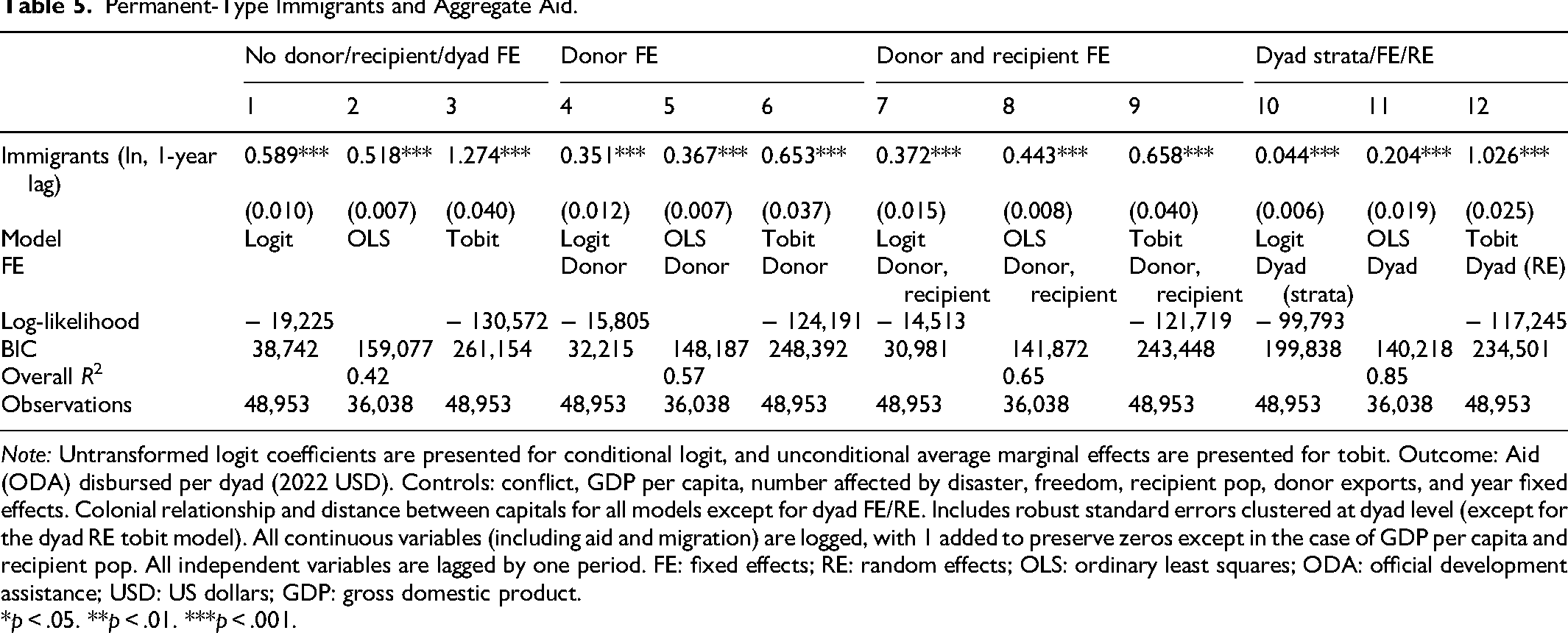
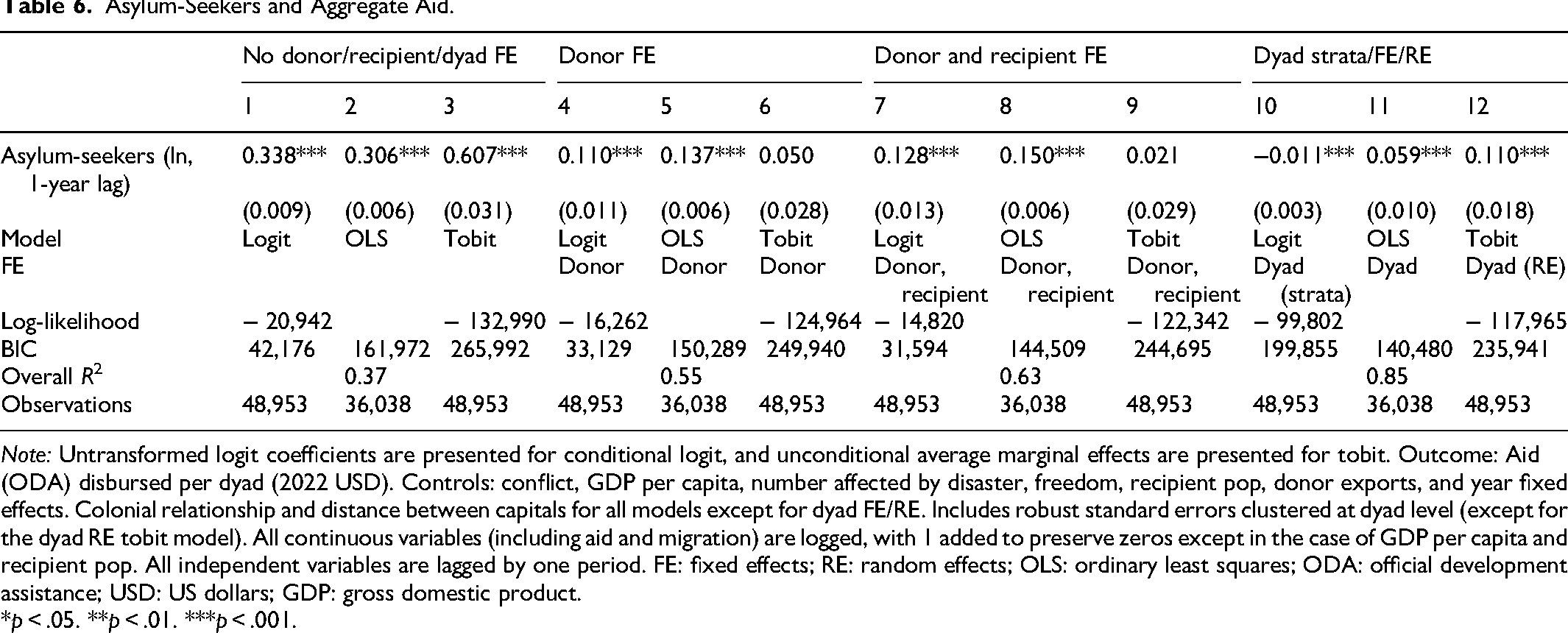
I first model aggregate aid allocation and compare across model specifications. In Tables 5 and 6, I present a two-part model consisting of a logit and ordinary least squares (OLS) model alongside a tobit model for each of four sets of specifications — no donor, recipient, or dyad fixed or random effects; donor fixed effects; donor and recipient fixed effects; and dyad strata (conditional logit), dyad fixed effects (OLS), and dyad random effects (tobit).
Permanent-Type Immigrants and Aggregate Aid.
Note: Untransformed logit coefficients are presented for conditional logit, and unconditional average marginal effects are presented for tobit. Outcome: Aid (ODA) disbursed per dyad (2022 USD). Controls: conflict, GDP per capita, number affected by disaster, freedom, recipient pop, donor exports, and year fixed effects. Colonial relationship and distance between capitals for all models except for dyad FE/RE. Includes robust standard errors clustered at dyad level (except for the dyad RE tobit model). All continuous variables (including aid and migration) are logged, with 1 added to preserve zeros except in the case of GDP per capita and recipient pop. All independent variables are lagged by one period. FE: fixed effects; RE: random effects; OLS: ordinary least squares; ODA: official development assistance; USD: US dollars; GDP: gross domestic product.
*p < .05. **p < .01. ***p < .001.
Asylum-Seekers and Aggregate Aid.
Note: Untransformed logit coefficients are presented for conditional logit, and unconditional average marginal effects are presented for tobit. Outcome: Aid (ODA) disbursed per dyad (2022 USD). Controls: conflict, GDP per capita, number affected by disaster, freedom, recipient pop, donor exports, and year fixed effects. Colonial relationship and distance between capitals for all models except for dyad FE/RE. Includes robust standard errors clustered at dyad level (except for the dyad RE tobit model). All continuous variables (including aid and migration) are logged, with 1 added to preserve zeros except in the case of GDP per capita and recipient pop. All independent variables are lagged by one period. FE: fixed effects; RE: random effects; OLS: ordinary least squares; ODA: official development assistance; USD: US dollars; GDP: gross domestic product.
*p < .05. **p < .01. ***p < .001.
I exponentiate the logit coefficients when I describe them in the text, and treat the coefficients for the OLS and average marginal effects for the tobit as elasticities. Table 5 shows a positive and statistically significant relationship between permanent-type immigrant inflows and aggregate aid within each model. The logit models (Models 1, 4, 7, and 10) estimate that every 10 percent increase in the number of immigrants from the aid recipient to the aid donor is associated with between a 0.44 percent and 6.07 percent increase in the donor's odds of allocating any aid to the recipient in the following year. 10 This is a wide range, but restricting variation to within-donor, both within-donor and within-recipient, and finally within-dyad levels yields informative results. The model fit deteriorates dramatically with the inclusion of dyad strata in Model 10's conditional logit, and the best fit according to log likelihood and Bayesian information criterion (BIC) estimators is the donor and recipient fixed effect model (Model 7), which I report in subsequent sections for the logit model. 11
The restricted OLS models (Models 2, 5, 8, and 11) estimate that for those dyads that experienced any aid (36,038 out of 48,953), a 10 percent increase in the number of permanent-type immigrants is associated with between a 2.04 percent and 5.18 percent increase in the quantity of aid allocated conditional on any aid being disbursed. The best-fitting model is the dyad fixed effects model (Model 11), which accounts for 85 percent of the overall variance in aggregate aid.
Finally, the tobit models (Models 3, 6, 9, and 12) present average marginal effects, accounting for the probability of being censored at zero (as in Bermeo and Leblang 2015), and estimate that a 10 percent increase in permanent-type immigrants is associated with an increase in the unconditional expected outcome of aggregate aid of between 6.53 percent and 12.74 percent. Again, the best-fitting model exploits within-dyad variation (Model 12).
The findings are mostly paralleled by those from the asylum-seeker models in Table 6. In most of the logit, OLS, and tobit models, there is a positive and statistically significant coefficient for the asylum-seeker variable. For the preferred models (Models 7, 11, and 12), a 10 percent increase in asylum-seekers is associated with a 1.29 percent increase in the odds of any aid being allocated, a 0.59 percent increase in the amount of aid conditional on any aid being allocated, and a 1.1 percent average marginal increase in the amount of aid allocated. 12 These two sets of findings align with prior work on the statistically significant positive relationship of overall and forced migration with subsequent aggregate aid allocation.
Migration-Related Aid
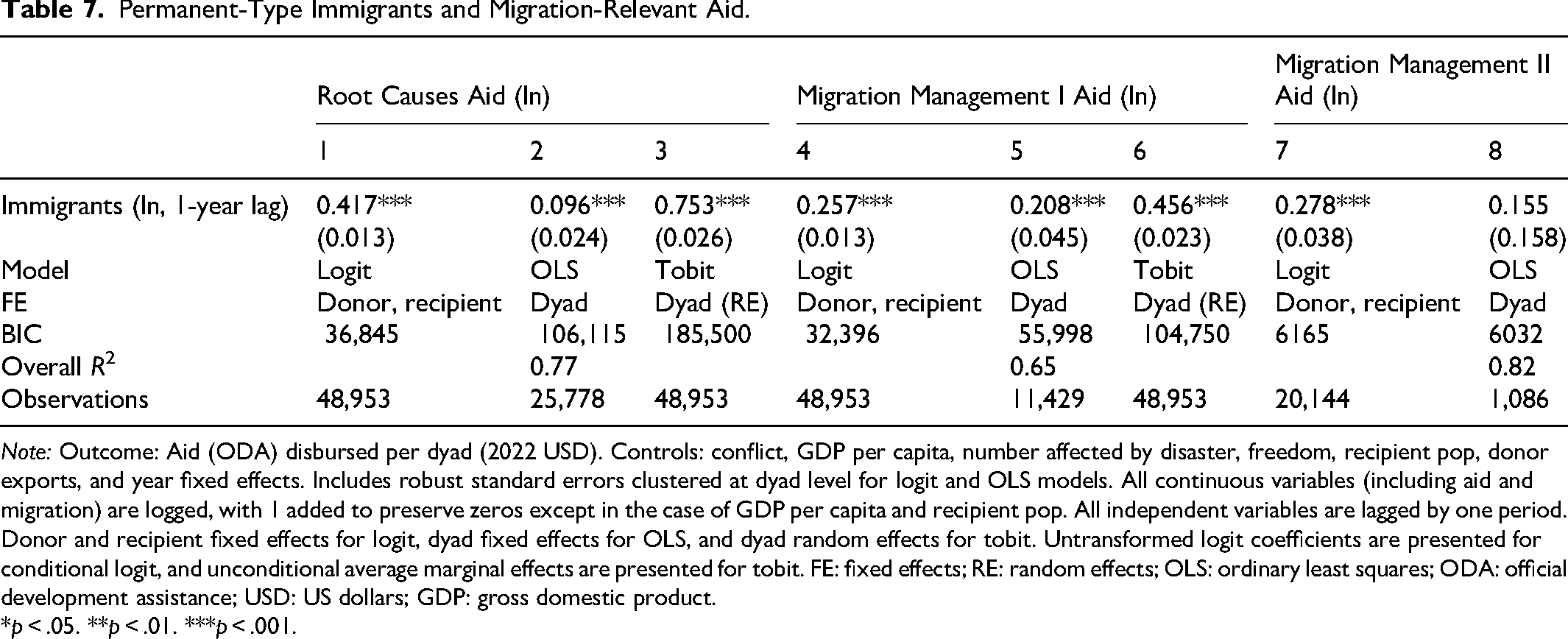
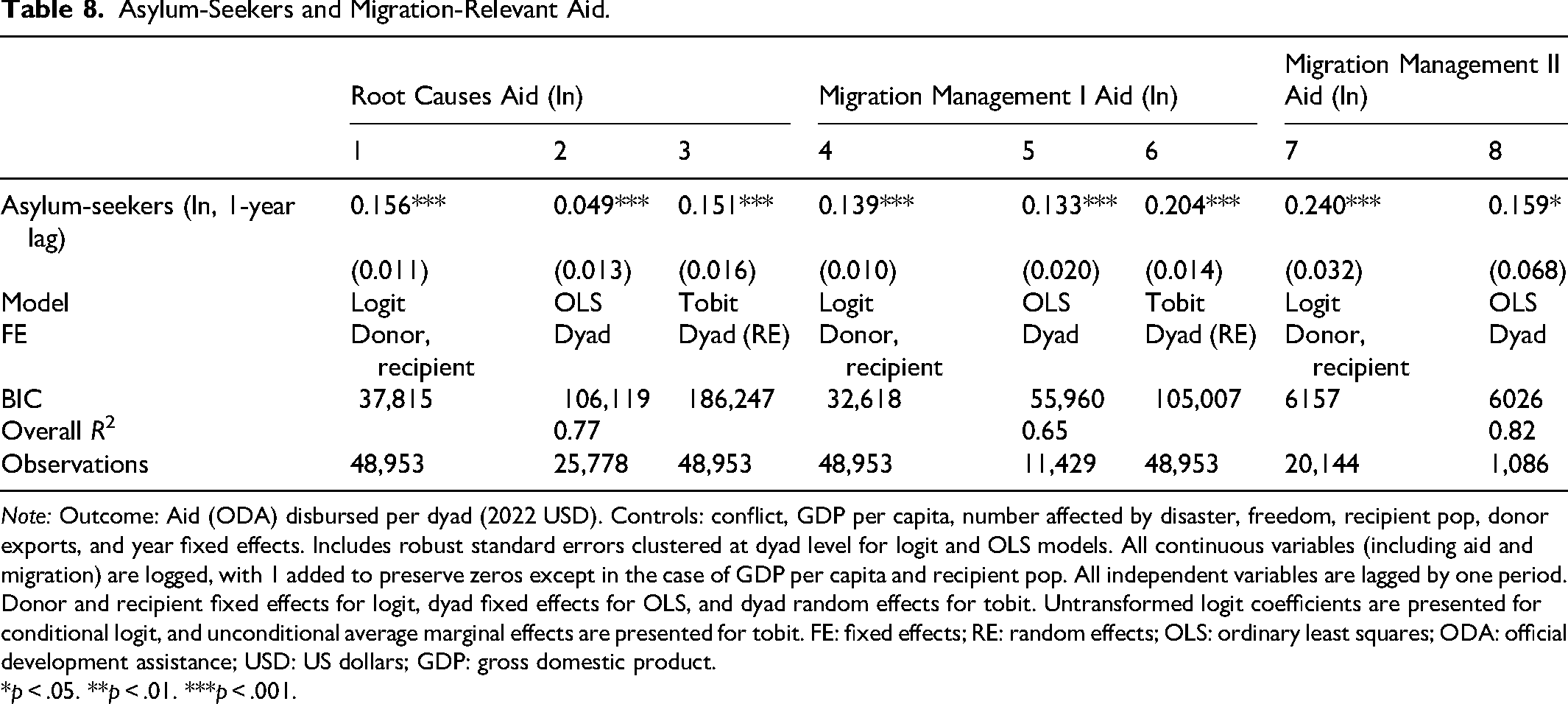
I now model the allocation of different types of aid. 13 This set of models relies upon aid categories designed to approximate the quantity or relative distribution of aid allocated for migration control purposes. I take three migration-related aid variables and apply the preferred specification models to each of them with permanent-type immigrants (Table 7) and asylum-seekers (Table 8) as the independent variables of interest. 14 For the Migration Management II variable, the dataset is restricted to aid flows in 2017 or later because the purpose code was only applied to aid flows beginning that year. As a result, the dyad random effects tobit model for Migration Management II Aid does not converge and is omitted. In these analyses, I find that donors significantly allocate aid associated with indirect and direct migration control in response to permanent-type immigrants and asylum-seekers, but with different emphases.
Permanent-Type Immigrants and Migration-Relevant Aid.
Note: Outcome: Aid (ODA) disbursed per dyad (2022 USD). Controls: conflict, GDP per capita, number affected by disaster, freedom, recipient pop, donor exports, and year fixed effects. Includes robust standard errors clustered at dyad level for logit and OLS models. All continuous variables (including aid and migration) are logged, with 1 added to preserve zeros except in the case of GDP per capita and recipient pop. All independent variables are lagged by one period. Donor and recipient fixed effects for logit, dyad fixed effects for OLS, and dyad random effects for tobit. Untransformed logit coefficients are presented for conditional logit, and unconditional average marginal effects are presented for tobit. FE: fixed effects; RE: random effects; OLS: ordinary least squares; ODA: official development assistance; USD: US dollars; GDP: gross domestic product.
*p < .05. **p < .01. ***p < .001.
Asylum-Seekers and Migration-Relevant Aid.
Note: Outcome: Aid (ODA) disbursed per dyad (2022 USD). Controls: conflict, GDP per capita, number affected by disaster, freedom, recipient pop, donor exports, and year fixed effects. Includes robust standard errors clustered at dyad level for logit and OLS models. All continuous variables (including aid and migration) are logged, with 1 added to preserve zeros except in the case of GDP per capita and recipient pop. All independent variables are lagged by one period. Donor and recipient fixed effects for logit, dyad fixed effects for OLS, and dyad random effects for tobit. Untransformed logit coefficients are presented for conditional logit, and unconditional average marginal effects are presented for tobit. FE: fixed effects; RE: random effects; OLS: ordinary least squares; ODA: official development assistance; USD: US dollars; GDP: gross domestic product.
*p < .05. **p < .01. ***p < .001.
Permanent-type immigrants are associated with statistically significant increases in the odds and amount of indirect Root Causes and direct Migration Management Aid allocation, with the exception of an insignificant coefficient in the dyad fixed effects OLS model for Migration Management II Aid (Model 8). A 10 percent increase in the volume of permanent-type immigrant inflows is correlated with a significant 4.26 percent, 2.60 percent, and 2.82 percent increase in the odds of any Root Causes, Migration Management I, and Migration Management II Aid being allocated, respectively (Models 1, 4, and 7). 15 Within the restricted samples with nonzero aid values, that 10 percent increase is associated with a statistically significant 0.96 percent and 2.08 percent increase in the amount of aid allocated to Root Causes and Migration Management I Aid, respectively (Models 2 and 5).
While the first-stage logit models show that donors’ allocation of Root Causes Aid is more highly correlated with increases in permanent-type immigrants than their allocation of Migration Management I Aid is, the second-stage OLS models reflect the opposite pattern. The tobit average marginal effects show that a 10 percent increase in permanent-type immigration flows is associated with a 7.53 percent increase in the unconditional average expected outcome of Root Causes Aid, but only a 4.56 percent increase in the unconditional average expected outcome of Migration Management I Aid.
The findings in Table 8 show that inflows of asylum-seekers are significantly and positively correlated with each type of aid in each model. As in the case of permanent-type immigrants, the coefficient for the logit model is larger for Root Causes than Migration Management I Aid (Model 1 versus Model 4). However, the second-stage OLS and tobit models show the opposite. Focusing on the tobit, a 10 percent increase in the number of asylum-seekers is associated with a 1.51 percent increase in the unconditional average expected outcome of Root Causes Aid and a 2.04 percent increase in the unconditional average expected outcome of Migration Management I Aid. While Migration Management II Aid only includes data from the most recent years (and as a result does not converge in the tobit dyad random effect model), it is striking how the logit and OLS coefficients are the largest of any of the three types of aid. This category of aid is the most conservative measure of foreign aid aimed at direct migration management, and its statistically and substantively significant correlations with asylum-seeker flows in the logit and OLS models further demonstrate the importance of the migration management strategy in response to asylum-seeker inflows.
To address concerns about the construction of these aid categories and better understand these results, I restrict the dataset to observations in which some aid of any kind was allocated. I then take a “long” version of the dataset with each CRS sector allocation for each dyad in each year as its own observation. I interact a sector factor variable with the migration variables in separate models and calculate the unconditional average marginal effect of permanent-type immigration and asylum-seekers by sector (see Figure 1 for combined results). While the average marginal effects for both types of migration were statistically significant and positive for almost every sector, there is noticeable variation both across sectors and between permanent-type migrants and asylum-seekers.
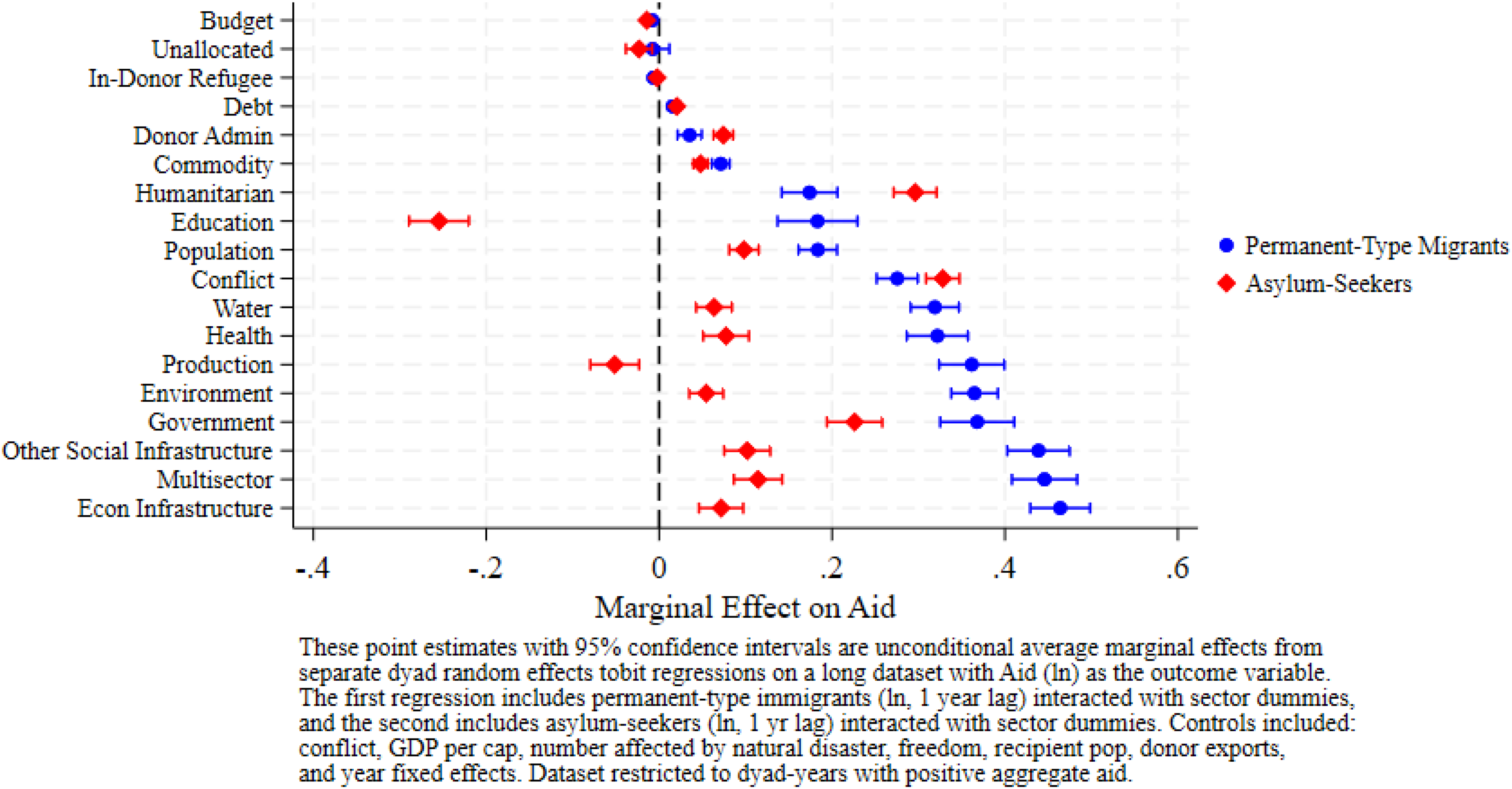
Average Marginal Effects by Sector and Type of Migration.
The unconditional average marginal effects of asylum-seeker inflows are statistically significantly larger in the humanitarian, conflict, and government sectors than in all other aid sectors, with a 10 percent increase in asylum-seeker inflows associated with over a 2 percent increase in each of those sectors. These sectors are associated with addressing the proximate causes of forced migration and dealing with migrants directly. Humanitarian, or emergency, assistance is largely targeted towards refugees, asylum-seekers, and internally displaced persons for relatively short-term goals. Government and conflict, peace, and security aid also directly manage people on the move. Migration Management II Aid, for instance, is in the government sector and is expressly dedicated to managing migrants. The CRS purpose code description also goes so far as to explicitly exclude aid aimed at migration's underlying causes (OECD 2024a). These three categories are not consistently oriented towards long-term development goals and often deal with people who have already moved, whether inside or outside of their country of origin. These categories also comprise almost 75 percent of Migration Management I Aid and 100 percent of Migration Management II Aid, reinforcing the previous finding that the migration management strategy is relatively more prominent in cases of asylum-seeker inflows.
Permanent-type immigration, on the other hand, is strongly correlated with far more sectors. The top three — economic infrastructure, multisector, and other social infrastructure — each have over a 4 percent increase associated with every 10 percent increase in permanent-type immigration in the previous year. There are eight sectors for which a 10 percent increase in permanent-type immigration is associated with an unconditional average marginal effect of at least 3 percent. These sectors are central to social and economic development and comprise 64 percent of Root Causes Aid, again consistent with previous findings that donors’ allocation of this type of aid is highly responsive to increases in permanent-type migrants. 16
Heterogeneity
The last set of results considers heterogeneity first over time and then across two donors, namely, the United States (US) and the European Union (EU). Due to the changing geopolitical contexts and the discourse around migration, it is possible that aid allocation strategies have changed over time in a non-linear fashion, and that the results could be masking this variation. Although each of the models includes year fixed effects, this approach cannot tell us how the importance of migration may have changed over time. I therefore interact a factor variable for year with the migration variables in the tobit models for aggregate, Root Causes, and Migration Management I Aid (see Supplemental Appendix IV). Holding the dyad and a number of time-variant recipient and dyadic characteristics constant, the average unconditional marginal effects of both types of migration on aggregate aid actually peak in 2008 and 2009. However, for asylum-seekers, there is a non-monotonic but significant decline over the time period, mainly broken up by a stretch of increasing average marginal effects from 2014 to 2018. These show a weakly decreasing responsiveness of overall aid allocation to immigration. However, there is no such decline in the average unconditional marginal effects of permanent-type immigration and asylum-seekers on Root Causes and Migration Management I Aid over time. 17 There are no significant changes in the sensitivity of Root Causes Aid allocation over the 2007–2023 period, and actually significantly elevated allocation of Migration Management I Aid in response to permanent-type immigration in most years relative to 2007 and 2008. These year interactions show that while aggregate aid may be less sensitive to migration over time, the categories associated with migration prevention are not significantly less sensitive and may even be more sensitive in some cases.
To explore donor heterogeneity, I separately apply a tobit model on aggregate and migration-related aid types, restricted first to the US and then to the EU. Thus, each of the marginal effect point estimates in Figure 2 is drawn from a separate regression. For the EU aid data, I include only disbursements from EU institutions, not from member states. 18
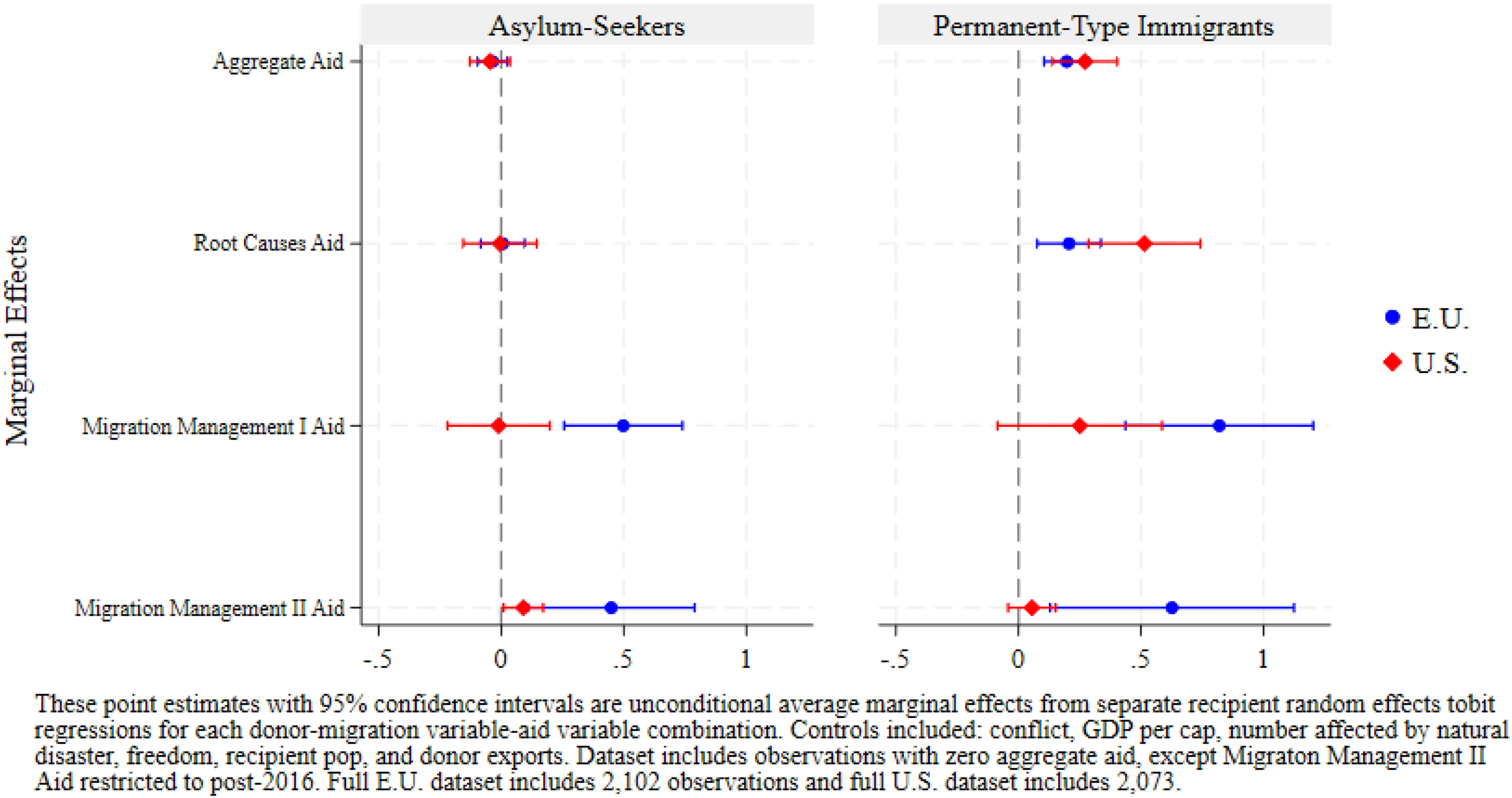
Marginal Effects by Aid and Migration Type for the European Union and the United States.
There is a striking difference in how the US and the EU allocate aid in response to immigration. The US does not significantly vary its allocation of aggregate aid, Root Causes Aid, or Migration Management I Aid in response to changes in the number of asylum-seeker applications, and it only slightly increases its allocation of Migration Management II Aid. However, in response to increases in permanent-type immigration, the US significantly increases its allocation of aggregate and Root Causes Aid by large percentages: a 10 percent increase in immigration is significantly associated with roughly a 3 percent and 5 percent increase, respectively. The EU, on the other hand, significantly and substantively increases its allocation of Migration Management I and II Aid in response to increases in both asylum-seeker applications and permanent-type immigration, with only small relative associations between permanent-type immigration and subsequent aggregate and Root Causes Aid allocation.
This prominent difference signals donor heterogeneity, even between some of the most vocal and studied proponents of using foreign aid as a migration control tool. The EU leads the way when it comes to implementing the migration management strategy in response to both types of migrants. When it comes to the root causes strategy, the larger coefficients on permanent-type immigration for the US — and, importantly, the relatively stronger association between permanent-type immigration and Root Causes Aid than permanent-type immigration and aggregate aid for the United States — indicate that it may be relying on this strategy more heavily than the EU is.
Discussion
In this paper, I show that both bilateral permanent-type immigration and asylum-seeker flows from an aid recipient to a donor are positively correlated with aggregate, Root Causes, and Migration Management Aid allocation in the subsequent year. However, the findings support the hypotheses that donors’ allocation of Root Causes Aid is relatively more responsive than their allocation of Migration Management Aid after receiving increased permanent-type immigration inflows, while the reverse is true after receiving more asylum-seekers. This divergent pattern is further supported by a sectoral analysis, which shows substantial differences in the sectors most sensitive to these two types of migration. Conflict, government, and humanitarian aid are associated with the highest average marginal effects for asylum-seeker flows, while most social and economic sectors have large average marginal effects for permanent-type immigrant flows. I also find minor variation over time, providing some evidence that overall aid allocation has become less responsive to immigration while the responsiveness of migration-related aid has remained constant or even increased. Finally, I find strongly differing results for the US and the EU's aid allocation patterns.
These findings build directly upon previous quantitative research on the relationship between immigration and foreign aid allocation. First, in line with prior literature on aggregate aid allocation, increases in immigration from an aid recipient to an aid donor are positively associated with increases in the likelihood of the donor allocating aid to the recipient country as well as the quantity of aid. The point estimates are also quite similar to those from previous studies (Bermeo 2017; Czaika and Mayer 2011), and the sectoral results align with Czaika and Mayer's (2011) finding that asylum-seeker inflows matter more for the allocation of humanitarian aid than for ODA generally. However, this paper's primary contribution is a set of comparisons that show different types of aid are more selectively associated with different types of migration, even when the dyad is held constant. These findings support and extend Bermeo's (2017) theory of targeted development, providing evidence that foreign aid allocation not only varies in amount according to the degree of cross-border “spillovers” but also varies in composition according to the type of spillover.
However, there is a concern emerging from this literature that there may be additional motives beyond migration control that could drive foreign aid allocation's sensitivity to migration. One proposed motivation is diaspora political influence. Immigrant inflows are strongly associated with immigrant population or stock size, and therefore positive correlations between immigration and aid allocation could be driven by a diaspora lobbying for greater aid to the origin country rather than by migration control efforts (e.g., Bermeo and Leblang 2015; Vázquez and Sobrao 2016; Lahiri and Raimondos-Møller 2000). Also, a reason to suspect the significant asylum-seeker findings is that they could reflect donors’ altruism and attentiveness to recipient need rather than the targeted development strategy (Czaika and Mayer 2011).
To test whether these alternative hypotheses erase the patterns I observe, I introduce dyadic immigrant stocks to the permanent-type immigrant models and additional forced migration variables to the asylum-seeker models (see Supplemental Appendices V and VI). Positive and statistically significant coefficients on these newly introduced variables in many of the models suggest that other motives discussed, such as diaspora influence and responding to forced migration crises in origin and host countries, are also relevant. However, the main findings still hold, suggesting that these other motives cannot fully explain away the patterns observed previously. The positive coefficients for the number of forced migrants hosted also align with the research on burden-sharing as a form of externalized migration prevention (e.g., Betts 2010; Tsourapas 2019).
This study also contributes to the qualitative literature on the migration-development nexus in policy making through its findings on different ways in which foreign development and humanitarian assistance are used for migration control. The construct for Root Causes Aid is a proxy, and Migration Management I and II Aid are approximate measures, so their raw levels should not be interpreted without extreme caution. However, the variation in their associations with permanent-type immigration and asylum-seeker inflows, even when holding the dyad and other characteristics constant, is informative. While the results do not suggest a perfect substitution between migration control strategies, they do support the conclusion that the balance shifts towards the root causes strategy in response to greater permanent-type immigration, and shifts towards the migration management strategy in response to greater asylum-seeker flows.
Under the assumption that donors pursuing targeted development strongly value aid effectiveness (Bermeo 2017), these findings can be understood as reflecting variation in perceived solutions to different forms of migration. If donors see permanent-type regular migration as a product of underdevelopment in migrants’ origin countries, they may attempt to address it with long-term economic and social development initiatives. On the other hand, if donors view asylum-seeking — used as a proxy for irregular migration — as a product of crisis, conflict, and political instability, they may seek to address it through conflict-prevention, improved governance, and humanitarian projects targeting people already on the move. A corresponding interpretation is that the difference in migration control strategy implementation is due to the greater domestic political urgency associated with preventing irregular migration — including the movement of asylum-seekers — in the short run. For instance, scholars have shown humanitarian infrastructures such as refugee camps to be a key tactic for “caging” forced migrants in developing countries (FitzGerald 2019; 2020). In spite of donors’ perceptions of problems and solutions, research on “pseudo-causal narratives” and the effects on migration of aid and its associated deterrence strategies shows that claims of effectiveness are not necessarily supported by the scholarly literature (Andersson 2014; Clemens and Postel 2018; de Haas 2007; Zaun and Nantermoz 2022).
The comparison between the US and the EU's disbursement patterns also yields interesting results. The more sensitive allocation of EU aid relating to migration management, regardless of migration type, aligns with the literature on its use of aid in border externalization. Within the EU's “migration-development nexus,” many scholars have found recurrent emphases on containment (e.g., Boswell 2003; Norman and Micinski 2023; Lavenex and Kunz 2008; Berger 2022). Yet the US's insignificant associations between migration and aid related to migration management are paired with a significant marginal effect of permanent-type immigration on Root Causes Aid that is even larger than that on aggregate aid. This is surprising given work directly comparing the US and the EU that focuses on their similarities and finds both emphasize development and humanitarian aid as part of securitized border externalization (Koff 2017; Martín Gil, Micinski, and Norman 2024). The findings from this paper point to how the EU has led the way in this respect, although they leave open the elements of aid conditionality, trade agreements, and non-ODA aid that are not captured in these data and play an important role in externalized migration control.
Conclusion
This paper asks how the OECD's DAC — the Global North donor association — responds to increases in immigration. This paper rigorously tests the relationship between different types of immigration and the allocation of different categories of foreign aid. Donors incorporate indirect root causes and direct migration management strategies into aid allocation decision-making, and do so differently in response to distinct forms of immigration. These findings contribute to theories of foreign aid as targeted development, demonstrating how not only the amount but also the categories of aid allocated vary according to the type and intensity of cross-border “spillover” effects from aid recipients to aid donors.
Extending beyond this work, there are a number of opportunities for future research. This paper takes donors’ aid categorization at face value, as donors themselves designate the sector of each project or aid disbursement. Future research could investigate the role of strategic labeling, as donors can often choose between multiple sector labels with limited oversight. For instance, a project on refugees’ vocational education intended to reduce migration could be labeled as education aid, humanitarian aid, or “facilitation of safe and orderly migration.” Analyzing independently coded aid data would be essential for understanding how bias in donor designations could affect the results of aid allocation and composition research. Additionally, the established heterogeneity among donor aid allocation strategies invites additional research into strategies of particular donors beyond this paper's preliminary analysis comparing EU and US aid allocation — research that likely requires both qualitative policy analysis and further quantitative work.
The liberal trilemma of “how to maintain economic openness and at the same time respect the preferences of citizens, while also respecting the fundamental human rights of foreigners” is not as relevant for understanding US immigration policy as it was a year ago (de Haas 2023). Managing migration and addressing its root causes was one highly publicized endeavor to respect the human rights of migrants while discouraging their migration in accordance with US citizens’ preferences to bar newcomers. Yet this form and justification of aid allocation is finished under the second Trump Administration, along with almost all US foreign development and humanitarian assistance, due to the collapse of the United States Agency for International Development (USAID). In the midst of the drastic reorientation of US-focused migration research and a reckoning in the literature on aid allocation, I argue that studies of foreign aid allocation and migration control remain relevant. Migration control is a core pillar of Trump's “New Washington Dissensus” and its reordering of the aid system towards norms of anti-multilateralism, transactional coercion, and securitization (Klingebiel and Sumner 2025b). There are indications that other countries are following suit, with both reductions in aid commitments and reorientation towards migration deterrence and other national security priorities (Klingebiel and Sumner 2025a). Even as foreign aid allocation undergoes drastic changes in both quantity and form, controlling migration remains an important, and often central, objective for Western donors.
Using fine-grained aid data and a compositional approach to aid allocation, I find strong evidence that the long-observed positive relationship between immigration and aggregate aid masks heterogeneity in aid composition, which varies for different types of immigration flows. This paper demonstrates multiple ways in which development assistance is instrumentalized as part of migration control in the Global North, and contributes methodologically to the aid allocation literature by reinforcing the importance of taking an aid composition perspective. More broadly, it suggests that targeted development is even more targeted than previously described, as donors modify the allocation of certain types of aid in accordance with how they experience cross-border “spillovers” from recipient countries.
Supplemental Material
sj-docx-1-mrx-10.1177_01979183251381275 - Supplemental material for Foreign Aid Allocation as Migration Control: Root Causes or Migration Management?
Supplemental material, sj-docx-1-mrx-10.1177_01979183251381275 for Foreign Aid Allocation as Migration Control: Root Causes or Migration Management? by Roxanne Corbeil in International Migration Review
Footnotes
Acknowledgements
I am grateful to Hannah Postel for her willingness to share the CRS codes she used in her 2018 paper with Michael Clemens. I would also like to thank the anonymous reviewers whose comments greatly improved this work. Finally, I greatly appreciate the feedback and support I received along the way from Rubén Hernández-León, Omar Lizardo, Roger Waldinger, Ian Lundberg, Chad Hazlett, and Victor Agadjanian.

Funding
The author received no financial support for the research, authorship, and/or publication of this article.
Declaration of Conflicting Interests
The author declared no potential conflicts of interest with respect to the research, authorship, and/or publication of this article.
Supplemental Material
Supplemental material for this article is available online.
Notes
References
Supplementary Material
Please find the following supplemental material available below.
For Open Access articles published under a Creative Commons License, all supplemental material carries the same license as the article it is associated with.
For non-Open Access articles published, all supplemental material carries a non-exclusive license, and permission requests for re-use of supplemental material or any part of supplemental material shall be sent directly to the copyright owner as specified in the copyright notice associated with the article.
