




Abstract
Many argue that direct democracy improves the quality of democracy. In particular, many scholars claim that it increases the representation of the public’s preferences by fostering communicative responsiveness between politicians and citizens. While studies have come to mixed conclusions about the effect of direct democracy on policy outcomes, little is known about how direct democratic processes affect politicians’ responsiveness. Using a field experiment, this study examines whether direct democracy increases the responsiveness of Swiss state legislators to citizen-initiated contacts on policy concerns. Contrary to popular belief, our results show that direct democracy does not enhance politicians’ responsiveness to policy requests.
Introduction
Direct democratic procedures are spreading across the world. The direct involvement of citizens in policy decisions has frequently been linked to improvements in the quality of democracy. For instance, many argue that direct democracy leads to policy choices that are (more) consistent with majority preferences (Leemann and Wasserfallen, 2016; Matsusaka, 2005). Previous research also suggests that direct democracy increases the political knowledge of citizens, voter turnout, party membership, and trust in political institutions (Altman, 2012; Dyck and Lascher, 2008; Olken, 2010; Peters, 2016). Yet, we know little about the effect of direct democracy on the behavior of elites and their responsiveness to citizen-initiated contacts.
Theories of representative democracy and direct democracy hold different expectations concerning citizens’ involvement in political decision-making (Christiano, 2015). In the former type of government, citizens are expected to participate indirectly in lawmaking by regularly selecting their representatives in free and fair elections. In contrast, direct democracy requires citizens to take an active part in choosing the public policies that will be implemented. In real life, these ideal types of democracy interact and contribute to reinforce or undermine the influence of political elites and representative institutions on policy-making (Altman, 2010). For example, Altman (2012 shows that the use of direct democratic procedures, and in particular initiative rights, increases turnout. There are, however, few studies examining how direct democratic procedures affect the functioning of representative democracy from the angle of elites. Thus, the purpose of this article is to investigate how direct and representative democracy interact and influence politicians’ political behavior. To do so, we use a field experiment on Swiss state legislators and formally test whether direct democracy increases communicative responsiveness, which in turn should translate into more policy congruence.
By examining how the institution of direct democracy shapes communicative responsiveness, our approach is similar to Putnam’s investigation of institutional performance across Italian regions (Putnam, 1993). In his seminal book Making Democracy Work, Putnam examines how institutions influence the practice of politics and government, including how it affects public officials’ responsiveness to citizen-initiated contacts in Northern and Southern Italy. The Swiss context provides a unique setting to answer questions relating to the effect of direct democracy and its relation to representative institutions. As the only country with a long history of direct democratic participation, it allows us to take advantage of variations in direct democratic institutions across Swiss cantons (the equivalent of US states). In practical terms, we emailed approximately 1,700 state legislators using fictitious aliases requesting an appointment for a policy-related conversation. We then compared the response rate of legislators to citizens’ requests across cantons with different levels of direct democracy.
There are reasons to believe that direct democracy shapes the behavior of elites and increases legislators’ responsiveness to citizen-initiated contacts. Broadly speaking, we identify two mechanisms behind this effect. First, in direct democratic contexts, citizens potentially threaten to bloc the legislative process by using their referendum or initiative rights to recall an existing law or propose a new law. As a consequence, policy-makers try to anticipate voters’ preferences and follow the position held by the majority, a process that is referred to as the indirect effect of direct democracy. Legislators thus have stronger incentives to listen to citizens’ policy concerns where direct democracy is strong in order to gain knowledge about what the public wants and avoid any blocking of the legislative process.
Second, research on the role of political elites in direct democratic contexts suggests that politicians remain powerful and contribute in shaping public opinion (Trechsel and Sciarini, 1998). Legislators can take advantage of citizen-initiated contacts to explain their position to voters in order to influence their views on specific policies. When direct participation rules in lawmaking are extensive, the stake to respond to citizens’ communication is even higher as political elites want to persuade voters in order to maintain their control over policy-making. Therefore, we expect politicians to respond more frequently to voters’ requests when citizens have more opportunities to participate directly in policy-making.
Focusing on legislators’ readiness to listen to the wishes of the public and explain their policy position to voters, i.e. communicative responsiveness, is important for understanding how the aggregation and articulation of citizens’ preferences take place. In direct democratic contexts, it is a privileged way for representatives to get knowledge about voters, influence public opinion, and increase their legitimacy by involving the public (Esaiasson et al., 2016). It has the potential to avoid legislative blockage, maintain legislators’ control over political decision-making, and increase voters’ satisfaction with their representatives, and policy outcomes more generally.
The findings from our field experiment, however, do not support our hypothesis. Although direct democracy might encourage citizens to participate more in politics and contact their legislators more frequently, direct democracy does not enhance politicians’ responsiveness to citizen-initiated contacts. Our results have important implications for our understanding of the benefits that direct democratic procedures provide across the world. While they might improve policy congruence and encourage political participation, they do not seem to shape the responsiveness of MPs to citizens’ direct requests.
Obstacles to Measuring Communicative Responsiveness
Research on citizens’ influence over political decision-making has mostly focused on policy responsiveness, i.e. whether legislators act in accordance with constituents’ views. These studies mainly rely on roll-call data or ideological positions drawn from survey responses to examine congruence between legislators’ and voters’ preferences. However, representatives also engage in other types of action to respond to their constituents’ needs and concerns. For instance, constituency service is a clear and simple way for legislators to respond to voters.
As traditional ways of participating in politics, such as turnout, are losing ground, citizens increasingly resort to more individualized and short-term means of political participation. Today citizens are more likely to directly contact their representatives, via mail, email, telephone calls, or social networks, to influence political decision-making. Constituency service is an important aspect of legislative work. Representatives spent a substantial share of their time and resources to reach and respond to voters. Recent studies suggest that representatives consider citizen-initiated contacts as one of the most efficient ways to participate in policy-making, after joining a party and voting (Hooghe and Marien, 2014; Naurin and Ohberg, 2013). Direct communications with constituents provide an opportunity for politicians to listen to the wishes of the public and explain their policy position, but also to adapt their behavior to follow majority opinion (Esaiasson et al., 2016).
However, little attention has been given to how politicians respond to citizen-initiated contacts, and in particular, how institutions contribute to shaping communicative responsiveness. Previous research largely uses observational data, and existing field experiments mostly focus on the Unites States. Experimental designs advance the literature by overcoming inferential challenges that often plague observational studies on communicative responsiveness and constituency service. In particular, surveys with elected officials are often characterized by low levels of response rates. For example, Hooghe and Marien’s (2014) study on how representatives perceive citizens’ requests in eight countries is based on surveys were response rates varied from 15% (Italy) to 39% (Belgium). 1 Moreover, experiments enable us to overcome limitations due to social desirability, which can lead politicians’ to overstate constituency work in surveys (De Vries et al., 2015). To sum up, our experimental design avoids widespread problems found in observational studies.
There are potential ethical issues in collecting data through field experiments, especially when they imply contacting politicians with fictitious identities and policy requests. Issues pertaining to deception, anonymity, and extra burden placed on politicians’ daily activities are the main ethical concerns raised by our research design. While most field experiments in political science examine citizens’ behavior, experimental designs that focus on political elites have only recently started to become a popular way to study political decision-making (Grose, 2014). Following the guidelines developed by Butler and Broockman (2011), our research design takes these important ethical concerns into account. Deception is necessary to overcome common shortcomings of observational studies on responsiveness and constituency service (politicians’ low response rates to surveys or social desirability bias). However, the deception of legislators is offset by minimizing “the burden placed on legislators’ time” (Butler and Broockman, 2011: 468). The email formulates a request in a short and simple way so that it is easy for legislators to respond. Grose (2014) notes that repeated field experiments on legislators might increase the burden on political elites. However, to the best of the author’s knowledge few experiments in the European and Swiss context have targeted legislators via email requests (see, e.g., De Vries et al., 2015 or Giger and Lanz, 2016). Second, the research guarantees the anonymity of politicians’ responses (and non-responses) to ensure that no harm will be caused to the participants of the field experiment by anonymizing individual-level data.
Experimental Design
In November 2015, we conducted a field experiment with 1,756 randomly selected state legislators elected in the German- and French-speaking cantons of Switzerland (70% sample of all legislators). These politicians received an email from fictitious voters requesting an appointment for a policy-related conversation (for similar experimental designs see, e.g., Broockman, 2013; Butler, 2014; Butler and Broockman, 2011; McClendon, 2016). 2 The analysis excludes 69 cases with wrong email addresses or auto-replies. In total, 1,687 legislators received the email. Similarly to other previous studies, the experiment treats the email addresses of the representatives and not legislators themselves (see, e.g., Butler and Broockman, 2011; McClendon, 2016).
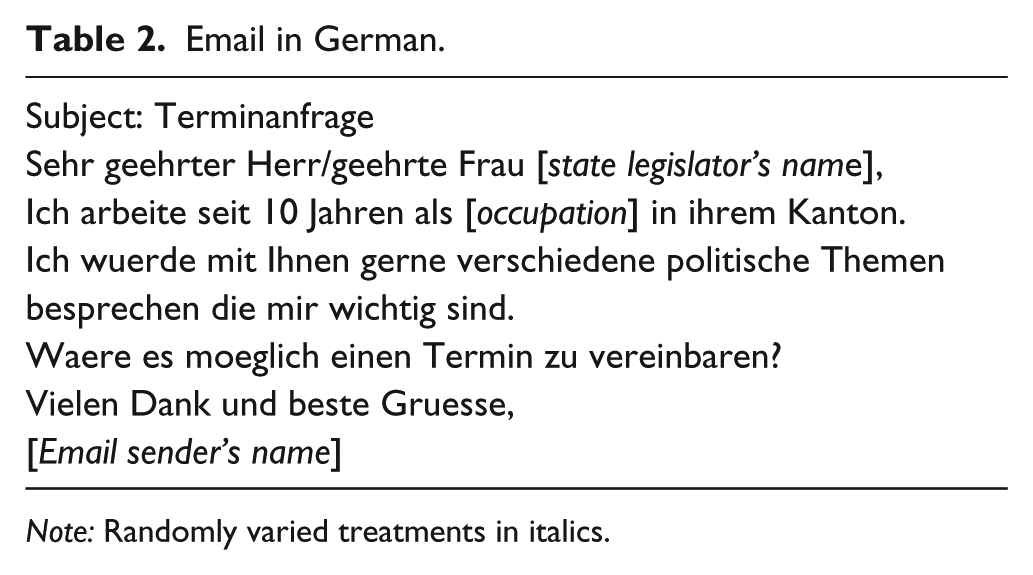
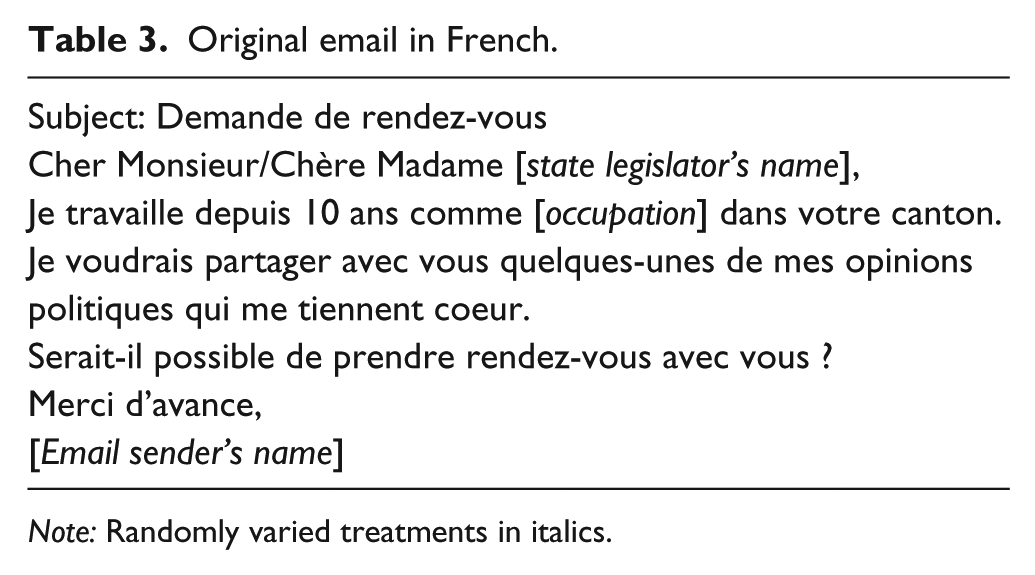
Table 1 shows the exact email translated into English. The original emails were in German to state legislators from the German-speaking part of Switzerland and in French to state legislators from the French-speaking part (see Tables 2 and 3 for emails in the original language). The emails varied in several factors that are not essential for this study. 3 First, the occupational background of the sender and whether they are a member of a union. While union membership is biased to the left, the sentence “I am an active union member” was randomly assigned as part of a treatment condition. Owing to random assignment, union status is unrelated to the main independent variable and therefore does not bias the results presented in this paper. Second, we diversified the email messages by using different sender’s names, gender and timing of the email. In particular, we selected 10 of the most common Swiss names (5 male and 5 female names) and created corresponding gmail accounts. In addition, we sent out emails in four different batches with one week between the batches. These factors are included as control variables in our analysis below.
Email sent to state legislators.

Note: Randomly varied treatments in italics.
Email in German.
Note: Randomly varied treatments in italics.
Original email in French.
Note: Randomly varied treatments in italics.
The exact wording of the email is partly based on informal interviews with state legislators. The interviews focused on how citizens usually contact their legislators (frequency and type of request, etc.). In general, politicians confirmed that they were frequently contacted by voters with policy requests: in Western Europe, service requests are dealt by civil servants and almost never by legislators. Voters usually contact legislators to share their opinion on a specific concern or ask them to explain their position on a particular issue or event. Communicative responsiveness is thus an important part of legislators’ work (for a discussion of this concept, see, e.g., Ohberg and Naurin, 2015). Our experimental design takes this information into account. Following the interviews, we excluded any reference to a particular political topic in the emails. Instead, the emails allude to “various political topics that are important to me”.
We match the data from our experiment with information on direct democratic institutions in Swiss cantons. Switzerland offers a unique setting to test the impact of direct democracy. Cantons provide important variation with regard to direct democratic rights. For instance, some cantons offer very extensive participatory rights, while other cantons are “more strongly oriented toward representative democracy” (Freitag and Ackermann, 2015: 6). We use two measures to gauge the scope of direct democratic rights in cantons. 4 First, we draw on an index measuring how much formal direct democratic rights are developed. The measure assesses the difficulty for citizens to use direct democratic procedures (e.g. the number of signatures required or the time granted to collect signatures). The index varies between 1 (low direct democratic rights) and 6 (high direct democratic rights). Second, we use “the yearly average of all cantonal popular votes (for initiatives and referendums) from 2006 to 2009” (Fatke, 2015) to measure the actual use of direct democracy. The measure ranges from 1 (the canton of Valais) to 19.5 (the canton of Glarus).
Both direct democratic indexes are common in the literature on Swiss direct democracy (Fatke, 2015; Freitag and Ackermann, 2015; Leemann and Wasserfallen, 2016). They have recently been updated by Schaub and Dlabac (2012). The indexes represent two complementary ways of measuring the extent to which direct democratic rights are developed at the cantonal level, namely presence and actual use of direct participatory rights. Using both indexes strengthens our results by examining whether they are consistent across different measures. The indexes are only moderately correlated (Fatke, 2015), which means that there are some differences between presence and actual use of direct democratic rights across cantons. For example, the Canton of Geneva offers citizens less opportunities to use direct democratic rights (the score is 1.75 on the first index) but popular votes are used comparatively frequently (the score is 15 on the second index).
Figure 1 illustrates the variation in the scope of direct democratic rights at the cantonal level when using the first index. Overall, the figure shows that these rights tend to be more developed in German-speaking cantons than in French- and Italian-speaking cantons. Formal rules are most extensive in the Canton of Appenzell Innerrhoden, followed by the canton of Basel Land and Solothurn, while they are the least developed in the cantons of Geneva, Ticino, and Vaud. The second index reveals that, between 2006 and 2009, popular votes were mostly used in the canton of Glarus and the least in the canton of Valais. Leemann and Wasserfallen (2016) calculated California’s score on the formal rule index. The State’s score was about 2.33 compared with Switzerland’s average score of 4.11. In light of this result, they conclude that Swiss cantons provide, on average, extensive democratic rights to their citizens.

Variation in direct democratic rights in Swiss cantons.
To answer the question whether legislators are more responsive to citizens when direct democratic institutions are more developed, we compare the response rate of legislators across cantons. The dependent variable is whether or not a legislator responds to the email. As a robustness check, we also use an alternative dependent variable, namely whether or not a legislator agrees to a political conversation. The two outcome variables capture different aspects of legislators’ responsiveness to citizen-initiated contacts that have played an important role in previous research. The first focuses on whether politicians respond at all (see, e.g., Butler and Broockman, 2011) and the second considers the quality of the response by capturing whether a legislator satisfies the request from a citizen to grant them a meeting. Using two distinct measures of responsiveness ensures that the results are consistent across different definitions of the outcome variable.
Because legislators are nested within cantons, the analyses use multilevel, logistic regression models with random effects for the canton level. Our models control for additional characteristics such as the sender’s occupational background, organizational membership, name, gender, the email batch, the party of the legislator, and whether the email was in French or German. In addition, we control for cantonal level factors, such as population size and unemployment rate.
Results
Of the 1,687 state legislators who received by email, 818 responded within two weeks so that the response rate was about 50%. Moreover, 622 politicians agreed to a conversation about political issues, either in person or via phone and email (36.9%). This response rate is similar to that of previous experiments carried out in the United States (see, e.g., Broockman, 2013; Butler and Broockman, 2011).
Table 4 reports the estimates from logistic regression models on state legislators’ responsiveness to citizen-initiated contacts. The analyses show that responsiveness is more widespread among legislators elected in German-speaking cantons. Other studies have arrived at similar conclusions (see, e.g., Giger and Lanz, 2016). Swiss–German cantons display more comprehensive direct democratic rights than French-speaking cantons. However, contrary to theoretical expectations, the results indicate that direct democracy does not increase politicians’ responsiveness to policy requests. Cultural differences could explain these differences in responsiveness. In particular, differences in politicians’ political socialization leading to specific conceptions of representation might lead to differences in emphasis with regard to responsiveness.
The effect of direct democracy on state legislators’ responsiveness.

Note: *< 0.05; ** < 0.01; *** < 0.001; standard errors in parenthesis Controls: Gender, occupation, union membership, name, MP’s party, email batch cantons’ population size, and unemployment rate.
The coefficient for formal participatory rules is negative and far from statistical significance (Model 1). Accordingly, legislators in cantons with more extensive participatory rights are not more likely to respond to constituents’ requests. Likewise, the second column of Table 4 indicates that an increase in the actual use of direct democratic procedures has no effect on politicians propensity to reply to citizens communications (Model 2). While the point estimate is positive, it is substantively small and far from being statistically significant. As a robustness check, we ran the analyses with an alternative dependent variable, namely whether or not a legislator agrees to a political conversation. The analyses yield similar results (see Table 5). To sum up, direct democracy might encourage citizens to participate more in politics (Altman, 2012) and to contact their legislators more frequently. However, our findings suggest that citizens’ direct participation in lawmaking does not encourage legislators to respond more to citizens policy requests. This result is consistent across different measures for the dependent and main independent variables.
The effect of direct democracy on legislators’ propensity to grant a meeting.

Note: *< 0.05; ** < 0.01; *** < 0.001; standard errors in parenthesis Controls: Gender, occupation, union membership, name, MP’s party, email batch, cantons’ population size, and unemployment rate.
An important limitation of our analyses is that the number of cantons is limited to 25 and some of the variation in direct democracy across cantons is explained by the language control variable (German- versus French-speaking cantons). 5 To address this problem, we conducted a simulation-based power analysis. The analysis examines the statistical power of our study by asking how large the true effect would have to be in order to be detectable. It involves three st.tif (Gelman and Hill, 2007). First, we simulated data based on the models presented in Table 4. The sample size, covariate distribution, model specification, and parameters are all determined by the estimated model but we incrementally changed the true effect size of the two direct democracy indexes. As a result, we obtained fake or simulated data for the outcome variable. Second, we used the simulated outcome variable to fit the same model presented in Table 4. Finally, we repeated the simulation st.tif 1,000 times and computed the statistical power as the average number of simulation runs with an effect that is statistically significant at the 0.05 level. The results are presented in Figure 2. They show how the statistical power, i.e. the likelihood that our study would detect an effect, depends on the true effect size. For small effects, the power is relatively low but increases rapidly for medium and large effects: 80% power is achieved for effect sizes of 0.22 and 0.14 for the first and second direct democratic index respectively. This corresponds to 1.246 and 1.150 in odds ratio. These findings indicate that our study has sufficient statistical power to detect medium and large effects particularly for the second direct democracy index but not necessarily small effects. Accordingly, these results suggest that Switzerland as the only country with a long history of direct democratic institutions provides a unique opportunity to study the effect of direct democracy on the responsiveness of MPs.
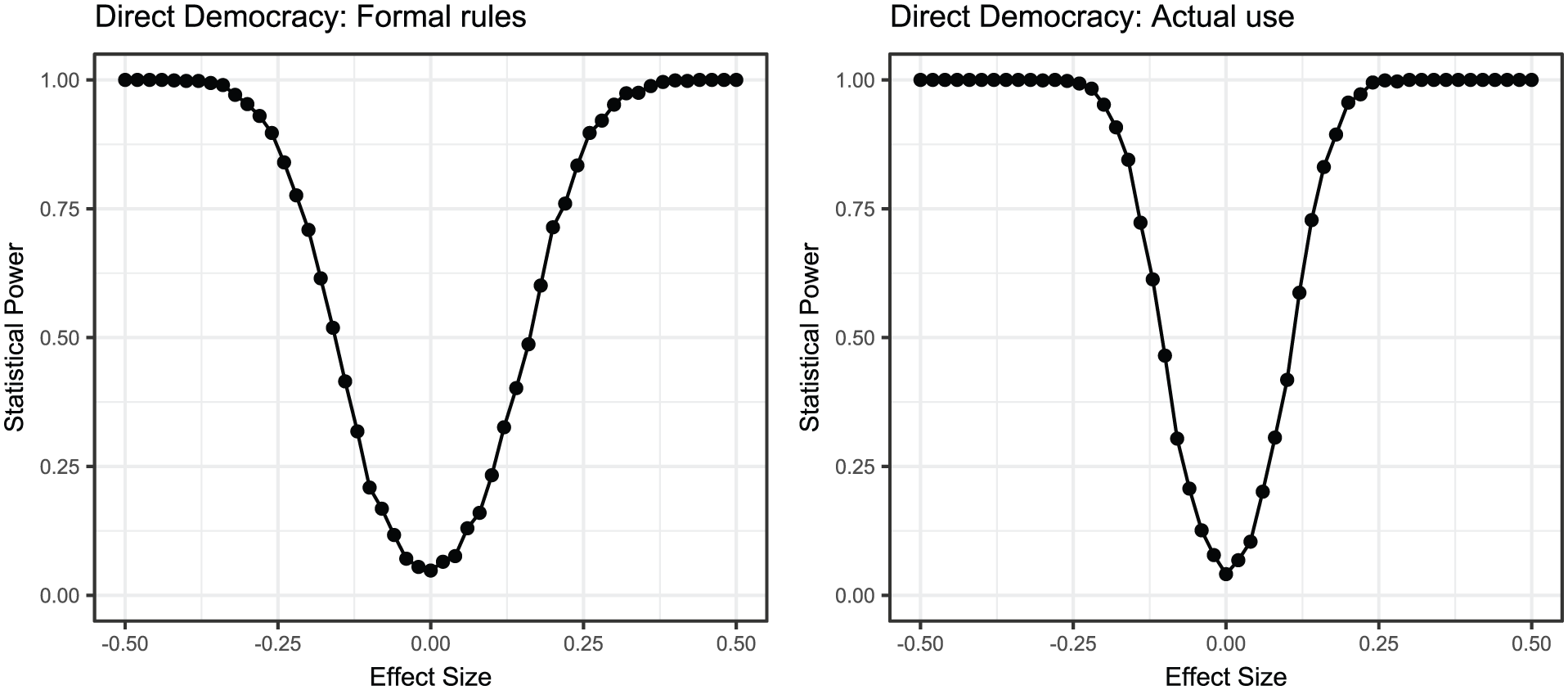
Statistical power of the study as a function of true effect size.
Conclusion
Recent studies have shown that citizens’ direct participation in decision-making generates policy outcomes that are (more) consistent with majority preferences. Moreover, research suggests that the institution of direct democracy has positive secondary consequences for citizens, such as enhancing voters’ political knowledge, and satisfaction with political decisions. However, little is known about how direct democratic procedures affect the behavior of political elites. In particular, no studies have, to the best of the author’s knowledge, examined whether direct participation in lawmaking increases politicians’ communicative responsiveness.
The effect of direct democracy on responsiveness is especially important given that “the main democratic power of direct democracy is that the political elite anticipate preference deviations and, in the case that voters have extensive direct democratic rights, follow the position held by (the large) majority of voters” (Leemann and Wasserfallen, 2016). Provided that legislators are both vote- and policy-seekers, they have incentives to respond to citizen-initiated contacts to gain knowledge about what citizens want to avoid any legislative blocking. In contexts where direct democracy is strong, representatives might also want to maintain control over political decision-making: responding to citizens’ policy requests provides them with the opportunity to explain their position to voters and shape public opinion. Therefore, we expected politicians to respond more frequently to voters’ policy requests when citizens have more opportunities to participate directly in lawmaking.
Our results show, however, that state elected officials are not more likely to respond to citizens’ policy requests when direct democratic rights are extensive. How can we explain this finding? It could be that politicians in cantons with more direct democracy receive more emails and that they are, therefore, less likely to notice and respond to them. This explanation is, however, unlikely since research suggests that direct democracy procedures do not automatically increase citizens’ political participation (see, e.g., Altman, 2012).
With regard to the literature on the indirect effect of direct democracy, our findings suggest that communicative responsiveness is not a central mechanism through which politicians can be informed about what the public wants or persuade voters to adopt certain viewpoints. There are, of course, other ways through which legislators can get informed about citizens’ preferences or persuade them to adopt their views. For instance, organized interests can play an important role in the aggregation of citizens’ preferences and are often integrated in the early stages of the legislative process to avoid blockages in lawmaking (Sciarini, 2007).
More importantly, however, not all voters and interest groups are equally active (and successful) in trying to reach out to politicians. For instance, studies have shown that legislators tend to represent the viewpoints of advantaged citizens (Giger et al., 2012; Gilens, 2012; Rosset, 2016). Therefore, legislators interested in passing policy (i.e. ensure themselves a victory in popular votes) and keeping their seat might want to take into account the preferences of the median voter rather than the preferences of citizens who contact them. In order to learn about the median voters’ position and persuade them effectively, legislators might best rely on other means than on one-to-one meetings with voters who contacted them, such as surveys, public meetings, or writing newspaper editorials. Put differently, there are alternative pathways than communicative responsiveness that can make politicians’ reactive to citizens’ concerns and needs. Future research should thus further examine how direct democratic rights affect political elites’ behavior.
Footnotes
Acknowledgements
I thank Daniel Butler, Nathalie Giger, and Joscha Legewie for their helpful comments on previous versions of this article.
Correction (March 2025):

Declaration of conflicting interest
The author declares that there is no conflict of interest.
Funding
The author gratefully acknowledges the financial support of the Swiss National Science Foundation (Grant Number: 164585).
Notes
Carnegie Corporation of New York Grant
This publication was made possible (in part) by a grant from Carnegie Corporation of New York. The statements made and views expressed are solely the responsibility of the author.