




Abstract
This research highlights the impact of state ballot measures on youth turnout. The primacy of ballot initiatives addressing issues salient to younger demographics, such as marijuana legalization and reproductive rights, varied across states, allowing for the statistical comparison of ballot initiative types by state and generational standing. By analyzing data from the 2022 election, this research extends prior studies, focusing on the role of ballot measures in mobilizing youth voters to test whether these mobilizing effects hold for a new generation entering voting age, as well as whether these effects persist for Millennials as they age into different life stages. Leveraging the Census Bureau’s Community Population Survey (CPS) November Voting Supplement File, this study models the impact of youth-salient ballot measures on voter turnout across different generational cohorts. The results reveal a significant association between the presence of youth-salient ballot measures and increased turnout among Millennial and Generation Z voters generally, and particularly for younger female voters. These findings show that when young voters are given the opportunity to vote on issues that are salient to them, they participate at higher rates.
Keywords
Introduction
Discourse after the 2022 midterm election largely centered on the expected “red tsunami” that failed to materialize. Republicans underperformed in swing districts and states, leading to an unexpectedly narrow Republican House majority and Democratic gains in the US Senate (Rutenberg et al., 2022). Instead of a uniform national increase, some states experienced relatively high levels of turnout for a midterm election, whereas others saw significant declines compared to 2018. While many explanations exist, ranging from candidate extremism to the overturning of Roe v Wade, we focus on the influence of the electoral environment, and more specifically the influence of topically important state ballot measures on turnout of younger voters. There were a variety of measures across the states that focused on issues salient to a critical block of voters- Millennial and Generation Z voters (National Conference of State Legislatures, 2025). Previous work has noted that young people can be brought out to vote when they are faced with issues they care about (LaCombe and Juelich 2019), and in this research note we investigate whether this dynamic persists in 2022.
This paper seeks to extend earlier work finding that salient ballot measures can boost young voter turnout (LaCombe and Juelich, 2019) now that Generation Z voters represent a block of nearly 33 million eligible voters, or 13.6% of the voting eligible population (McDonald, 2024). This growing block of new voters will play an increasingly large role in American politics, and it is also important to retest theories of age vs cohort as Millennials age to see whether the factors driving their turnout are more a function of their age or cohort experiences.
We see an important need to return to this question using updated data for several reasons. First, Generation Z voters now constitute a significant block of the voting population, providing an opportunity to test whether these voters behave similarly to how young Millennials did, or if the determinants of voting are distinct. Secondly, as Millennials continue to age, we have an opportunity to distinguish between cohort effects and aging. As Millennials age and gain some of the resources associated with voting (Brady et al., 1995), are they still mobilized by ballot measures? Lastly, the 2022 midterm elections shortly followed the overturning of Roe v Wade, leading to questions of whether voters were mobilized in general as part of a policy backlash, or whether increases in turnout were more so driven by ballot measures in select states where voters could directly address the issue.
We argue that measures salient to younger generations of voters should drive turnout among the very same voters because they do not feel the current party system responds to issues that matter to them. Young voters consistently report lower levels of satisfaction with democracy and are more likely to feel the system does not respond to their preferences or address issues they care about (Lawless and Logan Fox, 2015). Ballot measures provide a unique opportunity for these young voters to vote on issues that they care disproportionately about, just as in earlier eras measures banning same-sex marriage boosted turnout among Evangelical Christians (Campbell and Quin Monson, 2008; Smith, DeSantis and Kassel, 2006). We hypothesize that when more ballot measures are present that are salient to younger voter interests (such as measures on marijuana, abortion, and those that emphasize post-materialist values), young people should vote at higher rates.
To test our expectation, we first topic-coded state-wide ballot measures in the 2022 election by whether they highlight issues salient to younger generations of voters. We extend LaCombe and Juelich’s (2019) analysis using self-reported turnout from the Current Population Survey (CPS) and voter validated turnout Cooperative Election Survey (CES) to model turnout in the 2022 election by interacting the count of salient measures with a respondent’s generation. We find clear evidence that increased salient ballot measures increase voter turnout in general, and that the boost in turnout is much larger for Generation Z and Millennials. The effects are large enough in some cases to erase turnout differences between generations and add to a growing body of evidence that young people engage more in politics when they feel it addresses issues they care about.
Youth participation
Millennials have been documented to exhibit historically low rates of participation in politics. In the 2004–2016 presidential elections, 46–51% of Millennials cast a ballot, far outpaced by older generations who voted at rates of roughly 55–70% over the same period (Cilluffo and Fry, 2019). Even in the high turnout elections of 2018 and 2020, which saw increased youth turnout compared to past elections, Millennials still lagged their older counterparts. This trend of low youth turnout is not just a North American phenomenon, but also in many industrialized democracies (Franklin, 2004).
There are several explanations for declining participation among the younger generations, including the de-emphasis of civic education (Pasek et al., 2008) and civic organization membership (Putnam, 2000), a culture of skepticism toward political actors (Lawless and Logan Fox, 2015), institutional barriers holding back youth voters (Coll and Juelich, 2022; Juelich and Joseph 2021), a lack of youth-centered policies attracting young voters (Dalton, 2015; LaCombe and Juelich, 2019), and a lack of desire or willingness by campaigns to mobilize young voters (Nickerson, 2008; Rosenstone and Hansen, 1993). Nickerson (2008) finds that, though young voters are harder to contact, they are as likely to vote as older voters after being contacted. Similarly, Juelich and Joseph (2021) find that increased campaign contact may be a central reason why U.S. cities with ranked-choice voting have higher youth turnout. In ranked-choice voting elections, there is increased direct campaign contact, triggering higher rates of voter mobilization (Dowling et al., 2024), especially for younger voters (Coll and Juelich, 2022). Using similar logic, we argue that ballot measures, when comprising policy issues that are salient to younger voters, take young voters from observers to players in midterm elections.
In addition to the mobilizing effects of young voter contact, a litany of work by Dalton (2008; 2017) has shown that younger individuals are more willing to engage with politics when policies that affect them are highlighted by campaigns and candidates. LaCombe and Juelich (2019) find that youths are more likely to participate via direct democracy mechanisms when the ballot initiatives being voted on are salient to the younger generations (e.g., marijuana). Not only do these measures provide an opportunity to vote directly on issues that young people care about, but increased ballot measures result in more campaign spending and opportunities to directly contact and communicate with voters to mobilize them. For example, almost $70 million was spent on the campaign over Michigan’s Proposal 3, a measure to codify reproductive rights in the state constitution (Ballotpedia 2022). Nationally, over $1 billion was spent on statewide ballot measure campaigns (Ballotpedia 2022), and when these measures focus on issues salient to youth, not only do these issues play a larger role in discussions around the election, but they also provide more opportunities for campaign contact. Overall, these studies paint a picture regarding what gets young people to participate in politics: when they are engaged by political issues, younger individuals are more likely to interact with the political system. These findings suggest that, when young people get the opportunity to directly engage with policies that are important to them, they vote.
Direct democracy
Every state has some form of direct democracy, be it the initiative process, referendums, or both, although there is significant institutional variation in whether they have the initiative process and the ease of qualifying measures on the ballot (Bowler and Todd, 2004). While ballot measures are used to accomplish specific policy goals, their use changes the election environment for states, and a voter’s incentive structure to turn out. Most notably, there is a growing body of literature showing that when there is even one initiative on a ballot, there is an increase in voter turnout (Tolbert et al., 2001). Additionally, Biggers (2014) argues in Morality at the Ballot Box, that when policies are framed as moral (or not), voters turnout at higher rates, especially in low-salient elections like midterms.
Ballot initiatives are opportunities for the average citizen to have a direct say in the legislative agenda within a state. They not only allow the average citizen a say in the direct outcome of legislation, but the process has been observed to motivate less frequent participants to vote in elections (Schlozman and Yohai, 2008; Smith and Tolbert, 2009; Tolbert and Smith, 2005). The low turnout environment historically seen in midterm elections creates an opportunity for interest groups and parties to focus on issues to mobilize low propensity voters, including through ballot measures (Anzia, 2011, 2013).
Previous elections have seen ballot measures disproportionately affect turnout among groups of citizens when they focus on issues that are salient to them. In the 2000s ballot measures codifying bans on same-sex marriage emerged as a way to mobilize conservative Christians and Evangelical Voters (Campbell and Quin Monson, 2008; Smith, DeSantis and Kassel, 2006). These studies did not find evidence that churches were pushing parishioners to vote, but rather an individual motivation was at play- conservative Christians felt disproportionately passionate about the issue, and the mobilization from the measures comparatively increased their turnout. This reinforces Nicholson’s (2008) claim that direct democracy has the greatest impact when voters are informed about ballot measures. Holding all else constant, ballot measure usage increases turnout above and beyond the effect of having a direct democratic process.
Youth voters and direct democracy
Most young Americans are non-habituated voters but have strong and serious concerns for salient issues like higher education reform, abortion rights, and marijuana liberalization that outpace older generations (Rouse and Ross, 2018; Schmit et al., 2016). While Millennials and Generation Z are less likely to vote, donate money, and contact legislators than previous generations (Franklin, 2004; Henn et al., 2005; Klecka, 1971), there is evidence that when campaigns or elections focus on issues that young people care about, they can be mobilized. For example, the Obama campaign’s success in mobilizing young voters led to exploration as to why youth turnout was higher in 2008 but not in 2012, 2014, and 2016. Some of these scholars found that the youth are not participating in politics as much as other generational cohorts because of perceptions of the current political system being unresponsive or corrupt (Lawless and Logan Fox, 2015).
High levels of Millennial disenchantment with the democratic process (Foa and Mounk, 2016) stem from a lack of policies that reflect their preferences. Many Millennials and members of Generation Z feel that traditional policy-making institutions are unresponsive, leading them to view voting as less meaningful (Lawless and Logan Fox, 2015). For youth voters ballot measures represent a direct avenue for these voters to influence legislation aligned with their priorities. A similar pattern is seen in off-year elections, where individuals with a personal stake in the outcome, such as members of affected interest groups, tend to vote at disproportionately high rates (Anzia, 2011, 2013).
As observed in LaCombe and Juelich (2019), ballot measures on post-materialist issues (marijuana legalization and increasing funding to higher education), increases rates of Millennial voting. Ballot measures were also seen to erase differences in turnout levels between Millennials and older generations, especially during midterm elections. The paper examined voting records between 2002 and 2016 to assess if youths in states that had initiatives on the ballot that focused on marijuana legalization or higher education funding. Analyzing the 2022 midterm election in comparison to the 2002-2016 findings would provide two important additions to this vein of direct democracy studies. First, it could act as a litmus test for the veracity of the original findings with the addition of a new generation of voters (Generation Z). Second, if 2022 turnout rates based on post-materialist ballot initiatives being on the ballot do not follow the 2002-2016 trends, it could indicate a mass socialization of an age cohort, possibly beginning in 2018. This could be an indication of a shift from the apathetic voter model to a new model of voting for the youngest two generations.
The presence of additional ballot measures that are salient to young voters in a state will disproportionately increase turnout among Millennial and Generation Z voters.
Case selection: 2022 Elections
We extend the research from LaCombe and Juelich (2019) to evaluate whether these turnout effects can be found in the 2022 election. The 2022 election represents an ideal test case to evaluate theories of youth participation due to the large variation in state turnout (McDonald, 2024) and differing Republican under- or overperformance across states. National turnout dropped from 50% of the voting-eligible population in 2018 to 46.20% in 2022, but there was considerable fluctuation by state. Florida and New York saw a 6.2% and 3.2% drop in turnout rate, respectively, whereas Michigan and Arkansas saw increases, and other states with measures saw turnout remain relatively flat or had smaller decreases (McDonald, 2024). These large variations in state turnout and electoral performance suggest that state factors (potentially including ballot measures) are driving differential turnout rather than national factors, and previous work has found that ballot measures can boost turnout more in otherwise low-turnout electoral environments such as midterms (Biggers, 2014; Schlozman and Yohai, 2008). Additionally, as Generation Z Americans become eligible to vote (and now make up a large enough proportion of survey data to incorporate into models), there is a need to examine whether these turnout effects are specific to Millennials or apply to Generation Z as well. Similarly, as Millennials age, we can further evaluate cohort vs life cycle effects to see if post-materialist values still mobilize this generation.
Lastly, the 2022 election cycle saw many ballot measures across the states qualify centered around issues more salient to youth voters. On election night, voters in Arkansas, Maryland, Missouri, North Dakota, and South Dakota went to the polls to vote on making recreational marijuana legal (National Conference of State Legislatures, 2025). Similarly, voters in California, Michigan, Kentucky, Montana, and Vermont were able to vote directly on reproductive rights, with every state voting in favor of the pro-choice position (Ballotpedia, 2022). Both of these issues are ones that disproportionately affect younger generations and are on topics that are more salient to them (LaComb and Juelich, 2019). We see 2022 as an opportunity to extend this research and evaluate whether turnout effects can replicate in new electoral environments.
Data and methods
Our modeling approach extends LaCombe and Juelich’s (2019) research by replicating the analysis on a new data source. Like the original paper, we use the Census Bureau’s Community Population Survey (CPS) November Voting Supplement File. 1 This national survey is representative of the civilian population 16 years and older (only those 18 and older are included in the analysis). This telephone survey includes nearly 61,000 individual turnout records for the 2022 election, and sampling is stratified to create a representative file of adult citizens. Our dependent variable is a binary variable indicating whether a citizen voted in the 2022 election.
Number of Observations by Generation.

We collect data from the National Conference of State Legislatures’ (NCSL) Statewide Ballot Measures Database for 2022 ballot measures (both referendum and initiatives). After collecting the measures, we hand-coded them as being on topics that are salient to young voters or not. We follow the same logic as LaCombe and Juelich (2019) by coding measures as salient to young voters if they are issues where young voters diverge from other generations, either in their level of support for a given policy or the salience of it. This includes measures that expand legalization of recreational or medicinal marijuana, as well as expanding access to higher education. Given the aftermath of the 2022 Jackson Women’s Health Organization Vs Dobbs (2022) decision, we also coded the five state ballot measures regulating abortion rights at the state level. Measures that protect the environment or focus on combating climate change are coded as salient, given the disproportionate salience of these issues to young voters. Lastly, we topic coded measures as salient to young voters if they emphasized post-materialist values, such as expanding rights for self-expression or suffrage, advanced LGBTQ rights, or took a rehabilitative approach towards criminal justice.
Out of the 132 total measures in the 2022 generation election, 29 measures were defined as salient to young people’s interests. California had the most measures (4), while 28 states had no measures defined as salient to young voters (see appendix for number of salient measures and total measures by state, as well as summary statistics). Figure 1 shows the geographic distribution of measures. Unsurprisingly, these measures are more common in initiative states. There is significant heterogeneity in state partisan control and ideology, with salient measures being found both in the conservative (Mississippi, Tennessee) and liberal states (California, Vermont), as well as swing states (Michigan, Arizona, Nevada). We interact the count of a state’s measures with each generational measure to test whether these measures disproportionately drive young voter turnout compared to other generations. Distribution of salient ballot measures.
We estimate linear probability models (LPM) and parallel logistic regression models with state fixed-effects and standard errors clustered by state. This absorbs state-level variation that we do not control for, which might influence a state’s baseline turnout. We use CPS data to collect control variables for age, race, gender, income, and education. Both age and generation are included to distinguish between cohort and life-cycle effects. We also include indicators for a competitive gubernatorial or senate race in 2022 (defined as the final margin between the top two candidates as being less than 10%), and a measure for whether a state had a competitive presidential election in 2020 (less than a 10% margin between Trump and Biden). Lastly, we include Schraufnagel et al.’s (2022) update to the Cost of Voting Index for the 2022 election to account for differences in electoral laws. Higher values indicate there are more barriers to voting, while lower values indicate voting has a lower cost.
Like the original analysis, we estimate parallel models with and without interactions, as well as a model for just states with the initiative process to control for the possibility that initiative states in general may have a fundamentally distinct political environment that fosters differing levels of participation. This also allows us to make a direct comparison to LaCombe and Juelich’s (2019) analysis to test whether these salient measures still have the potential to boost voter turnout for younger voters. Like the original analysis, we include individual-level controls for sex, age, education, race, and income. While the CPS does not include data on individual level partisanship, we do estimate models with and without indicators for party ID using CES data and our results are unchanged. We also do not find that salient measures have a unique turnout effect by partisan identification. As a robustness check, we estimate models using CES measures of self-reported and validated turnout. Research has used voter file databases to identify difference in turnout among groups of voters (Fraga 2018; Stauffer and Fraga 2022). Given issues of over-reporting turnout in survey data, a comparison between self-report and validated turnout gives us more confidence in the findings. We include the same control variables and use the same model specification for CES data.
Lastly, one alternative explanation could be that direct democracy usage itself might reflect post-materialist values for participation and democracy. Therefore, in the appendix, we estimated parallel models interacting a count of all a state’s ballot measures with the generation, as well as another set of models with a count of non-salient measures only. In both sets of alternative models, we find that as the number of measures increases, so does turnout, but that the boost in turnout is not significantly different for younger generations compared to others. Lastly, given the centrality of abortion rights to the 2022 election, we estimate a set of parallel models only for younger voters to evaluate whether the turnout effects were concentrated more on women voters. In this subsample analysis, we interact our count of salient measures with a binary indicator for gender.
Results
Predicting Voter Turnout- 2022.

Standard errors in parentheses, clustered by state, fixed effects by state. *p < .1, **p < .05, ***p < .01.
Model 1 interacts with the number of salient measures with generation. We find support for our hypothesis and replicate LaCombe and Juelich’s (2019) finding that salient measures are associated with greater turnout boosts for Millennials and Generation Z. 3 For Generation Z respondents, this interactive effect grows slightly when analysis is constrained to just initiative states. Taken together, these findings show that younger generations are disproportionately more likely to vote when there are more ballot measures salient to their interests.
To fully interpret the interaction, we generate predicted probabilities using the Margins command in Stata 18
4
. For ease of interpretation, we present each generation in a separate plot. As can be seen in Figure 2, for every generation, there is an increase in turnout as the number of measures increases, but the slopes are much steeper for Millennials and Generation Z respondents. The results are also substantively large with respect to changes in predicted turnout. Holding all else constant, the predicted increase in percentage points for each additional measure by generation is 3.2% for Generation Z, 4.4% for Millennials, 1.8% for Generation X, 2.3% for Baby Boomers, and 1.3% for the Silent Generation. Simply put, these measures increase turnout for every generation but disproportionately are associated with higher turnout among the younger generations, sometimes boosting turnout by 2-3 more times for young voters. The larger predicted effects erase turnout differentials to the point that young voters are no less likely to vote than Baby Boomers, holding all else constant, when there are three or more salient measures on the ballot.
5
Predicted probability of turnout by generation and number of salient measures.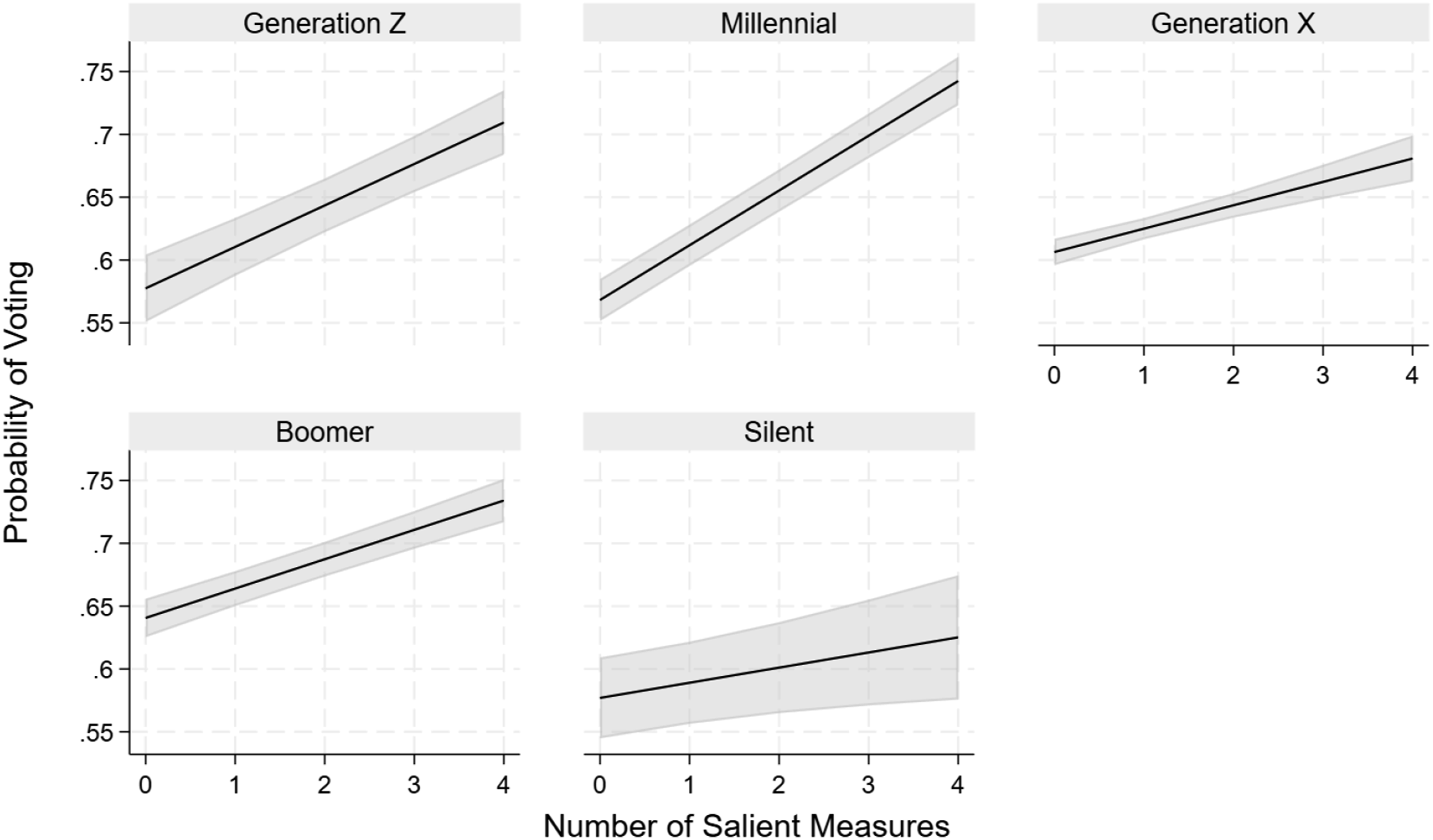
We find further support for our hypothesis in Model 3. If we restrict analysis to just states with the initiative process, we find even starker turnout effects by generation. Holding all else constant, increases in the number of measures has no effect on turnout rates for Generation X, Baby Boomers, or Silent Generation respondents. When plotting the interaction (see appendix) we can see that Generation Z and Millennial turnout increases by roughly 3.2 percentage points per additional measure, but that other generations see no change. These models show that young voters are being activated when ballot measures focus on issues they care about.
The control variables operate as expected. Wealthier and more educated voters are more likely to turn out, and turnout is significantly lower as the cost of voting increases. We also find that Hispanic turnout is lower than White turnout, while Black voters turn out at somewhat higher rates, depending on the specification, although the difference is smaller. Competitive elections generally see higher turnout rates, and campaign spending is not associated with higher or lower turnout. In sum, we replicate earlier findings that show younger generations turn out more when the electoral environment addresses issues they care about. 6
Predicting Voter Turnout for Using CES Data (Validated and Self-Reported Vote).

Linear Probability models. Standard errors in parentheses, fixed effects and clustered standard errors by state. *p < .1. **p < .05. ***p < .01.
Linear Probability Model Predicting Voter Turnout for Younger Generations Only.

Standard errors in parentheses, fixed effects and clustered standard errors by state. *p < .1. **p < .05. ***p < .01.
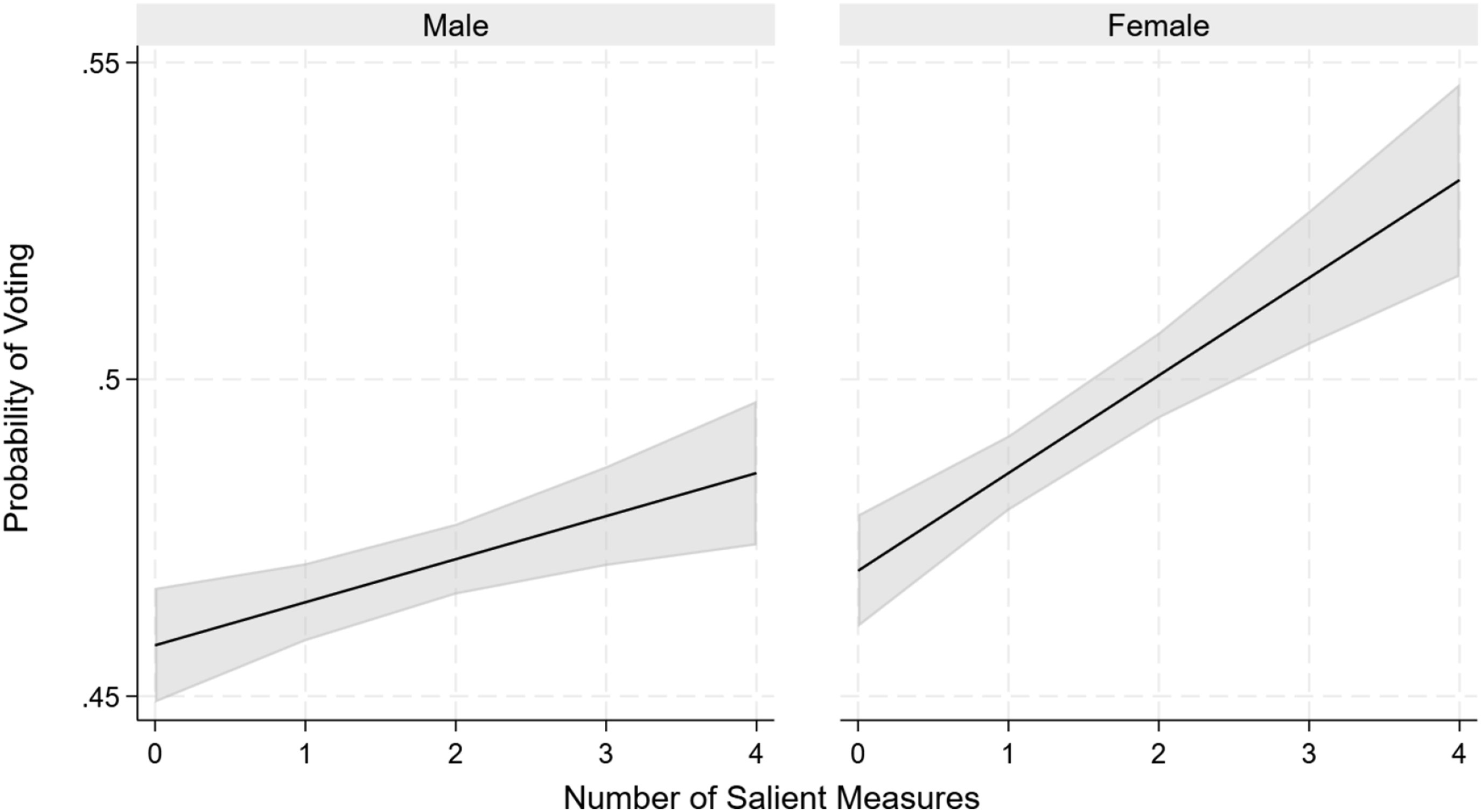
Predicted turnout by sex for generation Z and millennial voters.
Across the three sets of models, we find clear evidence that when ballot measures are present that are salient to Generation Z and Millennial interests, they increase turnout among these groups. Additionally, increased focus does not appear to come at the cost of lower political engagement for older generations, and there is some evidence that it may increase turnout among voters generally, just by less than for younger generations.
Conclusion
This paper returns to an enduring question about youth political participation. Existing research proposes a variety of reasons for lowered youth participation, ranging from a lack of habitual voting (Pluzter, 2002) to a lack of resources, or emphasis on nontraditional forms of political participation (Dalton 2013, 2015, 2017). We specifically focus on a common critique levied by youth voters that the political system does not respond to their distinct preferences. Millennial and Generation Z voters have distinct views across a variety of policies compared to older generations, and ballot measures provide a unique opportunity for voters to bypass the existing party system to vote on specific issues that are salient to them.
We use 2022 CPS data and replicate earlier findings from LaCombe and Juelich (2019) showing that when an electoral environment includes topics that are salient to younger generations of voters, then young voter turnout is higher. Higher numbers of salient ballot measures are associated with disproportionately higher Millennial and Generation Z turnout. This suggests there is considerable upside for politicians or activists to incorporate issues that younger generations care about that have been historically de-prioritized by the political parties and shows that Generation Z voters are behaving in similar ways to their Millennial counterparts at similar life stages. Responding to these concerns boosts youth turnout considerably, and there is no evidence that it lowers turnout for other groups of voters. In states that emphasized issues youth voters care about turnout was higher among demographics critical to the Democratic coalition. When young citizens have an opportunity to vote on issues they care about, they are more likely to participate.
When diving deeper into the data, we can see that turnout effects are even larger for young women, which might be attributed to the prominence of abortion rights in the 2022 election, but this effect is not larger for Democrats. Diving further into the data, we estimated models using just indicators for abortion or marijuana legislation respectively and found that the boost in turnout for young voters specifically can be attributed more to abortion ballot measures, but in both cases youth turnout was higher in states with marijuana or abortion measures (see appendix for predicted probabilities). However, even if we remove both abortion and marijuana measures, the remaining measures emphasizing post-materialist values still are associated with higher turnout among younger respondents. Even though abortion may have played a unique role in the 2022 elections, we still find persistent, robust evidence that ballot measures across a range of issues young people care about can help drive turnout among these relatively unengaged voters.
Footnotes
Declaration of conflicting interests
The author(s) declared no potential conflicts of interest with respect to the research, authorship, and/or publication of this article.
Funding
The author(s) received no financial support for the research, authorship, and/or publication of this article.

Supplemental Material
Carnegie Corporation of New York Grant
This publication was made possible (in part) by a grant from the Carnegie Corporation of New York. The statements made and views expressed are solely the responsibility of the author.
Notes
Appendix
Predicted probabilities of turnout for initiative states only.
Predicted turnout in states with and without marijuana ballot measures by generation.
Predicted turnout in states with and without abortion ballot measures by generation.
Modeling Voter Turnout- all Ballot Measures. Standard errors in parentheses, clustered by state, fixed effects by state. *p < .1. **p < .05, ***p < .01.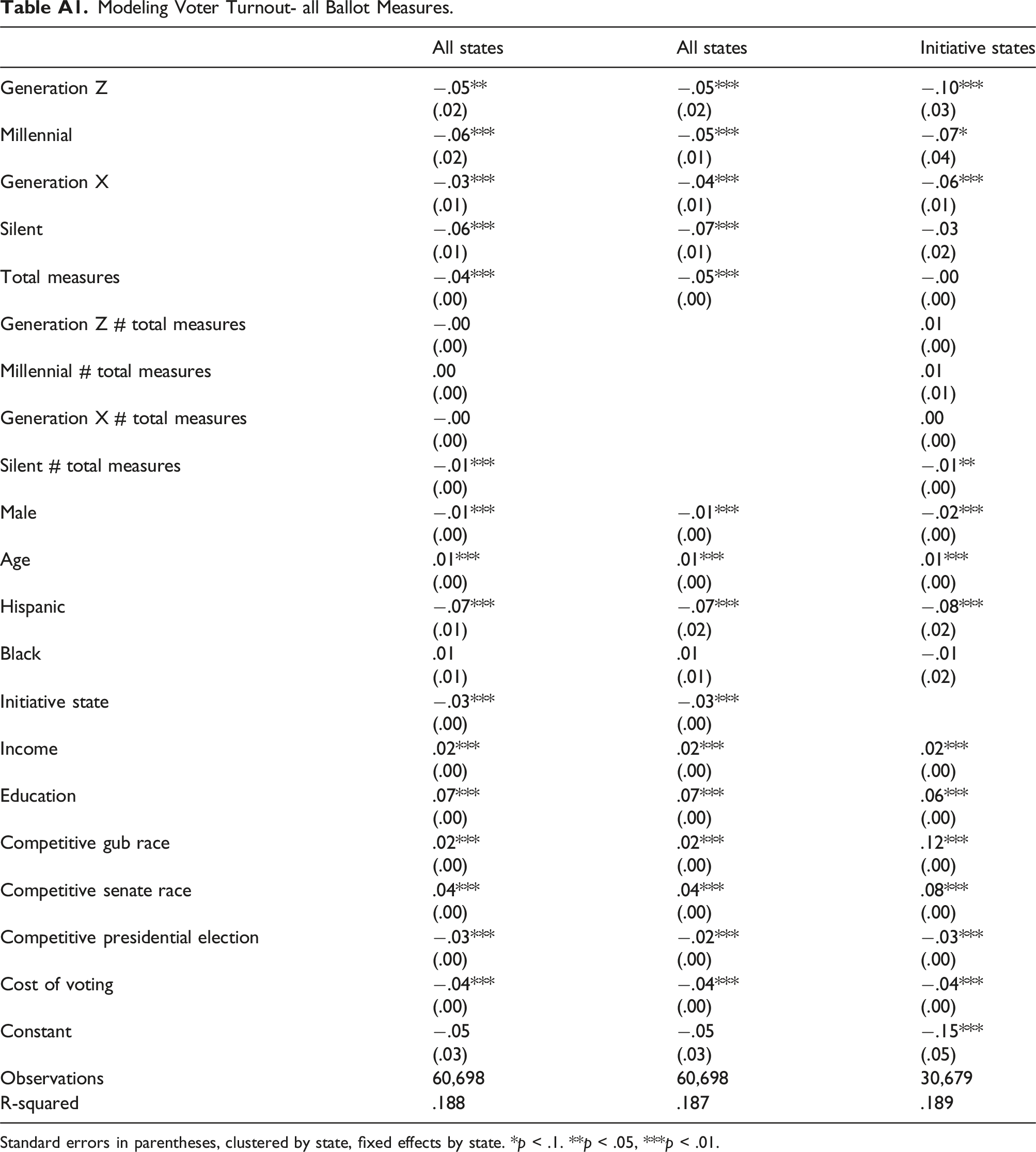
All states
All states
Initiative states
Generation Z
−.05**
−.05***
−.10***
(.02)
(.02)
(.03)
Millennial
−.06***
−.05***
−.07*
(.02)
(.01)
(.04)
Generation X
−.03***
−.04***
−.06***
(.01)
(.01)
(.01)
Silent
−.06***
−.07***
−.03
(.01)
(.01)
(.02)
Total measures
−.04***
−.05***
−.00
(.00)
(.00)
(.00)
Generation Z # total measures
−.00
.01
(.00)
(.00)
Millennial # total measures
.00
.01
(.00)
(.01)
Generation X # total measures
−.00
.00
(.00)
(.00)
Silent # total measures
−.01***
−.01**
(.00)
(.00)
Male
−.01***
−.01***
−.02***
(.00)
(.00)
(.00)
Age
.01***
.01***
.01***
(.00)
(.00)
(.00)
Hispanic
−.07***
−.07***
−.08***
(.01)
(.02)
(.02)
Black
.01
.01
−.01
(.01)
(.01)
(.02)
Initiative state
−.03***
−.03***
(.00)
(.00)
Income
.02***
.02***
.02***
(.00)
(.00)
(.00)
Education
.07***
.07***
.06***
(.00)
(.00)
(.00)
Competitive gub race
.02***
.02***
.12***
(.00)
(.00)
(.00)
Competitive senate race
.04***
.04***
.08***
(.00)
(.00)
(.00)
Competitive presidential election
−.03***
−.02***
−.03***
(.00)
(.00)
(.00)
Cost of voting
−.04***
−.04***
−.04***
(.00)
(.00)
(.00)
Constant
−.05
−.05
−.15***
(.03)
(.03)
(.05)
Observations
60,698
60,698
30,679
R-squared
.188
.187
.189
Descriptive Statistics.
Mean
SD
Min
Max
Voted
.6353092
.4813473
0
1
Gen Z
.1026887
.3035544
0
1
Millennial
.2534845
.4350094
0
1
Generation X
.2401397
.4271717
0
1
Baby boomer
.3221852
.4673174
0
1
Silent/Greatest
.0943359
.2922979
0
1
Male
.4766714
.4994596
0
1
Age
51.32074
18.5558
18
85
Hispanic
.1032324
.3042647
0
1
Black
.0932156
.2907367
0
1
Initiative state
.5054368
.4999746
0
1
Income
12.26892
3.646332
1
16
Education
3.497677
1.57687
1
6
Federal campaign spending (standardized)
.0129913
1.00634
−1.106503
4.743936
Competitive gub race
.1650796
.3712554
0
1
Competitive senate race
.1722792
.377626
0
1
Competitive presidential election
.2425286
.4286158
0
1
Cost of voting
.0068547
.9520702
−1.992395
1.454379
Observations
60,698