




Abstract
Beliefs in conspiracy theories about controversial issues are often strongly influenced by people’s existing beliefs and attitudes. We leverage a prominent football-related controversy – the US National Football League’s “Deflategate” scandal – to investigate how factual perceptions and conspiracy beliefs vary by fan loyalties to sports teams. Using an original survey sample, we explore two key drivers of conspiratorial beliefs about the scandal. First, we analyze how beliefs about Deflategate vary by respondents’ loyalties towards the New England Patriots. We find that beliefs are not only highly polarized by team loyalty but that the gaps are largest among more interested and knowledgeable fans, suggesting that individuals are processing the information they receive in a highly motivated fashion. Second, we find that individuals who endorse unrelated political conspiracy theories are also more likely to endorse two key conspiratorial claims about Deflategate. However, priming group solidarity and elite resentment – two possible motivations for the prevalence of conspiracy theories around controversial issues like Deflategate – does not have a significant effect.
Introduction
Conspiracy theories are pervasive in politics as well as in debates over food, health, and even sports (e.g. Bowman and Rugg, 2013; Gaines, 2014; Goertzel, 2011, Shiva, 2014). However, relatively little is known about why so many people endorse these often-unverified claims or how to most effectively correct them.
Previous research indicates that conspiratorial beliefs about controversial issues are strongly influenced by people’s existing beliefs and attitudes (e.g. Oliver and Wood, 2014; Pasek et al., 2014). As theories of motivated reasoning suggest (e.g. Lord et al., 1979; Taber and Lodge, 2006), people tend to accept conspiracy claims that are consistent with their predispositions and reject those that are counter-attitudinal. These biases are often tribal in nature – people tend to hold beliefs that are consistent with in-group views (see, e.g., Hardin and Higgins, 1996; Suhay, 2015). Research also shows that people are susceptible to false or unsupported beliefs about outgroups (see, e.g., Kosloff et al., 2010; Pyszczynski et al., 2010), especially when the target is a powerful elite (Uscinski and Parent, 2014).
Surprisingly, the tendency to endorse belief-consistent conspiracy theories may be more prevalent among the most knowledgeable people, who are often more motivated to challenge belief-inconsistent information and more capable of doing so effectively (Zaller, 1992). As a result, though more knowledgeable or educated people are least likely to believe in fringe conspiracy theories, the expected relationship can be reversed within groups such as political parties where belief in a particular conspiracy is prevalent (see, e.g., Nyhan, 2012; Nyhan et al., 2013).
However, previous research on political conspiracy beliefs has not fully separated the effects of group loyalties from other characteristics that might be correlated with group membership. For instance, Republicans are more likely to believe in the so-called birther conspiracy theory than Democrats (Pasek et al., 2014), but the two groups also differ on many observable and unobservable characteristics that could affect beliefs about Obama’s citizenship. By contrast, loyalties to sports teams also generate strong directional preferences but are largely determined by geography and are thus likely to be orthogonal to many characteristics that are associated with conspiracy beliefs (Tainsky and Stodolska, 2010).
We therefore leverage a prominent football-related controversy – the US National Football League (NFL) “Deflategate” scandal – to investigate how factual perceptions and conspiracy beliefs vary by fans’ arbitrary but deep loyalties to sports teams. Using a unique survey distributed by SurveyMonkey, an online survey platform company, we polled a large number of respondents both inside and outside “Patriots Nation” about the scandal. This research design allows us to explore two key aspects of the alleged conspiracy.
First, we show that factual perceptions not only vary widely according to team loyalty, but are more polarized among more knowledgeable fans, suggesting that individuals process the information they receive in a highly motivated fashion. Consistent with previous research (e.g., Goertzel, 1994; Swami et al., 2011), individuals who endorse unrelated political conspiracy theories are also more likely to endorse two key conspiratorial claims about Deflategate.
Second, we provide the results of an experiment embedded in the survey that primes two possible motivations for the prevalence of conspiracy theories around controversial issues like Deflategate – resentment toward the elites who are the supposed conspirators and pressure to remain loyal to an in-group – that are often confounded with group membership in politics. However, when we prime these motivations individually, neither has a substantial effect on conspiracy beliefs or factual perceptions.
Theory and context
The “Deflategate” controversy
The central allegation in the scandal known as “Deflategate” is that New England Patriots quarterback Tom Brady conspired to reduce the air pressure in footballs that the team used in a playoff game (see Online Appendix A for a summary of the controversy at the time the survey was fielded). In the months following the initial accusations, Patriots fans, as well as fans of other NFL teams offered numerous accounts of the disputed events, many of which can be characterized as conspiracy theories. Though many definitions of the term exist, we define a conspiracy theory as an explanation of events “which cites as a main causal factor a small group of powerful persons (the conspirators) acting in secret for their own benefit, against the common good” (Uscinski and Parent, 2014: 32). 1
We reviewed media and Internet coverage of the Deflategate affair and identified three notable conspiracy theories in discussions of the controversy.
It is important to note that the facts of the deflation controversy remain unclear. In particular, the evidence in the report commissioned by the NFL (Wells et al., 2015) has been widely questioned (see, e.g., Hassett et al., 2015: 10–11). In this paper, we therefore do not take a position on the veracity of any of the alleged conspiracies described above.
Hypotheses
We pre-registered the following hypotheses (http://egap.org/content/motivated-reasoning-group-and-anti-elite-bias-and-nfl-deflategate-controversy). 3
Respondent favorability toward the Patriots and ties to the New England region will be positively associated with disbelief that Brady violated NFL rules and belief that he was punished to distract from the NFL’s problems and negatively associated with belief that the judge in Brady’s appeal was unduly influenced.
H2a: The relationship between Patriot favorability/New England ties and belief in attitude-consistent conspiracy theories about Deflategate (either pro- or anti-Brady) will be stronger among respondents with more interest in/knowledge of football in general and the details of the Deflategate controversy specifically. H2b: The relationship between Patriot favorability/New England ties and belief in pro- or anti-Brady conspiracies will be stronger among respondents predisposed toward conspiracy belief (as measured by their average belief in two political conspiracy theories conditional on party).
H3a: The relationship between Patriot favorability/New England ties and belief in attitude-consistent conspiracy theories about Deflategate (either pro- or anti-Brady) will be stronger among respondents primed to feel a greater sense of group solidarity. H3b: The relationship between Patriot favorability/New England ties and belief in attitude-consistent conspiracy theories about Deflategate will be stronger among respondents primed to feel a greater sense of resentment toward elites.
H1 is the simplest test of motivated reasoning. We expect Patriots fans to absolve Brady, distrust Goodell, and regard Berman’s decision as objective and just, whereas fans of other teams should do the converse.
H2a predicts that motivated reasoning should be stronger among respondents who are more invested in football and thus have stronger directional preferences. 4 On the other hand, H2b suggests that a predisposition to believe in conspiracies should amplify the effects of motivated reasoning stemming from team loyalty. 5
Finally, H3a and H3b describe the expected effects of our experimental treatments in priming group solidarity and elite resentment (described further below). If the group solidarity hypothesis is correct, the prime should prompt fans to rally to the cause of their side, amplifying the beliefs associated with motivated reasoning. The elite resentment prime should similarly rally Patriots fans against Goodell and the NFL (the elites whom they saw as the villains) and drive Patriots opponents toward stronger anti-Brady beliefs (by reminding them of a hated dynasty).
Methods
Sample
We fielded an original online survey of 2,920 respondents from September 15–19, 2015. The survey was conducted using SurveyMonkey Audience, an online nonprobability Web panel of respondents recruited from over 30 million people who complete surveys on SurveyMonkey’s platform every month. The sample, while not representative, was diverse and included a large oversample of 1,407 respondents in New England (see Online Appendix B for details). Apart from the New England oversample, no quotas or weights were used in sampling or analysis of the data. The approval of the human subjects committee at Dartmouth College was obtained prior to fielding the survey (CPHS STUDY00029026).
Outcome measures
The key outcome of interest is a respondent’s level of belief in the three Deflategate conspiracies described above. We measured the perceived accuracy of four statements on a four-point scale (see Online Appendix B for question wording):
Deflate
“Tom Brady broke the NFL’s rules by directing team personnel to tamper with the footballs used in the playoffs last season.” (reverse-coded)
“There’s no solid evidence that Tom Brady did anything wrong during the playoffs last season.”
Distract
“The NFL is trying to punish Tom Brady in order to distract people from the league’s other problems.”
Absolve
“The judge’s ruling overturning Brady’s suspension has more to do with money and influence than with the facts of the case.” (reverse-coded)
Independent variables
The survey also measured several respondent characteristics that might affect motivated reasoning or conspiracy predispositions (wording in Online Appendix B):
US state of birth (New England = 1, elsewhere/not born in US = 0)
US state of residence (New England = 1, elsewhere = 0)
Favorite NFL team (Patriots = 1, another team/none/missing = 0) 6
Feelings toward Tom Brady (0–100 feeling thermometer scale)
Frequency of viewership of NFL games on television
Extent of ownership of NFL team clothing
Correct responses to three multiple-choice questions about the controversy 7
Belief in 9/11 “inside job” conspiracy
Belief in Obama “birther” conspiracy
Experimental treatments
Respondents were assigned to a placebo essay task or to treatments that primed respondents to think about group loyalties or elite resentments.
Compliance rates were high for the essay (response rates: 96% controls, 77% group solidarity, and 86% elite resentment). Responses generally reflected the assigned topic.
Statistical analysis
Below we report the results of our pre-registered hypothesis tests as well as some additional analyses (all deviations are labeled). We used ordinary least squares with robust standard errors for all statistical tests. All treatment effects are estimated as intent-to-treat effects.
Results
H1: Motivated reasoning
Our principal outcome measure is a composite index of Deflategate conspiracy beliefs that represents the mean of our four outcome measures after reverse-coding them to be directionally consistent. 8 Higher values indicate what we refer to as more pro-Brady beliefs, which includes greater belief that Brady did not break the rules and is being punished by the NFL to distract the public as well as greater disbelief in evidence of wrongdoing by Brady or judicial favoritism. Low values correspondingly indicate the converse. (We also conduct exploratory analyses of the relationship between Patriots favorability and each outcome measure separately as described below. See Online Appendix C for summary statistics.)
To test the relationship between respondents’ views of the Patriots and Brady and their beliefs about Deflategate (H1), we regressed our index of pro-Brady beliefs on our estimates of Patriots favorability, interest in NFL football, inclination toward conspiracy belief, and a set of basic demographic indicators. 9 The results in Table 1 confirm that the relationship between Patriot favorability and pro-Brady beliefs is very strong for the composite measure (model 1) as well as exploratory analyses of each of the four individual outcome variables. Respondents with favorable views of Brady and the Patriots were significantly more likely to believe that there was no evidence Brady did anything wrong and that the NFL was using the controversy to distract from the league’s problems. In addition, these respondents were less likely to believe that Brady broke any rules or that the judge was swayed by Brady’s influence and wealth. Figure 1 illustrates this relationship for belief in the distraction measure, which is perhaps the most prominent conspiracy theory among Patriots fans. Non-Patriots fans are nearly twice as likely as Patriots fans to regard that theory as not at all or not very accurate. 10
Motivated reasoning in Deflategate beliefs.

Ordinary least squares coefficients with robust standard errors in parentheses. The composite pro-Brady belief measure is the mean of the four outcome variables after the outcome variables in models 2 and 5 were reverse-coded (see text and Online Appendix A for details). *p < 0.10; **p < 0.05; ***p < 0.01.
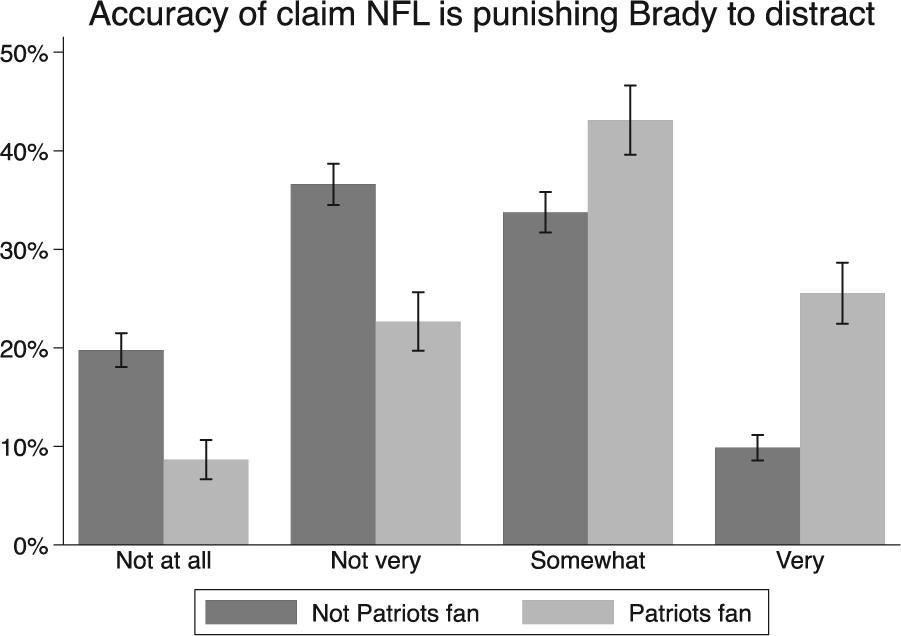
Belief in the US National Football League (NFL) distraction conspiracy by Patriots fandom.
H2: Motivated and conspiratorial subgroups
We predicted that the association between views of the Patriots and pro-Brady beliefs would be stronger among respondents who were more interested in the NFL and knowledgeable about Deflategate. Because these characteristics loaded on separate dimensions in a principal components factor analysis, we estimate two models to test H2a, estimating separately whether the relationship between Patriots fandom and conspiracy beliefs varies by NFL interest and Deflategate knowledge (see Table 2).
Motivated subgroups by interest/knowledge.

Coefficients from ordinary least squares models of composite pro-Brady beliefs (see text and Online Appendix A for details) robust standard errors in parentheses. *p < 0.10; **p < 0.05; ***p < 0.01.
We find that the relationship between Patriots favorability and attitude-consistent beliefs is much stronger among the most devoted and knowledgeable fans (this relationship holds for each of the four individual outcome variables as well – see Tables C2 and C3 in the Online Appendix). To illustrate this finding, Figure 2 shows how responses to the statement that the NFL punished Brady to distract from the league’s public relations problems become more polarized between Patriots fans (light grey) and non-Patriots fans (dark grey) as they devote more interest to the NFL and are more knowledgeable about the Deflategate controversy. As Figure 2 indicates, belief polarization is greater among respondents with higher levels of interest and knowledge using a tercile split on the variable in question. 11

Motivated beliefs in distraction conspiracy by interest/knowledge.
H2b: Predispositions toward conspiratorial belief and motivated reasoning
We find no evidence to support hypothesis H2b. Respondents’ conspiratorial predispositions, as measured by their belief in the 9/11 inside job and Obama birther myths, do not significantly moderate the relationship between Patriots favorability and pro-Brady beliefs or any individual outcome variables (see Table C4 in Online Appendix C). As Table 1 (above) shows, conspiracy predispositions are also not associated with our composite measure of pro-Brady beliefs conditional on other covariates.
However, the construction of the composite variable specified in our preregistration plan may obscure the relationship between conspiracy predispositions and beliefs about Deflategate. Because the models in Table 1 were designed to test hypotheses about motivated reasoning, our outcome variables were coded such that higher values indicate more pro-Brady beliefs, including both belief in conspiracies that exonerate him (the NFL targeting him to distract the public) and disbelief in those that implicate him (the judicial influence claim). Previous research, however, indicates that people who are predisposed to conspiracy may endorse conspiracy theories even when they are seemingly contradictory (e.g. Goertzel, 1994; Swami et al., 2011; Wood et al., 2012). The exploratory results for models 4 and 5 in Table 1 are consistent with these findings. We observe a positive relationship between endorsing conspiracy beliefs about politics and believing in conspiracy theories about the motives and intentions of the NFL and the judge who heard Brady’s appeal (p < 0.01 in both cases) even though they have differing directional implications. For instance, the proportion of respondents who found the claim that the NFL is punishing Brady to distract the public to be somewhat or very accurate increased from 44% among those who endorsed neither political conspiracy theory to 54% for those who endorsed one and 59% among those who endorsed two. 12
H3: Group solidarity and elite resentment primes
Finally, Table 3 reports the results of our experimental treatments priming group solidarity (H3a) and elite resentment (H3b), which did not have the expected effects on the relationship between Patriots favorability and pro-Brady beliefs about Deflategate.
Experimental effects on pro-Brady Deflategate beliefs.

Coefficients from ordinary least squares model of composite pro-Brady beliefs (see text and Online Appendix A for details) robust standard errors in parentheses. *p < 0.10; **p < 0.05; ***p < 0.01.
Specifically, the group solidarity prime did not moderate the effect of Patriots favorability; the marginal effect was not significant for any subgroup (Online Appendix Figure C2).
By contrast, we find that the elite resentment prime significantly moderated the effect of Patriots favorability, but the sign on the interaction term is negative – the opposite of our expectations. As Online Appendix Figure C3 illustrates, the marginal effect was positive for people with a neutral or negative views of the Patriots and null otherwise. Though the reason for this result is uncertain, one possible explanation is that the respondents who do not view the Patriots favorably still see the NFL as more powerful than the team or Brady. 13
Discussion
Using a unique sample and a novel topic, we examine the prevalence of motivated belief in conspiracy theories about a controversial issue. We find that beliefs about Deflategate are closely associated with respondents’ views of the New England Patriots, especially among those with high levels of interest and knowledge. These results are consistent with previous research on belief in political conspiracy theories. Motivated reasoning was not stronger among individuals with greater conspiracy predispositions or those primed with feelings of group loyalty or elite resentment. Instead, individuals who believed in unrelated conspiracy theories were more likely to endorse two seemingly contradictory conspiracy theories about Deflategate.
We note some important limitations to this research. The sample design allows us to make more confident inferences about Patriots fans due to our regional oversample but is not nationally representative. In addition, the study was conducted months after the Deflategate controversy peaked. Finally, we did not manipulate fan loyalty or exposure to information about the controversy.
Still, these results have several important implications for research on motivated reasoning and conspiracy belief. First, we confirm previous research that suggests conspiratorial beliefs are powerfully shaped by motivated reasoning. Second, our findings suggest that partisans with more factual knowledge about a contentious issue are more likely to hold attitude-consistent beliefs. Third, we find that some individuals have a conspiratorial mindset that extends across domains and induces them to accept seemingly contradictory conspiratorial explanations for phenomena. Finally, we help rule out the possibility that group membership and conspiratorial beliefs are determined by a common unobserved factor. By studying sports loyalties, which are primarily geographical, our research helps isolate the causal effects of motivated biases.
Footnotes
Acknowledgements
We thank SurveyMonkey for conducting data collection for this study and Thomas Zeitzoff and the editors and anonymous reviewers at Research & Politics for helpful comments. However, the conclusions and any errors are of course solely the responsibility of the authors.
Correction (March 2025):
Declaration of conflicting interest
The authors declare that there is no conflict of interest.
Funding
This research received no specific grant from any funding agency in the public, commercial, or not-for-profit sectors.
Supplementary material
The online appendix is available at: http://rap.sagepub.com/content/3/3. 
Notes
Carnegie Corporation of New York Grant
The open access article processing charge (APC) for this article was waived due to a grant awarded to Research & Politics from Carnegie Corporation of New York under its ‘Bridging the Gap’ initiative. The statements made and views expressed are solely the responsibility of the author.