




Abstract
Theories of observational learning and the effects of reputation formation on future conflict interactions have been applied much more steadily to interstate conflict than to civil conflict. Yet, many nations have multiple civil wars with multiple warring dyads, offering groups ample opportunities to watch and learn from prior interactions between other rebel groups and the government. When a government keeps the promises it made to the signatories in a previous negotiated agreement, we argue that the risk of subsequent challenges from other non-signatory groups declines as these groups update their beliefs about that government and the efficacy of violent versus non-violent mobilization. In our analysis of the implementation of comprehensive peace accords since 1989, we found that governments that kept their implementation commitments to the signatory group(s) in a negotiated settlement experienced fewer armed challenges from other armed groups in the future.
Keywords
Introduction
In the study of international conflict, it is generally accepted that states learn by observing the interactions of other states, and that the reputations that are formed have a bearing on the likelihood of future conflict or cooperation between states (Crescenzi, 2007; Huth, 1988; Keohane, 1984; Leng, 1988; Mattes, 2012; Mercer, 2010; Ward and Gleditsch, 2002). Theories of reputational learning, in which one actor observes the interactions of another and uses that information to predict the outcome of future interactions involving that same actor and themselves, have received far less attention in the civil war peacebuilding literature. This is surprising given the fact that so many countries commonly experience multiple, overlapping civil wars, each of which may comprise multiple warring dyads, providing ample opportunities for groups to observe the outcomes of prior peace processes.
In studies of civil war recurrence, peace agreements and their specific provisions are theorized as impacting only the opposing actors that negotiated and signed the agreement, that is, the signatories (Hartzell and Hoddie, 2003; Joshi and Mason, 2011; Mattes and Savun, 2010; Quinn et al., 2007; Walter, 1997). The prospects for future cooperation or conflict are explicitly framed from the point of view of the two opposing adversaries; outside groups who can observe the signatories interact are usually not taken into consideration at all. When outside groups are considered, they are portrayed as responding only to the mere presence of the prior negotiation, and not the extent to which the actors followed through on their negotiated commitments. For example, Walter (2006, 2009) examines how separatist movements respond to past government accommodation of other separatist movements but does not examine the degree to which those governments implemented the accommodation agreements they negotiated. We argue that the latter information, that is, the extent to which the government implemented the negotiated agreement, should be far more valuable to groups contemplating rebellion than merely knowing that a government negotiated with the group. Jarstad and Nilsson (2008) and Joshi and Quinn (2015a) do focus specifically on the implementation of peace agreements but limit their analyses to the signatories to the agreement and do not consider the effects of implementation on non-signatory groups.
In this study, we seek to answer the following question: Following the signing of a comprehensive settlement between a government and rebel group(s), do non-signatory groups alter their future conflict behavior in accordance with the government’s level of compliance with the agreement? Our analysis produces evidence suggesting that the amount of conflict a government will face in the future is significantly related to the level of commitment that a government displayed in prior peace processes. We find that governments who cheated a signatory group in a prior peace agreement by not following through on the terms that were negotiated are significantly more likely to face future armed challenges from other (non-signatory) groups as compared to governments who showed a high level of commitment to implementation of the prior agreement. In the next section, we discuss how reputational learning may allow actors to overcome the dilemmas that are said to prevent groups from reaching a deal to avoid war.
Theory
Bargaining theories of civil war attribute the emergence of civil war violence and its continuation to commitment problems and information uncertainties of a temporal nature that complicate bargaining efforts to avoid violence (Wagner, 2000). The credible commitment problem, for instance, is principally an implementation sequencing problem: no government will agree to implement the terms of a negotiated agreement before the rebel group has demobilized, and the rebel group knows that once it has implemented its own demobilization it is powerless to enforce the implementation of the rest of the agreement (Walter, 1997). Information problems in a civil war bargaining context also result from temporal sequencing issues: the rebel group will not have access to information on the degree to which the government complied with its implementation duties until it is too late to do anything about it. As powerful as this logic is, it only applies to the negotiating parties in a civil war context, that is, the signatories to the agreement. External rebel groups, that is, non-signatories, can observe whether or not the government implemented the agreed-upon reforms and can act accordingly to avoid being cheated in a likewise manner. We draw from Crescenzi’s (2007) model of how nations process reputation-related information from watching conflict interactions between other states to extrapolate some predictions of future conflict behavior between a government and non-signatory groups based on the government’s level of compliance with prior peace agreements negotiated with other groups.
Crescenzi’s (2007) model of reputational learning has two main components: information and relevance. States need to be able to locate relevant information from the interaction of other states from the much larger pool of irrelevant interactions. Cresenzi argues that states use the interactions of other states as proxies in an effort to predict the likely behavior of a contemporaneous rival. But which interactions are followed? According to the model, proxies are selected based on similarity: “Given three countries, A, B, and C, A can process information about B by looking at how B has historically interacted with C. States weight this information from the extra-dyadic behavior of other states. That is, A weights this information based on how similar it is to C. The more similar A and C are, the more A is able to treat C as a useful proxy for information” (Crescenzi, 2007: 386).
In a civil war context, actors A and C, in the above scenario, would be two different rebel groups fighting against the same government (actor B). Crescenzi argues that his reputational learning model predicts that “conflict begets conflict” and “cooperation begets cooperation.” Extrapolating this prediction more explicitly to a multi-group civil war context, we expect that when rebel groups observe a government cheating a proxy, those observing groups will be more inclined to continue their armed struggle against that same government. Alternatively, when groups observe a government upholding its negotiated commitments with a proxy, they will be less likely to choose armed conflict and more likely to pursue their desire to alter the status quo through non-violent mobilization.
Burundi’s peace process provides an illustrative example. In 2000, the CNDD, FROLINA, Palipehutu, and other groups signed the Arusha Peace and Reconciliation Agreement, while the original CNDD–FDD and FNL continued their armed challenge against the government. 1 Despite some early setbacks, the implementation of the Arusha Accord was relatively high with 14 of its 35 major provisions (40%) being fully implemented by the end of the third year. This showed that the government had a strong willingness and capacity to implement what was negotiated. In 2003, the CNDD–FDD and the government signed the Pretoria Protocol, effectively terminating the Government–CNDD–FDD conflict. Later in 2006, the government and the last remaining group, FNL negotiated the Agreement of Principles towards Lasting Peace, Security and Stability. According to the Uppsala Conflict Data Program (UCDP) (2015) conflict narratives, this agreement was “the first ever agreement signed by the Palipehutu–FNL and the government.” It seems implausible to us that CNDD–FDD and FNL would have entered into negotiations had the Burundian government balked on its implementation commitments, and many other cases suggest a similar pattern. Conversely, countries like India, the Philippines and Sierra Leone that have negotiated agreements with one or more groups but implemented the agreements at very low levels have continued to struggle with armed challenges from existing rebel groups as well as new rebel groups in future conflicts.
Our argument contributes to the wider literature on civil war by offering an alternative path to cooperative dyadic behavior through observational learning. To date, bargaining theories of civil war have examined reciprocity and the emergence of cooperation as an iterated Prisoner’s Dilemma game, in which two opposing players choose independently whether to defect or cooperate. Since cooperation makes one vulnerable to exploitation, mutual defection is the stable equilibrium in single-play dyadic interactions. Only when the same two players repeat the interaction can cooperation evolve over time as the actors learn about each other (Axlerod and Hamilton, 1981). To date, the only solution put forth to resolve this inherent dilemma has been third-party involvement (Karreth and Tir, 2013; Walter, 1997).
The issue of third-party involvement, we argue, fits well within our theory of observational and reputational learning. By allowing third-party participation, governments signal their commitment to implementation given the increases in scrutiny, verification and monitoring of the implementation processes that third-party guarantors bring to the table. When a proxy group is observed getting the Sucker’s Payoff of low implementation by the current government, existing groups will be more likely to keep fighting that government and latent groups, who are considering a fight, are more likely to conclude that violence against this government is necessary. Additionally, when a government cheats a signatory rebel group, the combatants who are now angered by that government’s betrayal, can form new groups or migrate to existing non-signatory groups. Greater generalizable evidence of observational learning in civil war peace processes is pursued in the next section, by following a sample of countries for which we have annual data on the extent that the government complied with its peace agreement implementation mandate. Based on this level of compliance, we examine future levels of armed conflict between the government and non-signatory groups.
Research design
To begin our analysis we first had to identify all non-signatory groups fighting a government in countries that negotiated a comprehensive peace agreement (CPA) after 1989 (UCDP, 2015). A non-signatory group is simply any rebel group that fights a government (meeting the UCDP criteria of 25 annual battle deaths) that was not a signatory to the previous CPA whose implementation is being tracked in the analysis. A non-signatory group can be a splinter faction that abstained from signing the peace agreement or a new group that arose after the peace agreement was signed. A non-signatory group can also be a group fighting in a separate civil war in the same country. The Communist Party of the Philippines (CPP) would be an example of a non-signatory group that fought the Filipino government in a separate civil war while the government implemented the 1996 Mindanao Final Peace Accord with the Moro National Liberation Front (MNLF).
The dependent variable is the duration of peace following the signing of the CPA, which is coded as surviving until a non-signatory group (in the same civil war or a different civil war) presents an armed challenge to the government. Groups that signed the comprehensive peace agreement, that is, the signatories, are excluded from the analysis; we only consider future violent interactions between the government and groups that did not sign the CPA.
To code a government-non-signatory conflict, we examined the UCDP Conflict Encyclopedia for those countries for which CPA implementation data exists in the Peace Accords Matrix Implementation Dataset (PAM_ID) (Joshi, Quinn and Regan, 2015). We code peace as failing [1] if a non-signatory group fights the government after the end of the first year of CPA implementation and [0] otherwise. We exclude immediate failures by allowing the CPA to survive for at least one year. This ensures that the government has an opportunity to achieve high levels of implementation if they are willing or able. It is the government’s long-term commitment to implementation that impacts its reputation, according to our argument, and not initial problems or residual violence that took place before implementation could have gained momentum.
According to our coding, peace failure occurs when any non-signatory group engages the government in armed conflict after one year of implementation of the CPA. This may include the non-signatory simply continuing their fight from before the CPA was signed or returning to the fight after a potential pause. In the data, there were 14 instances of peace failure (41%) between a government and a non-signatory group within a nation (same conflict ID and different conflict ID). This gives us ample variation to investigate whether a non-signatory group was more likely to challenge a government that has earned a reputation for not implementing what it agreed to in negotiations.
Our main explanatory variable is the annual CPA implementation rate in a country that signed a CPA. 2 These data come from the Peace Accords Matrix Implementation Dataset (Joshi et al., 2015). PAM_ID tracks the implementation of up to 51 different types of provisions across 34 CPAs in 31 countries from 1989 to 2015. Descriptive statistics in Table 1 give an overview of how the dependent, independent and control variables are distributed.
Descriptive statistics.
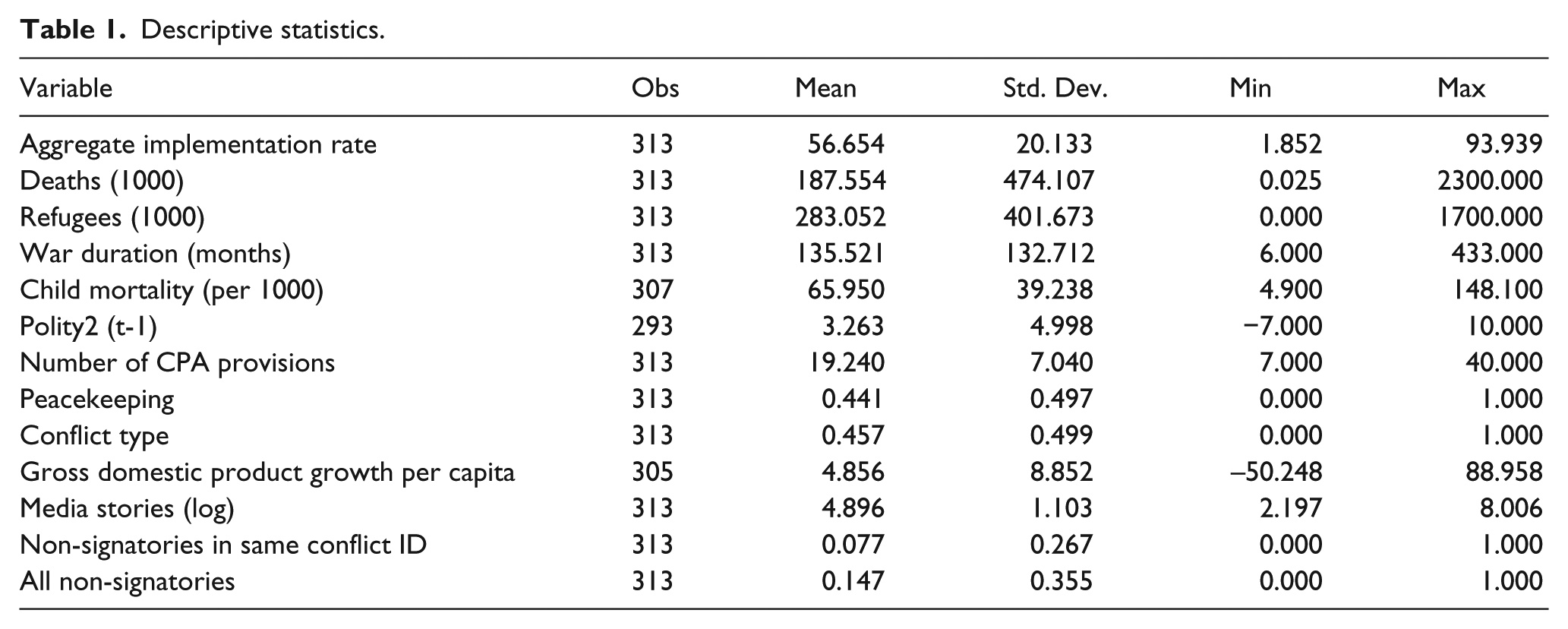
We control for a number of factors that may influence implementation and conflict behavior. We control for conflict type (UCDP, 2015) as our research has found that provisions related to decentralization, which are more common in territorial disputes, have lower rates of implementation (Joshi et al., 2015; Lee et al., 2016). We also control for the costliness of the civil war that produced the CPA with a count of previous battle-deaths and war duration taken from Joshi and Darby (2013). Utilizing the same data source, we control for number of refugees as prior studies suggest that greater refugee flows lower the cost of recruitment for armed groups (Salehyan and Gleditsch, 2006). More refugees mean more potential recruits for non-signatory groups looking to challenge the government. We also control for state capacity, which can influence implementation and war fighting (DeRouen et al., 2010; Joshi and Quinn, 2015a) with a measure of infant mortality rate and gross domestic product (GDP) growth rate from the World Bank (2013). Per capita GDP growth rate is a proxy for the amount of reconstruction that is taking place in the nation. Greater growth should also lower the ability of non-signatories to recruit. We control for level of democracy, which can influence peace agreement implementation by giving the signatory groups greater access to political power and resources. Civil war violence is also less likely in institutionalized democracies (Joshi and Mason, 2011; Vreeland, 2008). We control for the level of democracy using the polity2 measure from Marshall et al. (2013); this variable is lagged by one year. We also control for the number of media stories that mention implementation of the CPA by name. We expect that media reports represent one way that non-signatory groups can follow the progress of implementation in the nation. This variable is an annual count (logged) of news articles generated using Boolean searches in the LexisNexis Academic database that mention the CPA by name, each year. We also control for the number of provisions in a CPA and for the deployment of peacekeeping troops taken from Joshi et al. (2015). CPAs with a larger number of provisions may be more difficult to implement than CPAs with fewer provisions (Joshi and Quinn, 2015b). The deployment of peacekeepers is also likely to increase security and stability in the post-accord setting (Doyle and Sambanis, 2000; Joshi, 2013; Mattes and Savun, 2010; Walter, 1997).
Method, analysis and findings
To test our expectations, we use Weibull survival models as the Weibull distribution scale parameter (p) is greater than 1 and therefore fits the data well. Results from Cox models are similar and presented in the Appendix. Positive coefficients mean longer peace spells until armed conflict with a non-signatory group is observed. Table 2 contains 12 different models. The first six models (1–6) follow non-signatory conflict behavior outside the conflict ID that produced the CPA. The last six models (7–12) follow non-signatory conflict behavior both within and outside the conflict ID that produced the CPA. The first model is a basic model containing only the main independent variable: the annual CPA implementation rate. Models 2–5 build on the baseline model. These models are replicated in Models 7 through 12 for all non-signatory groups.
Annual aggregate comprehensive peace agreement (CPA) implementation and peace duration between governments and non-signatory groups.

Notes: coefficients are reported instead of hazard rate. Robust standard errors are in parentheses. *p < 0.05; **p < 0.01; ***p < 0.001.
The analysis supports our argument that a government, which implements negotiated reforms with one rebel group, can lower its chances of fighting other rebel groups in the future both inside and outside the specific conflict that produced the CPA. Throughout all the models presented in Table 2, CPA implementation rate is positive and statistically significant at a 99% confidence level or higher. For every percentage point increase in implementation, peace duration increases by 8.11 percent (based on Model 4). 3 Figure 1 illustrates the survival rate for every 25% increase in CPA implementation rate. As illustrated in the figure, as CPA implementation increases from zero to 75% the chances that the government will fight a non-signatory group greatly decrease. The lowest line in both graphs represents the lowest level of implementation and suggests that future conflict with a non-signatory group is almost inevitable for governments that negotiate CPAs and then do not keep their commitments. We did not find consistent support for any control variables. This fact lends additional support to our argument that the amount of violence a government faces is in large part due to that same government’s previous behavior and how it handled previous disputes with other groups.
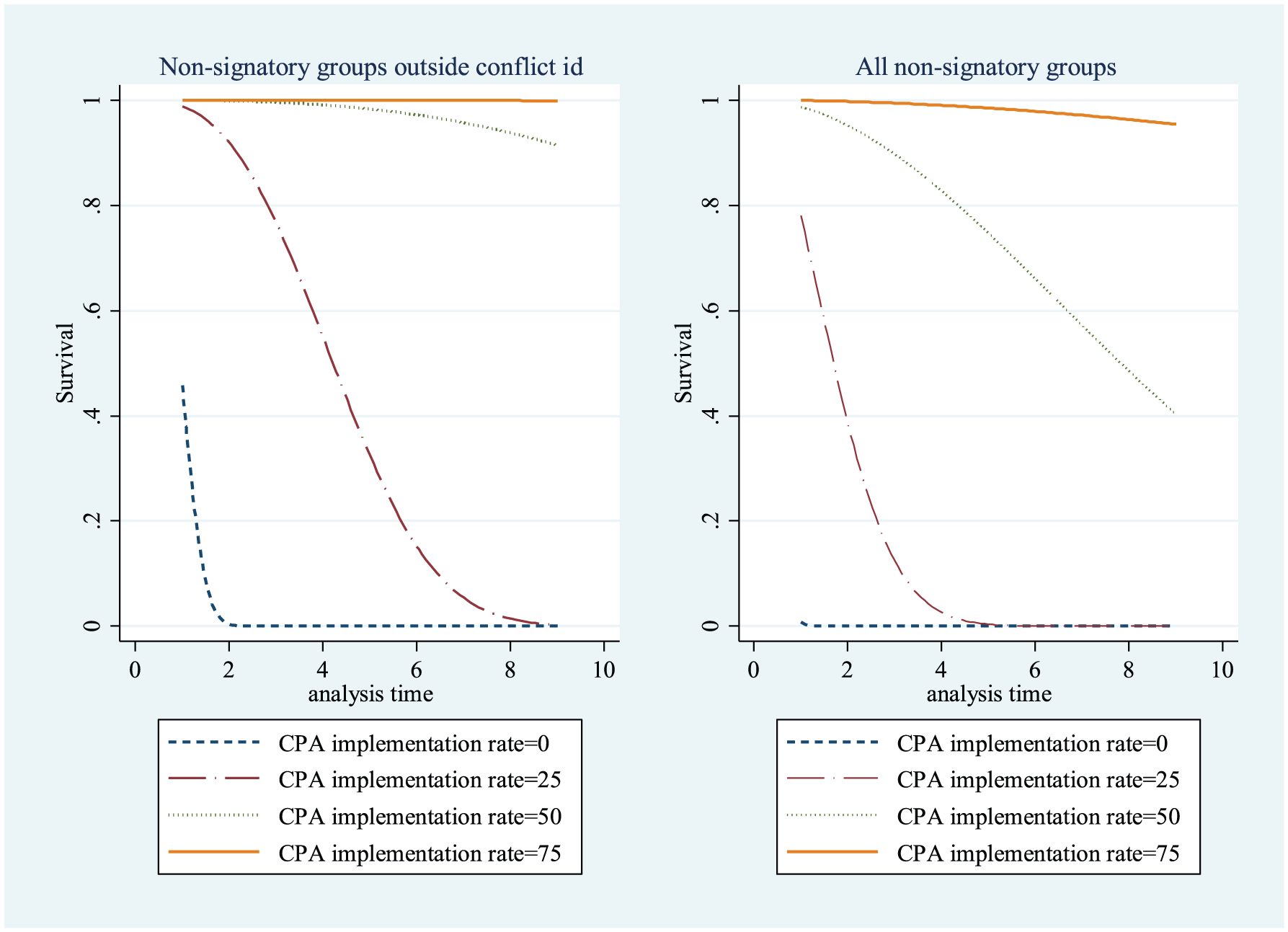
Weibull survival graph.
Conclusion
Standard bargaining approaches to explaining civil war based on problems of credible commitment and information uncertainty have failed to take into account the ability of armed actors to observe the interactions of the government and other armed groups and to use information gleaned from those interactions to update their assessment of the government as a reputable negotiation partner. For countries that signed CPAs after 1989, the findings here suggest that accommodating rebel groups by implementing a negotiated settlement does not encourage greater levels of future armed conflict from other groups as previous studies have maintained (Walter, 2006, 2009). Given the bounded nature of Walter’s arguments about reputation in civil war and the types of groups she examines, some of the discrepancy between Walter’s findings and ours may stem from differences between the armed groups. Another explanation that follows more closely from our results is that a good portion of the divergence in findings is likely attributable to the fact that Walter does not consider whether or not the government actually implemented the negotiated arrangement. It may be the case that many of those “accommodating” governments that negotiated a deal went on to face additional armed challenges in the future, not because they were seen as weak or conciliatory, but rather because they were perceived as having cheated those groups with whom they negotiated. Other self-determination movements that were paying attention might have concluded that the government had shown itself not to be a reputable negotiating partner, and any notions of reaching a deal to avoid war are discarded.
Footnotes
Declaration of Conflicting Interest
The author(s) declared no potential conflicts of interest with respect to the research, authorship, and/or publication of this article.
Funding
The author(s) received no financial support for the research, authorship, and/or publication of this article.

Carnegie Corporation of New York Grant
The open access article processing charge (APC) for this article was waived due to a grant awarded to Research & Politics from Carnegie Corporation of New York under its ‘Bridging the Gap’ initiative.