




Abstract
Transgender people—people whose gender identity or expression is different from their assigned sex at birth—and their allies advocate for the inclusion of gender identity or transgender in state non-discrimination policies. These policies generally proscribe discrimination in employment, housing, and public accommodations. Courts and administrative agencies have determined discrimination against transgender people is a violation of existing statutes, but there remain efforts by advocates to seek policies that explicitly prohibit discrimination on the basis of transgender status, which are often the result of legislation going through the political process. A pluralist understanding of the political process theorizes that a majority coalition of minorities can offer social groups policies they support. This rests on the presumption that a majority coalition of minorities should rule. Any indication to the contrary may suggest a democratic deficit, whereby more than a majority is necessary for policy introduction. We find that there is a substantial democratic deficit regarding the inclusion of gender identity or transgender in employment non-discrimination policies. On average, state support for the policy must be 81% in order for the state to have a policy reflecting such sentiment. This leaves substantial implications for the political powerlessness of transgender people in the political process.
Introduction
Transgender people across the United States have reported experiencing employment discrimination, including having been fired, not hired, or not promoted due to anti-transgender bias (Grant et al., 2011; Hartzell et al., 2009; Lombardi et al., 2002). Findings from the largest survey of transgender people in the US to date, the National Transgender Discrimination Survey (NTDS), suggest that employment discrimination and mistreatment in the workplace are common experiences among transgender people, with 90% of respondents reporting one or more of these experiences (Grant et al., 2011). Over one quarter of NTDS respondents have reported losing a job because they are transgender. Job loss can cause economic instability for individuals and their families, which can lead to a variety of negative outcomes. In the NTDS, those who reported losing a job because they were transgender had an elevated prevalence of several negative outcomes compared to those who had not lost a job due to bias. Those who lost a job were more likely to make less than US$10,000 annually (24% versus 11%), more likely to have experienced homelessness (40% versus 10%), and have higher prevalence of HIV, smoking, alcohol and drug use, and suicide attempts. To the extent that public policies can prevent employment discrimination among transgender people, such negative outcomes and their resultant costs to society may be reduced. Ordinances and statutes that prohibit employment discrimination based on gender identity are examples of the types of policies that may help reduce this type of discrimination and resultant negative outcomes.
As of March 2015, there is no federal statute that explicitly prohibits discrimination based on gender identity. A majority of states (31) also have not enacted laws that explicitly prohibit discrimination based on gender identity (National LGBT Task Force, 2014). While Congress and state legislatures have resisted extending these protections, federal agencies and courts have been increasingly likely to expand and interpret non-discrimination laws to protect transgender people. For example, in 2014, President Obama issued executive orders adding gender identity to the list of characteristics protected from discrimination in employment by federal contractors and in federal civilian employment (Executive Order Nos 13,672 and 13,087). Similarly, in 2012, the US Department of Health and Human Services and the US Department of Housing and Urban Development issued policies explicitly prohibiting discrimination based on gender identity in connection with agency-funded programs (US Department of Health and Human Services, 2012; US Department of Housing and Urban Development, 2012). Several federal agencies have also recently issued interpretations of existing laws prohibiting discrimination based on sex to include discrimination based on gender identity, including the US Equal Employment Opportunity Commission (Macy, 2012), the US Department of Justice (2014), the US Department of Labor (2014), and the US Department of Education (2014). Several federal courts, too, have issued opinions interpreting sex non-discrimination requirements to protect people who have been discriminated against because of their gender identity (e.g. Barnes v City of Cincinnati, 2005; Glenn v Brumby, 2011; Schroer v Billington, 2008; Smith v City of Salem, 2004).
These agencies and courts may make decisions that are counter-majoritarian, but when “those political processes to be relied upon to protect minorities” systematically leave minorities on the losing-side of enacted policy (US v Carolene Products Co., 1938: 152n.4), they act for them. A key attribute of political power is whether a group’s preferences are enacted to policy (Stephanopoulos, 2015). The preferences of the public inform the policy process, making public opinion fundamental in shaping policy outcomes.
Little is understood about how the American public structures its opinions about transgender people and rights. Recent studies find that people tend to be more supportive of transgender people and rights when they consider themselves more knowledgeable about transgender people, know someone who is gay or lesbian, or support gay rights (Flores, 2015; Norton and Herek, 2013). Beyond opinion formation, it is also important to understand how and whether public policy reflects these opinions. Social policy issues are likely more responsive to public sentiment because these issues tend to be easy and salient (Lax and Phillips, 2009a; Page and Shapiro, 1983). In this context, an “easy” issue is one that people can generally understand and formulate an attitude about at a gut level. Furthermore, subsequent policies may be primarily focused on ends rather than the process (e.g. Carmines and Stimson, 1980).
Recent studies, however, have found that certain biases exist that influence the extent to which policies match the desires of the public. Lax and Phillips (2009a, 2012) show that there are opinion deficits in a democracy. A democratic deficit may manifest in two ways: policy responsiveness may be hyperactive by passing a policy before a majority of the public favors it, or policies in states may be slow to match public sentiment and may not be adopted until more than a majority of the public favors the policy. In the latter case, systemic lack of congruence between public opinion and public policy may suggest that some areas of social policy require greater consensus among the public before lawmakers act. Lax and Phillips (2012) show that the greatest influences on policies outside public opinion are institutional and partisan factors that either encourage policies to match the desires of the public or detract them from doing so. The current study makes three contributions: (1) we expand upon the democratic deficit by relating it to political powerlessness as understood in the context of constitutional law; (2) we use established methods to estimate statewide public opinion on transgender inclusion in non-discrimination laws; and (3) we contribute to a small but growing literature on empirical studies on transgender politics and policy. We also continue to show that partisan factors play a strong role in policy responsiveness.
The democratic deficit and political power
While policies may be responsive to the public, they may not necessarily match the majority will. A deficit in the democratic process suggests that some social groups may be politically disadvantaged while others are advantaged. Lax and Phillips (2009a: 383), for example, find that policies relating to lesbians and gay men are often met with a conservative bias: [S]ome of our findings do raise concerns for democratic theory. We observe that the strength of the relationship between opinion and policy varies significantly across issues. And, despite responsiveness to opinion, majorities certainly do not always get their way. Some policies consistently reflect opinion majorities; for others, even clear supermajority support seems insufficient for policy adoption. This is most true for hate crime laws and policies that address marketplace equality (e.g. employment, housing protections).
Not all policies are conservatively biased. There may be other factors that influence whether policies are responsive and congruent to opinion such as issue salience, institutional factors, and elite partisanship (Lax and Phillips, 2009a, 2012).
The rights of transgender people have been less visible than other lesbian, gay, bisexual, and transgender (LGBT) issues such as marriage equality. The LGBT advocacy coalition has debated whether and when transgender rights will be included in and placed higher on the policy agenda (Minter, 2006). National gay rights organizations, for example, have been slow to include transgender rights in their platforms, though most are now inclusive (Tadlock, 2014). A simple search of New York Times articles on Lexis Nexis shows that “transgender” and “discrimination” appear in 392 articles while “gay” and “discrimination” appear in 935 articles. 1 Our focus on a single policy holds salience constant. Given the less salient nature of transgender rights, it may be easier to find policy incongruence. If we find there is a clear and large democratic deficit on the inclusion of transgender people in state non-discrimination policies then this may imply the political power of transgender people is at a disadvantage in the political process. A lack of political power can be one indication to the courts and administrative agencies that a minority group cannot solely rely on the political process to seek relief.
Political powerlessness among a minority group can signal to courts that laws and policies disadvantaging the group should be subject to a more scrutinizing form of judicial review under the US Constitution’s Equal Protection Clause (US v Carolene Products Co., 1938). In the past, the US Supreme Court has used indications of political powerlessness, along with three other factors, to determine that laws and policies that classify people based on race, national origin, alienage, sex, or non-marital parentage should be reviewed closely for unconstitutionality under this principle (see Yoshino, 2011). Though there is a body of scholarship evaluating the political powerlessness of sexual orientation minorities (including gay, lesbian, and bisexual people) and LGBT people (e.g. Halley, 1989; Hutchinson, 2014; Miller, 1984; Powers, 2010; Schraub, 2010), little research has focused on whether transgender people are politically powerless as a distinct group. A systematic democratic deficit is one likely marker of political power because it suggests that the political process may be insufficient for minorities to seek rights. At times, the court defers to other branches when the group under question does not meet the factors that warrant greater scrutiny. Why might the political process be insufficient on transgender-inclusive non-discrimination policies?
Underpinning political power is a pluralist understanding that some social groups may get some of their policy desires through the political process (Stephanopoulos, 2015). Minorities are generally secure because they may have fair chances of passing policies they prefer (Stephanopoulos, 2015). Powerlessness may then be understood as a systematic lack of policies reflecting a group’s interests relative to other groups. A purely majoritarian perspective would not be concerned much about political power because “[i]t is irrelevant to [the theory] if certain groups fail to join the winning coalition with sufficient regularity” (Stephanopoulos, 2015: 33). Undergirding pluralist or majoritarian theories, however, is that majorities (or coalitions of minorities) rule. A democratic deficit suggests otherwise. 2 The political process may insufficiently translate a coalition of minorities to rule on policies. If this is systematic to policies related to a particular minority, then this may be another way the political process disempowers some social groups.
Estimating public opinion in the states
To be able to examine whether state policy is responsive to the preferences of the public, there needs to be a way to estimate opinions on transgender-inclusive non-discrimination policies across the states. The dearth of studies on this topic is also reflective of the available amount of national or statewide survey data on this topic. There is, fortunately, a single national survey conducted by the Public Religion Research Institute that asks respondents whether “Congress should pass laws to protect transgender people from job discrimination.” We use this measure with established methods of estimating statewide public opinion with multilevel regression and post-stratification (MRP) (Gelman and Little, 1997; Lax and Phillips, 2009b; Park et al., 2006). While the question wording is clearly about federal policy, there is little evidence to suggest that responses would significantly change if the question referenced state-specific policies. There is also little reason to believe that MRP estimates would be inaccurate, as recent criticisms of the method have shown that on morality policy and gay rights, MRP tends to perform exceptionally well (Buttice and Highton, 2013). Estimation is conducted on a complete case sample size of 968 respondents, excluding residents of the District of Columbia. Lax and Phillips (2009b) show that national polls of “sufficient size (1000 or more)” are on average off by 6 percentage points when compared with statewide polls (p. 118). The current sample size may be less than sufficient, so we report the 95% credible intervals for each state estimate.
The estimation procedure relies on the traditional approach of modeling opinions in favor as a function of basic demographic characteristics in a hierarchical model




The previous vote share to the Republican candidate in the 2008 Presidential Election is used as additional information at the state level to increase precision in the estimates. The model is run using empirical Bayes with three Markov chains and 100,000 Monte Carlo simulations. The first half of the iterations is dropped as a burn-in process and, of the remaining iterations, every 50th is retained for a total of 1002 simulations. The results indicate proper mixing
The results of the estimation are provided in Table 1, which also indicates whether states have policies consistent with the public sentiment. The estimates, while all above a majority of support, range from 66% to 90%, and the lower bounds of the 95% credible intervals are all above 50%. 3 The average level of support for transgender inclusion in non-discrimination policies is 78%, and 18 states have policies in place that are congruent with majority opinion. Less than half of the states are congruent with majority opinion.
Opinion estimates and summary statistics.

Utah passed a transgender-inclusive non-discrimination law in March 2015.
A 95% confidence interval is reported applying frequentist methods.
Responsiveness
First, we examine policy responsiveness to public opinion, and we report the results in Table 2. The estimates of public opinion on transgender inclusion in non-discrimination laws significantly predict the probability that a policy is in place. 4 On its own, support for the policy explains over half of the variation in the adoption of the policies, and 90% of the cases are correctly predicted. We also compare whether policy-specific opinion versus general measures of state ideology accounts for policy adoption because previous literature suggests that general ideology may out-perform policy-specific measures, as lawmakers may lack policy-specific constituent opinion (Erikson et al., 1993). The models include measures of Voter Ideology and Government Ideology from Berry et al. (1998). Two measures of government ideology are used, so we provide results alternating which variable is included. The inclusion of these variables does not alter the main finding, and these models perform worse overall. A parsimonious model with only policy-specific opinion is the best to explain responsiveness.
Policy responsiveness.

p < 0.05.
p < 0.01.
p < 0.001 (one-tailed tests).
As it remains the most parsimonious model, we predict the probability that a state has a transgender-inclusive non-discrimination policy as it relates to policy-specific opinion using the bivariate logistic regression (Model 1). The relationship is positive and quite sharp. Once opinion reaches a tipping-point, there is a high probability of policy adoption. This tipping-point is far from a simple majority. Figure 1 suggests that, on average, a super-majority of 81% is necessary before the policy is likely to be adopted.
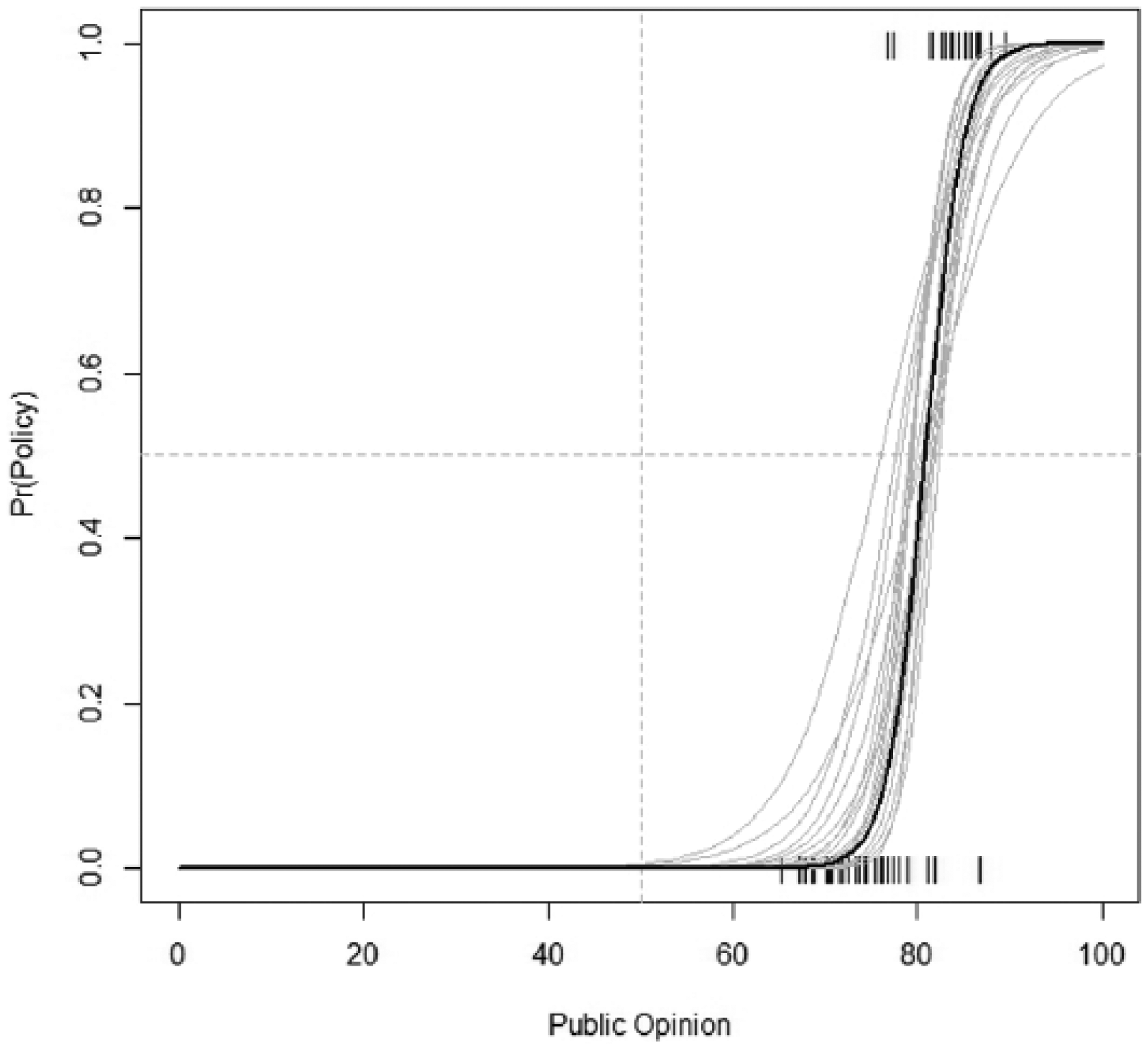
Policy responsiveness. The black line represents the probability that a policy exists in a state by opinion from a logistic regression, and the gray lines represent 20 simulations to show uncertainty in the prediction. Statewide opinions are plotted on the top axis for states that have a policy and on the bottom for those that do not.
We now address institutional and partisan factors affecting responsiveness. Lax and Phillips (2009a, 2012) show that these factors may explain why policies are inconsistent with opinion. In addition to the ideology measures presented before, we include the Squire Index of Legislative Professionalism (Squire, 2007), the percentage of the legislature that is aligned with the Democratic Party (averaged between the upper and lower chambers in each state), and whether the state had a Democratic Governor in 2010. The results in Table 3 indicate that the party composition of the legislature is another strong component affecting policy. As legislatures become more strongly Democratic, it is more likely transgender-inclusive non-discrimination laws are consistent with majority opinion.
Modeling factors affecting responsiveness.

p < 0.05.
p < 0.01.
p < 0.001 (one-tailed tests).
Note: Nebraska excluded due to non-partisan legislature when N=49.
To convey how this effect operates on transgender-inclusive non-discrimination policies, we show the probability of policy adoption by varying the strength of majority opinion conditioned by how Democratic the legislature is. Figure 2 provides three policy probability curves, each reflecting a different percentage of Democrats in the legislature. 5
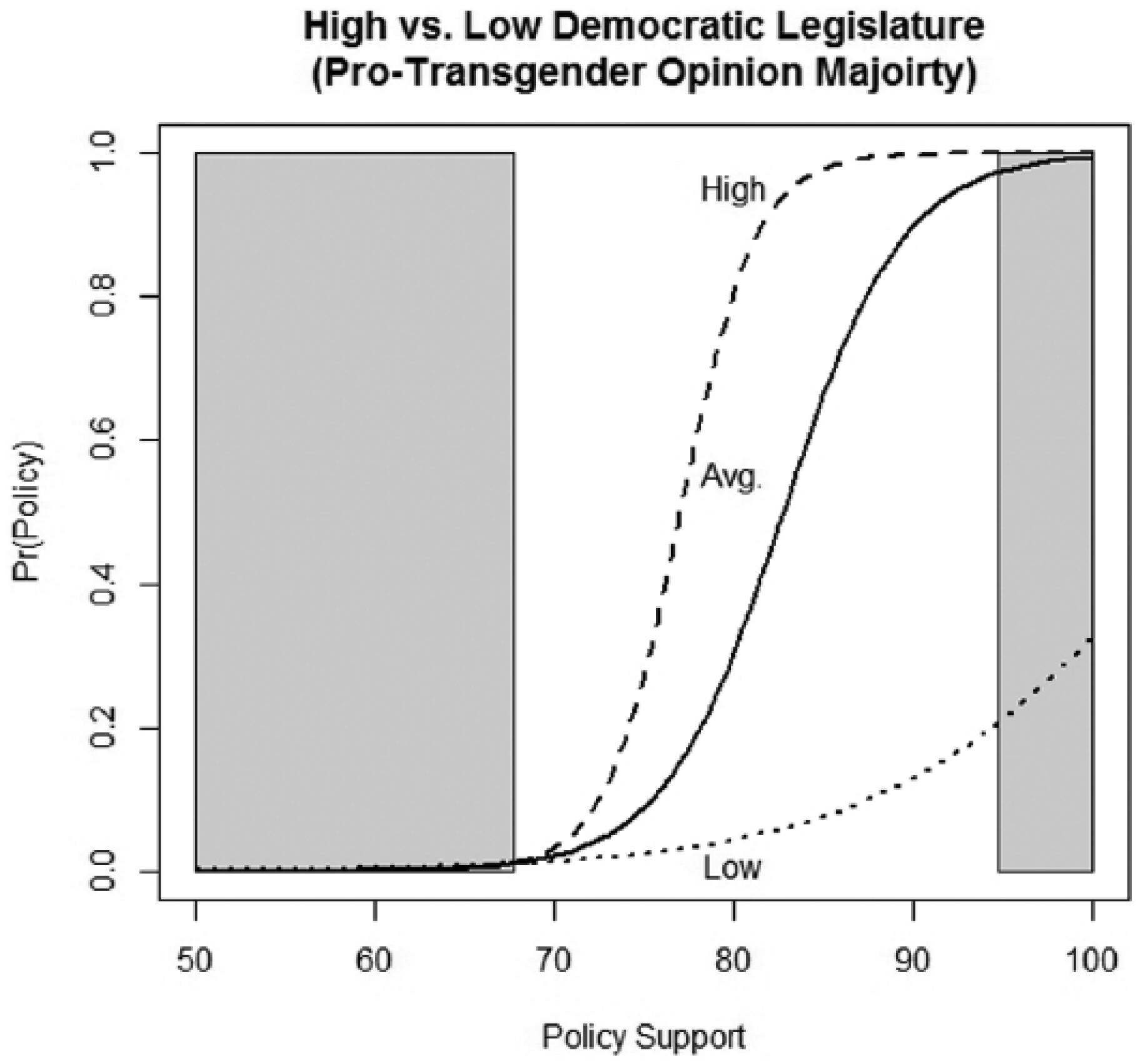
The probability that a transgender-inclusive policy is in place is plotted varying the share of the legislature that is Democratic. A “Low” Democratic legislature is one standard deviation below the average level, and a “High” Democratic legislature is one standard deviation above the average level. The white space indicates the range of opinion estimates to indicate where the predictions are most applicable.
The probability of having a liberal policy is quite different given the partisan make-up of the legislature. Legislatures with a high percentage of Democrats are more likely to be responsive to majority opinion, while legislatures with a low percentage of Democrats appear unresponsive. While the presence of Democrats does not completely account for the mismatch between majority opinion and policy, the results clearly suggest that parties moderate the influence of public opinion.
Discussion
A pluralist understanding of political power is that social groups may achieve some of their policy goals (Stephanopoulos, 2015). Social groups, in this conception, never have majorities but must form coalitions that create compromises in the policy process. Minorities may then have fair chances of passing policies they prefer (Stephanopoulos, 2015). Powerlessness may then be understood as a systematic lack of policies reflecting a group’s interests relative to other groups. The basis of pluralist theory is that coalitions of minorities rule. A democratic deficit suggests otherwise.
Policy adoption may be responsive to the desires of the public but, even so, it does not necessarily match the desires of the formed majority. For minority groups, especially groups that will unlikely garner a majority of any legislature, municipality, or district, it is important to understand the translation of majority opinion on minority rights. The best existing estimates of the transgender population suggest that it is smaller than that of the LGB population, with transgender people making up 0.3% of the population (Gates, 2011). The presence of a democratic deficit raises substantial doubt about the health of state democracies on transgender non-discrimination policies. Our findings are indicative of the political power of transgender people in the political process, though we are limited by necessarily focusing on a single policy. A fuller study can evaluate whether a democratic deficit persists across numerous transgender rights policies when policy-specific opinion polls are available. Future research may then address why and whether certain policy types have larger or smaller deficits.
The present research adds to studies on public attitudes on transgender rights, and ours is the first to examine the relationship between opinion and policy adoption. Recently, there have been judicial and administrative decisions that have determined that discrimination against transgender people constitutes a Title VII violation on the basis of sex. These decisions may, from one perspective, be counter-majoritarian. But our findings suggest that the courts and administrative agencies may actually be more consistent with the majority will than legislatures. The legislature may actually be the counter-majoritarian body in this instance (see also Bishin, 2009). The findings also suggest that the least responsive legislatures are reflective of partisan politics. As parties strategically control the legislative agenda (Cox and McCubbins, 2005), they may intentionally or unintentionally fail to act on prohibiting discrimination to a vulnerable group of people who have disproportionate rates of workplace discrimination.
