




Abstract
The presence of shared interests between politicians and citizens is central to many accounts of political representation, yet there has been little empirical research into how citizens perceive these interests and whether they think a ‘communion of interests’ exists between them and their elected representatives. Using new survey data, this paper explores the extent to which Britons think their Members of Parliament share the same everyday experiences as they do. It further explores the relationship between these perceptions and indicators of specific and diffuse political support. We show that British citizens generally say that politicians are less affected by social and economic conditions and less reliant on public services than they are. The size of this perceived ‘discommunion’ affects voting behaviour and satisfaction with democracy.
Introduction
Politicians like to claim solidarity with the people. ‘We are all in this together’, said the British Conservative party’s George Osborne, then shadow chancellor of the exchequer, as he outlined a package of planned government spending cuts and public sector pay freezes in October 2009. The phrase would later become the defining mantra of David Cameron’s coalition government (d’Ancona, 2013). However, the idea of being ‘in it together’ is not only a rhetorical device for justifying difficult decisions; it is also an age-old principle at the heart of representative democracy. The presence of some ‘communion of interest and sympathy in feelings and desires’ was central to Edmund Burke’s conception of ‘virtual representation’ (Judge, 1999: 101), while James Madison in Federalist No. 57 insisted that without a ‘communion of interests and sympathy of sentiments… every government degenerates into tyranny.’ The centrality of shared experiences is also reflected in recent scholarship about the political representation of groups in contemporary Britain and elsewhere (Campbell et al., 2010; Celis and Childs, 2008; Fieldhouse and Sobolewska, 2013; Mansbridge, 1999). Moreover, as many politicians recognise, perceptions of solidarity are an important reality of their own. Citizens who believe that their leaders have different interests may punish them at the ballot box, and may even become disenchanted with democratic processes.
This paper explores the extent to which Britons perceive a ‘communion of interests’ between themselves and elected politicians in general, focusing specifically on Members of Parliament (MPs). It further explores the relationship between these perceptions and indicators of specific and diffuse political support (Easton, 1975). A number of commentators have suggested that Britain is witnessing the emergence of a disconnected political class (Oborne, 2007; Riddell, 2012). There is certainly good evidence that many citizens perceive MPs to be elitist and remote, if not inhabitants of an entirely different world (Heath, 2011). Yet, while recent research has shed light on other aspects of public attitudes towards representation (Campbell and Cowley, 2014a, 2014b; Cowley, 2013), little attention has been paid to perceived common interests and, in particular, to what extent citizens think MPs share the same everyday experiences as they do. Capturing such perceptions is likely to be important for scholars who wish to understand popular evaluations of political processes. If voters do not think that politicians share their experiences, they may feel unrepresented; they may even think that politicians are unable to represent them. Drawing on new survey data, we demonstrate the importance of this dimension of representation in Britain. We show that citizens generally say that politicians are less affected by social and economic conditions and are less reliant on public services than they are, and that the size of this perceived ‘discommunion’ affects turnout, support for the incumbent government and satisfaction with democracy.
Representation and interests
Scholarly interest in political representation has generated a vast and varied literature. Our study is broadly concerned with an aspect of what Pitkin (1967) terms ‘descriptive representation.’ This view of representation focuses on the characteristics of representative agents, usually members of legislative institutions. It is characterised by the notion ‘that a representative body is distinguished by an accurate correspondence or resemblance to what it represents, by reflecting without distortion’ (Pitkin, 1967: 60). Calls for more accurate correspondences or resemblances between citizens and political elites are frequently heard in Britain and elsewhere. These calls are often made specifically to help politically disadvantaged groups, notably women and ethnic minorities, overcome adverse selection biases (Murray, 2014; Sawer, 2000).
The ‘descriptive representativeness’ of elected representatives does not refer only to their visible characteristics. As Mansbridge (1999: 629) points out, it can also refer to the experiences they share with other members of the community: thus ‘a representative with a background in farming is to that degree a descriptive representative of his or her farmer constituents.’ Shared experiences are especially important because they facilitate policy responsiveness, or what is usually termed ‘substantive representation’ (Pitkin, 1967). As Mansbridge (1999: 629) goes on to note, ‘shared experience… might reasonably expect to promote a representative’s accurate representation of and commitment to constituent interests.’ Certain visible characteristics, notably gender and race, can exert a powerful influence on a representative’s ability to share experiences. For these reasons, many scholars have concluded that descriptive representation improves the chances of substantive representation (Campbell et al., 2010; Mansbridge, 1999; Norris and Lovenduski, 1995; Phillips, 1995; Schwindt-Bayer and Mishler, 2005).
While the descriptive representativeness of political institutions can have profound consequences, so too can popular perceptions of the same. There is good evidence, from Britain and elsewhere, that citizens generally want representatives who are ‘like them,’ either in appearance or thought, who are local, and who have experienced what they have experienced (Arzheimer and Evans, 2012; Campbell and Cowley, 2014a, 2014b; Cowley, 2013; Cutler, 2002). There is also good evidence that higher levels of perceived descriptive representativeness can forge ‘bonds of trust’ between citizens and their representatives (Mansbridge, 1999: 641; see also Gay, 2002); can boost the legitimacy of political institutions (Sawer, 2000); and can strengthen perceptions of policy responsiveness (Schwindt-Bayer and Mishler, 2005). Yet such evidence, especially in terms of how perceptions translate into action, generally pertains to the perceived representativeness of politicians’ visible characteristics, not their experiences. Perceptions of politicians’ experiences, however, are also likely to shape citizens’ beliefs about representatives’ abilities to promote their interests, and are thus likely to shape citizens’ satisfaction with incumbent authorities and democratic processes. In the next sections of this article, we investigate how these issues play out in Britain.
Survey and data
To explore how British citizens think their elected representatives’ everyday experiences compare with their own, we fielded a small battery of survey questions in an online survey of the British adult population. The survey was organised by the British Cooperative Campaign Analysis Project (B/CCAP) and was administered in April 2010 by YouGov. 1 Although B/CCAP as a whole was a multi-wave panel study, our key instruments were included in only one wave, making our analysis essentially cross-sectional. These instruments measured the extent to which citizens thought both they and most MPs were affected by or experienced three distinct and important areas of public policy: the economy, crime and public services. 2 Respondents were presented with the following questions.
Crime in Britain affects different people in different ways. To what extent are different groups affected by crime? Some people rely more than others on public services like education and health. How reliant are different groups of people on public services? Changes in the state of Britain’s economy affect people in various ways. To what extent are different people affected when the economic situation deteriorates?
For each question, respondents were asked to locate themselves on a 0–10 scale, where 0 meant they were not at all affected by crime or the economic situation, or were not at all reliant on public services, and 10 meant they were very much affected or reliant. Respondents were also asked to locate ‘most MPs’ on the same 0–10 scale.
The results are reported graphically in Figures 1–3. Taken together, they suggest the existence of a perceived discommunion between ordinary citizens and MPs across a number of policy domains. In terms of the first domain (Figure 1), respondents generally perceived MPs to be affected less by crime (mean score of 3.3) than they themselves were (4.4). There was an even greater discommunion with respect to the second domain (Figure 2). Respondents generally said that they were more reliant on public services (mean score of 5.9) than were MPs (3.4). The greatest perceived discommunion between citizens and MPs was evident when we asked respondents about the economy (Figure 3). Very few respondents said that they were unaffected by a deterioration in the economic situation, whereas many more said that they were greatly affected (the mean score was 6.6). Many took the opposite view, however, when it came to their elected representatives (3.4): respondents were more likely to say that MPs tended to be less affected by economic downturns, and very few said MPs were very much affected.

Crime: to what extent are you and most Members of Parliament (MPs) affected?

Public services: to what extent are you and most Members of Parliament (MPs) reliant?

Economy: to what extent are you and most Members of Parliament (MPs) affected?
When interpreting the results, it is important to emphasise that the question explicitly refers to ‘most MPs’ and taps respondents’ perceptions of the broader political class, rather than specific individuals or groups of politicians. Voters may well perceive the experiences of their own MP, or of MPs from a particular political party, to be somewhat different to those of MPs in general, something we are unable to explore here. It is also important to emphasise that, despite the low regard in which elected politicians are generally held, not all respondents automatically located most MPs at the extreme end of the scale. Figures 1–3 show variation in MP placement, with respondents offering different opinions about the extent to which MPs experienced the three policy areas.
The individual-level drivers of perceptions
Thus, most Britons would appear to perceive a gap between themselves and politicians with respect to how they are affected by crime and economic downturns, and in how reliant they are on key public services. To some extent, these perceptions are almost certainly a product of contextual factors, including prevailing economic and social conditions and recent government policies. The size of any perceived discommunion is thus likely to change over time.
While the results from our single national cross-sectional survey cannot tell us much about the temporal nature of perceived discommunions, we are able to investigate some of the individual-level factors that drove perceptions among British voters before the 2010 General Election. One obvious place to begin is the notion that representatives’ visible characteristics are likely to have some impact on their actual life experiences. Thus, citizens who share the same social characteristics of most MPs may be more likely to believe that their experiences are closer to those of MPs—and vice versa—than individuals who least resemble the ‘typical’ MP. When it comes to age, gender, education and socio-economic status, which are all factors associated with membership of Parliament (see Cowley and Kavanagh, 2010: 306–329), we would expect older people, men, university graduates and those with higher incomes to perceive a greater communion of interest between themselves and MPs than younger people, women, non-graduates and those with lower incomes. Partisanship, attentiveness to politics and media consumption may also be expected to affect perceptions. Individuals who identify with the major parties may be more likely to believe their experiences are closer to those of most MPs than those who do not, given the integrative role of parties and partisanship. Similarly, those who pay close attention to current affairs may perceive a greater sense of communion with their MPs, since people who are interested in politics tend to have a stronger sense of political efficacy (Craig et al., 1990). Meanwhile, readers of serious ‘broadsheet’ newspapers may perceive their experiences to be closer to those of MPs than ‘tabloid’ readers, in line with the media-malaise thesis (Newton, 2006).
To investigate these relationships, we first created measures of the perceived discommunion—or what might be termed a respondent’s sense of ‘in it togetherness’—for each of the three policy areas. We focused on the magnitude of the perceived discommunion, since this arguably matters most in terms of politicians’ capacity to be responsive. After all, politicians may be less responsive to citizens’ interests if they have less of a stake in a given policy area, but they may also be less responsive if they have a greater stake. Our measures were therefore of the absolute gaps between where respondents located themselves on the relevant 0–10 scale and where they located most MPs. The distributions of the resulting ‘gaps’ are shown in Figure 4. As can be seen, and in line with Figures 1–3, the crime ‘gap’ and thus the scale of the perceived discommunion in this domain was the smallest (mean score of 2.4). The economy gap (4.0) was the largest of the three, with the public services gap (3.3) in the middle.

Magnitude of perceived discommunion of interests across three policy domains.
We then created a composite discommunion scale, which was simply the arithmetic mean of the crime, public services and economy gaps. This three-item scale had a Cronbach’s alpha of 0.74, indicating good reliability. We then used this 0–10 scale, where a low score reflects a smaller gap and a high score reflects a greater gap, as a dependent variable in an analysis of what drives respondents’ perceptions of a discommunion of interests between themselves and most MPs. Because of the way we constructed the dependent variable, a negative coefficient means that the relevant variable reduces the scale of the perceived discommunion, whereas a positive sign indicates that this variable increases it.
While our primary interest is investigating the magnitude of the perceived discommunion, we also recognise that the direction of perceptions may matter. As Figures 1–3 suggest, most citizens take the view that MPs are more sheltered from the everyday challenges that they have to grapple with, and it is these citizens who can be expected to have the most pronounced concerns about a distant and unrepresentative political class. To explore the importance of direction as well as magnitude, we created a second variable based on the positive gap between respondents’ self-perceptions and perceptions of most MPs: after subtracting the latter from the former, we excluded the negative scores before creating another three-item 0–10 scale. 3 The resulting variable provided a measure of how much more respondents thought they were affected by crime and economic downturns than MPs were, and how much more reliant on public services they thought they were.
The results of our analyses are reported in Table 1. Both the ‘absolute’ and ‘positive’ models are very similar in direction and statistical significance. Among the independent variables, age was significant insofar as younger respondents, contrary to expectations, perceived a smaller discommunion than middle-aged ones, whereas the perceptions of those over the age of 54 were not statistically different from those of middle-aged respondents. Graduates and richer people (those earning over £40K) also perceived a smaller gap, in line with expectations. Those who paid more attention to politics, here measured on a four-point scale, perceived a larger gap, a relationship that went against what we anticipated. Newspaper readership was not significant. As for partisanship, respondents who identified with Labour, the Conservatives and the Liberal Democrats believed the gap to be smaller, but only for those who identified with the Labour Party was the coefficient significant (p < 0.05) in both models. Still, this finding suggests that partisanship continues to integrate citizens into political processes, as anticipated.
Ordinary least squares model of the perceived discommunion of interests.

Note: Standard errors in brackets. *p < 0.05; **p < 0.01; ***p < 0.001. Reference categories: age 35–54; income between £20K and £40K; newspaper non-reader; no party identification.
The consequences of perceived discommunions
We now come to the implications of perceived discommunions of interests between voters and their leaders, starting with voting behaviour. As illustrated by the 2010 coalition government’s narrative of being ‘in it together,’ politicians are conscious that citizens’ perceptions of mass-elite solidarity may have electoral consequences. We were able to examine whether this was so in the context of the 2010 General Election, thanks to the multi-wave panel-design of the B/CCAP: all respondents who participated in the April 2010 wave were also polled in June 2010. We were thus able to relate citizens’ pre-election perceptions to their reported turnout and vote choice.
We expect a greater sense of discommunion to suppress turnout, in much the same way that a low sense of external efficacy does (Clarke et al., 2004). Voters who have less confidence in the system’s ability to respond to them are less likely to vote; voters who think their MPs enjoy very different experiences to them may think them less able or willing to be responsive. We also anticipate that, among citizens who do vote, a greater sense of discommunion is likely to reduce support for the incumbent party, in line with the standard ‘reward–punish’ model of voting behaviour (Clarke et al., 2009). In addition to these anticipated relationships between the magnitude of perceived discommunion and voting behaviour, we also expect the direction of perceptions to matter: respondents who say most MPs are much less affected by economic and social conditions than they themselves are, as opposed merely to enjoying different experiences than their MPs, will be even less likely to vote or support the incumbent party.
To test these expectations, we included both our ‘absolute’ or magnitude measure and our ‘positive’ or directional measure of perceived discommunion, together with a number of controls, in two multivariate models: a model with the dependent variable of reported turnout, a simple dummy variable where 1 means the respondent did vote; and a model with the dependent variable of reported vote choice, a dummy variable where 1 means that the respondent recalled voting for the incumbent Labour party. Our control variables include age, sex, education and income, party identification, newspaper readership, political attentiveness and retrospective evaluations of the national economy, a key indicator of government ‘performance’ (Clarke et al., 2004, 2009).
Table 2 reports the results of our first two models. When it comes to reported turnout at the 2010 General Election, perceptions of both an absolute and a positive gap depressed the chances that a respondent would vote, but only in the latter case was this effect large enough to be statistically significant. This finding is consistent with our expectation about the additional importance of the direction of any perceived discommunion. In both models, political attentiveness increased turnout, as one would expect: people who followed daily affairs were more inclined to vote than those who did not. Age also mattered: those under 35 were less likely to vote than older groups, conforming to well-known patterns of voting behaviour. When it comes to explaining vote choice, both the magnitude and the direction of perceived discommunion were significant and negatively signed: people who thought MPs were further removed from their experiences in absolute terms were more likely to vote against the government, and those who thought MPs were less affected by economic and social conditions were even more likely to vote this way. Among the other variables, a perception that the national economy had deteriorated made a vote for the incumbent party less likely, while Labour identifiers were significantly more likely to vote Labour, and Conservative identifiers were less likely to vote Labour, although the last relationship was significant only in the magnitude model.
Binary logistic models of turnout and Labour vote in 2010.

Note: Standard errors in brackets. *p < 0.05; **p < 0.01; ***p < 0.001. Reference categories: income between £20K and £40K; no party identification; newspaper non-reader.
While there is evidence that a sense of discommunion is a factor in aspects of voting behaviour, perceptions of mass-elite solidarity may also have other political consequences. In particular, such perceptions can be expected to affect levels of diffuse support for the political system (Easton, 1975). We explored this possibility by examining the relationship between perceptions of discommunion and satisfaction with democracy, as measured on a four-point scale, ranging from 1 (‘not at all satisfied’) to 4 (‘very satisfied’). In essence, we expect a greater sense of discommunion to be associated with lower levels of satisfaction with democracy: respondents who think politicians are consistently not ‘in it together’ with them may feel that the system is failing at a basic level. Once again, we further expect this effect to be more pronounced among respondents who said MPs are much less affected by a range of economic and social conditions than they themselves are.
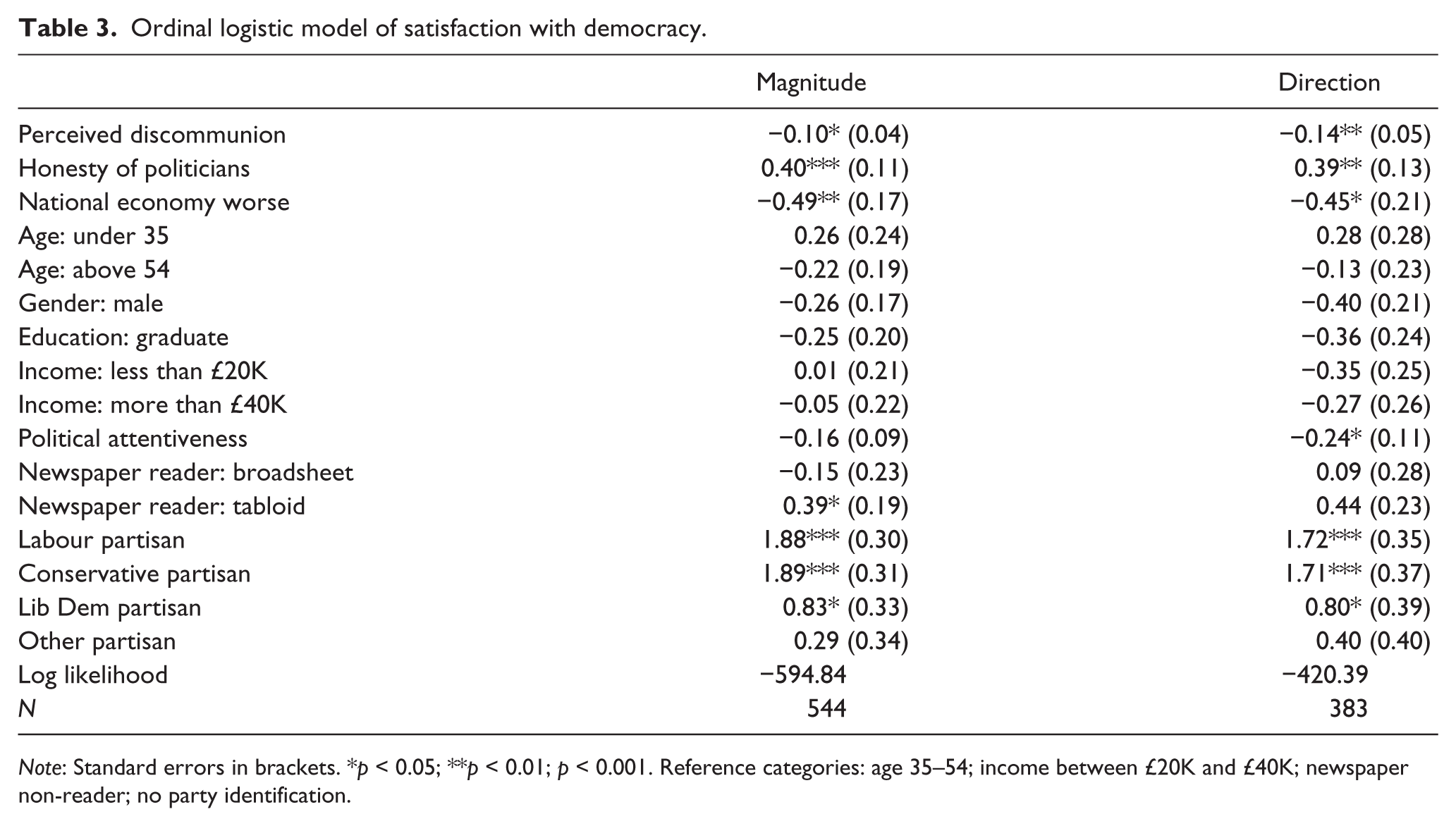
In contrast to our models of turnout and voting Labour, the direction of causality is more difficult to establish with absolute certainty. However, it is far more likely that respondents’ relatively specific perceptions—in this instance of their own and most MPs’ experiences of crime, the economy and public services—affect a general sense of satisfaction with democracy, rather than the other way round. There may, however, be some confounding factors, such as a general sense of disengagement or disillusionment with elected politicians, which may account for both respondents’ perceptions of most MPs’ experiences and their satisfaction with democracy. In order to mitigate this potential problem, we controlled for political attentiveness and perceptions of elected politicians’ standards of honesty, measured on a scale from 1 (‘very low’) to 5 (‘very high’). Table 3 presents the results.
Ordinal logistic model of satisfaction with democracy.
Note: Standard errors in brackets. *p < 0.05; **p < 0.01; p < 0.001. Reference categories: age 35–54; income between £20K and £40K; newspaper non-reader; no party identification.
The table shows that, even after controlling for these influences, perceptions of a discommunion of interests had a significant and negative impact on satisfaction with democracy: people who perceived a greater discommunion were less likely to express satisfaction with democracy; the relationship was marginally greater in the directional model. Among the control variables, those who identified with one of the three mainstream parties, and especially Labour and the Conservatives, were more likely to express higher levels of satisfaction with democracy. Those who felt that the national economy had deteriorated were less likely to express satisfaction. Attentiveness was negatively signed in both models, meaning that respondents who paid more attention to politics were likely to express satisfaction with democracy, perhaps because they were more familiar with recent scandals, but this relationship was only significant in the second model. Those who perceived politicians to be honest were more likely to express higher levels of satisfaction in both models.
To illustrate the impact of different variables on satisfaction with democracy, Figure 5 displays the impact of the magnitude of perceived discommunion (‘absolute gap’) on the likelihood of expressing different levels of satisfaction with democracy, holding all the other variables constant at their mean (or, for the dummy variables, their median), as logged odds are difficult to interpret. The graph suggests that the likelihood of being ‘very satisfied’ with democracy was low, but there was a slight downward trend: as perceptions of a discommunion increased in size, satisfaction with democracy decreased. The reverse was true for the likelihood of being ‘very dissatisfied,’ which increased with an increasing perceived discommunion. The chances are that someone was ‘fairly satisfied’ with democracy decreased dramatically as the sense of discommunion grew. The probability of expressing ‘a little’ satisfaction increased quite substantially as perceptions of a discommunion increased from a small gap to a medium-sized one. Thus, Figure 5 illustrates the effect that a sense of discommunion has on satisfaction with democracy, even after controlling for potentially confounding factors such voters’ disengagement and mistrust of politicians.

Predicted probabilities of satisfaction with democracy by magnitude of perceived discommunion.
Conclusion
At a time when many citizens appear to feel alienated from established political processes, it is important to identify what it is about politics that people dislike. We would not go so far as to say that a perceived discommunion of interests is absolutely fundamental to any explanation of contemporary political disaffection, but we do suggest that it is part of the story, and that it is also relatively neglected feature of public opinion that merits further inquiry. There are certainly good reasons to think that liberal democracies need communions of interest, perceived as well as real, between their politicians and citizens. Shared experiences and interests help politicians respond better to popular preferences. Knowing that politicians face the same experiences and challenges may also boost citizens’ confidence in their elected representatives. As we have shown in the case of Britain, the greater the perceived communion, the greater the sense of satisfaction with democracy. There is also evidence that perceptions of shared experiences and interests can affect voting behaviour, irrespective of performance evaluations—in this instance whether to turn out to vote, and whether to support or oppose an incumbent party.
The findings presented in this paper are, of course, limited in time and space. It is unclear how typical Britain is of other liberal democracies in terms of its pronounced mood of not-in-it-togetherness, and the effects of these beliefs on diffuse and specific support. It is also unclear whether the responses we measured in 2010 were above or below the historical mean in Britain. Moreover, our data prevent us from exploring whether citizens perceive a greater communion with specific representatives, in particular their own local MP, than the political class in general. Further research is clearly needed to explore the spatial and temporal dynamics of these beliefs, and how they are shaped by economic, social and institutional factors. Further research is also needed to explore the relationship between perceptions, on the one hand, and aspects of politicians’ behaviour, such as constituency service, and social characteristics, such as gender and professional backgrounds, on the other. Knowing more about these dynamics and relationships may help us understand better the current political disenchantment in Britain and in other liberal democracies. As we have demonstrated in this article, it matters if citizens think they and politicians really are ‘in it together’.
Footnotes
Acknowledgements
We would like to thank Sarah Birch, Scott McClurg and the journal’s anonymous reviewers for their helpful comments and suggestions. Any errors of fact or interpretation remain our own.
Declaration of conflicting interests
The authors declare that there is no conflict of interest.
Funding
This work was supported by the ESRC (grant number RES-000-22-3459) and British Academy (grant numbers SG-52322).
