




Abstract
Candidate selections are seen as the ‘secret garden’ of UK politics. Hundreds of parliamentary constituencies rarely change hands, meaning that the ‘real election’ is the incumbent party’s selection process. Yet scholarship into candidate selection in the United Kingdom remains limited. In this article, we build a novel dataset of known shortlisted candidates in winnable seats to offer the first cross-party analysis of who gets shortlisted, and what factors influence success among shortlisted candidates. We find that shortlisted female and ethnic minority candidates are still less likely to be selected as parliamentary candidates, while living locally is by far the most significant factor affecting selection success. However, the nature of the 2019 snap election allowed parties to use emergency powers to advantage party insiders in late selections. We further find that, contrary to media focus, party faction was not a significant factor in Conservative or Labour Party selections.
Introduction
Prior to the 2019 general election, nearly 14 million UK voters lived in constituencies represented by the same party continuously since 1945 (Garland, 2019). Incumbent party candidates in such constituencies effectively have a job for life. 1 Yet how British parties select candidates for office remains under-researched. Despite regular studies into the backgrounds of MPs and candidates (e.g. Allen, 2013; Butler et al., 2021; Cairney et al., 2016; Lamprinakou et al., 2017), there is little recent research into who applies and who succeeds in UK parties’ candidate selection processes (for an exception, see Ashe, 2019).
Over the 2010s, UK MPs became more representative of the population in terms of gender and ethnicity (Butler et al., 2021) but less representative in terms of class, education and occupational background (Allen, 2013; O’Grady, 2019). These changes are logically the result of distinctive characteristics among more recently elected, and therefore more recently selected, MPs. This suggests that the barriers faced by female and ethnic minority aspirants may have declined since Norris and Lovenduski’s (1995) ground-breaking study found that UK selectorates were biased, although the barriers faced by candidates with fewer economic and educational resources may have increased (Murray, 2021).
Norris and Lovenduski’s pioneering work led to the long-standing British Representation Audit, formerly the British Candidates’ Study (Campbell and van Heerde-Hudson, 2019). These data have shown that candidates selected to run for Parliament are unrepresentative in terms of people living with disabilities (Evans and Reher, 2020), occupational and educational background, gender and ethnicity (Allen, 2018; Best et al., 2001; Butler et al., 2021; Cairney et al., 2016; Lamprinakou et al., 2017). However, in seeking to understand who emerges from the selection process as a candidate for Parliament, we also need to understand who makes it onto the selection shortlist, and who succeeds and fails in the competition for support from members. Analysing the mix of shortlisted candidates offers new insight into the ‘supply side’ of the selection process, by showing what kinds of people are available for members to select between. Then by analysing what factors predict success or failure among shortlisted candidates, we gain new insights into the ‘demand side’ of the selection process – where party members favour some kinds of candidates over others in selection contests.
An analysis of the selection processes and outcomes in winnable parliamentary constituencies is timely for three reasons. First, given changes in the make-up of MPs in recent elections, it is worth revisiting the three-decade old research showing that the House of Commons’ un-representativeness in terms of gender and ethnicity is partly the result of biases among selectorates (Norris and Lovenduski, 1995). Second, the last two British general elections have been ‘snap’ elections called with little advanced notice. This has meant that parties have not finished selecting candidates before the election was called, leading to rushed selections and deviations from standard procedures. These may benefit both central parties trying to influence the selection process and ‘insider’ candidates (Rahat, 2007). Testing whether different types of candidates are more likely to succeed when central parties have more power over the selection process allows us insights into whether local members have different conceptions than party elites of what makes a good candidate (Albaugh, 2022).
Third, candidate selection has in recent elections been seen as a battleground for factional control over Parliamentary parties (Cowburn and Kerr, 2022). Jeremy Corbyn’s leadership of the Labour Party between 2015 and 2019 was marked by continual battles with an unsupportive Parliamentary Party largely to the right of him ideologically (Cowley and Kavanagh, 2017; Ford et al., 2021). This led campaign groups on the left, such as Momentum, to call for sitting MPs to face mandatory re-selection, and for such groups to endorse and mobilise behind candidates in parliamentary selection battles (Gerbaudo, 2021). Despite the left-wing leanings of the leader’s office, there were also reports of left-wing Labour candidates facing obstacles to selection in 2019 (Butler et al., 2021). For the Conservatives, candidates in 2019 were required to sign a pledge to support Boris Johnson’s Brexit deal (Ford et al., 2021), after several less Eurosceptic MPs had the whip removed in September 2019. As with Labour, there were also multiple reports of central party interference in selections (Shipman, 2019).
This study seeks to shed light on candidate selection processes and outcomes by analysing a database of candidates shortlisted for a winnable Parliamentary constituency at the 2019 general election. The data were collected by the authors from various online sources and through contact with journalists and party activists. It represents the first cross-party database on the pool of candidates shortlisted for winnable seats in the United Kingdom. Through analysing these data, we seek to answer the questions of who parties shortlist in winnable constituencies, what predicts successful selection among shortlisted candidates, whether the predictors of success differ between the Labour and Conservative parties 2 or by how soon to the election that the selection took place, and whether candidates who belong to certain party factions are more likely to win selection.
We find evidence consistent with demographic biases both in the supply side of who gets shortlisted, and in the demand side of who wins contested selection contests. We find that some parties are failing to proportionately shortlist candidates from marginalised groups: the Conservatives overwhelmingly shortlisted white or male candidates in winnable seats, and the Liberal Democrats and Scottish Nationalist Parties also failed to proportionately shortlist ethnic minority candidates in their winnable seats. There is also evidence that the selection process itself introduces further biases, with party selectorates favouring male and ethnically white candidates when such candidates are available on shortlists. We find that older female candidates and non-local ethnic minority candidates, already less likely to be shortlisted by some parties, face a further penalty in selection contests when they do make the shortlist.
The factor that is by far the most predictive of successful selection among the shortlisted is local residence, suggesting that selectorates, whether strategically or normatively, are reflecting the electorate’s preference for local candidates (Campbell and Cowley, 2013; Evans et al., 2017). Despite the media focus on factional battles in Labour Party selections, we do not find that either supporters or opponents of Jeremy Corbyn were less likely to be selected once shortlisted, nor that less Eurosceptic Conservatives were less likely to be selected by their party members.
Finally, we find that parties were more likely to shortlist candidates with experience of having worked for the party closer to the 2019 election, when central parties had more influence over selections. This suggests that parties were fast-tracking party insider candidates, particularly given that the central bodies of the two main British parties took a more active role in the shortlisting process under emergency procedures. The ‘snap’ nature of the 2019 election and the large numbers of MPs who stood down just before the election was called (Butler et al., 2021) may therefore have created particularly favourable conditions for party insider candidates to be selected. Furthermore, we find some evidence that ethnic minority and female candidates were more likely to be shortlisted closer to the election, perhaps reflecting that such candidates are generally less able to commit to campaigning over a long time period. If future elections are called less suddenly, then unless parties deliberately delay selection processes, our findings suggest we are likely to see even more white male candidates selected in winnable constituencies.
Background: Why do parliamentary selections matter?
Candidate selection has a central influence on the demographic make-up and factional mix of MPs. The range of backgrounds and perspectives in Parliament is important for both symbolic and substantive representation: representatives’ characteristics matter both in themselves and by influencing the policies they support (see on gender: Celis and Childs, 2008; Wängnerud, 2009; on class and occupation: Alexiadou, 2016; O’Grady, 2019; on ethnicity: Sobolewska et al., 2018; on people living with disabilities: Reher, 2022; on LGBT representation: Bönisch, 2022).
The selection process itself has an important impact on these outcomes (Bjarnegård and Kenny, 2016; Gauja and Cross, 2015). In particular, where central parties have more influence over the selection process, this is more likely to result in more representative groups of candidates, particularly in terms of gender (e.g. Krook, 2010; Pruysers and Cross, 2016). Rahat and Hazan (2001) developed the theory that more centralised selection procedures lead to more diverse slates of candidates since selectors who have responsibility for the entire candidate slate are more likely to take action to ensure the representativeness of the entire candidate slate. Under more decentralised selection processes, selectors are more concerned with selecting the ‘best’ candidate for their locality, regardless of the overall diversity of the candidates selected by the party. This can lead to inequitable outcomes, particularly when selectorates may be biased against candidates with certain characteristics (Bochel and Denver, 1983; Durose et al., 2013; Norris and Lovenduski, 1995). The balance of power between the central party and local units can therefore affect which types of candidates are more likely to be selected.
At first glance, there is relatively little difference between the formal selection procedures used by the four largest British Parliamentary parties, as outlined in Table 1. Under normal selection rules, candidates are elected at a ‘hustings’ event where local members select candidates from a shortlist. The main differences lie in the shortlisting process. There is more obvious central party involvement by the Conservative and Labour Parties, although Labour differed from both the Conservatives and Liberal Democrats in having no nationally approved list of Parliamentary candidates in 2019. This was a decision taken after the 2010 election partly for financial reasons but also to open the process up (Ashe et al., 2023; Criddle, 2016). However, the party’s National Executive Committee (NEC) retains veto power on selections. All main UK parties therefore act as ‘stratarchies’ (Bolleyer, 2012; Cross, 2018), whereby power is shared between the centre and local units with neither having absolute control over candidate selection.
Summary of selection procedures used by UK political parties.

Note: data from Low (2014); Butler et al. (2021).
However, there is more deviation between different parties’ processes in the case of a ‘snap election’. This is where the government calls an election before the end of its 5-year maximum term. UK political parties often select candidates for the next election midway through the parliamentary cycle, but when a snap election is called, they may have failed to select candidates in many winnable constituencies, as was particularly the case for the Labour and Conservative parties at the 2019 UK general election (Butler et al., 2021). One of the most significant changes to selection processes under snap elections is that Labour’s selection process becomes more centralised. This was the case in 2019 when all selections in Labour held seats that had not selected candidates before 3 November – less than a week after the December general election was announced – were selected by a panel of local, regional and national representatives. For both the Conservatives and Liberal Democrats the selection process is sped up for a snap election, and in the Conservatives’ case this reduces the influence local parties have in drawing up the shortlist.
The greater degree of centralisation in the Labour and Conservative parties’ selection procedures under a snap election may thus lead to a more representative group of candidates. However, central parties may be concerned not just with the representativeness of candidates but with ensuring that their favoured candidates secure selection in winnable seats (Albaugh, 2022; Koop and Bittner, 2011). These favoured candidates are less likely to have local links due to party leaders desiring them to secure selection in safer seats.
Aside from differences in the selection processes, the preferences and prejudices of selectorates affect the demographic and factional make-up of MPs. With the exception of some Labour candidates selected under emergency procedures, candidates in winnable seats are selected by local party members. Past research has uncovered gender bias among these selectorates (Norris and Lovenduski, 1993), a problem which Ashe’s (2019) in-depth study of Labour’s selection processes found had persisted across the 2001, 2005 and 2010 elections, with female candidates significantly less likely to win selection in constituencies where Labour did not use all-women shortlists. This disadvantage in open selections came during a period when Labour used all-women shortlists extensively to increase female representation in the Parliamentary Labour party from 23% (2001) to 31% (2010) (Criddle, 2001, 2010). Several scholars have concluded that rule changes to selection procedures only have an impact on gender equity when the changes are combined with a willing party culture (Gauja and Cross, 2015; Kenny and Verge, 2013). A recently published study using data from the 2021 German election found that female candidates were still significantly less likely to win selection contests, as were ethnic minority female candidates, but only when seeking selection for right-wing parties (Debus and Himmelrath, 2024). In the United Kingdom, Durose et al. (2013) found that female or ethnic minority candidates were perceived as ‘acceptably different’ provided they displayed other desired characteristics such as being local, middle-aged, middle-class, able-bodied or heterosexual, or having prior experience in a politics-related profession. Candidates belonging to multiple marginalised groups therefore face particularly strong barriers to selection (Debus and Himmelrath, 2024). On top of these ‘demand-side’ problems (Norris and Lovenduski, 1993), candidates with less time and financial resources are less likely to seek selection – and such constraints weigh more heavily on candidates from marginalised groups (Murray, 2021). Candidates living with disabilities face both resource and accessibility barriers (Evans and Reher, 2020).
While much of the analysis of the diversity of the House of Commons has focused on the increase in female and ethnic minority MPs in recent parliaments, the proportion of MPs from working-class backgrounds has declined (O’Grady, 2019), and MPs are increasingly drawn from ‘instrumental’ occupations closely related to politics. This is the product of both supply and demand. Working-class people, or those with lower levels of education, are less likely to seek selection, particularly since the decline of highly unionised industries that hitherto offered a blue-collar route into politics via union activity. Even when shortlisted, working-class applicants faced a disadvantage against well-spoken rivals at selection hustings (Greenwood, 1988; Norris and Lovenduski, 1993). Ashe (2019), however, found that candidates on lower incomes actually had an advantage in the 2000s Labour selection contests once they put themselves forward, perhaps reflecting members’ desire to select working-class candidates when given the chance, which would suggest this particular form of under-representation was, by then, more one of supply than demand.
A characteristic that appears to have increased in salience is the localness of candidates. Indeed, Norris and Lovenduski (1993) rarely mention localness although it was identified as important in earlier work on Labour selections (Bochel and Denver, 1983). Ashe’s (2019) more recent investigation found that locally resident candidates were advantaged, as were those with local government experience. Recent research from Germany and Canada has also revealed local selectorates’ preferences for local candidates (Berz and Jankowski, 2022; Cross et al., 2022). This may in part reflect their perceptions of broader electoral demands: several studies have underlined a consistent and strong voter preference for local candidates (Campbell and Cowley, 2013, 2014; Evans et al., 2017). This demand for representatives with local roots may in turn reflect a disenchantment with Westminster politics and a resulting preference for ‘authentic’ candidates (Valgarðsson et al., 2021), with selectors and electors alike suspicious of central party insiders ‘parachuted’ into safe seats.
Selections are also key in determining the political, as well as demographic make-up of parties. Bochel and Denver’s 1970s study of Labour Party selection meetings found that 37% of attendees in winnable seats identified the factional composition of the Parliamentary Party as a factor in their decision-making. Context is important here, as the Labour Party was notoriously divided during this period, as it was again during the leadership of Jeremy Corbyn. More recently, Cowburn and Kerr (2022) argue that the Labour Party selected higher numbers of left-wing candidates in 2019 than at the previous election in 2017.
The outcome of parliamentary selections is therefore contingent on selection procedures, demand side and supply side considerations. In this article we address all three. We examine the demographic and factional make-up of the shortlists (supply), test which factors selectorates favour and penalise when choosing between shortlisted contenders (demand), and compare early selections with later selections where central parties play a larger role (procedures).
Theory and hypotheses
Researchers can investigate parties’ selection processes in two ways. The first is to seek data from parties on who applies, who gets shortlisted and who wins selection. This is the option taken by Ashe (2019), who offers a rich, detailed analysis of Labour Parliamentary selections during the 2000s. We chose the alternative option of collecting information on parties’ shortlists from publicly available sources. This makes best use of rich but often ephemeral information shared by and about candidates in the public domain around the time of selection processes, facilitating timely analysis of recent selection processes across multiple parties without the large investments of time and effort required to secure cooperation and the release of internal information from parties. The main limitation is coverage – not all selections are fully reported in public sources, and we remain ignorant about selection stages taking place outside of the public eye – in particular the processes used to draw up shortlists from broader applicant pools. However, this approach does allow us to understand whether aspirants with certain characteristics are more likely to be shortlisted in winnable seats, and to test which factors predict success among the candidates who do make it onto shortlists.
In compiling these data, our central questions concern who gets shortlisted for, and who wins, parliamentary selection contests in winnable seats. Gathering information on selection pools is resource intensive, and in the long run it is selections in winnable seats which matter most for the content of Parliament. For example, the Conservative Party has historically been more likely to select female candidates in less winnable constituencies (Wäckerle, 2022), meaning relatively little change in the gender mix of elected Conservative MPs despite more female candidates being selected. We therefore focus our attention on who seeks, and who wins, selection in constituencies that British parties can realistically hope to win.
First, we want to examine whether local selectorates continue to exhibit biases against candidates from marginalised groups when choosing from a shortlist in selection events. If instead it is the case that candidates from marginalised groups are less likely to win selection once shortlisted, this would suggest that the party elites involved in compiling shortlists are more open to candidates from marginalised groups than local selectorates are.
While historical evidence suggests that at least some selectorates discriminate against female candidates (Ashe, 2019), there has been a sharp increase in gender and ethnic diversity in recent Commons elections, and survey experiments with German party elites have found that contemporary selectorates prefer female candidates (Berz and Jankowski, 2022). Taken together, this evidence suggests it is possible that selectorates have come to see female or ethnic minority candidates as desirable, and may treat them equally or even more favourably when given the opportunity to select them from shortlists. There is evidence from outside of the United Kingdom that the disadvantage faced by female or ethnic minority candidates is enhanced by right-wing ideology (Debus and Himmelrath, 2024; Gauja and Cross, 2015). However, we do not expect to find this to be the case in the United Kingdom. The Conservative Party has long adopted a mainstream approach to issues of gender and racial equality, even if they have steadfastly refused to allow for all-women shortlists or similar procedures. Furthermore, at the time of writing the Conservative Party has had three women leaders (to Labour’s none), and indeed has been selecting ethnic minority candidates in winnable seats with overwhelmingly white British populations since the mid-2000s (Branigan, 2006) at a time when most Labour ethnic minority MPs were still being selected in constituencies with relatively large ethnic minority populations. Hence our first hypothesis is as follows:
Hypothesis 1 (H1). Candidates from marginalised groups (female, racialised minority, LGBT and people living with disabilities) no longer face a disadvantage once shortlisted.
Second, we investigate the advantages afforded to ‘party insiders’ in light of media reports surrounding central party interference in the 2019 selections (e.g. Shipman, 2019) and the increase in MPs from politics-adjacent professions (Butler et al., 2021; O’Grady, 2019). We propose past work for a party as an indicator of an ‘insider’ candidate who will better understand the informal rules of the game. Central party elites may also seek to tilt the rules in favour of ‘insider’ candidates when they have more influence over the shortlist (Albaugh, 2022; Koop and Bittner, 2011). Their desire to do so may also be accentuated during the snap election period, as by then party elites will have a clearer idea of the likely composition of their parliamentary party after the election, and this may encourage them to interfere more strategically in the shortlisting process, increasing the demand for shortlisting ‘insider’ candidates. Furthermore, the greater role of the central party in the selection process under emergency procedures increases the ability of the central party to favour certain candidates. This leads to the following hypotheses:
Hypothesis 2 (H2). Shortlisted candidates who have worked for the party are more likely to be selected.
Hypothesis 3 (H3). Shortlisted candidates who have worked for the party are more likely to be selected under emergency selection procedures.
We then assess the impact of the snap election on the likelihood of candidates from marginalised groups being shortlisted. Central party elites may use their influence over the selection process to address any deficiencies in the proportion of female or ethnic minority candidates selected for winnable constituencies. In addition, snap elections may encourage candidates with fewer resources to apply for selection. Standing for Parliament can cost tens of thousands of pounds in lost income and campaigning expenses (Hardman, 2014; Murray, 2021; Norris and Lovenduski, 1993), costs which rise if a candidate has to move to a different part of the country. The average costs an aspirant spent on seeking selection were £2000 on average in 2015, and significantly higher for more desirable seats (Campbell et al., 2018). The fact that so many candidates for winnable constituencies were selected so late in 2019 allows us to analyse whether an accelerated selection process increased the opportunities for candidates with fewer resources. This leads to the following hypotheses:
Hypothesis 4 (H4). Candidates from less traditional occupational backgrounds are more likely to be shortlisted closer to the election.
Hypothesis 5 (H5). Non-local candidates are more likely to be shortlisted closer to the election.
Hypothesis 6 (H6). Candidates from marginalised groups (female, racialised minority, LGBT and people living with disabilities) are more likely to be shortlisted closer to the election.
Finally, given that selecting candidates is an important mechanism for shifting the balance of factional power within a parliamentary party, we test whether candidates from ascendant factions are more likely to be selected. In Labour’s case, given strong membership support for Jeremy Corbyn in the leadership contests of 2015 and 2016 (Dorey and Denham, 2016), we expect shortlisted candidates nominated by left-wing groups will be more likely to be selected. In the Conservatives’ case, given their long-running tensions over the European issue and Boris Johnson’s clear prioritisation of ‘getting Brexit done’, we expect Conservative candidates who supported a ‘Leave’ vote in the 2016 EU referendum will be more successful, and therefore the following hypotheses:
Hypothesis 7 (H7). Shortlisted Labour candidates who have been endorsed by, or who are associated with, left-wing groups or opinions are more likely to be selected.
Hypothesis 8 (H8). Shortlisted Conservative candidates who supported a Leave vote are more likely to be selected than those who supported a Remain vote.
Data and methods
To test these hypotheses, we built a database of candidate shortlists at the 2019 UK general election for the Conservatives, Labour, Liberal Democrat and Scottish National Parties in winnable constituencies. Together, these parties won 626 out of 632 British constituencies at both the 2017 and 2019 general elections. We define ‘winnable’ constituencies as follows:
a) held constituencies where the incumbent MP was not restanding;
b) OR constituencies gained by the party;
c) OR plausible target constituencies, defined as where a party was in second place at the 2019 general election and less than 10% behind the winning party, or 20% in the case of Labour target seats. 3
Within this sampling frame, we collected shortlisted candidates’ names. Although parties do not routinely reveal such information, details often appear on semi-official party websites such as ConservativeHome or Labour List, 4 on social media or in the local media. Where this search was not fruitful, we followed up with enquiries to local journalists and political activists.
Table 2 sets out our success rate. In total, we sourced the shortlists for 49% of our sampled constituencies, although this varies substantially by party and constituency type. We were most successful in ‘replacement’ seats where an incumbent stood down, and found it easier to source information about Labour selections, in part as these are discussed more by party activists on Twitter.
Success rate in identifying shortlists by party and type of constituency.

We supplemented information found in shortlist announcements by searching candidates’ digital footprints for the following biographical details:
Gender;
Year of birth;
Ethnic minority status; 5
Self-identification as LGBT;
Self-identification as disabled;
Tertiary educational background;
Occupational background;
Previous candidature and elected office(s);
Party faction.
In addition, for each selection case we collected data on the date the selection took place.
To test our first two hypotheses, we conducted a multi-level logistic regression analysis to find out which characteristics predict selection success. Predictors include whether candidates were female, minority ethnic or had worked for party, age, ‘localness’, having stood as a parliamentary candidate previously and experience of being an elected local Councillor. The effects of age may be non-linear; previous research has suggested selectorates prefer ‘Goldilocks’ candidates perceived as being neither too young and inexperienced or too old and ‘over the hill’ (Norris and Lovenduski, 1993). Therefore, we operationalise age as both an ordinal variable with four categories – 18–30, 31–45, 46–60 or 61+ 6 and as a simple variable based on year of birth. We include levels for each selection contest to better analyse the effects of our independent variables.
Candidates clearly believe localness is desirable, as they highlight (sometimes spurious) local links in their literature (Milazzo and Townsley, 2020). However, determining the ‘localness’ of a candidate is subjective, and often context dependent. For example, is a candidate who lived in a constituency for part of their childhood more local than one who has lived in an otherwise similar constituency 20 miles away their whole life? 7 Given the many difficulties in operationalising subjective localness, we adopt a simpler approach, coding candidates by whether we could find evidence that they were resident in the constituency at the time of the selection. We acknowledge that this measure may miss some non-resident candidates regarded by selectors as having genuine local links to a constituency.
To test whether candidates with certain characteristics are more likely to seek selection closer to the election, we code all selections by when they took place. We define three periods:
a. before 1 February 2019;
b. between 1 February and 29 October 2019;
c. after 29 October 2019.
Candidates applying during the first period could reasonably have expected that an election was several years away, as prior to this point the government looked likely to run for its full term. From February 2019 onwards, however, Theresa May’s government became increasingly unstable, particularly after May faced a vote of no-confidence among Conservative MPs and then a Commons defeat for her Brexit plans (Menon and Wager, 2021). Selections here took place in a context where an early election looked likely, although the precise timing remained unclear. Finally, selections after 29 October 2019 took place after the House of Commons resolved to call a December 2019 election (Cowley, 2021) and an imminent election was therefore certain.
Given the difficulties in establishing income or wealth, we use occupation at the time of selection as a proxy for candidates’ resources, drawing on the schema developed by Cairney (2007) and frequently used in candidate studies (e.g. Butler et al., 2021). In particular, we focus on brokerage and instrumental professions. Brokerage includes ‘traditional’ professions such as medicine, education or law seen as conducive to pursuing a career in politics as salary, security and flexibility enable the combination of professional and political activities. Instrumental professions are politics-adjacent professions such as journalism, PR, lobbying and so on, which provide relevant training, experience and networks to aspirant politicians. We created a dummy variable for whether a shortlisted candidate was working in either a brokerage or instrumental profession.
To test our hypotheses that candidates with certain resources were more likely to be shortlisted closer to the election, we ran a series of bivariate models with binary variables for our demographic variables of interest as our dependent variables, and our categorical variable for selection period as our predictor.
Finally, to examine the effects of party factions (H7 and H8), we use a mix of criteria for Labour: endorsements by left-wing or centrist organisations, support for Corbyn or his rivals in the 2015 and 2016 leadership contests, and social media posts about Corbyn and his successor Keir Starmer. 8 We also include a control for whether a candidate was union-endorsed to reflect unions’ considerable influence in the Labour selection process (Ashe et al., 2023). To identify Conservative candidates’ Brexit preferences, we employ Lynch’s (2020) dataset supplemented with social media posts.
Who gets shortlisted?
First, we present descriptive statistics on shortlisted candidates in Table 3 by party, with overall figures in the 5th column. Candidates shortlisted for more than one constituency are only included once. Numbers in brackets show the make-up of each party’s Parliamentary Party elected at the 2017 UK General Election for comparison.
Descriptive statistics of shortlisted candidates compared with MPs by party.

Data from Booth (2017); Campbell and van Heerde-Hudson (2019).
All figures are column percentages. Figures in brackets are proportion of party’s 2017 MPs holding these characteristics.
For the Labour and Conservative parties, shortlists are drawn up by a combination of local and central party actors, whereas for the Liberal Democrats and the SNP there is no formal role for the central party beyond approving that aspirants can seek selection. Hence differences in the make-up of shortlisted candidates between these two groups of parties offer an indication of which types of candidates parties with more centralised candidate selection procedures are most eager to promote. We observe no significant differences between parties with more or less centralised procedures with regard to the gender or ethnicity of shortlisted candidates. In 2019, all parties shortlisted a greater proportion of female candidates than their share of female 2017 MPs, although for the Conservatives this only amounts to a third of shortlisted candidates being female. Both Labour and the SNP shortlisted a greater proportion of ethnic minority candidates, although the difference is much starker for the Labour Party on both gender and ethnicity. The Conservatives and Liberal Democrats are not shortlisting more ethnic minority candidates to try to improve the ethnic diversity of their parliamentary parties.
Generally the differences are starker between individual parties rather than between parties with more or less centralised shortlisting procedures, although of course the number of Liberal Democrat and SNP observations is much smaller. For example, Labour had a higher proportion of shortlisted candidates who had not stood previously. This may reflect the party attracting a different pool of applicants under Jeremy Corbyn. Shortlisted SNP candidates were less likely to have previously served as Councillors. The Conservative were less likely to shortlist candidates aged over 60.
The lack of data on candidates’ disability or sexuality likely reflects difficulties in gleaning such information from candidates’ digital footprints. We therefore choose to exclude these categories from our formal models, as we do for university education given that the overwhelming majority of shortlisted candidates for all parties are graduates. However, we also find more ‘Oxbridge’ (Oxford and Cambridge University) graduates among Conservative and Liberal Democrat candidates, and no Oxbridge-educated shortlisted SNP candidates.
On occupational background, we observe some interesting patterns. The SNP is the only party where fewer than half of shortlisted candidates worked in brokerage or instrumental professions, the most common entry routes for politicians. The wider range of occupational backgrounds among shortlisted SNP candidates may reflect the success of the SNP’s broad church of nationalism (Johns and Mitchell, 2016). A higher proportion of Conservative candidates are party workers, reflecting the large number of Special Advisers 9 seeking selection in 2019. There were relatively few party workers among Labour candidates, which may reflect tensions between the Corbyn leadership and the Labour party bureaucracy. Finally, a relatively high proportion of Conservative candidates work in banking or finance, which likely provide opportunities similar to brokerage professions in terms of income and networks.
We further analysed whether candidates who were shortlisted for multiple winnable constituencies differed in their characteristics from those who were only shortlisted once. Serial candidates were much more likely to work in brokerage professions, demonstrating how such occupations facilitate political careers (Cairney, 2007), although surprisingly those who worked in instrumental professions directly adjacent to party politics were less likely to be shortlisted multiple times. Serial candidates were also more likely to have worked for the party and to have stood previously, and were less likely to be resident in any of the constituencies in which they were shortlisted. Further analysis of these data are presented in Appendix 2.
Early and late selection contests
Labour selections generally took place before early 2019, while Conservative selections generally occurred closer to the election (see Appendix 3 for more details). Given this, we perform separate analyses for the two main parties on whether candidates with certain characteristics were more or less likely to be shortlisted closer to the election, with the results displayed in Figure 1 alongside an analysis on the combined data 10 with a control for party. We expected that candidates from less traditional backgrounds would be more likely to seek selection closer to the election. While we do observe that ethnic minorities are more likely to be shortlisted closer to the election, this is not the case for female candidates. We also observe that aspiring Labour candidates who have worked for their party were more likely to be shortlisted after the election was called, but do not find that candidates from brokerage or instrumental occupations were more likely to be selected in any period. We find no support for our hypothesis that local candidates are significantly less likely to be shortlisted in later contests.
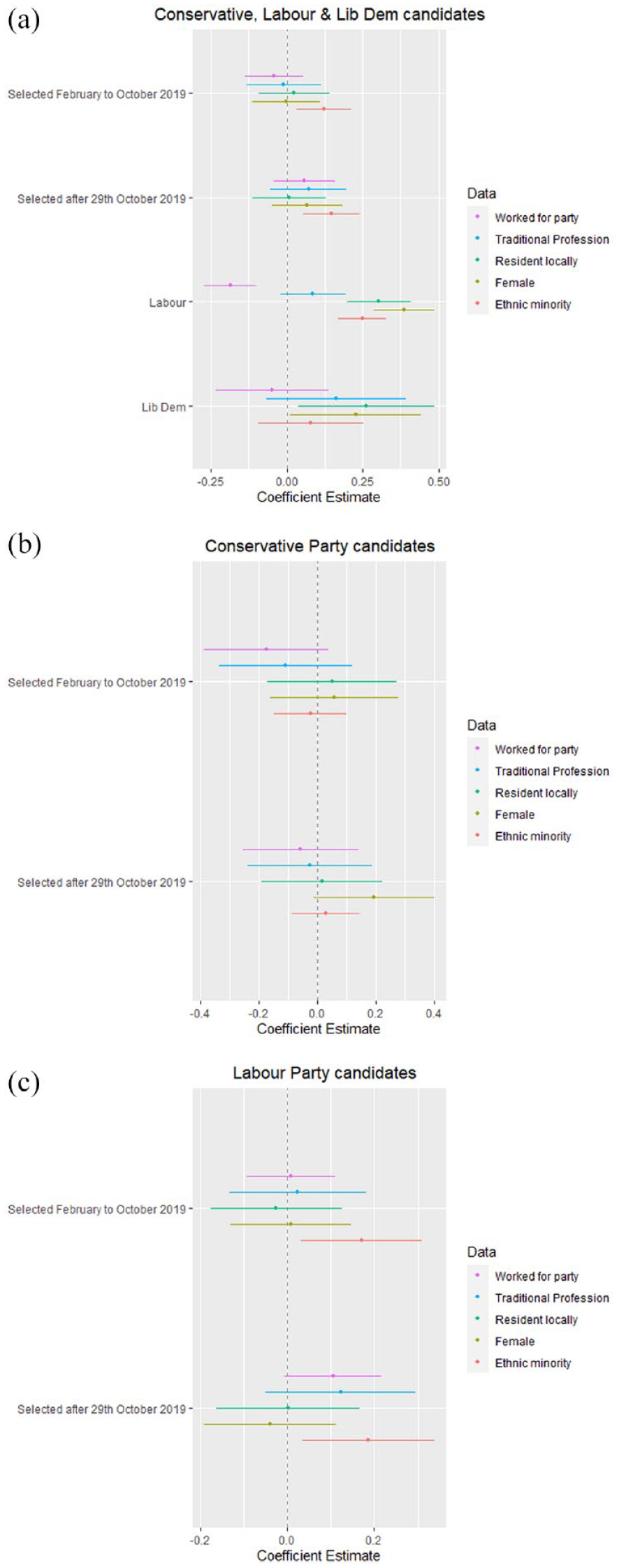
Coefficients showing effect of selection period on likelihood of candidates with particular characteristics being shortlisted.
Given the small number of Conservative selections that took place prior to February 2019, as a robustness check we rerun our analyses for Conservative candidates simply testing whether candidates with certain characteristics were more likely to be shortlisted after the snap election was announced, finding this to be the case for female candidates but not for any other of our variables of interest. We show the results in Appendix 3. Overall, we find some support for our hypotheses that those who have worked for the party (H3) and those from more marginalised groups (H6) are more likely to be shortlisted closer to the election, but no support for our expectations that more candidates from traditional occupation pathways into politics (H4) or who are not locally resident (H5) would be more likely to be shortlisted closer to the election. The effect for party workers in Labour is consistent with a larger advantage for party insiders in late selections where national parties have more influence over shortlisting. The effect for ethnic minorities and for women in Conservative selections suggests that central parties may also use their influence to address imbalances in the demographic make-up of candidates selected in winnable seats.
Together, this suggests that national party decision-makers use their greater influence to ‘parachute’ favoured candidates or minority candidates into late selection processes, consistent with evidence from Canada that central parties intervene in selections to favour star candidates and women (Koop and Bittner, 2011). Although one way of ‘parachuting’ candidates is by having them contend for selection unopposed – for instance, by dissuading rival candidates to run (see Schindler et al., 2023) – our conclusions about late selections are almost exclusively based on contested selections with more than one candidate. This is because selection contests where shortlists were not made public were excluded from our analysis, and from 145 selections contests that took place in winnable constituencies for which we have complete information on shortlists, only 7 were confirmed acclamations. If some of the cases for which we could not find confirmatory evidence about the shortlist size were indeed uncontested selections, then our results regarding parachuted insiders are likely to be conservative.
Who gets selected?
Figure 2 presents results from multi-level logistic regression models with candidates (level 1) nested within selection shortlists (level 2) testing the effects of our variables of interest on the likelihood of selection for all candidates (green lines), Conservative candidates only (blue lines), Labour candidates in all-women shortlists (pink lines) and Labour candidates in mixed-sex selections (burgundy lines). All independent variables included in the model are binary, hence the effect sizes are standardised.
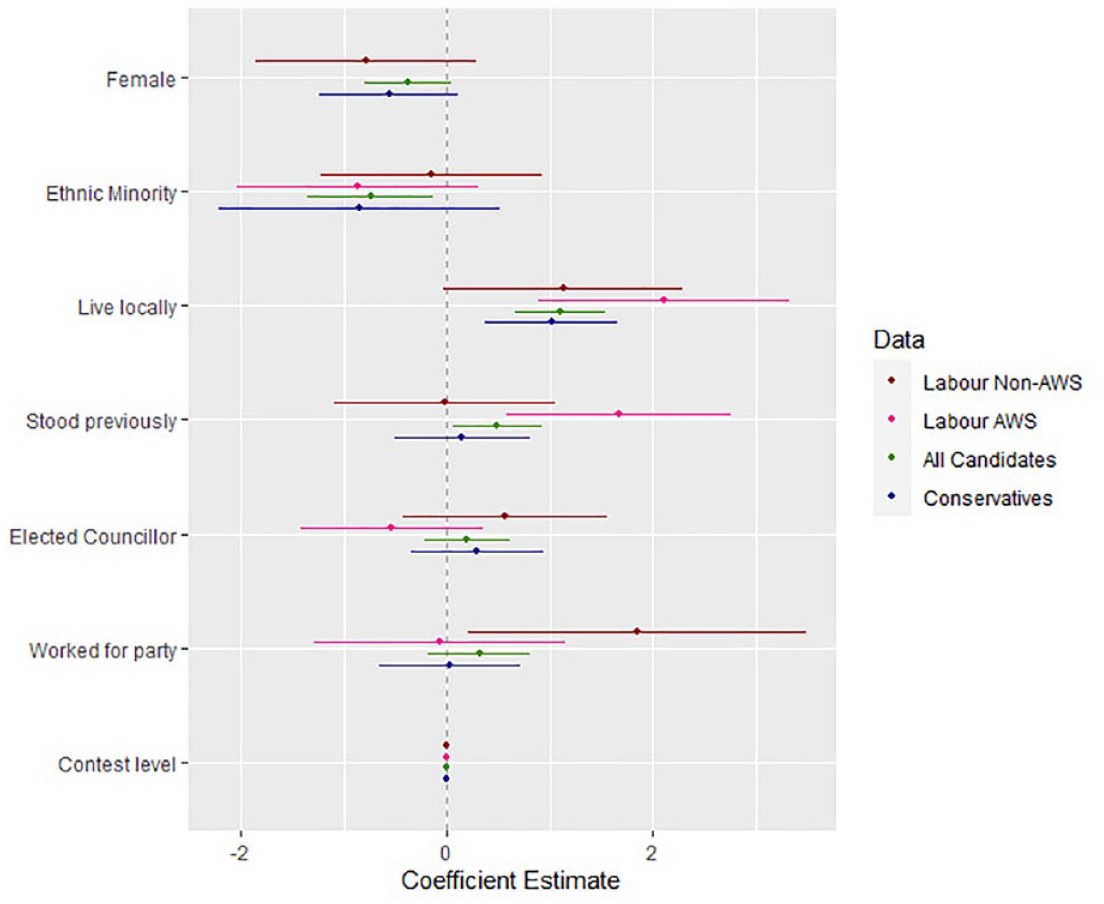
Logistic multi-level regression models of selection success among shortlisted candidates.
We find, against our expectations, that shortlisted female and ethnic minority candidates are less successful in winning selections. This is the case for both Labour and Conservative selections, although the effects are not significant when the data are restricted to selections within each party individually. Our second hypothesis is also rejected as there is no significant relationship between having worked for the party and selection success. As a robustness check, we restricted this variable to only include individuals who had worked for the ‘national’ party, including Special Advisers, which might offer a better indicator of ‘insider’ status. This did not substantially change the results, and interestingly we find a negative (albeit non-significant) effect of working for the national party, suggesting that such a background may hurt more than it helps. 11 Instead, the factor that proves by far the most substantively and statistically significant across the board is local residence. Local candidates are much more successful in every party’s selection processes.
We further observe some patterns of note between Labour selections that used all-women shortlists and those that did not. Candidates with experience of working for the Labour Party did better in mixed-sex selection contests, while candidates with previous Parliamentary election experience fared better in all-women contests. Unlike Ashe’s (2019) findings based on Labour data from the 2000s, we do not find that local Councillors were more likely to be selected in mixed-sex contests.
Robustness checks
Our models above exclude age, as we could only obtain age data for 313 of our 439 shortlisted candidates. Against our expectations, when we do include age in our model, we find a linear effect with younger candidates more likely to be selected and the fit of our model greatly improved, although the results for our other variables do not substantially change. 12 In Appendix 6, we test a model including variables for whether candidates self-identify as LGBT or disabled, which also do not substantially affect other results. LGBT candidates are more likely to be selected (although this relationship is not significant), which may reflect the wide tolerance for the LGBT community in the United Kingdom (Curtice et al., 2019). Finally, in Appendix 7 we show the results of models that include interactions between gender, ethnicity, age and localness. These affect the findings in two ways. First, the negative effect of being minority ethnic doubles when we interact ethnicity with local residence, showing that the penalty ethnic minority aspirants face is enhanced if they do not live in the constituency. Second, by interacting age with gender we find that older women are significantly less likely to be selected. Figure 3 displays the effects.
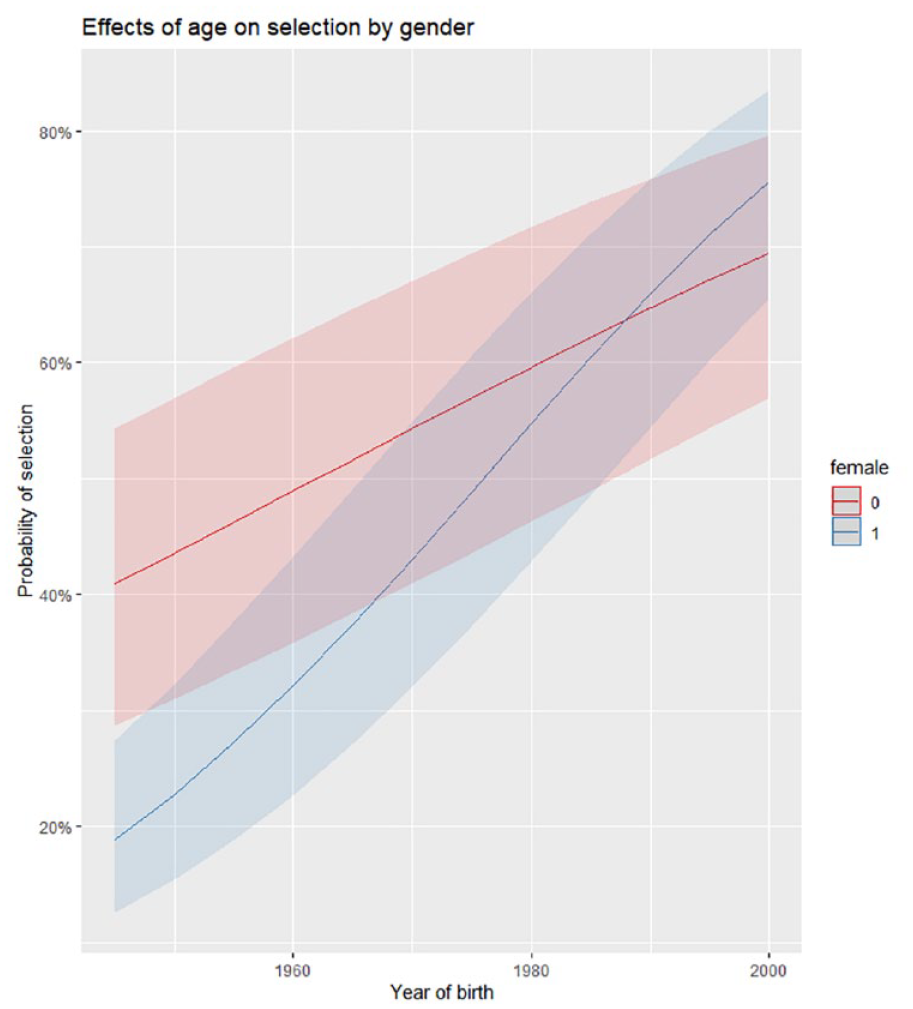
Effects of age on probability of selection by gender.
Party factions
Descriptive statistics indicate evidence of a relationship between party factions and selection success in both parties. As Figure 4 shows, half of the selection contests in winnable seats were won by Corbynites, but only a quarter by Corbynsceptics.
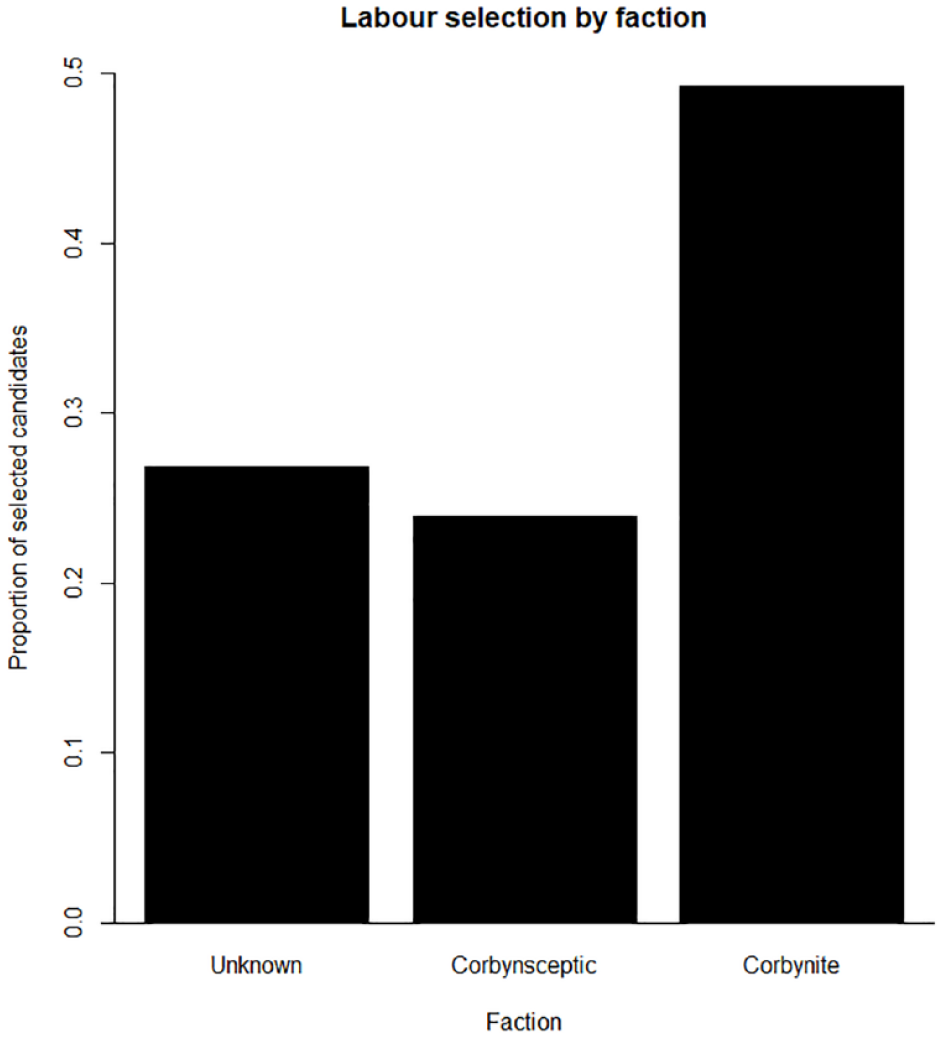
Success of shortlisted Labour candidates by faction.
Despite the greater media attention paid to factional friction in the Labour Party, we find a greater factional effect with the Conservatives, with evidence that Brexit alignments influenced selection success in 2019. Just 11 of 69 (16%) Conservative selection contests were won by known Remainers, while 33 of (48%) were won by known Leavers, as set out in Figure 5. Consistent with our expectations, Conservative members in 2019 preferred candidates with stronger Brexit credentials.
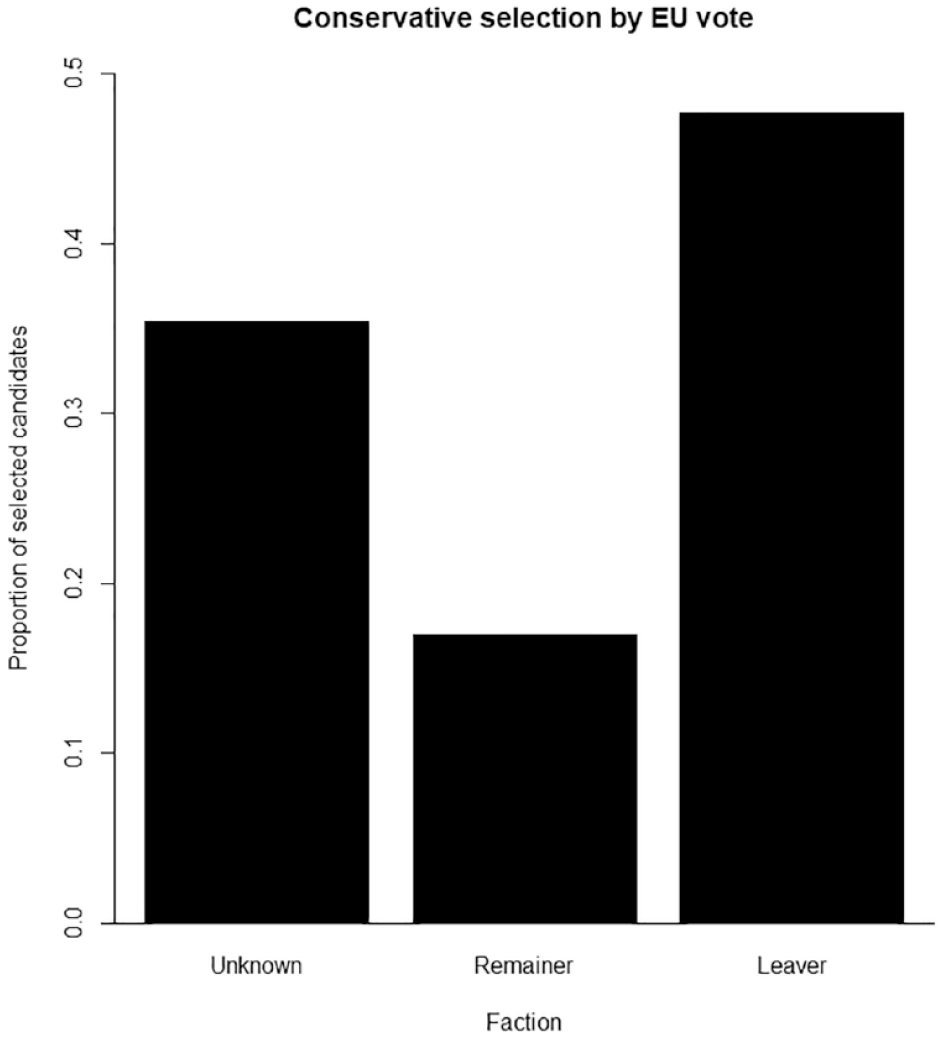
Success of shortlisted Conservative candidates by faction.
We therefore add faction to our models predicting candidate success in the Labour Party. As Table 4 shows, we find no evidence that known Corbynites were more likely to be selected over known Corbynsceptics, contrary to our expectations in H7. However, candidates with no known association to party factions were significantly less likely to be selected, perhaps suggesting that it is association with a broader faction that matters more than the particular faction that a candidate is aligned with.
Factors affecting likelihood of success for shortlisted Labour candidates.

*p < 0.05. **p < 0.01. ***p < 0.001.
Bold indicates statistical significance.
Next, we add candidates’ Brexit vote to our model predicting the success of shortlisted Conservative candidates. As the results in Table 5 show, Leave support has a positive effect but falls well short of statistical significance once other factors are controlled for, so we also reject our fifth hypothesis.
Factors affecting likelihood of success for shortlisted Conservative candidates.

p < 0.05. **p < 0.01. ***p < 0.001.
Bold indicates statistical significance.
Conclusion
We have sought to shed light on one aspect of the ‘secret garden’ of candidate selection by constructing and analysing a database of candidates shortlisted by the four largest British political parties ahead of the 2019 general election, and then examining what factors predict failure and success when party members choose candidates from shortlists. While there have been many studies of the pools of successful candidates standing for the Commons, there is much less analysis of who succeeds and who fails in selection contests, the stage of the candidate selection process when party members exercise the most influence. Our analysis of the first systematic, cross-party resource on candidates shortlisted in winnable constituencies has yielded new insights into the predictors of success in these selection contests, and on the roles played by parties, factions and proximity to the election in determining selection outcomes.
We find that local roots matter a great deal to selectors, as they do to voters more broadly (Campbell and Cowley, 2013; Evans et al., 2017) and to selectorates in other countries (Berz and Jankowski, 2022; Cross et al., 2022). Local residence is by far the strongest predictor of selection success among shortlisted candidates from all parties, even though we adopted a conservative approach and only coded candidates as local if we found evidence that they resided in the constituency at the time of selection, excluding others who may have been perceived to have genuine local links aside from current residence in the constituency. Voters consistently report a strong preference for local candidates. Our evidence suggests the party members choosing candidates in winnable seats either share this preference or respond strongly to it when choosing their candidates.
The other predictors of selection suggest that selectors continue to penalise women and ethnic minorities when selecting between shortlisted candidates, and in particular older women and non-locally resident ethnic minorities. This suggests that without central party intervention, the biases faced by such candidates will perpetuate as they seem to be in part driven by members’ prejudices. Unlike recent research from Germany, we do not find that the barriers faced by intersectional marginalised groups are greater in right-wing parties (Debus and Himmelrath, 2024). However, we do find that some parties are failing to proportionately shortlist candidates from marginalised groups: the Conservatives overwhelmingly shortlist white or male candidates in winnable seats, and the Liberal Democrats and Scottish Nationalist Parties also fail to shortlist ethnic minority candidates in proportion to their share of the population. Thus we expect that progress towards a more descriptively representative UK House of Commons will remain slow at future elections.
Surprisingly, in a context featuring intense internal party conflict, we found no evidence that factional alignments mattered for selection success for shortlisted Labour candidates. Once on the shortlist, candidates who opposed Jeremy Corbyn or were endorsed by groups critical of the Labour leader were as likely to succeed as Corbyn supporters backed by Corbynite groups. Similarly, we do not find that Leave-voting shortlisted candidates are more likely to be selected as Conservative candidates than Remain voters. However, for both parties there were simply a lot more shortlisted candidates from the faction aligned with the leader. This suggests that candidates from rival factions may have been less likely to be shortlisted, either due to a lack of demand (discrimination at the shortlisting stage) or lack of supply (less willingness to stand when their faction was not in the ascendant).
We also find that the timing of selection matters. Shortlists drawn up close to the election featured more ethnic minorities, for Labour more central party workers and for the Conservatives, more women. This is suggestive evidence for parties using late selections to fast-track favoured party insiders or to correct demographic imbalances, something which may have happened more at a ‘snap’ election like 2019 where many MPs announced their intentions to stand down close to polling day.
Our analysis of candidate selections has highlighted the potential for selection processes to shape patterns of representation, and has highlighted the powerful influence that party members exercise through their choices in selection contests over who is given the chance to enter the House of Commons. Yet this limited initial exercise raises as many questions as it answers. Resource constraints obliged us to focus only on winnable seats, only on the final shortlisting and selection stages of the selection process, and only on a single election. We do not know how the choices and characteristics of aspirants influence their prospects of applying, or of being longlisted, nor do we know what influence party officials and members have at these stages. We have offered some initial glimpses into the ‘secret garden’, but most of its landscape remains unexamined. Given the central role played by selection in shaping the background and beliefs represented in Westminster, and through this influencing many legislative and political outcomes, future work should look to renew our understanding of this most central, yet least understood, of party political processes.
Footnotes
Appendix
There are no differences between single and serial candidates in terms of gender or ethnicity, but several striking differences elsewhere. Serial candidates were much more likely to work in brokerage professions, demonstrating how such occupations facilitate political careers (Cairney, 2007), although surprisingly those who worked in instrumental professions directly adjacent to party politics were less likely to be shortlisted multiple times. They were also more likely to have worked for the party, and also to have stood for Parliament previously or served as Councillors. Unsurprisingly, there is a significant difference in terms of whether applicants were resident locally. Nearly two-thirds of those shortlisted once lived in the constituency in which they were shortlisted, while under half of serial candidates were resident in any of the constituencies for which they were shortlisted.
DW plot showing model coefficients for whether Conservative candidates with particular characteristics were more likely to be selected closer to the election.
Acknowledgements
The authors sincerely thank the anonymous reviewers and attendees at the 2022 EPOP Conference and a 2022 University of Manchester Democracy & Elections seminar for their helpful suggestions for improving this manuscript. They also thank the local journalists who provided invaluable information about local shortlists when such information was not available elsewhere.
Funding
The author(s) received no financial support for the research, authorship and/or publication of this article.
