




Abstract
This article examines the impact of armed conflicts on the expansion of old-age pension systems in the Global South. Using new longitudinal data on pension coverage and focusing on 82 countries in Africa, Asia, and Latin America between 1900 and 2014, the study combines descriptive analyses and logit regressions to assess the timing and likelihood of pension expansion during war and post-war periods. The analysis reveals that the probability of pension expansion increases during and particularly after war. Interestingly, the association is especially robust for civil wars. Post-war pension expansions are typically directed towards dependent workers, while self-employed groups benefit less. The results suggest that governments often use pension reforms as instruments of stabilisation and legitimacy in war-torn societies. The study contributes to comparative welfare research by highlighting the warfare-welfare nexus beyond the Western world and across different types of conflict.
Introduction
Old-age pensions are the most widespread social protection scheme across the globe and a critical cornerstone for achieving broader social development goals, including poverty and inequality reduction (ILO, 2021). While nearly all countries worldwide have implemented some form of old-age pensions, there is only limited understanding of the historical and political dynamics that shaped their emergence and expansion in the Global South. 1 One blind spot in comparative research is the role played by emergencies. In this article, we examine the impact of war on pension coverage expansion in 82 countries in Africa, Asia, and Latin America between 1900 and 2014. Our focus on armed conflicts is motivated by a growing literature on the warfare-welfare nexus in Western countries. Inspired by Titmuss’ seminal essay on war and social policy (Titmuss, 1958), this body of research has shown that large-scale interstate wars, notably the two world wars, accelerated the introduction and expansion of social security schemes (Obinger and Schmitt, 2020, 2024; Obinger et al., 2018; Porter, 1994; Walter and Emmenegger, 2022). Old-age security is no exception as World War II was ‘a watershed for pension development’ (Esping-Andersen, 1990: 100).
In contrast to Western countries, civil wars are the predominant form of armed conflict in the Global South (Wimmer, 2013). However, the influence of civil wars on the development of old-age pension systems has been largely ignored by comparative research on countries in the Global South. The same applies to the effects of interstate wars in this region. This article aims to fill this gap by focusing on the effects of armed conflicts on the inclusiveness of old-age pension systems. Our empirical analysis shows that the introduction of pensions and their coverage expansion to previously excluded groups become more likely during war years and in the immediate post-war period. Interestingly, this effect particularly holds for civil wars.
This article proceeds as follows. The next section summarises the current state of research on the determinants of pension expansion. We then discuss possible impacts of armed conflicts on the introduction and expansion of pension policies. Following this, we outline the development of pension policies in 82 countries across the Global South and present our empirical findings about the impact of interstate and civil wars on the initiation and expansion of pension policies. The final section offers concluding remarks.
Literature review on the introduction and expansion of pension schemes
In most countries, civil servants were historically among the first groups to benefit from old-age protection schemes (Mesa-Lago, 1978; Rothenbacher, 2004: 7) while the vast majority of the population either had to work until death or disability, or rely on family support and private provision in old age (Hinrichs and Lynch, 2021: 492). Over time, pension programmes became more and more inclusive (Baldwin, 1990; Immergut et al., 2007; Korpi, 1983). This expansion typically occurred either by incorporating previously excluded occupational or social groups into existing pension schemes or by implementing new, group-specific pension schemes. Countries following the latter path often ended up with highly fragmented pension systems, as numerous historical examples from Europe, Latin America, and North Africa illustrate (Cutler and Johnson, 2004; Hakim, 2019; Mesa-Lago, 1978).
Why did countries introduce pension programmes and expand them to include previously excluded groups? The literature offers various explanations. Some scholars emphasise the role of socio-economic transformations – such as industrialisation, demographic aging, urbanisation, the decline of traditional family support structures, and the strain on municipal poor relief – as key drivers of social security expansion (Flora and Alber, 1981; Schmitt et al., 2015; Usui, 1994; Wilensky, 1974; Williamson and Pampel, 1993). Economic growth, particularly as a by-product of industrialisation, enabled the extension of pensions to groups previously deemed too weak to contribute. Economic growth also plays an important role for the expansion of non-contributory financed pensions in non-Western countries. The commodity boom in Latin America at the start of the 21st century, for instance, allowed many countries to introduce tax-financed social pensions that have since spread globally (Arza et al., 2022; Leisering, 2023).
Other scholars stress political factors as central to welfare expansion. The regime type, in particular, has been shown to significantly influence pension development. In autocracies, the first pension programmes implemented were typically designed as social insurance schemes, which allowed rulers to channel benefits towards groups vital for regime survival. While democracies also favoured contributory social insurance initially, later they far more likely implemented non-contributory pension programmes aimed at broader, often poorer, segments of the population (Grünewald, 2022a; Schmitt, 2019). In addition, regime type affects pension coverage as democracies tend to protect more groups than autocracies – both at the time of programme introduction (Grünewald, 2021) and in the long term (Knutsen and Rasmussen, 2018).
Beyond regime type, the distribution of power resources, left-wing ideology, and the formation of cross-class alliances were decisive for pension development. The question of how these factors affect pension policies, however, has been answered quite differently. One line of scholarship highlights the mobilisation of industrial workers, including their representation in left-wing parties, as key drivers of both initial welfare implementation and subsequent expansions to previously uncovered groups (Esping-Andersen, 1990; Korpi, 1983, 2006). While compelling, this ‘left-working class’ hypothesis has been subject to criticism. Detailed examinations of expansion sequences often fail to confirm a decisive influence of working-class actors (Baldwin, 1990: 7). Instead, some scholars argue that the urban middle class or farmers played a critical role in extending coverage to further and partly wealthier groups, as social risks like old age cut across class boundaries (Baldwin, 1990; Mares, 2003; Petersen, 2009; Ulriksen, 2012). Cross-class coalitions rather than the power resources of the labour movement are therefore of key importance for pension expansion.
Colonial legacies have also profoundly shaped pension development in the Global South. In former French colonies, social insurance schemes modelled on the French system were introduced, reflecting a Western conception of the ‘worker’ as defined in the Colonial Labour Code from 1952 (Schmitt, 2020). After independence, these countries often adopted earnings-related pension systems while retaining the broad definition of a worker, resulting in comparatively high legal coverage rates (Grünewald, 2022b). In contrast, the influence of British colonialism on pensions was more inconsistent and ambiguous (Schmitt, 2020).
Finally, international factors such as policy diffusion and the role of international organisations have played a significant role in the expansion of old-age pensions (Schmitt et al., 2015). Since its foundation in 1919, the International Labour Organisation (ILO) has actively promoted social security and international labour standards. In 1933, it adopted six conventions (C035–C040) concerning old-age, invalidity, and survivors’ pensions. Notably, Convention C035 explicitly called for the extension of old-age insurance to cover ‘persons employed in industrial or commercial undertakings, in the liberal professions, and for outworkers and domestic servants’ (ILO C035). With the Social Protection Recommendation No. 202 from 2012, the ILO also spearheaded the campaign for tax-financed welfare, such as social pensions (HelpAge International, 2006), whereas the World Bank became a key actor in promoting the privatisation of pension systems, especially since the 1990s (Müller, 2000; Orenstein, 2011, 2013).
While the existing literature identifies a wide range of socio-economic, political, colonial, and international drivers behind the introduction and expansion of pensions, the role of emergencies – particularly wars – remains largely overlooked.
Why should war matter?
There is a growing scholarly consensus that industrialised mass warfare has been a significant catalyst for welfare state expansion in Western countries in the aftermath of military conflict (Obinger and Schmitt, 2020, 2024). However, existing research on the relationship between interstate wars and social policy development has largely focused on Western contexts and therefore paid limited attention to countries in the Global South.
For Western countries, scholars have identified both demand-side and supply-side mechanisms through which warfare may contribute to increased generosity, broader coverage, and higher social spending in the immediate post-conflict periods (Obinger et al., 2018: chap. 1). On the demand side, four main mechanisms are typically highlighted. First, the devastation of war compels governments to provide income support for the large numbers of military and civilian casualties. Second, the heightened exposure of populations to extreme risk and uncertainty during wartime fosters greater acceptance of collective risk-pooling institutions (Dryzek and Goodin, 1986; Rehm, 2016; Walter and Emmenegger, 2022), thereby increasing the likelihood of pension scheme introduction and expansion. Third, the expansion of welfare after war can be seen as the fulfilment of social promises made during wartime to secure mass support and enhance political legitimacy. In this sense, post-war pension policies function as compensation for the population’s sacrifices during periods of high military spending that crowd out welfare investments. Finally, warfare has been shown to shape individual preferences and behaviour. Empirical evidence suggests that exposure to war violence increases solidarity, fosters pro-social attitudes, and heightens demands for fairness in the distribution of war-related burdens – factors that support social policy expansion (Frizell et al., 2025).
From a supply-side perspective, warfare can push significant political and economic transformations that facilitate welfare expansion. These include state-building, democratisation, electoral reform (e.g. the adoption of proportional representation), shifts in political power, government centralisation, enhanced fiscal capacity through new taxation mechanisms (Frizell, 2025; Scheve and Stasavage, 2010), and the creation of welfare ministries (Petersen et al., 2023). Furthermore, international organisations founded after both world wars played an important role in promoting peace through collaborative social policy initiatives (Schmitt et al., 2015).
While the link between interstate warfare and welfare development in Western nations has attracted considerable academic attention, the impact of civil wars as the main form of conflict in Global South countries remains comparatively underexplored (Frizell et al., 2026). Existing research at the intersection of social policy and civil conflict has primarily focused on how welfare provision influences the risk of civil war onset (Azam, 2001; Azam and Mesnard, 2003; Justino and Martorano, 2018; Taydas and Peksen, 2012). Much less is known about how civil wars affect the development of social policies and their impact on welfare provision is theoretically ambiguous. On one hand, fragile economies and weak state institutions, typical for post-civil war contexts (World Bank, 2011), may hinder the implementation of expansive social policies. On the other hand, welfare expansion may be strategically employed to pacify rival societal groups during the post-war period (Liu, 2024).
The limited studies that do exist generally suggest that civil wars undermine governments’ ability to implement and maintain social policies. Violence, destruction of infrastructure, displacement, economic collapse, and political instability severely constrain the delivery of essential services such as pensions, thereby exacerbating poverty, inequality, and social exclusion. For instance, research on education systems has shown that civil wars often lead to sharp declines in service provision (Lai and Thyne, 2007). Case studies further indicate that civil wars can give rise to clientelistic and exclusionary welfare practices. In such contexts, entitlements like pensions are often disproportionately allocated to favoured groups – such as state officials or security forces – at the expense of broader inclusion (e.g. Cerami, 2023, on Iraq).
In addition, civil wars tend to erode administrative capacity and weaken institutional frameworks, making it more difficult for public servants to deliver basic services, particularly in conflict-affected or post-conflict areas (e.g. Okello and Taylor, 2023, on Uganda’s protracted civil war). Vulnerable populations, especially internally displaced persons, often suffer most acutely, as public service providers withdraw from these regions.
Despite these predominantly negative outcomes, a few studies point to partial positive effects. For example, Paglayan (2022) finds evidence of education expansion following civil wars in 40 European and Latin American countries. Likewise, Eibl and Hertog (2024) show that regime-threatening rebellions lead oil-rich governments to expand welfare spending. Moreover, case-based evidence suggests that civil wars affect both the introduction and expansion of pensions. In Sierra Leone, for instance, social security became an integral ‘part of the process of rehabilitation, reconstruction and settlement’ (National Social Security and Insurance Trust (NASSIT), 2026) after the decades-long civil war. Following the Lomé peace agreement in 1999, President Ahmad Tejan Kabbah charged the newly appointed Minister of Labour and Industrial Relations with the creation of a social security system (EIU, 1999; NASSIT, 2026). While the agreement did not immediately put stop to the war, the reform process continued. In mid-2001, as the fighting had finally subsided on the ground and the country approached de facto peace, the parliament ultimately adopted ‘The National Social Security and Insurance Trust Act’, which for the first time granted old-age pensions to private sector workers. In Nicaragua, by contrast, the Sandinista government, who came to power in 1979 during the civil war, planned the expansion of social security to ‘cover the entire population that constitutes the national community’ (Ley de Seguridad Social–Decreto No. 974, 1982, own translation) in one of its first laws. This also comprised the expansion of pension benefits to the rural sector, as has been further outlined in legislation from 1984 (Acuerdo Ministerial N° 8, 1984). Even though agricultural workers did not initiate the civil war, they had to endure the heaviest exactions, and given their economic and strategic importance for the Sandinista government became the main intended beneficiaries of social, economic and agrarian reforms (Deere and Marchetti, 1985; Phillips, 2004).
Nonetheless, such cases could well be exceptions rather than the norm, and the broader impact of civil wars on the introduction and expansion of social policies remains poorly understood. This raises two central questions: what effects does warfare have on the introduction and expansion of pension schemes in the Global South and are these effects dependent on the conflict type (interstate vs civil war)? Before answering these questions, we describe the development of pension policies in countries of the Global South.
Pension schemes in the Global South: descriptive patterns
The first pension systems in the Global South emerged in the early to mid-20th century, predominantly as earnings-related social insurance schemes. These systems were based on wage earners’ contributions, with pension benefits directly tied to prior earnings. To this day, earnings-related schemes remain the most widespread and dominant form of retirement provision in the Global South. By contrast, only a few countries initially adopted alternative models, such as provident funds or mandatory individual accounts, 2 to ensure old-age protection. Earnings-related pensions, provident funds, and mandatory individual savings accounts are all contribution-financed schemes as they link benefits to individual contributions based on previous earnings (ILO, 2021). In recent decades, many countries have additionally introduced non-contributory pensions as a supplementary pillar (Leisering, 2023). Typically financed through taxes, these social pensions provide benefits independent of prior contributions, broadening access to income support for older adults (ILO, 2021). But when was the inclusiveness of contributory pension systems broadened to cover further groups?
Figure 1 illustrates, for our country sample, the years in which manufacturing, commercial, agricultural, domestic, and temporary workers, as well as farmers, the self-employed, and apprentices were granted old-age pensions for the first time. Darker colours reflect a higher expansion intensity in the given year. The figure also shows the number of independent countries over time. Given the dominance of contribution-financed programmes, the analysis is restricted to these pension programmes only. The data stem from the PENLEG II – Pension Legislation around the World (Africa, Asia, the Americas) data set which captures the entire sequence of pension development in 100 countries from its origins until today and focuses on all pension programmes for workers in the private sector that are either granted as a social right or to which people have to make mandatory contributions (Grünewald, 2025a). 3 While most of the categories mentioned in the figure are self-explanatory, three groups require more elaboration. The category ‘commerce’ refers to all employees involved in commercial activities such as selling products or services. ‘Domestic workers’ are persons working in private households with tasks such as cooking, cleaning, or gardening, whereas ‘temporary workers’ are defined as all workers with a non-permanent employment contract (Grünewald, 2025b: 4). In nine countries, the protection of certain groups was reversed and sometimes reintroduced decades later, as in the case of Peru, where mandatory old-age protection for domestic workers was abolished one year after the pension system was implemented (1937) and not reintroduced until 1973. Groups that have been excluded, but whose coverage is sometimes reinstated, include the self-employed, domestic workers, farmers, agricultural workers, and temporary workers. As such events are rare, we decided only to consider the date when a group was protected for the first time, disregarding later reversals or reintroductions.
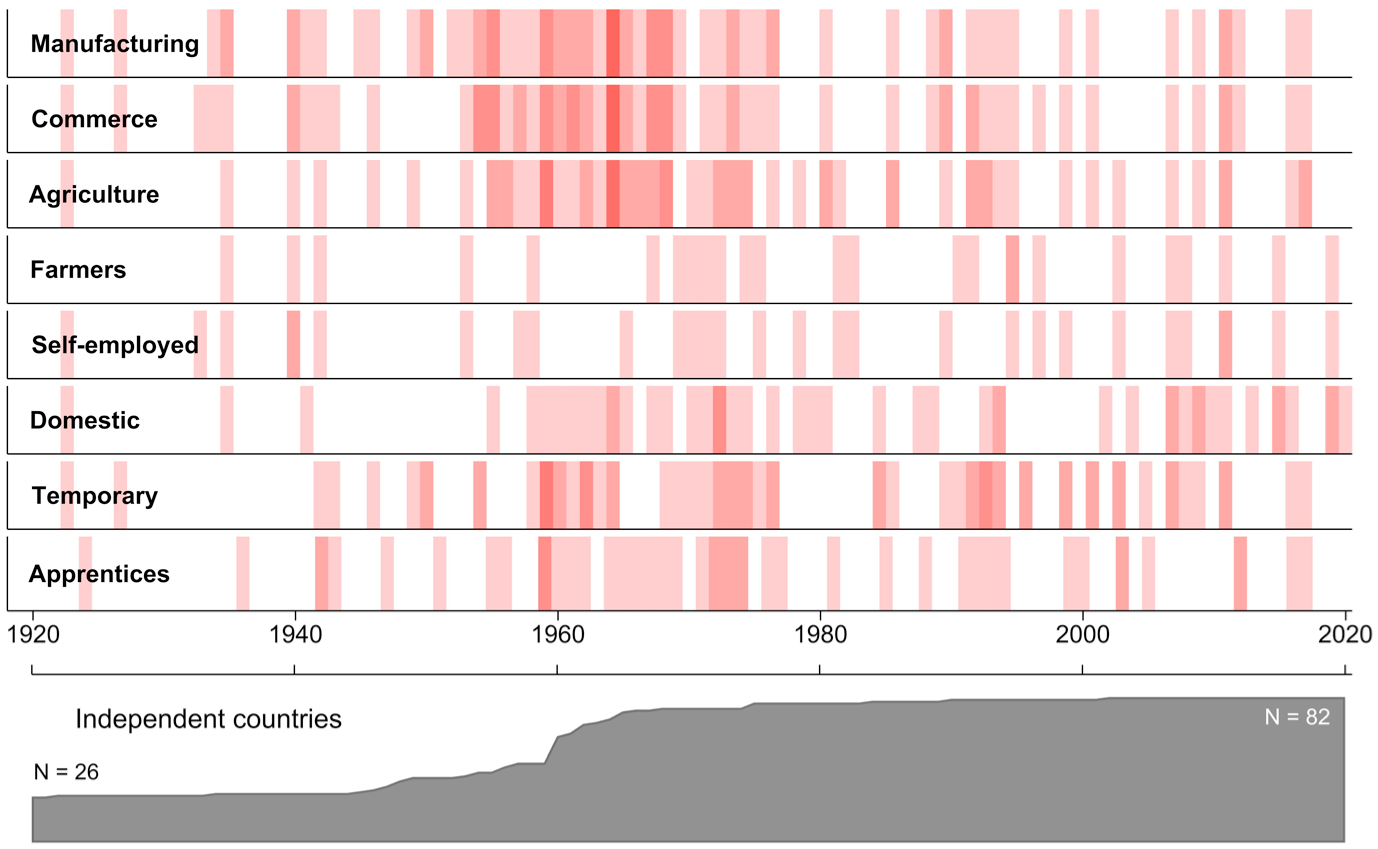
Pension coverage expansions, by group.
Figure 1 shows an expansionist trend around the 1960s, when many former colonies became independent and thus introduced or expanded their pension programmes (Schmitt, 2015). A similar trend is visible in the 1990s when many Asian countries, such as Thailand, Brunei Darussalam, Laos, and Vietnam, implemented contribution-financed pension programmes for the first time. Moreover, between 1989 and 1995, nine more countries in this region and Latin America extended their pension coverage to further groups such as farmers, the self-employed, or temporary and domestic workers. But which groups were protected by the first pension programme and which patterns of subsequent pension coverage expansion can be identified? As our data reveal, on average 3.6 of the eight groups considered were protected in the first pension programmes. Zooming into the constellations of groups covered more closely, we find 27 distinct coverage patterns at the start. The most frequently covered group constellations consist of (a) agricultural, manufacturing, and commercial workers (15 cases) followed by (b) manufacturing and commercial workers (7 cases), (c) agricultural, manufacturing, commercial workers and apprentices (6 cases) or (d) agricultural, manufacturing, commercial, and temporary workers, as well as apprentices (6 cases). These coverage patterns underline both the assumed importance of industrial workers for the introduction of pension programmes (Korpi, 1983) – they were protected right from the start in all but two countries in our sample – and the importance of economically more affluent groups, such as commercial workers (Mares, 2003). Moreover, colonial legacies are visible. In line with previous research (Grünewald, 2022b), former French colonies covered a broader range of occupational groups when introducing their first pensions, which is, inter alia, reflected in the coverage patterns (c) and (d). Which and how many groups were already protected at the start also shaped the subsequent expansion pattern. Ecuador (first introduction in 1935), for instance, initially only covered manufacturing and commercial workers. To reach its current level of inclusiveness, pension system coverage was expanded six times. By contrast, 12 countries, mostly in Africa, have not expanded their pension coverage at all since their pension introduction. This also applies to many Asian countries, which were latecomers in terms of old-age protection and hence had less time to progress compared to, for example, Latin American countries, which partly introduced their first pensions already in the 1920s and 1930s.
In summary, countries differ significantly in both the extent and kinds of groups they included under their first pension legislation. This initial variance also led to different subsequent expansion patterns. As emphasised in the existing literature on Western welfare states, emergencies such as wars were often catalysts for pension reforms. Therefore, the next section will take a closer look at the relationship between war and the development of pension systems in the Global South.
War and pension schemes: descriptive patterns
This section analyses the relationship between war and pension coverage in the Global South from three distinct angles. First, is there a temporal coincidence between war and coverage expansion, and if so, do expansions occur in anticipation of, during, or after the war? Second, does the type of war – civil or interstate – matter? Third, which occupational groups are most likely to be included as a consequence of war?
In a first step, we compare the probability of pension coverage expansion for our 82 countries (see Supplemental Appendix Table A1) across three time periods: five years before the outbreak of a war, during the war, and five years after its conclusion, 4 and use the baseline probability, which applies to all other periods, as a reference.
The period classification is based on civil and interstate war data from Correlates of War data sets, 5 providing maximal temporal coverage (effectively from 1900 to 2014). The original data include all armed conflicts reaching an intensity of at least one thousand battle-related deaths per year, across all conflict parties. While this restricts the sample to conflicts of a significant scale, the involvement of each party – particularly in interstate wars with multiple participants – may still be limited. Since we are not interested in large-scale wars as such, but rather in their repercussions on the country level, and in view of rendering the coding of civil and interstate wars as consistent as possible, we apply an additional criterion for war participation. Only countries that suffered at least one thousand battle-related deaths over the course of the conflict are regarded as participants. For civil wars, where we chose to also include fatalities on the non-government side (undeniably capturing part of the conflict intensity on the country level), the stricter criterion has no effective ramifications. For interstate war, however, the coding effectively excludes around one-third of country-conflict episodes of moderate scale. Based on this new coding, there were still 175 civil and 57 interstate wars recorded for the relevant country sample, 6 with civil wars lasting somewhat longer (3 years versus just over 2 years on average), but also causing fewer deaths on average (by half, adjusted for pre-war population). The final sample, consisting of more than six thousand country-year observations, accordingly includes over 700 instances of one or more ongoing wars.
Figure 2 plots the probability of pension coverage expansion across conflict periods, with the number of country-years in each period in parentheses. 7 The dashed line shows the baseline probability for the majority of country years belonging to neither period. Several findings stand out. First, in the five years preceding a conflict, the probability of expansion is just over half of the baseline probability. Clearly, wars do not encourage pension expansion before their outbreak. Once the war has broken out, the probability more than doubles, surpassing that of the baseline probability by a considerable margin. In the immediate post-war period, the probability is equally high – to a large extent reflecting a large number of pension expansions in the first year of peace. 8
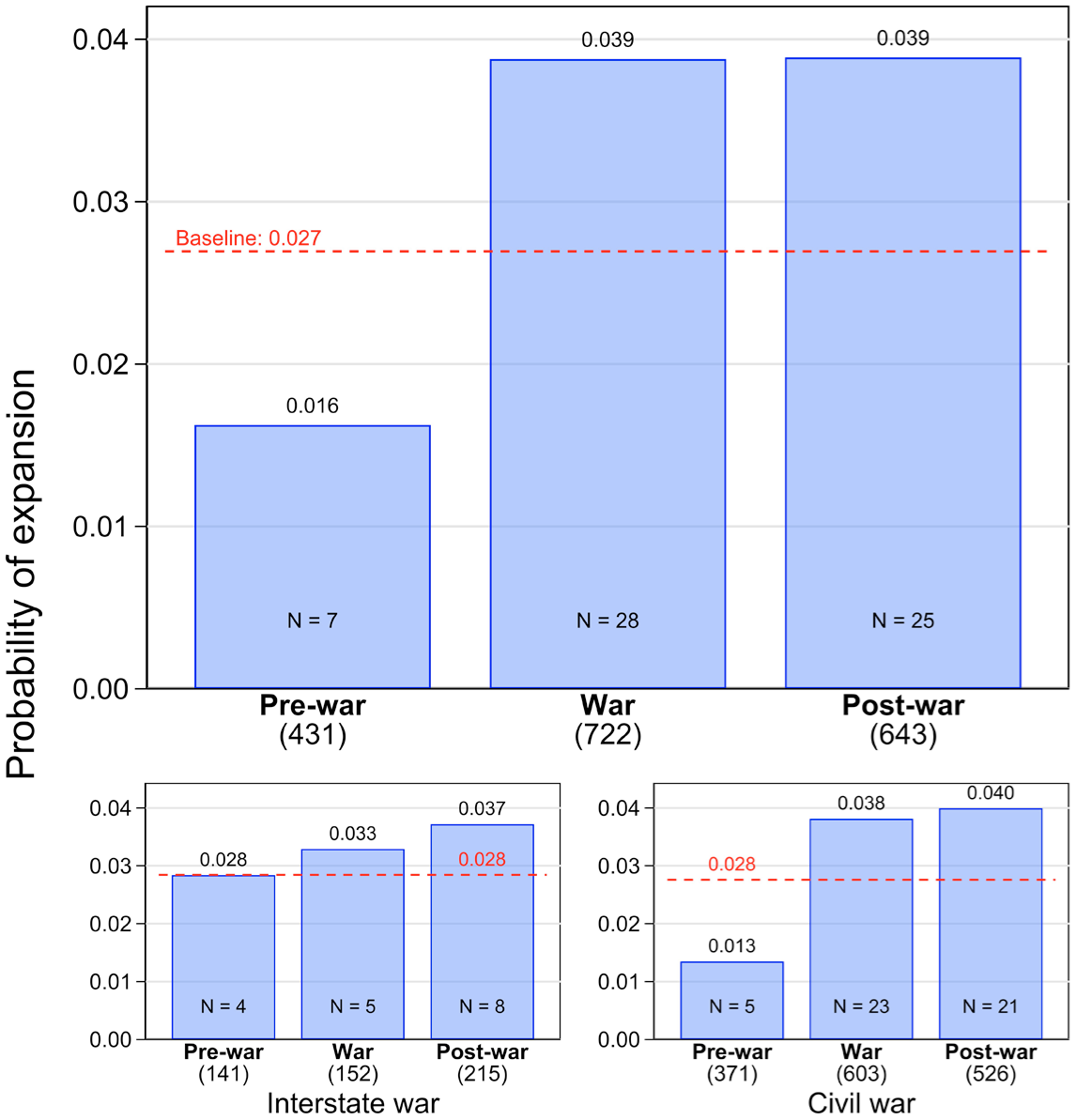
Pension coverage expansion and periods of war.
When disaggregating the conflict periods by war type, as in the two lower panels of Figure 2, it becomes clear that the pattern is to a large extent driven by civil wars. The probability of pension expansion likewise varies in relation to interstate wars, gradually increasing from parity with the baseline ( ‘peacetime’) probability in the pre-war period to considerably above in the post-war period. For civil wars, in contrast, pre-war periods are characterised by a very low expansion probability, which suddenly triples as war breaks out, and then remains at a level around 50% higher than the baseline as the war ends. It would appear that civil wars are at least as conducive to pension coverage expansions as interstate wars; indeed manifesting a much sharper break before and after the onset of war. The explanation for the difference in dynamics is not evident.
On one hand, the apparent difference in pre-war probability could be driven either by a selection mechanism, whereby state weakness and poverty both retard welfare expansion and increase the risk of future civil war (but not interstate war); or a lead-effect, whereby the outbreak of large-scale civil war tends to be preceded by simmering low-intensity rebellion, disturbing enough to divert government attention from welfare questions, but not so severe as to trigger demand for social protection.
On the other hand, the more pronounced and immediate increase in the probability of pension coverage expansion following civil war onset, if representing a true underlying process, is more puzzling. As noted, interstate wars are on average shorter and of higher relative intensity than civil wars, thus conceivably constituting exceptionally sharp societal shocks. This ought to be conducive to social policy expansion. A partial explanation may lie in the disparate nature of interstate wars included in our data. For, even with our more restrictive coding of interstate war participation (requiring 1000 battle-related deaths on the country level), many interstate engagements are relatively limited. In fact, the typical (median) interstate war involvement causes fewer fatalities than the typical civil war, adjusted for pre-war population. 9 Another, and probably more important factor is the fact that interstate wars – in contrast to civil wars – can be fought far from home territory, typically limiting their societal impact. In order to probe their potential variated impact, all interstate wars have been manually classified according to the territory on which they took place. 10 When only including interstate wars fought on home territory, the calculated probability of pension expansion rises compared to that of Figure 2, both before, during, and after the conflict. 11 While the statistical leverage is insufficient for firm conclusions, the difference would seem to point to the importance of taking location, and not simply participation, into account. Wars fought far from home may engender tremendous material cost and human losses, but the acute risks are restricted to a limited and well-defined group. Interstate wars fought at home, in contrast, and similar to civil wars, often imply society-wide risks and destruction.
If war, and civil war in particular, appear to encourage pension expansion in general, does this pattern apply to some groups more than others? Disaggregation by group significantly reduces our degrees of freedom and thus the ability to infer conclusions based on bivariate associations. However, the patterns may nonetheless be suggestive. Figure 3 shows the probability of first-ever-inclusion for each group, before, during, and after war. Since inclusion events can only occur once per country, all observations following an inclusion are excluded from the calculation. As the figures in the bars make clear, we are dealing with a small number of expansionary events for any group and period (considering the resulting uncertainty we refrain from reporting the calculated probabilities). It can nonetheless be noted that, for most categories, the probability increases clearly during and after a war compared to the pre-war period, aligning with the previously presented aggregate pattern. The most apparent exceptions pertain to farmers and the self-employed – both characterised by their lack of external employment dependence – for whom the probability of inclusion hardly changes across periods. As distinctly autonomous market actors, it is not far-fetched to assume that they would be more capable, and thus expected, to independently manage economic risks, including those arising due to war. In contrast, while internally diverse in terms of economic sectors and employment relations, all other groups are dependent on a labour market over which they have little control. These are also the groups driving the pattern of wartime and post-war pension coverage expansion.
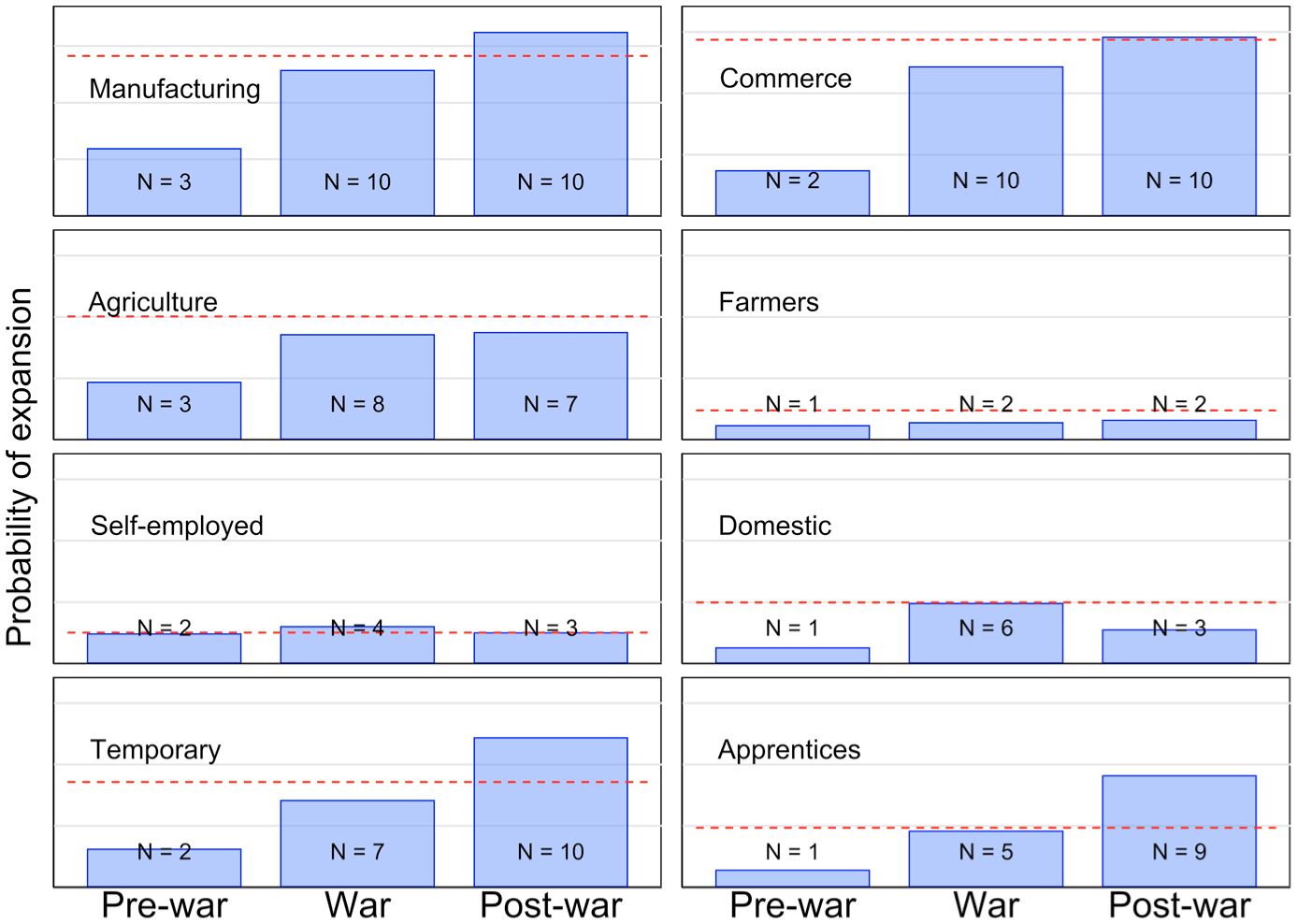
Pension coverage expansion and war, by group.
Regression analysis
The descriptive evidence above suggests a strong covariation between war and pension coverage expansion in the Global South, in line with historical experiences from the Global North (Obinger and Schmitt, 2020). Given the considerable differences in the economic and institutional context and not least in the modes of warfare, this was not a foregone conclusion.
In order to further explore the coincidence of war and pension expansion, in this section we analyse the association statistically with event history analysis, controlling for different economic and political variables in a series of logit regressions (following Beck et al., 1998). The approach provides an intuitive alternative to proportional hazard models and notably allows us to flexibly account for unknown and possibly complex time dependencies (i.e, changing hazards) for initial as well as subsequent outcomes. The outcome of interest is the expansion of pension coverage to previously excluded groups. Given the possibility of multiple consecutive expansions, which moreover cannot be treated as fully independent, we model the probability of expansion through a multi-event setup. A country is considered ‘at risk’ – thus entering the sample – at independence or in 1900 at the earliest; it exits the sample as soon as all eight occupational groups have been included.
To account for time-dependency in the outcome, which could cause biased estimates, a cubic spline accounting for time elapsed since becoming ‘at risk’ and since the last event is included. 12 Since there is a finite number of groups, and the probability of further inclusion may also depend on the number of groups already included, we likewise control for the number of groups previously included. We also add a 5-year post-independence dummy, covering the year of independence and the four subsequent years, since such an event is likely to both usher in major reforms and increase the risk of war. 13
The main association of interest is captured by a dummy variable indicating ongoing war and the immediate post-war period (+5 years), as well as a dummy for the pre-war period.
There are several additional variables that are likely to affect both the occurrence of war and welfare reforms, and accordingly need to be controlled for. First, democracy may both affect the risk of conflict (Oneal and Russett, 2001) and determine the possibilities for social groups to press for reform (Knutsen and Rasmussen, 2018). The continuous index of electoral democracy from V-Dem (Coppedge et al., 2022), which measures the extent to which a country corresponds with the ideal of an electoral democracy, is therefore included in the regressions. For the same reason, we include a variable for real Gross Domestic Product (GDP) per capita (see Fearon and Laitin, 2003; Wilensky, 1974) from the Maddison Project (Bolt and van Zanden, 2020); a variable capturing the degree of urbanisation, from the HYDE database (Klein Goldewijk, 2023); and a variable for ethnic fractionalisation (Fearon, 2000). Since pension systems often have colonial roots, we further include dummies for British or French colonial past (Hensel, 2018). To control for the influence of left-leaning governments, presumably more likely to introduce expansionary reforms, we employ an index capturing the executive’s reliance on socialist ideology (Tannenberg et al., 2019, V-Dem v.12).
The results are presented in Table 1, where models 1, 2, and 3 estimate the association, expressed as log odds, for all wars, civil wars, and interstate wars, respectively. The main coefficients of interest largely align with the probability comparisons in Figure 2: war and the immediate post-war period are positively associated with the expansion of old-age pensions to new groups, but the aggregate results are most clearly driven by civil wars (statistically significant at the 95% level). While the coefficient for interstate wars has a positive sign (but falls well below statistical significance), that for civil wars would suggest an increase in probability of around 50%. Apart from the positive associations for the urbanisation ratio and the post-independence dummy, none of the other covariates reach statistical significance. Most importantly, however, the inclusion of the controls increases our confidence that the main association found in the previous section is robust, since factors which may affect both conflict risk and pension expansion are accordingly adjusted for. The results are further robust to alternative codings of the independent variable (Supplemental Appendix Tables A5 to A7) and the modelling of time dependence through cubic polynomials instead of splines (Table A8).
Logit regressions – Pension expansions, all groups.
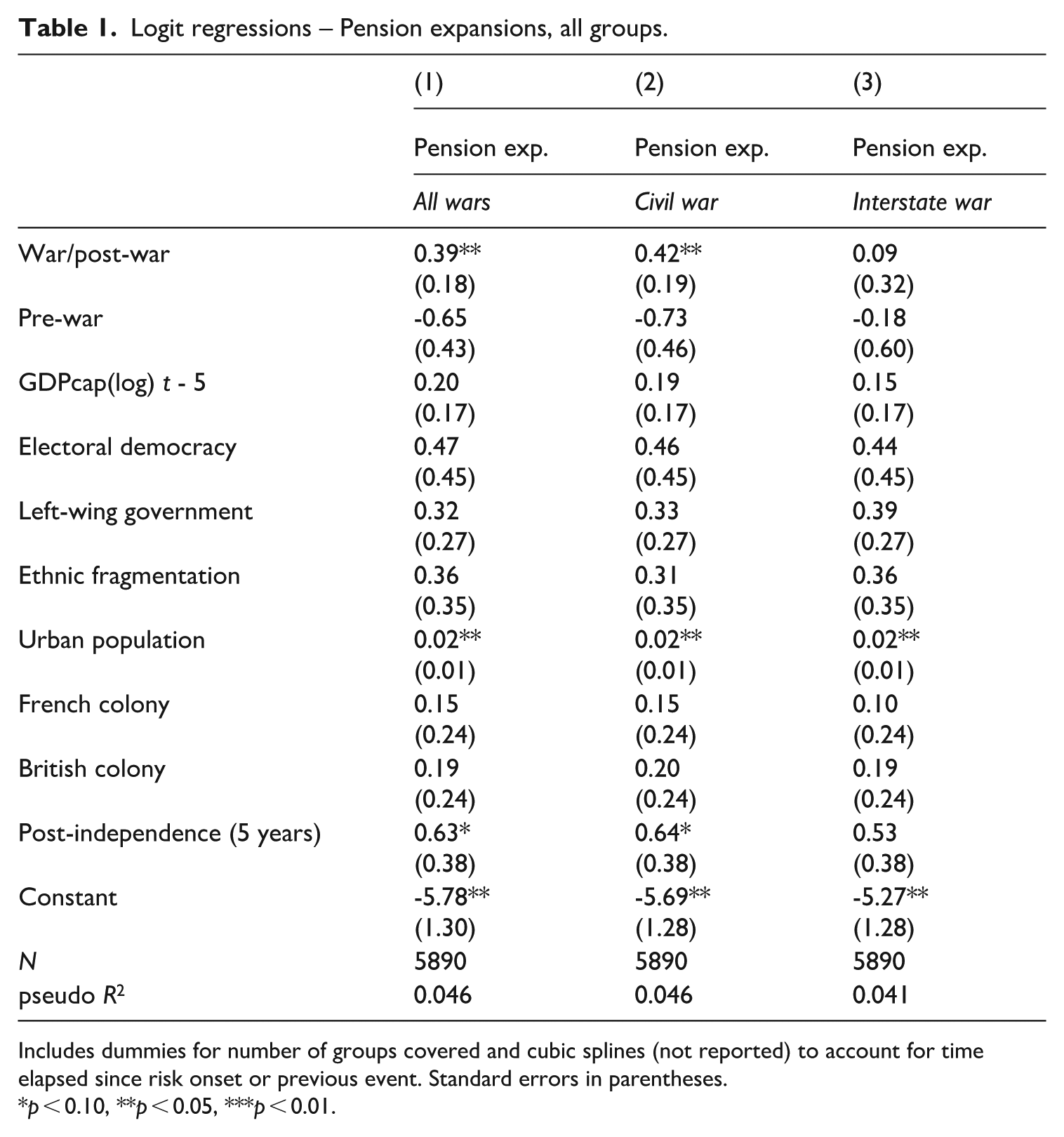
Includes dummies for number of groups covered and cubic splines (not reported) to account for time elapsed since risk onset or previous event. Standard errors in parentheses.
p < 0.10, **p < 0.05, ***p < 0.01.
Discussion and conclusion
Recent years have witnessed a growing interest in the impact of warfare on welfare state development in comparative perspective. Focusing on the two world wars, macro-comparative studies have examined the effects of military conflict on various aspects of social policy such as social spending, welfare legislation, educational reforms, taxation, and the creation of a welfare bureaucracy. A key finding is that large-scale wars, such as the two world wars, have been an important driving force for welfare state expansion. However, the extant literature is flawed in two respects. First, empirical studies have exclusively focused on the Western world. Eastern Europe, a region that had been heavily affected by warfare, was left out of these inquiries as was the entire Global South. Second, research only focused on interstate wars and therefore neglected the repercussions of civil wars on social policy.
To fill this gap, we examined whether and how interstate and civil wars have affected social policy in the Global South. Focusing on contribution-financed old-age pensions as the most common social protection scheme around the world and relying on the new PENLEG II data set, the aim was to find out whether armed conflicts swayed governments to expand pension coverage across 82 countries between 1900 and 2014. The key conclusion is that war matters: descriptive evidence shows that the probability of pension coverage expansion is higher in war years and post-war years than during peacetime. Indeed, a significant number of coverage extensions were enacted in the very first year after the end of a military conflict. However, the general association is stronger for civil wars than for interstate wars. The finding is corroborated by multivariate regression analysis. In terms of occupational groups, dependent workers benefit most from the expansion of pension coverage.
Given their novelty, it is worth briefly elaborating on the main findings. First, civil war is known to have detrimental effects both on welfare outcomes and on state institutions, and is commonly thought to undermine welfare development. However, the analysis surprisingly suggests a strong positive association between civil wars and pension expansion. Several complementary explanations appear plausible. It could simply be that popular demand for social protection engendered by civil war trumps the fiscal and institutional constraints. Increased involvement by international donors may add pressure for reform while simultaneously alleviating the constraints. We may further speculate whether the expansion of contributory pensions could also serve auxiliary, financial purposes during and after civil war. As the collected contributions of defined-benefit schemes are only paid out with significant delay, the accumulated funds could also be used for other purposes in the interim. Moreover, defined-contribution schemes may indirectly enhance the state’s capital credibility and thus encourage much-needed (foreign) investments. In this perspective, pension expansion would respond to, rather than aggravate, the financial predicament of governments afflicted by civil war. Finally, pensions may also represent a particularly effective means of pacifying war-torn societies by tying (previously excluded) population groups to the state. While implying low up-front costs, by promising substantive future benefits, additional population groups effectively gain an interest in the long-term preservation of the embattled regime.
Second, interstate wars, which have been a driving factor of welfare state expansion in the Global North, do not, in contrast, appear to have had any strong influence on pension expansion in the Global South. However, further disaggregating interstate wars by the location of fighting would suggest a stronger association for wars that were fought on home territory compared to those fought far away. The weak effect of interstate wars in our sample could then partly be explained by a shift in their character, not only towards more restricted engagements but also a higher frequency of expeditionary-type wars, having an asymmetric impact on the parties. To what extent the home/away distinction represents a substantive difference in effect, and in that case, whether it is driven mainly by differences in social risk (demand) or collective threat perceptions (solidarity), are questions that deserve further investigation. In a more general sense, it speaks to the need to move beyond the binary civil-interstate divide and look more closely at how various dimensions of armed conflict – for example, duration, intensity, and spatial scope, but also how it is politically framed and perceived – ultimately shape the expansion of social policy.
Some limitations of the study, each pointing to future avenues of research, are worth highlighting. While the present analysis has identified surprising correlations and suggestive macro-patterns, causal identification through econometric methods is inherently challenging due to the internal and largely endogenous character of civil wars and the rare occurrence of interstate wars. Limitations in data availability compound the problem.
Notably, events such as independence, civil wars and democratisation often coincided or unfolded in quick succession. In our analysis, pension expansions peaked around the 1960s. In these early post-independence contexts, social policy often became integral to the nation building effort (Kpessa et al., 2011). At the same time, the political landscape, especially in Africa, remained volatile, as expressed not least in a high incidence of coups and civil wars (Roessler, 2011). Accordingly, while we carefully control for any temporal association with independence in our models, we cannot fully exclude a common influence of underlying, long-term nation-building projects on both war and pension expansion. Similarly, a second spike in pension expansions can be observed in the 1990s, coinciding with the third wave of democratisation and a rise in civil wars (Marks, 2024). While the regression analysis includes controls for electoral democracy, the multi-dimensionality of democracy as well as its complex relationship with civil war – as both potential cause and effect – makes it inherently difficult to isolate in an observational large-N analysis. Doing so calls for a more fine-grained approach that considers distinct dimensions of democracy while paying particular attention to sequence of events. Case studies, which facilitate disentangling the influences of concurrent factors, identifying the active mechanisms as well as tracing the process through each step in the causal chain, appear as a promising way forward.
Furthermore, our analysis pertains to de jure policy expansions. The timing and extent of actual implementation, however, remain unknown. Studying the effective implementation of said programmes, for example, by gathering and analysing data on de facto coverage rates, would not only offer an opportunity to corroborate the present findings, but to add nuance. Finally, as a central field of social insurance, the analysis has focused on old-age pensions. Yet recognising the distinct characteristics of different spheres of social policy, it is far from certain that war has the same effect across different programmes. Looking also at other social policy fields and adopting a comparative lens would not only complete the picture but also tell us more about the variated functions of social policy in times of war and crisis.
Supplemental Material
sj-docx-1-gsp-10.1177_14680181261429928 – Supplemental material for Armed conflicts and the expansion of old-age pensions in the Global South
Supplemental material, sj-docx-1-gsp-10.1177_14680181261429928 for Armed conflicts and the expansion of old-age pensions in the Global South by Jakob Frizell, Aline Grünewald, Carina Schmitt and Herbert Obinger in Global Social Policy
Footnotes
Acknowledgements
We wish to thank Bastian Becker and Tobias Böger for providing invaluable input for the analysis, and the two anonymous reviewers, whose comments helped us strengthen the final article. Errors and omissions remain our own.

Ethical considerations
Not applicable (the study does not involve human or animal subjects).
Funding
The authors disclosed receipt of the following financial support for the research, authorship, and/or publication of this article: This work was supported by the German Research Foundation (DFG) as part of the Collaborative Research Centre 1342 ‘Global Dynamics of Social Policy’ (project number 374666841 – SFB 1342).
Declaration of conflicting interests
The authors declared no potential conflicts of interest with respect to the research, authorship, and/or publication of this article.
Data availability statement
Supplemental material
Supplemental material for this article is available online.
Notes
Author biographies
References
Supplementary Material
Please find the following supplemental material available below.
For Open Access articles published under a Creative Commons License, all supplemental material carries the same license as the article it is associated with.
For non-Open Access articles published, all supplemental material carries a non-exclusive license, and permission requests for re-use of supplemental material or any part of supplemental material shall be sent directly to the copyright owner as specified in the copyright notice associated with the article.
