




Abstract
Do neoliberal economic reforms in Latin American democracies mobilize citizens to overcome their collective action problems and protest? A recent addition to the scholarship on this crucial question of the relationship of markets and politics, Bellinger and Arce (2011), concludes that economic liberalization does have this effect, working to repoliticize collective actors and reinvigorate democracy. We reexamine the article’s analyses and demonstrate that they misinterpret the marginal effect of the variables of theoretical interest. Thus, the article’s optimistic claims about the consequences for democracy of economic liberalization in the region are not supported by its own empirical results. It is argued here that its results suggest instead that protests became more common in autocracies when they moved away from markets. Rather than speaking to how people have mobilized to protest against liberal reforms in Latin America’s democracies, the work’s analyses illuminate only when people protested against the region’s dictatorships.
The latter decades of the twentieth century witnessed two dramatic transformations across Latin America: a universal, if uneven, adoption of economically liberalizing reforms and a near complete replacement of the region’s autocracies with more democratic regimes. Not surprisingly, the relationship between these two processes has been intensely debated (see, e.g., Huber and Solt, 2004; Walton 2004). Many have argued that economic liberalization, by shifting decision-making power on a wide variety of matters from state to market, has limited and undercut democratic governance and so worked to demobilize civil society (see, e.g., Kurtz, 2004). Others have contended that the hardships imposed by liberalization have in fact reinvigorated democracy by spurring a variety of societal actors to organize themselves and mobilize against neoliberal reforms (see, e.g., Silva, 2009). Determining which of these perspectives more accurately depicts the relationship between economic liberalization and collective political action in Latin American democracies is central to understanding if market liberalism has successfully redefined citizenship rights as exclusively political or if instead collective actors are broadening the concept of democratic citizenship to include social and economic rights. It speaks, in other words, to the question of which side of Polanyi’s (1944) ‘double movement’ has gained the upper hand across the region (see, e.g., Roberts, 2008).
Bellinger and Arce (2011), in their article entitled ‘Protest and democracy in Latin America’s market era’, provide the broadest empirical examination yet conducted on this question, examining the impacts of economic liberalization on protest in seventeen Latin American countries from 1970 to 2003. It argues for the second view outlined above, the repoliticization thesis, maintaining that grievances resulting from economic liberalization provide strong framing opportunities for diverse social actors to overcome their collective action problems and that, in the favorable political opportunity provided by democracy, the result will be more protest. After presenting a series of unconditional fixed effects negative binomial regression models, the article concludes that ‘collective political activity rises with economic liberalization in democratic and semidemocratic contexts’ (Bellinger and Arce, 2011: 699). Consequently, it maintains that fears that market-oriented reforms have eroded democracy across the region are unwarranted. On the contrary, it contends, there is reason for optimism: economically liberalizing reforms ‘are extending and deepening democracy’ (Bellinger and Arce, 2011: 700).
The article makes several important contributions to the ongoing debate. Scholarship on the question had been previously dominated by case studies of positive examples of mobilization, with the result that ‘although it is indisputable that much of the social protest in contemporary Latin America is explicitly directed against neoliberal policies’, the relationship between reform and protest had ‘not been subjected to rigorous empirical tests across cases and over time’ (Roberts, 2008: 338). Further, Bellinger and Arce (2011) examines trends in protest in the region over more than three decades, ensuring the inclusion of both the full process of economic liberalization and that of democratization. The article is also an exemplar of sensitivity analysis, operationalizing both regime type and protest in a number of different ways and demonstrating similar results across all specifications. Finally, it usefully sharpens the concept of economic liberalization to better match the theories suggested by qualitative studies on the topic. In contrast to earlier cross-national work, which investigated whether protest was associated with the level of liberal economic policies, Bellinger and Arce (2011, 692) examines how collective actors ‘respond to changes in economic policy’ because arguments regarding the phenomenon focus ‘on the societal effects of economic reforms, not the level of economic liberalization generally’.
Despite these important contributions, our re-analysis reveals that the claims by Bellinger and Arce (2011) are based on an incorrect interpretation of its statistical results. Specifically, the study runs into two pitfalls often encountered in the use of multiplicative interaction terms: it incorrectly interprets the coefficients separately and fails to calculate correctly the marginal effect of the variable of theoretical interest (see, e.g., Braumoeller, 2004; Brambor et al., 2006). Remedying these issues demonstrates that there is no support for the contention that economic liberalization produces higher rates of collective political protests in democratic or semidemocratic settings, dampening hopes that unfettered markets and democracy are proving a felicitous combination in Latin America.
Replication, results and reinterpretation
According to the repoliticization theory, protest in Latin America results from a confluence of motive and opportunity (Bellinger and Arce, 2011: 691–692). Economic liberalization, in this view, always generates grievances that motivate people to collective action. These grievances are more likely to actually cause protests to occur, however, when democracy is present to provide a favorable political opportunity structure. The implication is that, at least in democracies, protests should increase as liberalizing reforms increase. The article claims that the evidence it presents supports this argument. This claim is incorrect.
The faulty claim stems from the interpretation of multiplicative interaction terms. The analyses presented use negative binomial regression – a method that logarithmically transforms the dependent variable to account for the skewed distributions commonly found in count data – to estimate the following equation:

In this equation, β3 and β5, the coefficients for the two multiplicative interaction terms, allow the effect of economic liberalization on protest to vary with regime type: democracy, semidemocracy, or autocracy. 1 These multiplicative interaction terms are completely appropriate. That protests should become more common as economic reforms intensify and especially so in democratic (and, perhaps, semidemocratic) settings is, of course, a conditional hypothesis, and it is ‘well established that the intuition behind conditional hypotheses is captured quite well by multiplicative interaction models’ (Brambor et al., 2006: 64).
It is equally well established that models containing multiplicative interaction terms require particular care in interpretation (see, e.g., Braumoeller, 2004; Brambor et al., 2006). Here, the article’s conclusions were justified on two foundations: first, that ‘the interaction terms – Economic Liberalization × Democracy and Economic Liberalization × Semidemocracy —are positive and significant’ and, second, that the conditional ‘coefficients for Democracy and Semidemocracy grow larger, more positive, and statistically significant when economic liberalization increases’ (Bellinger and Arce, 2011: 695). We reproduce the relevant Bellinger and Arce (2011) results in Table 1.
Economic Reform and Protest: Bellinger and Arce (2011) Results.
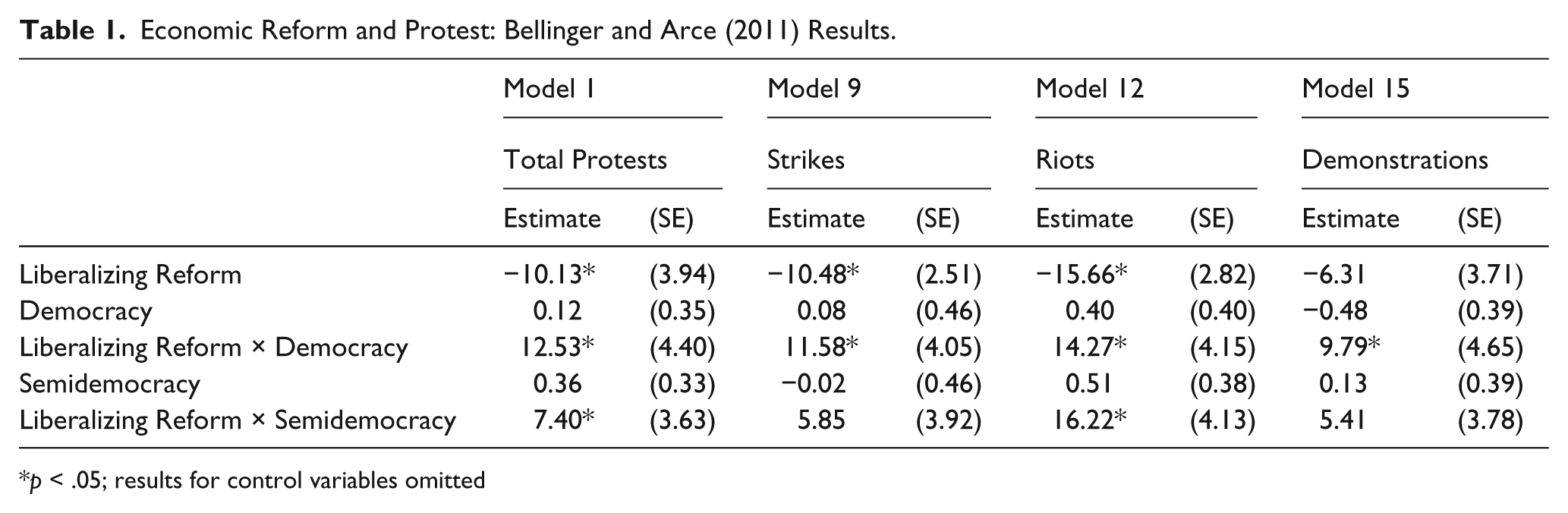
p < .05; results for control variables omitted
Neither of these two foundations is up to the task. The former is insufficient to support the conclusion: as Brambor et al., (2006: 74) note, the ‘analyst cannot even infer whether X has a meaningful conditional effect on Y from the magnitude and significance of the coefficient on the interaction term’. We show below that the coefficient of the interaction term is only one component of the effect being examined here. The latter is not directly relevant to the question at hand. Given that the study is ‘primarily concerned with how collective actors respond to economic liberalization in varying political contexts’ (Bellinger and Arce, 2011: 695), it is the coefficient of Economic Liberalization for each regime type that is much more to the point.
A reinterpretation of these results is therefore needed. 2 The marginal effect of economic liberalization on the logged number of protests (recall that negative binomial regressions directly estimate the effects of independent variables on the log of the dependent variable) is found by taking the partial derivative of Equation 1 with respect to economic liberalization:

That is, the estimated effect on logged protest of a change in economic liberalization equals the sum of (1) the estimated coefficient of economic liberalization, β1, (2) the product of the coefficient of the interaction between liberalization and democracy, β3, and the indicator variable for democracy, and (3) the product of the coefficient of the interaction between liberalization and semidemocracy, β5, and the indicator variable for semidemocracy. This simplifies to the sum β1 +β 3 for democratic regimes, to the sum β1 +β5 for semidemocracies, and to just β1 for autocratic regimes. This last point makes clear the only appropriate interpretation of β3 and β5: they represent not the effects of Economic Liberalization in democracies and semidemocracies, as asserted in Bellinger and Arce (2011, 695), but rather only the difference in the effect of Economic Liberalization from its effect in the reference category, autocratic regimes.
Calculating the magnitude of the effect in each of the three regime types is straightforward, but the standard error (and statistical significance) of only the reference category, autocratic regimes, can be determined from the information provided in the article’s tables. The formula for the standard error for democratic regimes is:

Similarly, the standard error for semidemocratic regimes is calculated as:

Although the variances of β1, β3, and β5 are easily found in the article’s tables – they are the squares of the standard errors for these coefficients – the covariances between the coefficients are not available from the information provided in a regression table: instead, the full variance-covariance matrix is needed.
As a practical matter, the most straightforward approach to finding these standard errors is a trivial re-specification of the model: the choice of reference category for a categorical variable is arbitrary, and the standard error of the coefficient for the reference category chosen is directly available in the regression results (see, e.g., Braumoeller, 2004: 815; Brambor et al., 2006: 74). Here, replacing the dummy variable for democracies in Equation 1 with a dummy variable for autocratic regimes – that is, making democracy the reference category – makes no substantive change in the model, but the reported coefficient and standard error of Economic Liberalization in this re-specified model (corresponding to β1 in the equations above) represent its effect in democracies. The standard error and statistical significance of the effect of Economic Liberalization in semidemocracies can be found similarly, by including dummy variables for autocracies and democracies and so making semidemocracy the reference category.
Using a dot-and-whisker plot (see Kastellec and Leoni, 2007), Figure 1 depicts graphically the estimates and 95% confidence intervals of the effect of economic liberalization on the logged number of protests for each regime type when countries are classified according to Freedom House data. 3 We follow Bellinger and Arce (2011: 693) in emphasizing the Freedom House results because ‘Freedom House arguably provides the closest match to [the] conceptualization of political opportunity’ employed in that piece. As Bellinger and Arce (2011) demonstrate, and our replication confirmed, a variety of other measures of regime type yield substantively similar results; we therefore relegate these results to the appendix. Figure 1 displays how the results of the negative binomial regressions indicate that economic liberalization does not have a statistically significant effect on protest: this is true whether we look at the total number of protests (Model 1 of Bellinger and Arce (2011)), or strikes (Model 9), or riots (Model 12), or anti-government demonstrations (Model 15). The results show that in autocracies the liberalizing reform variable was statistically significantly associated with fewer protests, with the exception of demonstrations. In light of this finding, the fact that β3 and β5 are estimated to be positive and statistically significant reveals only that more liberalizing reform in democracies and semidemocracies did not have the negative association with protest that it did in autocracies, not that it served as a focal point for the formation and mobilization of collective actors as the repoliticization theory would have it.

Coefficients of economic reform on protest by regime type.
We, of course, are more directly interested in the effect of economic reforms on the number of protests, not on the log of protests and, as noted above, the latter is the quantity estimated by the negative binomial regression employed in Bellinger and Arce (2011). Figure 2 presents the number of protests in autocracies, semidemocracies, and democracies predicted by the four models across the observed range of economic liberalization when all other variables are fixed at their mean values. In each case, the solid lines indicate the predicted number of protests and the shaded regions correspond to the 95% confidence intervals of these predictions. For autocracies, the numbers of total protests, strikes and riots (but not demonstrations) are predicted to be statistically significantly lower as liberalizing reform increases. For semidemocracies and democracies, the wide confidence intervals in every panel can easily encompass a horizontal line representing no change at all in protest activity over the range of economic liberalization. In fact, under these conditions, in semidemocracies the point predictions of all four measures of protest decline with rising liberalization, and in democracies riots are also predicted to fall as economic liberalization rises. None of this supports the interpretation that ‘collective political activity rises with economic liberalization in democratic and semidemocratic contexts’ offered in Bellinger and Arce (2011: 699).

Predicted protests over the observed range of economic reform by regime type.
An extension: Protest and liberal economic reform
The results of Bellinger and Arce (2011) do not support the interpretation offered in that article. Liberalizing economic reforms in democracies do not in fact predict that more protests occur. The conclusion that they do, as we have shown above, was based on common misinterpretations of multiplicative interaction terms. The confusion regarding the application of multiplicative interaction terms is compounded by the article’s measure of liberalizing reform.
A second look at Figure 2 reveals that liberalizing reform only has statistically significant effects on protest in autocratic settings and that these effects occur largely, if not entirely, across only the negative values of the variable. As discussed above, however, the Bellinger and Arce (2011) measure of liberalizing reform represents change in the level of economic liberalization. Positive values represent reforms that increase the role of free markets and reduce the role of the state in the economy. Negative values, in turn, represent moves away from free markets; that is, statist reforms. Including both liberal reforms and statist reforms in the same measure in this way constrains them to have equal and opposite effects on protest. Given that changes in either direction may generate losers with incentives to mobilize, to assume that reforms in one direction increase protests and reforms in the other reduce them would seem unwise. Further, nothing in the repoliticization theory suggests that the effect of liberal reforms is the opposite of statist reforms.
Removing this constraint is easily accomplished by splitting the measure into two variables. The first measures the magnitude of liberal reforms and takes on a value of zero when statist reforms are adopted; the second measures the magnitude of statist reforms and takes on a value of zero when liberal reforms are adopted. Table 2 presents the relevant results when these two variables are substituted for the original liberalizing reforms measure in the Bellinger and Arce (2011) models.
Disaggregated Economic Reform and Protest.
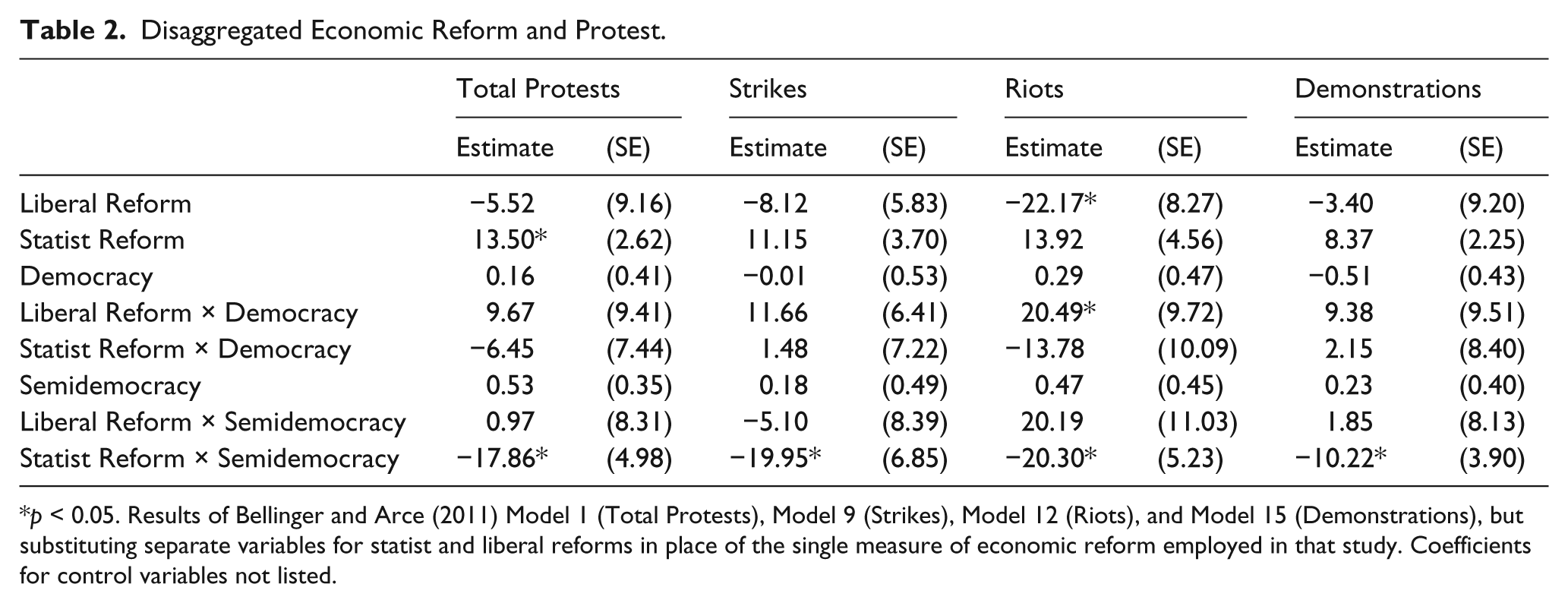
p < 0.05. Results of Bellinger and Arce (2011) Model 1 (Total Protests), Model 9 (Strikes), Model 12 (Riots), and Model 15 (Demonstrations), but substituting separate variables for statist and liberal reforms in place of the single measure of economic reform employed in that study. Coefficients for control variables not listed.
The coefficients for the interaction term between liberal reform and democracy indicate that there is no statistically significant difference between autocracies and democracies in the coefficient of liberal reform for total protests, strikes, or antigovernment demonstrations. There is a statistically significant difference in the coefficient for riots, but as we noted earlier, because the effect in democracies of liberal reform on the logged number of riots is equal to the sum of this coefficient and the coefficient for liberal reform, this is insufficient to support the conclusion that riots increase with liberal reform in democracies. Figure 3 displays the coefficients and standard errors of liberal and statist economic reforms in all three regime types.

Coefficients of statist and liberal economic reform on protest by regime type.
It reveals that the estimated coefficient for liberal reforms in democracies on riots is in fact negative and not distinguishable from zero. The only statistically significant coefficient for liberal reforms in democracies is on demonstrations. Any support this finding might provide for the repoliticization theory is more apparent than real, however. This coefficient is not statistically significantly different from those for semidemocracies and autocracies, providing no evidence that the more favorable political opportunity structure in democracies yields a more vigorous protest response. Moreover, the predicted difference in the actual quantity of interest, the number of demonstrations, between a country with no liberal reform and one with the largest observed liberal reform is small and not statistically significant: 0.9 ± 1.0 demonstrations, as can be seen in Figure 4. Like those for the other measures of protest, the confidence interval for the predicted number of demonstrations in democracies can accommodate a horizontal line representing no change at all over the full observed range of liberal reform.

Predicted protests over the observed range of liberal economic reform by regime type.
If, as we have demonstrated, the results of Bellinger and Arce (2011) and our extension to it do not support the repoliticization theory, what do they show? A re-examination of Figure 2 reveals that liberalizing reform, measured as a single variable, only has statistically significant effects on protest in autocratic settings and that these effects occur largely, if not entirely, across only the negative values of the variable. This point is confirmed in Figure 3: when liberal and statist reforms are measured separately, the positive and statistically significant coefficients for statist reforms in autocracies stand out as the only consistent results. Figure 5 confirms these effects on the actual quantities of interest, the number of protests, over the observed range of statist reform.
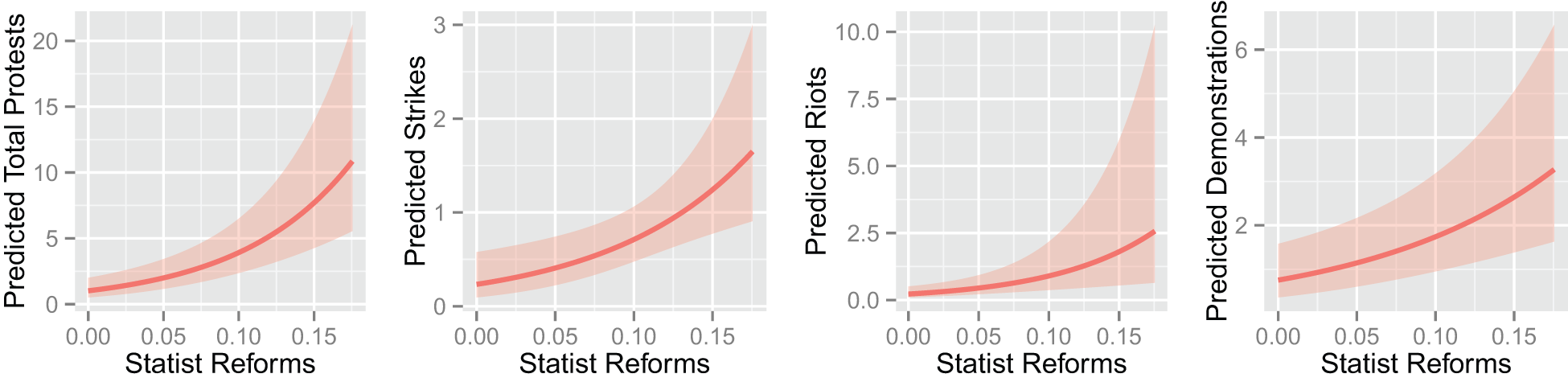
Predicted protests over the observed range of statist economic reform in autocracies.
Rather than speaking to how people have mobilized to protest against liberal reforms in Latin America’s democracies, then, these results illuminate when people protested against the region’s dictatorships. Latin American autocracies frequently pursued a two-pronged strategy of depoliticization, pairing free market reforms of the economy with harsh repression of civil society. It was when these regimes backed away from free market policies – a signal that divisions had arisen in the authoritarian coalition of the military, domestic business, and foreign capital – that emboldened citizens went to the streets to protest.
Chile under Pinochet is the paradigmatic example on both counts. When its program of nearly complete financial deregulation led to financial crisis in 1982, the military government abruptly reversed course and intervened extensively in the Chilean economy. Dubbed by critics the ‘Chicago Road to Socialism’ in mocking reference to the Via Chilena that the Pinochet government had worked to eradicate, the statist reforms in Chile in 1983 are second in size in the Bellinger and Arce (2011) data only to those that marked the return of Peronism to Argentina in 1973. Massive demonstrations followed this sign of the government’s weakness: the observations for Chile from 1983 through 1985 constitute three of the four highest protest years in this dataset. For more on the Chilean case, see, among other works, Remmer (1989).
Conclusion
Despite the important contributions made by Bellinger and Arce (2011) to the debate on the relationships of economic liberalization, democracy and protest, there is no support for the article’s conclusions in its empirical results. The repoliticization theory suggests that liberalizing reforms should, in democratic settings, provoke protests. In a critical re-analysis of the empirical evidence offered, we reveal that they do not. There is no support for the conclusion that liberalizing reforms produce political protests in Latin America’s democratic or semidemocratic regimes. Instead, this evidence indicates only that protests were only triggered by statist reforms in Latin American autocracies.
That economic liberalization may not consistently provoke protest in democracies should not come as a surprise. Roberts’ (2008: 337) survey of the case-oriented scholarship on resistance and acquiescence to neoliberal reforms in Latin America concludes, ‘Liberalization does not create homogeneous interests, hardships, or insecurities among subaltern groups, and neither does it generate a uniform response’. Future work on the issue should focus on elucidating the conditions in which liberalizing reform by democratic governments generates collective protest.
One particularly important facet of this research will be the collection of higher quality data on protest across the region. The analyses replicated above, like previous cross-national research, rely on data drawn from Banks (2008) for protest counts (see Bellinger and Arce, 2011: 692). As Herkenrath and Knoll (2011: 164) document, for Latin American countries these data are based solely on protest coverage in the New York Times. One might argue with some justification that events covered by the NYT ‘are precisely the type of events that affect national political outcomes’ (Bellinger and Arce, 2011: 692). However, a meticulous comparison of protest coverage in the NYT and local media sources, though limited to just three Latin American countries in one year, found that ‘there are significant country differences in the magnitude of the respective distortions’ in coverage even when a host of protest characteristics are taken into account (Herkenrath and Knoll, 2011: 164). These distortions in the Banks data, of course, make it more difficult to discern whatever effects liberalizing reforms may have on protest.
The issue of the relationship between liberalizing reforms and collective protest across Latin America’s democracies is crucially important. By bringing more and better quantitative data to the examination of the problem than previous work, Bellinger and Arce (2011) made important contributions to the debate. As we have shown, however, the article’s results are far from conclusive. Whether markets are undermining or reinvigorating democracy in the region remains an open question.
Footnotes
Appendix: All Re-analyses
Declaration of conflicting interest
The authors declare that there are no conflicts of interest.
Funding
This research received no specific grant from any funding agency in the public, commercial, or not-for-profit sectors.