



Abstract
In the Anthropocene, the world’s oceans have come under unprecedented human pressure. Countries have responded to this pressure by organizing themselves internationally around the idea of sustainable ocean governance. However, the geopolitical context in which sustainable ocean governance has taken shape in recent decades has begun to shift. After two centuries marked by British and American maritime hegemony, several other states are now asserting their maritime presence, raising the question of whether an increasingly multipolar environment will bring the relatively stable international maritime order to an end. In this paper we collect, organize, and analyze evidence from academic literature that reports and investigates a shift in geopolitics at sea. Based on the results of this literature review we explore how the international maritime order is changing and discuss what this geopolitical shift means for sustainable ocean governance.
Keywords
Introduction
The world’s oceans are under unprecedented pressure from the exponential increase in human activity in the Anthropocene. Greenhouse gas emissions are projected to raise ocean temperatures over the coming century (Cheng et al., 2022); climate change may cause structural changes in the oceans, such as coral bleaching and sea level rise (DeConto et al., 2021; Siegert et al., 2020); and global fish stocks are being fished at unsustainable levels (FAO, 2022). At the same time, breakthroughs in deep-sea mineral extraction are imminent, with associated environmental risks remaining uncertain (van Putten et al., 2023; Washburn et al., 2019). Maritime trade is now closely intertwined with globalization, acting as a linchpin of the global economy (Rodrigue, 2017), but is also predicted to further stress ocean ecosystems through the spread of invasive species (Sardain et al., 2019).
In light of these challenges, humanity’s dependence on the oceans and the need to protect them has been widely recognized (Brodie Rudolph et al., 2020; Laffoley et al., 2021). The last decades have seen the international community making significant efforts to stem human impact on the oceans, notably through the International Seabed Authority (ISA) in 1982; the United Nations Convention of the Law of the Sea (UNCLOS) coming into force in 1994; the United Nations Fish Stocks Agreement (UNFSA) in 1995; Sustainable Development Goal 14: Life Below Water in 2015, and the Biodiversity Beyond National Jurisdiction (BBNJ) agreement in 2023 (Lodge, 2009; Lodge et al., 2007; Mendenhall et al., 2023; Spalding and de Ycaza, 2020).
However, while the need to govern ocean ecosystems and resources to ensure sustainable use (henceforth “sustainable ocean governance”) has gained international acceptance, its potential has become uncertain due to shifting geopolitical circumstances. After two centuries largely characterized by British and American naval hegemony, the maritime order is now heading toward increased multipolarity as several states are establishing themselves as maritime powers (Bastos, 2014; Kraska, 2011). Activity is seen from new non-state actors at sea, ranging from pirates (Schneider, 2023), to rebels (Notteboom et al., 2024) and militias (Luo and Panter, 2021). Global trade networks face potential long-term changes with the advent of the so-called Maritime Silk Road (e.g. Baniya et al., 2020) and the opening up of the Northern Sea Route (e.g. Ng et al., 2018). Parallel to these political and economic changes, the scramble for marine natural resources has intensified, producing images of the oceans as a new frontier (Jouffray et al., 2020).
The title of our paper invokes one of the oldest disputes in international maritime law, which took place in the 16th–17th centuries as European states were competing to establish maritime power globally (Steinberg, 2001). The dispute revolved around whether the seas were to be treated as open territory, free to navigate for all (Mare Liberum or “free sea”; see Grotius, 1609) or as closed territory, to be appropriated with exclusive owner and user rights (Mare Clausum or “closed sea”; see Selden, 1635). Under the 19th century British Empire, “freedom of the seas” became the conceptual and normative doctrine on the world’s oceans (Bianco et al., 2023; Frei, 2020; Koh, 1983) and ultimately provided the foundation for today’s legal treatment of the High Seas as a “commons” under UNCLOS (De Lucia, 2019). With the geopolitical situation at sea now showing signs of undergoing transformation, we find it timely to reignite the debate on the international maritime order and sustainable ocean governance. As a contribution to this debate we pose the question, “how is maritime geopolitics in the 21st century changing, and what do these changes imply for sustainable ocean governance?”
In search for an answer, our study takes stock of discussions on current geopolitical developments at sea using literature that is systematically-selected from across several academic fields. This set of publications is analyzed through a narrative review, focusing on global trends and four regions that receive particular attention: the Arctic, the Indian Ocean, the Pacific Ocean, and the South China Sea. We present and interpret the reviewed material through four key themes: environmental issues and natural resources; inter-state seapower balance; maritime governance institutions; and maritime traffic and trade. The analysis identifies and discusses emerging characteristics of maritime geopolitical shifts, and we discuss in the final sections of the paper the long-term significance of these cumulative changes for sustainable ocean governance.
Methodology
A major challenge of our literature review lies in addressing the intricate, multidisciplinary characteristics of the subject—geopolitics on the global oceans—coupled with the substantial volume of pertinent publications. Our strategy from the outset has been to provide a broad, general overview of a limited but carefully selected sample of relevant literature to allow for “middle-range” (Merton, 1949) conclusions that transcend the contextuality of single cases while avoiding overt abstractions.
To arrive at these conclusions, we conducted a systematic narrative review. Standard narrative reviews typically “describe and discuss the state of the science of a specific topic or theme from a theoretical and contextual point of view” (Rother, 2007: 1), but often lack a clear literature selection strategy with inclusion and exclusion criteria (Paré et al., 2015). We therefore followed the guidelines set out by Ogbonnaya and Brown (2023) and Siddaway et al. (2019) and consulted the elements of a systematic-narrative hybrid review proposed by Turnbull et al. (2023). We applied their recommendations by selecting the literature in four steps (Figure 1). This systematic, step-by-step selection of the literature minimized selection bias, while the narrative approach provided motivation for selecting literature from multiple disciplines with varying objects of study (Turnbull et al., 2023). Before we outline each of these steps, we will first clarify how we established the phenomenon under study (Merton, 1987).
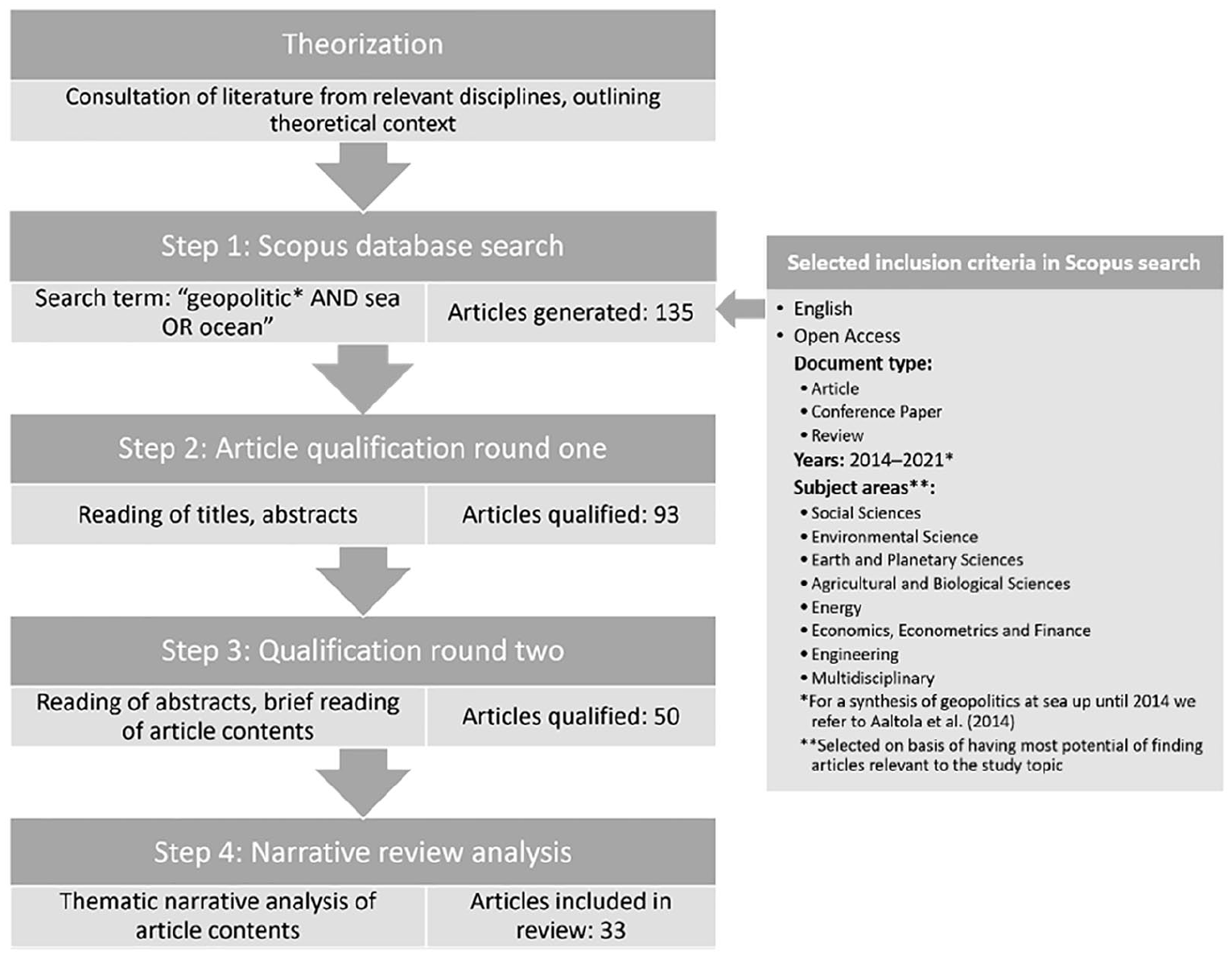
Systematic literature selection process.
Although geopolitics at sea can be characterized in various ways, such as “marine” or “maritime” geopolitics (Germond, 2015), it can be broadly defined as “the analysis of the interaction between, on the one hand, [the global seas and oceans] and, on the other, political processes” (adaptation of the definition of geopolitics by Cohen, 2003: 12). In what follows, we lean on Steinberg’s “The social construction of the sea” and others (e.g. Germond, 2015) to further substantiate four dimensions, or themes, in which geopolitical interactions in relation to global oceans and seas are manifest in the 21st century (Steinberg, 2001: 11):
1. Environmental issues and natural resources refers to “the oceans as a resource provider” (Steinberg, 2001: 11), including the biophysical aspects and human uses of the oceans in the 21st century, and their repercussions for ocean sustainability.
2. Inter-state seapower balance refers to “the oceans as a space across which power is projected” (Steinberg, 2001: 11), and thus includes attention to changes in power relations between states and how these play out at sea, for example the ideas of “balance of power” (Waltz, 1979) and “seapower” (Germond, 2015).
3. Maritime governance institutions refers to how societies organize governance to address collective challenges and dilemmas (Keohane, 1984), for example, legitimate use of violence at sea, freedom of the seas, ocean stewardship, etc., stemming from use of global oceans and seas (Germond, 2015).
4. Maritime traffic and trade refers to “the oceans as a transport surface” (Steinberg, 2001: 11) and a source for economic growth (Germond, 2015), that is, how global maritime traffic and trade on oceans and seas influence political stability.
We further theorized (Swedberg, 2014) these four themes through engaging literature on international relations (IR) theory; the impact of the Anthropocene on ocean ecologies; sustainable ocean governance; and historical and contemporary geopolitical and environmental developments. The purpose of this theorizing stage was to outline a context from which we could formulate questions and points of attention for the narrative analysis of the final set of papers.
The first step to arrive to a final set of papers was to adopt a search term based on our definition of geopolitics at sea. Together with a set of inclusion criteria (Figure 2), “geopolitic* AND sea OR ocean” was entered in Scopus on November 24, 2021, generating 135 articles.
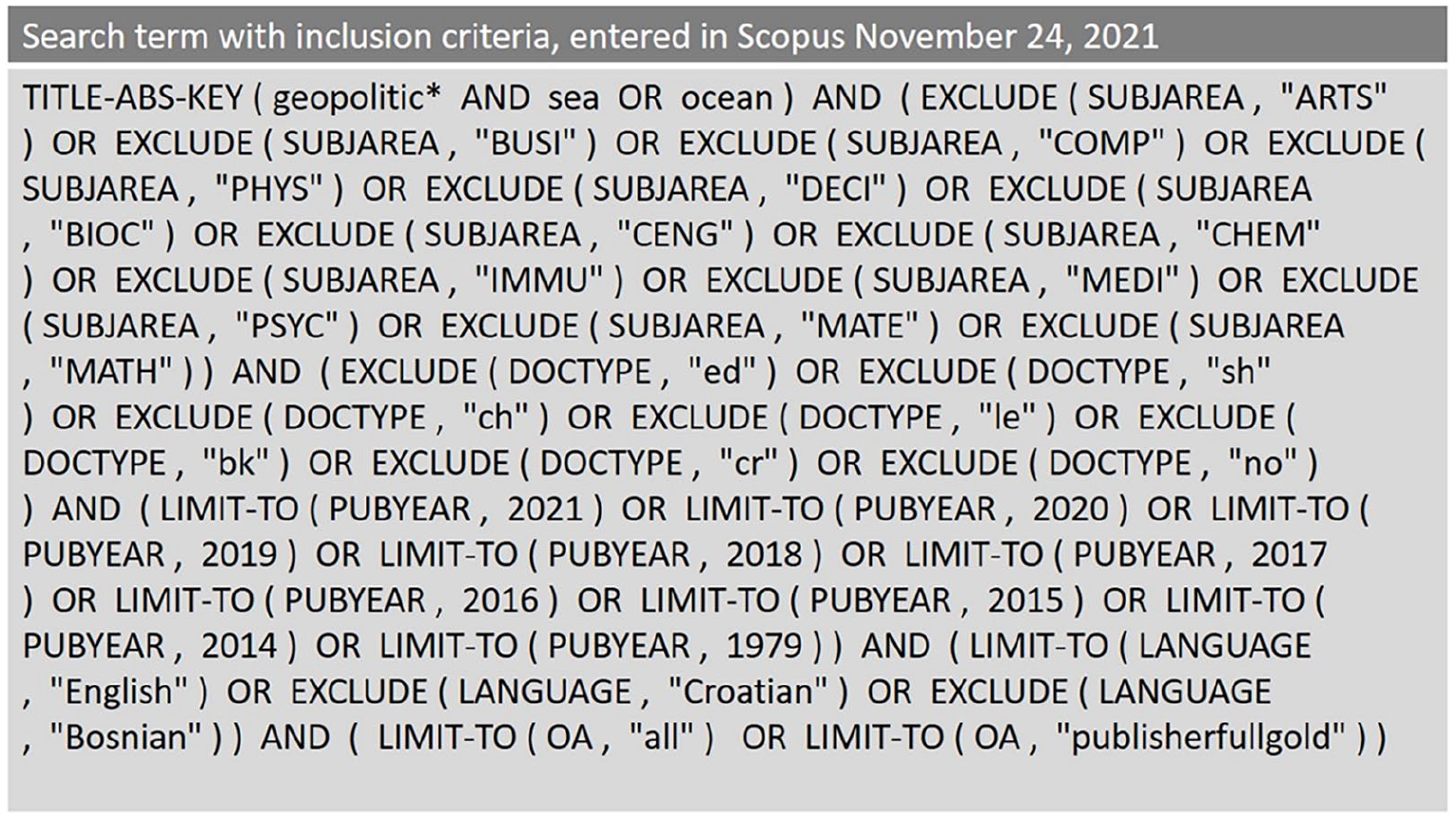
Scopus search term.
Step two involved reading article titles and abstracts, and a read-through of the full text. We read the articles inductively, looking for commonalities which could serve as a basis for organizing the sample literature. Having established a theoretical frame for the analysis of the literature sample, we finished Step two by once again going through the core set of 135 articles to select 93 articles that clearly aligned with the four themes that we identified earlier.
Step three then involved a close reading of the remaining 93 articles. Here, we discovered a reoccurring emphasis on four geographical regions: the Arctic, the Indian Ocean, the Pacific Ocean, and the South China Sea. We also noticed articles taking a global perspective (e.g. articles discussing topics such as international maritime law). In order to have a set of articles that were thematically and geographically interconnected, we discarded 43 articles that did not take either a global perspective or discuss the aforementioned four regions.
In Step four we conducted a content analysis of the remaining 50 articles, which is standard practice in systematic narrative reviews in order to identify potential “commonalities and differences between the studies” (Turnbull et al., 2023: 3). First, we categorized excerpts that corresponded to one or several of the themes—for example, discussions on inter-state seapower balance (Theme 2) in the South China Sea or maritime governance institutions (Theme 3) in the Pacific Ocean. Next, using the set of questions (presented in their respective themes in the Results section) developed from the theorization stage, we performed in-depth analysis of the content and compiled the findings under their respective themes. Based on this analysis we excluded another 17 articles from the set, due to their insufficient alignment with the remaining articles. We excluded, for example, articles discussing megafauna protection in the Indian Ocean (Barkley et al., 2019), High Seas fisheries management under UNCLOS (Hays et al., 2020), prospects for ecosystem-based governance of the Arctic (Platjouw, 2019), and Indonesian securitization of illegal fishing issues following increased Chinese activity (Putra, 2020). The final set of articles to be included in the review thus consisted of 33 articles, from 25 different journals and one conference series, with subject areas primarily consisting of social sciences, earth sciences and environmental sciences (Appendix 1). Where necessary, we have added footnotes with references to additional literature to complement or clarify information from the set of papers included in our review.
Results
The aforementioned four themes provide the framework for this section. Each theme is first introduced, drawing on literature from the theorization stage to provide a historical and geopolitical context, before culminating in key questions. We then respond to the questions through analysis of the literature which we present under each theme. For transparency, we have included page numbers when referring to relevant content in the systematically-selected literature.
Theme 1—Environmental issues and natural resources
Over the past century, the planet’s geographical features have gradually become taken for granted and reduced to an unspoken assumption in political thinking. International relations are presumed to unfold between clearly defined territories, and great power rivalries have likewise played out within fixed geographical boundaries. However, as we move deeper into the Anthropocene and humanity continues to alter the environment, the political relevance of certain geographical and biophysical features will become more apparent, prompting a reconsideration of the geo in geopolitics. The Anthropocene may thus reintroduce geographical features to the fore of international politics (Dalby, 2014).
We are now seeing this reintroduction unfold in the case of the oceans: while they used to be a central feature of political debates in previous centuries (e.g. Mahan, 1890), De Carvalho and Leira (2022) argue that the oceans have been understudied in 20th century International Relations due to the “relatively ahistorical roots of the discipline” (p. 3) and its development during a “period of naturalized oceanic hegemony” (p. 3). But after this period of depoliticization, the oceans and their contents now seem to be (re)surging as important environmental entities in (geo)political thought. There is growing recognition of the oceans as a new economic “frontier” for existing and emerging industries (Jouffray et al., 2020). This “frontier” rhetoric has been increasingly applied to marine and submarine spaces by political institutions (e.g. United States Congress, 1987) and more recently in academia (Hannigan, 2016; Havice and Zalik, 2018). For evidence to undergird this claim, observers point to increasing human pressure on marine resources. Jouffray et al. (2020), for example, describe the ensuing intensification of ocean resource use as a “blue acceleration,” pointing to how growing aspirations for use of marine resources and territory is unprecedented in human history. Technological developments and mineral scarcity on land are now incentivizing public and private institutions to start looking for minerals beneath the ocean floor (Koschinsky et al., 2018). Fisheries conflicts have been increasing since the 1970s (Spijkers et al., 2019) and the percentage of unsustainably fished stocks grew from 10% in 1974 to over 35% in 2019 (FAO, 2022), with an uncertain outlook for fish stock recovery (Britten et al., 2021). Substantiating the rhetoric of the ocean as a “frontier” are emerging powers staking claims of ownership of remote islands, reefs, and sandbanks (Aaltola et al., 2014). A crucial question from these observations and reflections is whether we are seeing a gradual shift from oceans being viewed as a global “commons” to a territory to claim, contest and colonize.
With these trends in mind, we next examine whether and how the selected literature carries evidence of oceans and their resources becoming important factors of global geopolitics. Our analysis focuses on discussions about: (1) the political and economic interest in (new) ocean resources; (2) dynamics of the interplay between political developments and the marine environment, that is, how they influence and affect each other.
Literature analysis
Deep sea minerals
We find three articles discussing the advent of deep-sea mining expeditions. The discussions are not taking an explicit geopolitical perspective or focus on specific oceans. They lend evidence, however, for the claim that exploitation of deep-sea minerals is rising on the global political agenda, resembling Dalby’s (2020) prediction of geophysical entities being increasingly integrated into political discourse and decision-making processes in the Anthropocene. All three articles also depict the exploitation of deep-sea minerals within the context of the ocean as a new “frontier.” According to Lusty and Murton (2018) the interest in deep-sea mining expeditions is growing due to a combination of increasing demand and shortage of supply of land-based minerals. Land-based mining can continue to provide future supplies, but the risk-prone mining industry sees the deep ocean as “just another frontier” (Lusty and Murton, 2018: 3–4). Likewise, Hallgren and Hansson (2021) describe the race for deep sea minerals as a “21st century Klondike gold rush” (p. 1), while Childs (2020) conceptualizes the venture as a commodity “frontier” (pp. 1–2).
Deep-sea mining is being included in the discourse on “the blue economy” as a market-driven approach to environmental governance and development (Childs, 2020: 19). The World Economic Forum, for example, expects deep-sea minerals to enter the metal market within a decade, and has called for stakeholders to engage with the technical, environmental and social sustainability aspects of this industry (Hallgren and Hansson, 2021: 2). Lusty and Murton (2018) note that government-funded research on deep sea mining is increasing in several countries. State legislation is being updated to enable mining of deep-sea minerals, possibly due to strategic interests and to secure flows of raw material. In the long term, however, deep-sea mining depends on its economic viability, including its competitiveness with mining of land-based minerals (pp. 4–5). As of 2021, no commercial-scale mining of the deep sea had taken place, but several mining projects exist within the jurisdictional waters of individual states. The ISA had, at the time of the study, awarded 30 exploration contracts spanning over 15 years with 21 different contractors (Hallgren and Hansson, 2021: p. 2). 1 Currently, the deep-sea mining industry is waiting for the ISA to finalize the “Mining Code,” an overarching legal document setting guidelines for future exploitation. Of concern here is the agenda of wanting to push toward a “faster, rather than slower consensus decision to commence exploitation,” meaning that the “opportunity to set the best possible mining practices from the start is at risk” (Hallgren and Hansson, 2021: 2).
While several deep-sea metals are vital for low-carbon technologies, and therefore thought essential for sustainability transitions, the mining operations will inevitably impact the ocean environment (Hallgren and Hansson, 2021: 13; Lusty and Murton, 2018: 5–6). The deep-sea plains are believed to be the largest ecosystems on the planet, with a vast species richness and undocumented taxa. Large areas are, however, still unexplored and much baseline data about the deep-sea natural world is lacking (Hallgren and Hansson, 2021: 4–5, 12). Knowledge is therefore currently inadequate to make objective, evidence-based decisions on what would constitute sustainable extraction (Lusty and Murton, 2018: 6). While some argue that mineral extraction would occur within a relatively short timeframe, its long-term ecological impact, such as the dispersal of sediment plumes into ocean water, remains unclear (Childs, 2020: 16).
The Arctic—Natural resources and a new shipping route
We also come across discussions on the growing geopolitical importance of the Arctic. Gladkiy et al. (2020) give an overview of the Arctic Ocean’s natural resources, noting that 25% of global oil and gas reserves, and notable deposits of valuable metals, are concentrated within the basin. Importantly, the majority of Arctic gas reserves and up to 80% of the region’s oil reserves are concentrated within the Russian Arctic (Gladkiy et al., 2020: 4). Western sanctions imposed on Russia in recent years have forced changes in Russia’s governance of Arctic resources, leading to more regional cooperation with countries such as China (Shapovalova et al., 2020: 6). Another major economic attractor is the Northern Sea Route (NSR), which is expected to become the primary shipping lane for the region’s resources (Shapovalova et al., 2020: 1, 4, 6).
Arctic ecosystems are extremely fragile and sensitive to external influences. The sensitivity of ice sheets, for example, could generate global environmental problems that lead to additional economic costs (Gladkiy et al., 2020: 4). Saebi et al. (2020) also warn that future shipping through the NSR may contribute to the spread of invasive species across the Arctic from distant locations, including Australia, South America, and Africa (Saebi et al., 2020: 1–2, 10–11).
These studies indicate that the growing economic and political importance of Arctic resources come with risks of environmental degradation. However, Gladkiy et al. (2020) warn that as environmental aspects collide with geopolitical and economic priorities, it is uncertain whether the environment will receive similar levels of attention considering the high political and economic significance of the region (p. 6).
Pacific Ocean—Sea level rise
Two articles discuss the consequences of potential sea level rise for islands and low-lying nations. Sammler (2020) explains how expected sea level rise may have substantial regional variability, depending on atmospheric pressure, glacial freshwater, and water mass distribution. The material impact, including coastal erosion, inundation, aquifer salination, and loss of wetlands, will be uneven, based on physical geography and coastal infrastructure. Large horizontal shifts of shorelines can occur from relatively small changes in sea level (Sammler, 2020: 12–14). Storlazzi et al. (2018) highlight the humanitarian consequences of these changes by computing possible scenarios of how sea level rise can increase the risk of annual overwash—waves exceeding the height of dunes, transporting sand and seawater inland—of low-lying atolls, thereby threatening groundwater resources and thus the possibility to inhabit these islands. Some scenarios point to this happening as early as the 2030s. Should nearby coral reefs also collapse, the exposure of the atolls to waves will increase, which could exacerbate the flooding further (Storlazzi et al., 2018: 5–6).
South China Sea—Islands as geopolitical satellites
Four papers discuss the contested Spratly and Paracel islands and the Scarborough shoal in the South China Sea. The Spratly archipelago, consisting of hundreds of atoll formations, is an important habitat for marine life. However, ongoing disputes regarding the so-called Nine-dash line, a Chinese claim on maritime zones that overlaps with the waters of other countries, have negative consequences for coral ecosystems in the entire region as countries, particularly China and Vietnam, are building artificial islands on top of atolls and reefs (Barnes and Hu, 2016: 1; Pramono et al., 2020: 6). By excavating sediment from the seafloor and piling it on top of the reefs, the heightened elevation effectively turns atolls or reefs into islands (Sammler, 2020: 14–15). These artificial islands are used for both civilian and military purposes, including anti-ship and anti-air missile systems (Moon et al., 2021: 15). Analysis of satellite data provides evidence of environmental changes around the islands: Barnes and Hu (2016) estimate that over 15 km2 of land area have been created, primarily by China, upon 15 previously submerged coral reefs. Apart from damage to the reefs, nearby coral communities were likely also damaged by the construction activities (Barnes and Hu, 2016: 6–8). UNCLOS explicitly states that artificial islands cannot expand current maritime jurisdictions. Nevertheless, the islands still provide material support structures, such as ports, airstrips, and communication and surveillance infrastructure. These island bases have enabled China to declare an Air Defense Identification Zone, covering not only their own maritime jurisdictions but also overlapping waters of other nations (Sammler, 2020: 15).
Theme 2—Inter-state seapower balance
Inter-state competition is a fundamental concern in IR literature, particularly for the so-called realist school. This tradition of thought sees the international relations between states as inherently anarchic: if there is a rising powerful state, other less powerful states may join together in opposition as a form of counterbalance. This balance may shift over time, as states form new coalitions and respond to new threats (Andersen, 2018; Ikenberry, 2009a). Eventually, this inter-state competition tends to settle into an equilibrium, a tendency which Waltz (1979) defined in his theory of the “balance of power.” One of the most debated theoretical questions in IR today is why no coalition of states has successfully counterbalanced the hegemony of the United States—why, in other words, the current world order is in such a state of imbalance (Andersen, 2018).
One piece of the answer may be found in the field having its origins in a historic period of hegemony at sea, which instilled a form of “seablindedness” among IR theorists (Blachford, 2024). Further, as we will discuss in more detail below, geopolitical developments at sea now point toward a shift in this observed (im)balance of power which may illuminate the decisive role of seapower in forging the current world order.
Contemporary American superiority at sea builds on two centuries of Western hegemony. Following the defeat of France at Trafalgar in 1805 and Waterloo in 1815, the 19th century saw the British Empire largely unchallenged at sea, which paved the way for a century of British maritime hegemony—Pax Britannica. Through controlling most of the important maritime trade routes and maintaining a dominant position in world trade (McClam, 2016) and adopting free trade policies after the Crimean War (Frei, 2020), the British essentially became an enforcer of the principle of free, open seas. The Royal Navy was used to keep the seas open for free trade, suppression of piracy and slave trade, and charting of the oceans (Koh, 1983). Following technological improvements in maritime transport, the world saw an unprecedented increase in global trade between 1820 and 1913—the first wave of globalization (Pascali, 2017). After World War II, the United States assumed the role of global maritime hegemon (Layne, 2018). The US followed Mahan’s (1890) blueprint, inspired by the British Empire, for becoming a dominant sea power, and increased its capacity at sea (Stavridis, 2017). With the US now safeguarding the global lines of communication (Layne, 2018), globalization advanced toward a second stage under Pax Americana in the post-1945 period (Kaukiainen, 2014; O’Rourke, 2008).
Some signs now point to a fracturing of Western hegemony on the oceans. The US Navy decreased in size after the Cold War and now struggles to rebuild (Black, 2023; Russell, 2020; US Naval Institute, 2024). Meanwhile, competing major powers, such as China, are working to establish themselves as dominant naval powers in ocean regions around the globe (e.g. Baev, 2021; Ghosh, 2020; Li, 2016; Naha, 2021). As these powers consolidate their maritime claims, the United States gradually loses its position as the sole concentrated global maritime power (Aaltola et al., 2014). The political implications of this development for the global maritime order may already be unfolding: Kraska (2011) observes that the political-legal doctrine of US maritime hegemony, described as “freedom of the seas,” is increasingly considered irrelevant in contemporary debate on ocean law and policy. It is more often regarded as a “quaint relic of the past than an essential framework for the future” (Kraska, 2011: 32). Aaltola et al. (2014) likewise note that some of the emerging powers are challenging the existing maritime legal order, including attempts to expand their sovereign jurisdiction beyond their territorial seas (Aaltola et al., 2014). Particularly China and India may attempt to redefine UNCLOS as they continue to grow in power and influence (Bianco et al., 2023). An immediate example is China’s assertiveness in the South China Sea where it is disputing the maritime boundaries of other states, testing the potency of UNCLOS and the legal regime that underpins it (Beckman, 2013).
Having outlined the concept of balance of power as used in IR and the current challenges posed to the US-led maritime world order, we use this knowledge as a foundation to explore how the literature: (1) characterizes the balance of power between states at sea in the present and near future; and (2) discusses whether environmental changes, such as climate change, influence the maritime balance of power—or vice versa.
Literature analysis
Toward a multipolar international order?
To set the stage for the rest of the analysis, we begin with an outline of developments in the contemporary global power balance as found in Riddervold and Rosén (2018). In their introduction, they discuss an international security order transforming from a unipolar US-led hegemony toward a multipolar, bipolar, or apolar system. Of key importance here is the trend not being a weakening US, but the emergence of other states, most notably the BRICS (Brazil, Russia, India, China and South Africa) countries. This can alter the power relations between states, redefining the international order (Riddervold and Rosén, 2018: 1).
China’s growing maritime presence
China’s rising maritime power receives attention in four articles. The country has explicit aims to become a maritime power and applies two central strategies to achieve them: increased maritime assertiveness and the Maritime Silk Road (MSR). Its ocean economy is seen as a tool to advance these ambitions and establish China as a strong, internationally respected state. Efforts to propel its blue economy should be interpreted in the context of historical attempts by other states to use the oceans as a means to increase geopolitical power (Fabinyi et al., 2021: 9–10, 14). China’s One Belt One Road initiative, of which the MSR constitutes the maritime branch, is indicative of China’s increasing geopolitical ambitions and could, if realized, “fundamentally transform the geography of global affairs” (Ferdinand, 2016: 16–17). The purposes of the One Belt One Road initiative are said to be multiple: a roadmap for guiding Chinese capital internationally; a means to create new markets for Chinese goods; a tool to challenge US political dominance; and a tool to declare a global vision of the mutual benefits of cooperation (Grydehøj et al., 2020: 3).
Through a set of comparative studies of state and non-state actor interactions in the global commons (meaning the High Seas but also areas such as cyberspace), Riddervold and Newsome (2021) find that China pursues a combination of “great power politics” and “economic rationale” in these different areas. Chinese priorities for different commons areas will likely influence their degree of involvement and the type of multilateral relations that develop. In general, the country seems “less keen on establishing international regimes where it has strong interests” (Riddervold and Newsome, 2021: 13). China’s significance in economic, demographic and geopolitical terms means that its decisions on ocean governance are likely to have global impacts, and a more active presence on the world’s oceans in the future will increase the political weight of its blue economy (Fabinyi et al., 2021: 2).
China and the West in Northeast Asia and the South China Sea
Four authors discuss how China’s maritime geopolitical ambitions are putting it at odds with the US. The US sees China as a bigger threat to its global hegemony than Russia: controlling the global commons is essential to US global power, and the ability to freely patrol the South China Sea is crucial for its capacity to maintain regional hegemony (Riddervold and Rosén, 2018: 9–11). According to Moon et al. (2021), the size and technical sophistication of the Chinese Navy therefore constitutes a major driver of US Pentagon’s strategic decision-making. Moreover, the situation where a military hegemon is seeing its comparative advantage slip away, can tempt renewed military investments and subsequent arms races. China is unlikely to back down and will want to counter US efforts to contain it. The authors therefore predict a continued intensification of US-Chinese rivalry, although escalation into a full-scale conflict is unlikely (Moon et al., 2021: 10–11, 17, 20). Unrest in the South China Sea originates from China’s claims to the Nine-dash line, a territory which covers 80% of the South China Sea (Moon et al., 2021: 15, 19). Weissmann (2015) suggests that the US presence in the South China Sea might give ASEAN (Association of Southeast Asian Nations) members some leverage in their relations with China (Weissmann, 2015: 21). Further, Ferdinand (2016) hypothesizes that the last decade’s growing friction between China and the US, particularly over China’s maritime territorial claims, indicates that potential “flashpoints” are unlikely to disappear soon. From this perspective, the One Belt One Road initiative can be seen as a Chinese tool to compete with the US through strategic economic policies (Ferdinand, 2016:13).
Moon et al. (2021) also discuss tensions—a “new Cold War”—between China and the US in Northeast Asia, particularly regarding Taiwan and the Korean peninsula. The US see China as a rival in the region, rather than a partner or competitor, and is working to limit Chinese expansion and influence outside its borders (Moon et al., 2021: p.3). The scholars predict that the geopolitical situation in Northeast Asia is likely to worsen following the end of the COVID-19 pandemic. Taiwan risks becoming a “crisis center” in the region with heightening military tensions across the Taiwan strait since July 2020. The Korean Peninsula will also remain a major flashpoint and smaller countries in Northeast Asia will be pushed to align with one power or the other (Moon et al., 2021: 20–21).
Weissmann (2015) predicts that China’s assertive positioning in the South China Sea is likely to continue, although war would be against China’s interests as it risks undermining economic growth and political stability (Weissmann, 2015: 22). This reasoning is echoed in Ferdinand (2016) who argues that while China has hardened its position in territorial disputes, its actions have generally been restrained. However, Chinese ambitions for its ocean economy have still affected maritime disputes with other states. Maritime conflicts are, for example, often portrayed by China as threats to its sovereign rights, and economic development goals (Ferdinand, 2016: 9). China’s maritime assertiveness can be illustrated by the prolonged territorial dispute between China and the Philippines, as described by Pramono et al. (2020): the Chinese Nine-dash line, while holding a weak claim under international law, intersects the Philippines’ Exclusive Economic Zone (EEZ). The conflict is prolonged due to Chinese rejections of attempts to solve the issue through international court. 2 The Philippines therefore needs to remain active in asserting its EEZ, or China might assume acceptance of its history-based claims (Pramono et al., 2020: 6–7).
Finally, one article highlights how the EU has a more neutral approach toward China in the region: Riddervold and Rosén (2018) find that the EU does not have a strong position on the territorial dispute in the South China Sea. Despite US nudging, the EU is unwilling to take sides in the conflict. In contrast to the US priorities of free navigation with its military vessels, the EU acts as a soft power in the region and is developing a more autonomous and independent South China Sea policy. Its relations with China are mostly of diplomatic and economic character (Riddervold and Rosén, 2018: 10–11).
Increasing Chinese presence in the Indian Ocean
Four articles also point out how tensions are growing between China and India in the Indian Ocean: Bhattacharya (2019) sees China’s ambitions for the Indian Ocean region, particularly in the developing of ports in littoral states, as reminiscent of how Imperial Japan influenced Indo-Pacific geopolitics (Bhattacharya, 2019: 15, 22). Kabir and Ahmad (2015) express concerns that India’s and China’s ambitions to expand their influence in the Indian Ocean region may increase regional tension, or even result in conflict. This can risk spilling over to other areas and affect smaller littoral states. American, Chinese and Indian policymakers are all aware that the Indian Ocean and its adjacent waters, particularly the Bay of Bengal, might become a center for global conflict and competition in the coming century. China’s naval power expansion is of concern to the US, India and other Asian states. In contrast to China’s presence, several ASEAN countries perceive India as a positive factor in the region’s power balance (Kabir and Ahmad, 2015: 11, 17, 20, 27, 29). The US seems to hold a similar view: Turner (2016) finds that India’s rise is met with comparative calm in US policy compared to their concern about China’s presence (Turner, 2016: 3, 20).
The importance of secure sea lanes in US maritime strategy is particularly notable in the Indian Ocean. Chinese ambitions for the region have increased US interest in having India and ASEAN contributing to safeguarding freedom of navigation in the region. India’s geographical location, including the Andaman and Nicobar Islands at the mouth of the Malacca Strait, can be of high military importance regionally (Bhattacharya, 2019: 11, 22). Related to the Malacca strait, we also find some discussion on Chinese multilateral relationships: Mohlin (2021) hypothesizes that China may make future arrangements with Cambodia to use its airports. China’s ambitions seem to revolve around becoming a blue water navy, which will have significant reach once planned aircraft carriers are operable. Cambodia can offer access to ports and airfields closer to the Malacca strait, which will alter the strategic game around the Malacca Strait and areas of the Andaman Sea (Mohlin, 2021: 8–9).
While the maritime capabilities of the US in the Indian Ocean are still greater compared to those of India and China, the power balance could change. All three countries are expected to increase their naval assets substantially throughout the 2020s and 2030s, but it will likely be difficult for a single state to dominate the region. In this scenario, the US would have to shift from having a dominant position in the region to something resembling a partnership with regional powers, possibly acting as a “balancer” between India and China (Kabir and Ahmad, 2015: 21, 28, 33).
The Arctic—Russian ambitions for natural resources and the Northern Sea Route
Human alteration of the environment in the Arctic may also have geopolitical implications: both Bolsunovskaya et al. (2014) and Gladkiy et al. (2020) observe that several countries are redefining their interests and advancing their positions in the region. Gladkiy et al. (2020: 8) write that the Arctic is becoming more and more relevant in the coming century for two major reasons: the possible advent of the NSR and the accelerating shortage of global natural resources. The loss of Arctic sea ice increases prospects for sea traffic and exploitation of natural resources, particularly offshore oil and gas (Bolsunovskaya et al., 2014: 1).
Judging from three papers from our sample, Russia is set to be a central player in the Arctic. Bolsunovskaya et al. (2014) suggest that Russia has incentives to actively strengthen its presence in the Arctic. Developing shelf areas would make Russia the owner of the corresponding natural resource deposits, which would improve economic cooperation with other countries (Bolsunovskaya et al., 2014: 6). Russia has committed significant resources and capital to be at the forefront of developing the area. However, US and EU sanctions have limited Russia’s ability to continue exploring the Arctic for natural resources (Dalaklis et al., 2018: 15–17). The necessity for Russia to protect its EEZ and continental shelf, as well as maintaining control over the NSR, constitutes a political risk. Initiatives from non-Arctic states that impose international forms of Arctic management, such as encouraging the transformation of the Arctic Council into an intergovernmental organization, can have negative implications for Russian influence in the region (Bolsunovskaya et al., 2014: 6).
The NSR is described as highly important for Russia’s influence in the region. Full integration of the NSR into the global maritime transport system would improve Russia’s geopolitical status (Dalaklis et al., 2018: 17), which is in line with Miheeva (2019) who highlights the importance of Russian modernization and development of NSR infrastructure. However, depending on
The developing Chinese-Russian collaboration in the Arctic also receives attention: Miheeva (2019) observes that China has become a major participant in economic and political development of the region, now being Russia’s main partner in these efforts. However, some caution is advised with regard to their divergent interests. Chinese business ambitions with the Arctic have shifted, from a desire to increase availability of Asia-Europe traffic, to an increased interest in building port infrastructure and exerting influence over the NSR through co-management (Miheeva, 2019: 5). Russian economic development in its Arctic zone may stagnate if relations with China deteriorate and Chinese investments are withdrawn (Miheeva, 2019: 2, 5, 6–7).
International attention to the Pacific Ocean
One article gives a general overview of geopolitical developments in the Pacific Ocean. Siekiera (2020) expects the Pacific Ocean to receive more global attention in the coming decades due to climate change, threats to biodiversity, and a growing share of world trade and investments. France is a major geopolitical player in the region and maintains a visible legal and political presence in anticipation of potential benefits of future exploitation of undersea gas reserves and minerals (Siekiera, 2020: 1–2, 5, 10).
Theme 3—Maritime governance institutions
IR scholars observe that the contemporary international system of states, organizations and individuals stands out in history for the extent of global cooperation and the relatively lengthy period of peace. Explanations, particularly from the liberal school of IR, often highlight the role of democracy, economic interdependence, and inter-governmental organizations (IGOs) in relation to the global reduction of conflict-related deaths (Charrette and Sterling-Folker, 2013; Dunne et al., 2013). IGOs include near-global organizations like the United Nations and the International Monetary Fund, as well as regional cooperative organizations (Dunne et al., 2013). Scholars from the neo-liberal branch of IR also emphasize that international organizations working outside government, for example Non-Governmental Organizations (NGOs), play an increasing role in world affairs, developing in response to global issues that are difficult to solve unilaterally by individual states, such as health, human rights and the environment (Viotti and Kauppi, 2019; see also Keohane and Nye, 1973). 3
Due to the global complexity and scale of Anthropocene challenges, scholars now suggest that global governance will need to expand and innovate (Dalby, 2020). Academic discussion has increased in recent decades about new global governance models, such as Earth System Governance (e.g. Biermann et al., 2010). This could take the shape of a new United Nations-style system for managing Earth’s ecosystems, including new types of multilateralism and global governance structures that are better aligned with new understandings of the planetary system (Biermann, 2014). Scheffran (2023) agrees that addressing global environmental sustainability and geopolitical tensions requires new cooperative governance mechanisms that steer the world toward social-ecological transformation rather than a return to old geopolitical power conflicts.
From an IR perspective, the calls of Dalby (2020), Biermann (2014), and Scheffran (2023) for multilateral environmental institutions resemble the liberal view that international institutions are necessary to manage global challenges (Dunne et al., 2013; Viotti and Kauppi, 2019). However, realist IR scholars would insist that global governance is a phenomenon contingent on power politics and that states remain the primary actors in international affairs. In their view, international institutions do not have an independent impact on global politics but are instruments of statecraft (Charrette and Sterling-Folker, 2013). Central to this view is the theory of hegemonic stability which holds that a dominant power assumes regional or global leadership in addressing a particular issue, typically to advance its own interests. The leadership provided by hegemonic states tends to facilitate collaboration among states. The hegemonic state benefits, but less powerful states can also find advantages from the ensuing, more stable world system (Viotti and Kauppi, 2019; see also Gilpin, 1981). A modern example of this is how post-World War II American hegemony influenced the creating and maintaining of the international organizational structure that constitutes the backbone for contemporary global cooperation, including the creation of the UN (Ikenberry, 2009b). Understanding this relationship is important because the idea of hegemonic stability also implies that a contemporary world order remains dependent on the continued status quo of power capabilities among states (Charrette and Sterling-Folker, 2013). Breakdowns of hegemonies are typically thought to produce disorder and deterioration of established international agreements (Viotti and Kauppi, 2019). In other words, if the relative power distribution among states were to change, then so would the established patterns of global organization and management, with significant implications for existing international organizations (Charrette and Sterling-Folker, 2013).
The question of whether global maritime governance can achieve sustainable stewardship of the Anthropocene independently, or if it relies on global hegemony to underpin it, should be considered in light of the interplay between contemporary geopolitical developments at sea and maritime governance. As discussed under Theme 2, scholars argue that US hegemony at sea is now being challenged, and the implications for maritime governance are reflected upon in Aaltola et al. (2014): after centuries in which the global maritime commons have been dominated by a succession of liberal and trade-oriented powers, they are increasingly subdued to a more fragmented multipolar international system. Whether this will lead to more conflict or cooperation, and whether the future system will emphasize global or regional solutions, will determine the overall nature of the global maritime commons (Aaltola et al., 2014). Maritime safety standards and environmental regulations require a common global framework to ensure application, but the progressive weakening of the international maritime legal system means that the prospect of sustainably managing common maritime spaces and resources becomes more uncertain. This increases the likelihood of continued pollution, overfishing and ecological disaster (Aaltola et al., 2014).
In view of the observations made in Aaltola et al. (2014), the potential of global governance mechanisms and institutions to independently navigate toward sustainable stewardship of the global oceans needs further inquiry. Questions for the literature remain whether: (1) the prospect for global maritime governance is described as positive or negative, and if there are variations across the different regions; and (2) what challenges for global maritime governance, including Anthropocene-related challenges, are observed by scholars and how they are characterized.
Literature analysis
New challenges for international ocean governance
Several authors discuss the changing outlook for maritime governance, both on global and regional levels. Druzhinin and Lachininskii (2021) give an overview of the future economic role of the seas from a Russian perspective, although the considerations likely hold for other countries as well. The growing geopolitical and geo-economic significance of the oceans can be seen on several fronts: their importance to global trade logistics, coastal cities becoming centers of the world economy, the increase of military presence, and the potential for minerals and raw materials on the sea shelf (Druzhinin and Lachininskii, 2021: 1–2).
In an introduction to a special issue, Riddervold and Newsome (2021) discuss past and future governance of the global commons, which include the High Seas but also Antarctica, the atmosphere, and outer space. The global commons have historically escaped claims of sovereignty due to their inaccessibility, and their management, particularly in the case of the High Seas, has been guided by the principle of the common heritage of mankind. Referring to and acting under international law has been the norm, and protecting “human heritage” commons areas has taken some legal precedence over state sovereignty. However, the results of the special issue indicate the possibility of a shift in international law, moving away from the Westphalian system of regulating inter-state relations toward a system with more explicit focus on individuals and groups as targets for legislation. The authors predict increasing contestation of the global commons as the international system responds to advances in technology, environmental change, globalization, China’s rise, and the relative decline of the West. Conflicts over the commons may increase in the future and non-state actors may play a bigger role on the oceans (Riddervold and Newsome, 2021: 1–2, 4, 14–15).
Bueger et al. (2019) also notice legal challenges for the governance of marine commons from a security perspective. Maritime security issues are becoming more transnational, as its challenges increasingly overlap state borders or cross over into the High Seas. Transnational maritime security issues engage several political-legal domains, making traditional strategic studies and legal perspectives inadequate for modern security challenges at sea. Security issues are now also more interconnected legally since they have spill-over effects in one or several other domains simultaneously: for example, illegal fishing affects both biodiversity and coastal communities, and may transgress state maritime borders and extend into the High Seas. This also has implications for security on land, as illustrated by, for example, piracy (Bueger et al., 2019: 1, 4).
International law and the case of the Arctic
Gladkiy et al. (2020: 5) see the role of the Arctic in the emerging world order as one of the most urgent problems, further complicated by its unclear legal status. Sakharov (2015) warns that the prospects for cooperation in the Arctic Council may be negatively impacted by relations between the West and Russia following the conflicts in Syria and Ukraine. The Arctic Council—primarily focused on topics such as environmental issues, search and rescue cooperation and human capital development—lacks the ability to solve many of the region’s political challenges, including territorial disputes and differing views on the legal status of polar waters (Sakharov, 2015: 50, 51).
For this reason, Gogoleva et al. (2020) call for a unified legal act for the Arctic, suggesting that “the main problem in the regulation of legal relations in the Arctic zone is the lack of a single, coherent normative legal act” (p. 6). Such legislation is missing due to fundamentally different views on where Arctic borders should be drawn. In Russian scientific literature, for example, the “theory of polar sectors” 4 exists as an alternative perspective on the international delimitation of the Arctic. While not found in official documents, this Soviet-era theory would see only Russia, Canada, and the US as claimants to the region, rather than the current eight Arctic states. The theory of polar sectors also contrasts with UNCLOS regulations in which states do not have the right to claim parts of the High Seas as additions to their state territory. Still, Russia has always acted upon this theory as its own approach, which is why the authors now call for a unified policy for the Arctic states. Should other Arctic states attempt to dismiss the theory of polar sectors in the future, Russia will “need to assert its rights to the Arctic territories” (Gogoleva et al., 2020: 2–6, 7).
International law and sea level rise
Sammler (2020) gives a thorough overview of the geopolitical and legal dimensions of shifting coastlines or, more specifically, the difficulties of “collapsing a coastal area into a flat line” (p. 2). The fundamental issue is that the sea acts as a marker for political borders across the globe. However, sea levels are now rising due to climate change. Though coasts are constantly shifting, they need to be constructed as technical objects in order to be employed as stable political markers. Sea level rise destabilizes this act of vertically measuring political baselines, revealing the inherent fragility of these measurements. Changing sea levels can therefore potentially shift sovereign boundaries, even from relatively small shifts in sea level height (Sammler, 2020: 3, 12). This dilemma leads Sammler (2020) to conclude that “while the concept of sea level is not being disputed politically, the marks it makes on the world as baselines and borders which are derived from these markers are” (p. 15).
During the UNCLOS negotiation process post-World War II, substantial changes in coastal geography from events such as sea level rise were not foreseen (Vidas et al., 2015: 6). UNCLOS is currently not equipped to deal with the legal challenges following changes in sea level, such as decreasing or even losing island territory and associated EEZs (Siekiera, 2020: 10). Sea level rise may thus warrant UNCLOS to re-evaluate the entire structure of maritime zone codification, due to its reliance on coastal geography to decide the baseline from which maritime zones are legally defined, and by extension the boundaries of the High Seas. Consequently, experts of UNCLOS have proposed a new rule of international law that would in effect either freeze the baselines or fix current boundaries of maritime zones: “preserving a static legal situation in the face of an increasingly dynamic process of natural change” (Vidas et al., 2015: 5–6). Both alternatives, to freeze baselines as proposed or re-evaluate them in correspondence with changing coastal lines, suggest a breach of UNCLOS as it is currently written (Sammler, 2020: 13).
Political impact of sea level rise on small island nations
The legal regulations for claiming ocean areas mean that rising sea levels have particularly significant political implications for small island nations and low-lying states. Siekiera (2020) writes that changes to the ocean are “the biggest threat facing the Pacific islands because of the loss of territory, and thus sovereignty of the submerged states” (p. 2). The Pacific Ocean comprises around 25,000 islands, of which several average only a few meters above sea level (Siekiera, 2020: 10). UNCLOS rules mean that small islands are granted relatively large EEZs. However, this also means that the EEZ risks being lost if sea level rise would render these islands submerged or uninhabitable: under UNCLOS, “[r]ocks which cannot sustain human habitation or economic life of their own shall have no exclusive economic zone or continental shelf” (UNCLOS Article 121, in Sammler, 2020: 12). 5 Submersion of features used to define baselines, such as rocks or sandbanks, will thus have tangible consequences for low-lying archipelagic states in the Pacific (Sammler, 2020: 12–14).
Sammler (2020) illustrates the potential consequences by highlighting the island nation of Kiribati, which consists of 32 coral atolls and one island, split into three separate island groups which add up to around 800 km2 of land territory. The ocean territory encompasses around 3.5 million km2. However, 97% of the country lies below 5 meters above mean sea level, averaging at around 2 meters. Past governments have raised concerns that the country will become uninhabitable in 30–60 years because of inundation and contamination of freshwater supplies. Implications for offshore claims are a significant concern as Kiribati’s economy relies heavily on ocean resources (Sammler, 2020: 14).
Theme 4—Maritime traffic and trade
Maritime trade has played a significant role in transforming the global economy (e.g. Rodrigue et al., 1997), particularly through increasing economic interaction between distant states (Hoffmann and Kumar, 2013). Maritime traffic constitutes 80% of today’s global trade, with substantial increases expected in the coming decades (Hanson and Nicholls, 2020). The evolution of the Anthropocene is intertwined with the globalized reach of trade: originating with the Columbian Exchange between 1492 and 1800 and continuing with the resource trade during the Industrial Revolution circa 1800–1950, trade played a constitutive role in the global transfer of natural resources. The wave of globalization spreading since the 1950s coincides with “the Great Acceleration” of natural resource use and environmental change (Brolin and Kander, 2022; Steffen et al., 2015).
A central tenet in liberal IR scholarship is that economic interdependence and interconnectivity between states, following activities such as trade, have a pacifying, or at least moderating, effect on state behavior (Viotti and Kauppi, 2019; see also Keohane and Nye, 1973). This effect comes from a situation of state interdependency in which conflicts would endanger access to markets, imports and capital, increasing the associated risks and costs. The global decrease in deaths from violent conflicts following the end of the Cold War is often attributed to economic interdependence, alongside the rise of international institutions and the spread of democracy (Dunne et al., 2013).
Although globalization is often associated with “free flows of capital and goods” (Ravenhill, 2020: 12), realist IR scholars would emphasize the role of the hegemon (Charrette and Sterling-Folker, 2013; Viotti and Kauppi, 2019) in providing conditions for these flows to “be free.” Historian O’Rourke (2008) points out that globalization develops within a political context: previous historical periods of sustained expansion in world trade have tended to coincide with an infrastructure of law and order provided by a dominant hegemon (O’Rourke, 2008). Two centuries of enforced peace under Pax Romana (27 BC–180 AD), for example, had a stimulating effect on trade in the Mediterranean Sea (Temin, 2012) and the two waves of globalization in the 19th and 20th centuries rested on geopolitical stability provided under Pax Britannica and Pax Americana (O’Rourke, 2008). Kraska (2012) likewise argues that “the liberal order of oceans enables globalization” (Kraska, 2012: 11). To summarize, while economic interdependence may raise the stakes of inter-state conflict, the context in which this interdependency develops may not be an independent, lasting trend but a temporary epoch conditioned by the current hegemon. Indeed, Ravenhill (2020) warns that globalization is reversible, and O’Rourke (2008) points out that the world economy was markedly interdependent in the late 19th century under British hegemony—a few decades before World War I broke out.
Having laid out some potential conditions for world trade to develop, the 21st century brings two uncertainties to the geopolitical context for maritime traffic and trade. First are the biophysical changes to the environment stemming from the Anthropocene (Dalby, 2020; Lewis and Maslin, 2018), which may alter some preconditions for global maritime traffic. One of the major developments in this area is the increased viability of maritime trade routes in the Arctic. This phenomenon is already frequently discussed in terms of its impact on global trade (e.g. Melia et al., 2016), not least because of the geopolitical implications for Russia (Arild, 2023; see also Themes 1 and 2).
Second are the consequences for maritime trade following potential changes in the power balance between states at sea, as discussed under Theme 2. Past centuries have seen the global maritime commons dominated by a succession of liberal and trade-oriented powers in the British and US maritime hegemonies (Aaltola et al., 2014; Blachford, 2024). However, a shift of the global power balance toward a more multipolar, fragmented world order will likely impact the conditions for maritime trade (Aaltola et al., 2014). In this new order, rising state powers may use their trade networks to extend global influence and challenge the Western-led maritime order, as exemplified by China’s Belt and Road Initiative (e.g. Shafi et al., 2023). Moreover, a geopolitical shift in the maritime order could also create more opportunities for illegal maritime non-state actors such as pirates, terrorists and criminal syndicates (Behr et al., 2013) to appropriate marine traffic and trade flows. To better understand the consequences that the Anthropocene and geopolitical power shifts may have for maritime traffic and trade, the literature is consulted on: (1) whether human alterations of the marine environment influence geopolitical developments related to maritime traffic and trade; and (2) how state agendas for maritime traffic and trade in respective regions might have geopolitical implications.
Literature analysis
To provide context on the influence of geographic features on maritime trade, we first provide a description of maritime sea lanes from Wang et al. (2018): maritime sea lanes are narrow linear areas of water that act as global connecting points between marine territories and account for a significant majority of ship traffic. Globally, there are seven of these, of which the Malacca Strait and the Suez Canal are of highest strategic significance. These channels are key to sea route organization and transport of strategic material, which made them focal points for military and geopolitical struggles (Wang et al., 2018: 16). In our literature sample we find discussions of three key developments that may impact global maritime traffic.
The Arctic—States preparing for the Northern Sea Route
First is the potential opening of the NSR following the effects of climate change. The NSR was established as an administered entity under the Soviet Union in 1932 and is now being discussed as a corridor for shipping goods between Europe and East Asia (Dalaklis et al., 2018: 8, 17). Current and future increases in activity in Arctic sectors such as transport, natural resources, fishing, tourism and energy production suggest an intensification of maritime shipping. Russia’s economic partnership with China in the region is also expected to generate additional maritime traffic.
The NSR has challenges that restrict its feasibility as an alternative to the Suez Canal: shallow waters limit ship size, there is a lack of deep-water ports, and search and rescue capabilities are limited, which requires crossing ships to have high standards of autonomy and safety. Furthermore, harsh conditions and free-floating ice contribute to the difficulty of scheduling and navigation and raise ship construction costs, all of which impact negatively on economic viability (Dalaklis et al., 2018: 12). Appropriate infrastructure and availability of icebreakers will be essential for maintaining a secure route through the region. Russia has leading icebreaker capabilities, including nuclear-powered icebreaker vessels, giving it a strong advantage. Acknowledging Arctic challenges, full integration of the NSR into the global maritime transport system would greatly improve Russia’s geopolitical status (Dalaklis et al., 2018: 13, 17).
Gladkiy et al. (2020) examine the geopolitical implications of the NSR, noting that the US has major concerns over the new trade route. According to Gladkiy et al., US policy is aimed at weakening Russia’s strategic position in the Arctic and the US is considering creating “checkpoints” in the Bering Strait and northern Norway. The Arctic region has several aspiring stakeholder states, as illustrated by the Arctic Council and its observer-status countries. However, the authors describe the NSR as a “historically established national transport communication of Russia” (Gladkiy et al., 2020: 8). They argue that there is no basis for internationalization of the route and that it will remain dependent on Russian navigation support (Gladkiy et al., 2020: 8).
Russian interests in the future of Arctic governance are further illuminated by other authors. As also described under Theme 1, Bolsunovskaya et al. (2014), in their analysis of political risks related to Arctic hydrocarbon deposit development, express concerns over initiatives from non-Arctic states to impose international governance over the region, concluding that Russia needs to protect its EEZ and maintain national control over the NSR (Bolsunovskaya et al., 2014: 6). Miheeva (2019) gives a similar view, stating that since modernization and development of the NSR is an important project for Russia, the chance that parts of it could fall outside of the Russian EEZ, thus being “placed under international administration” (p. 4), would counter Russian logistical and military interests. Here, the author also concludes that Russia and China have “fundamentally different views on the prospects of the NSR” (p. 5) as China hopes to gain influence over the NSR through the creation of international governance mechanisms. However, Russia filed for an extension of its continental shelf in 2015. 6 If accepted, this would negatively impact Chinese ambitions to gain influence over NSR development of the Arctic region, which could complicate Russian-Chinese relations (Miheeva, 2019: 5–6).
Southeast Asia—Chinese ambitions to circumvent dependency on the Malacca strait
As presented by Wang et al. (2018), the Malacca strait is one of the most geopolitically significant sea lanes in the global maritime system. Scott (2019) gives a brief overview of Indonesia’s position in relation to the strait: the country faces the Indian Ocean to the west, the South China Sea in the north, and the Pacific Ocean to the east. The rise of new maritime powers gives the country a position at a geopolitical crossroads. The sea-lanes and chokeholds, specifically the Malacca, Sunda, Lombok, and Makassar straits, augment Indonesia’s geostrategic role (Scott, 2019: 3).
The Malacca strait also plays a significant role for China’s energy sector: around 80% of China’s energy import is transported through the strait, making it vulnerable to other states. The US aims to exert control over the strait, and India has the naval and air power to control access through bases on the Andaman and Nicobar Islands. Whether it is the US or India that controls the Malacca strait, it will have “a stronghold on Beijing’s energy access, which constitutes a serious concern for China” (Kabir and Ahmad, 2015: 15–16, 21).
China has therefore been exploring land and sea-based options to bypass its dependency on the strait, via regions such as the Bay of Bengal where it has invested billions of dollars in infrastructure (Kabir and Ahmad, 2015: 16). Mohlin (2021) gives one example of these explorations that can significantly disturb the geopolitical situation around the Malacca strait. China has gone from being East Asia’s largest oil exporter to being the world’s second largest importer. This has increased its dependency on open sea routes, in particular the Malacca Strait. To decrease this vulnerability, there are speculations of a canal project through Thailand—the Kra Isthmus canal. This would give China unhindered access to the Andaman Sea and further into the Indian Ocean. It would also shorten the distance between China and Europe by almost 1200 nautical miles. The Thai government allegedly did not have a policy on the canal project in 2018, however as of 2021 it was being discussed in the Thai parliament and the next steps of the project were being considered (Mohlin, 2021: 237, 239). The implications for the Southeast Asia region would resemble the situation when the Suez and Panama canals were created (Mohlin, 2021: 240). A canal through Thailand could also be secured much more easily by China than the Malacca strait, which is surrounded by several sovereign countries who would be affected by a crisis or conflict. Should a stand-off occur between China and the US or India, few of these countries would be likely to allow Chinese warships in their territory (Mohlin, 2021: 240).
China’s growing maritime presence in the wider Asian region
Finally, five authors discuss China’s evolving maritime ambitions and how other countries are responding. China’s shipping strategy has developed from initially emphasizing safe energy transports, to focusing on safeguarding Chinese sea rights and interests (Wang et al., 2018: 16). The Maritime Silk Road (MSR) constitutes a central part of China’s ambitions through its potential to enhance trade, enable Chinese investments, and increase food and energy security (Fabinyi et al., 2021: 10). The dominant regions in the MSR are Southeast Asia, Northeast Asia, West Asia, and Europe, due to the different political, economic, trade and resource environments relative to other countries in the network (Mou et al., 2021: 1–2, 20–21). Meanwhile, as mentioned in Theme 2, the US patrols the South China Sea to secure access to key traffic routes. Maintaining open trade lines and freedom of navigation for its naval fleet is a major concern for the US, as it is crucial for the maintaining of its regional hegemony. Chinese control of the South China Sea would make US presence impossible (Riddervold and Rosén, 2018: 10).
Littoral countries in the Bay of Bengal, located in the northeast parts of the Indian Ocean, will play a significant role in the realization of the strategic ambitions of major powers such as India, China, and the US. They can facilitate connectivity and contribute to energy security, while in return benefiting from infrastructure development, financial assistance, and military modernization (Kabir and Ahmad, 2015: 27). Bangladesh and Myanmar are predicted to become bridges between South and Southeast Asia, pushing them to modernize infrastructure and increase connectivity. Chinese access to ports in Bangladesh can make it a key location for the MSR. Pipelines through Myanmar could also help reduce China’s heavy dependence on the Malacca Strait for energy transportation by as much as 30% (Kabir and Ahmad, 2015: 22–25).
Discussion and conclusion
A retired US Navy Captain recently argued that the age of American naval dominance is over, warning that a rise of regional maritime powers challenging the “freedom of the seas” doctrine could lead to a new era of ocean territorialization, causing a decline in global maritime trade and transforming the oceans from a “commons” into a “no-man’s-land” (Hendrix, 2023). In this study we have laid out a similar thematic context, showing how the “freedom of the seas” doctrine, upheld by the British-American liberal order for two centuries (see e.g. Blachford, 2024; Kraska, 2011; O’Rourke, 2008), may be a passing historical epoch. The findings of our literature review warrant discussion of whether we are moving toward a new global political doctrine, or indeed an increasingly fragmented or absent global doctrine, for the oceans.
Maritime geopolitics is a complex, evolving topic spanning across multiple academic fields. Before discussing our results, we wish to acknowledge some limitations of the review: First, the systematic selection of articles and database limited the number of articles we were able to include in the analysis. As such, with 33 papers we do not claim that the review has comprehensively covered the majority of literature on the topic and acknowledge that our review excludes a number of relevant studies and developments. Further, the state-centric perspective of the sampled literature delimits the coverage of gender considerations, the rise of non-state maritime actors such as pirates and militias, and the growing importance of non-governmental organizations for maritime governance. Finally, the database search, being done in November 2021, also excludes coverage of recent geopolitical developments of significance, such as Russia’s invasion of Ukraine in February 2022; Ukraine’s subsequent deployment of naval drones to attack Russian warships; the 2023 UN agreement on Biodiversity Beyond National Jurisdiction; the attacks by Houthi rebels in the Red Sea in early 2024; and the continued Chinese aggression at sea against, primarily, Taiwan and the Philippines.
Nevertheless, through our analysis of a limited but carefully selected sample of literature, we have observed some geopolitical changes in the areas of environmental issues and natural resources, inter-state seapower balance, maritime governance institutions, and maritime traffic and trade, in the sea basins of the Arctic, the Indian Ocean, the Pacific Ocean, and the South China Sea.
An increasingly multipolar order at sea, spearheaded by China’s rise as a maritime power, may pose a long-term challenge to the American maritime hegemony, particularly if the MSR manages to compete successfully with established trade networks. Similarly, Russia and India may consolidate their positions as maritime powers in the Arctic region and the Indian Ocean respectively (Dalaklis et al., 2018; Gogoleva et al., 2020; Pramono et al., 2020; Sammler, 2020). While it is unlikely that any of these three countries will build the capacity to take on the mantle of global maritime hegemon, one or more of them may aspire to regional-level hegemony, laying claims to territory or resources in defiance of international maritime law.
From a global sustainability perspective, existing international institutions of maritime governance are faced with two significant challenges: if and how UNCLOS can deal with sea level rise and the potential loss of state EEZs, and the degree to which a multipolar order at sea can uphold international institutions. In addition, China’s artificial islands in the South China Sea (pp.18–19), the Kra Isthmus Canal in Thailand (pp. 49–50), climate change potentially strengthening the viability of the Northern Sea Route (pp.17, 29–30, 46–48), and the prospect of deep-sea mineral extraction (pp.14–16) constitute four examples of how deliberate and non-deliberate human changes to the ocean environment may come to have geopolitical implications and influence the inter-state seapower balance. As such, they resemble Dalby’s (2020) forecast of an increasing political relevance of geographical features in the Anthropocene.
In closing, we circle back to Grotius’ (1609) and Selden’s (1635) principles for ocean governance before drawing our conclusions on the potential geopolitical future at sea. As outlined in the introduction, the 17th century saw a defining debate on whether the oceans should be free to navigate (Mare Liberum) or closed and territorialized (Mare Clausum). In the mid-19th century, Grotius’ “freedom of the seas” became the normative doctrine for the High Seas and its principles were inherited by UNCLOS (e.g. De Lucia, 2019; Frei, 2020). But as Steinberg (2001) notes, while Mare Liberum thus far has been universally accepted in principle, it is entirely possible that alternative visions for the oceans will take precedence as actors’ priorities shift in the future (p. 209).
Corroborating Steinberg’s observation, the geopolitical trends identified in this study suggest that we may, after two centuries of free seas, be entering a period of “contested seas,” or Mare Controversum. We propose this as a suggestive term to capture the potential new direction of maritime geopolitics: not the free seas of Mare Liberum, not the closed seas of Mare Clausum, but a third trajectory where the seas will be neither completely free nor closed, subject to the ambitions of regional hegemons. Such a regime might see an increased need for maritime territories managed by states—or other actors—to be upheld by force rather than law. This scenario would resemble the “ocean frontier” rhetoric outlined earlier: a territory with regionally shifting boundaries and politics, reliant on local power dynamics to uphold them.
Should this potential future materialize and the world order take a more multipolar character at sea, adherence to international law and multilateral collaboration may follow a similar pattern. We therefore raise the question what such a development would imply for the environmental sustainability and governance of the world’s oceans. Scholarly solutions to global environmental concerns often rely on international institutions to solve complex global issues, as illustrated by arguments for Earth system governance (e.g. Biermann et al., 2010; Biermann, 2014), new cooperative governance mechanisms to facilitate social-ecological transformation (Scheffran, 2023), ocean stewardship (Harden-Davies et al., 2020; Mengerink et al., 2014), and solutions proposed to address “grand challenges” for ocean sustainability (e.g. Borja, 2023; Ferse, 2023). However, if hegemonic breakdowns risk deterioration of established international agreements (Charrette and Sterling-Folker, 2013), we conclude that the prospect for such proposals is unclear. As security and natural resource control take precedence over sustainability concerns along a turbulent ocean frontier, we may instead see diminishing state compliance with existing international legislation such as UNCLOS, warranting reconsideration of which form(s) of sustainable ocean governance can realistically be established in the context of Mare Controversum.
Footnotes
Appendix
Source journals for review sample.
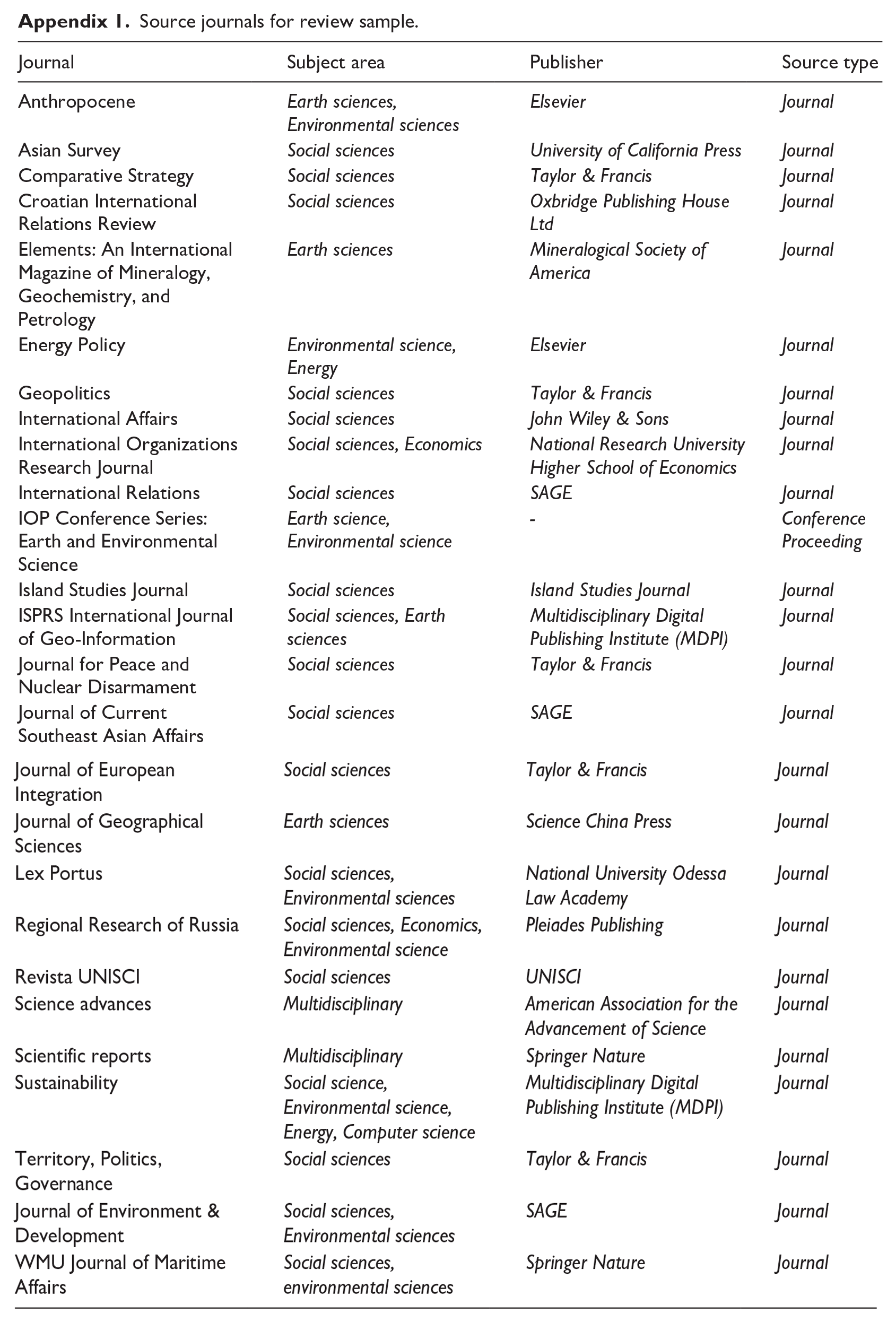
| Journal | Subject area | Publisher | Source type |
|---|---|---|---|
| Anthropocene | Earth sciences, Environmental sciences | Elsevier | Journal |
| Asian Survey | Social sciences | University of California Press | Journal |
| Comparative Strategy | Social sciences | Taylor & Francis | Journal |
| Croatian International Relations Review | Social sciences | Oxbridge Publishing House Ltd | Journal |
| Elements: An International Magazine of Mineralogy, Geochemistry, and Petrology | Earth sciences | Mineralogical Society of America | Journal |
| Energy Policy | Environmental science, Energy | Elsevier | Journal |
| Geopolitics | Social sciences | Taylor & Francis | Journal |
| International Affairs | Social sciences | John Wiley & Sons | Journal |
| International Organizations Research Journal | Social sciences, Economics | National Research University Higher School of Economics | Journal |
| International Relations | Social sciences | SAGE | Journal |
| IOP Conference Series: Earth and Environmental Science | Earth science, Environmental science | - | Conference Proceeding |
| Island Studies Journal | Social sciences | Island Studies Journal | Journal |
| ISPRS International Journal of Geo-Information | Social sciences, Earth sciences | Multidisciplinary Digital Publishing Institute (MDPI) | Journal |
| Journal for Peace and Nuclear Disarmament | Social sciences | Taylor & Francis | Journal |
| Journal of Current Southeast Asian Affairs | Social sciences | SAGE | Journal |
| Journal of European Integration | Social sciences | Taylor & Francis | Journal |
| Journal of Geographical Sciences | Earth sciences | Science China Press | Journal |
| Lex Portus | Social sciences, Environmental sciences | National University Odessa Law Academy | Journal |
| Regional Research of Russia | Social sciences, Economics, Environmental science | Pleiades Publishing | Journal |
| Revista UNISCI | Social sciences | UNISCI | Journal |
| Science advances | Multidisciplinary | American Association for the Advancement of Science | Journal |
| Scientific reports | Multidisciplinary | Springer Nature | Journal |
| Sustainability | Social science, Environmental science, Energy, Computer science | Multidisciplinary Digital Publishing Institute (MDPI) | Journal |
| Territory, Politics, Governance | Social sciences | Taylor & Francis | Journal |
| Journal of Environment & Development | Social sciences, Environmental sciences | SAGE | Journal |
| WMU Journal of Maritime Affairs | Social sciences, environmental sciences | Springer Nature | Journal |
Acknowledgements
We are grateful to our colleagues in the Natural Resources and Sustainable Development research program—Jayne Glass, Lars Rudebeck, Magdalena Kuchler, and Stacy VanDeveer—for discussing earlier versions of this paper with us.
Funding
The author(s) disclosed receipt of the following financial support for the research, authorship, and/or publication of this article: This paper is a deliverable for the NOCRISES project (Negotiating Ocean Conflicts among RIvals for Sustainable and Equitable Solutions) funded by Belmont Forum and FORMAS (project. nr. 2019-02378).
