



Abstract
If the Anthropocene is a rupture in planetary history, what does it mean for international environmental law? When the Earth System crosses irreversible tipping points and begins a forceful, nonlinear transformation into a hostile state which I call the ruptured Anthropocene, the concept of protecting the global environment from humans would lose its meaning. Not only the dichotomy between humans and nature becomes irrelevant, but the environment itself will no longer exist as an object for protection. I argue that, for international environmental law to stay relevant in the ruptured Anthropocene, it needs to shift away from its traditional focus on restoring the planetary past, and instead play an active role in the making of planetary futures. Its new purpose will need to be active planetary stewardship, whereby humans add self-awareness for deliberate self-regulation of the Earth System. Such an attempt at ‘taming’ the so-called Gaia 2.0 will, however, create winners and losers, and the new form of law will have to address fundamental questions of justice on a planetary scale. Building on the concept of earth system law emerging in the earth system governance literature, I draw the contours of international environmental law 2.0 for the ruptured Anthropocene and discuss the challenges of instituting active planetary stewardship.
Keywords
Introduction
The Earth System is on the verge of crossing tipping points. Defined as ‘a critical threshold at which a tiny perturbation can qualitatively alter the state or development of a system’ (Lenton et al., 2008: 1786), tipping points mark an abrupt change in the equilibrium state of Earth’s various tipping elements. Among the most impending tipping points is in the West Antarctic ice sheet, which is predicted to disintegrate if current global warming trends continue (IPCC, 2019). This transformational process will in turn interact with other tipping elements such as the thermohaline circulation and the Amazon rainforest, which could also transition into a new state (Nobre et al., 2016; Stouffer et al., 2006). The interactions between tipping points will likely generate a global tipping cascade (Lade et al., 2019; Rocha et al., 2018), posing catastrophic or even existential risks to humanity and other life-forms (Bostrom and Ćirković, 2008; Xu et al., 2020). Based on models and observations, earth system scientists warn that ‘we might already have lost control of whether tipping happens’ (Lenton et al., 2019: 595), and that the risk of irreversible transformation on a planetary scale could be imminent. This has led some critics to conclude that ‘[i]t’s too late to negotiate with the Earth’ (Hamilton, 2015a: 39). Humanity is not simply standing on a precipice as many seem to argue (Ord, 2020), but rather stumbling towards it. We may fall at any moment, which will mark an irreparable rupture in time (Hamilton, 2015b).
Yet, taking the idea of rupture as a plausible hypothesis and discussing its governance implications have largely been avoided in academic literature. The situation might be comparable to how adaptation was considered taboo in early climate policy debates (Pielke et al., 2007). Understandably, we would want to remain hopeful that there is still time to save humanity from falling off the precipice; otherwise we might have no reason to act now. But accepting that global tipping could be inevitable is not necessarily a matter of binary choice between environmental determinism and technological utopianism (Dalby, 2016). Rather, it is about accepting what is likely inescapable and creating a habitable planet (Dryzek and Pickering, 2019). It underscores the need for humanity to fully embrace the idea of planetary stewardship and become humble yet active stewards of the Earth System (Chapin et al., 2010; Steffen et al., 2011). What this new form of ‘environmentalism’ will look like is yet unclear. We have only begun to reflect on the assumptions of today’s environmental institutions in search for a new teleology in what I call the ruptured Anthropocene that lies beyond the precipice.
In this article, I explore the implications of the concept of Anthropocene rupture for international environmental law in particular, which is here loosely understood as the system of norms, rules, principles, and other institutions that work to protect the global environment from human impact (Kim and Mackey, 2014). My thesis is that, for international environmental law to stay relevant in the ruptured Anthropocene, it would need to shift away from its traditional focus on restoring the planetary past, and instead play an active role in the making of planetary futures. When tipping occurs, the relatively stable conditions of the Holocene will likely become impossible to restore, especially through the conventional environmental approach of simply reducing the human footprint. The notion of environmental protection would then lose its relevance, and international environmental law will need a new purpose in the ruptured Anthropocene.
This new purpose, as I will argue, is to create a life-supporting Gaia 2.0 by nurturing the planetary stewardship capacity of human societies. Gaia 2.0 is a term Lenton and Latour (2018) introduced to denote a fundamentally new state of the Earth System. Whereas Gaia has so far ‘operated without foresight or planning on the part of organisms’, the hypothesis is that humans are now capable of playing a significant role in the deliberate self-regulation of Gaia 2.0 (Lenton and Latour, 2018: 1066). We may for example set goals and steer the course of ‘Spaceship Earth’ towards a desirable future for all life-forms. Gaia 2.0 is, in a way, a Gaia tamed by humanity. International environmental law would then need to provide an effective and legitimate framework for human societies to fully embrace the complexity of the Earth System, intimately connect with Gaia, and become responsible stewards of all earthlings (Folke et al., 2021).
Under various banners such as Lex Anthropocenae (Kotzé and French, 2018), scholars have been sketching out the contours of next-generation international environmental law 2.0 for a profoundly changed, complex world of the Anthropocene (Brown Weiss, 2020; Brunnée, 2019; Gonzalez, 2015; Kim and Bosselmann, 2013; Kotzé, 2017; Lim, 2019; Robinson, 2014; Scott, 2013; Vidas et al., 2015; Viñuales, 2018). In this article, I contribute to this burgeoning literature, and more broadly to the study of global environmental governance in the Anthropocene (Biermann, 2021; Burch et al., 2019; Dryzek and Pickering, 2019; Galaz, 2014; Pattberg and Zelli, 2016), by drawing on the concept of earth system law that has emerged as a promising alternative legal imaginary (Kotzé and Kim, 2019). As a nascent concept, however, earth system law has not yet fully embraced the inevitability of global tipping. Instead the discussion has been occupied with the limitations of current international environmental law for respecting planetary boundaries (Kotzé, 2020) and how earth system law could be more effective in that regard (Kim and Kotzé, 2021). Noting this, the aim of this article is to explore the implications of the Anthropocene rupture, specifically, for earth system law and governance.
Following this introduction, I begin with an overview of the key differences between the Holocene and the Anthropocene, which I further divide into two distinct periods: the early Anthropocene and the ruptured Anthropocene, separated by the moment when a global cascade of tipping points is triggered. Then I explain why international environmental law in its current form would lose its relevance in the ruptured Anthropocene, and argue that it will need to support an active form of planetary stewardship and become instrumental in taming Gaia 2.0. Finally, I refer to the concept of earth system law, and offer my perspective on how it might capture what is required of international environmental law 2.0 in the ruptured Anthropocene.
The ruptured Anthropocene
The concept of the Anthropocene is highly contested. There is a lack of consensus on when exactly this most recent geological epoch began with estimates ranging very widely from the first deliberate use of fire by hominids one to two million years ago and the onset of agriculture about 10,000 years ago, to the Great Acceleration in human activity that followed the Second World War (Lewis and Maslin, 2015; Malhi, 2017). Despite the disagreement, the core idea of the Anthropocene is widely shared: the Anthropocene denotes a period in geological time when Homo sapiens has become a geophysical force (Steffen et al., 2007). For the first time in planetary history, a single species has acquired the power to disturb the self-regulation of the Earth System. No doubt this demands us to rethink our place and role in the community of life (Biermann and Lövbrand, 2019).
With the Anthropocene understood in such a way, however, its implications for international environmental law have not been fundamentally different to those of the Holocene; that is, we must live within the limits of the planet Earth. Humanity would simply need to take more of the same measures as stipulated in existing international environmental agreements to prevent serious or irreversible damage, such as ‘dangerous anthropogenic interference with the climate system’ (United Nations Framework Convention on Climate Change, Article 2). The only difference would be the sense of urgency and priority to implement these laws by, for example, recognizing that we are in a climate emergency. This has led legal scholars to call for bolstering existing ‘legal boundaries’ to limit human impact on the environment within planetary boundaries (Chapron et al., 2017), which collectively define the Holocene basin of attraction (Rockström et al., 2009).
But fundamentally, planetary boundaries will lose much of their relevance and usefulness once we step over the edge of the cliff that lies somewhere beyond the boundaries, and start a deep dive into the Anthropocene’s dark abyss (Biermann and Kim, 2020; Kim and Kotzé, 2021). This is not to suggest that our current environmental efforts to minimize our interference with the Earth System is completely meaningless. Even if we have lost the ability to avoid tipping points, we would not want to overshoot at high speed. However, it is important to recognize that, once we cross tipping points, the transformation of the Earth System will likely be irreversible, making a return to Holocene conditions an impossibility in the absence of active intervention on the part of humans (Steffen et al., 2018).
What I therefore take as the starting point for reimagining international environmental law is that the Anthropocene signifies the start of an entirely new, no-analogue state of the Earth System, one that is fundamentally different from the Holocene (Steffen et al., 2004). At its core is the notion of regime shift or critical transition (Scheffer et al., 2012), in which the Earth System transitions from one epoch to another. We are familiar with examples of such ecosystem change at sub-global scales (Folke et al., 2004) with tundra turning to boreal forests or tropical forests turning to savannas (Biggs et al., 2018). The idea of the Anthropocene suggests that similar thresholds exist at the planetary scale, and the entire Earth System, as it has in the past, can and will go through a regime shift from one stable state to another, but this time due to human actions. Once the Earth System crosses a critical tipping point in the climate system, for example, it would enter a new basin of attraction and takes on new dynamics. Then the Earth System will never be the same again even if human societies manage to reduce the atmospheric greenhouse gas concentrations back to pre-industrial levels. The Earth System would need to be pushed even harder to the opposite extreme to be brought out of the new stable state (Steffen et al., 2018). When the West Antarctic ice sheet collapses, for example, it will not regrow to the present extent until temperatures are at least one degree Celsius below pre-industrial levels (Garbe et al., 2020).
This understanding of the Anthropocene as a rupture in planetary history (Hamilton, 2015b) builds on the view of the Earth System as a complex adaptive system (Steffen et al., 2020). It is a system that exhibits nonlinear properties such as resilience, but also threshold behaviour if pushed too far. From this perspective, to say that the Earth System has entered the Anthropocene means that humans have pushed the planet beyond some of its critical tipping points and triggered global tipping cascades (as opposed to simply suggesting that humans have the ability to do so), and now the Earth System has started a one-way transition into a new stable state. This planetary regime shift may take place on geological timescales over millennia to complete due to feedback delays. Based on the current trajectory, scientists predict that a ‘Hothouse Earth’ awaits at the end (Steffen et al., 2018), which will likely be hostile to life as we know it. Once the Earth System reaches that state, the resilience of the system will try to keep it in the new state. Simply reducing the human footprint would be insufficient or even counterproductive to move the Earth System out of the new basin of attraction.
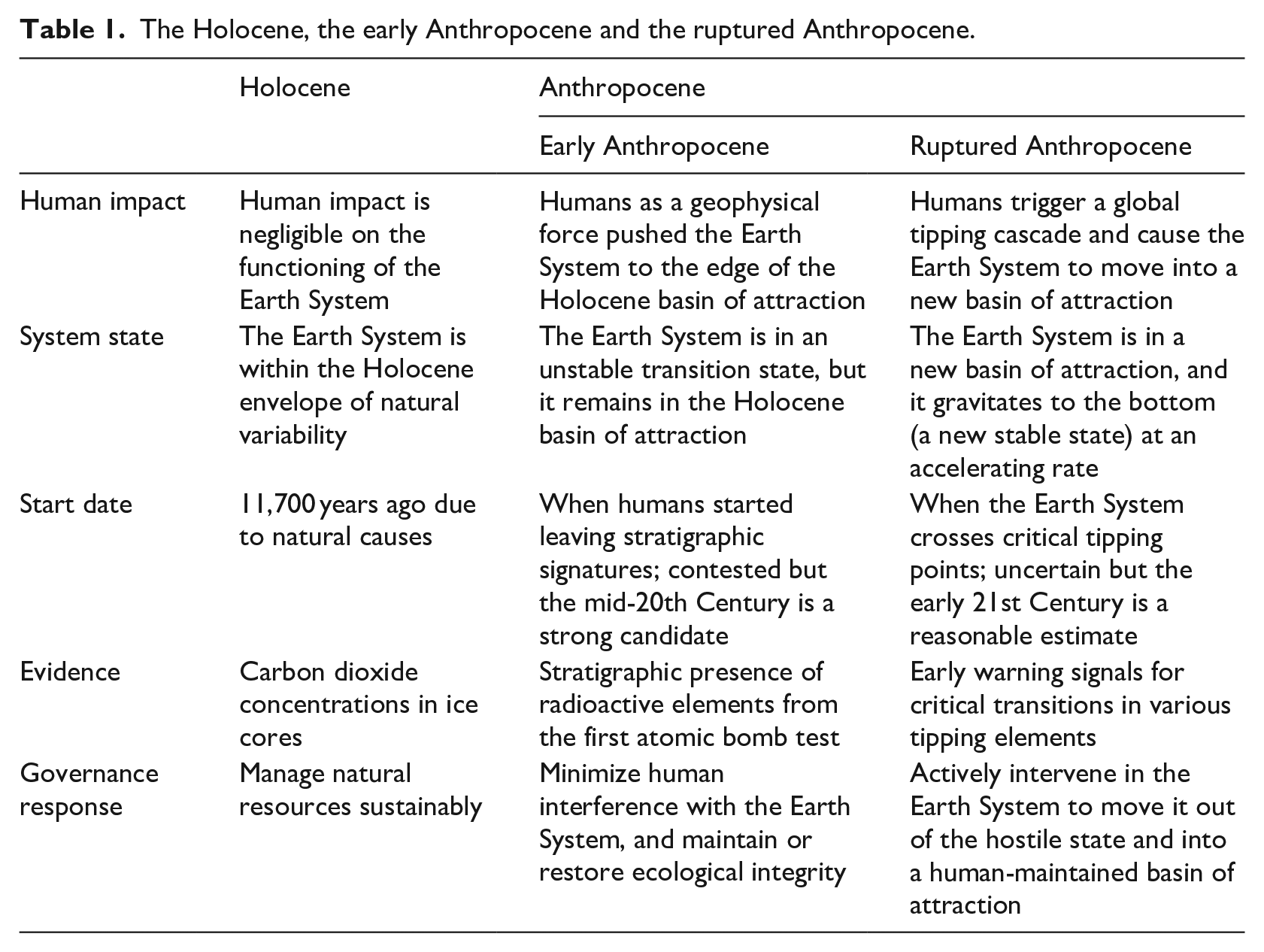
From a governance perspective, it is then useful to differentiate the Anthropocene epoch into two distinct periods: before and after global tipping cascades are triggered. I call them the early Anthropocene and the ruptured Anthropocene, which are two different conceptualizations of the Anthropocene from stratigraphic and Earth System perspectives, respectively (Steffen et al., 2016). Table 1 provides an overview of their key differences, also in relation to the Holocene. From an Earth System perspective, the early Anthropocene is when the Earth System still remains in the Holocene basin of attraction, whereas the ruptured Anthropocene begins when the Earth System has entered a new basin of attraction. The precise moment when the Earth System would move into a new basin is difficult to predict. But for the purpose of informing governance responses, it is reasonable to assume that the ruptured Anthropocene begins when we can no longer avoid tipping points by just reducing the human footprint on the planet, but when humans must also actively intervene in the Earth System (e.g. MacMartin et al., 2018). In the rest of this article, I proceed with the assumption that we have reached that point of no return, given the combined commitments under the United Nations Framework Convention on Climate Change (2021) still fall far short of what is required to limit global warming below two degrees Celsius, which is expected to be the tipping point for the Greenland and West Antarctic ice sheets (Pattyn, 2018).
The Holocene, the early Anthropocene and the ruptured Anthropocene.
International environmental law in a state of limbo
If we accept that humanity has in effect entered the ruptured Anthropocene, then it prompts us to revisit and scrutinize the foundations of international environmental law. This is necessary not only because the rupture implies the blurring of the human-nature dichotomy (Biermann, 2021), but more importantly because the environment itself is undergoing profound transformations, as the Earth System tends towards a new, less habitable, basin of attraction. The biosphere is not simply disappearing into the technosphere, but a new ‘environment’ is arriving, and this time, it will in all likelihood not be friendly to humans and many other forms of life. Modern environmentalism therefore has come to an end with the Anthropocene rupture in the sense that the environment no longer exists as an object for protection from humans. International environmental law, in its current form, would therefore soon lose relevance since it has been designed precisely with this objective in mind: to protect the environment from human activities.
Current international environmental law, just like domestic environmental law (Tarlock, 1994), has been founded on the equilibrium paradigm in ecology (Kim and Mackey, 2014). The assumption is that the basin of attraction in the Holocene is known to science, and if the Earth System was left by itself with little anthropogenic interference, we may reasonably predict the stable state in which the system would end up. This state is called Holocene stability, which is what international environmental law currently aims to restore. Generally speaking, international environmental law emerged and evolved over the past few decades with a view to regulating human activity to ‘let nature be’, and maintain global environmental change within the Holocene envelope of natural variability. This claimed purpose of international environmental law found its expression in the notion of integrity, which was famously proposed by Leopold (1949) as a normative ideal on par with beauty and stability of the biotic community. Today, all major soft law instruments of international environmental law such as the Rio Declaration on Environment and Development embrace global ecological integrity as a key virtue (Kim and Bosselmann, 2015), as well as several multilateral environmental agreements including the Paris Agreement that notes in its preamble ‘the importance of ensuring the integrity of all ecosystems’.
But what is the meaning of global ecological integrity in the ruptured Anthropocene where equilibrium no longer remains a valid assumption on a planetary scale? The integrity of Earth’s ecosystem in the ruptured Anthropocene would not be the same as integrity as we know it. The Earth System after rupture acquires a different identity, and its new normal state will unlikely be forgiving to many life-forms, including humans. The Earth System will continue to support life in the ruptured Anthropocene, but life that would thrive in such conditions will be drastically different from today’s. Indeed the sixth mass extinction is accelerating, whereby more than three-quarter of species may disappear in a geologically short interval (Barnosky et al., 2011). Humans in particular will likely struggle to prosper in such changing conditions, and for those in vulnerable positions, even to survive (Lynas, 2020). Living in harmony with nature might eventually become an oxymoron as the ‘revenge of Gaia’ intensifies (Lovelock, 2006). And yet, this nonlinear transition from the early Anthropocene to the ruptured Anthropocene is irreversible, unless humans destabilize the new stable state. The notion of planetary integrity that has played a significant role in guiding international environmental law will therefore lose its utility as a reference point for the unattainable re-wilding campaign of international environmental law (Bridgewater et al., 2014).
So, international environmental law is currently in a state of limbo, or the ‘Anthropocene gap’ (Galaz, 2014). It remains nostalgic of the past, but the past conditions of the Holocene have become impossible to restore by reducing our ecological footprint. The Earth System has silently crossed irreversible tipping points (or it will do so soon), and humanity has no other option but to go forward in time into the (un)knowable unknown. Global environmental protection as currently understood as curtailing human interference with the Earth System will not remain suitable as the dominant paradigm during this one-way transition into a deep, likely hostile, basin of attraction. What it means to be an environmentalist when the Earth System was tending towards Holocene stability is fundamentally different to when the Earth System is undergoing a transformation in the ruptured Anthropocene. International environmental law will need a new raison d’être for ‘postapocalyptic’ environmentalism.
Taming Gaia 2.0
The idea of Anthropocene rupture is not about giving up and ‘try anything now’ (Purdy, 2015). Accepting that the Earth System will not go back to the Holocene state does not imply there is no urgency or reason for humans to act responsibly. For one, we may still have some control over the rate at which environmental risks cascade or damage accumulates (Hughes et al., 2013; Lenton et al., 2019; Rocha et al., 2018). This is especially so if we manage to maintain biodiversity for ecosystem resilience (Folke et al., 2021) or govern interacting tipping elements (Galaz et al., 2017; Sterner et al., 2019; Walker et al., 2009). But we must act fast. The Earth System will pick up momentum as it goes through transformation and there is little we could do then to change its trajectory. The sooner we act, the more agency we would have over the future of Earth.
At a more fundamental level, however, what surviving in the ruptured Anthropocene demands is a paradigm shift from a passive to an active form of planetary stewardship. The idea that humans need to become active stewards of the Earth’s life-support system implies that simply reducing human interference is not sufficient to maintain planetary life-supporting capacity, but we need to actively intervene where necessary. Metaphorically speaking, humanity needs to make Spaceship Earth manoeuvrable. If international environmental law in the early Anthropocene aimed to maintain Spaceship Earth on its previous trajectory (Kim and Bosselmann, 2013), international environmental law 2.0 in the ruptured Anthropocene should help imagine a safe and just future for all, put the ‘derailed’ spaceship back on a desirable trajectory, and monitor its course.
Gaia 2.0 as conceptualized by Lenton and Latour (2018) is a useful metaphor for thinking about the challenge of navigating Spaceship Earth through the ruptured Anthropocene. The basic premise of this concept is that, in the Anthropocene, humans have not only become a geophysical force, but we have become aware of the consequences of our actions on the planet. The emergence of self-awareness as a new feedback loop between humanity and Gaia theoretically allows for deliberate self-regulation. In other words, Gaia 2.0 refers to a hypothetical state of the Earth System where humans have not only acquired disruptive agency, but also some degree of curative agency for life on Earth. Gaia 2.0 is a Gaia tamed by humanity. I borrowed the notion of taming from Barabási (2005) in the context of ‘taming complexity’, but also from the French novel Le Petit Prince by Antoine de Saint-Exupéry (1943). In the novel, the fox explains to the little prince that ‘apprivoiser’ (taming) means ‘créer des liens’ (establishing ties) and ‘deviens responsable pour toujours de ce que tu as apprivoisé’ (becoming responsible forever for what you have tamed). It is in this sense that humanity may need to act somewhat like ‘the God species’ (Lynas, 2011). As I will illustrate below, however, the idea of playing God to survive on Earth raises uncomfortable questions. A key role for the new form of international environmental law would then be to regulate, or strengthen and limit, the exercise of our curative agency.
One could imagine geoengineering, as a potential interventionist tool, becoming a significant part of what international environmental law 2.0 would need to regulate. Here I am not resorting to geoengineering as a quick fix or cheaper alternative to costly climate mitigation measures (Caldeira et al., 2013). Geoengineering is neither quick nor cheap when unintended consequences and associated costs of externalities are fully taken into account (Barrett, 2008; Zarnetske et al., 2021). But certain forms of geoengineering, such as ocean alkalinity enhancement (Burns and Corbett, 2020), may become a necessary part of long-term survival strategies for creating the minimally required conditions for a habitable planet. Despite uncertainties and imperfections, geoengineering may become indispensable for terraforming Earth so it can continue to support life as we know it in the ruptured Anthropocene. International environmental law 2.0 would then need to provide the legal basis for humanity to make wise use of powerful but controversial tools such as geoengineering for the purpose of active planetary stewardship.
The idea of Gaia 2.0 is still hypothetical, and hence it needs to be considered with caution. The exercise of curative agency, despite its good intentions, will certainly lead to unintended consequences with social and environmental implications. In fact, it may no longer be useful to frame humans as ‘overwhelming the great forces of nature’ (Steffen et al., 2007: 614). The ability to perturb a system may not require a great force. Although humans have agency to disturb the Earth System and push it across tipping points, we will unlikely acquire the power to shape it precisely the way we want. We will need to approach the Earth System as a hypercomplex entity, whose behaviour we will never entirely master and control. Gaia has always been powerful and will remain so.
While continuing to express humanity’s humility in the light of powerful Gaia, international environmental law 2.0 would need to become a key instrument with which human societies negotiate with and tame Gaia 2.0. Environmentalism in the ruptured Anthropocene will not stay in the reactive and passive form of environmentalism, curtailing our impact or interference with the environment as it has been doing and continues to do so, but must rather adopt a form of active planetary stewardship (Steffen et al., 2011). This means identifying, deliberating and selecting interventions, and actively steering the Earth System towards a desirable future among many other plausible futures (Bai et al., 2016). We disturbed the system and now, whether we like it or not, we must take full responsibility by taking ownership, and choose our own future. Earth system governance scholarship has begun exploring the implications of such thinking (Burch et al., 2019), and international environmental law scholarship will need to join the debate (Stephens, 2018; Vidas et al., 2014; Viñuales, 2018).
Earth system law: A legal imaginary for charting a habitable future
In recent years, a group of scholars in the Earth System Governance community has proposed earth system law as a new legal paradigm for the Anthropocene (Gellers, 2021; Kotzé, 2020; Kotzé and Kim, 2019, 2020; Kim and Kotzé, 2021; Mai and Boulot, 2021). Although its meaning is still evolving, Kim and Kotzé (2021: 11) offer a tentative definition: Earth system law [is] an innovative legal imaginary that is rooted in the Anthropocene’s planetary context and its perceived socio-ecological crisis. Earth system law is aligned with, and responsive to, the Earth system’s functional, spatial and temporal complexities; and the multiple Earth system science and social science-based governance challenges arising from a no-analogue state in which the Earth system currently operates.
While it is neither exclusively confined to the international nor environmental domains, the earth system law imaginary finds its origin in international environmental law scholarship. Conceived as forming the juridical dimension of earth system governance, earth system law is useful for the systematic interrogation of the role of international environmental law in the Anthropocene, particularly in relation to questions about complexity, inclusivity, interdependencies, and pathways for planetary justice (Kotzé, 2019).
Importantly, earth system law, as currently conceptualized, acknowledges that the pursuit of environmental protection is unlikely to remain tenable as we move deeper into the Anthropocene (Lorimer, 2015). Although primarily built on the assumptions of what I define as the early Anthropocene (Table 1), earth system law does recognize the possibility and implications of the Anthropocene rupture. In particular, it is explicit in finding international environmental law ill-equipped ‘for navigating, and ultimately surviving, the unknown and unsafe space that lies far outside the planetary boundaries’ upper limits’ (Kim and Kotzé, 2021: 13). In that sense, earth system law acknowledges the arrow of time (or the irreversibility of the Anthropocene rupture) and seeks to address the normative void (or global environmental protection becoming an outdated concept). Earth system law is proactive rather than reactive, and future-oriented rather than past-dependent. It is founded on neither anthropocentric nor ecocentric ethics, the division of which has become irrelevant. Instead, earth system law embraces the ethics of planetary stewardship (Schmidt et al., 2016).
However, the concept of earth system law and its attendant scholarship have not yet fully embraced the idea of Anthropocene rupture. In that regard, there are at least four prominent challenges that earth system law research will need to address in the coming years. Addressing these challenges will help to institute active planetary stewardship for taming Gaia 2.0 through the exercise of curative agency.
The first is the challenge of building reflexivity into the design of earth system law. Stewarding the Earth System demands us to think about the consequences of our action in ‘deep-time’ and plan on geological timescales (Shoshitaishvili, 2020), but also to react quickly to abrupt changes and cascading risks (Galaz, 2019). For example, we will need to align our thinking with very slow Earth System processes as well as pick up early warning signals for anticipating critical transitions and navigating these very transitions as they unfold (Scheffer et al., 2009, 2012). Therefore, earth system law will need to strike a balance between stability and flexibility (which would constantly shift), while accepting change as the norm and institutionalize reflexivity into law (Dryzek, 2014). We may need a system of law that is fully modelled after the complex adaptive Earth System itself (Kim and Mackey, 2014). The architecture of earth system law would not only allow for institutional adaptation to incremental changes, but also for switching to a new system state when the state of its regulatory objects undergoes transformation.
The second is the challenge of democratizing earth system science. Earth system law needs to be informed by earth system science, and yet earth system science has been criticized for lacking democratic legitimacy. This is particularly concerning because earth system science heavily depends on modelling as a key method (Steffen et al., 2020), where the assumptions that modellers bring to their models influence output. Therefore, it is important to consider who these scientists are and where they come from, especially those that participate in the drafting of authoritative scientific assessments that shape policy (Ho-Lem et al., 2011; Gay-Antaki and Liverman, 2018). One issue under discussion is how to democratize planetary boundaries (Kim and Kotzé, 2021), which are criticized as technocratic (Biermann and Kim, 2020). Some argue that democratization in this context is achievable through a legitimate division of labour between experts, citizens, and policy-makers (Pickering and Persson, 2019). Yet, the non-governmental nature of such target-setting initiatives raises fundamental questions of legitimacy and accountability of earth system science. The recently formed Earth Commission is an example (Rockström et al., 2021), which faces the inherent challenge of representing diverse values in the targets they set for all. Earth system law will need to become instrumental in addressing such issues and ultimately improve the science-policy interface.
The third is the challenge of expanding the scope of planetary justice. At the core of earth system law are fundamental questions of justice on a planetary scale (Biermann and Kalfagianni, 2020). The politics of the ruptured Anthropocene will likely be ‘ugly’ (Dalby, 2016) or unsettling to say the least, and this will have myriad implications for justice at all levels and scales. Whichever trajectory humans choose for the future of our planet, certain groups and species will win while others will lose from new planetary risks (Berkhout, 2014). Then it is the role of earth system law to ensure that the costs and benefits are equitably shared. Importantly, the scope of planetary justice must reach beyond Holocene thinking, and address normative questions involving resource allocation not only between the rich and the poor (Kashwan et al., 2020), but also between the present and future generations, as well as between humans and non-humans (Dryzek and Pickering, 2019). Earth system law should guarantee the marginalized, the unborn and the non-human a voice and a seat at the table (Gellers, 2021), and ensure their needs and interests are properly considered when choosing a future.
The fourth is the challenge of anticipatory governance. In the ruptured Anthropocene, the politics of the future will become increasingly potent. The imaginaries of the future will become powerful while the images of the irreversible past will lose relative importance. Then it becomes important to consider who is actively creating the imaginaries of the future, through what process, which imaginary becomes dominant, and why (Lövbrand et al., 2015; Oomen et al., 2021). The making of planetary futures does not and should not happen in a ‘cockpit’ (Hajer et al., 2015), and global goal-setting becomes ‘the ultimate challenge of planetary stewardship’ in the Anthropocene (Young et al., 2017: 53). A key role of earth system law will be to regulate the power of ‘futuring’, and ensure inclusivity in the process of social exploration and experimentation (Carpenter et al., 2019). This would require the strengthening of democratic institutions at all levels of governance. For example, the world’s diverse regions should be able to maintain autonomy and make their own choices about their futures (Bennett et al., 2021), but these choices will need to be reconciled at the global level through deliberative governance (Dryzek et al., 2019).
Conclusion
The Anthropocene is not simply pointing to the increasing scale and magnitude of human impact and the associated need for urgent action. As a rupture in planetary history, the Anthropocene requires a corresponding ‘state shift’ in the way we think about the past and future. This includes a reconsideration of the assumptions on which international environmental law is founded, namely the restorability of Holocene stability. When the Earth System crosses critical tipping points and begins a forceful, nonlinear transformation into a new state, the notion of protecting the global environment from humans will lose its meaning.
Earth system law for the ruptured Anthropocene is therefore not merely a more stringent form of international environmental law of the early Anthropocene. The environment as we know it will soon end, and it will no longer exist as an object for protection from human activities. By embracing a new set of assumptions of the ruptured Anthropocene, earth system law will have to be radically different in fundamental ways from international environmental law in its current form. What will become key is to regulate the exercise of our curative agency in taming Gaia 2.0 and maintaining its capacity to support life as we know it. In this regard, earth system law will need to play an active role in steering Spaceship Earth towards a desirable future, while centrally concerned with questions of justice on a planetary scale.
With the overall aim to stimulate a debate, this article has raised more questions than providing answers. What exactly this new form of earth system law will look like remains an open question. But I argue that earth system law is critical in enabling a safe and just transition for a safe and just future, by creating a level playing field for the politics of the future. Its contents should be filled by as many human and non-human voices as possible. To that end, earth system law scholarship will require interdisciplinary and transdisciplinary research efforts, not only by drawing on legal theories, but also by actively engaging with earth system scientists and earth system governance scholars, as well as various stakeholders who can represent the marginalized, the unborn, and the non-human.
Footnotes
Acknowledgements
This article has benefited immensely from the comments of Louis Kotzé, Peter Bridgewater, and anonymous reviewers. An earlier version of the article was presented at two workshops, ‘Constitutionalizing in the Anthropocene’ (Tilburg University, 2020) and ‘The Social Dynamics of the Technosphere’ (Max Planck Institute for the History of Science, 2021), where the author received valuable input from, among others, Michael Leach and Phillip Paiement.
Declaration of conflicting interests
The author(s) declared no potential conflicts of interest with respect to the research, authorship, and/or publication of this article.
Funding
The author(s) received no financial support for the research, authorship, and/or publication of this article.
