



Abstract
The Anthropocene as a new planetary epoch has brought to the foreground the deep-time interconnections of human agency with the earth system. Yet despite this recognition of strong temporal interdependencies, we still lack understanding of how societal and political organizations can manage interconnections that span several centuries and dozens of generations. This study pioneers the analysis of what we call “deep-time organizations.” We provide detailed comparative historical analyses of some of the oldest existing organizations worldwide from a variety of sectors, from the world’s oldest bank (Sveriges Riksbank) to the world’s oldest university (University of Al Quaraouiyine) and the world’s oldest dynasty (Imperial House of Japan). Based on our analysis, we formulate 12 initial design principles that could lay, if supported by further empirical research along similar lines, the basis for the construction and design of “deep-time organizations” for long-term challenges of earth system governance and planetary stewardship.
Keywords
Introduction
The notion of the Anthropocene places human impacts on the earth system in planetary timescales that last over millennia (Archer, 2016; Fox et al., 2017). Anthropogenic interventions in the earth system—such as the deposition of nuclear waste or the production of concrete—are not only based on the exploitation of resources that accumulated in the deep past; they also limit the scope of action of generations far in the future (Beckstead, 2013; Brunnengräber et al., 2015; Cooper et al., 2018; Irvine, 2014; Lehne and Preston, 2018; World Commission on Environment and Development, 1987).
These long-term and partly irreversible human impacts result from humankind’s modern capacity to alter the planet, yet without having developed the concurrent institutions to ensure that this capacity is used responsibly and sustainably (Biermann, 2014; Johnson et al., 2014; Lenton et al., 2008; Schmidt et al., 2016; Steffen et al., 2015, 2018). In particular, the temporal depth of human actions conflicts with the short-termism of current political systems and institutions, which remain dominated by election cycles of just a few years (Galaz, 2019; Reisch, 2015; Underdal, 2010). This lack of an institutionalized deep-time perspective is observable, among others, in powerful “Great Again” retrotopias of a romanticized fossil fuel past, indicating that changes in civilizations are interrelated with changes in their conceptions of time (Baumann, 2017; Jefferson, 2019 [1789]; Koselleck, 2004; Rifkin, 1987). Against this background, it is striking that hardly any societal and political organizations temporally correspond to the deep-time interdependencies in the Anthropocene (Costanza et al., 2012; Irvine, 2014; Rivera-Collazo et al., 2018; Stager, 2011; Yusoff, 2013; Zen, 2001).
And yet, in order to enhance planetary health, which encompasses the health of human civilizations and the condition of the natural systems on which it relies, the practical demand for novel types of organizations that last over long periods of time is rapidly increasing (Almada et al., 2017; Deem et al., 2019; Horton, 2013, 2016; Whitmee et al., 2015). The maintenance of biodiversity, the control of biogeochemical flows, or land-use changes, for example, need protection over long periods of time to be effective (Langmuir and Broecker, 2012). Carbon sequestration and storage as well as nuclear waste, in general, require continued management within stable institutional safeguards and communication systems over centuries, if not longer (see, for example, Sebeok, 1986: 149–173). Depending on the issue, organizational agency is essential at various stages of multi-level governance in the Anthropocene (Battersby, 2017). Thinking about space mining, for example, as a potential object of governance over very long periods of time, one organization at the top level of the United Nations seems essential, perhaps as a reformed United Nations Office for Outer Space Affairs. Contrarily, the Svalbard Global Seed Vault, as an example of an existing organization that is meant to last essentially forever to preserve genetic information, requires a polycentric web of regional, national, and even local seed banks to connect crops to agricultural practices. Consequently, novel organizations are not restricted to a specific level in the governance architecture, they have rather to be seen as opening the field of multi-temporal governance, such as in anticipatory governance that aims to build capacities for futures on a complex and ever-changing planet (Coenen et al., 2012; Pattberg and Zelli, 2016; Vervoort et al., 2015).
Against this background, human influences on the trajectories of change of the planet need to be approached in a deep-time manner (Chapin et al., 2010; Heringman, 2015). The raisons d’être of novel organizations as part of that planetary stewardship arise from three, often intertwined, functions fostering planetary health. First, objects need to be kept safe. This encompasses (in)animate nature, such as areas of wilderness; artificial objects created by humans, such as nuclear waste or scientific knowledge; and hybrid objects characterized by flows between humans and their environment, such as infrastructures or agricultural land. Second, populations need to be kept alive, including humans as well as flora and fauna. Of course, keeping one population alive must not be based on the extinction of another one or ideally not under conditions that restrict self-development (such as in zoos). Third, novel relations need to be enabled between humans and the earth system, co-constituting renewed orders in and after the Anthropocene (Bonneuil and Fressoz, 2016; Dougherty and Dondanville, 2017; Freemaux and Barry, 2019). This function connects the human with the planetary condition to refine democracy as a government of, by, and for the people and the planet (drawing on Lincoln, 1863).
However, the social sciences—including comparative history, organization studies, international relations, and social theory—lack a structured understanding of deep-time societal institutions and organizations, which reinforces the need for a novel type of research in the Anthropocene (Bai et al., 2016; Biermann et al., 2016; Brondizio et al., 2016; Palsson et al., 2013; Shinohara, 2016). While time-centered concepts exist in theory, these are not translated in organization studies whose time-related insights are still vague and miss conceptual clarity (see, for example, Adam, 1998; Adam and Groves, 2007; Brunelle, 2017; Dawson, 2014; Montuori, 2000; Roe et al., 2008). Research on long-term organizational survival focuses on decades at best—but not on longevity in a deep-time manner over hundreds or even thousands of years (see, for example, Aldrich and Ruef, 2006; Maclean et al., 2016; Suddaby and Greenwood, 2009; Wadhwani and Bucheli, 2014). Hence, even when calls for new organizations that involve future generations are made, the deep-time perspective of the Anthropocene is often simply recognized as an unsolved challenge (see, for example, Adam, 1990; Bai et al., 2016; Berkhout, 2014; Boston, 2017; Hoffman and Jennings, 2015; Palsson et al., 2013). In sum, existing research cannot explain how to conceptualize organizations that exist over deep time and that are able to address deep-time interdependencies of the earth system.
In short, the demand for deep-time organizations is rising with the recognition of the Anthropocene and its novel challenges of earth system governance and planetary stewardship. Yet, the political and social sciences lack behind in conceptualizing and empirically investigating how organizations could function over very long periods of time.
This study is a first attempt to pioneer the exploration of “deep-time organizations,” and to develop first hypotheses of what design features might allow societal and political organizations to survive and fulfill a mission over very long time. Given that such long-living organizations are rare, and that common social science methods such as experimentation or direct observation are impossible to use, we have chosen to empirically study those organizations that have shown greatest longevity in their respective field and have survived over several centuries, if not millennia. We assume that such organizations are the best sources of empirical evidence of organizational design elements. In short, learning longevity from history to build deep-time organizations for the future is the core of our pioneering research project.
Analyzing such deep-time organizations empirically requires the clarification of two time-related concepts: longevity and deep time. We refer to longevity in terms of the long historical lifespan of the organizations that we study as the oldest in their field. Longevity, as a measure expressed in time units, covers in our study a period of continued existence that ranges from about 200 up to 2000 years and allows for a broad set of possible “ingredients” leading to long-term survival. Deep time is a geological concept that covers the earth system’s gradual change; as such, it is largely incommensurable with historical time frames (Glikson and Groves, 2015). We use it to define the twofold requirement of deep-time organizations in human systems: they need to exist over deep time and need to address deep-time challenges. The connection of historical longevity with the twofold requirement of deep-time organizations enables the development of appropriate design principles.
Our study proceeds as follows. We first outline an exploratory research design, followed by a description of the central findings that we gained by studying empirically a dozen organizations that are the oldest in their field and that have survived over hundreds and thousands of years, seeking “to unveil their secrets of longevity.” We then discuss lessons from these organizations against the three functions fostering planetary health and reformulate our findings in the form of tentative design principles for the conceptualization of deep-time organizations within the context of the Anthropocene. We conclude with options for further research on deep-time organizations as a new field of study in long-term governance.
Research design
In order to better understand the longevity of societal and political organizations, we developed a twofold exploratory research design. First, we chose cases on the dependent variable—that is, greatest longevity in their field—to gain insights into possible independent variables—that is, certain organizational characteristics. Based on this, we formulated tentative guiding principles about the functioning of deep-time organizations. Our article thus provides indicative research in the form of a pioneering scoping study. We now lay out our comparative conceptual framework, explain the case selection, and describe the methods that we applied.
Conceptual framework
A conceptual framework is needed to enable comparisons to detect general patterns of longevity across organizations (Mahoney and Rueschemeyer, 2003; Mahoney and Thelen, 2015; Skocpol, 1984: 374). While we know which dimensions are central for organizations to be an organization, we do not know which dimensions are central to ensure longevity, and in which combination and manifestation. To detect these, we use a well-established definition that describes organizations as “(1) social entities that (2) are goal-oriented, (3) are designed as deliberately structured and coordinated activity systems, and (4) are linked to the external environment” (Daft, 2013: 12; Thompson, 1967).
Building on this general definition, also our analytical concept is fourfold. We assume that successful deep-time organizations for planetary stewardship in the Anthropocene would need (1) to incorporate their goal-orientation based on their specific situatedness in the world, (2) to connect to the outer world in a specific way in order to achieve their goals over long periods of time, (3) to establish an appropriate internal management structure, and (4) to deliver important functions related to the earth system over very long periods of time.
Following this approach, we analyzed organizations with proven longevity regarding these four categories. We first collected data on the situatedness in the context of the organizations’ fields of activity, purpose, years of existence, location, and members.
Second, we analyzed external relations, that is, how the organizations connect to others, including involvement opportunities, networks connected to, and places of outreach.
Third, we studied the internal functioning and processes of the organization’s management, by assessing the international organizational structure, the internal decision-making procedures, and the regular reactions to external events.
Finally, we investigated the dissemination of the organization’s products to their external environment. This output-category covers the objects the organization creates and delivers, including issues disseminated, ways of dissemination, and feedbacks on delivery.
Taken together, we sought to uncover whether and how these organizations have developed a shared approach to longevity, turning longevity into a principal component of their organizational structure and culture, and thus constitute longevity as a temporal common (Bluedorn and Waller, 2006: 357; Cunha, 2009: 220–221).
Methods
We collected historical data based on three types of sources: academic publications, entries in major encyclopedias, and publications of the organizations about their history. For each organization that we investigated, we ensured that at least two types of information were consulted. This triangulation of sources preceded a critique of texts to determine their validity as well as recognition of their originating context (Kipping et al., 2014). Based on the conceptual framework, we develop an analytical scheme that allows us to connect evidence and interpretation to identify and extract characteristics of longevity in a comparative manner.
We apply this analytical scheme in the form of a qualitative meta-analysis by meaning condensation to develop novel explanations that go beyond those in the primary literature (Gläser and Laudel, 2010: 199–204; Kreiner, 2016: 351; Levitt, 2018: 374). For the research process, this means that we identify sources, categorize relevant contents according to the analytical scheme, and detect patterns of longevity within each and among organizations to formulate tentative design principles for the establishment of deep-time organizations.
Case selection
Our cases are formally institutionalized organizations with the greatest longevity in their field. In addition, a written and publicly available knowledge base needs to exist for each organization in order to allow for comparative analysis.
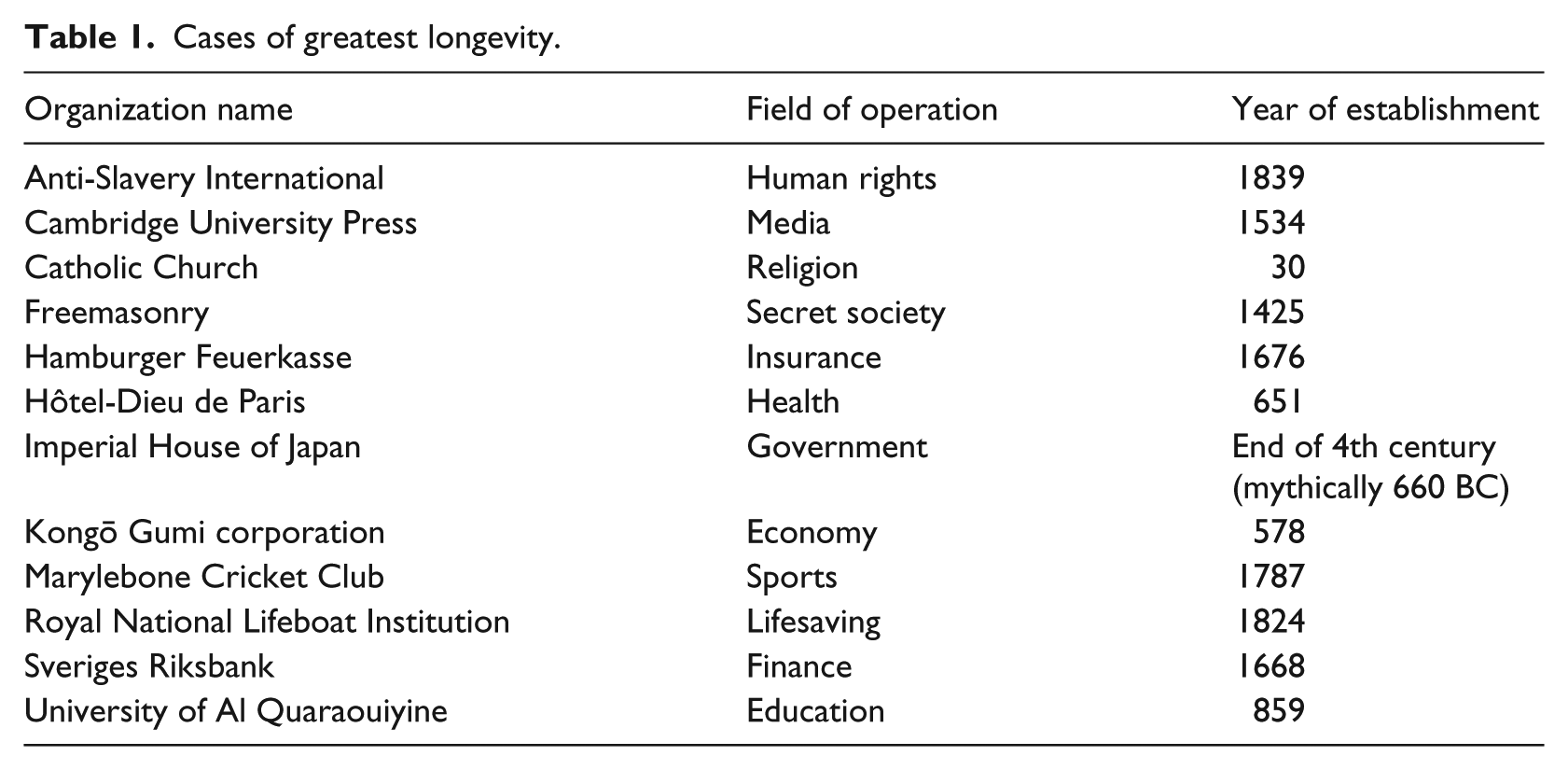
The selection criterion of greatest longevity in their field is based on the organizational lifecycle, which can be separated in four stages of organizational development, namely, entrepreneurial, collectivity, formalization, elaboration, and into five stages of decline, namely, blinded, inaction, faulty action, crisis, and decline (Daft, 2013: 545–569). The organizations that we selected were for a long time in the elaboration phase, have reached maturity, and showed resilience by handling declining performance with adequate corrections. We have chosen the extreme cases on the dependent variable (greatest longevity) as the oldest in their field, from the oldest still existing company to the oldest monarchy and the oldest publishing house. The cases span across different fields and regions to increase diversity and thus the generalizability of detected longevity patterns (see Table 1).
Cases of greatest longevity.
Analysis: patterns of great longevity
According to the analytical scheme, we sought to find explanatory factors for great longevity in the organizations’ situatedness, external relations, internal management, and dissemination.
Situatedness
Regarding the situatedness of the organizations that we studied, three patterns of longevity can be shown.
Pattern 1: First, throughout their history, all organizations that we studied connected their identity in one way or the other to an almost unachievable or timeless public purpose that served a common good in their field. This holds obviously true for nonprofit organizations such as Anti-Slavery International (2019b), which works “to end slavery throughout the world”; the University of Al Quaraouiyine, which dedicates its education to the “waqf” concept (Hardaker and Sabki, 2012; Wan et al., 2016); and the Royal National Lifeboat Institution (2019c), which aims “to end preventable loss of life at sea”; as well as state organizations such as the Sveriges Riksbank with its doctrine “hinc robur et securitas” (“herefore strength and safety”) particularly focusing on financial abundance (Wetterberg, 2009: 107). It holds also true for companies like Cambridge University Press, which targets “to unlock people’s potentials with the best learning and research solutions” (Cambridge University Press, 2019) or the Marylebone Cricket Club (2019a) as “a private club with a public function.”
Pattern 2: Second, it is striking that political, social, or economic elites played a crucial role in the establishment and continued operation of organizations of great longevity, including close ties to state power and abundant resources. This is observable not only for state organizations and public corporations such as the insurance company Hamburger Feuerkasse, which was founded by the city parliament of Hamburg (originally an independent state ruled by a network of patrician families), but also for the Marylebone Cricket Club with its founding members being from the British moneyed aristocracy and first-class cricketer Thomas Lord (Marylebone Cricket Club, 2019a; Poppelbaum, 2009: 10). The same holds for nonprofits like Anti-Slavery International, the precursor of which was formed in 1787 by Thomas Clarkson, who ordained a deacon after studying in Cambridge, together with Sir Thomas Fowell Buxton, a Member of Parliament; and for the Royal National Lifeboat Institution, whose founder Sir William Hillary was an appointed baronet (Bruce, 2014; Kaye, 2005, 2007; Mortimer, 1999: 138–139; Wilson, 1990). Likewise, the Hôtel-Dieu de Paris was initiated by the bishop Landry of Paris and supported by Parisian elites, including judges as the highest office holders in the city who repeatedly secured indirect taxes (McHugh, 2006). Also, the University of Al Quaraouiyine was funded by national elites—that is, Fatima bint Muhammad Al-Fihriya Al-Qurashiya, the daughter of a successful merchant—and became intricately connected to sultans in the following centuries (Zeghal, 2014: 128).
Pattern 3: In terms of geography, it is striking that many organizations of great longevity are located in areas that seldom had to suffer major disruptions such as violent revolutions or foreign occupation. In particular, four of the organizations of extreme longevity that we investigated are based in the United Kingdom, a monarchic state that did not collapse or become occupied during their time of existence over several centuries. Even more, the British Empire was a dominant world power over the last centuries and allowed these organizations to flourish globally, as for instance the Marylebone Cricket Club did in an exemplary way (Bradley, 1990). Two more organizations of extreme longevity are located in Japan, where again a monarch in form of the Imperial House as well as a related set of dominant cultural mechanisms such as regulation, control, and responsiveness might have aided the survival of organizations over centuries (Eisenstadt, 1996: 106–140). Possibly not coincidentally, both the United Kingdom and Japan are located on islands, which made it harder for foreign forces to occupy these countries and alter or destroy domestic organizations.
Regarding the situatedness of organizations, we hence recognize three patterns: Great longevity seems to be related to geographical locations where no major disruptions occurred; organizations with national elites as first and founding members; and the integration of a broader public purpose.
Relations
We further analyzed whether and how organizations of great longevity have built up traditions of reaching out to, and interacting with, their surrounding environment. Empirical evidence indicates that individual factors seem central. Yet, three patterns recurring through several organizations can be identified as well.
Pattern 4: First, organizations with great longevity seem to prefer a degree of exclusion and restricted membership to those they really need. Exclusion rules vary from restrictions on members who volunteer and donate for norm campaigning organizations like Anti-Slavery International or Royal National Lifeboat Institution, to mandatory membership as it was practiced for centuries within the insurance Hamburger Feuerkasse (Anti-Slavery International, 2016; Evenden, 1989: 3; Royal National Lifeboat Institution, 2019d; Vincent, 2017). Inclusion only by birth or family ties has been typical in the case of the Imperial House of Japan and the Kongō Gumi corporation, even though the emperor practiced polygamy and the Kongō Gumi family over many centuries adoption (Lokowandt, 1996; Yoshimura and Sone, 2006: 146).
In the case of companies like Cambridge University Press, the Sveriges Riksban, and the Hôtel-Dieu de Paris, only professionals like printers, bankers, or physicians could join the organization. Religious organizations like the Catholic Church and the Freemasonry allowed inclusion only following traditional rituals (Bartunek, 1984; De Hoyos, 2014: 360–361). A special case is the exclusive Marylebone Cricket Club (2019b) with a highly restricted number of members and a waiting list of currently 29 years, with new admissions requiring additional support by existing members.
Overall, exclusion and inclusion mechanisms over centuries seem to ensure the selection of members with a view to fulfill the long-term objectives of the organization, often including an elite-based support environment. In case of Hamburger Feuerkasse, for example, mandatory membership within a limited geographical region allowed for building a durable identity within Hamburg’s societal and political context, which led to broader protests by customers when Hamburger Feuerkasse was eventually privatized in the 1990s (Poppelbaum, 2004: 70).
Pattern 5: While each organization of great longevity has specific network connections that match their purpose—such as links of Cambridge University Press to libraries and universities worldwide—almost all of the organizations that we studied are also closely connected to the state and stay connected to national elites that had played a crucial role during their establishment. This holds obviously for the Emperor of Japan as well as for the Pope, who remains influential in the national politics of countries with large catholic populations. Also Freemasons have often been part of national elites, including 21 signatories of the Declaration of Independence in the United States (such as George Washington) or more recently, for example, through French Foreign Minister Jean-Yves Le Drian (Feuerherd, 2017). Likewise, the Sveriges Riksbank (2019b, n.d.: 54) holds close ties to the Swedish Parliament as well as internationally to the European Union, the International Monetary Fund, and so forth. Hamburger Feuerkasse was even founded as a public bureaucracy that included in its management body members from the government of the city state of Hamburg (Poppelbaum, 2009: 14). The Marylebone Cricket Club (2018) keeps close ties to British Royalty with the Queen and the Duke of Edinburgh being Marylebone Cricket Club’s patron and past president, respectively. In case of the Royal National Lifeboat Institution (2019b), the Queen functions as patron and the Duke of Kent as president. Kongō Gumi’s whole business—building and repairing castles and temples—was supported by the state (O’Hara, 2004: 5). The connections of the Hôtel-Dieu de Paris to the Parisian political elite are central as well. In many ways, public resources have been used to ensure survival, for instance, with subsidies from public funds that Cambridge University Press has received for over 200 years (Black, 2007: 23).
Pattern 6: Once fully set up, organizational outreach stayed remarkably stable during the history of the investigated organizations with great longevity, all of which largely avoided major experiments, even though outreach differed from one organization to another, with a focus on one city to the entire world, and from total secrecy to public campaigning at public places. Cambridge University Press, for example, started considerable international expansion in the 1980s since it assumes that “[a]t the highest intellectual level there is one market: the world,” but its outreach was always connected to research and education (Black, 2007: 34, 44, 59–60). Also Freemasonry entered new territories, but their outreach remained focused within their buildings that primarily exist within larger cities only (Snoek and Bogdan, 2014: 1). In the case of Kongō Gumi or Hamburger Feuerkasse, one could have expected that over the centuries, they offer their services also outside Japan or Hamburg and further diversify; but they did not. Hamburger Feuerkasse even calls itself not only placed in Hamburg but being a part of Hamburg (Poppelbaum, 2004: 72). Kongō Gumi’s outreach is defined by the customer in its home country with which it aimed for a long-lasting relationship based on good performance—in a relationship that in fact lasted over thousand years (Yoshimura and Sone, 2006: 146–147). Counter-factually argued, the Marylebone Cricket Club did not create a separate and successful soccer division over time, and the Royal National Lifeboat Institution did not establish a section for life savings in the country-side. Neither Kongō Gumi nor Hamburger Feuerkasse tried to become multinational enterprises.
In sum, considering the organization’s relations we found this indicator to range between secrecy to very transparent interaction modes. Overall, however, a strategic outreach approach that matches with the individual organization’s purpose and its own characteristics seems to be central for long-term survival. Moreover, organizations of great longevity seem to include only members they need to fulfill their purpose, to connect to the state sphere as well as the national elites right from the beginning, and to find a core activity area and stay with it over the course of centuries.
Management
We also investigated the internal structure of organizations of great longevity, and found a diversity of organizational forms between strong hierarchies and wider networks. There is a set of organizational features that seems to add up to a specific management structure.
Pattern 7: First, while each organization had different internal organigrams, two alternative patterns stand out. We observe either a strong public, state-based involvement in management or alternatively a hierarchical system with leaders arising from within. Organizations that have developed a structure that involves predominantly state-based elites include Sveriges Riksbank (n.d.: 57–60), whose general council was made up for many years by members of the Swedish Parliament and which is today still appointed by it. In a similar way, Hamburger Feuerkasse included before its privatization in 1994 members of the Hamburg state parliament and even citizens in its management (Poppelbaum, 2009: 14). The Royal National Lifeboat Institution (2019e) also involves a public with its many governors electing a council that then appoints a chairperson, trustees, and so forth.
On the contrary, there are highly hierarchical organizations of great longevity with leaders arising from within, often with successions over centuries. These include the Catholic Church (with its hierarchical pyramid of pope, cardinals, bishops, and priests), the Freemasonry (with entered apprentices, fellows of the craft, and then master masons), and Kongō Gumi and the Imperial House of Japan, which are both based on family succession over dozens of generations (Lokowandt, 1996; Snoek and Bogdan, 2014: 2; The Editors of Encyclopaedia Britannica, 2019; Yoshimura and Sone, 2006: 146). Since these organizations do rarely include experts from outside, they had to establish inside knowledge and competition; Kongō Gumi, for example, used to create internal groups of seven to eight members who competed against each other to become group leader and against other groups for higher places in the company’s hierarchy (Yoshimura and Sone, 2006: 146). Also, the Marylebone Cricket Club has an elected committee for which only a restricted number of people can vote, which has been compared to the Catholic Church’s conclave (Bradley, 1990: 3). An exceptional feature that we observed only once is the loose network of Freemasonry: even though grand lodges exist within each country and each lodge in each city is hierarchically organized, there is no worldwide center or hierarchy (Snoek and Bogdan, 2014: 1; Bullock, 2000).
Pattern 8: Decision making includes a variety of features, but the most distinct one is the way organizations of great longevity seem to incorporate control mechanisms. Related to pattern 7, organizations establish their decision making by using an organizational structure that includes state-based elites to create ownership and responsibility or alternatively a hierarchical organizational structure with a distinct set of stable, or “timeless,” behavioral rules. Organizations with strong hierarchy guide decision-making procedures through clear standards of behavior and transcending rites, often internalized and explicated by leaders and members alike. An illustrative case is Kongō Gumi as a millennia-old family business. As an overarching principle, the company refers to an idea called “ie,” which literally translates as “house” but as a concept extends toward a corporate house that transcends bloodlines and where continuation of the company is most important (O’Hara, 2004: 9). The family honors numerous traditions that include guidelines from the company’s 32nd master in the 18th century, which reads as follows:
Always use common sense. Don’t drink too much, use obscene words, or harbor vicious will toward others. Master reading and calculating with the abacus, and practice [your craft] all the time. Give each task your full attention. Don’t diversify. Concentrate on your core business. Be well mannered and humble, and respect status. Respect others and listen to what they have to say, but do not be overly influenced by their words. Treat employees with a warm heart and kind words. Make them feel comfortable and work with them heart-to-heart, but create an atmosphere that reinforces your role as the boss. Once you accept a job, do not fight with other people about it, especially clients. (O’Hara, 2004: 7)
The “ie” as well as the guidelines are of a timeless character and function as a control mechanism for the hierarchical structure of the company. Just when the company seemingly ignored these guidelines and diversified in the 1980s by dabbling in land and building hotels and hospitals, it got into problems when Japan’s real estate market collapsed, and the family had to sell its business, after more than 1400 years, to the real estate company Takamatsu (Pilling, 2007). In case of the Freemasonry, these control mechanisms are expressed through rites like quests that govern action, function as a symbolic or defining feature, and link masonic degrees (De Hoyos, 2014: 355–361). In a similar way, other hierarchical organizations, like the Catholic Church, apply rites and strict guidelines of behavior (Coriden et al., 1985).
Conversely, less hierarchical organizations involve (selected) state-based elites as a control mechanism. An exemplary case is Cambridge University Press at the beginning of the 18th century (Black, 2007: 18). Until then, the Press was not utterly successful and had to move under operational control of the university. While the university previously just licensed a tradesman to run the business, it now set up a body of senior scholars, the Curators, who later became the Press Syndics, which supervised accounts and met regularly. Since then, the university exercised its responsibility and ownership through this committee of dons, making the press a successful business.
Pattern 9: In general, organizations of great longevity are not isolated from their environment but need to react to external events in order to deal with (abrupt) change, for instance, by incorporating changes in their organization, by turning change into their core business, or by becoming recognized as system-relevant. Within our sample of organizations with extreme longevity, we found three types of how organizations deal with change. First, some organizations had to survive tremendous shocks but managed to live on because of the support by, and stable interconnections with, national or local political elites. This includes in the case of Hamburger Feuerkasse a fire in 1842 that burned down 20% of all buildings that they insured, which could only be refinanced through a government loan, which was made possible through the insurance’s long-held connections to the state of Hamburg. Hamburger Feuerkasse also survived interference by the Nazi regime and its later privatization due to EU regulations in 1994 (Poppelbaum, 2004: 71, 2009: 30–31, 34–35). The Hôtel-Dieu de Paris survived the French Revolution with the Jacobins then being highly critical of a hospital that had close ties to the church (Risse, 1999: 305). And the Imperial House of Japan survived the end of World War II, with its emperor remaining on the throne because the United States government assumed that through this measure, occupation could be facilitated by better co-opting national elites (Middleton, 2015: 401). In all cases, regardless of the degree of disaster or shock, the organizations that we studied were considered system-relevant and hence supported by other actors.
A second group of organizations turned external events into parts of its business model. This includes Kongō Gumi, which built and re-built castles and temples after they were destroyed by war or natural disaster (O’Hara, 2004: 2–8), and the Sveriges Riksbank (2019c), whose main task is to safeguard financial stability. Finally, a third kind of organizations incorporates external events and change. This includes the Catholic Church, which seeks to provide societal order in times of social tension and change by legitimized change within its own organization’s body that is internalized with an encyclical as a procedural starting point (Hubbard, 2016: 30, 41).
In sum, regarding organizational management, the internal structure of organizations with extreme longevity shows a diversity of organizational forms between strong hierarchies and wider networks. Two types of organizational management may favor longevity: strict hierarchical structures that are supported by timeless standards of behavior, on one hand, and organizations that practice the involvement of a specific public, mostly state-based elites, which not only creates ownership among those involved but also functions as a control mechanism. Regarding reactions to external events, organizations with great longevity seem to be system-relevant and well-connected to national or local elites, turn change into their business model, or incorporate change gradually.
Dissemination
Finally, we found that organizations with great longevity disseminate something to societal actors. There are two types of issues that they distribute, two major ways of delivery and three kinds of feedback.
Pattern 10: First, all organizations with great longevity provide certain services that are overwhelmingly either basic human needs or transcendental. Basic human needs are delivered by organizations like Hôtel-Dieu de Paris, which developed from multipurpose caring for the poor and sick with 1400 beds to a modern hospital with 350 beds focusing on emergencies and diabetes; the Royal National Lifeboat Institution that saved over 140,000 lives at sea since 1824; and Anti-Slavery International that frees humans from slavery (Anti-Slavery International, 2019a; Bynum, 1994; Cameron, 2002; Kraeger, 2010; McHugh, 2006; Royal National Lifeboat Institution, 2019a; Science Museum, 2018). Also the Sveriges Riksbank (2019d) seeks to support the basis of economic prosperity through a stable and functioning financial system. The same holds for Hamburger Feuerkasse, which ensured even after the catastrophic fire in 1842 that people can afford housing (Poppelbaum, 2009: 34–35); Cambridge University Press in its early history as a religious printer and nowadays publishing education material on nearly every subject (McKitterick, 1992, 1998, 2004); and the University of al-Qarawiyyin providing Islamic education (Hardaker and Sabki, 2012). Organizations delivering transcendental issues include the Catholic Church and the Freemasonry as a civil religion. Even though the role of the Emperor of Japan changed over time in terms of being the sovereign himself or, like most time, delegating sovereignty to someone to govern, what remained stable was his function as a symbol of state, and identity as a kind of deity (kami), nowadays in form of the highest Shinto priest (McNelly, 1969: 370; Nakamura, 1959; Ohnuki-Tierney, 2005: 222). Even Kongō Gumi can be grouped with those organizations, as it has supported transcendentalism by building its material foundation in form of shrines (Nishiyama, 2003; O’Hara, 2004: 2–3). The only exception is the Marylebone Cricket Club, which delivers with Cricket a sport that is primarily entertainment-focused (Malcolm, 2005: 117). While some of the organizations pioneered once in their field and found their organizational niche, none explicitly demonstrated thereafter a high affinity to experiments at the forefront of further developments.
Pattern 11: All investigated organizations with extreme longevity are in their field mostly benevolent monopolists that provide key services that are mostly socio-culturally embedded. In order to deliver these services, organizations need to establish certain ways of dissemination. These ways of dissemination, however, differ in terms of fulfilling the purpose of each organization, from Cambridge University Press owning bookshops accompanied by worldwide marketing to symbolic guidance by public appearances of the Japanese Emperor. Beside these individual ways of dissemination, three patterns occur.
First, most organizations have a de facto monopoly: there is only one Emperor in Japan, one Royal National Lifeboat Institution, one Sveriges Riksbank. Even the Catholic Church has a quasi-monopolist position in those predominantly Christian countries that did not follow the reformation movements. Cambridge University Press was one of the few printing houses allowed to print bibles, and membership in Hamburger Feuerkasse was mandatory. This monopoly position stayed stable over time, including original methods and activities of Anti-Slavery International that are still paralleled today (Cunneen, 2005: 86).
Second, organizations accompanied their dissemination by socio-cultural support. This includes customer-oriented channels and events to support and embed in local identity as Hamburger Feuerkasse did (Poppelbaum, 2004: 84), the sponsorship of the Nobel Prize in Economics by Sveriges Riksbank, or gambling opportunities in the context of games played by the Marylebone Cricket Club (Munting, 1996: 17; Riksbank, 2019a).
Third, dissemination is organized sensitive to power maintenance. Kongō Gumi for example has passed on vital professional skills through an apprenticeship-like system where constructions skills are handed from one generation to the other without textbooks so that knowledge stays only within the company and is unavailable for others (Nishiyama, 2003). It can also be detected that new markets and their distribution were created, such as Cambridge University Press with school books and a global market at the highest intellectual level (Black, 2007: 44). Finally, organizations like the Marylebone Cricket Club (2019a) captured in a very holistic manner all ways to distribute cricket, including a museum, a library, and specialized academies.
Pattern 12: Organizations with great longevity are often recognized in their environment as prototypes that deliver real-world change or stability that people benefit from. To do so, organizations must generate feedback over extended periods of time. We found three sorts of feedbacks. First, some organizations deliver real-world social change or ensure stability. Anti-Slavery International, for example, stands for the former by freeing slaves (Kraeger, 2010: 29), and Sveriges Riksbank (2019d) stands for the latter by guaranteeing financial stability through safe payment mechanisms and inflation control. A second type of feedback refers to organizations as prototypes. This finds its expression not only in the formation of similar organizations elsewhere as in the case of the Hamburger Feuerkasse whose foundation led to the establishment of fire insurances all over Germany but also in a symbolic sense as in case of the Emperor with forming the ideal of the most noble family (Eisenstadt, 1996: 40–41; Poppelbaum, 2009: 12). A third sort of feedback is individual benefit. This includes physicians of the Hôtel-Dieu de Paris increasing their prestige and gaining paybacks in private practice or people receiving lasting honor by bequeathing their estate to the Royal National Lifeboat Institution, which made up over two-thirds of their income through such transfers in 2017 (McHugh, 2006: 209–210; Royal National Lifeboat Institution, 2019a).
In sum, considering how services are disseminated and feedbacks generated, we found three patterns. First, services distributed are either basic human needs or transcendental. Second, the organizations generate a situation where they often have a de facto monopoly to adjust their ways of dissemination—which are supported socio-culturally or are sensitive to maintain power —without needing to fight off competitors. Third, organizations engender feedback in regard to their social impact, their role as prototypes, and their offer to bestow individual benefits to members.
Discussion
Humankind has attained the ability to alter the planet in ways that will affect many generations to come. Yet, it remains unclear how these deep-time interferences translate in organizational capacity enabling long-term planetary health. For this reason, the identification of corresponding design principles can facilitate the development of novel “deep-time organizations.”
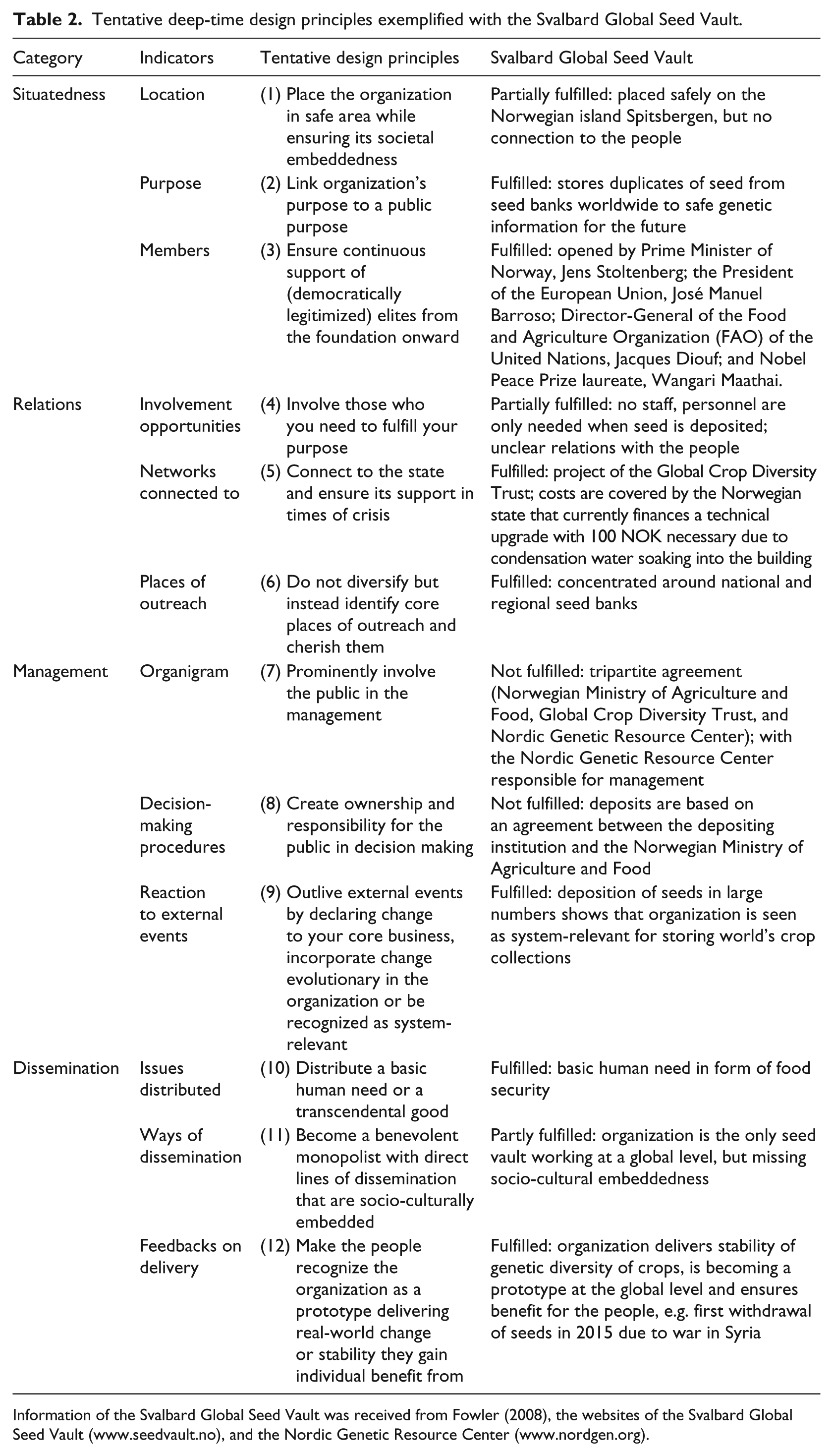
In this study, we investigate historical organizations that are the oldest in their field in order to identify patterns of great organizational longevity. Guided by the virtue of reflexivity (Beck et al., 1994; Pickering, 2019), these patterns need to be aligned with the three functions of deep-time organizations that we derived in the introduction: keeping objects safe, keeping populations alive, and enabling novel relations between humans and the planet in a democratic manner. This results in the 12 design principles summarized in Table 2, which lay the foundation for subsequent research and may guide, in principle, the creation and evaluation of deep-time organizations.
Tentative deep-time design principles exemplified with the Svalbard Global Seed Vault.
Information of the Svalbard Global Seed Vault was received from Fowler (2008), the websites of the Svalbard Global Seed Vault (www.seedvault.no), and the Nordic Genetic Resource Center (www.nordgen.org).
While nine of these patterns are directly translatable into design principles, three patterns require major adjustments.
First, pattern 1 relates organizational longevity to geographical locations where no major disruptions occurred. It is mostly based on observations from historical organizations located on an imperialistic island nation without any foreign occupation. This connection, however, must be disengaged as it violates the functions of deep-time organizations that we identified, notably: it disables self-development due to non-democratic governance. This is why we reformulate the design principle as “place the organization in a safe area while ensuring its societal embeddedness.”
Second, in the context of pattern 7, we have shown that great organizational longevity often correlates with strict hierarchy based on either religion or family bonds. Again, this is incompatible with a world where planetary health and democracy need to reinforce each other (Biermann, 2014; Dryzek and Pickering, 2019; Eckersley, 2019; Hanusch, 2018). Therefore, we translated the alternative pattern, also leading to longevity, into the design principle “prominently involve the public in the management.”
Third, corresponding decision-making procedures in hierarchic organizations of great longevity are guided by timeless, often inhuman and undemocratic, standards of behavior. Therefore, we translate the alternative pattern that we observed into the novel design principle “create ownership and responsibility for the public in decision making.” In other words: it is neither feasible nor desirable to structure deep-time organizations in the Anthropocene—such as for the storage of carbon or genetic information—like the Japanese imperial house or the Catholic Church.
Considering these limitations, however, the tentative design principles compile a checklist on how to build or evaluate a deep-time organization. We now illustrate this checklist with the case of the Svalbard Global Seed Vault (see Table 2). The Svalbard Global Seed Vault (2019) is one of the rare existing organizations that explicitly strives for deep-time planetary stewardship by securing the world’s genetic diversity of crops in providing “facilities for the safe deposit of seeds samples that have distinct genetic resources of importance for food security and sustainable agriculture.” It is, in a way, a back-up for national and regional seed banks and thus a fail-safe for future generations. In principle, the Seed Vault is meant to function for centuries, if not for ever.
The checklist functions as a prototype to assess the deep-time potential of an organization, aiming to serve as a starting point for large numbers of evaluations. For the purpose of this scoping study, we apply a simple “fulfilled—partially fulfilled—not fulfilled” scheme. As a result, we find in case of the Svalbard Global Seed Vault evidence that it performs in line with at least 7 of our 12 tentative design principles.
The major obstacle is its relation to the people, particular in the management and its location. It is largely unclear how the Svalbard Global Seed Vault is culturally embedded in a way that future generations will know in which societies which crops were developed and successfully planted, which would connect crops to its socio-environmental settings. Moreover, the organigram and decision-making procedures are not in line with our design principles, because the public is involved in the management only indirectly through some public organizations but not through elected officials or global civil society representatives that take part in decision making. In terms of building deep-time organizations democratically, the Svalbard Global Seed Vault may hence consider readjusting these two components toward a more democratic structure that would involve the public and create ownership and responsibility for it in decision making. This could involve the appointment of trustees that link such deep-time organizations with functional heads of major societal and political organizations with long-term orientation, such as supreme court judges, senior parliamentarians, university presidents, local leaders, heads of scientific academies, and so on.
In addition to these design principles, we perceive two further implications. A first implication follows from our overall analysis and relates to the role of our scoping study of deep-time organizations within broader multi-level governance architectures (Biermann and Kim, 2020). Throughout history, humans created organizations for their survival and ever new challenges: at the beginning, focused on basic human needs like food and shelter at a local level, then for settlements and its interaction at a regional level, during the industrial revolution at national level, followed by the rise of international organizations to enable the exchange of nation-states at a global level, while in the last decades, the rise of a largely network-based world society corresponds with the rise of transnational organizations (Battersby, 2017; Shinohara, 2016). In other words, novel organizations emerged with increasing societal complexity. And yet, the end of spatial differentiation seems to be reached as organizations exits at and across all levels. As a consequence, deep-time organizations now correspond to a next stage of societal complexity, pointing beyond the multi-level toward a new dimension of multi-temporal governance architectures. Deep-time organizations open this dimension with a focus on the long-term, even though other temporalities await governance as well, such as the (de)synchronization of natural and societal rhythms or the treatment of temporal violence across generations. The implications of the Anthropocene hence spawn a set of challenges that may cause governance systems to fail unless they are transformed (Biermann et al., 2012; Burch et al., 2019; Chakrabarty, 2018; Fukuyama, 2014; Patterson et al., 2017).
The second implication calls for a revision of concepts that deal with organizational survival in order to explain longevity over very long time frames. This is due to the fact that most of these concepts have emerged in a different epoch of world affairs. Some are too restricted for the range of challenges that might occur in time frames of centuries or millennia, such as resilience, which focuses primarily on external threats, or too assumptive, relying too much on contextual conditions of the 20th century (see, for example, Battersby, 2017; Beunen and Patterson 2019; Davoudi et al., 2013). The challenges of the Anthropocene require not only novel organizations but also other concepts than those that engendered the Anthropocene (Dryzek, 2016; Lövbrand et al., 2015).
This scoping study builds the basis for future research on deep-time organizations in at least four directions.
First, more reflexive research needs to consider in more depth what kind of deep-time organizations we actually want to create. Drawing on historical examples of century-old family succession (as in the case of not only monarchies but also family business like Kongō Gumi) and long-standing exclusion based on class (like with the Marylebone Cricket Club) or gender (like with the Catholic Church) is, of course, in conflict with the proposition of planetary health; this is why we had to adjust certain observed patterns in different design principles that are better in line with democratic requirements. What other types of structural affiliation of deep-time organizations with national and international political systems are conceivable for the democratic societies of the 21st century? What should be the normative basis guiding the creation of positive social imaginaries of deep-time organizations in accordance with the circumstances of the Anthropocene? How can we ensure that future generations are free to reinvent themselves and deep-time organizations according to future circumstances, while guaranteeing the needed stability of organizational structures?
Second, the empirical basis of research on historical organizations has to be extended. Additional studies are needed to analyze larger datasets of organizations with great longevity and to see whether the indicative results of our scoping study hold. In particular, such larger datasets may include non-formalized institutions that do not keep written records, such as century-long continued practices in the context of sacred groves or land shrines in Africa and the Americas, and contrasting comparisons with collapsed organizations, such as unsuccessful competitors.
Third, the design principles can be used to evaluate further existing organizations striving to address deep-time challenges. This includes organizations similar to the Svalbard Global Seed Vault as one of the rare existing organizations that explicitly strives for deep-time planetary stewardship. Also, it requires further analysis to explore what we can learn from recently established or potential deep-time organizations in-the-making, such as in context of carbon sequestration and storage. How can practices of societal relations with deep time be transferred to other socio-ecological settings and organizations? How can urgently needed deep-time organizations be set up in a democratic manner in time?
Fourth and last, even regarding issues where we did not observe a clear pattern in the historical organizations that we studied, will this not rule out other design principles for future organizations? New patterns can emerge, necessitating “possibilistic” ways of thinking (Lepenies, 2008). To give an example, many advocates calling for recognition of deep-time interdependencies in the web of interconnections between humans and non-human-nature are nowadays grassroots movements (Smith et al., 2016). Against our findings that often correlated organizational longevity with links to national state-based elites, these new developments may suggest novel options of setting up deep-time organizations without such elites being involved. This line of future-oriented research needs to develop the idea of how to think of prospective deep-time organizations. It needs to do so carefully, defending the right to a non-projected future as an inalienable right, meaning that even deep-time organizations need to be open to be re-designed by future generations. In form of thought experiments, the historically derived, translated, and applied design principles can be used to sketch out how such an organization might be thought of.
Conclusion
The notion of the Anthropocene overthrows conventional propositions of human-planetary relations. In particular, it brings the deep-time interrelations of humans with the earth system to the forefront. And yet, humankind just starts to develop research and organizational capacities to deal with this novel condition.
This scoping study aimed to better understand great organizational longevity of organizations in order to help with establishing deep-time organizations for earth system governance. We found 12 patterns that correlate with great longevity of organizations, and translated these into tentative design principles for the establishment of deep-time organizations in the Anthropocene, with an illustration of the Svalbard Global Seed Vault. The design principles that we identified, and as refined and adjusted, could build the basis for the establishment of novel deep-time organizations that might need have to last over very long time frames to tackle deep-time challenges, such as the management of final depositories for nuclear waste, regulating space mining, maintaining biodiversity, or storing carbon. Even though the insights of this study are based on a pioneering historical analysis that requires further refinement in subsequent research, the formulated design principles seem to indicate a revision of concepts aiming to explain organizational survival, such as adaptability, to illuminate longevity over centuries and millennia.
Taking a look at the broader context of this study, it is evident that societies have reached a new stage of complexity. After having differentiated within the dimension of space across multi-level governance architectures, we now enter the dimension of time, which requires novel multi-temporal governance mechanisms and institutions. The foundations of this novel type of planetary thinking have yet to be elaborated with a democratic stance, as the Anthropocene “confronts the political with forces and events that have the capacity to undo the political” (Clark, 2014: 27–28; Clark and Szerszynski, 2020).
Making the implicit but always existing temporal dimension of long-term earth system governance explicit, is a new endeavor. This article aimed to serve as a starting point to enter this exciting new research area by exploring deep-time organizations as a new field of study.
Footnotes
Declaration of conflicting interests
The author(s) declared no potential conflicts of interest with respect to the research, authorship, and/or publication of this article.
Funding
The author(s) received no financial support for the research, authorship, and/or publication of this article.
