



Abstract
Global Environmental Governance (GEG) has been a growing phenomenon since the middle of the 20th century, although the concept itself and its acronym are more recent and were in fact rarely used before 2000. The early interest in GEG was much preoccupied with environmental diplomacy and international legal agreements from the Stockholm UN conference 1972 onwards. The addition of the ‘global’ reflected the general rise in awareness of the significance of globalization since the 1980s. The further growth, and the transformation of GEG, in earnest since the Millennium has been increasingly marked by yet another category, ‘the planetary’, mirroring the increasing influence of Earth System Science on environmental and climate discourse. This has affected both GEG and ‘the environment’ itself. The conceptual shifts, including the rising interest in the Anthropocene, reflected profound changes in the human-Earth relationship. To analyze these shifts, which is the aim of this paper, I will use the ‘Planetary Boundaries’-concept, launched in a highly cited paper in the journal Nature in 2009 and further developed in later publications, seminally in 2015 and 2023. I will consider the PB-concept, and versions of the often shown diagram that accompanied it, as both a case of ‘planetary modelling’ and, at the same time an ‘environing technology’ that is performative and shapes what the environment ‘is’ while modelling it. I also emphasize that the PB-model has led a ‘social life’, which has defined its continued evolution as a key agency in the formation of an Anthropocene Weltanschauung, with normative properties. I posit that the model helped shape the shift towards the epistemic and temporal ‘environment’ that has become mainstreamed in the UN Sustainable Development Goals and other goal setting projects.
Keywords
Global environmental governance became known under this name from around the year 2000. Sometimes the abbreviation GEG is used, and I will use GEG for convenience in this article. The vision GEG represents is older though. It represented an idea of a world that can act in unison and peacefully, with appropriate institutional means, to protect the environment and manage natural resources wisely and fairly. This vision emerged gradually alongside the rise of the modern understanding of ‘the environment’ in the immediate post-WWII years (Warde et al., 2018). Those with an early interest in GEG were preoccupied with environmental diplomacy and international agreements, especially from the Stockholm UN conference on the global environment 1972 onwards (Selcer, 2018). Inclusion of the ‘global’ reflected the ever-growing awareness of interdependencies, spurred by the wide acknowledgement of a rising ‘globalization’ since the 1980s. Further growth, and the transformation of GEG since the Millennium has been increasingly marked by yet another category, ‘the planetary’, mirroring the increasing influence of Earth System Science, including the rapidly growing role of climate change as a policy issue. This influence has affected the understanding of not just environmental governance, but also ‘the environment’ and GEG.
These conceptual shifts summarized wide and profound changes in the human-Earth relationship. To analyze them, and bring out some of the tendencies both of environmental governance and planetary modeling I will use the concept of ‘Planetary Boundaries’ (PB for short). Stemming from scholarly and policy networks linked to a large extent to Stockholm, it was launched in a multi-authored article in the journal Nature in 2009. The PB-concept has circulated widely and has had an unusual impact, at least in its first two main incarnations (Rockström et al., 2009, Steffen et al., 2015a), both scientifically and as evidenced by citation numbers and in policy (Chawla, 2024). The core tenet of the concept is that planetary stability requires the planet, as understood by Earth System Science (ESS), to stay within nine scientifically defined ‘guardrails’ based on their Holocene range. PB is thus not simply a hypothesis, or a theory, let alone a fact. Rather it is a comprehensive idea based on masses of scientific information assembled into what is often presented as a ‘framework’ designed for a particular style of thinking about Earth and environmental governance drawing on advances in ESS.
The often circulated and very important illustration of PB-thought that accompanied PB from the very outset was a diagram, showing the nine PB-dimensions, today termed: Stratospheric ozone depletion, Loss of biosphere integrity, Chemical pollution and the release of novel entities, Climate Change, Ocean acidification, Freshwater consumption and the global hydrological cycle, Land system change, Nitrogen and phosphorus flows to the biosphere and oceans, and Atmospheric aerosol loading. It is, modestly, called a diagram but in essence and in practice over time it has come to serve as a model of the planetary human-Earth relationship as seen with an ESS-lens. It thus belongs in a wider set of what we might call Anthropocene visuals – such as the equally iconic Great Acceleration hockey stick curves (Steffen et al. 2004: 132-3) – which synthesize and present complex information about the entangled relationship between ‘humanity’ as an acting entity and the planet as a system, or perhaps more precisely a system of systems, where societies are integrated causing accelerating resource use and undesired environmental impacts especially since the mid-twentieth century.
Although perhaps not a model in the conventional sense, in this article I will discuss PB and the PB-diagram as a model in the sense of a systematic and stylized representation of reality with interrelated parts, importantly used not only for scientific but also for policy purposes. I will also argue that PB, not least through its model character has performative qualities, suggesting that its design and in-built assumptions and ideas help enact the phenomenon it purports to analyze and propose measures to change in order maintain a desirable state of the Earth, or rather the human-Earth relationship. To do this, I suggest it is useful to consider PB as an environing technology, a device, material or conceptual, that defines dimensions of reality into ‘environment’ and thus makes it attainable for policy (Sörlin and Wormbs, 2018). I posit here that the PB-concept helped bring about the shift towards an epistemic and temporal ‘environment’ that has become mainstreamed as part of the 17 UN Sustainable Development Goals and other similar, often quantified global goal setting projects. An achievement, but as the Agenda 2030 decade is now past midway and these schemes are being evaluated, it is increasingly doubtful how effective they are. While work is ongoing to reach goals, the critique is comprehensive (Arora-Jonsson, 2023). As critics have pointed out, while well meaning such schemes tend to “embody a technocratic impulse” that subjects the planet to expert management without addressing deeper “political-economic roots of the Earth system crisis” (Albert, 2020).
After initial comparisons with earlier limits approaches, I will elaborate on the pre-history and the, by now, long career of PB, and how the concept can be usefully located among epistemic and ideological controversies of contemporary environmental and science history. I will argue that PB paper grew into, and in some sense was from its outset, a modeling project, indicated by the word ‘planetary’. It rested on planetary modelling and thus moved ‘environing’ to the planetary scale. Somewhat oxymoronic expressions such as ‘global’ or ‘world’ environment had been around for many decades, but PB, using ESS as its predominant epistemic foundation, pushed the policy relevance to the planetary level and could thus reintroduce the concept of limits in ways that avoided mistakes made in the limits to growth-debates of the 1970s. ESS was and has remained central to the PB-project and the scale of that frame of thought was planetary, rather than ‘environmental’ in the local sense. In reality, ESS thought aspired to re-theorize the entire sustainability discourse and subsume it under a common pattern of inquiry and practice, an aspiration that has had significant impact over the last quarter-century.
Another point I want to make is to expand the understanding of ‘models’. I will talk about conceptual models as entities that are not just stylized representations of a reality or a theory, often summarized in a visual representation (Gramelsberger et al., 2020). Instead, I will think about them as owning a social life. I borrow this expression from work in anthropology on the local use and adaptation, or micro-reception, of climate change models (Hastrup and Skrydstrup, 2013). Here I will apply the idea of a social life somewhat more widely and consider the social transformation of a planetary model as it travels through time and interacts with multiple forms of social agency and adapts to real world changes, normative and scientific debates, and of course new knowledge. In particular, when we consider the relationship between immensely complex aggregates such as the ‘human-Earth relationship’. I propose there is much to gain from thinking about both the model itself and its societal evolution over time. Even in its wider circulation, among non-modelers, it remains a model and retains its workings in the world.
My line of argument is about planetary modelling, or modelling of the planetary, as a social activity practiced in loosely organized meeting and documenting formats. Empirically, I suggest that planetary modelling of the human-Earth relationship so far has been innately interdisciplinary and engaged multiple strands of expertise, which coalesce into epistemic communities sharing patterns of thought (Haas, 1992; Haas and Stevens, 2011). The scientific modelling work at the core of the PB framework is essentially an attempt to present and understand interactions across time and space of societies and ‘the planet’ and its systems on multiple scales. In that sense, PB can be described as a model of models, or a kind of meta-model. The epistemic communities that have engaged in this modelling work are also loosely organized in ways similar to those that Ludwik Fleck presented in his idea of the Denkkollektiv, the social and collective contextualization of individual facts into a more comprehensive meaning making and understanding (Fleck, 1935; Trenn et al., 1979). Although planetary modelling is a form of knowledge production that has played out in a more multi-centred way than Fleck imagined, and in larger and more amorphous social forms than the stylized scientific group he studied. Planetary modelling has not taken place in a theoretical and conceptual ‘research school’ (Geison and Holmes, 1993; Servos, 1993). According to Jack Morrell’s classic definition, research schools tend to be exclusive and to hone in on a particular issue, typically with a strong method, perspective or theory and preferably in an emerging field and with easy at hand publishing outlets, for example their own journal. They will also possess a charismatic leader, receive good institutional support and funding, have trusting disciples among junior scientists who adopt the leader’s research style and direction and cooperate in sometimes hard competition with rival understandings of a shared issue or problem (Morrell, 1972). Clearly, there is a social life to the research school as well but the size of the school is typically modest and it requires a strong sense of a set of core truths and values and a loyalty to these among the school’s members.
Models and theories in the research school thus typically work through demarcation and differentiation. The history of ESS, and its predecessors over the last century, are overall very different. Since Vladimir Vernadsky’s pioneering work in biogeochemistry in the 1920s, it has been an evolving and meandering form of knowledge. Vernadsky eclectically borrowed and integrated knowledge from a range of fields as well as from the social and human sciences, including historical work, and linked the anthropos seamlessly with the planetary scale, paving the way for the recent, profoundly interdisciplinary field of geo-anthropology (Rispoli, 2022: 19–22). From the 1970s onward, ESS has increasingly come together as an established and unifying research field (Gramelsberger et al., 2020; Steffen et al., 2020). Through assemblage and aggregation, involving a constantly growing and self-rejuvenating community of scientists and scholars willing to participate in the project, ESS had by the first 2 decades of the 21st century, reached Weltanschauung proportions (Warde et al., 2018: 151–170, on 159, 166). Perhaps more importantly, this understanding has also had an increasing influence on environmental and climate related issues, in particular on the planetary scale, but with implications for regional, national and local scales. One that, in addition, claims to provide some kind of steering of the human enterprise so as to make it more viable for the long-term wellbeing of both societies and of the planet itself.
In that sense, Earth System modelling in its PB-incarnation could indeed be seen as one of the more ambitious efforts to actually help forging a Global Environmental Governance (GEG). Despite hopes and promises ever since the 1972 Stockholm UN conference, GEG has in reality had limited institutional power and never really coalesced into a comprehensive, let alone central authority (Sörlin et al., in press). The question could therefore be asked: Can GEG be seen as a potential diplomatic and a political derivative of modelling? Or, more succinctly: Does success in governing the environment begin with modelling it? (Wickberg et al., 2024). Might it be productive to frame GEG discourse and history according to such an understanding? Work in this direction has already been ongoing for some time, under labels such as ‘Earth System governance’ and, more recently, ‘Anthropocene governance’ (Biermann et al., 2009; Biermann et al., 2012; Pattberg and Zelli, 2016), now also with its own journal, Earth System Governance (since 2019). 1 These questions evoke curiosity precisely about the social life of models. As models meander and travel in epistemic and social processes, they often take on narrative features, some of which might have been there from the outset, for example, the doom or salvation stories that seem omnipresent. Can models evolve further? Could they integrate well-being, health and equity dimensions and thus get further impetus as part of real, concrete social and political processes? Can they bridge across from pure data to advocacy and directional agency in an encounter between hard science models and knowledge derived from the humanities and social sciences, as several scholars have advocated over the past decade (e.g. Hulme, 2015)? The evolution of PB can shed some light on these questions.
Planetary boundaries in its third decade
In late May 2023, an interdisciplinary team of researchers were assembled at the Royal Swedish Academy of Sciences in Stockholm to present results from a project on how to insert safety and equity as relevant and quantified PB dimensions. A simultaneously issued publication described the initiative thus: ‘Our proposed ESBs are based on existing scholarship, expert judgement and widely shared norms, such as Agenda 2030’. The Earth System Boundaries (ESB) that Rockström referred to are Climate, Biosphere, Water, Nutrient cycles (fertilizers), and Aerosol cycles, all derived from but not identical with the nine Planetary Boundaries. Considering the criteria of safety and equity in the new model, Johan Rockström and several co-authors explained, required setting the ESBs more stringently, since certain populations would suffer from loss of either equity or safety, or both well before critical global ESBs are reached (Rockström et al., 2023: 103).
This was not an obvious outcome of the PB-modelling history when it started in the first decade of this century. The first PB article, published in 2009 had nothing of this sort. ‘PB 2.0’, as it was being called, published in Science in 2015 had already articulated an understanding of the importance of equity, societal distribution of wealth and burdens, and historical responsibilities. Now, in PB/ESB 3.0 in 2023, there is a quantified articulation of safety and justice and a framing of these value based categories as relevant for governing and assessing the human enterprise on the planet. This recent iteration of the PB framework is interesting for at least two reasons. The first is that what was originally presented as a version of ‘planetary modelling’, empirically anchored albeit quite abstract, has in less than 20 years transformed into a wider socio-environmental narrative and proposed pathways for progressive governance of the human-Earth relationship, or the dimensions of this relationship that are linked to the Earth System. The second reason is that in now taking value-based categories seriously, it is perhaps possible to conceive of Earth System Governance as still, despite much headwind, capable of attracting thoughts and ideas that may prove useful for framing and directing badly needed societal transformation according to the promises of Agenda 2030 global ethics and commitments (Figures 1 and 2).
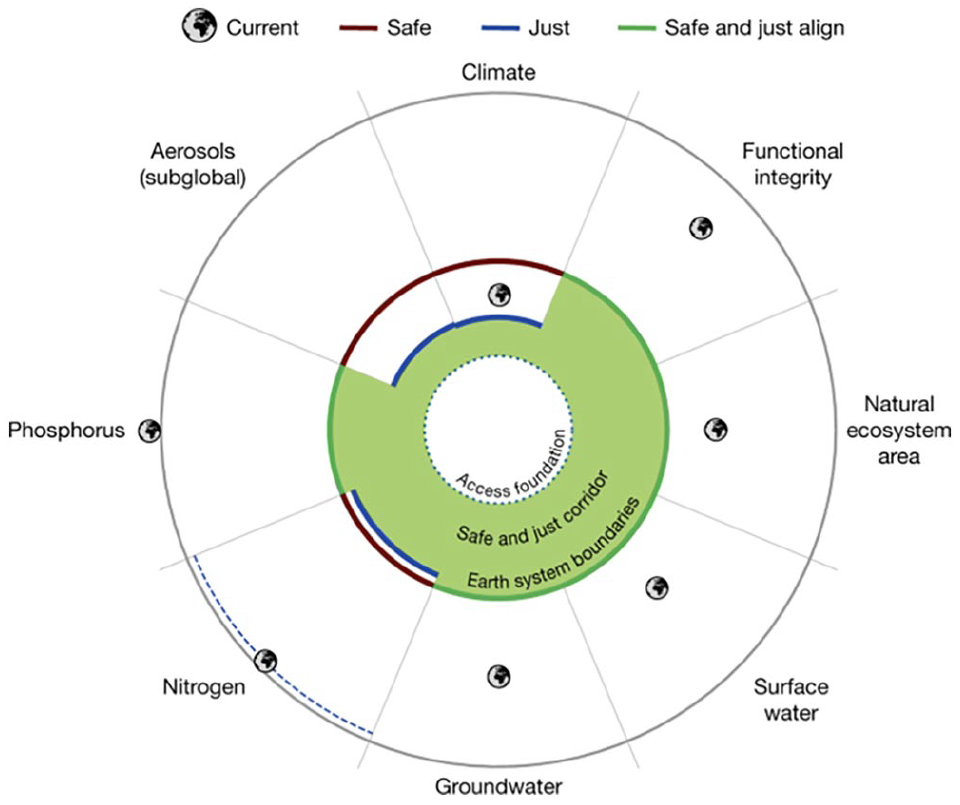
Earth System boundaries.
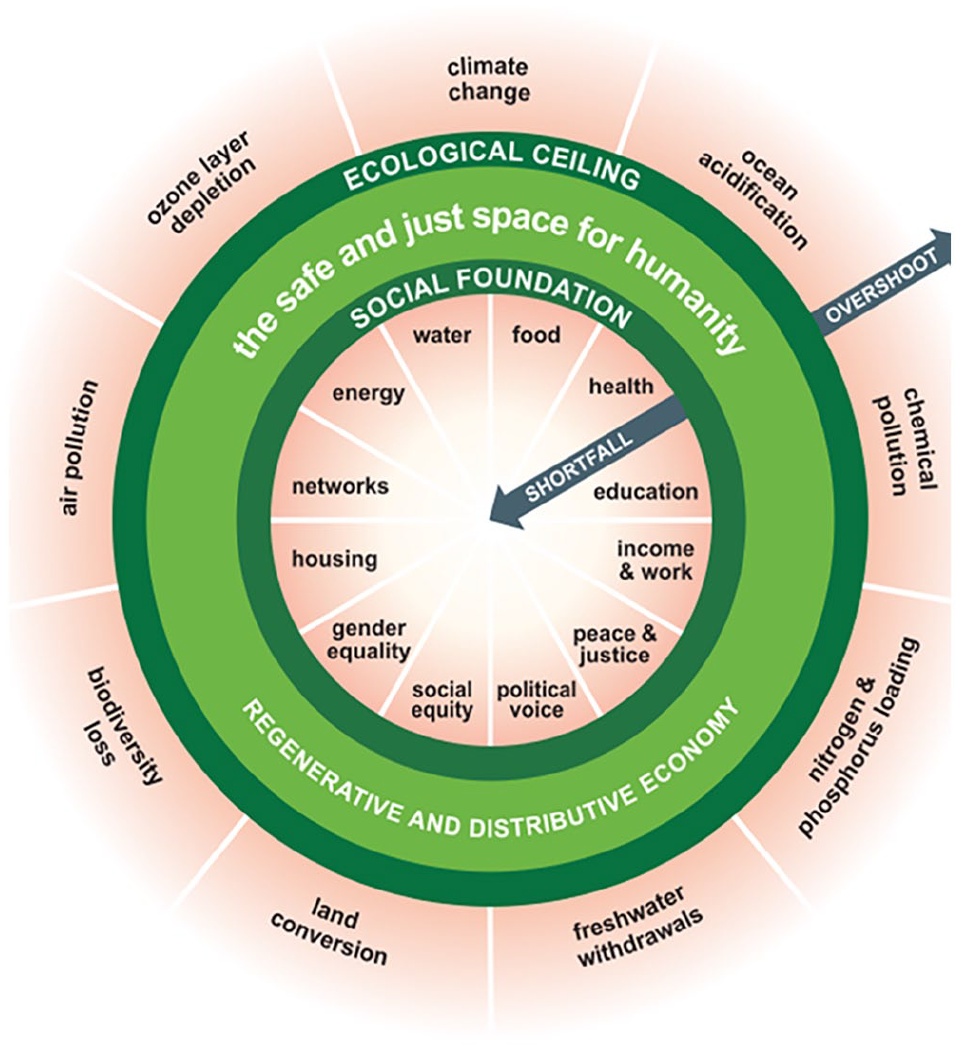
Economist Kate Rowarth’s doughnut metaphor from 2012, building on ideas of bounding developed by Barbara Ward in the 1960s and 1970s.
The kind of planetary modelling that became PB- and EBS frameworks in the 21st century came out of aggregation of new elements in a social process, which remains to be untangled. Part of it was an outcome of an older history of quantification related to the understanding of time and rates of anthropogenic environmental change. This notion of a dynamic human species transforming nature has deep roots. Clarence Glacken eminently demonstrated its trajectory since Antiquity in the Western World in his classic Traces on the Rhodian Shore (Glacken, 1967). Less remembered is it that at a milestone conference on human agency held in Princeton in 1955, Glacken presented the Anthropocene idea, albeit in a slightly different phrasing, and its conceptual history, and reminded the 70 participants that already in the early 20th century ‘several geologists were calling man the dominant geological force of the planet’ (Glacken, 1956: 86). Some participants equally emphasized the strong human impact on what in the title of the conference was called ‘the face of the earth’, indicating that the deeper systemic understanding was not yet established. Others, however, downplayed man’s potential as an agent on the planetary scale. WMOs first president C. Warren Thornthwaite said humans might be able to change the face of the earth, but not change climate (Thornthwaite, 1956).
Clearly, matters were unresolved, but some framing thoughts were in circulation. What was missing was a decisive and quantitative link between the speed and magnitude of the anthropogenic forces and the consequences of it on scales that were relevant. This avenue opened through the concept of ‘environment’ in the decades immediately following World War II, what Glacken, again with remarkable Anthropocene foresight, termed ‘the Malthusian shadow’ over the 20th century (Romero and Watts, 2017). Long before ESS was a self-acknowledged activity, the framing of the environment had already added a temporal dimension. It had been informed by a rising corpus of models, such as Alfred J. Lotka’s on predator-prey population dynamics in the 1920s, and ecological models of lakes, grasslands, and forests that were clearly environmental in their implications, but did typically not before mid-century appear by that name (Warde and Sörlin, 2015).
The articulation of ‘the environment’ as a relevant category of analysis led to a phenomenal rise of interest in understanding effects in ecosystems, water, ice, snow, forests, wetlands, species populations, air quality, natural resources, and public health, all of which were proven to be affected by anthropogenic forces. In due course, this included global temperature and climate, and the list has just grown and grown. Changes were predominantly going in the wrong direction, undermining ecosystems, wasting resources, overusing fish stocks, and eroding soils. The environment became a ‘problem’, even a range of problems that were connected by their anthropogenic roots (Warde et al., 2018). This new ‘environment’ required construction before it could be understood as such and before an environmental framing could be put on so diverse phenomena. Environing technologies (Sörlin and Wormbs, 2018) facilitated this transition. They worked most efficiently when they could combine conceptual framings of new issue areas, such as pollution, resource scarcity, or climate change, with solid empirical monitoring and functional models that could reduce complexity and present credible causal relationships between human/societal agency and environmental impacts.
The rise of ‘environmental expertise’ meant in earnest the appearance of aggregated strata of scientific specialists. They came from different disciplinary backgrounds and concentrated their efforts on understanding such, largely negative, effects of human action. Much of this process took place from the 1920s through to the 1980s when this new understanding was generally acknowledged for many environmental and governable objects (Aronowsky, 2018; Höglund Hellgren, 2022). Most of these objects had been literally ‘produced’ in the course of that past half century, step by step drawn in under one or the other environmental governance frame: carbon, methane, fluorides, phosphorus, nitrogen. Each linked to one or the other of the earthly spheres – atmosphere, hydrosphere, lithosphere, cryosphere, biosphere, held together by the technosphere (Haff, 2014), in a very ESS and Anthropocene style integration of the elements under growing human agency.
The planetary model was born out of ‘the environment’
Still, there was no overarching model. ‘The environment’ as a concept and a buzzword had a truly integrating effect on the conversation and on the organization of knowledge, legislation, politics, and other dimensions of society. Data driven quantification on large scales had also begun, with the International Geophysical Year 1957/58 as a launching pad for a new era with satellites, distributed data sensors, real time computerized data management and worldwide collaborations (Goossen, 2020; Whitmarsh, 2023). Systematized approaches to the environment and society started to appear in large numbers, and systems analysis using computing power was applied on an ever-growing number of governable objects, with energy as a key exemplar (Turnbull, 2023). Rates of change over time across a wide range of linked social and natural parameters had started to play a major role (Sörlin, 2022).
Cold War strategic ambitions directed much of the work and certainly funded it. Nonetheless, an inadvertent outcome of the research was the gradual realization that the human-earth relationship was dynamic, co-evolving and environmental although often destructively so (Doel, 2003; Hamblin, 2013). It is essential to see these contextual and infrastructural (the technology was rare and costly) conditions for the formulation and promotion of Planetary Boundaries, and also the Anthropocene idea. Only then could they coalesce and take the major step out of the cognitive frame where Glacken was able to put it already half a century before Nobel Prize-winning atmopsheric chemist Paul Crutzen first uttered the A-word in 2000.
The dynamic immensity of the terraforming anthropogenic forces soon became apparent and impulses from the Earth and atmospheric sciences are part of the standard narrative of the evolution of PB. The new knowledge required a temporal framing, just as the Planetary Boundaries model did. The entire idea would be meaningless unless there was a time factor involved. It was, after all, when rates of change became very fast, spurred by the fossil-agro-industrial Juggernaut that the boundaries could be transgressed. Just as Alfred W. Crosby, the environmental historian, whose Harvard dissertation work in the 1950s had been on the Baltic hemp trade (Crosby, 1965), suggested in his influential book Ecological Imperialism (1986). Crosby showed that the expansion of Europe over the course of a millennium from 900 to 1900 entangled the ‘new Europes’ worldwide within a biological web of plants, animals, epidemic diseases, and the gene pool of the Old World. Similar transplantations had happened before, not least when early humans made their exodus out of Africa and spread across the world in a process that took hundreds of thousands of years. Now it accelerated fantastically, spurred, Crosby argued, by evolutionary and epidemiological benefits that the Old World populations and biota had gained from higher population densities. In addition to their technology, science, capitalist ruthlessness, and ideas of racial supremacy with slavery authorized by the church, as Eric Williams observed a century ago in his classic Capitalism and Slavery (1944/2022).
The Columbian exchange (Crosby, 1972) is a perfect name for these global processes, but not entirely correct. They had started long before Columbus and would of course continue after him. Crosby’s socio-biological diffusion theory was clearly a model of Early Modern globalization and of European expansion and power making. It would be to stretch it, though to call it ‘planetary’. Others, close to the Anthropocene core, built on Crosby and other big-thinking historians of the Early Modern world (e.g. Diamond, 1997; Mann, 2011; Pomeranz, 2000; Wallerstein, 1974). Notably so, Simon L. Lewis and Mark A. Maslin in their ‘Orbis hypothesis’, using the Latin word for ‘world’, Orbis, because it marks the first time planet inhabitants intermingled so dramatically. A global Holocene low of atmospheric CO2 was reached in 1610, after dropping 10 ppm in a mere century as a result of people dying in smallpox, measles –virgin soil epidemics – and through colonial war, aggression and neglect. Especially in the Americas, forests were regaining land post-1492 (Lewis and Maslin, 2015, 2018; a response in Zalasiewicz et al., 2015). From this line of work, here only hinted at, we may conclude that there is a deeper ‘planetary’ with a long and violent history, which also built on models and expectations of how the world worked and how peoples, cultures, and natural resources fitted into it, and strands of such historically-minded ESS are currently retrieved and utilized to put together a wider Anthropocene history.
A new step for modelling planetary scale agency
Historical understanding of the deep entanglement of human societies with continent-sized, indeed global biological realities was thus not new when the Earth System science community began to engage with interactions on the planetary scale. Developments in ESS at the turn of the millennium still represented a significant step forward. They were interdisciplinary, allowing for a wider analysis. Global comparisons were systematic, with more researchers engaged and with a greater scientific capacity. They were quantified and presented in a fashion that allowed comparison. They also universalized and generalized historical change, to a scale that was more compatible with the outlook of the ESS community. That community further exposed the deep human-earth entanglement, using a wider range of methodologies, expanding the stratigraphic ones that turned out essential in the quest to establish the Anthropocene as a geological epoch. In the last instance, this made it possible to visualize environmental and climate change in graphic representations.
This process was further assisted by the increasing interest among small groups of historians to write history along much bigger timescales than before. Several books were published in the first years of the new century that located human history on a planetary, if not astronomical, timescale identifying connections across thousands and hundreds of thousands of years. Some had the words ‘big history’ in their titles, some linked to astronomy, others to neuroscience or genetics. The interest coincided with new kinds of historiography inspired by Anthropocene thought and a search, which has since then expanded, for synchronization of temporal scales, both natural and historical (Alvarez, 2018; Christian, 2004; Latour, 2017; Smail and Shryock, 2011). These kinds of material histories of Earth System timescales circulated among the ESS community and were cited in their work. Discussions took place, for example, in a research network called IHOPE, Integrated History and Future of People on Earth, which linked to the global programs. An important conference was held in Dahlem, Berlin, in 2005 (Costanza et al., 2007) . Their wide-ranging results were published in academic journals, typically less in history than in outlets oriented towards ESS- and global change research (Cornell et al., 2010; Costanza et al., 2012; Van der Leeuw et al., 2011). This trend has developed into new strands of rich and nuanced ‘Anthropocene history’ as it is sometimes now called (e.g. Chakrabarty, 2021; Thomas, 2022; Westermann and Höhler, 2020).
Such was the situation among the Earth System sciences in the early years of the 2010s: a rapidly progressing discussion reaching across many disciplinary domains to establish the scale and impacts of the human dimensions of the human-earth relationship. Seen in this way, it was perhaps not far-fetched to think that the dimensions of impact that the previous evolution of Anthropocene knowledge suggested could be turned into a set of quantifiable Earth System indicators, which are essentially what the PB are, including the potential to become policy objects. The term used in the text of the 2009 PB article is ‘guardrails’, while in the title these are described, perhaps more evocatively, as delimiting the “safe operating space for humanity” (Rockström et al., 2009).
The quantified boundaries represented a ‘space’ within which ‘humanity’ could ‘operate’ without risking to ‘tip’ ‘the Earth’ out of its ‘Holocene state’. The latter was presented as a state of stability, in which humans had been able to thrive and evolve into complex modern societies. So, progress was defined as being related to Earth System stability rather than to other factors usually presented by archaeologists, anthropologists and historians. This in some sense linked back to 19th- and early 20th-century theories of geographical and climatic explanation, sometimes called ‘determinist’ that had become less common after World War II. In retrospect, it may seem easy to explain, but before it had taken place it was not obvious. The choice of a vague Holocene stability as a boundary criterion, rather than precise calculations of risk, human lives lost, or other standard indicators may in fact have made PB more explainable, palatable, and more ‘scientific’ than ‘human’. However also prone to a lingering and more sophisticated historical and epistemic critique from the humanities and social sciences (Coen and Albritton Jonsson, 2022).
In the course of the 2010s, the PB model both coalesced and expanded into a more comprehensive narrative. On January 15, 2015 the second major PB paper was published in Science and launched at the World Economic Forum in Davos, in a conscious attempt to make use of the WEF’s growing ‘discursive power’ but at the same time acquiring some of its vagueness of ‘accountability’ (McNeill, 2023). There was by then an established discussion around what had been a persistent critique of the original PB-concept, namely that it was passing over the issue of who was responsible for endangering the planet through emissions and overconsumption. This section of the Science paper got its own distinct rubric: ‘Planetary Boundaries in a Societal Context’. It opened with admitting the lack of ambition on this score in the 2009 PB paper in Nature: The current levels of the boundary processes, and the transgressions of boundaries that have already occurred, are unevenly caused by different human societies and different social groups. The wealth benefits that these transgressions have brought are also unevenly distributed socially and geographically. It is easy to foresee that uneven distribution of causation and benefits will continue, and these differentials must surely be addressed for a Holocene-like Earth-system state to be successfully legitimated and maintained (Steffen et al., 2015a).
The section had several references to literature in the humanities and social sciences from which much of this strand of the critique came (Castree et al., 2014; Heise, 2008; Masco, 2010; Pálsson et al., 2013; Robin et al., 2013). But just as important is to observe how a set of auxiliary statements were now increasingly made in the PB community, constructing a narrative arc that started to transform premises of planetary modelling itself. A further push in the same direction was offered, with more than chance synchronicity, as an update of the Global Acceleration charts, originally from an IGBP publication in 2004, was released on the following day, January 16, 2015 in The Anthropocene Review (Steffen et al., 2015b). Only a few years later, in the same journal, some of the core names in the ESS community made more far reaching statements about the need to widen the scope of forces at play and include social and cultural dimensions in their modelling. The Anthropocene qualitatively differs from previous eras in Earth’s history in three key characteristics: (1) There is planetary-scale human agency. (2) There are social and economic networks of teleconnections spanning the globe. (3) It is dominated by planetary-scale social-ecological feedbacks (Donges et al., 2017).
This article went on to argue that ‘economic, social and cultural forces’ should be included in the understanding of ‘the physical and biological Earth System’, because they ‘are now an intrinsic part of it’ (Donges et al., 2017). The authors, including modelling specialists, now admitted that the human sciences critique of the Bretherton NASA diagram in 1986 had been relevant all along. 2 Humans and their societies were marginalized in ESMs, just as humanists and social scientists had accused these models for. This was an awkward constraint and a gross misrepresentation of realities and it must be rectified if the models should be able to stay relevant and realistic (NASA, 1986; Isberg, 2023). The 2017 article was a major call, fully in line with the post-naturalism that had already been part of the more discursive and philosophical approaches to the models (Chakrabarty, 2009; Purdy, 2015) and had now as it were returned home, to the ESS community where the Anthropocene concept had come from in 2000. The claim was grand: ‘we need a new paradigm in Earth System science’, the authors argued, and it should include both the ‘natural’ and the ‘human’ systems. ‘It is time to close the loop and bring socially mediated dynamics explicitly into theory, analysis and models that let us study the whole Earth System’ (Donges et al., 2017).
Co-evolving narratives – Schellnhuber meets PB
These ideas also gradually revealed a weakness of the visual representation of the PB-concept in 2009. With its suggestive nine zones, starting in a Point Zero middle, coloured green, and expanding outwards towards their respective quantified boundaries, the transgressing ones in an alarmist red, it did capture the idea of the physical change and also the temporalities involved. However, the diagram said nothing at all about how these processes came up, nor did it say anything about who were affected, how, and where. Just like the falling fruit of the proverbial Newtonian apple tree, with its linear acceleration towards the centre of the Earth, the PB diagram was a simplification of all the possible relationships that could be observed, in this case about the relation between humanity and the Earth System. Parsimony has its virtues. Probably this model reductionism was what had caused its immediate sensation. The broad and lively debates about the paper, engaging far more and wider groups of actors than the ESS community itself, asked about complexity, and returned to old Bretherton critiques (Barton, 2023).
One of the authors of the 2017 papers was the former director of the Potsdam Institute for Climate Impact Research, Hans Joachim Schellnhuber. His 1990s ‘switch and choke point paradigm’ was a planetary model with fairly loose geographical parts presenting a dozen tension zones around the world, for example the West African tropical rainforest, the Indian Monsoon transformation, the reversed Albedo in Himalayan glaciers, the massive rolling back of the Amazon rain forest, the fate of the Greenland ice sheet, and several others. This idea was not at the time connected to the idea of boundaries, but it had a lot of potential for conceiving how the actual interface between the massive Anthropocene pressure on global systems actually played out. These were regional manifestations of a larger planetary whole, Schellnhuber argued, an idea that was absorbed by the climate change science circuit, where ESS scientists played a central role (Schellnhuber, 2002).
Schellnhuber’s narrative was the kind of ground truthing that the PB model needed and would refer back to. Schellnhuber was heavily cited in an essential background paper in June 2008 (see below) and also cited in the original 2009 publications. At the same time, his own tension zones idea was offered the vehicle of cohesiveness and dynamism that the PB model and its diagram provided. The fusion of these two models, related but different, was a win-win story that at the same time speaks to the dilemmas of planetary modelling. Because it is a non-negligible challenge to connect so disparate, geographically distant and elementally dispersed crisis zones (ice sheets, rain forests, monsoons, ocean currents, etcetera) and bring them in under the same framing. The boundary argument essentially suggested that the transgressing of one or several of nine boundaries could explain why such crisis zones occurred in the first place. While still acknowledging the crisis zones, PB in this way de-territorialized the crisis and made it genuinely, although critics would say superficially, planetary by instead putting the explanatory power on planetary numbers, subsuming all kinds of human agency that went into the transgression, regardless of why, when, and where on earth it occurred, into one generalized force. The planetary scale of connections was in and of itself not a new idea; it had deep roots in 20th century geophysics and Vernadskian holism (Rispoli, 2022). But the fact that it would cover such a broad range – nine categories – each with their own quantified boundary was a leap forward and spurred both the imagination and augmented the potential for concerted global governance.
On the other hand, the PB model weakened the identification of the immediate agency in a specific place at a particular time, and thus diffused ethics and responsibility, that could more readily be located in Schellnhuber’s tension zones. The latter had a geography, a kind of three-dimensional relation to actual causes and effects in real time and space that the PB frame paid little attention to. The tension zones rather looked like global scale mega-versions of the classical local environmental crisis point: a point emission, a polluted lake or creek, a clear-cut forest, an asbestos dump, a spotted owl extinction area. Environmental destruction in such cases typically came with a face, a name of a company or a city, and with standoffs between green preservationists/protectors and greedy/heavy handed big business or deep state. They were not easy to find in the PB model. Both PB and Schellnhuber’s tension zone model fit the environing technologies concept, however. Each in their own performative way mobilized data and visual representations to decisively establish new dimensions of the ever expanding ‘environment’. They also both hammered in the profound connections between the natural and the socio-economic, thus further alerting us to the Anthropocene post-nature condition that was now increasingly articulated (Purdy, 2015; Wapner, 2014).
A model with a mission
The pre-history of the PB model is telling because it illustrates the shift of mode in which the planetary scale and de-territiorialized thought entered a conversation which had hitherto been ‘environmental’ (in the old sense) and time-space specific. The PB-idea came out of the then, in 2007, newly established Stockholm Resilience Centre, a research institute at Stockholm University. Its flagship project from the very start became to take further ideas that had been percolating in the ESS community that the Earth System operated in a kind of Holocene balance and would, under too much pressure, run the risk of behaving very differently in non-linear and hence unpredictable ways. The planet, and all its inhabitants, would tread into uncharted, potentially dangerous and very likely undesired territory.
Preparations began in 2007, and in March 2008 a small group summoned by SRC director Johan Rockström gathered to discuss the idea. 3 By then the project was titled ‘The Tipping Points we cannot cross: Defining the Boundary Conditions for Planetary Sustainability’. It invoked the idea of tipping points, popularized by Malcolm Gladwell in his book with that title (2000), but with deeper roots, one of which leads to Nobel Laureate (2005) economist Thomas Schelling’s (1971) study of ‘white flight’ from predominantly non-white neighbourhoods (Card et al., 2008). The tipping point was the share of white population below which all whites would leave, typically between 5% and 20%. In all its social and moral tragedy perhaps an astute observation, foreboding social difference on a planetary scale in the Anthropocene as ever-growing regions, in particular in the global South with climate change will become ‘uninhabitable’ and force the privileged to leave (Wallace-Wells, 2019). Ironically, at the same time as one of the high-priority political projects of the new Anthropocene epoch is to effectively bar the poor from the same regions to seek refuge northwards. The project document also talked about boundaries, or at this point rather ‘conditions’ that would influence sustainability at or near boundaries, and it took on the ‘planetary’ scale in its title. Those present may not have fully fathomed the implications of this at the meeting, but this was actually how ESS thought could wrap a new theoretical and conceptual framing around the entire sustainability discourse. It did so by making it planetary and thus by subsuming other issues, concepts and understandings under its umbrella, and by modelling it.
What unfolded in the next eighteen months was a thorough and protracted process of developing this idea and seeking support for it, and critical reflection on it, among relevant experts. Already at the meeting in March there was a paper, called the ‘Zero paper’ on the table presenting the general ideas behind the project and the then 10 proposed boundaries. It also contained a historical discussion of how limits had been used in the past as well as the ‘ethics’ of introducing such limits. 4 A later version of the Zero paper, from May 2008, fleshed out the wider context of the project: to launch a set of science-based limits to human action on the planetary scale. At this point, the boundaries were in many ways different from the ones that later appeared in the Nature article: one on ‘fisheries’, one on ‘cycles’ (mentioning both nitrogen and phosphorous), one on the ‘Chemisphere’, one on ‘Aerosols/Air quality’. Planetary boundaries were an attractive idea but as usual, the devil sits in the details.
In the spring of 2008, plans were discussed for a 2-day workshop in June at the Tällberg Forum – a mixed and modestly funded annual gathering of international and Swedish environmental professionals, civil servants, business leaders, politicians and a sprinkling of philanthropically minded celebrities and luminaries in Sweden’s rural province of Dalarna. The first decision bullet point read: The workshop shall aim to create agreement on about 10 key boundary conditions, expressed in absolute terms and addressing not only the climate (350 ppm) but also issues such as ocean acidity levels, biodiversity loss rates (i.e. geophysical and ecological indicators). Ideally, the workshop can communicate such ‘consensus messages’ to the Forum audience. Ethical implications and various other aspects need to be addressed in this work, but the aim is also to provide a necessarily ‘simplistic’ picture.
5
Another key idea of the Zero paper was that the politics of boundaries thinking can be less optimistic than earlier attempts had been, that represented ‘previous patterns of thought that in an unreflective way projected future progress of humanity against a canvas of a bountiful and boundless natural world’. That type of thinking had come from the Brundtland report in the late 1980s, and been repeated in Rio 1992. This time, boundaries were going to be different.
While we acknowledge the achievements from the past several decades we use as a point of departure the stark and depressing fact that despite all intentions not much has happened to curb environmental decline and serious negative effects on social-ecological systems all over the world.
6
This was another dimension of planetary modelling: that it reasoned at the outset about tactics and policy outcomes. The mission of the model was not just to represent the world, or the planet and its inhabitants, chiefly humans and humanity. It was also to help protect the planet for the better. Clearly, the foundation was scientific but it grew out of a developmental and sustainability context that required a more comprehensive approach where public and policy reception were crucial. The social life of the Planetary Boundaries model was in this respect different from many other science-based models. As a model it was also explicitly normative. These boundaries must not be transgressed. Not to transgress them is to align with the goal of a world becoming more sustainable. It would not immediately make the world a better place, but it would help minimize serious risk and undesired states.
The fact that this connection was there and embraced by the PB architects, can probably explain its immediate visibility and the attention it drew. Despite the fundamental differences between this boundary model and previous ones, such as the Limits to Growth 1972 they had this in common. The modelling addressed, directly or indirectly, big global issues of power, economics, and resources. This also meant that the PB idea became exposed to more kinds of discussion and critique compared to most science-based models, including critique that didn’t have scientific answers. One was linked to whether the model allowed, or even encouraged continued economic growth. To many critics of PB in the years following the publication, it seemed clear that the guardrail idea meant that this was mostly a dressed-up version of the ecological modernization idea (a greener, eco-efficient, less impactful version of global capitalism) that seemed attractive but had already failed to deliver. Another strand of the critique came from Environmental Justice Organisations, Liabilities and Trade (EJOLT) atlas of environmental conflicts that was circulating in the Anthropocene debates (Armiero and De Angelis, 2017). The Global South and the formerly colonized regions, but also the Northern poor and those countries and regions – and they were many – that felt that their fair share of the available space and resources on the planet had been or was being eaten up by a few rich countries. These interests often had nothing against growth, on the contrary, but they were skeptical of continued growth in the rich world since these regions had already consumed a great deal of the planet’s resources and space for livability. The situation was not dissimilar from that around 1970 when the first big, and profound, environmental awakening prompted central groups in the OECD to contemplate a zero growth strategy (Schmelzer, 2012). The OECD didn’t in the end, and no other major agent did either.
Expanding the social life of the model
These controversies were the reason why the second Planetary Boundaries paper in Science 2015 addressed issues of equity and distribution. After some years of communicating a more optimistic pro-growth conclusion from the first PB article it had become more and more obvious, through debate, that it made sense to take the very concept of boundary more seriously. The conclusion gravitated towards asking governance to use boundaries as incentivizing tools to ‘do more with less’. Growth in essence meant more constraints, not fewer. This meant a renewed interest in the logic of limits that had been part of the Limits to Growth-controversy in the 1970s. This gradual shift of tonality was also propelled by external factors such as the Stern Report (2006) on climate change and, soon after, the financial meltdown in 2008 to 2009, which undermined trust in market solutions and reignited interest in the ‘real’ economy. New economic ideas were also presented that purported to be in line with the PB models. Leading ESS scientist Will Steffen, first author of the PB 2.0 article, had already started to think about how the boundaries thinking could be used to work with economic incentives to counteract overconsumption of resources and to carefully consider issues of equity (Steffen and Stafford Smith, 2013).
Essentially, the concern was about equity that now started to make itself visible in planetary modelling, an idea that would have seemed extremely alien to its NASA pioneers in the 1980s (Barton, 2020). Some economic thinkers had already shown an interest in PB. The Oxford economist Kate Raworth proposed yet another model that would combine resource saving economics and demands on equity with the PB framework and its idea to stay within global guardrails. Raworth constructed her own model, or perhaps better metaphor, for this: ‘doughnut economics’ (alternative edibles have been suggested, like pie!). She introduced doughnut economics as a direct consequence of the massive debates that followed from the 2009 Planetary Boundaries paper and started publishing on the topic in relation to the PB model in the early 2010s. In 2017, she published her acclaimed book (Raworth, 2102, 2017).
Raworth’s work and worldview echoed the social justice convictions of fellow economist Barbara Ward, who worked intensely on the development/environment interface in the 1960s and 1970s. Ward wrote some very significant policy reports in the 1970s and the early 1980s and had paved her way with the environment minor classic Spaceship Earth (1966). Only One Earth—her background report, with René Dubos, for the Stockholm UN conference of 1972 – had an array of planetary conceptualizations like ‘planetary order’, ‘planetary interdependence’, ‘planetary society’, ‘planetary community’, ‘planetary economy’ (Ward and Dubos, 1972). Ward had talked about an ever more connected, and post-colonial, world with what she termed ‘inner’ and ‘outer’ limits. A fair and sustainable world should allow all members of the global community to reach at least as far out as the inside limit: human rights and a reasonable level of wellbeing. The outer limit was a ceiling related to the Earth’s carrying capacity. If the outer limit was transgressed, it would sooner or later create problems, environmental, and resource scarcity, and negatively affect chances for the masses to reach the inner limit.
The gap between inner and outer limits could only be so wide (or the doughnut could only be so thick). Beyond, it was thin air, a heating atmosphere, resource scarcity. To focus solely on limiting the outer boundary (the outside of the doughnut), on the other hand, would alienate the world’s poor and continue their material and existential detriment. A scenario that seemed particularly unpleasant after the 1972 Stockholm Conference, which had focused a lot of diplomatic energy on the global equity gap (Macekura, 2015; Paglia, 2021). This structural inequity gap remains. In an era in which the UN Sustainable Development Goals (from 2015) set much of the environment and development agenda, satisfying inner circle needs for all (grow the doughnut inwards) was therefore a prerequisite for achieving the Earth system stability boundaries of the outer circle.
Ward’s model, rather than Limits to Growth, could be seen as an early precursor of some of the PB ideas, and this connection now became rediscovered and taken on board by at least some influential members of the ESS/PB-community. As it seems, it was a productive move. The Science article in 2015 created much less stir compared to the 2009 one in Nature. It has also been considerably more highly cited. Thus from the early-2010s, many of the developments and critiques surrounding the boundaries paradigm, including the second PB paper (Steffen et al., 2015a), have more explicitly addressed the equity aspects of limits. This in some respects mirrors the development of Anthropocene discourse, which at around the same time was under increasing pressure from critics applying justice, equity and accountability perspectives (e.g. Malm and Hornborg, 2014). Especially, since Raworth’s intervention a decade ago, the development and equity aspects, on a global or planetary level, have become increasingly explicit as a dimension of Anthropocene bounding, pointing to a significant relationship in this evolution of intellectual and conceptual history connecting scientific, economic, and moral thought.
Conclusion
This discursive analysis may explain the strong focus in recent years to broaden and re-cast the PB planetary model both scientifically and for policy and the public. New initiatives have been taken to build a more socially and globally inclusive narrative. One outcome is a public understanding project called Earth for All, with a book by that title from 2022, launched in connection with the Stockholm +50 meeting to commemorate the UN Conference in 1972 (Dixson-Declève et al., 2022). A like-spirited project is the Earth Commission, which works to connect in a scientific way the PB model with a way of thinking along the lines of a doughnut model of safety and equity. Results from that project have been published since 2022 (Gifford et al. 2024).
With that, we are back, full circle, where this paper started. How can we understand this trajectory of PB modelling? I have looked inside the project in its early phases and its declared ambitions. Drawing on the debates around the model over the years and on my own involvement in work on both the 2009 and the 2015 papers, I have followed some of the honest and significant critiques. In particular, I have tried to be observant of the shifts in emphasis and direction, which soon 20 years after the initial ideas are quite considerable. The main empirical observation is that the model has had a broad purpose and, from the outset, had an ambition to break new ground and establish a new outlook, ultimately addressing environmental governance. At the core it has been a way of representing and communicating a particular understanding of the increasingly stressed human-earth relationship that ESS (in particular, but also several other fields of knowledge) assembled over a period of several decades. This understanding is very much in line with that of Anthropocene research, although PB and the work to propose an Anthropocene epoch have been separate, albeit mutually synergistic projects.
The PB version of planetary modelling also comes across as pragmatic and adaptable. Development and refinement of the model has clearly been done for scientific reasons. There has been progress on the quantification of two (of the nine) dimensions and the ninth dimension has now got a name, ‘chemical pollution and the release of novel entities’. The most active ‘boundary work’ (Gieryn 1983) around PB science has been to make it relevant as a useful normative tool, a framing meta-understanding that aims to help environmental governance actors from the local to the global level to navigate and for world citizens at large to understand the world they inhabit in a novel way.
This has made the protagonists of the PB story responsive to critique. An influential critique has been the one that argued that PB disregarded issues to do with social equity and human safety and that this was a serious flaw, unhelpful to the project’s goal. These issues were raised already in the preparations of the 2009 Nature paper. In the following decade, they played a central role in moving planetary modelling further towards issues of responsibility and sharing. By then the idea of boundaries had also shifted back, from neoliberally tainted ideas about the PB ‘safe operating space’ as a ‘level playing field’ and turned in the direction of the dual circles of Barbara Ward, revived as doughnut economics by Kate Raworth (Sörlin and Paglia, 2025: chapters 7 and 8). Boundaries were no longer just a geophysical abstraction in a de-territorialized conceptual space. There were attempts to integrate them in the model with actionable, concrete social and geographical realities. That had proven to be necessary, given the sustainability framing from which this strand of planetary modelling came.
As a historical phenomenon, the PB project represents an encounter, still evolving, between the massive expansion of the Earth System sciences in the postwar period and the rise of the environment as a political project. It integrates a leap of scales, from planetary to global and the local, in that order, thus initially playing down local processes and human agency on other scales than as ‘humanity’. While ESS science successfully led the way, the weaknesses in the original conceptualization were on the moral and political implications that went into the project and alienated broad groups, not least in the Global South (Biermann and Kim, 2020). The PB story tells us that modelling of such a big phenomenon as the human-Earth relationship is more than what Thomas Kuhn (1962) once called ‘normal science’ that incrementally grows knowledge. PB turned the table and it did so because it attempted something that wanted to achieve new avenues for governance.
The concepts ‘environing technologies’ and ‘social life of models’ can help us capture the work that PB qua model has done so far. Beyond its solidly scientific underpinnings and their continuous revision, the model has had a diverse social life and engaged interests, communities, and opinions wide and far. The social life of PB has meant friction and debates far beyond models that circulate more exclusively in the scientific realm and typically don’t have a normative mission. The wide impact of PB is, in this analysis, because it had. It has over its multi-decadal lifetime become influential because it has served as an ‘environing technology’, re-defining both how ‘the environment’ can be understood by increasingly embedding the social domain into it and by making the environment a relevant concept on the planetary scale. Making ‘environing’ planetary, PB has also augmented the parameters of Global Environmental Governance, by integrating Earth System boundaries as criteria of success.
Footnotes
Funding
The author disclosed receipt of the following financial support for the research, authorship, and/or publication of this article: The European Research Council (ERC) through the Advanced Grant “SPHERE – Study of the Planetary Human-Environment Relationship: A History of Global Environmental Governance”, grant number 787516, and the Swedish Research Council (VR) through its Center of Excellence grant for the Center of Anthropocene History in the Division of History of Science, Technology and Environment, KTH Stockholm, grant number 2022-01167.
