




Abstract
A growing number of transdisciplinary art-science projects across the world are taking up the challenge of representing geological and cosmic time and of rendering visible, audible and tangible the powerful forces that shape the planet’s systems. While art historians have often found the earth art movement to exemplify a new awareness of the geological impact of human activity on the planet, I argue that art may engender a more genuinely planetary perspective when it pays attention to those forces we cannot compel. Gesturing towards the limits of human agency with regard to the Earth may ultimately be a more effective way of challenging anthropocentrism, and of locating human history within planetary time. My analysis draws on works by four contemporary artists – Rafael Lozano-Hemmer (Canada/Mexico), Claudia Müller (Chile), Paul Rosero Contreras (Ecuador) and Michelle-Marie Letelier (Germany/Chile) – that explore the science of turbulent dynamics that are impervious to human action, such as solar flares, earthquakes, winds, tides, tsunamis and volcanic eruptions. As Nigel Clark argues, the fundamental asymmetry that governs our relationship with a volatile planet is often lost in accounts of the entanglement of human and nonhumans that have recently prevailed in the humanities and social sciences. The works I discuss revise the practices of earth art to create a ‘planetary art’, cultivating a sense of the planet beyond the human that allows us to understand its dynamics more fully, and to resituate human agency more properly within geohistories of matter and energy. In many cases, this art remains fully alert to the geopolitics of the Anthropocene, focusing on the increased vulnerability of the Global South to climate change and environmental disaster, and gesturing towards a decolonial critique of the objectification of nature and the dissociative, rationalist knowledge produced by modern science.
Keywords
In the mid-90s, Michel Serres (1995) was already registering the devastating impact of ‘the dense tectonic plates of humanity’ on a hitherto ‘mute world’ (pp. 16, 3). Our excesses, he writes, have awoken the ‘mute, passive, obscure things’ around us that had ‘obediently slumbered’, but will now respond to us with violence (pp. 48, 39, 3). In such discourse, we recognize the now-common tropes of thresholds and tipping points, often deployed by scholars who argue that humans are now truly ‘geological agents’ in their impact on the planet (Oreskes, 2007: 93). Coming to grips with the consequences of human activity for the Earth’s systems is unarguably an essential step in forging policies to mitigate the damage being caused. But in the political urgency that shapes many debates about climate change, there is a risk that ‘humans emerge as the subject of the drama of the Anthropocene’ while geological time fades from view (Chakrabarty, 2018: 25). An emphasis on human agency may simply lead us full circle, back to the anthropocentric conception of a passive Earth made up of inert matter, only stirred by our own excesses, and waiting to be saved or destroyed by its human inhabitants.
The challenges of apprehending planetary time, and of situating human history properly within it, are not always met by a growing host of environmental writers and activists, despite the crucial importance of such questions to thinking our way through and beyond the Anthropocene. In an unprecedented way, as Chakrabarty (2018) affirms, we consciously connect events that happen on vast, geological scales – such as changes to the whole climate system of the planet – with what we might do in the everyday lives of individuals, collectivities, institutions, and nations (such as burning fossil fuels). (p. 6)
This cognitive leap across scales and the sheer dimensions of planetary space and time pose particular obstacles to representation. Rob Nixon (2011) suggests that, given the relative invisibility of the ‘slow violence’ of environmental catastrophe, its portrayal in images and narratives becomes a formidable task (pp. 2–3).
A growing number of transdisciplinary art-science projects across the world are taking up the challenge of representing geological and cosmic time, and of rendering visible, audible and tangible the powerful but often invisible forces that shape the planet’s systems and even its orbit through space, such as gravity, atmospheric turbulence, and electromagnetic and seismic waves. Many of them do so in ways that do not emphasize the geological agency of humans so much as the enormous strength and dynamism of systems that are wholly beyond human control. This brings an important corrective to narratives of the Anthropocene in which humans are often granted too much power in a ‘mute world’. In this essay, I will argue that art may play a more powerful role in engendering a genuinely planetary perspective when it pays attention to those forces we cannot compel. Gesturing towards the limits of human agency with regard to the Earth may ultimately be a more effective way of challenging anthropocentrism, and of helping us to locate human history more properly within planetary time. My corpus is drawn from recent Latin American art-science projects that frame the turbulent dynamics of the Earth’s systems – in solar flares, earthquakes, winds, tides, tsunamis and volcanic eruptions – that are impervious to human action. These projects challenge notions of ecological balance and harmony that still persist today in narratives of conservation and climate change, pointing instead to the inherent violence and the chaotic phenomena that have always shaped the planet’s geosphere.
Latin America is a particularly interesting context in which to explore the relationship between human agency and the Earth’s systems, given the extensive impact of extractivism, deforestation and monocrop agriculture on the continent’s landscapes but also the relative vulnerability of many regions of the Global South to non-anthropogenic devastation in the form of earthquakes and volcanic eruptions. Latin America has also been a source of important critiques of modernity, the colonial exploitation of nature, and scientific rationalism, which have emerged with particular force in the work of Latin American(ist)s such as Enrique Dussel, Walter Mignolo, Arturo Escobar and Mary Louise Pratt, among many others. As I will suggest below, the planetary perspectives being cultivated by many Latin American artists often become part of a decolonizing strategy that contests the subjugation of nature under (European) modernity and coloniality, and censures the role of science in underpinning (neo)colonial ventures.
The projects I explore here turn to – and often literally tune into – the planet and to the forces that influence its geophysics. They take part in a new emphasis on the planetary that is becoming increasingly evident in art and in other creative and intellectual fields (Elias and Moraru, 2015; Moraru, 2015). For Mitchell Thomashow (2003), if ‘Global environmental change is simultaneously ubiquitous and invisible’, an ecological perception that is based on ‘a sense of place’ and what we can ‘see, hear, smell, taste, and touch’ gives us the most effective point of entry to interpreting the biosphere (pp. 36, 5, 76–77). Ursula Heise (2008) argues instead that ‘what is crucial for ecological awareness and environmental ethics is arguably not so much a sense of place as a sense of planet’, which can be stimulated through ‘nonlocal types of knowledge’ as well as place-based ones (pp. 55–56). The artworks discussed here do not take on the challenge of making planetary forces visible to us by immersing us in the ecologies of our own backyards; neither do they perform site-specific interventions in matter. They focus instead on making visible or audible forces that often lie beyond human perception and transcend a particular location, often devising performances that leave no material trace behind. These are some of the ways in which they revise the practices of earth art to produce what might more appropriately be termed a ‘planetary art’, as I will suggest below.
The works of the four artists presented here invoke natural forces of enormous power without lapsing into species-bound narratives of human agency or vulnerability. The solar flare simulations created by Rafael Lozano-Hemmer (Mexico-Canada) explore the dynamics of the most powerful explosions in the solar system, which can have a dramatic impact on Earth, 93 million miles away. Works by Claudia Müller (Chile) focus on the interplanetary forces that produce tides and trace the impact of the Pacific-wide tsunami triggered by the 1960 earthquake in Valdivia, the most powerful ever recorded. Paul Rosero Contreras (Ecuador) captures the tremors that animate the Earth’s crust in the Andes and the cracking of glacial ice in Antarctica, creating works that expose us to the vast – but often invisible – forces that bring tectonic plates or ice shelves to collide, separate or melt. Michelle-Marie Letelier (Chile–Germany) highlights the influence of global wind and tide patterns in the development of extractivist industries in South America and in trade routes to and from the continent. Her work demonstrates particularly well that a turn to the planetary may in fact reveal, rather than erase, differences in geography, culture or politics. Using rescaling techniques, the creation of formal analogies that suggest self-similar structures across massively different scales, and the transduction of one energy state to another, these works produce a shift in perspective and spatial relations that unroots us from any specific place. This does not mean that they are abstracted from materiality. Several of the works use sound, partly for its immersive and affective qualities, but also because it connects us physically with a planet on which all matter, organic or inorganic, vibrates, and emphasizes the intricate resonances and reciprocities that bind all matter into a dynamic, evolving system.
These works respond to Timothy Morton’s (2013) proposal that ‘Art in the Age of Asymmetry must thus be a tuning to the object’, as the cycles of the Earth ‘demand a geophilosophy that doesn’t think simply in terms of human events and human significance’ (loc. 3062, 217). They allow us to explore a tension between, on the one hand, the intimate entanglement of human and planetary histories, and on the other, what Morton refers to as the ‘withdrawnness’ of the unseen forces and objects that shape the Earth’s systems. I read them as important gestures towards the asymmetry that governs encounters between humans and the inhuman agencies that shape the conditions of life on our planet. I use ‘inhuman’ rather than ‘nonhuman’ here to refer to those forces and dimensions in which human presence and influence are entirely absent. The imbalance of power between the human and the inhuman, as Nigel Clark argues, is often lost in accounts of entanglement that have recently prevailed in many branches of the humanities and social sciences. While Clark (2010) acknowledges the seminal importance of Bruno Latour’s sustained study of the complex assemblages of humans and nonhumans that make up human society, for example, he reminds us that ‘all is not equal in the world of mixing and mobilizing things’ (p. xvi). Although remaining fully aware of the many ways in which humanity has become ‘a preeminent force in planetary nature’, often to the severe detriment of the environment, Clark also chooses to focus on what earth sciences are revealing about the dynamics of the physical world beyond our capacity to intervene, emphasizing in this way ‘our susceptibility to the earth’s eventfulness’ (pp. xiii, xiv). An understanding of this vulnerability, which is unevenly experienced across the world, helps to guard us against the universalizing tendencies of species-thinking and is essential, as I argue in my conclusion, to an ethical, decolonial approach to the geopolitics of environmental change.
Flatsun and the illusion of human agency
The Mexican–Canadian artist Rafael Lozano-Hemmer studied Chemistry before working as an artist, developing projects that cross the boundaries between architecture, performance and electronic art. Many of his participatory works take place in public spaces such as plazas, parks or the night sky above a city. They redeploy technologies of surveillance – robotic searchlights, biometric data tracking and geolocation techniques – for aesthetic, relational or democratic ends that subvert the uses for which they were originally developed. The monumental scale of his urban projects is often repeated in his gallery works, including Blue Sun (2018) and Solar Equation (2010), examples of a number of quasi-architectural solar models that Lozano-Hemmer has designed to simulate the turbulent flares and sunspots that can be observed on the surface of the sun. 1 In these works, Lozano-Hemmer consciously drew on the kinetic art of Jesús Rafael Soto (Venezuela) and Julio Le Parc (Argentina), whose own giant spheres invite participation, appearing to shift subtly in the light as the viewer moves around the work. 2
In comparison with Blue Sun and Solar Equation, the smaller scale of Flatsun (2011) gives greater prominence to the interactive element programmed into these works. 3 This, I will suggest, allows the work to convey more effectively some of the contradictions that mark Anthropocene thought on human agency. With a diameter of 140 cm, Flatsun is exactly a billion times smaller than the real sun. The disc-shaped screen is mounted in a dark gallery, with its centre at torso-height (see Figure 1). It uses complex algorithms to simulate the solar flares that erupt from the turbulent gases and tangled magnetic field lines at the sun’s surface. 4 A pinhole camera registers the presence of gallery visitors, producing greater turbulence when it detects more movement or slowing down and eventually fading to black if no one is there.
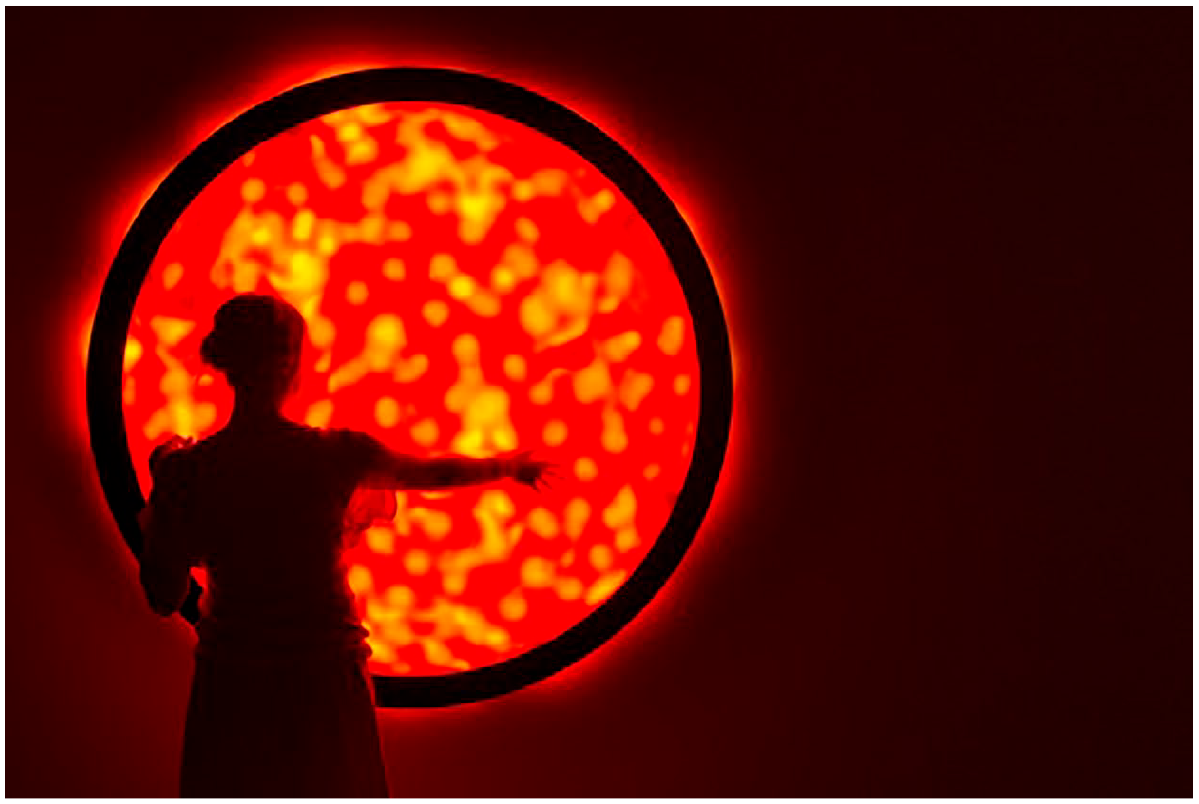
Flatsun (Rafael Lozano-Hemmer, 2011). Photograph by Antimodular Research.
Flatsun is inspired by the images that have emerged from the Solar and Heliospheric Observatory (SOHO) and the Solar Dynamics Observatory (SDO), which have been operating since 1996 and 2010, respectively. Real-time and archived videos capturing solar flares and sunspots are available to view from the both observatory websites.
5
Lozano-Hemmer describes the conversion of hydrogen into helium and the creation of the elements that make up the universe as ‘the image of our time’. As he says, es una imagen de Blake, es una imagen turbulenta, es una imagen que sí nos pide una cierta humildad y que nos lleva a adquirir una conciencia de la violencia del universo, sobre todo cuando contemplamos la escala con la que esas explosiones suceden. it is an image from Blake, a turbulent image, an image that does demand a certain humility from us and that makes us aware of the violence of the universe, especially when we contemplate the scale on which these explosions are taking place. (Álvarez Romero, 2015: 39)
However, the act of scaling down the sun to a comfortable size, hanging it on the wall of a gallery and making it interactive speaks not of our humility but of our presumption in imagining that a giant star might respond to our actions. Standing in front of the screen, we are reminded of our cosmic insignificance, but also encouraged to imagine a power that we do not possess: there is currently no action humans can take that can impact the Sun, while we on Earth are certainly vulnerable to the action of solar flares, which can knock out power grids and satellites.
Although the small scale of the disc affords us an apparently objective viewpoint, its interactive element works against this: every one of our actions produces a reaction, meshing us together in a single system with the object of our observation. This sense of intimate connectivity pervades our contemporary understanding of our species’ relationship with the Earth and its climate. As we become increasingly aware both of the sensitivity of the Earth to our actions, we may conclude with Latour (2017) that ‘the Earth is no longer “objective”, in the sense that it can no longer be kept at a distance, considered from the point of view of Sirius and as though it has been emptied of all its humans’ (p. 62). Our planet and its atmosphere are no longer simply a backdrop to human activity, simply the environment in which humans have evolved; there are no subjects and objects, but acts of co-production in which ‘agencies are redistributed’ (Latour, 2018: 76).
Flatsun also becomes a hyperbolic performance of our increasing power as a species to affect the geophysical dynamics of our own planet, and even to intensify or counteract the sun’s effects on weather in space (Gombosi et al., 2017). Since Galileo’s hypothesis that the Earth revolves around the Sun, science has persuaded us of the diminished importance of humans on a planet that is not at the centre of the Universe; in contrast, we are now being asked to acknowledge the inordinate power of human action over the ecosystems of an entire planet. Thinking about the vast cumulative effects of humans as a species on the Earth’s systems may be an important step in understanding the scale of the crisis we are in. But that same vision can return to us an inflated sense of human power and importance in relation to our environment, as well as relying on the ontological separation between humans and nature that is central to Enlightenment thinking. At the same time, the turbulent dynamics of the solar flares simulated in Flatsun remind us of our insignificance and powerlessness, reminding us of cosmic dramas that are being played out on scales beyond our imagination and in which lie well beyond the reach of human agency. Lozano-Hemmer’s work thus successfully captures the unstable, continually oscillating notions of human agency that characterize the Anthropocene, in which the evaluation of our own power as individuals or as a species swings from hubris and narcissism to impotence and back again.
Claudia Müller: tides, tsunamis and other hyperobjects
If in Flatsun we are asked to imagine the dizzying prospect of being able to provoke the sun’s explosions, in the work of the Chilean artist Claudia Müller, the stars and planets remain stubbornly beyond the reach of human influence. Her installations bring us into (mediated) contact with ‘hyperobjects’ that are too vast for us to perceive and that exceed our conceptual grasp. Timothy Morton (2013) uses the term ‘hyperobjects’ to refer to ‘things that are massively distributed in time and space relative to humans’, such as black holes, the solar system or radioactive materials (loc. 106). We can never see hyperobjects directly or in full, but we can infer their presence and the force they exert from graphs, instruments, sunburn, radiation sickness or tsunamis (loc. 1263, 2682). They are both present to us and ‘profoundly withdrawn’, beyond human reach (loc. 3023–3024). In other words, they are only detectable through their imprint on other objects; as Morton puts it, ‘hyperobjects disclose interobjectivity’ (loc. 1454). Müller’s work often focuses on the action of interplanetary forces such as gravity and electromagnetism on the Earth’s systems, and particularly on the hydrosphere. It reflects our contemporary sense of the huge importance of hyperobjects and how they shape our intimate, everyday experience. These are forces that radically shape the foundations of life on Earth but that we can barely measure with instruments, let alone see directly with our eyes, emanating from realms in which human agency is entirely absent.
A number of Müller’s videos and installations demonstrate the dynamics of water flow and how this is affected by the gravitational pull of the sun and moon as well as by the topography of a river basin. They become a study of time and space, as mediated through the flow of water: how the elliptical orbit of the planets creates the cyclical rise and fall of tides on Earth, how the volume of water and the gradient of the slope modify the flow of a stream, how gravity interacts with water and air pressure to form a vortex or how the measured fall of water from one container to another has been used by humans to calculate time. Capturing the effects of gravity on water flow in scaled-down models allows us to grasp the workings of powerful elements and forces that are often invisible to the human eye; conversely, it also helps us to situate the familiar and the everyday within a cosmic interplay of matter and energy.
In Constelante (Constellate, 2011), a whirlpool is created in a small bucket of water with the help of a water pump. 6 As it rotates at the base of the tub, a vortex develops as a result of the interaction between centrifugal force and gravity, leaving a hole at the centre. The image of the vortex is projected by an overhead camera onto a nearby wall, producing the illusion of depth on the wall’s surface. 7 The effect is heightened by the use of pieces of candle wax and polystyrene beads in the tub, which accentuate the circular motion of the water. The motor, to which a timer is attached, works intermittently, such that the whirlpool forms, unforms and reforms in a continual cycle. The title of the exhibit suggests a cosmic dimension to these cycles, and indeed the projected whirlpool brings to mind the swirling star trails of spiral galaxies.
The spinning of the whirlpool and of spiral galaxies takes place because of the action of gravity, a fundamental force that keeps planets in orbit but also profoundly shapes our everyday experience on Earth. Müller’s works are often intended to create contemplative images from natural phenomena and glimpses of the cosmic sublime in the elements that surround us every day, 8 just as in Constelante, we may behold the structure of galaxies in a bucket. The kind of visuality Müller’s piece affords us, therefore, is not the monarch-of-all-I-survey perspective of interstellar adventure, but one that finds, as Moraru (2015) puts it in his study of the aesthetics of planetarity, ‘the macro’s murmur in the vernacular of the micro, in the tiny, the local, and the humble’ (p. 213). We gain a sense of how intricately the planet is formed and reformed, continually and at all scales, by forces that exceed our grasp.
In Semi-diurno (Semi-Diurnal, 2013), 9 the central space is dominated by three columns, reaching from the floor to the ceiling of the gallery. In each column, slender steel rods support the vertical arrangement of eight water containers. Seven of the bottles are upended, with water passing from one container to the next in a controlled flow through nozzles. From the final container, resting on the ground, the water is pumped up to the top, to begin its journey downwards again. The columns act as clepsydras, one of the oldest known instruments for measuring time, and commonly used in many of the world’s regions before the invention of the pendulum clock in the 17th century. The flow of water from one container to another is regulated, and the level of water in one of the containers may be compared to marked lines that represent time passed. Narrow nozzles are used to create a more predictable laminar flow from the natural turbulence of water, making it possible to measure time with reasonable accuracy. 10
This central work is surrounded, however, by other pieces that emphasize forces and flows that may be harnessed by human technology but cannot be tamed by it (see Figure 2). The installation as a whole focuses on the nonlocal interactions of objects that are too immense for us to perceive or imagine, which are both spatially separated and intimately connected, producing a convergence of very different scales. ‘Semi-diurnal’, the term from which the exhibition takes its title, is the name given to a tidal cycle in which two high and two low tides occur every day, of around the same height. The exhibition featured a video that demonstrates the natural rhythms of tides, which are caused by the gravitational pull of the moon and the sun as the earth rotates. Composed of shots taken around sea level by an underwater camera, the video shows the rise and fall of the tides, plotted against a graphic that shows the changing phases of the moon over a month. 11 A series of accompanying watercolour illustrations, in varying shades of vivid blue, also take tides as their theme. But here the predictable, everyday rhythms of high and low tides, and the direction of the world’s ocean currents, give way to the extraordinary and extreme event of a tsunami. One of the illustrations traces the trajectory of the large merchant ship Santiago, tossed around Corral Bay in the turbulent waves of the tsunami that followed the 1960 Valdivia earthquake in Chile, among the most powerful ever recorded. Another shows the travel time of the resulting tsunami across the Pacific Ocean at one-hour intervals (see Figure 3).
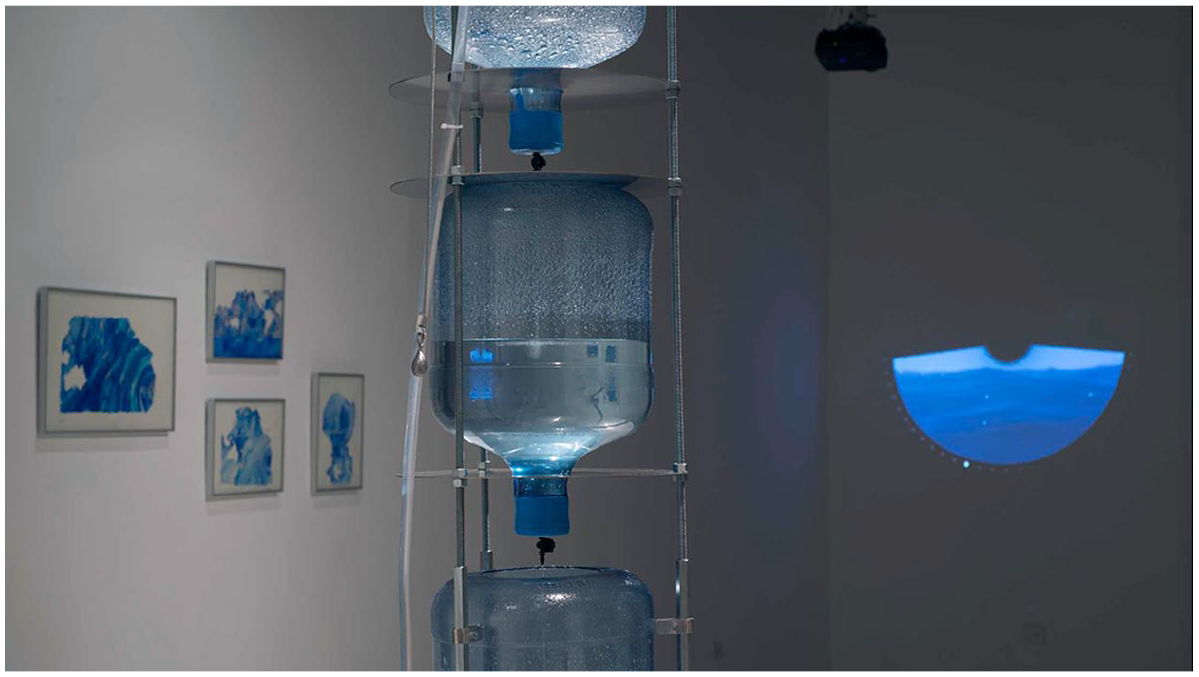
Semi-diurno (Claudia Müller, 2013). Photograph by Patricia Novoa.
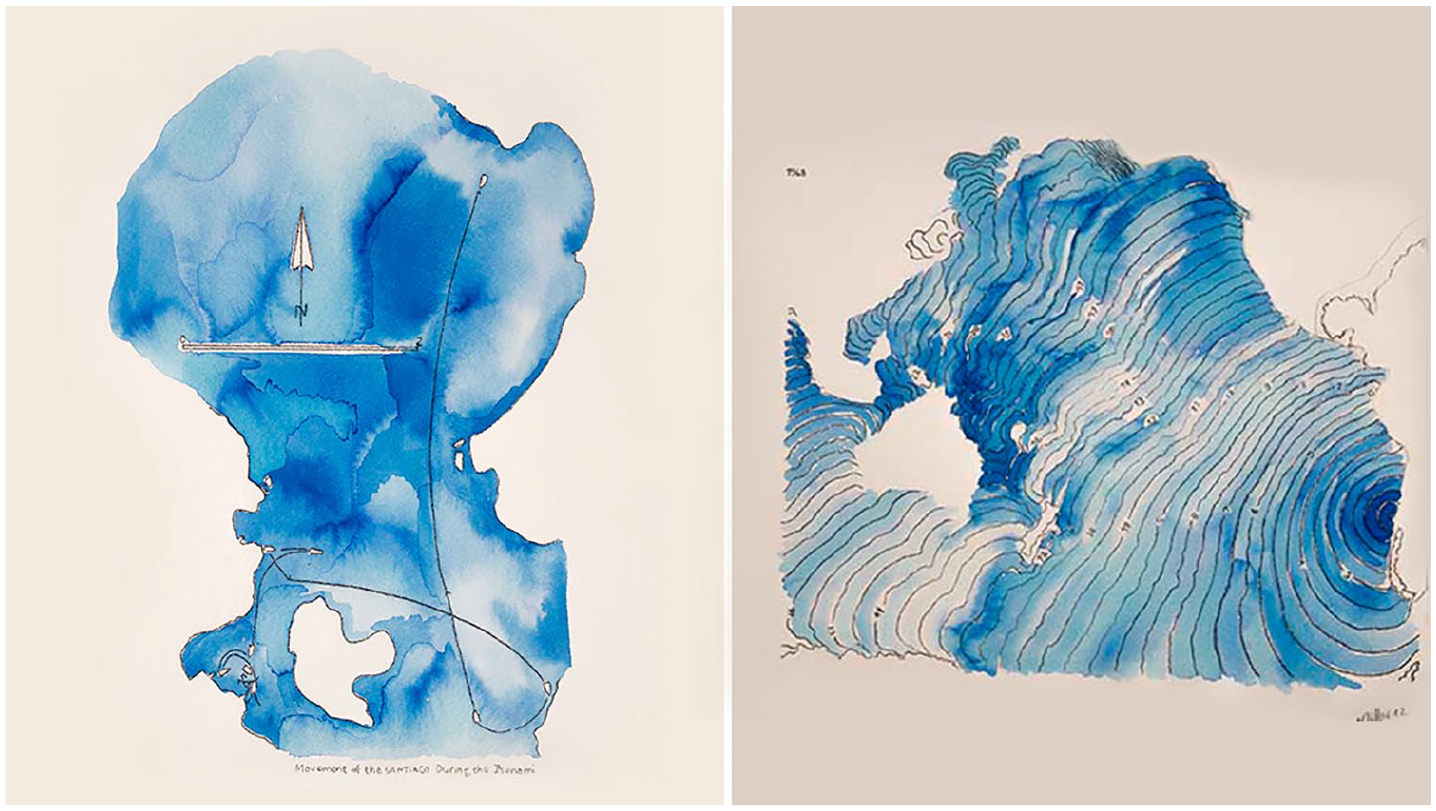
Semi-diurno (Claudia Müller, 2013). Photograph by Patricia Novoa.
Müller’s work encourages us to understand the extent to which the Earth’s elements are forged, held in place or put into motion by forces of immense power that operate across enormous distances, such as gravity and electromagnetism. It thus demonstrates the extent to which our experience of time and space is dependent on forces that originate well beyond the limits of the Earth’s atmosphere. Morton (2013) suggests that ‘such gigantic scales are involved – or rather such knotty relationships between gigantic and intimate scales – that hyperobjects cannot be thought as occupying a series of now-points “in” time or space’ (loc. 887–889). For this reason, he calls them ‘nonlocal’: they produce a ‘false immediacy’ (such as raindrops falling on our head) that is really the effect of an enormous system of interconnections that we cannot see and can barely measure (such as global warming) (loc. 910–914). This contradictory experience of embodied immersion in apparently local phenomena produced by the complex interaction of galactic forces is effectively conveyed in the video that formed part of the Semi-diurno exhibition. The camera plunges us repeatedly below the water level of the sea as the tide rises in accordance with the pull of gravity, creating a sense of the intimacy and immediacy of being engulfed by the swelling sea that is contradicted by the great distance separating us from the cosmic forces at play in its currents and tides.
In her study of earth art, Amanda Boetzkes (2010) finds that many contemporary artists (she cites James Turrell, Chris Drury, and Olafur Eliasson) are turning to ‘the aesthetic dimension of elementals’, such as air, light and water (loc. 352). In this way, Boetzkes suggests, artists may ‘resist the perceptual intention to conceive of the earth environment as a set of things or as a closed system’ (loc. 1699). These elements are themselves subject to forces and phenomena, like gravity, that are entirely removed from human control. Müller’s studies on water expand our sense of the planetary far beyond the bounded and the tangible. They exemplify the shift from earth art to planetary art I propose here, which involves a shuttling between the local and the (inter)planetary, and between tangible matter and invisible forces, displacing the human as agent.
Paul Rosero Contreras: seismic soundscapes
In Audiopoiesis (2013), the Ecuadorian artist Paul Rosero Contreras recorded the natural frequencies of surfaces in the Antarctic – rocks, glaciers, beaches – by means of contact hydrophones. The frequency spectrums were modified to make the sounds audible to human ears, and interwoven into an electronic composition. 12 The rhythmic taps and synthesized shudders of the soundscape produce an other-worldly effect. While the result is not dissonant, it takes us beyond the limits of our cultural experience; in this way, as Rosero explains, his use of sound here (and in other works) is intended as ‘a process of dehumanization’. 13 However, Rosero’s recordings are also a way of grasping the enmeshing of human and geological time, as the ‘sonidos secretos’ (secret sounds) of polar surfaces are ‘bancos de preservación de la historia humana’ (banks that preserve human history). 14 We know that polar ice contains evidence of human-assisted climate change in the form of trapped gas bubbles, and that the sounds of Antarctica therefore contain coded references to the human impact on global temperatures, ice thickness and melting rates. This human history is not deciphered for us, however, remaining opaque and resistant to interpretation.
Reflecting on artworks that produce sonifications of seismic data and other natural phenomena – including Air Pressure Fluctuations (2000) by the artist and scientist Felix Hess and The Place Where You Go To Listen (2004) by the composer John Luther Adams – Timothy Clark (2015) identifies a ‘putative avant garde’ that seeks to reframe real phenomena as ‘a kind of installation art’. Its value, he suggest, lies in its quest ‘to shake human cultural frames and scales of perception, revealing our own implication in material dynamics we cannot command and the illusoriness of any would-be sovereign overview’ (pp. 187–188). Data that would be employed in science to measure and predict is diverted in these artworks to generate an affective relationship with those elements of the planet that lie beyond human perception. Vibration brings us into intimate connection with the Earth, as the capacity to vibrate and to resonate is shared by all matter, living and non-living. Indeed, the phenomenon of resonance blurs distinctions between subject and object, or object and milieu, describing a system of reciprocal stimulation.
This notion of reciprocity is developed further in other works by Rosero, produced in situ at the summits of active volcanoes in Ecuador and other countries. Stornato was created in October 2015 on the summit glacier of the active Cotopaxi volcano in Ecuador, during a period of high seismic activity and daily emissions. 15 Rosero dragged a cart containing a three-dimensional (3D) printer up the volcano and used contact hydrophones placed on the ice to record the glacier’s vibrations. The signal was then processed with the help of custom software and printed using polylactic acid (a biodegradable thermoplastic polymer), finished with sulphur powder. The resulting sculpture was a spiral of spikes of varying heights (see Figure 4). Its delicate, ethereal beauty belies the immensely destructive power of the forces it traduces, which resist any human attempt to predict or control.
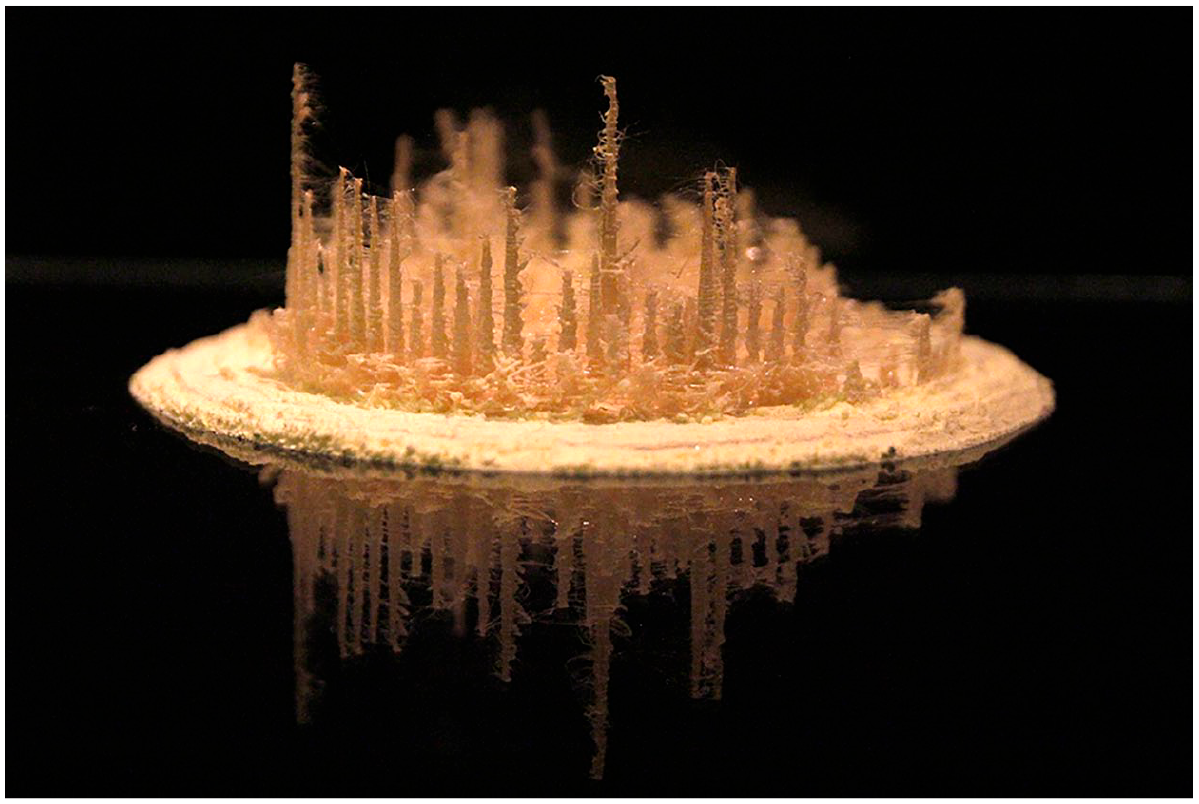
Stornato Version I (Paul Rosero Contreras, 2015). Photograph by Paúl Rosero Contreras/Dos Islas Studio.
The knowledge of plate tectonics that emerged in earth sciences in the late 1960s radically reformed our understanding of the planet, turning apparently exceptional events such as earthquakes and volcanic eruptions into the ordinary consequences of the Earth’s continual movement. Stornato has nothing of the utility of a seismograph, used to monitor and predict seismic activity in order to alert humans to the risk of danger. Its intent is not to understand in order to minimize harm to humans, but to give material expression to the restless creative and destructive energies of the Earth. In its conversions of acoustic energy to electrical and then to mechanical and thermal energy, Stornato references the manifold and continual transformations that take place in nature from one form of energy – thermal, chemical, kinetic, acoustic – to another, and which are responsible for the complex chains of nonlinear causality that bring greater instability (e.g. to climate cycles).
The action of carting the printer up to the glacier and creating the piece, no mean feat given the weight of the printer, the high altitude and the low temperature, was recorded as a performance in a video that is usually exhibited alongside the sculpture, a still from which is shown in Figure 5. The video’s title, The Opening (2015), gains meaning from Rosero’s exhibition text, in which he cites Merleau-Ponty’s concept of touch, bringing together the sensing being and the sensible in an intertwining made possible by the fact that ‘the world is made of the very stuff of the body’ (Merleau-Ponty, 1993: 125). Rosero cites Judith Butler’s summary of Merleau-Ponty’s thought on this subject: To be touched is, of course, to undergo something that comes from the outside, so I am, quite fundamentally, occasioned by that which is outside of me, which I undergo, and this undergoing designates a certain passivity, but not one that is understood as the opposite of ‘activity’. To undergo this touch means that there must be a certain openness to the outside that postpones the plausibility of any claim to self-identity. (Butler, 2004: 189)
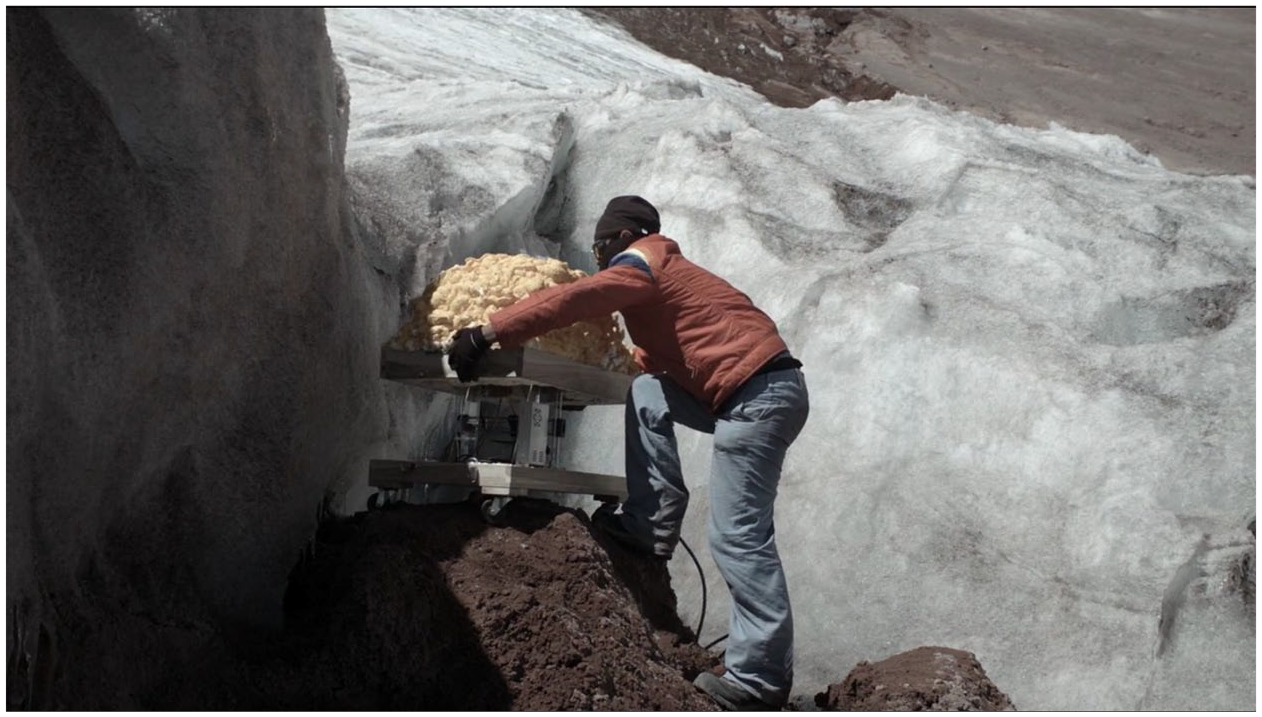
The Opening (Paul Rosero Contreras, 2015).
In his essay ‘Eye and Mind’, Merleau-Ponty (1993) contrasts painting with modern science in its apprehension of the world. ‘Science’, he claims, ‘manipulates things and gives up living in them’, while art draws upon the ‘fabric of brute meaning’ that science prefers to ignore (pp. 121, 123). ‘It is by lending his body to the world that the artist changes the world into paintings’, as the artist is immersed in the world through the embodied nature of his perception, bringing body and world together in a common ‘flesh’ (p. 123).
A sense of this intertwining and reciprocal composition is reinforced by the camerawork for the video, which emphasizes horizontality over hierarchy. Low- and high-angle shots, which might have suggested the looming might of the volcano or the impressive feat of the human climber, are avoided in favour of ones that show movement across the frame on a horizontal plane. Picture-postcard shots of the volcano’s cone are also conspicuously absent, leaving images of increasingly barren rocks and screes as the artist ascends, accompanied by the howling wind. Nature is not depicted here as a force to be conquered, however, and there is no hint here of the punishing physiological effects of altitude that had to be overcome, which might have produced a narrative of human heroism.
The work itself, Stornato – meaning diverted or transferred, in Italian – uses a range of media technologies to capture, convert and transmit data obtained from natural sources. Jussi Parikka (2015) suggests that Our relations with the earth are mediated through technologies and techniques of visualization, sonification, calculation, mapping, prediction, simulation, and so forth: it is through and in media that we grasp earth as an object for cognitive, practical, and affective relations. (p. 12)
In Rosero’s work, however, the earth as given to us through such techniques is not only something we grasp, but also that which grasps us. A number of elements in Stornato’s form speak of a reciprocal ‘touch’ between humans and the environment, in which each adapts itself to the demands of the other, and receives the form of the other as it impresses its own, in such a way that the categories of ‘active’ and ‘passive’ do not apply.
Stornato performs a meshing-together of artistic, technological and geological processes that demonstrates the locus of art at the site of a material intertwining between the body and the world. The technique Rosero used to print the model is known as Fused Filament Fabrication (FFF). A plastic coil is passed through a heating chamber that turns it into molten material, which is then deposited in layers. The process is strikingly similar to the heating of magma in chambers beneath the Earth’s crust, which is then ejected in molten form and solidifies to form strata. Sulphur, used as a medium in the construction of Stornato, is also referenced in the casing for the 3D printer in The Opening, which is given the appearance of a cart piled high with yellow rocks, indicating the practice of sulphur mining at volcano sites.
These materials have not simply been enlisted for human purposes: to obtain minerals and to work with them to fashion objects, we have to adjust ourselves to their own demands, in encounters that shape us both. Sulphur mining is a form of extraction that involves severe damage to human health in the form of toxic fumes, and climbing active volcanoes brings obvious risks. Rosero’s works do not simply engage in biomimicry or geomimicry – one could, of course, understand all art and technology as drawn from the forms and rhythms of nature – but epitomize the way in which art is produced from an encounter between the human body and its material environment in which both are shaped. In another project on vibrations developed in Antarctica, for example, Rosero documented his body’s physiological response to the environment, including pupil adaptation to extreme brightness (Contreras, 2013: 110–121).
The language of reciprocity, reflexivity and mutualism in Merleau-Ponty’s account of the ‘chiasm’ or the ‘touch’ between body and world suggests a symmetry that is far from the truth, however. To understand the ‘stuff’ of our bodies and that of other things to be intertwined and co-constituting does not require us to assume that this encounter is one between equal powers. A number of Rosero’s volcano works, including videos and 3D sculptures generated from seismic activity, were brought together in The Andean Pavilion, shown as part of the Bienal Sur in 2017. 16 Rosero describes the installation as ‘the reenactment of a momentary encounter between a volcano, a human, and a machine’, and an exploration of the human-environment dynamics that undergo constant change in settings that are ‘heavily defined by natural phenomena’ (Contreras, 2017: 422). The works were explicitly conceived as a response to discourses of climate change that assert the geological agency of humans, which lead Rosero to conclude that ‘el mismo concepto del Antropoceno es bastante antropocéntrico’ (the very concept of the Anthropocene is quite anthropocentric). 17 His work offers a counter-emphasis on the devastating and untameable inhuman force of volcanoes. 18 It is perhaps not a coincidence that discourses heralding the new geological agency of humans have emerged from the urban Global North, where natural disasters are comparatively rare. 19 It is harder to imagine them gaining the same purchase in a country as vulnerable to earthquakes and volcanic eruptions as Ecuador. It remains the case that the power of a nuclear bomb, the epitome of humanity’s destructive capability, is still dwarfed by the force of a volcanic explosion.
Nigel Clark (2010) affirms that ‘the reason why global climate is susceptible to being changed by human “forcings” is because it is inherently unstable’ (p. xi). However great the scale of human intervention in the planet’s systems, an important asymmetry remains: ‘the impression that deep-seated forces of the earth can leave on social worlds is out of all proportion to the power of social actors to legislate over the lithosphere’ (Clark, 2010: xvi). We can see in Rosero’s work an important distancing from the kind of environmental art that aims to produce a direct experience of nature for human viewers, on the assumption that the affective, immersive effects of art may promote an attitude of care. 20 There is no attempt here to provide a transparent, unmediated access to nature, in the way that Morton (2007) finds to be characteristic of ecomimesis (pp. 151, 154). If the techniques of hypermediation used do demonstrate our ability to record and remix the traces of natural phenomena, they also register how removed we are, perceptually, from the sources of their power, and how little control we may exercise over these.
Michelle-Marie Letelier: trade winds and toxic metals
The fundamental asymmetry of encounters between humans and geophysics is also evident in the work of the Chilean artist Michelle-Marie Letelier. Many of her projects focus on the chemical properties of minerals such as copper, coal and nitrates, while exploring their roles within histories of extraction and global trade. Letelier has dedicated several years to researching the export from Chile to Europe of sodium nitrate, a chemical compound used to make fertilizers and explosives, thus – as she puts it – serving both life and death. 21 Sodium nitrate, also known as Chilean saltpetre or ‘white gold’, became Chile’s main export towards the end of the 19th century, once the nation had secured a virtual monopoly over the trade, having annexed those areas of Peru and Bolivia that were rich in saltpetre deposits during the War of the Pacific (1879–1884). The Chilean supply of saltpetre to the Allies for ammunition during the First World War was a significant factor in their victory, while historians have suggested that it was only Germany’s discovery of a method to produce a synthetic form of nitrate that allowed it to continue fighting as long as it did (Hardach, 1981: 59–60). The rise of synthetic nitrates and the collapse of nitrate prices at the close of the war brought the Chilean saltpetre boom to an end.
Letelier’s Offshoring Pathways (2014) consists of a large plexiglass tray containing a sodium nitrate solution, into which positively and negatively charged copper wires are placed. 22 The wires trace the nitrate shipping routes taken by the Peking, one of the largest sailing ships ever built, which made 34 voyages to and from Northern Chile around the treacherous Cape Horn from 1911 until the opening of the Panama Canal in 1914. As the solution evaporates over the course of a week, the sodium nitrate precipitates out, forming transparent crystals that allow the dark colour of the tray beneath to show through. This creates the appearance of a land mass roughly the shape of South American continent. At the same time, copper ions dissolve into the solution along the negatively charged copper wire, colouring the ocean a vivid blue-green (see Figure 6). 23 The presence of copper in the installation is also historically significant, as copper took over as Chile’s main export after the decline of the saltpetre trade. Electrolysis, which is needed to create the reaction in Offshoring Pathways, is used to purify copper from the ores extracted through mining.
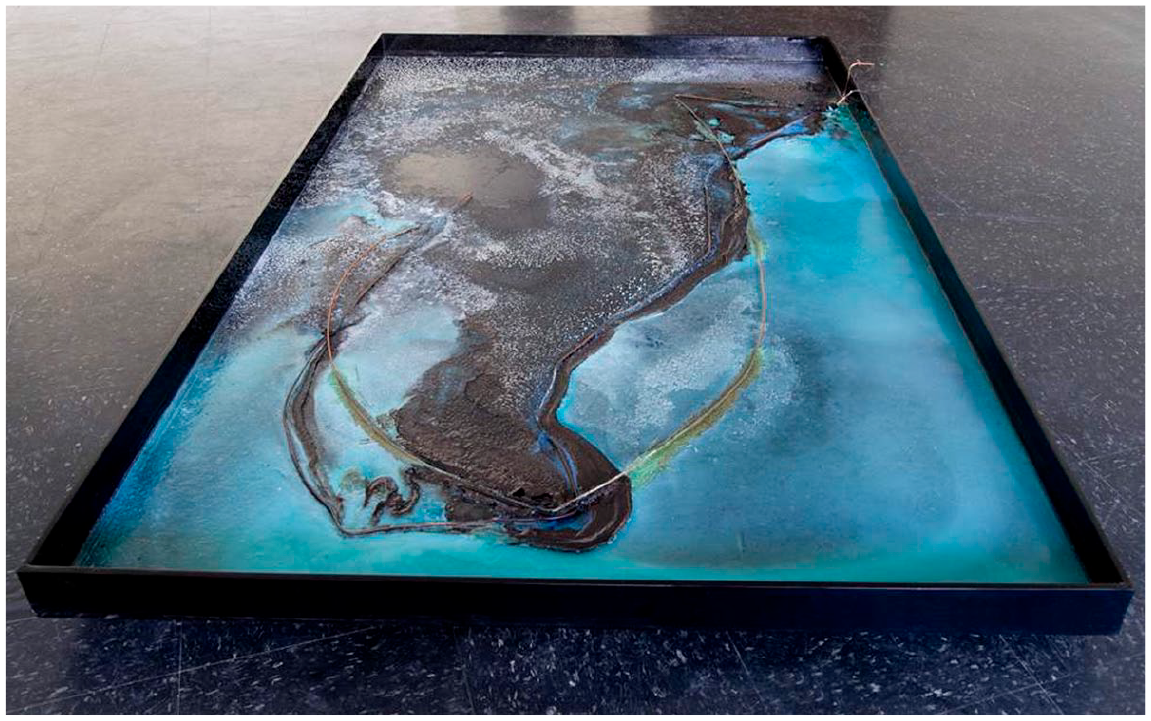
Offshoring Pathways (Michelle-Marie Letelier, 2014). Photograph by Mariana Garay, marianagaray.com.
The installation formed the central piece of Letelier’s Caliche Winds exhibition in 2014. 24 Among the accompanying sketches and photographs was a drawing entitled Winds, Routes and Turbines, a re-interpretation of Matthew Fontaine Maury’s 1857 ‘Winds and Routes’ chart. 25 Maury’s map was produced to accompany his monumental The Physical Geography of the Sea (1855), the first comprehensive study of oceanography to be published. Letelier ‘updates’ Maury’s chart, adding contemporary shipping routes (e.g. via the Panama and Suez Canals) and fictional offshore wind farms. She leaves the continents plain white and removes most of the labels, in order to focus the viewer’s eye on the dense patterning of ocean currents and winds that facilitated European expansion (see Figure 7). For the Buenos Aires exhibition in 2017, energy to the Offshoring Pathways installation was supplied in the form of a small wind turbine, again symbolizing the importance of wind in the development of global trade routes. 26 Wind was also an important factor in the original formation of Chile’s nitrate deposits. Although their precise origin is still a matter of debate – they may have been generated by algae and bacteria in desert basins, blown across the desert in sea spray or even ejected into the atmosphere as a result of volcanic activity – wind evidently played a critical role in transporting them across the desert (Ericksen, 1983: 372–373).
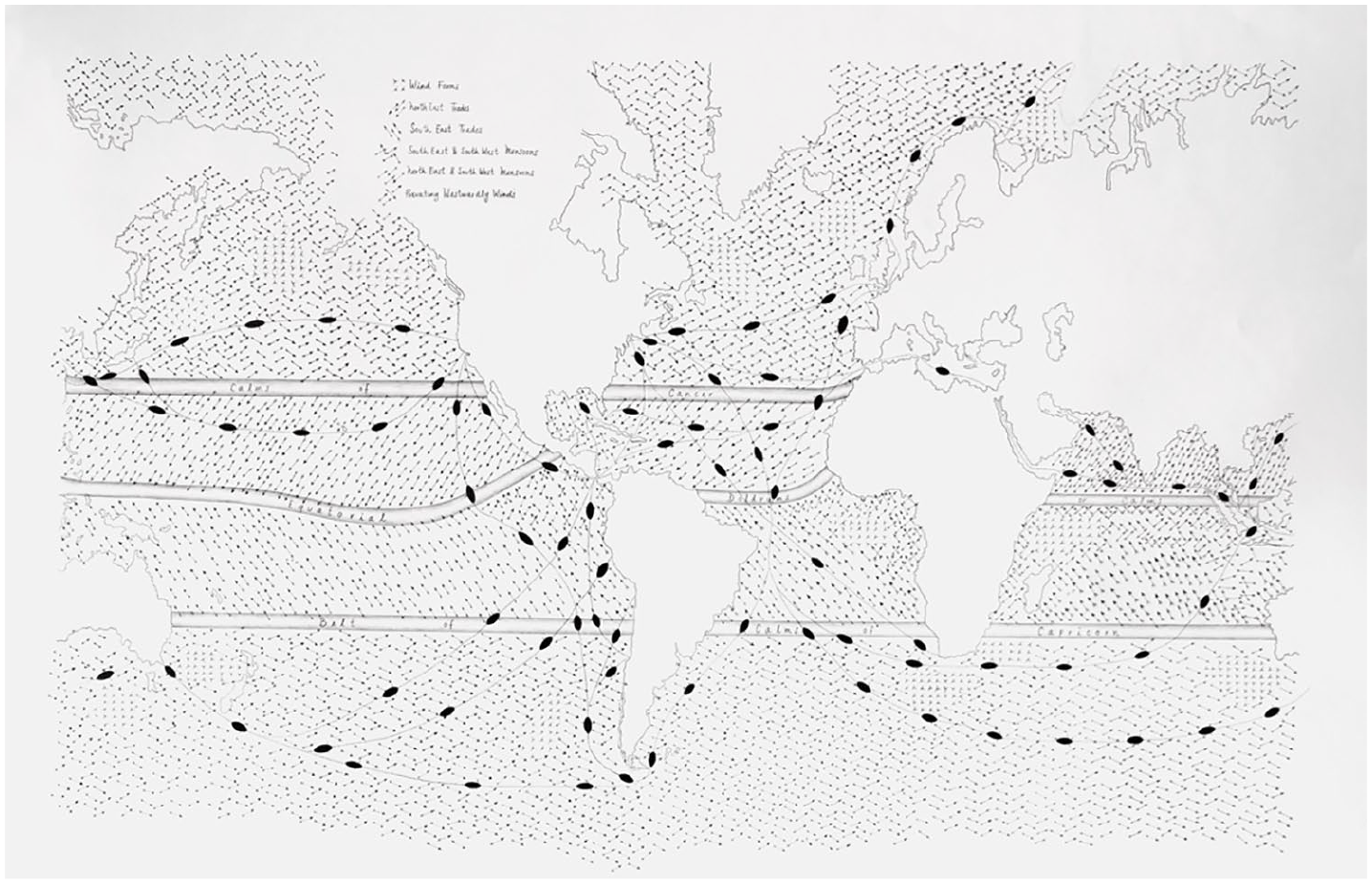
Winds, Routes and Turbines from Caliche Winds (Michelle-Marie Letelier, 2014). Photograph by Mariana Garay, marianagaray.com.
In her study of meteorological art, Janine Randerson finds that artists have often used scientific visualization processes in their works with the purpose of creating ‘new ways to envision, revisit, or resist the power relations of meteorological mapping’ (Randerson, 2018: 45). Maury’s work, like that of many oceanographers over time, has principally served military and commercial ends. Letelier’s reworking of the map performs a different function. To incorporate this iconic map within Caliche Winds is to encourage reflection on the conditions that have enabled the large-scale extraction, transport and trade of raw materials from South America over several centuries. What is highly significant here is that Letelier does not primarily point to socioeconomic or geopolitical causes, such as (neo)colonial exploitation or unequal development. Ultimately, Caliche Winds seems to suggest, Europeans were able to expand into South America and to develop lucrative trade routes because of the direction of the prevailing winds and tides.
Does this mean that modern world history has followed a course that is predestined in the chemical composition of minerals or the currents that set the oceans in motion? To dispense with human agency here would be nonsensical and politically offensive. But if the social, economic and environmental injustice of extractivism in Chile (and many other countries in Latin America) finds its causes in European expansionism and the history of global capitalism, it is also rooted in planetary geophysics, and specifically in the uneven distribution of minerals and in the particular patterns of winds and tides. We are reminded by Letelier’s works that the ‘geo-’ of ‘geopolitics’ does not simply refer to the cultural or political location from which we speak, but also to the geological make-up of its landscapes and its position within the atmospheric and oceanic systems of the planet. We glimpse the truth that no quest for social justice, however fervent, will make a level-playing field of this planet, whose prevailing winds carry contamination from one continent to another, and whose volatility is disproportionately felt in its poorest regions.
Significantly, Offshoring Pathways excludes any visualization of human experience. By working at a microscopic level (the formation of crystals) to represent much bigger forces (the shaping of a continent’s landscape via mining sites and trade routes), the individuals who worked in the mines or on the boats are effectively lost to sight, as are the millions whose lives were (and are) affected by the exploitation of natural resources in South America. This absence is also conspicuous in an earlier project, in which Letelier documented the abandonment of the mining camp at Chuquicamata: the world’s largest open-pit copper mine, in the middle of the Atacama Desert in the north of Chile, and the place to which she moved at the age of eight. 27 Letelier returned as an adult to photograph and film the deserted camp, from which thousands of inhabitants had to move as the site was declared unsafe in 2002 due to the high levels of toxins unleashed by mining operations. Among other contaminants, arsenic is often present in high quantities in copper deposits in Chile; if untreated, it is released through mining processes into the air and water around the mine. The Chuquicamata camp has become yet another of the ghost towns scattered across the Atacama, testament to past mining booms in Chile. Much of the site has now been covered with tonnes of waste material from the nearby mine. 28
Nikolaus Geyrhalter’s extraordinary documentary Earth (2019) opens with the statistic that humans move 156 million tonnes of rock and soil a day across the planet. This makes our species, Geyrhalter asserts, ‘the most decisive geological factor of our time’. The unprecedented extent to which we are flattening, detonating and tunnelling through the Earth’s crust causes more environmental damage than we can even account for. Writing specifically about Latin America, a region that has been profoundly and literally shaped by mining and other forms of extractivism, Marisol de la Cadena and Mario Blaser (2018) maintain that extractivism is how the Anthropocene makes itself present in this part of the world: what can be more eloquent of human geological force than the removal of mountains in a time-efficient search for minerals, the damming of large bodies of water to reroute rivers for hydroelectric commercial purposes, the transformation of rain forests into palm oil plantations or cattle grasslands and of deserts into land for industrialized agriculture? (p. 2)
Devoid of human inhabitants, Letelier’s works are telling of the extent to which mining in Latin America creates ‘expendable populations in massive proportions’ that are displaced to meet the demands of ‘necropolitical alliances between the state and corporations’ (de la Cadena and Blaser, 2018: 2). Extractivism, as De la Cadena and Blaser argue, continues the colonial practice of ‘terra nullius’: ‘it actively creates space for the tangible expansion of the one world by rendering empty the places it occupies and making absent the worlds that make those places’ (p. 3). The apt title of an exhibition of Letelier’s mining camp photographs, ‘ERASE’, could refer both to the Spanish ‘érase una vez . . .’ (‘once upon a time . . .’) or the English ‘erase’, meaning ‘to remove the traces of’.
A recent emphasis on the undeniably enormous impact of our activity on the planet’s landscapes can lead us to forget, however, the far more powerful effects on us of their own colossal explosions and upheavings, carried out on a very different timescale. It is the absence of humans in Letelier’s works – and in the abandoned camp itself – that speaks volumes about the asymmetry of human and nonhuman agency in such encounters. While it is human intervention in the geological landscape that has released pollutants to the point of unhabitability, these heavy metals were already present in the earth, locked into layers of sediment as a result of volcanic activity over millions of years. They point to the planet’s past, an unimaginably deep time whose earth-churnings and convulsions have far outstripped all our mining efforts in magnitude, and that also point forward to the prospect of a planetary future without us. From the perspective of geological time, the distribution of agency looks very different. If empires have been built on the extraction and commodification of geological material, that matter – far from passive or inert – may yet prove a decisive agent in the history of human existence on the planet. For the present, its effects are most keenly felt where the largest and least regulated extraction operations are concentrated, often located in Latin America and elsewhere in the Global South.
Inhuman agency and ethics
The works discussed here by Lozano-Hemmer, Müller, Rosero and Letelier remind us of the extent to which human society is, as Clark (2010) puts it, ‘intrinsically, inescapably, ensnarled in a mass of forces and objects that greatly pre-exist our emergence and have no need of our continued existence’ (p. 105). Müller and Rosero in particular move away from representing geological events as human-induced, as exceptional, or even as natural disasters, as all of these would insert the Earth into human dramas being played out within human temporalities. Letelier likewise traces the flows, crystallizations and sedimentations that predate the entirety of human history but have profoundly shaped it. In their mappings, mediations and materializations of seismic forces and tidal waves, these artworks confront us with the crashing indifference of geophysics to the fates of humanity, and the troubling truth that environmental justice is our idea, not the planet’s. We did not start with an Earth in perfect equilibrium that we then proceeded to mess up, but one that was already governed by unequal and unpredictable forces. This understanding suggests that the quest for climate justice is practically impossible while remaining, of course, ethically imperative.
Clark (2010) suggests that the recent emphasis of the social sciences on complex, hybridized and technologically mediated ‘nature-cultures’ may usefully draw our attention to ‘the co-constitutive relations of the social and the physical’. In doing so, however, they ‘discourage thinking in terms of natural systems in which the human imprint is negligible or non-existent’ (p. 15). Confronting the limits on our capacity ‘to construct, enact, perform, compose, assemble, or otherwise renegotiate the realities in which our lives pass’ means rethinking ethics in the context of a volatile Earth (p. 30). Clark advocates ‘a receptiveness to the needs of others’ that does not primarily look for social, political or economic wrongs to put right, tracing the many and undeniable ways in which the privileged are guilty of, or complicit in, the suffering of the underprivileged. Instead, it would arise from an understanding of our shared vulnerability to the planetary elements that is an ineradicable part of the human condition (pp. 66–67). In other words, our response to suffering should be founded on an understanding of what we cannot change, as well as what we can.
Beyond landscape and earth art
The Western tradition of landscape art, which places an objectified nature under the gaze of a human subject, is challenged in these works in several ways. Their continual shifts in scale and perspective require us to perform mental leaps that take us from the molecular to the astronomical in a way that troubles the static, linear viewpoint of landscape painting. By rejecting naturalistic modes of representation, many of these works avoid recreating an illusion of mastery over nature. The staging of chemical reactions (Letelier), transductions from one energy state to another (Rosero) and the interplay of planetary and cosmic forces (Müller; Lozano-Hemmer) emphasize the performativity of matter rather than the creativity of the human artist; far from being relegated to a background to human activity, the nonhuman world comes to the fore in all its vibrant power. In all cases, the ‘landscapes’ created in the works are not the subjective renderings of an individual artist but the result of the interaction of geophysical forces and chemical reactions that are too complex for us to model with accuracy. Nixon (2011) reserves an important role for ‘writer-activists’ – why not artists too? – in bearing witness to threats that remain imperceptible to the senses, either because they are geographically remote, too vast or too minute in scale, or are played out across a time span that exceeds the instance of observation or even the physiological life of the human observer. (p. 15)
The timeframe of Offshoring Pathways, for example, whose reactions take place at a rate that eludes our immediate senses, points very effectively to the ‘slow violence’ of environmental change that Nixon describes. It registers a temporality that exceeds our grasp and, at the same time, draws attention to the potential role of art in expanding our perception of planetary time.
These artworks create a particularly unsettling version of the sublime as it has developed in landscape painting, among other artistic forms and movements. In the face of the failure of the imagination to grasp the vast expanses of space and time, and the power of the forces that govern these, the Kantian sublime returns us to a more comforting satisfaction in the capacity of human reason to encompass what had originally disoriented us and in our technological mastery over nature. Pulling us into the thrill of an (inter)planetary sublime, these works generate more unease than comfort: their acts of technological mediation and transduction may demonstrate how we are able to frame and even sometimes to harness geophysical forces for aesthetic, economic or other ends, but they also remind us that we remain signally unable to predict where and when they will disrupt human lives, often to disastrous effect. Although we experience the mind-expanding thrill of the sublime, we are not allowed to forget that any sense of mastery is – as in Flatsun, Semi-diurno or Stornato – merely an illusion.
For their recent publication in this journal, Ballard and Linden (2019) searched for an artwork that might ‘embody the social and cultural impacts of the Anthropocene’, in providing ‘evidence of humans acting with geological force on the planetary system’ (p. 143). They opted for Robert Smithson’s Spiral Jetty (1970) which, as they acknowledge, has become an obligatory reference for art historians discussing earth art, especially within the context of the Anthropocene (p. 146). Smithson’s material intervention into the land fuses artistic practice with geological process in a way that seems to exemplify the increasing capacity of humans to act directly on the geosphere and biosphere. It expresses a ‘sense of self as part of the planetary Earth System’ (p. 143) that is crucial to negotiating a path through the Anthropocene to a future era in which human activity will be less destructive. While the artworks I have explored in this essay also remind us of the extent to which we are intricately enmeshed in the Earth’s systems, they cultivate a sense of the planet beyond the human that allows us to understand its dynamics more fully, and to resituate human agency more properly within geohistories of matter and energy.
Although these projects bear some conceptual affinities with the earth art (or land art) movement in the 1960s and 1970s, they make no interventions into landscapes and produce no site-specific works, other than short performances that leave no lasting material impression on sites. Instead, they organize and document mobile, live, fleeting encounters with the fluxes of elemental phenomena and the trembling of the earth. For the most part, they are not representations of matter but transductions of energy. They do not enact a return to the Earth as the ground of unmoveable certainties, as an escape from modernity, or as a Romantic reaffirmation of inner spirituality. In her reading of artworks by Olafur Eliasson, Boetzkes (2010) suggests that The goal is [. . .] not to recover nature in a disenchanted modern environment but rather to show how technology might be redirected toward the destabilization of habitual ways of perceiving natural events and can be the basis of a sensitive interaction with the earth. (loc. 2189)
The technologies of transduction used by the artists discussed here similarly destabilize and defamiliarize the planet, disclosing the ceaseless flows and mutations that characterize an apparently inert matter. Although these works in many ways embed art in nature in order to show the entanglement of human and nonhuman histories, they also demonstrate the powerful disembedding effects of art – its rescalings, its mixing-up of milieus and its folding-in of space and time – that help us think beyond the limits of human perception.
Art and science in the Anthropocene
Ballard and Linden suggest that Smithson’s work and its critical reception in the art world contributed to a disciplinary shift that takes us ‘from art understood within the white walls of the gallery to art in direct conversation with the planet’. Ironically, however, as they note, this did not take place ‘in collaboration with disciplines outside the domain of art itself’ (Ballard and Linden, 2019: 143). The projects I have discussed here are much more genuinely transdisciplinary in the way they bring together the aesthetic and the scientific. As we have seen, they deploy a range of scientific recording, imaging and modelling techniques in order to register the effects of (inter)planetary forces and to make them present to us. Many of them also clearly aim to increase our understanding of the natural world, an objective shared with most scientific experiments and forms of data visualization and interpretation. Where, then, does the specificity of the aesthetic reside here?
In his discussion of contemporary works of bioart and ecoart from Latin America, Jens Andermann (2018) uses the term ‘becoming-unspecific’ to describe the way these artworks stage the dissolution of the artistic into scientific practice or into forms of life itself (loc. 6352). In this process, he does not find a rejection of the aesthetic experience itself, but of ‘una forma determinada de entenderla como aquello que nos distingue y nos constituye en humanos y sujetos: como aquello que nos especifica’ (a particular way of understanding (aesthetics) as that which differentiates us and constitutes us as humans and subjects: as that which specifies us) (loc. 6427–6429). The works I have discussed belong neither to bioart (they do not incorporate living material) nor really to ecoart (they are not primarily motivated by ecological or environmental concerns). As I have suggested, they inscribe themselves instead within a contemporary variant on earth art, which we might call planetary art, to mark its stronger connection with the geological and the cosmic sublime and the (inter)planetary forces that shape the Earth’s systems. But they participate nevertheless in the same redefinition of the aesthetic that Andermann observes, which displaces us as humans from a privileged position as subjects and recreates us as co-agents of the aesthetic, not just with other living forms, but with the fundamental physical forces and chemical interactions that have given form to everything on Earth and in the universe.
The specificity of the aesthetic is also evident here in the deliberate distance taken from the more instrumental aims of science and technology with respect to the natural world. Rosero’s expressive renderings of seismic energy disclose to us the continual vibrations that shake the Earth and shape its landscapes, but would be entirely useless in the science of earthquake prediction. Likewise, the analogies and mappings created by Letelier and Müller are often impressionistic rather than scientifically accurate, but are designed to suggest a broader conceptual truth concerning the interconnections between human histories and geological time, or between the local and the galactic. We could understand these works as decolonial in their representation of nature as a set of forces that cannot be measured, contained or exploited by human technology. They call into question the (Eurocentric) ‘planetary consciousness’ that arose, as Mary Louise Pratt (2008) argues, from imperial mapmaking and circumnavigation projects (pp. 29–30), by promoting sensory relationships with planetary forces that are not based on the systematization of nature for the purposes of colonization and commercial exploitation. What is more, they replace the ‘rationalizing, extractive, dissociative understanding’ of universalist European science (Pratt, 2008: 37) with an experiential knowledge that is rooted in affect and social relations as much as in data and analysis, and interrogates the complex relationships between geophysics and geopolitics.
Clark (2010) suggests that science is ‘one of the most important ways’ we have of understanding not only how our activities interweave with those of the world around us, but also ‘what the world does in our absence’ (p. xviii). The arts and humanities often articulate the importance of their role in ‘humanizing’ science, reembedding it within the social, cultural, political or ethical contexts from which it has been abstracted in the production of generalizable knowledge. I would argue that a rather different relationship between the disciplines is being forged in these projects, in which science paves the way for art to engage critically and affectively with the inhuman. The sensory, affective experiences these artworks stage with elements and forces of the Earth that lie beyond human influence and human time may play a crucial role in enabling the construction of a planetary imaginary and in helping us navigate towards a less anthropocentric era.
Footnotes
Declaration of conflicting interests
The author(s) declared no potential conflicts of interest with respect to the research, authorship and/or publication of this article.
Funding
The author(s) disclosed receipt of the following financial support for the research, authorship, and/or publication of this article: The author gratefully acknowledges the award of a grant from the British Academy to cover expenses associated with this research project.
