




Abstract
Part 1 of this article made a case for “pleonastic” translation, i.e., adding pleonasms (synonymous adjectives) to metaphorical nouns to bridge the cultural distance between the ancient Israelite text and the present-day reader. Part 2 exemplifies this approach with a translation of some of the body-description verses from the Song of Songs (esp. 7.2-6 [English 7.1-5]). Introductory considerations concerning this biblical book are offered, addressing, e.g., life-setting, register, and hermeneutical key. Rooted in translation theory and metaphor theory, this article draws attention to the various aspects of the Song of Songs and proposes a “dynamic equivalent” way (following Nida and Taber’s call for clarity) to provide present-day readers with a comprehensible translation of its ancient metaphors. This results in a respectful translation with additional pleonasms and other types of elucidations.
Keywords
Part 1 of this article (TBT 71: 101-19) introduced a pleonastic approach to the translation of metaphor, especially in poetry in the Hebrew Bible. This second part exemplifies the approach with a translation of Song 7.2-6 (English 7.1-5).
1. Song of Songs
a. Introduction
One may appreciate the poetic art of the Song of Songs, but without hermeneutics or with the wrong hermeneutics, the poem does not make sense. One might attempt to share the emotion, but perhaps the only conclusion one could draw is that the poet is crazy, in the best case, crazy about his beloved (and likewise she about her beloved; cf. Soulen 1967).
When dealing with the Song of Songs, many questions could be asked before turning to the text, and answered while reading the text, such as matters of unity, meaning, or (canonical) theology. To a certain extent these elements are of exegetical importance for the translation. Wendland’s middle way between what he calls “secular” and “theological” meaning has exemplified this. 1 Nevertheless, the present article focuses on the “secular” aspect of the meaning of the Song of Songs because a better understanding of this aspect contributes to a fuller appreciation of the Song; it extends the basis for intertextual and figurative readings by emphasizing the uniqueness of the Song, deepening the understanding of the field from which the assumed metaphoric language of the Song is taken. That is, the better the “secular” understanding of the Song’s imagery, the richer the “metaphor” of the Song as a whole. In the present case, understanding the cognitive environment that fuelled the ancient audience’s comprehension of the Song and its description of the female lover can enrich the intertextual connections and the reading of the text’s metaphors (see also section 5b in part 1).
The original setting of this poetry would be another important issue in translation. That said, it is possible that this setting changed as early as the book’s reception into the canon of Scripture (maybe even before, and definitively afterwards), so not all readers would see the original setting as necessarily determinative for interpretation or translation. 2 Still, the present article aims to be true to the “original” life-setting and register (as approached through historical study). Even though definite conclusions cannot be reached for these issues, an exploration informs the exegesis and subsequently the translation.
Beyond that, one needs to be aware of the canonical setting. “Most English translations disguise some of the most blatant erotic imagery with euphemism and metaphor, as is appropriate considering the poetic nature of the literature and the need to preserve a certain propriety for a general audience” (Walton, Matthews, and Chavalas 2000, 577). 3 This seems to imply not only that the general audience should not be confronted by taboo subjects, but also that this kind of translation is appropriate for the Bible in general. The erotic imagery is modest in how it clothes the protagonists (cf. section 1c below) but blatant in its meaning. How is one to find a middle way, hinting at the sexual contents but remaining modest?
b. Life-setting(s) of the Song of Songs
For the Song of Songs many life-settings have been suggested: wedding song, 4 hieros gamos, 5 a play, 6 an erotic dream (pornography?), 7 parody on prophetic speech, 8 a protest song, 9 or a female counterpart to Prov 1–9. 10 Most of these readings acknowledge the physical character of the love poetry in the Song of Songs. Some theological or spiritual readings might deny this physical aspect, but most other readings positively acknowledge it. “Love poetry” is also the general category most commentators work with. Theological and ethical readings are left aside here. This love poem expresses desire. Walsh describes the Song of Songs as a book of yearning, “feasible in historical time, but missing the here and now of a life” (Walsh 2000, 22). The book’s use of erotic metaphors “enlists the audience’s imagination and desires along with its arousal” (Walsh 2000, 45). This (initial) approach to the Song of Songs as a basis for translation is in line with the “secular” (or erotic) reading argued for above (section 1a).
c. Register
The complex history of the Song of Songs contributes to the different takes on its genre one could advocate. 11 It is unclear to what extent the book’s language and ideas from Mesopotamia 12 and Egypt 13 were still present as context or in the consciousness of later readers. In comparison with its literary environment, the Song of Songs stands out as sophisticated and decent. It is true that it addresses intimacy, but not in a vulgar manner. As Cheryl Exum puts it, the Song “renders our looking less voyeuristic, and our pleasure more aesthetic than erotic by clothing the lovers’ bodies with metaphors, which never quite give access to the body described” (Exum 2005, 24).
Although the metaphors express admiration in physical terms and convey yearning, through their dynamic meaning they communicate at least as much the inner beauty of the person described. As such, Fox’s observation might be applicable in analogy: “The motifs contained in the love poems not only reflect the quality of life attainable by the elite, but also describe the romance and fiction which might characterize the fantasies of the Volk” (Fox 1985, 82). Besides this being a Romantic idea, and apart from the question of how much orally transmitted Volkspoesie (folk poetry) would have been appropriated in the Song of Songs, the Song of Songs as a “book” had its life-setting and register among those of high literacy. Despite all the complexities regarding orality and scribal culture 14 and therefore the possibility of vulgar language being echoed in our written text, the present article builds on the impression that the Song of Songs contains decent love poetry which properly addresses intimacy and which requires the same respect in translation. This prudence and regard characterize the way the present skopos aims to convey the intimate love of the Song of Songs.
d. Difference
The Song of Songs in translation, like Hebrew poetry in general, should convey some of the ancient cognitive environment of the Song, thus making the reader familiar with the associations of the metaphors. Because of the vast gap between the ancient source culture and the present-day target culture, not all the necessary background information can be transmitted; moreover, a diversity of “readership” (or rather “audience”) can also be stipulated for its recitation in antiquity. Many modern readers of the translation are aware of this gap and they might expect a text with unfamiliar expressions; still even an “exotic” text might call for understanding and therefore a pleonastic approach is fitting (also given the skopos; cf. Baker 2011, 255–63).
Differences that are harder to assess concern ancient attitudes toward—and the present-day expectations of—sexuality, fertility, and eroticism. Approaching the text as a product of (fellow) human beings, one can deal with this issue by means of respect. Respect is not only needed concerning these issues but is also at the core of an ethics of translation in general. For the Song of Songs in particular, special respect needs to be given to the ancient author and his culture, to the female lover (when dealing with the third description song) in her vulnerability and her strength, and to women outside the text, both those on whom the female lover might be modelled as well as women in the audience of the translation to whom such a translation should not be disruptive but proper. Especially when dealing with Bible translation—but also in general—one needs to be aware of the effects a translation could have. 15
2. Exegesis of Song 7.2-6 (English 7.1-5)
Iconographic exegesis, a proven method for the exegesis of Hebrew Bible metaphors, is employed 16 —not to the exclusion of other approaches—to gain insight into the cognitive environment that fosters the ancient understanding of biblical metaphors. The iconographic material is not to be included in an edition of the translation because this ancient pictorial material might evoke modern associations not communicated by the text (a different skopos, e.g., allowing comments, could change this).
The following contains a few remarks on each verse, as not everything can be argued for within the space of this article. In what follows, I give my working translation and my pleonastic translation, exegetically argued for below; the latter (without the former!) is the proposed translation exemplifying the approach to translation argued for here.
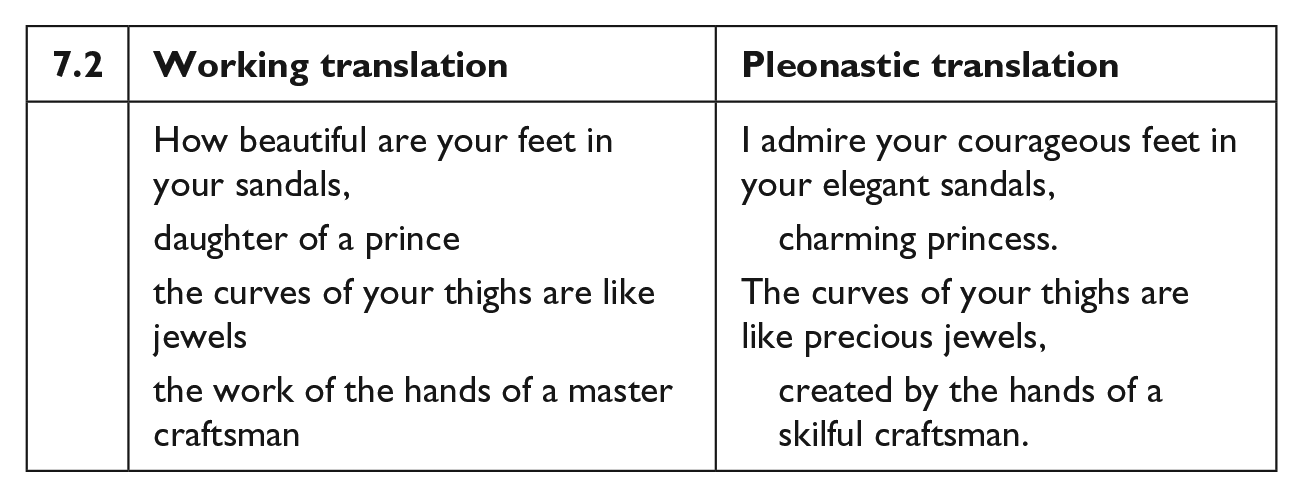
אמן (’amman) is one of the many hapax legomena in the Song of Songs, sometimes translated as “skilful artist,” or less anachronistically, “skilled craftsman.” Such translations already contain an adjective to elucidate its meaning; without an adjective the meaning can be expressed with the (composite) noun “master craftsman.” According to Hess, “there is an indirect allusion to God,” whose role as Creator is gratefully acknowledged (Hess 2005, 213). If understood this way, one could include such a weak allusion by using “create” for rendering מעשׂה (ma‘aseh “work”); this allusion becomes stronger in a canonical context. 18
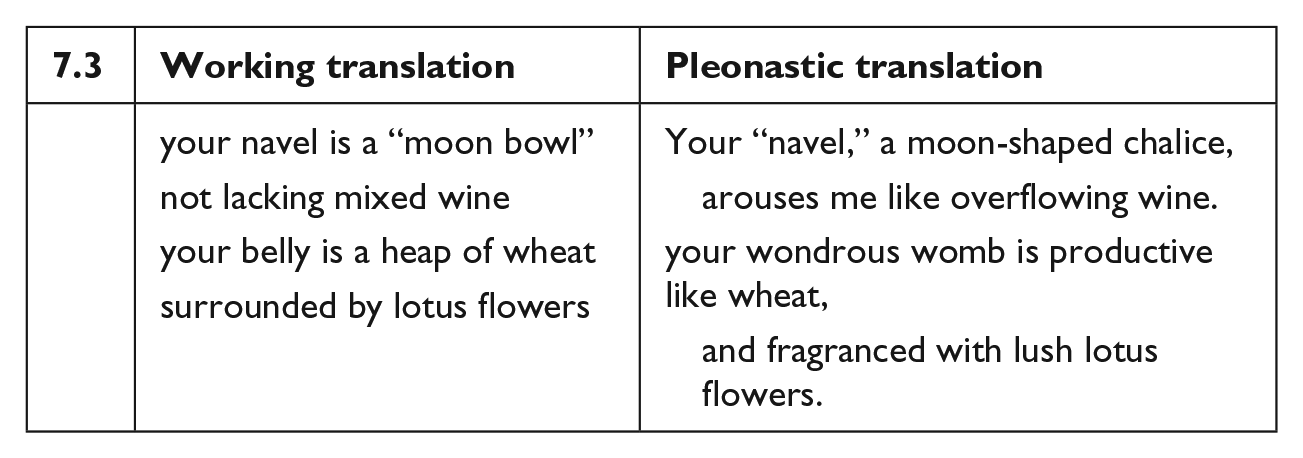
After the choice for the weak reference to the woman’s vagina in translating שׁרר “navel” because of what is implicit in the Hebrew, other elements in the translation of the sentence can strengthen an approximation of the implied association. One should remember that the poem is a song of desire and does not describe intercourse as such. This can be another reason to prefer the body part over a more dynamic rendering in the translation. This implication is strengthened by rendering “not lacking mixed wine.” “Not lacking” is a litotes for abundance, expressed with “spilling over.” Interpreting mixed wine as a kind of aphrodisiac, “arousing” replaces “mixed” to communicate sensual stimulation. The wine as fluid adds to the picture, in both source and target language. For poetic reasons, my pleonastic translation has dropped the litotes. 23
Together with wine, “wheat” expresses something of the riches of the land, being a main ingredient of the ancient Israelite diet. The translation offered did not find a way to express this link explicitly.
Wheat could be encircled with flowers at a harvest festival. Also when food was served, it could be embellished with flowers, stressing its appetizing character and its delicious nature. Thus, what is beautiful and enjoyable is presented as even more desirable. The lotus symbolizes life-renewing strength and could be related to birth.
Taking these considerations together, I have chosen to convey some of these implications by translating “womb” instead of stomach, implying the life-giving fertility of the woman, her capacity for re-creation, and the role the man plays in this. Besides, the word “womb” could be associated with security, thus making a link to the following verse. Nevertheless, “womb” should not be regarded as an interruption of the bottom-up structure of the poem/song. It is to be noted here that the floral embellishment does not serve as any kind of protection, and therefore the “unprotected” rendering of “womb” might imply similar accessibility for this festive occasion. The adjective “wondrous” strengthens the idea of observing beauty and for the flow between the W-words “wheat” and “womb.” The alliteration “lush lotus” strengthens the poetic character of the English translation, and fits the pleonastic approach.

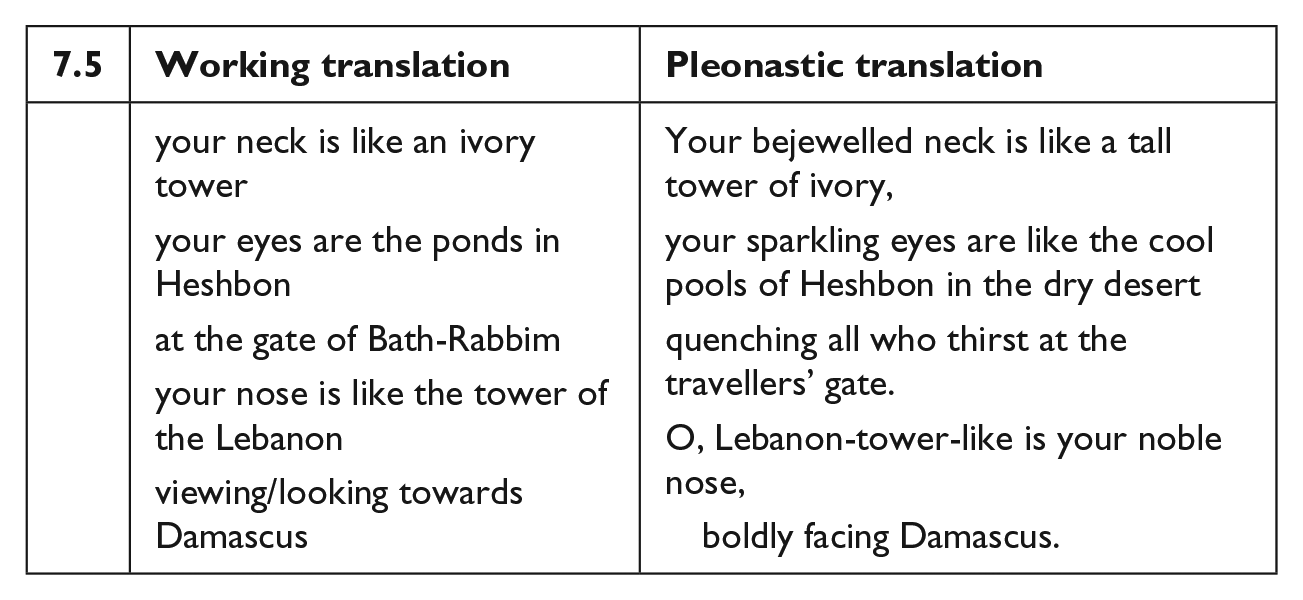
Transjordan Heshbon had water reservoirs that may have been royal ponds or public spaces (cf. Geraty 1993, 628). The connection with the gate implies that desert travellers could satisfy their thirst there. Bat-rabbim (בת־רבים) means “daughter of many”; the Septuagint translates so, apparently not knowing of any town with such a name. 26 Peetz translates “Tochter der Groβen” (daughter of great ones) and comments, “was sehr gut zum Bild der tanzenden Fürstentochter past” (which suits the image of the dancing princess very well) (Peetz 2015, 276). Our translation loses this possible implication.
The Lebanon, in association with Solomon’s dominion, could be considered an idyllic place (Uehlinger 2000, 95–109). In association with the strong enemy Damascus, the image evokes a military image, like the tower in Song 4.4. Women were sometimes represented as well-defended cities, especially with crowns and necklaces. For ancient readers, Lebanon in association with the nose would evoke a wordplay on the word for the scent frankincense לבונה (lebonah) (Nowell 2013, 26). If the reader is aware of the (archaic) English word “olibanum,” the word play is even retained; in order to add the “O,” the order of the Hebrew is reversed in English. Since this requires a hyphenated word for grammatical reasons and diminishes the flow of the line, the construction may appear as marked language (i.e., grammatically correct but unusual in the sense of language pragmatics) and therefore hint at the word play as a meaningful construction for the ancient audience (cf. Baker 2011, 141–52).
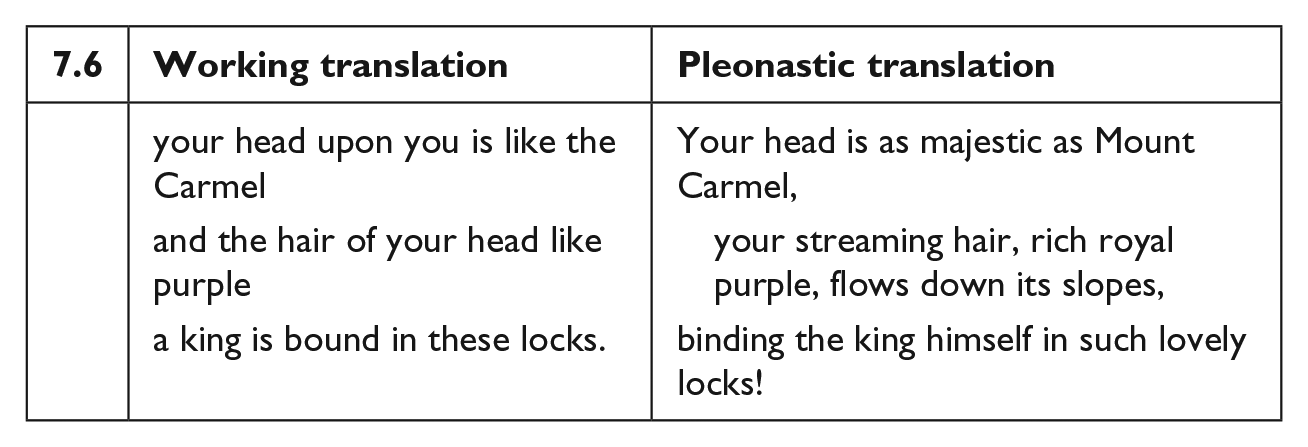
ארגמן (argaman) is not the colour purple itself, but refers here to the expensive purple-dyed cloth, in antiquity produced from molluscs in Tyre.
דלה (dallah) in Isa 38.12 means “loom-threads.” It might be a metaphor in the Song of Songs (the threads of your head), but the meaning of the verb דלל (dalal) “hanging” makes it hard to argue against “hair” being the common association; possibly it is even a dead metaphor. Hair was associated with power and, in some cases, wildness; it can enhance attractiveness. Keel refers to drawings of Egyptian dancers from Deir el-Medina (Schroer and Staubli 2001, 96–102). Making the description complete from feet to hair, the “locks” are also used as a bridge to the following verses by rounding off the description song and turning to a song expressing yearning and desire more explicitly.
The reference to a king forms a ring composition with “princess,” in between which images from nature, agriculture, and the military are placed. In sum, this song depicts a woman celebrating her loveliness, beauty, attractiveness, strength. In this mix of impregnability and intimacy the song expresses (possibly mutual) admiration and yearning.
Although much could have been elaborated on, the following translation should be telling enough. Hopefully, this “pleonastic translation” serves as a proper response to Wendland’s call: “Solomon’s sonorous and symbolic Song definitely needs to be given more attention and effort than it is usually afforded in most translation programs” (Wendland 1995, 55).
2 I admire your courageous feet in your elegant sandals, charming princess. The curves of your thighs are like precious jewels, created by the hands of a skilful craftsman. 3 Your “navel,” a moon-shaped chalice, arouses me like overflowing wine. your wondrous womb is productive like wheat, and fragranced with lush lotus flowers. 4 your breasts are like frolicking fawns, the tender twins of a gazelle. 5 Your bejewelled neck is like a tall tower of ivory, your sparkling eyes are like the cool pools of Heshbon in the dry desert quenching all who thirst at the travellers’ gate. O, Lebanon-tower-like is your noble nose, boldly facing Damascus. 6 Your head is as majestic as Mount Carmel, your streaming hair, rich royal purple, flows down its slopes, binding the king himself in such lovely locks!
Footnotes
1.
See footnote 5 in part 1. Cf. Klangwisan 2014 (see footnote 14 in part 1) and  , who acknowledge a secular/erotic meaning but underline other interpretive contexts in which the Song of Songs has “more” (religious) meaning.
2.
“It is therefore possible to understand why the scholarly reading of the Song of Songs has been able to refer the sense of the poem alternatively to secular pleasure, monotheistic faith, or pagan myth. As we may now recognize, all three of these dimensions are present. The pleasures described in the text indeed had a religious context or, more exactly, an interreligious one” (, 105).
3.
Cf. the examples in part 1, section 1.
4.
Many scholars assume so, e.g., Lamparter 1988, esp. 62–65; Fox 1985, esp. 227–52; , 315.
5.
Schmökel 1952; cf. Nissinen 2007, who assumes that the Song of Songs carries on a tradition of erotic poetry also related to sacred marriage. , 286) holds that such a link mocks the atmosphere of the book and the spirit of the collectors of the Old Testament; however, the possible relation to sacred marriage can be studied in the light of the song’s meaning before the canonization process.
6.
Ewald 1867; Stoop-van Paridon 2005; cf. .
7.
Clines 1995, 104, and , 137—a reading that was reason to question its canonical position (S. Castellio in the sixteenth century and, e.g., E. Reuss in the nineteenth century).
9.
Hunter 2000: against the practice, e.g., of women being married off by their male relatives; Mulder 1991, 76: against polygamy and its promiscuity; , 74–78: against the prohibition of mixed marriages.
14.
Cf. Blenkinsopp 1995; Niditch 1996; .
15.
Cf. Baker 2011, 274–99; , 290) expresses the “hope that our brief excursion into the creativity and ethics of translation in this book will encourage readers [and translators] to think of translation and interpreting as diverse, challenging, exciting, and highly consequential activities.”
16.
17.
This holds for most of the body parts referred to. Rendering the body parts dynamically would cause a big change in the translation of the metaphors, as most body parts are compared to objects. Cf. part 1, footnotes 25 and 37 and section 5b.
18.
It should be underlined that a weak allusion that becomes stronger in a canonical context bears a “general” theological nature and is not “doctrinal” as such; cf. Zogbo’s warning against ideology in translation and her call for non-doctrinal vocabulary (esp. for key terms; , 347). Cf. footnote 1 above.
19.
E.g., Pope 1977, 40; Wilkinson 1991, 209–10; , 40.
20.
The moon may be associated with female fertility, cf. Staubli 2003, 70–71; and “the moon is still today a symbol of beauty, perfection, piety, and virility” (, 225). Assuming familiarity with this association, the word “moon” is left without additional adjective.
21.
24.
Cf. the association of the two symbols on pictorial material from Israel-Palestine: http://www.bible-orient-museum.ch/bodo/details.php?bomid=16398; .