



Abstract
Syphilis is known as the great masquarader. We describe a case of a young patient with an atypical chancre.
An 18-year-old male was referred to our sexually transmitted infection service for a penile lesion that evolved over the last 6 weeks. Previous sexually transmitted and bloodborne infections (STBBI) screening that did not include a syphilis serology revealed anal chlamydia and gonorrhoea, treated with azithromycin, cefixime and doxycycline with no symptom improvement at the time of consultation. The patient, who had been circumcised in the past, identified as a man who has sex with men (MSM) and reported inconsistent barrier method use and four sexual partners in the last 3 months. Clinical evaluation revealed a crusty hyperkeratotic cap covering the whole glans with reduced meatal opening, synechias (Figure 1) and bilateral inguinal lymphadenopathy. Systemic symptoms and urethral discharge were absent.
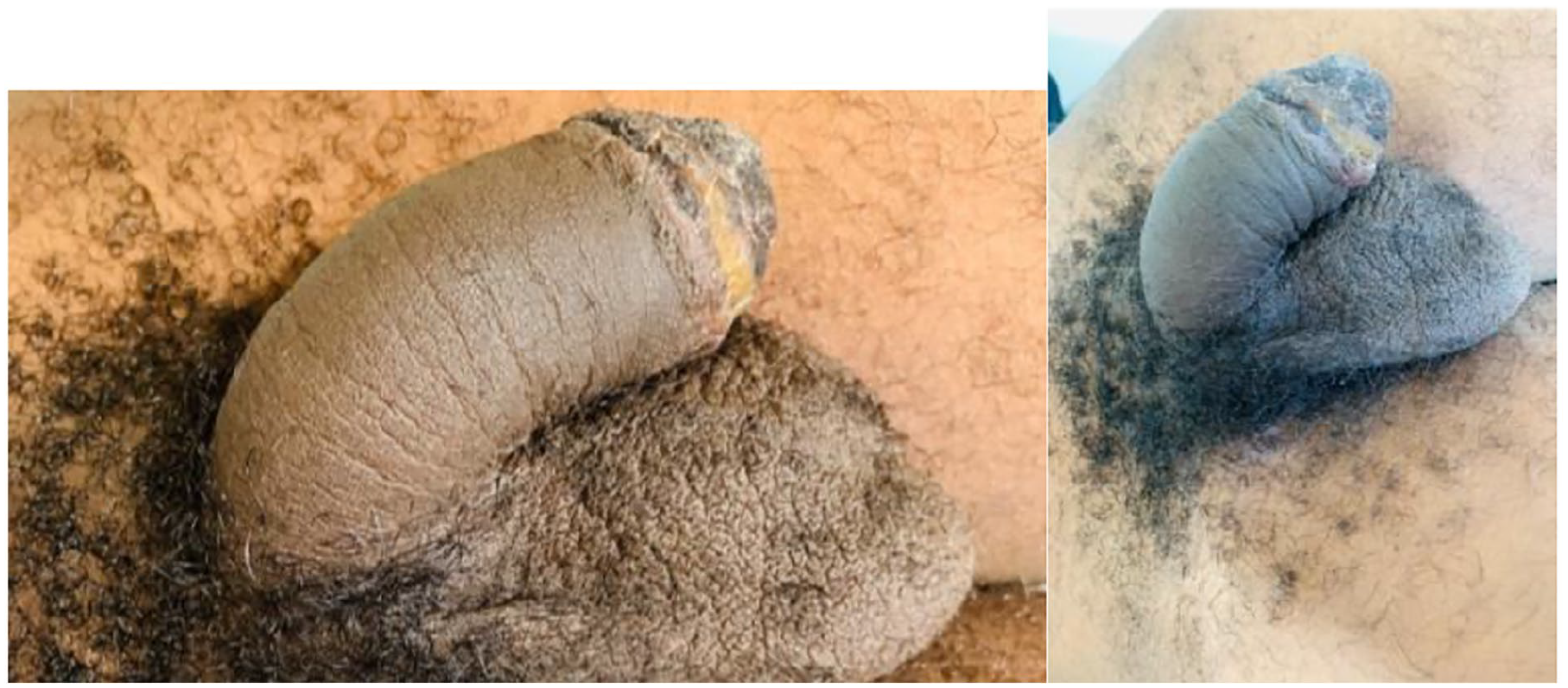
Hyperkeratotic dry and crusty cap overlying the whole glans.
Enzyme immunoassay (EAI) and rapid plasma reagin (RPR) tests confirmed a diagnosis of syphilitic balanitis of Follman (SBF). Treatment with 2.4 M units of Penicillin G Benzathine was initiated, resulting in rapid lesion improvement and complete resolution at 1-month follow-up (Figure 2).

Complete resolution after 2.4 million U IM of penicillin G benzathine.
Syphilis chancre is the hallmark of primary syphilis, and when present appears in the first 90 days after Treponema pallidum inoculation. 1 Classic presentation has been described as a single, unifocal, painless, indurated and moist erosion of several millimetres in the genital area or elsewhere. Many atypical syphilis chancre subtypes have been described. 1 SBF is a rare presentation of primary syphilis described as erosive balanitis associated with bilateral inguinal lymphadenopathy. 2 Differential diagnoses can include candidal, herpetic, atopic and psoriasic balanitis, or glans synechiae associated with lichen planus or lichen sclerosus. SBF diagnosis requires a high index of suspicion which can be facilitated by careful inquiry of STBBI risk factors and the finding of bilateral lymphadenopathy. Management includes penicillin G benzathine treatment with primary syphilis dosage, as well as STBBI screening and counselling. 3 In our patient, SBF clinical presentation, which is usually described as oozing and erosive, was further modified by the drying effect of his circumcised glans leading to a puzzling hyperkeratotic cap with hardened synechiae.
This case underscores the importance of comprehensive sexually transmitted illness (STI) testing and consideration of syphilis in sexually active MSM with atypical genital lesions, particularly when accompanied by lymphadenopathy. It also reinforces the idea that syphilis is indeed ‘the great masquerader.’
Footnotes
Acknowledgements
Patient consent for picture publication.
Declaration of conflicting interests
The author(s) declared no potential conflicts of interest with respect to the research, authorship and/or publication of this article.
Funding
The author(s) received no financial support for the research, authorship and/or publication of this article.
