




Abstract
The outer third of external auditory canal is cartilaginous and contains pilosebaceous glands and hair follicles. The medial two third is bony, and the skin is devoid of these skin appendages and its secretions. It also has outward migratory property which makes the ear self-cleansing. Here we present an exceeding rare case of hair in the tympanic membrane causing distressing symptom of scratchy sensation, tinnitus, and otalgia. We hypothesize, it is the distortion of migratory pattern medially due to repeated otitis externa caused by abuse of cotton bud that led to presence of hair in the tympanic membrane.
Introduction
The external auditory canal (EAC) consists of lateral cartilaginous and medial bony part lined by skin. The skin in the lateral one third bears skin and contains sebaceous and ceruminous glands. The wax in the ear canal is composed of these glandular secretions and desquamated keratinocytes. 1 The medial bony canal has very thin skin and is devoid of skin appendages. The stratified keratinized squamous epithelium in the lateral surface of tympanic membrane (TM) and the ear canal has lateral migratory property that serves as self-cleaning and repairing mechanism for the TM and the ear canal.2–7 Epithelial migration on the TM and EAC had been evaluated in a number of otic diseases in humans, such as otitis externa5,8 and middle ear cholesteatomas. 9 Most of these epithelial migration studies were done with application of ink dot on the TM and EAC to study the migration pattern. Many of these studies had revealed a distorted or slow epithelial migration.
Here we present an exceedingly rare case of repeated otitis externa caused by abuse of cotton bud leading to medial migration of squamous epithelium. We hypothesize that the hair normally seen in the lateral cartilaginous portion of EAC have migrated to the TM causing distressing symptoms. In our knowledge, this is the first reported case of hair bearing epithelium in TM.
Case
A 40-year-old female presented to the ENT OPD with history of ringing and scratching sound in both of her ears. She had a blocked sensation and pain in her ear. She also gave repeated history of ear discharge which were treated as otitis externa in the past. She gave history of cleaning her ear with different objects such as cotton buds, match stick and even with sharp objects like pins. There was no history of vertigo. Examination revealed excoriation of the ear canal. There was hair growth in the TM along with the wax that are normally not present in the medial part of EAC let alone the TM (Figure 1). The brushing of the hair in the TM was the cause of distressing symptoms of scratchy sensation. Pure tone Audiometry and impedance showed normal hearing level and normal middle ear functioning (Figure 2). She was counselled on avoidance of ear cleaning, and otitis externa was treated with steroid-antibiotic ear drops. Follow-up after a year showed that the otitis externa had resolved but hair was still present in TM suggesting persistence of distorted epithelial migration (Figure 3).
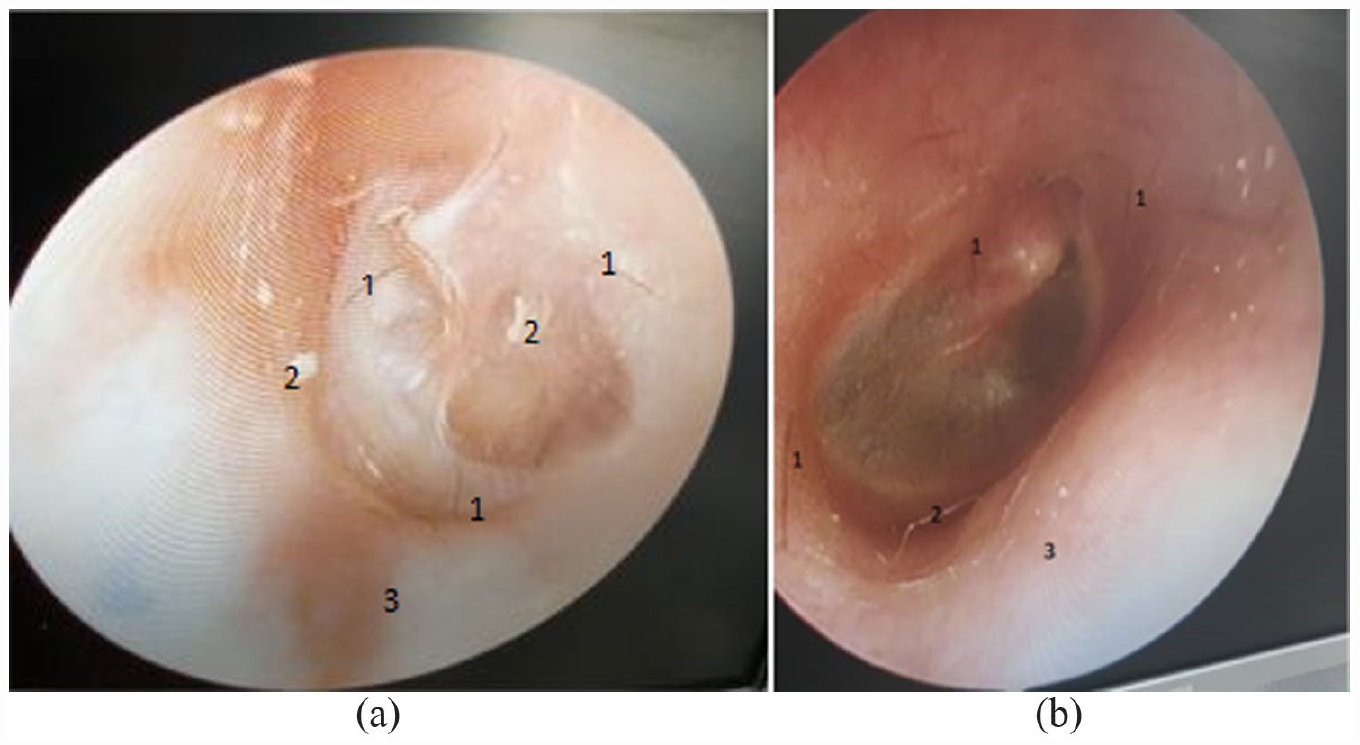
(a) Picture showing hair growth and wax in tympanic membrane with excoriation of floor of external auditory canal (1 = hair, 2 = wax, 3 = excoriated EAC). (b) Evidence of cotton bud abuse by the presence of 1 = hair follicles, 2 = cotton wool, 3 = excoriation of ear canal.

Pure tone audiogram showing the normal hearing level in this patient.
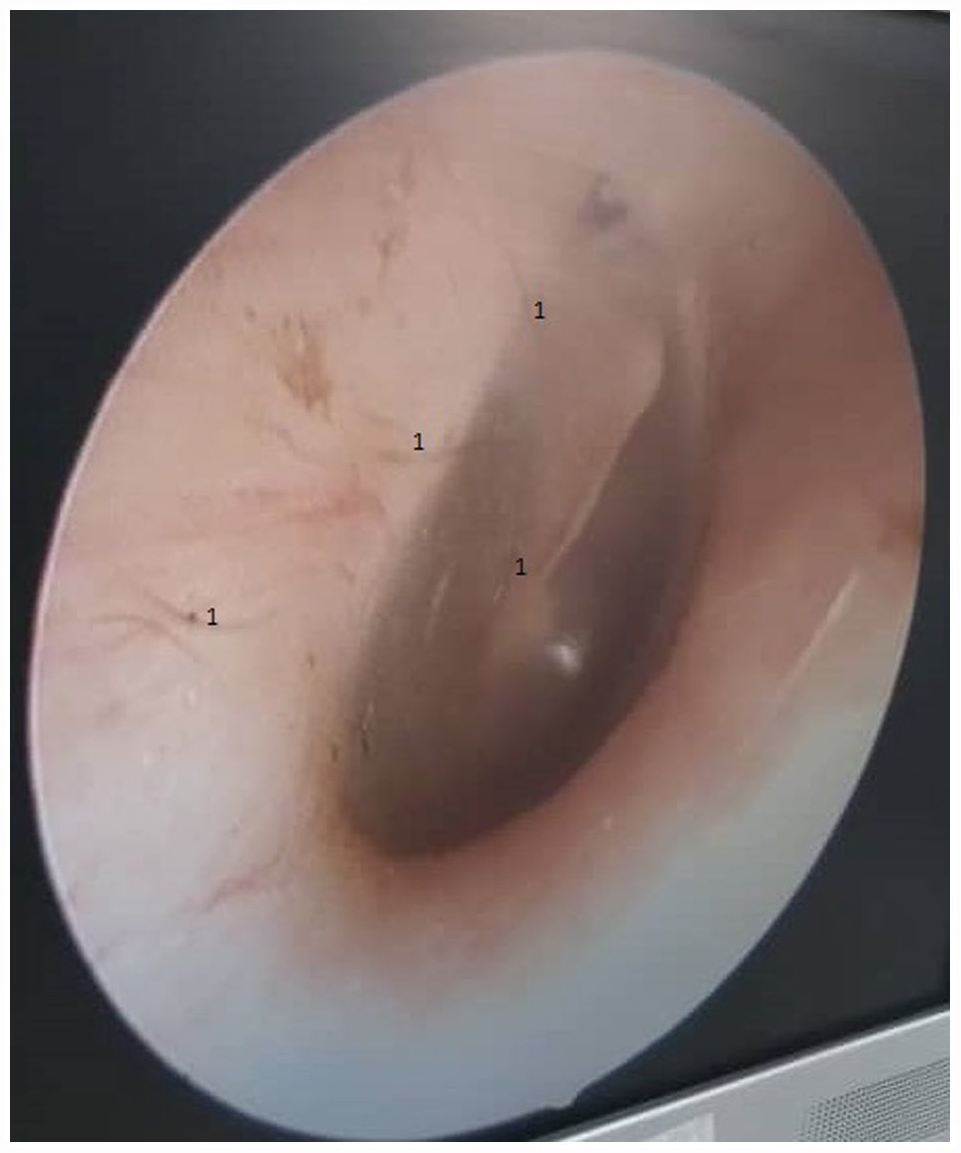
Follow-up of the patient after 1 year. The otitis externa has resolved but hair follicles are still present in the bony meatus and tympanic membrane marked by number 1.
Discussion
EAC needs to stay free of any debris or obstruction to have an optimum transmission of sound waves to the TM and then to the cochlea via the ossicles. Epithelial migration in the TM and EAC is a necessary physiologic function to keep the ear free of ear wax build up from the desquamating keratinized squamous epithelium in the TM and EAC.
Migration of epithelium has been demonstrated by several authors. Migration has been demonstrated in the living human TM by using ink dots placed near the centre (umbo) of the outer surface.10,11 The ink dots move out on to the external canal and continue in the same direction until the osseocartilaginous junction. Upon reaching the osseocartilaginous junction, the squamous debris gets mixed with cerumen and is expelled out.
Abnormal epithelial migration has been studied in different disease conditions such as recurrent otitis externa, chronic secretory otitis media, external ear canal cholesteatoma, and keratosis obturans. Antonio et al found that epithelial migration was slow in external ear cholesteatomas. Makino and Amatsu 12 demonstrated slower epithelial migration in keratosis obturans. The abnormal migratory pattern has also been well established in otitis externa5,8 and middle ear cholesteatomas. 9
Since the advent of cotton Q-tips in 1923, Q-tips are widely used by people for cleaning of ear and various other purposes. Use of Q-tips had been a leading cause of otitis externa. 11 The prevalence of ear cleaning in Bhutan is very high. There has also been a misconception among the Bhutanese that ear canal cleaning is a healthy practice as demonstrated in our earlier studies. 13 Repeated ear cleaning can cause the distortion of normal flora in the EAC as well as trauma to the EAC skin, thus predisposing to repeated otitis externa. We hypothesize that the repeated use of cotton buds to clean the ear canal had caused recurrent otitis externa. Recurrent otitis externa over time had distorted the normal epithelial migratory process causing medial migration of epithelium there by leading to hair growth over the TM.
There are limitations to this case report. A single case cannot prove the distortion of epithelial migration in ear canal secondary to cotton bud abuse. Thus, further studies are required to study the distortion of epithelium migration in otitis externa and its pathophysiologic phenomenon.
Conclusion
This exceedingly rare case of hair on the TM shows how epithelium migration in the external ear can be distorted by abuse of cotton bud (Q-tip) to clean the ears. We hypothesize the medial migration of hair bearing squamous epithelium to TM. This abnormal epithelial migration will result in accumulation of wax, otitis externa, and distressing symptoms of hair brush in the TM normally devoid of hairs. It is important to create awareness among the public against the use of cotton bud as cotton bud usage is very common in our society.
Footnotes
Acknowledgements
Not applicable.
Author contributions
Declaration of conflicting interests
The author(s) declared no potential conflicts of interest with respect to the research, authorship, and/or publication of this article.
Funding
The author(s) received no financial support for the research, authorship, and/or publication of this article.
Ethics approval
Our institution does not require ethical approval for reporting individual cases or case series.
Informed consent
Written informed consent was obtained from the patient(s) for their anonymized information to be published in this article.
