




Abstract
Common obstacles to successful retrieval of retrievable inferior vena cave filter include embedded filter hook and severe tilt of the filter. We described a modified wire-loop snare technique using self-made fishhook-like pigtail catheter and 11-F-long sheath to retrieve a severe tilted filter with embedded hook successfully. The modified wire-loop snare technique is simple and effective requiring only standard equipment and single venous access. This technique may be suitable for some types of retrievable filter with embedded hook.
Introduction
Severe tilt with embedded hook is a common obstacle to successful retrieval of the retrievable inferior vena cava filter (IVCF). One reason leading to retrieval failure is that the wire and catheter could not be guided between the inferior vena cava (IVC) wall and the filter neck. 1 This report described a modified wire-loop snare technique using self-made fishhook-like pigtail catheter and 11-F-long sheath (Cook Medical, Bloomington, IN, USA) to retrieve a severe tilted filter (Cook Medical) with embedded hook successfully.
Case
A 77-year-old female patient was presented to the emergency department complaining of shortness of breath and right lower extremity pain. Ultrasound demonstrated a huge pelvic mass (26.3 cm in maximum diameter) and thrombosis of right saphenous vein and popliteal vein. To prevent pulmonary embolism, we deployed a retrievable IVC filter (Cook Medical) before the resection of pelvic mass. The venogram demonstrated that bilateral iliac veins enlarged and the IVC was compressed severely by the huge mass (Figure 1(a)). The retrievable filter was deployed at the level of the distal IVC close to the bifurcation through the right femoral vein approach (Figure 1(b)). Then, the patient underwent pelvic mass resection, and the pathology result revealed a mucinous cystadenoma in the right ovary.
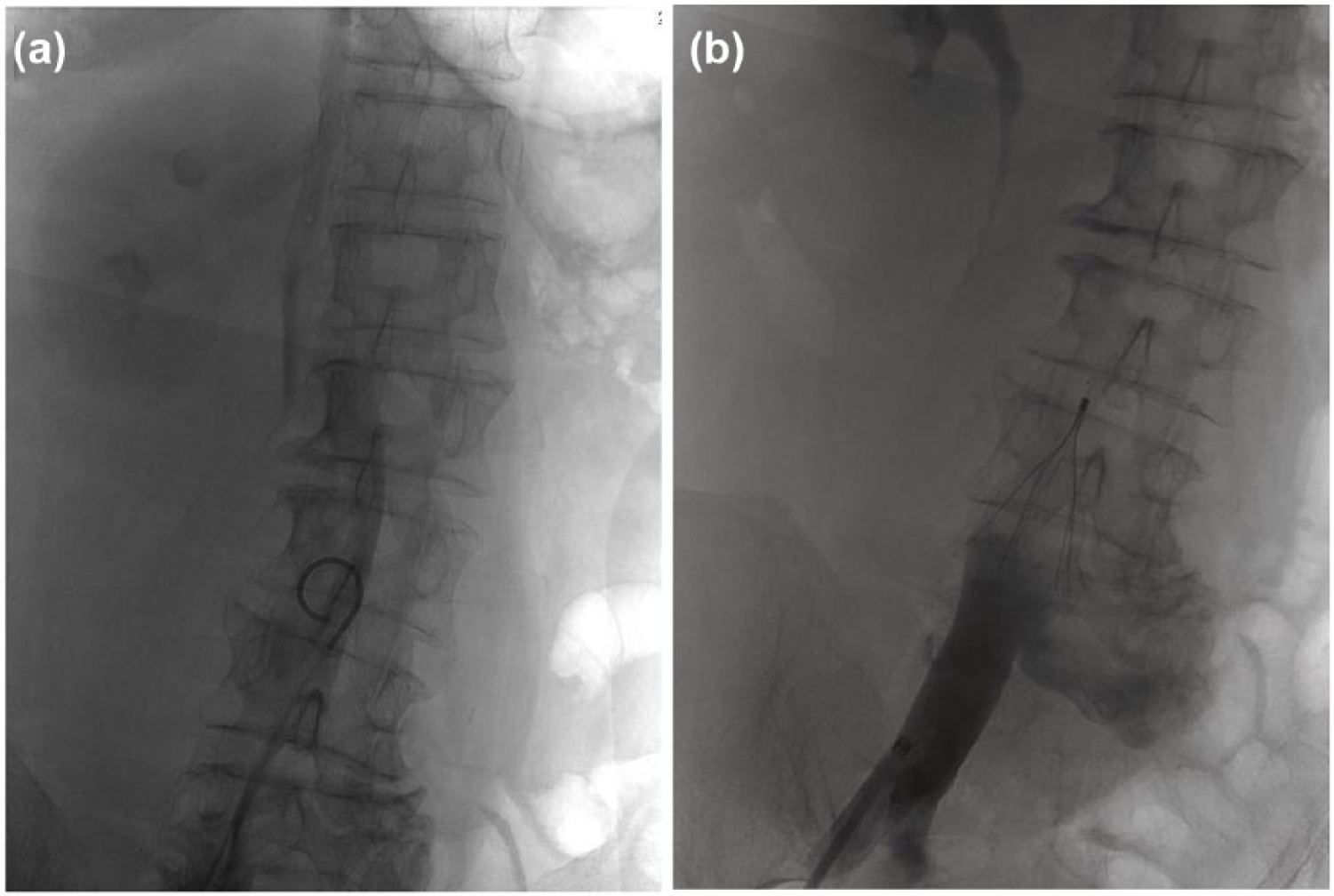
(a) The IVC was compressed severely by the huge mass and (b) a retrievable filter was deployed at the level of the distal IVC close to the bifurcation.
After 5 weeks, the venogram confirmed that the filter tilted with hook embedded in the IVC wall (Figure 2(a)). A right-sided internal jugular vein approach was used with placement of an 11-F-long sheath. Conventional snare technique was attempted, and the filter hook could not be snared. A 5-F pigtail catheter (Cordis, Fremont, CA, USA) was remade fishhook-like by cutting off the end of it (Figure 2(b)). A 0.035-in-long soft guidewire (Terumo Corporation, Shibuya-ku, Tokyo) and a self-made pigtail catheter were introduced to the IVC through the sheath. Simultaneously, a 5-F diagnostic catheter (Cordis) and a snare (Lepu Medical, Beijing, China) advanced to the proximal IVC. The pigtail catheter was placed between the filter neck and the IVC wall. The soft guidewire was directed through the interstice of the filter neck and the IVC wall and advanced back into the snare (Figure 2(c)). The leading end of the wire was snared and withdrawn into the sheath to form a loop and snare the hook (Figure 2(d)). Cranially directed tension was applied to the trailing end of the wire and the snare to release and snare the embedded hook. The sheath advanced over the filter to collapse the filter, and the filter was removed.
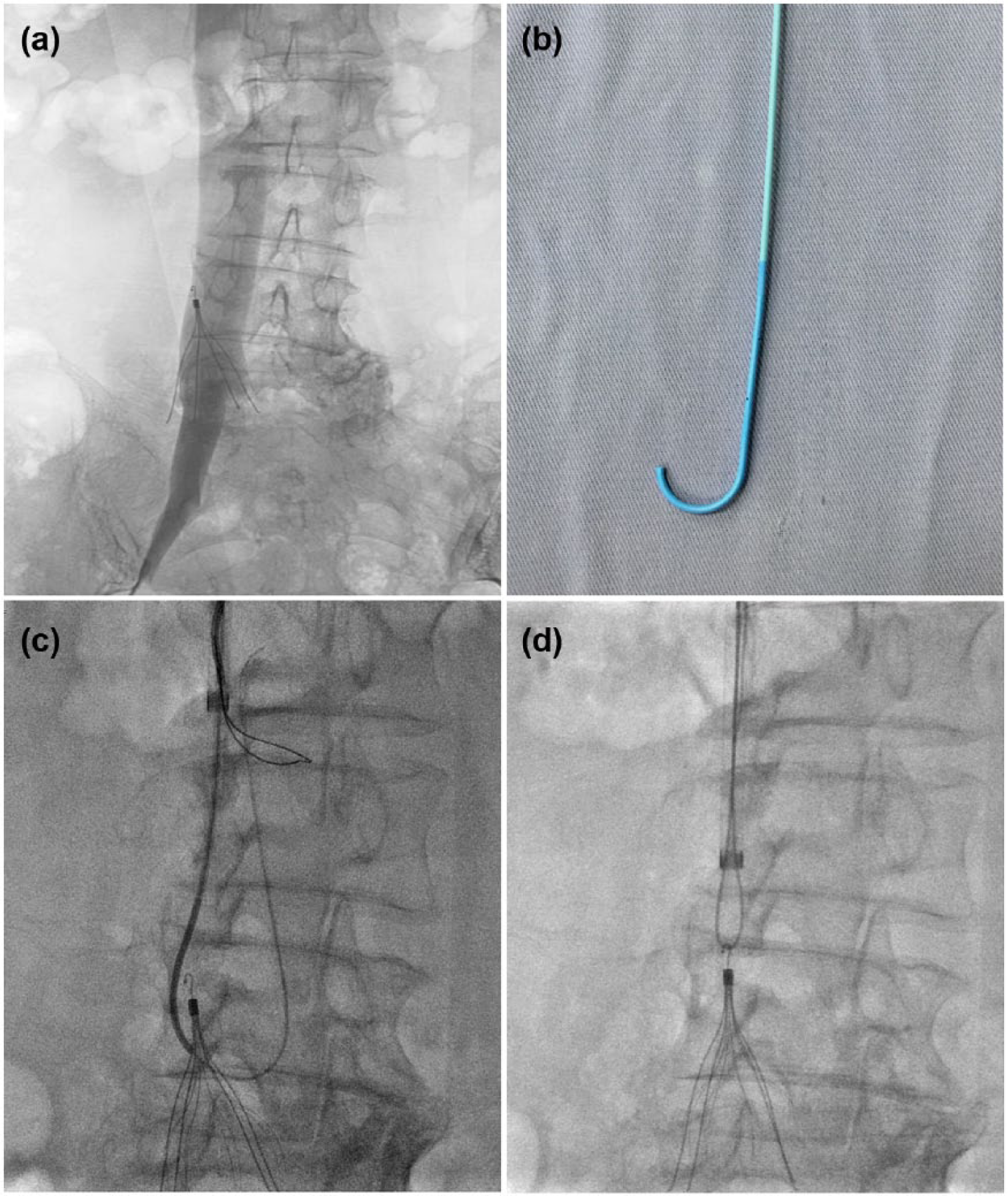
(a) The venogram demonstrated that the filter tilted with hook embedded in the IVC wall, and there was a interstice between the filter neck and the IVC wall, (b) a 5-F pigtail catheter was remade to be fishhook-like by cutting off the end of it, (c) the soft guidewire was directed through the interstice of the filter neck and the IVC wall and advanced back into the snare and (d) the leading end of the wire was snared and withdrawn into the sheath to form a loop and snare the hook.
Discussion
Severe tilt with embedded hook is a common obstacle to successful IVC filter retrieval. Many advanced techniques for these difficult retrievals have been described. Foley et al. 2 reported a fall-back technique for IVCF retrieval by creating a wire loop between the filter legs with the success rate of 96%. Al-Hakim et al. 1 described a hangman technique creating a wire loop between the filter neck and IVC wall for release of embedded filter hooks, and the retrieval success rate was 81.8%. The reason leading to retrieval failure is the wire could not be guided between the IVC wall and the filter neck. Moreover, larger sheaths (14 F or even 18 F) used in the process of retrieval may result in the internal jugular vein injury and associated complications. In addition, Esparaz et al. 3 depicted a similar wire-loop technique of fibrin cap disruption as an adjunctibe method for filter retrieval 6 months after deployment. Forceps technique was reported to be a safe and effective technique to remove severely tilted and embedded IVC filters.4,5 Dual access snare-over-wire method was tried by some authors and proven to be feasible in difficult removal of retrievable IVC filters. 6
In this report, we describe a modified wire-loop snare technique which is effective and can improve the success rate of retrieval. First, pigtail catheter is remade to be fishhook-like and cut off to different shape to direct the wire tip through the interstice between the filter and the IVC wall. Even if there is no interstice between the filter and the cava wall, the self-made catheter can direct the guidewire to pass through separate interstice of the filter struts to form wire loop and stretch the hook away from the cava wall. Then, we perform this technique using a small long sheath (11 F) through which a 5-F pigtail catheter and a 5-F diagnostic catheter can pass simultaneously without bleeding from the gutter. The smaller sheath also diminishes the injury to the internal jugular vein. Furthermore, in addition to the conical filter types, this technique can potentially be applied to other types of retrievable filter such as OptEase. If the filter tilts severely and both struts and hooks are embedded in the cava wall completely, we can perform dual wire-loop snare passing through the separated struts of the proximal and distal baskets through jugular and femoral access simultaneously. By stretching to the opposite way, the filter collapses and the hook is stretched away from the cava wall. Subsequent conventional snare technique may be performed successfully.
Conclusion
The modified wire-loop snare technique is effective and simple. This technique may improve the success rate of some types of retrievable filters with severe tilt and embedded hook, such as OptEase and Celect.
Footnotes
Declaration of conflicting interests
The author(s) received no financial support for the research, authorship and/or publication of this article.
Ethical approval
Ethical approval to report this case was obtained from the Ethical Committee of the Affiliated Hospital of Qingdao University.
Funding
The author(s) received no financial support for the research, authorship and/or publication of this article.
Informed consent
Written informed consent was obtained from the patient(s) for their anonymized information to be published in this article.