




Abstract
Objectives:
For treatment and prevention of deep vein thrombosis(DVT) and pulmonary embolism(PE), retrievable inferior vena cava(IVC) filters have commonly been used as an effective bridge to anticoagulation. However, we experienced unexpected difficulty in endovascular retrieval of some IVC filters. Most problems were due to endovascular treatment devices issues, filter intimal migration, filter disintegration, filter-associated thrombosis, and right atrium/ventricle migration.
Methods:
Disposable biopsy forceps was used to engage the filter hook and reform the shape of the filter struts. Endovascular retrieval assisted by use of the biopsy forceps via a similar vein was effective and provided a less-invasive, low cost method for removal of problematic IVC filters.
Results:
We described easily performed methods that uses disposable biopsy forceps for the retrieval of IVC filters that are difficult to remove because of filter hook migration into the caval wall.
Conclusion:
We developed an easily performed method that uses intestine biopsy forceps for the retrieval of IVC filter that are difficult to remove.
Introduction
Temporary retrievable inferior vena cava (IVC) filter implantation serves as an effective “bridge” to anticoagulation therapy. However, various types of retrievable IVC filter failures have been reported.1–7 Most of these failures were due to endovascular treatment, device issues, filter hook intimal migration, filter disintegration, filter-associated thrombosis, and right atrium/ventricle migration. 5 In the event of retrievable IVC filter hook migration into the caval wall, we have developed an easily performed troubleshooting method that uses intestine biopsy forceps for the removal of retrievable Optease® IVC filter, which have not traditionally been regarded as retrievable.
Case reports, methods
In the first case, a 71-year-old woman, who was previously diagnosed with a left sprained knee joint, was admitted to our hospital. A few days later, she complained of pain in the left leg and edema. Enhanced computed tomography (CT) revealed a thrombus expanding from the left external iliac vein to the femoral vein, and chest CT showed a thrombus in the right main pulmonary artery. She was diagnosed with a left deep vein thrombosis (DVT) and pulmonary embolism (PE) that require emergency treatment. We inserted an Optease® (Cordis, USA) IVC filter and performed acute thrombolytic therapy. The post-IVC implantation course with simultaneous anticoagulation therapy was uneventful, and the filter indwelling time was 10 days. As usual, a 10 Fr. introducer sheath was used to attempt filter retrieval from the right femoral access during venography. However, because of filter caudal hook intimal migration into caval wall, it was difficult to retrieve the filter into the 10 Fr. vascular sheath (Figure 1). In this urgent situation, we used EndoJaw® disposable intestine biopsy forceps (OLYMPUS, Japan) that corresponded to a 6 Fr. vascular sheath. The biopsy forceps was used to reform the filter struts tenting, and the filter was removed through the same introducer 10 Fr. sheath by correcting the tilt of the caudal filter hook and snaring the hook (Figures 2 and 3).
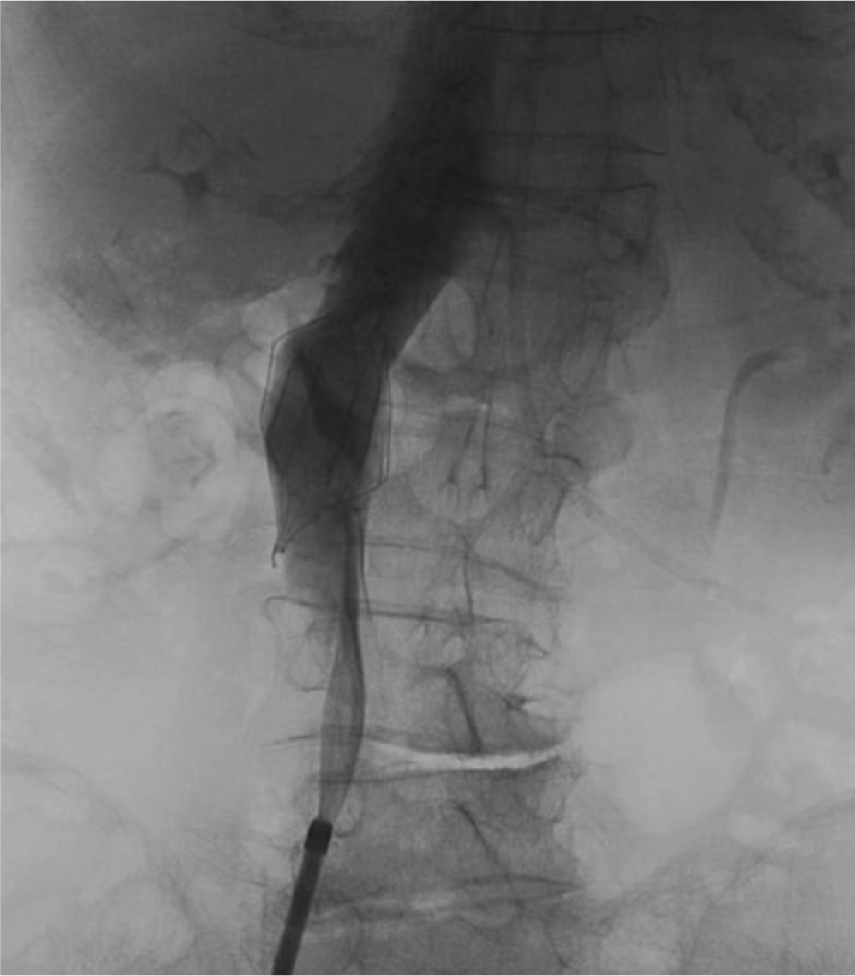
Venography shows a retrievable IVC filter hook showing intimal migration into the IVC wall.
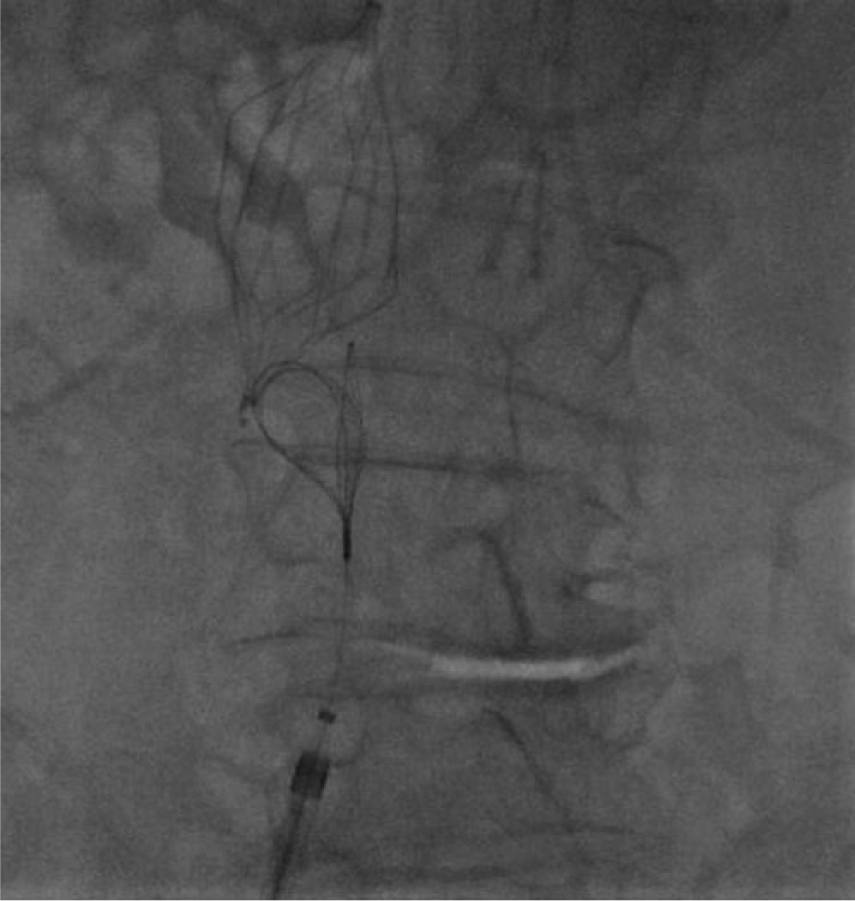
Fluoroscopic image showing IVC filter hook intimal migration at the L1 level. The filter caudal hook was difficult to snare because it became embedded into the IVC wall.

The IVC filter could be removed by disposable biopsy forceps. Correction of the tenting struts using the biopsy forceps and snaring of the filter hook are shown on a cavogram.
In the second case, a 91-year-old female has complained of pain in left leg and edema that had been present for a few days. In addition, enhanced CT revealed thrombus expanding from the left common iliac vein to the femoral vein and PE. We immediately initiated thrombolytic and anticoagulation therapy at the time of IVC filter insertion. The filter indwelling time was 12 days for the simultaneously performed anticoagulation therapy. At retrieval, an inclination of the filter was observed in venography. To separate the filter hook from the underlying caval wall, we utilized the disposal intestine biopsy forceps that corresponded to a 6 Fr. sheath (Figures 4 and 5). The strut of the filter body was grasped to separate the caval wall. We could then easily snare the caudal hook and remove the filter through the same 10 Fr. introducer sheath through the right femoral vein. Biopsy forceps were required to dissect the tip from the caval wall to allow removal of the filter body (Figure 6).

The filter hook migrated into the caval wall in venography.

The filter hook could be retouched by disposable biopsy forceps.

Snaring of the filter hook and removal of the filter body into 10 Fr. sheath are shown.
We subsequently used disposable biopsy forceps to reform the shape of filter strut and engage the filter hook. In these trouble cases, a retrieval 6 Fr. vascular sheath has been inserted through the right femoral vein at first. For snaring the caudal hook of the filter, the hook requires to be tilted to adjust the normal central position on a cavogram. Biopsy forceps were used to grip the side-struts through the same introducer 10 Fr. sheath from the right femoral access. The 6 Fr. disposal biopsy forceps were used to remodel the filter hook in the center position to achieve release of the tilted/migrated filter hook from the caval wall. No major complications occurred in either case as a result of this technique. The Review Board of Tokoname Municipal Hospital approved this study.
Discussion
Temporary retrievable IVC filter implantation is often used for patients with DVT and PE in the acute phase. The Optease® retrievable IVC filter is a non-permanent-type filter that can be inserted through the jugular, femoral, or antecubital vein and has a completely different design with vertical side-struts and a diamond-shaped double basket. A centrally located hook at the basket is designed for retrieval from the femoral vein approach. No struts fracture has been reported while maintaining basket shape, but change of form has been noted.1–4,6
Several reports have described various types of retrievable IVC filter failures.1–4,6,7 Because the basket shape of Optease® usually does not lead to strut fracture, in filter retrieval, the sheath from the femoral vein was advanced over the filter after snaring the filter hook, and the device was subsequently removed leaving the sheath behind. However, a tendency toward filter hook intimal migration into caval wall has often been observed using venography. At retrieval, we have often observed that the hook could not be snared by a standard retrieval kit. Retrieval problems involving filter intimal migration, filter fracture, filter-associated thrombosis, and IVC occlusion have been reported. 5
Rimon et al. 7 reported that Optease® filter retrieval was attempted in 139 cases, and there were four retrieval failures (2.8%) due to the inability to engage the filter hook and seven failures due to the inability to sheathe the filter because of intimal overgrowth (5.0%). Onat et al. 8 reported 115 removals of 124 retrieval attempts, with nine retrieval failures (7.2%) due to the inability to engage the filter hook of Optease® and TrapEase®. Although high rates for retrieval of Optease® filter have been reported,1,3,4 we have often encountered retrieval problems. Various methods for achieving difficult retrievals of other retrievable filters have been described. For example, a renovated access route was changed from the contralateral femoral approach, ballooning dilation was used for IVC stenosis, and guide wire–induced detachment of the filter hook from the caval wall was performed.9–13 Sugiura et al. 9 reported the use of the loop-J-type wire technique for successful retrieval of the Günther Tulip filters® that was surrounded by minor clots. Van Ha et al. 10 described various retrieval techniques involving the use of catheter twist, modified snare, loop snare, and balloon techniques. The endobronchial forceps were reported to have been successfully used in 10 cases of fractured G2 filter to retrieve the filter body. 10 For vessel narrower than IVC, they used endobronchial forceps to retrieve the fractured filter struts.
There are few reports on the long-term benefits of filters and increasing reports of possible long-term complications. 14 We follow this recommendation to avoid retrieval failures and early initiation of anticoagulation. 14 In our hospital, duplex ultrasonography and enhanced CT are routinely performed before filter retrieval on the 7th/10th day. We use this approach to try and reduce severe complications (retained thrombus, IVC occlusion) 4 that may be caused by prolonged IVC filter implantation.
We have found it occasionally difficult to retrieve filters that have slightly tilted or migrated in the caudal direction. 3,11 . In these trouble cases, a retrieval 6 Fr. vascular sheath has been inserted through the femoral vein at first. For snaring the caudal hook of the filter, the hook requires to be tilted to adjust the normal position on a cavogram. Biopsy forceps were used to grip the side-struts through the same introducer 10 Fr. sheath. The 6 Fr. disposal biopsy forceps were used to remodel the filter hook in the center position to achieve release of the tilted/migrated filter hook from the caval wall.
In an attempt to retrieve the Optease® filter, we have used disposable intestine biopsy forceps, and this approach did not require any “special” technique or device in difficult case. Disposable biopsy forceps was used to engage the filter hook and reform the shape of the filter struts. No major complications have occurred during or after filter retrieval as a result of this technique.
Conclusion
We developed an easily performed method that uses intestine biopsy forceps for the retrieval of an IVC filter that is difficult to remove because of filter hook migration into the caval wall.
Footnotes
Declaration of conflicting interests
The authors declare that there is no conflict of interest.
Funding
This research received no specific grant from any funding agency in the public, commercial, or not-for-profit sectors.