



Abstract
Background:
Social anxiety disorder is the most common anxiety disorder in children with burns, which require psychological treatments including storytelling. Therefore, this study was conducted with the aim of determining the effect of storytelling on the social anxiety of hospitalized children with burns.
Methods:
In this clinical trial study, 52 people in two test and control groups were selected by random sampling. Storytelling education was conducted in 13 sessions for the intervention group. Data analysis was done using statistical tests by SPSS 22 software.
Results:
A significant difference was observed between social anxiety before and after the intervention (p = 0.001). Accordingly, social anxiety and fear of negative evaluation have decreased after the intervention.
Conclusion:
Based on this study’s results, storytelling effectively reduces the social anxiety disorder of children with burns and reduces social anxiety at different childhood ages.
Introduction
Today, burn accidents and their consequences are considered a public health problem affecting all people in different age groups. 1 Burn injuries are intentional and unintentional injuries caused by exposure to heat, electricity, and chemicals. 2 Burns are considered one of the most destructive injuries. 3 So that the World Health Organization has estimated that 265,000 deaths occur due to burns in the world every year. 4 According to the results of a study, burn accidents account for 6.48% of accidents in Iran. 5 According to the Burn Research Center of the University of Iran, the number of these patients in the country is eight times the global average. 6 Burn incidents and their consequences are the main cause of death and disability in children, children’s burns comprise about 30%–50% of all burns. 7 According to the latest report of the World Health Organization and UNICEF, burns caused by fire are the cause of death of about 96,000 children per year, in other words, burns are the main cause of death in children up to the age of 14. 8 The results of a study showed that burns are one of the most important incidents that threaten the health of children in Iran, and it is considered the most common injury and the third cause of death in this age group, and the highest amount of burns occur in children under 5 years old. 9 Burn is a phenomenon that has negative biological, emotional, psychological, and social effects on people. 10 Burned children are not exempted from this rule and according to the evidence, they experience many physical, psychological, and social distresses during exposure and treatment of burns. 11 One of the most common problems for burn patients is anxiety, which is also noticeable in children. 12 Anxiety is a vague and unpleasant feeling in the form of worry that can cause tension, anger, and fear in children. 13 Carson believes anxiety is a natural response to dangerous situations and a warning sign. Almost all people have experienced some symptoms and signs of anxiety during their life. 14 Anxiety in children manifests itself in many ways, and social anxiety is the most common anxiety disorder in childhood. 15
Social anxiety is characterized by an obvious and persistent fear of social situations. 16 Sheinberg et al. believe that social anxiety is also known as social phobia. 17 The results of studies show that social anxiety disorder is the most common and the third mental disorder, so it is estimated that between 5% and 13% of the population have this problem.18,19 Social anxiety is seriously related to the increased possibility of mood disorders and can cause significant functional disorders in children as well. 20
According to the evidence, solving the psychological problems that affect burn patients improves their quality of life and health, and not solving these problems in the acute stage can lead to the development of chronic mental diseases in them. 21 Therefore, it seems necessary to plan measures to reduce the social anxiety of hospitalized children with burns. Nurses play an important role in caring for burn patients and reducing the level of anxiety in these patients. Also, nurses spend more time with the child than other members of the health team, and for this reason, they have a unique opportunity to influence the physical and emotional health of the child. And nurses who are familiar with these measures can play a significant role in reducing patients’ anxiety by using them. 22 One of these methods that can have a significant effect on reducing children’s anxiety is storytelling, which can be used as a nursing intervention to reduce children’s anxiety. 23
Storytelling is an ancient verbal art that is also very popular among Iranian children. Erikson considers the story as a healing suggestion, in other words, storytelling means sharing stories through words, sounds, and visual images, which can be used as a low-cost nonpharmacological treatment to reduce the anxiety of hospitalized children. 24
The research conducted in this field also shows that storytelling can be effective in the treatment of many mood and behavioral disorders, so Bahmani and Barzegar showed in their research that storytelling reduces aggression and increases social skills in preschool children. 25 Storytelling can improve the child’s social behavior and cause relaxation, and socialization, and increase the child’s social skills. 26 The results of Beaudoin et al.’s research showed that story therapy improves social and emotional skills in 8–10-year-old children. 27 Anxiety can have a negative effect on the recovery and rehabilitation of burn patients. Therefore, controlling anxiety caused by burns is very important. Storytelling can be effective in reducing psychological disorders such as children’s social anxiety. Storytelling is a very useful, safe, and low-cost solution that has a high implementation capability in the management field and can be used in a wider dimension in all hospitals and health centers related to children. Based on the above information and the importance of the subject and considering the different background conditions of children with burns compared to other patients and conducting limited studies in the field of determining the effect of storytelling on the social anxiety of children with burns so far, this study aims to determine the effect of storytelling on social anxiety children with burns were admitted to the hospital.
Methods
This clinical trial study (IRCT20210407050877N1, 15/05/2021) was conducted on 52 children with burns admitted to the hospital by random sampling method, and the study samples were placed in two groups (26 people) and control (26 people).
The inclusion criteria for the study included: age 4–7 years, having a history of burns and hospitalization due to burns, consent of the children and their family to participate in the study, and ability to answer the questionnaire questions. The exclusion criteria for the study included: absence of more than two storytelling sessions, simultaneous participation in other counseling or treatment sessions, and the children and their family’s unwillingness to continue cooperation during any stage of the study.
It should be noted that the study was carried out after receiving the code of ethics (IR.AJUMS.REC. 1399.960) from the ethics committee of the University of Medical Sciences. Given that the subjects were under the legal age, verbal, and written informed consent was obtained from parents/legally authorized representatives for their child’s participation in the study.
The storytelling intervention for the test group was carried out in such a way that the test group received the storytelling method in 13 sessions. Also, storytelling was done during the morning and evening shifts when the child did not have a specific procedure, and storytelling was done for the child in the hospital bed or on a chair next to the bed in the hospital room. In addition, based on the opinion of the children’s physician, storytelling was performed for children whose burns were mild or moderate.
It should be noted that both groups completed demographic and social anxiety questionnaires. Meanwhile, no storytelling intervention was performed on the control group. After the storytelling intervention was implemented for only the test group, the used questionnaires were completed again by two groups and then the results were analyzed and compared. The storytelling session program included welcoming and introducing the researcher, dividing the children into two test and control groups, and administering the pretest. Introducing different types of storybooks to the experimental group and asking them to listen to the stories read by the researcher. It should be noted that in all sessions, the stories were read by the researcher and the children listened to the stories very seriously. Even when the researcher entered the ward, they shouted with great joy that their aunt had come to tell us a story. In addition, the families requested different types of storybooks from the researcher so that they could tell stories to the child at home after he was discharged from the hospital. It should be noted that the content of the storybooks presented by the researcher to the burnt children is as follows:
Self-awareness and the story of the secret of the strange creature for the awareness of feelings, thoughts, emotions, and motivations and with the aim of helping to increase self-concept and recognize different types of emotions. Effective communication and storytelling with the title of strange guests. Interpersonal relationships (the story of the statue of friendship), courage or determination, courage and self-expression (boldness), and self-confidence in the field of interpersonal communication. Empathy with the story of peacock feathers and greedy bears. Problem-solving in five steps using the big mistake story. Creative thinking with the story of the white tooth and bamboo stalk. Critical thinking with the story of fire in the green forest. Dealing with emotions with the aim of overcoming fear, anxiety, and anger. Decision-making with the story of flying above the valley of fear. Coping with stress with the aim of identifying types of stress. A review of the discussed topics and summarization of the content. Based on the statements of expert professors and child psychiatrist colleagues, it was decided to examine the effectiveness of this method for determining the anxiety status of a hospitalized burned child the posttest would be evaluated after 2 weeks.
In this study, the sample size was calculated using the formula for comparing two means given below and based on the results of similar studies 11 and with a confidence level of 95%. The initial sample size was calculated to be 22 people for each group; therefore, with a probability of 20% of people dropping out during the study. Therefore, with a probability of 20% dropout during the study, the final sample size was estimated to be 26 people in each group (52 people in total). The assignment of individuals to each group was also random.

The tools used in the study include the demographic questionnaire and social anxiety questionnaire of Watson and Friend, 28 which are explained below: The demographic information questionnaire of the participants and the social anxiety questionnaire included 58 questions, of which 28 questions (questions 1–28) are related to the social anxiety subscale and 30 questions (questions 29–58) are related to the fear of negative evaluation subscale. The continuum of answers is rated based on the spectrum of true and false, and zero and one scores are assigned to each answer, respectively. The social anxiety subscale consists of 28 items, 15 of which have (+) answers and 13 (−) answers. The range of scores is between 0 and 28, with scores above 12 indicating high social anxiety and scores between 0 and 3 indicating low social anxiety. The fear of negative evaluation subscale also has 30 items, 17 of which have (+) answers and 13 items have (−) answers. The range of this subscale is between 0 and 30, where scores above 18 indicate people with a fear of negative evaluation by others, and scores below 9 indicate people with little fear of negative evaluation by others.
The validity of this demographic questionnaire was done through content validity. In this way, the researcher, taking into consideration the desired research variables and reading books and articles, prepared the initial questionnaire, and then it was given to ten faculty members of University of Medical Sciences. The validity of this demographic questionnaire was done through content validity. In this way, the researcher, taking into consideration the desired research variables and reading books and articles, prepared the initial questionnaire, and then it was given to ten faculty members of the Faculty of Nursing and Midwifery of Ahvaz University of Medical Sciences. The social anxiety questionnaire in Iran was translated and psychometrically analyzed by Musa Rezaei and colleagues in 2020. This questionnaire has high validity and reliability, and the reliability coefficient of this questionnaire was reported as 0.92 using Cronbach’s alpha method. 29
Statistical analysis
It should be noted that descriptive statistics, mean, and standard deviation were used for statistical analysis of demographic characteristics. Also, to test the assumption that the data distribution is close to the normal distribution, the Kolmogorov–Smirnov test, skewness, and kurtosis indices. Also, to analyze the results, paired t-test, independent t-test, Chi-Square were used. All statistical tests were analyzed with the help of SPSS 22 (IBM) software, and the significance level was considered 0.05.
Results
The mean and standard deviation of the age of the children in the test group is 7.51 ± 2.11 and in the control group is 6.55 ± 2.2. A total of 32 boys and 20 girls participated in both the test and control groups. The results showed that there was no statistically significant difference between the variables of age and gender in the two groups (Table 1).
Comparison of the average age group in two control and test groups.
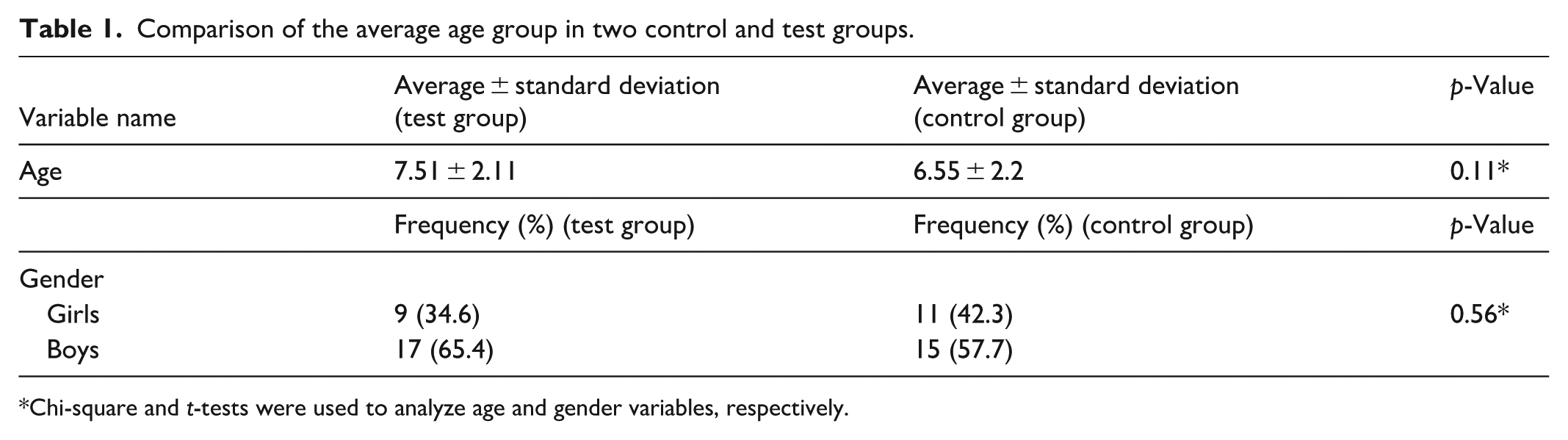
Chi-square and t-tests were used to analyze age and gender variables, respectively.
By examining the mean and standard deviation of social anxiety and fear of negative evaluation before intervention in both test and control groups, it was found that there is no statistically significant difference between the two groups (p = 0.22). Also, the mean and standard deviation of social anxiety before and after the intervention was obtained at 21.30 ± 1.34 and 5.96 ± 1.18, respectively; the mean ± standard deviation of the fear of negative evaluation was 23.34 ± 1.29 before the intervention and 5.19 ± 1.096 after the intervention. A statistically significant difference was observed by examining the mean and standard deviation of social anxiety in two groups before and after the intervention (p < 0.001) (Table 2).
Examination of social anxiety items in two test and control groups.
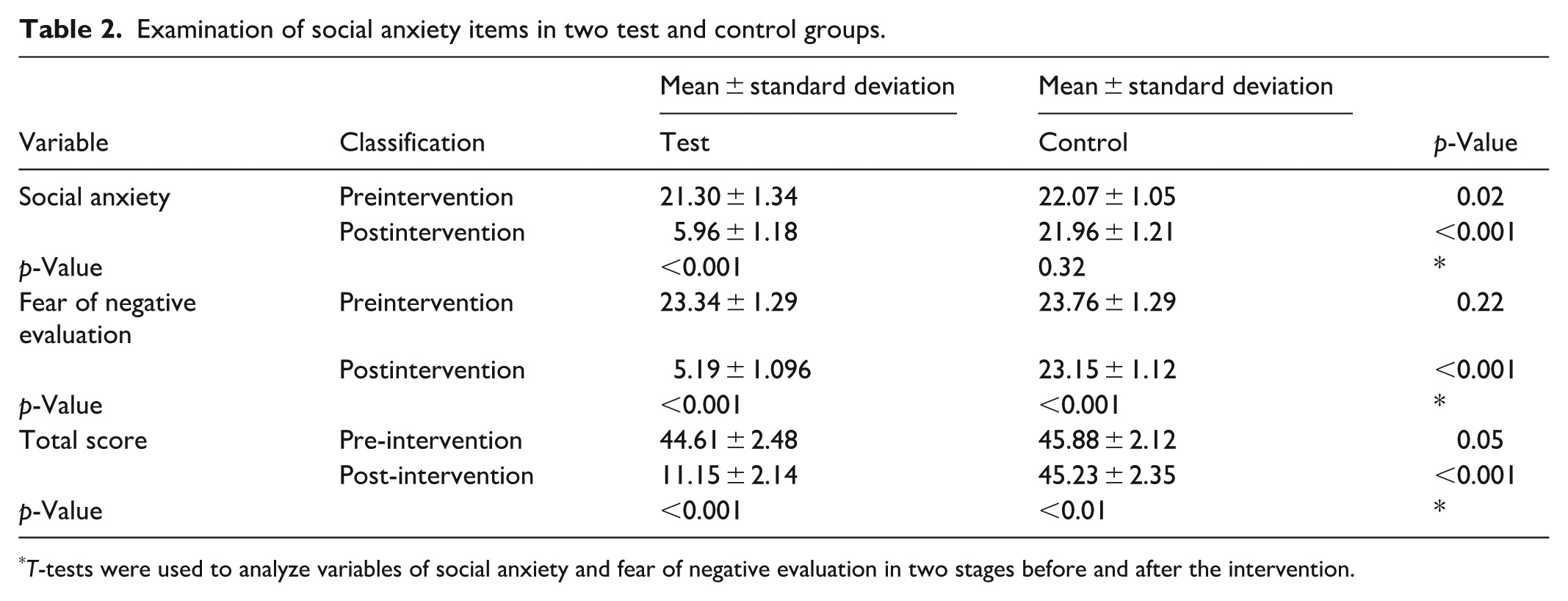
T-tests were used to analyze variables of social anxiety and fear of negative evaluation in two stages before and after the intervention.
Discussion
This research was conducted with the aim of determining the effect of storytelling on the social anxiety of hospitalized children with burns. The results of Shojaei et al.’s study also showed that there is no statistically significant difference between any of the demographic variables in the groups, 30 which is consistent with the results of this study. Also, the study of Hakim et al. confirms the results of this study. 31 According to the results obtained from this study, it can be said that the absence of statistically significant differences in any of the demographic variables indicates that they have no effect on the changes in the storytelling score on the social anxiety of children with burns. The findings of this study showed that according to the mean and standard deviation of social anxiety and fear of negative evaluation before the intervention in the two test and control groups, there was no statistically significant difference between the two groups (p = 0.22).
In line with the findings of the present research, the results of a study, which was conducted with the aim of the effect of storytelling on reducing the anxiety of hospitalized children, showed that there was no statistically significant difference in social anxiety between the test and control groups before the intervention. 31 Also, the results of the mentioned studies and this study showed that before the intervention, the level of anxiety was high in both the control group and the test group.
This increase in child anxiety can be due to various reasons. For example, when the child is separated from the home or the people she is attached to, followed by hospitalization, which is considered a painful experience for the child and imposes a lot of mental pressure on the child, especially children with burns who suffer from physical and mental complications and can cause problems in the child’s adaptation to the surrounding environment and create tension in her. Another finding of the current research showed that according to the mean and standard deviation of social anxiety after the intervention, a statistically significant difference was seen between the control and test groups (p = 0.001), The results indicated that the intensity of social anxiety has decreased after the intervention. Therefore, it can be said that storytelling is effective in reducing the severity of social anxiety in children with burns admitted to the hospital.
In confirmation of the findings of the present research, Baghbani et al.’s study, which aimed to determine the effectiveness of storytelling on the social anxiety of elementary school boys, was conducted with an action research approach. The results showed that students’ social anxiety decreased after the intervention 32 which is in line with the results of this study. Therefore, it can be said that storytelling is a suitable method for communicating with children and conveying concepts, and it is a sensitive tool for understanding children’s thoughts, identifying their tendencies, and helping them to understand the world around them more accurately, and it helps to increase self-awareness and improve interpersonal relationships of the child. The child understands the complexities of human behavior by observing the various characters in the stories and can better communicate with the people around them, which reduces their social anxiety. 32 In line with the findings of the current research, the results of a study that was conducted with the aim of determining the effect of storytelling on reducing the anxiety of 4–7-year-old children hospitalized showed that there was a statistically significant difference between the anxieties of the two groups after the intervention. Storytelling has reduced the anxiety of children in the test group (p < 0.01). 31 Therefore, it can be said that stories create a platform for emotional projection and emotional release by providing an opportunity. Also, identifying and increasing children’s understanding can be an important source in changing and improving children’s mental problems and disorders. In this way, storytelling has a positive effect on the prevention of permanent and irreversible psychological effects, including social anxiety, prevention of perceptual transformation in children, assistance in treatment, and its continuation.31,32 According to the obtained results, it was found that there is a statistically significant difference in the mean of social anxiety in the control and test groups (p > 0.001). Also, there is a statistically significant difference between the average score of social anxiety before and after the intervention (p = 0.000).
In the way that the intensity of social anxiety has decreased after the intervention, in confirmation of the findings of the present study, the results of the study by Zarei et al. showed that there was a statistically significant difference between the two groups of test and control after the intervention (p < 0.001). 12 which has expressed the reduction of worry and social anxiety in the test group, which is consistent with the results of this study. In this regard, it can be said that the children evaluate and analyzes their behaviors and ideas through listening to stories. Moreover, inspired by the characters in the story, they try to correct their behavior and succeed in gaining self-awareness and gaining new insight into their inner issues. Then she projects this identification into her own life in order to participate in the beliefs, thoughts, and emotions of the story character and indirectly work on her emotional and cognitive issues. 12 Finally, if the children understand the connection between the subject of the story and the subject of their life, they can directly think about their problems and find a solution for them, and in this way, they can manage or reduce the psychological disorders created in them. 32 Also, the results of the researchers’ studies that confirm the findings of this study showed that storytelling intervention has a positive effect on reducing children’s social anxiety (p < 0.05).23,33–35. Therefore, stories can provide a framework for understanding and encouraging children to solve serious problems. By telling stories, nurses can encourage children to accept treatment measures, so that in addition to paying attention to the psychological aspect of these children, their cooperation in the treatment will follow. Among the limitations of this study, we can mention the lack of suitable space for the children participating in the research for the storytelling program, as well as the fact that storytelling coincides with the time of dressing the child’s burn. Also, among the strengths of this study, we can mention the increase in the awareness of families about the use of storytelling to reduce children’s anxiety during hospitalization and the unique reception of parents and nurses to the method of storytelling to reduce anxiety and tension in children.
Conclusion
The results of the findings showed that storytelling is a nonmedicinal, new, easy, accessible, favorite, and suitable method to reduce the social anxiety of children with burns. Through storytelling, children learn the strategies to deal with interpersonal problems and acquire the skill of expressing themselves in a constructive and useful way. Therefore, storytelling can be used as an effective technique along with other psychological treatments to reduce children’s social anxiety, which reduces internal behaviors and improves the quality of the child’s interactions with the family, environment, and society. Meanwhile, by implementing storytelling in healthcare institutions, of course in a regular and planned manner by healthcare providers, children can be given the gift of peace of mind and spirit.
Supplemental Material
sj-docx-1-smo-10.1177_20503121251394458 – Supplemental material for The effect of storytelling on the social anxiety of hospitalized children with burns: A clinical trial study
Supplemental material, sj-docx-1-smo-10.1177_20503121251394458 for The effect of storytelling on the social anxiety of hospitalized children with burns: A clinical trial study by Ashrafalsadat Hakim, Masoumeh Hamid, Ashraf Tashakori and Mohammad Hossein Haghighizadeh in SAGE Open Medicine
Supplemental Material
sj-docx-2-smo-10.1177_20503121251394458 – Supplemental material for The effect of storytelling on the social anxiety of hospitalized children with burns: A clinical trial study
Supplemental material, sj-docx-2-smo-10.1177_20503121251394458 for The effect of storytelling on the social anxiety of hospitalized children with burns: A clinical trial study by Ashrafalsadat Hakim, Masoumeh Hamid, Ashraf Tashakori and Mohammad Hossein Haghighizadeh in SAGE Open Medicine
Footnotes
Acknowledgements
This article is taken from the master’s thesis of nursing (IR.AJUMS.REC.1399.960/IRCT20210407050877N1). We would like to express our sincere gratitude to the esteemed Vice Chancellor for Research and Technology of Ahvaz Jundishapur University of Medical Sciences and also to the esteemed parents who could not have done this research their cooperation.

Ethical considerations
This study was approved by the Vice Chancellor for Research and Technology ethics Committee of Ahvaz Jundishapur University of Medical Sciences (IR.AJUMS.REC.1399.960). The study was registered in the Iranian registry of clinical trials (IRCT20210407050877N1, 15/05/2021).
Consent to participate
Informed consent was obtained from all the Parents/Legally Authorized Representatives of the children to start the research. Meanwhile, all the methods were performed according to the relevant guidelines and regulations.
Author contributions
Ashrafalsadat Hakim: Writing—original draft; Masoumeh Hamid: Data collection; Ashrafalsadat Hakim, Ashraf Tashakori, Mohammad Hossein Haghighizadeh: Data analysis; Ashrafalsadat Hakim: Reviewing the final edition.
Funding
The authors received no financial support for the research, authorship, and/or publication of this article.
Declaration of conflicting interests
The authors declared no potential conflicts of interest with respect to the research, authorship, and/or publication of this article.
Data availability statement
The data sets used and/or analyzed during the study are available from the corresponding author.
Supplemental material
Supplemental material for this article is available online.
References
Supplementary Material
Please find the following supplemental material available below.
For Open Access articles published under a Creative Commons License, all supplemental material carries the same license as the article it is associated with.
For non-Open Access articles published, all supplemental material carries a non-exclusive license, and permission requests for re-use of supplemental material or any part of supplemental material shall be sent directly to the copyright owner as specified in the copyright notice associated with the article.
