




Abstract
Background:
Sleep disorders and disturbances are a significant issue that affects occupational health and safety, yet their association with occupational injuries remains understudied. Therefore, this systematic review and meta-analysis aimed to investigates the association between sleep disturbance, sleep disorder, and occupational injuries among industry workers in Ethiopia.
Methods:
Observational studies reporting occupational injury, sleep disturbance, and sleep disorder were considered in this study. A comprehensive search of electronic databases, including PubMed, Google Scholar, Semantic Scholar, HINARI, and ScienceDirect, and a Google manual search was conducted up to December 18, 2024. The recommended Preferred Reporting Items for Systematic Reviews and Meta-Analyses guidelines were used for reporting items. Data were extracted using a standard data extraction template and exported to STATA V 17 for analysis. The Joanna Briggs Institute quality assessment tool was used to determine the quality of the reviewed research articles. To estimate the pooled association, a random effects model was used. The Egger’s regression test and the funnel plot were used to evaluate publication bias.
Results:
This review included a total of 27 studies that met the inclusion criteria. The finding revealed that industrial workers who have sleep disorder and sleep disturbance had a 2.6 and 2.5-fold increased risk of experiencing occupational injuries than those without sleep disorder and disturbance, respectively. Subgroup analyses demonstrated that high heterogeneity exists among manufacturing and agricultural workers for sleep disorders and moderate heterogeneity among building and construction sectors for sleep disturbances. The leave-one-out sensitivity analysis showed the robustness of the results.
Conclusion:
Sleep disorders and sleep disturbances increase the risk of occupational injuries. Therefore, integrated interventions tailored to the manufacturing, service-providing, building and construction, and agricultural workers context are required. Applying workplace policies, prioritizing mental health supportd to lessen the effects of sleep disturbances and disorders in service-providing industry sectors, and implementing thorough health and safety training, promoting better sleep hygiene practices to lower their risk of injury in agricultural workers, are advised.
Keywords
Introduction
Occupational injuries refer to any bodily injury or harm incurred by an employee while performing their duties in the industry. 1 It represents a profound public health problem with extensive economic and social ramifications. It ends in short-term or long-term loss of labor and financial costs for individuals and companies. Companies face direct costs for compensation payments and repairs of damaged materials, as well as indirect costs like production delays and decreased credibility.2,3
Occupational injuries are a worldwide occupational phenomenon with socio-economic and health impacts. In the USA, it causes nearly 6500 workplace fatalities and 13.2 million nonfatal injuries and costs $145 billion. 4 In Europe, the statistical authority for the European Union evidenced that the average fatal occupational injury rate of workers across more than 15 European nations was 1.57/100,000 workers. 5 In addition, according to the International Labour Organization report, 2.78 million workers lose their lives to work-related illnesses and accidents each year, and another 374 million employees suffer from non-fatal work-related injuries and illnesses. 6
In Sub-Saharan Africa, the annual number of fatal occupational accidents is a little over 54,000, with a fatality and accident rate of 21 and 16,000/100,000 workers, respectively. 7
Occupational injuries affect all industry sectors, including manufacturing, construction, mining, small-scale enterprises, agriculture, healthcare, and municipal solid waste collection. The combined scale of occupational injury in mining, manufacturing, and construction sectors in Africa was 57% 8 and 53.23% for small-scale industry labor force in sub-Saharan Africa. 9 Like many developing countries, Ethiopia faces a significant occupational injury burden. From a total of 26,000,000 in the workforce, the estimated fatal accident and fatality rates were 5596 and 21.5, respectively. 7 Needlestick injuries among healthcare workers range from 28.9% for 1-year occurrence to 43% for lifetime prevalence. 10 The pooled magnitude of occupational injury was 44.7% 11 and 46.8% 12 among construction workers. Among small-scale industry workers, the prevalence ranges from 14.7% 13 to 65.8%. 14 Sanitation workers, crucial for maintaining urban health and hygiene, are particularly vulnerable to occupational injuries, ranging from 12.9% to 63.9%.15–20 The other industrial sector in Ethiopia is agriculture, which is consistently cited as among the most hazardous industries worldwide, with workers exposed to mechanical, chemical, biological, ergonomic, and safety hazards in their natural work environment. This sector exposed workers to unconventional work arrangements, the introduction of innovative technologies, including the use of dangerous machinery and new chemical substances, unsafe practices, and negligence of safety protocols.21–23 In this sector, occupational injury rates vary from 36.7% to 77.5%.24,25 Therefore, the above magnitude indicated that occupational injuries are a significant public health issue, and identifying their risk factors is crucial for reducing and developing preventive measures.
Previous literature showed that occupational injuries resulted from a multifaceted interplay of risk factors. sex, age, smoking, alcohol consumption, 26 overweight, drug use, obesity, 27 low income, and rural residence, working in hazardous areas, job dissatisfaction, workplace supervision, 11 sleep disturbance and disorder,20,28 job categories like mechanic and welding, and unsafe practices by workers. 29 Similarly, psychosocial factors, fatigue, 30 job stress, work arrangements, and environmental and social conditions are risk factors for occupational injuries.29,31–33 However, from the listed risk factors, sleeping disturbances and disorders are the major, repeatedly listed factors that intensify the number of occurrences and severity of occupational injuries. The human body requires sleep to function properly. However, interrupted sleep has numerous negative outcomes, such as increased mortality, 34 diabetes mellitus,35,36 obesity,37,38 burnout, 39 reduced performance, and occupational injury.40,41 Sleep disturbances and disorders have profound implications for individuals’ overall well-being and functional capacity. This is particularly common among industrial employees who are subjected to long shifts, high risk working conditions, and extended working hours. 42 These variables can aggravate sleep problems, causing exhaustion, diminished cognitive function, and decreased attentiveness, and intensify the risk of occupational injuries. The aforementioned industry in Ethiopia presents specific challenges for their workers that result in sleep disturbance and disorder. For instance, healthcare industry workers often involve shifts and prolonged working hours,42,43 and agricultural workers are exposed to seasonal pressures and physically strenuous tasks.44,45 In construction, mining, 8 small-scale industries, 9 and solid waste management endure dangerous situations,18,46,47 which can alter their sleep habits and increase the risk of injury. However, even though sleep health is vital and well understood, comprehensive findings on the relationship between sleep disturbance, sleep disorder, and occupational injuries remain limited. Moreover, despite occupational injuries being well studied in Ethiopia, limited studies have investigated the role of sleep disturbance and disorder in compounding occupational injuries. Research in other regions has shown a clear link between sleep problems and increased injury risk, but limited findings have been conducted within the Ethiopian industrial context. 41 Besides, filling this gap will help to improve worker health, reduce occupational injury, and enhance their productivity. Furthermore, determining the role of sleep disturbance and disorder in occupational injuries is both timely and essential due to the expansions of industries in Ethiopia. Therefore, this systematic review and meta-analysis was performed to investigate the role of sleep disturbance and disorder in the occurrence of occupational injuries among industry workers in Ethiopia. This review seeks to offer a robust evidence base that can inform policymakers, employers, and health practitioners in designing targeted interventions to enhance worker safety and productivity.
Methods
Reporting system and registration
We performed a systematic review by targeting literature on the association between sleep disturbance, sleep disorder, and occupational injuries among industry workers in Ethiopia. This review adhered to the Preferred Reporting Items for Systematic Reviews and Meta-Analyses (PRISMA) guidelines. The protocol for this review was registered with Prospero record ID: CRD42024623674 on the International Prospective Register of Systematic Reviews.
Data sources, study period, searching strategies, and study selection
An extensive literature search of observational studies was performed from electronic databases, such as PubMed, Google Scholar, HINRI, Semantic scholar, and Science Direct. We included literatures published from the establishment of the above databases up to December 18, 2024, by four authors independently (A.E.B., A.K., A.A.Y., E.T.A.). Google Manual search was also carried out to maximize the number of retrieved articles. Articles from earlier systematic reviews were re-examined and included. Additionally, we reached out to specialists in the area to gather more information on both published and unpublished research. We developed the following search strategy using MeSH and relevant keywords via the PMC Advanced Search Builder, including Boolean operators. The key search terms included: “Sleep Disorder*” OR “Sleep Wake Disorders” OR Insomnia OR “sleep disturbance*” OR “sleep deprivation” OR “sleep problem*” AND “occupational injur*” OR “work-related injur*” OR “industrial accident*” OR “workplace injur*” OR “job-related injur*” OR “needle stick injur*” OR “needle stick and sharp injur*” OR “occupational trauma” OR “occupational accident*” OR “workplace accident*” OR “ergonomic injur*” OR “repetitive strain injur*” AND “industry worker*” OR “manufacturing worker*” OR “construction worker*” OR “agricultural worker*” OR “healthcare worker*” OR “small scale industry worker*” OR “small scale enterprise worker*” OR “mining worker*” OR “metal worker*” OR welder* OR “textile worker*” OR “transport worker*” OR “taxi driver*” OR miner* OR “hotel worker*” OR “agricultural worker*” OR “solid waste collector*” OR “municipal solid waste collector*” OR “hospital cleaner*” AND Ethiopia. Then finally we used search filters such as Abstract, Free Full Text, Full Text, English (Supplementary File 1). To enhance the search, we added synonyms, abbreviated symbols, and free-text keywords in addition to the primary keywords. Full-text articles published in English were incorporated in the review. The reference lists of reviewed articles were carefully checked, and the “similar articles” feature of the databases was evaluated to identify additional relevant articles. EndNote 20 (Clarivate Plc) was used to screen all included and excluded articles. The selection of articles began with an independent review of titles and abstracts, followed by a full-text screening of the selected articles by six authors. To access grey literature, we searched through institutional repositories, theses, dissertations, and government reports, which often contain unpublished or less widely disseminated studies. This comprehensive search strategy allowed us to capture both published and unpublished studies, ensuring a thorough review of the available evidence on the association between sleep disturbance, sleep disorder, and occupational injuries among industry workers in Ethiopia. Any disagreements were resolved through consensus. The screening process was carefully recorded to enable the completion of a PRISMA 2020 flow diagram.
Eligibility criteria
Studies that fulfilled the following criteria were included in this review.
Publication period: studies conducted up to December 18, 2024.
Papers that did not document the association between occupational injuries and sleep disorder, disturbance, and sleep problem within the specified population, dual-published papers in thesis and manuscript, duplicate data sources, unrelated papers, and studies where the full text was not accessible or not retrieved, and studies with poor methodological quality were excluded. Qualitative findings, editorial letters, and non-research papers were excluded.
Finding the pooled association between sleep disturbance, sleep disorder, sleep problems, and occupational injuries among all industry sectors in Ethiopia was the objective of the study.
Data extraction and quality assessment
After exporting all articles to EndNote 20, duplicate entries were excluded. The remaining data were retrieved using a standardized form that was initially tested on two included articles. This form was created in Microsoft Excel 2016 and used to record study characteristics and outcomes. Four authors (A.E.B., A.K., A.A.Y., and E.T.A.) were charged for extracting data. The extracted data includes the following recording details: authorship, year of publication, industry type, study design, sample size, study period, and odds ratio (OR) for the association of sleep disturbance, disorder, and occupational injuries.
After screening of relevant articles for eligibility by the six reviewers, the quality of each paper was evaluated using the Joanna Briggs Institute (JBI) critical appraisal tool. 48 The tool has a total of 8 criteria with response options of yes, no, unclear, and not applicable. Each reviewer independently evaluated the risk of bias for each study, with the results expressed on a hundred percent scale. The risk of bias was classified as six to eight low, three to five moderate, and zero to two high biases. Finally, papers with low risks of biases were included in this review. To resolve any disagreement that arose during the quality scoring, the average score from all reviewers was calculated.
Risk of publication bias assessment
To evaluate publication bias and the potential effect of small studies, we used Begg’s funnel plots and Egger’s test. First, we visually checked the funnel plots’ symmetry. Second, we used Egger’s regression test to quantify the possibility of publication bias.
Data analysis and synthesis
For all analyses, Stata software V 17 (StataCorp LLC, Texas, USA) was used. To harmonize the different associations and to ensure comparability across studies of sleep disturbance, disorder, and occupational injuries, we use the adjusted OR (AoR). To determine the pooled association and the summary measure of sleep disturbance, disorder, and occupational injuries, a random effects model was applied. Heterogeneity among the included studies was examined using the I2 statistic; I2 values of 50% or above indicate significant heterogeneity, whereas values below 50% indicate homogeneity. A p < 0.05 and a 95% confidence interval (CI) were deemed statistically significant for relationships, heterogeneity, and the lack of publication bias. Standard errors were calculated using the DerSimonian–Laird estimator with the Knapp and Hartung adjustments. Subgroup analyses were conducted to look at potential sources of heterogeneity, with an emphasis on parameters like industry type and study period. Furthermore, a series of sensitivity analyses were undertaken to investigate the validity and robustness of the summary measures. Sensitivity analysis, such as a leave-one-out, was undertaken by gradually removing each study to ensure that no single study had an undue influence on the overall conclusions. All analyses were carried out by employing the “metan” package in the Stata software version 17 (https://www.stata.com).
Results
Searching process
A total of 542 articles were identified through electronic databases and manual searches. After deleting duplicate records, 387 records were considered for this assessment. Three hundred thirty articles were removed based on their titles and abstracts and 35 articles were omitted due to the exclusion criteria. Lastly, a total of 27 articles were included in this study. The selection process was summarized using a PRISMA flow diagram (Figure 1).
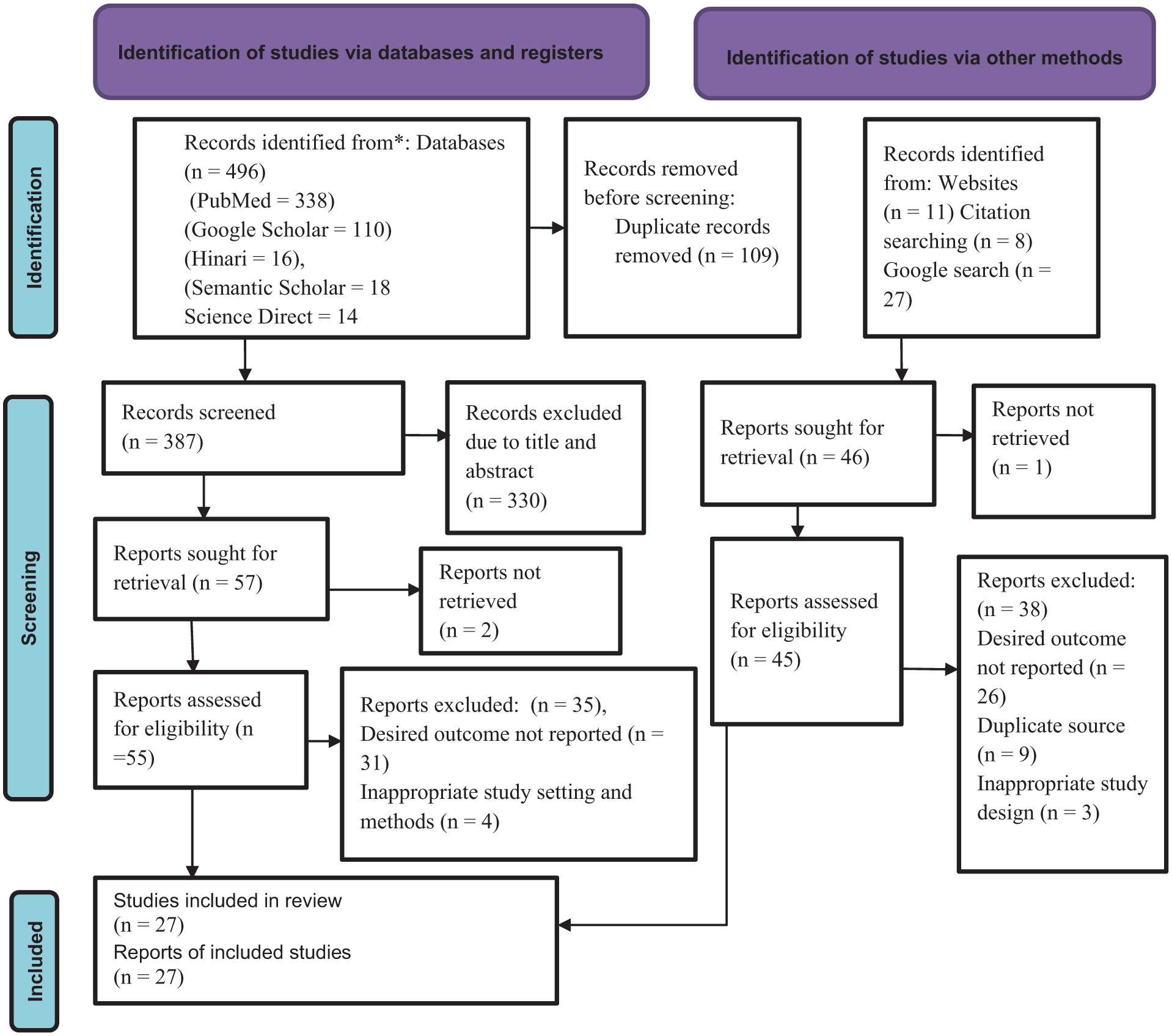
PRISMA flow diagram for the role of sleep disturbance, disorder, and occupational injuries among industrial workers in Ethiopia. A systematic review and meta-analysis 2024.
Characteristics of the included studies
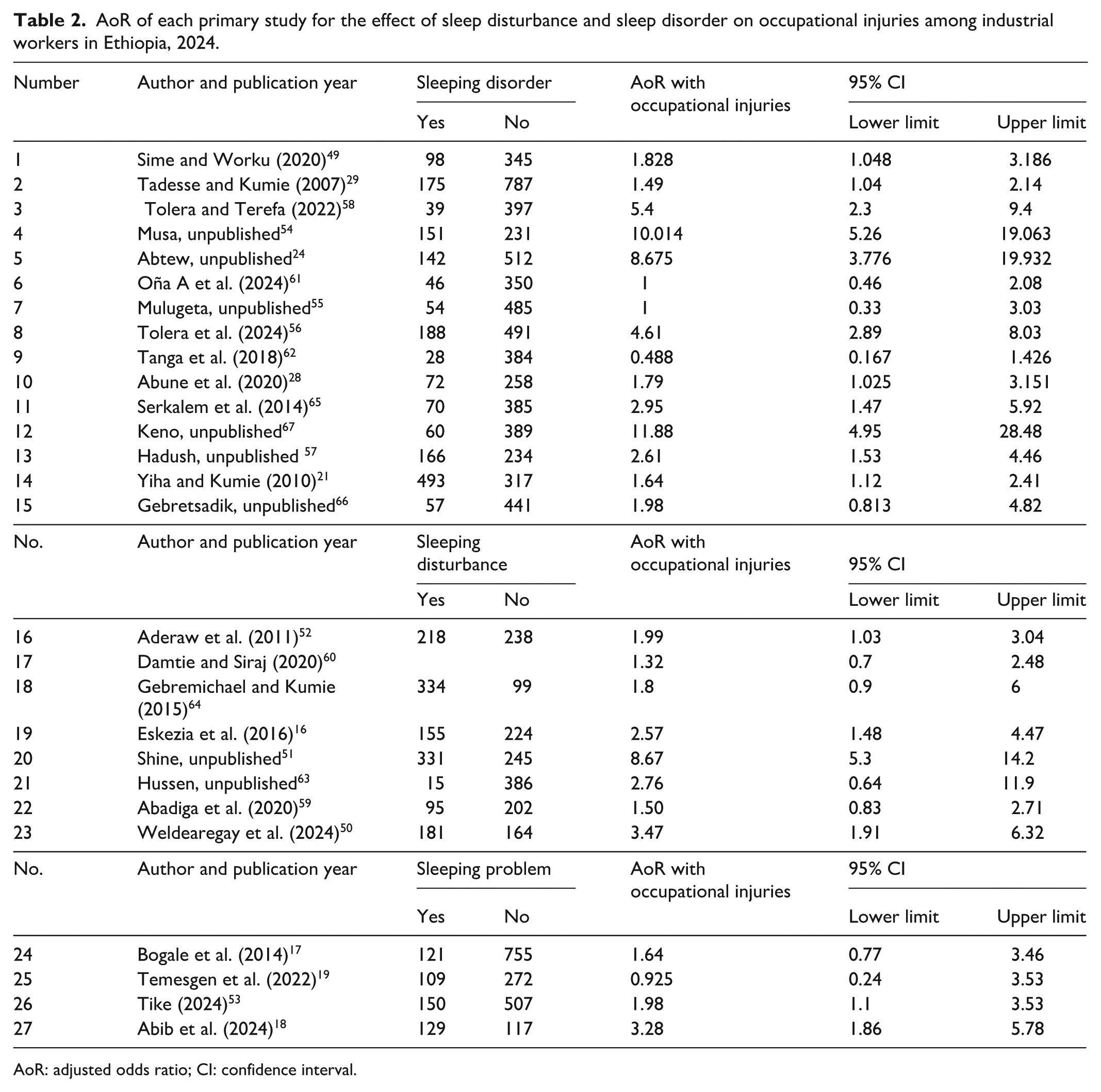
In this systematic review and meta-analysis, the publication year, study area, study design, industry type, sample size, and their respective ORs are summarized in Tables 1 and 2. The review considered a total of 27 studies, 2 case-control and 25 cross-sectional, with a total of 13,193 participants16–19,21,24,28,29,49–67 with sample sizes ranging from 246 to 962.
Characteristics of studies included to determine the association between sleep disturbances, disorders, and occupational injuries among industrial workers in Ethiopia, 2024.

ASTURP: Adama Science and Technology University Research Park; CS: cross-sectional; FFI: face-to-face interview; IAQ: interviewer-administered questionnaire; KII: key informant interview; OC: observational checklist; SA: self-administered; SAQ: self-administered questionnaire; SR: simple random; SQ: structured questionnaire.
AoR of each primary study for the effect of sleep disturbance and sleep disorder on occupational injuries among industrial workers in Ethiopia, 2024.
AoR: adjusted odds ratio; CI: confidence interval.
The reviewed articles were published between 2007 and 2024. In this review, six studies were conducted among textile factory workers. Two studies were done in each sector of agricultural settings and building and construction. Four studies were performed on waste management workers and one study was conducted on each of the following industry workers: hospital cleaners, health care workers, iron and steel workers, fire and emergency workers, Mugher Cement Factory workers, and beverage industry workers. The included studies used face-to-face interviews, record reviews, self-administered questionnaires, observational checklists, and key informant interviews for data collection. The reviewed articles have AoRs ranging from 0.488 to 11.88 (Table 2). The methodological quality of the incorporated studies was evaluated using the JBI critical appraisal checklists. Most studies clearly defined their study population and used structured and reliable measures for measuring outcome variables. However, some studies do not clearly show how potential confounders were handled. The included studies have five to eight quality scores, and their quality was considered during the interpretation of findings (Supplementary File 2). Table 1 presents a description of the incorporated studies.
Meta-analysis
The pooled association between sleep disorder, sleep disturbance, and occupational injuries among industrial workers in Ethiopia
In a review of 15 studies,21,24,28,29,49,54–58,61,62,65,66,67 the estimated link between sleep disorder and work-related injuries was found to be 2.6 (OR = 2.63, 95% CI: 1.78–3.88; I2 = 82.8%, p < 0.001). This revealed that industry workers who have sleep disorder had 2.6 times greater odds of experiencing occupational injuries than those without sleep disorder (Figure 2). In addition, the pooled association between sleep disturbance and occupational injuries was calculated by pooling eight studies.16,50–52,59,60,63,64 The output demonstrated that industrial workers who have sleeping disturbance had a 2.5-fold increased risk of experiencing occupational injuries compared to those who did not experience sleeping disturbances (OR = 2.54, 95% CI: 1.54–4.17; I2 = 78.7%, p < 0.001; Figure 3). Moreover, the combined effect of sleeping problems with occupational injuries was found by pooling four studies.17–19,53 The result indicated that industry workers who have a sleeping problem were found to be 2.2 (OR = 2.18, 95% CI: 1.54, 3.08; I2 = 28.8%, p = 0.239; Figure 4). This indicated that industrial workers who have sleep problems have a two times higher chance of being affected by occupational injuries than those without sleeping problems.

Frost plot for the pooled association between sleep disorder and occupational injuries among industrial workers in Ethiopia, 2024.

Frost plot for the pooled association between sleep disturbance and occupational injuries among industrial workers in Ethiopia, 2024.

Frost plot for the pooled association between sleep problems and occupational injuries among industrial workers in Ethiopia, 2024.
Heterogeneity and subgroup analysis
In this meta-analysis, considerable heterogeneity was found among the included studies. To acknowledge this heterogeneity, we conducted a separate subgroup for sleep disturbance with occupational injuries, and sleep disorder with occupational injuries. The subgroups were conducted by industry type (agricultural workers, manufacturing workers, building and construction workers, and service-providing workers) and by study periods (before and after COVID-19).
Subgroup analysis for sleep disturbance, sleep disorder, and occupational injuries
A subgroup analysis was performed for the pooled association between sleep disturbance and occupational injuries by industry sectors. The result showed that 2.06 (95% CI: 1.35, 3.12, p < 0.178, I2 = 38.9 %), 6.07 (95% CI: 2.15–17.15, p = 0.146, I2 = 52.7%), and 1.98 (95% CI: 1.17, 3.36, p < 0.192, I2 = 41.1%) for manufacturing, building and construction, and service-providing sectors, respectively (Supplementary File 3). In addition, subgroup analysis by study period indicated that 3.06 (95% CI: 1.52, 6.13, p < 0.01, I2 = 80.4%) and 1.91 (95% CI: 1.05–3.46, p = 0.056, I2 = 65.4%) for before and after COVID-19, respectively (Supplementary File 4). Moreover, the subgroup for the association between sleep disorder and occupational injuries showed that 2.42 (95% CI: 1.37, 4.28, p < 0.001, I2 = 85.2%), 2.81 (95% CI: 1.64–4.83, p = 0.047, I2 = 67.2%), and 3.61 (95% CI: 0.71, 18.45, p < 0.01, I2 = 92.1%) for manufacturing, service giving, and agricultural sectors, respectively (Supplementary File 5). Furthermore, subgroup analysis by study period elaborated that 2.70 (95% CI: 1.77, 4.11, p < 0.01, I2 = 82.8%) and 2.2 (95% CI: 0.49-9.85, p < 0.001, I2 = 90.7%) for before and after COVID-19, respectively (Supplementary File 6).
Publication bias
The presence of publication bias (small study effect) was investigated among the selected studies. Publication bias arises when research with noteworthy findings is more likely to be published than those with no significant outcomes. To address the issue of selective publication, a thorough literature search using different databases was conducted. Publication bias was assessed through a Begg’s funnel plot and Egger’s regression test at a p < 0.05. Duval and Tweedie’s trim-and-fill method was employed to estimate missing or unpublished studies. Accordingly, the funnel plot for the estimated association of sleep disorders and occupational injuries indicates that the distribution of papers was asymmetrical; however, the Egger’s test was determined to be statistically insignificant (p-value = 0.406), meaning that there was no evidence of small study effect (supplementary file 7).
Sensitivity analysis
A sensitivity analysis was employed to determine the impact of each study on the pooled estimated relationships between sleep disturbance, sleep disorder, and occupational injuries. We carefully removed articles with a high risk of bias and investigated how different measures of size affected the overall results. Leave one out analysis for sleep disturbance and occupational injuries indicates that the overall pooled estimate was sensitive to study conducted by Shine, unpublished that affected the overall pooled estimate by 18.9% and after removing this study the result was consistent with OR= 2.06 (95% CI, 1.58, 2.69) (supplementary file 8). In addition, the leave out one analysis for sleep disorders and occupational injuries showed that none of the papers seem to be an extreme outlier that affects the overall estimate. Each study has less than 10% change on the overall pooled estimate (supplementary file 9).
Discussion
Sleep is essential for maintaining cognitive functions, motor skills, and overall alertness. 68 However, poor sleep quality, including sleep disturbance and disorder, is a fundamental issue in workers’ mental health.68,69 When employees suffer from sleep disturbance or disorder, it impairs their cognitive and memory function. 70 This resulted in a higher risk of occupational injuries.71,72 Therefore, this systematic review and meta-analysis aimed to fill the knowledge gap by investigating the role of sleep disturbance and sleep disorder on developing occupational injuries. The result showed that sleep disorder and sleep disturbance increase the risk of occupational injuries. In addition, potential subgroup analysis demonstrated that there was significant heterogeneity among the included studies.
Subgroup analysis for sleep disturbance and occupational injuries
The subgroup analysis by industry sectors demonstrated that moderate heterogeneity was found from building and construction workers and low heterogeneity from the service-providing and manufacturing sectors. This observed heterogeneity may be because of workers in building and construction sectors perform tasks with varying physical demand and risk levels. Construction employees work on physically strenuous tasks in adverse environments, which exposes them to health complications and safety risks. 73 The work environment in those sectors is less controlled and more exposed to noise 74 and cold or hot weather, 73 which affect their sleep quality and risk of injury. In addition, most of the employees in construction sectors suffered from job insecurity due to their temporary employment status, less education, lack of training, and inexperience with the tools and workplace hazards. 12 These factors may interfere with their sleep hygiene and increase the risk of occupational injuries. Manufacturing and service-providing sectors may have more standardized job responsibilities, and controlled environments that result in consistent findings. Despite the low heterogeneity exist among service-based and manufacturing sectors, the pooled effect sizes are high. The possible reasons may be service-based sectors such as healthcare workers are subject to night shifts, extended working hours, and on-call duties that affect their sleep and increase occupational injuries. 75 Indeed, sanitation workers are vulnerable to unplanned waste management systems, and hazardous working conditions, such as manual lifting, carrying, pulling, pushing, and gaps in occupational safety, may expose them to sleep disturbance and occupational injuries.18,46,47 In addition, the subgroup analysis by study period evidenced that significant heterogeneity exists before 2020. This may be due to variations in methodologies they use; inconsistency in workplace safety measure implementation regarding shift work, night shifts, and rest breaks. 76 In contrast, studies performed after 2020 demonstrated moderate heterogeneity with borderline significance. The possible reason may be that workers worry about the effect of the Covid-19 pandemic on their health, family, or colleagues, which may affect their sleep and lead to occupational injury. 77
Subgroup analysis for the association between sleep disorder and occupational injuries
The subgroup analysis by industry sector indicated that significant heterogeneity exists in the manufacturing and agricultural sectors and moderate heterogeneity with borderline significance from service-providing sectors. This may be due to variations in study demographics, work characteristics, sample sizes, sampling techniques, and difference in working natures. For instance, workers in the textile industry could endure long work hours and repetitive duties; dust exposure and musculoskeletal problems may make it harder to fall asleep and cause occupational injuries.78–80 Small-scale industry workers might have less structured work environments and irregular working hours, high job insecurity, new or temporary workers, nonstandard forms of employment, and low availability of resources, which impact their sleep quality and increase occupational injuries. 81 Indeed, the subgroup analysis in agricultural sectors indicated a high heterogeneity between studies. This may be attributable to variability in agricultural practices and seasonal variations in exposure risks. 82 Furthermore, as compared with the agricultural and manufacturing sector, the subgroup analysis in the service-providing sector confirmed a moderate heterogeneity with borderline significance among the included studies. This could be due to differences in working natures and working environments among the included studies. For instance, hotel industry workers who are exposed to irregular working hours, work–family conflicts, 83 and high-stress environments 84 can disrupt sleep and increase injury risk. On top of that, intense interpersonal relationships, labor-intensive activities, and complex procedures may introduce this variability. 85 Hospital cleaners may be exposed to hazardous, unhygienic, and physically demanding waste collection tasks that lead to poor sleep quality and an increased risk of injuries. 56 Fire and emergency workers may face impaired performance and increased injury risk as a result of inadequate or poor sleep. 72
The findings of this systematic review and meta-analysis indicate that industry workers who have sleep problems were at higher risk of experiencing occupational injuries than workers without sleep problems. This finding is in agreement with other systematic reviews and meta-analyses. 41 This finding is also supported by a study conducted among juveniles that found sleeping problems were associated with injury risks 86 and a study conducted among part-time farmers in Kentucky, USA. 44 Moreover, study findings in this systematic review and meta-analysis show that workers with sleep disturbances were more affected by occupational injuries. This is in agreement with a study conducted in China, 45 Korea, 87 and a systematic review and meta-analysis done among sanitation workers. 88 This may be due to when workers suffer from sleep disturbance, their cognitive performance and reaction times are impaired. 87 This ends in diminished focus, slowed response times, and poor decision-making skills, all of which are important for carrying out their responsibilities in a safe manner.87,89
Sleep troubles weakened employees’ ability to be awake and execute their jobs well. It results in distractions, forgetfulness, and inaction at work and affects their workplace safety participation and compliance, ultimately causing workplace injuries.90–92 Sleep deprivation due to sleeping disturbance and sleeping disorder may negatively affect their mood and judgment, thus elevating the risk of occupational injuries. 93 In addition, sleep disorder affects the ability to maintain wakefulness, functional capacity, working memory, and concentration ability in evaluating their work environment and working conditions. 94 Moreover, sleep disorder affects the immune system and overall physical health, making workers more vulnerable to illnesses, reducing performance, and raising the likelihood of occupational injuries. 41 For instance, workers working in manufacturing, construction, and agriculture, where precise and timely actions are necessary, cognitive impairment from sleep issues might result in fewer involvements in safety standards, increasing the likelihood of errors, accidents, and injuries. 90 The other possible justification may include sleep disturbance or sleep disorder affecting the ability to maintain alertness and assess or monitor workplace conditions. 94 This may result in diminished physical performance, affecting workers’ ability to operate machinery or perform manual tasks effectively. 95 Furthermore, it can cause weariness, reduced attentiveness, and delayed reaction times. 96 Having a detrimental effect on mood and stress levels that limit adherence to safety protocols that may increase occupational injury. 97
Implication of the study
The findings of this review have a notable implication for improving industrial workers’ well-being and ultimately reducing occupational injuries. It contributes to the broader understanding of the impact of sleep disturbance and disorder on occupational injuries, particularly in low- and middle-income countries. The outputs also stress the contextual challenges of workers in various industries in Ethiopia and will inform tailored interventions that consider local circumstances and global evidence-based, efficacious interventions. Besides, this review informs the need to implement and strengthen workers’ security and protection policies that integrate sleep health as a core component of occupational safety. Furthermore, this study demonstrated the need for inclusive strategies that adapt to diverse workplace environments.
Strengths and limitations
This systematic review and meta-analysis provide important findings on the association between sleep disturbance, sleep disorder, and occupational injuries across various industry types in Ethiopia. The results provide useful epistemic contributions from a low- and middle-income country perspective, which is generally disregarded in global studies. Besides, it has practical implications for policy and intervention development. However, the study’s findings are constrained by considerable heterogeneity among the reviewed literature, which may affect the pooled results. To address this, we conducted a subgroup analysis to examine potential variations in the results. In addition, differences in study designs, sample sizes, population characteristics, and limited descriptions of how sleep disturbance, sleep disorder, and sleep problem were measured may introduce potential biases. Future research using longitudinal designs, sufficient sample sizes, and standardized definitions is needed to get more reliable conclusions about the causal relationship between sleep-related issues and occupational injuries.
Conclusion
Sleep disorders and disturbances increase the risk of occupational injuries. Therefore, integrated interventions tailored to the manufacturing, service-providing, building and construction, and agricultural workers context are required. Applying workplace policies, prioritizing mental health support to lessen the effects of sleep disturbances and disorders in service-providing industry sectors, and implementing thorough health and safety training, promoting better sleep hygiene practices to lower their risk of injury in agricultural workers, are advised. Furthermore, implementing social security and workers’ protection policy is essential.
Supplemental Material
sj-docx-1-smo-10.1177_20503121251353280 – Supplemental material for The role of sleep disorder and disturbance in the occurrence of occupational injuries among industry workers in Ethiopia: A systematic review and meta-analysis
Supplemental material, sj-docx-1-smo-10.1177_20503121251353280 for The role of sleep disorder and disturbance in the occurrence of occupational injuries among industry workers in Ethiopia: A systematic review and meta-analysis by Anmut Endalkachew Bezie, Asmare Asrat Yirdaw, Eyob Tilahun Abeje, Lamrot Yohannes, Giziew Abere and Awoke Keleb in SAGE Open Medicine
Supplemental Material
sj-docx-2-smo-10.1177_20503121251353280 – Supplemental material for The role of sleep disorder and disturbance in the occurrence of occupational injuries among industry workers in Ethiopia: A systematic review and meta-analysis
Supplemental material, sj-docx-2-smo-10.1177_20503121251353280 for The role of sleep disorder and disturbance in the occurrence of occupational injuries among industry workers in Ethiopia: A systematic review and meta-analysis by Anmut Endalkachew Bezie, Asmare Asrat Yirdaw, Eyob Tilahun Abeje, Lamrot Yohannes, Giziew Abere and Awoke Keleb in SAGE Open Medicine
Supplemental Material
sj-docx-3-smo-10.1177_20503121251353280 – Supplemental material for The role of sleep disorder and disturbance in the occurrence of occupational injuries among industry workers in Ethiopia: A systematic review and meta-analysis
Supplemental material, sj-docx-3-smo-10.1177_20503121251353280 for The role of sleep disorder and disturbance in the occurrence of occupational injuries among industry workers in Ethiopia: A systematic review and meta-analysis by Anmut Endalkachew Bezie, Asmare Asrat Yirdaw, Eyob Tilahun Abeje, Lamrot Yohannes, Giziew Abere and Awoke Keleb in SAGE Open Medicine
Supplemental Material
sj-docx-4-smo-10.1177_20503121251353280 – Supplemental material for The role of sleep disorder and disturbance in the occurrence of occupational injuries among industry workers in Ethiopia: A systematic review and meta-analysis
Supplemental material, sj-docx-4-smo-10.1177_20503121251353280 for The role of sleep disorder and disturbance in the occurrence of occupational injuries among industry workers in Ethiopia: A systematic review and meta-analysis by Anmut Endalkachew Bezie, Asmare Asrat Yirdaw, Eyob Tilahun Abeje, Lamrot Yohannes, Giziew Abere and Awoke Keleb in SAGE Open Medicine
Supplemental Material
sj-docx-5-smo-10.1177_20503121251353280 – Supplemental material for The role of sleep disorder and disturbance in the occurrence of occupational injuries among industry workers in Ethiopia: A systematic review and meta-analysis
Supplemental material, sj-docx-5-smo-10.1177_20503121251353280 for The role of sleep disorder and disturbance in the occurrence of occupational injuries among industry workers in Ethiopia: A systematic review and meta-analysis by Anmut Endalkachew Bezie, Asmare Asrat Yirdaw, Eyob Tilahun Abeje, Lamrot Yohannes, Giziew Abere and Awoke Keleb in SAGE Open Medicine
Supplemental Material
sj-docx-6-smo-10.1177_20503121251353280 – Supplemental material for The role of sleep disorder and disturbance in the occurrence of occupational injuries among industry workers in Ethiopia: A systematic review and meta-analysis
Supplemental material, sj-docx-6-smo-10.1177_20503121251353280 for The role of sleep disorder and disturbance in the occurrence of occupational injuries among industry workers in Ethiopia: A systematic review and meta-analysis by Anmut Endalkachew Bezie, Asmare Asrat Yirdaw, Eyob Tilahun Abeje, Lamrot Yohannes, Giziew Abere and Awoke Keleb in SAGE Open Medicine
Supplemental Material
sj-docx-7-smo-10.1177_20503121251353280 – Supplemental material for The role of sleep disorder and disturbance in the occurrence of occupational injuries among industry workers in Ethiopia: A systematic review and meta-analysis
Supplemental material, sj-docx-7-smo-10.1177_20503121251353280 for The role of sleep disorder and disturbance in the occurrence of occupational injuries among industry workers in Ethiopia: A systematic review and meta-analysis by Anmut Endalkachew Bezie, Asmare Asrat Yirdaw, Eyob Tilahun Abeje, Lamrot Yohannes, Giziew Abere and Awoke Keleb in SAGE Open Medicine
Supplemental Material
sj-docx-8-smo-10.1177_20503121251353280 – Supplemental material for The role of sleep disorder and disturbance in the occurrence of occupational injuries among industry workers in Ethiopia: A systematic review and meta-analysis
Supplemental material, sj-docx-8-smo-10.1177_20503121251353280 for The role of sleep disorder and disturbance in the occurrence of occupational injuries among industry workers in Ethiopia: A systematic review and meta-analysis by Anmut Endalkachew Bezie, Asmare Asrat Yirdaw, Eyob Tilahun Abeje, Lamrot Yohannes, Giziew Abere and Awoke Keleb in SAGE Open Medicine
Supplemental Material
sj-docx-9-smo-10.1177_20503121251353280 – Supplemental material for The role of sleep disorder and disturbance in the occurrence of occupational injuries among industry workers in Ethiopia: A systematic review and meta-analysis
Supplemental material, sj-docx-9-smo-10.1177_20503121251353280 for The role of sleep disorder and disturbance in the occurrence of occupational injuries among industry workers in Ethiopia: A systematic review and meta-analysis by Anmut Endalkachew Bezie, Asmare Asrat Yirdaw, Eyob Tilahun Abeje, Lamrot Yohannes, Giziew Abere and Awoke Keleb in SAGE Open Medicine
Footnotes
Acknowledgements
The authors appreciated and acknowledged the articles used in this study, as well as the database providers Google Scholar, PubMed, HINARI, Science Direct, and semantic scholars.

Ethical considerations
This is a systematic review and meta-analysis, the review protocol was registered with the International Prospective Register of Systematic Reviews (record ID: CRD42024623674).
Author contributions
Anmut Endalkachew Bezie: conceptualization, data curation, formal analysis, investigation, methodology, software, supervision, validation, visualization, writing – original draft, writing – review and editing. Asmare Asrat Yirdaw: data curation, software, investigation, methodology, visualization, writing – review and editing. Eyob Tilahun Abeje: data curation, investigation, methodology, visualization, writing – review and editing. Lamrot Yohannes and Giziew Abere: data curation, investigation, methodology, writing – review and editing. Awoke Keleb: conceptualization, data curation, investigation, methodology, software, validation, visualization, writing – review and editing.
Funding
The author(s) disclosed receipt of the following financial support for the research, authorship, and/or publication of this article: The funding process is solely done from the writing authors.
Declaration of conflicting interests
The author(s) declared no potential conflicts of interest with respect to the research, authorship, and/or publication of this article.
Data availability statement
All data generated or analyzed during this study are included in this published article and its supplementary materials. Further inquiries can be directed to the corresponding author.
Supplemental material
Supplemental material for this article is available online.
References
Supplementary Material
Please find the following supplemental material available below.
For Open Access articles published under a Creative Commons License, all supplemental material carries the same license as the article it is associated with.
For non-Open Access articles published, all supplemental material carries a non-exclusive license, and permission requests for re-use of supplemental material or any part of supplemental material shall be sent directly to the copyright owner as specified in the copyright notice associated with the article.
