



Abstract
Objectives:
The objectives of the study are to assess the knowledge of advanced life support among general nurses in Spain, identify knowledge gaps and analyze the demographic, educational, and occupational determinants of their level of knowledge.
Methods:
A cross-sectional study was conducted from November 2020 to February 2021 among general nurses in Spain. A structured self-administered questionnaire was used to collect data on demographics, educational, and professional background, as well as theoretical knowledge questions. A binary logistic regression analysis was performed to identify the influencing factors associated with the outcome of the educational measure.
Results:
A total of 888 general nurses participated in the study, with representation from all 52 Spanish provinces; 80% of whom were female nurses. The 72.3% of the nurses did not attain the 70% correct score on the theoretical questionnaire, a prerequisite for achieving an adequate pass rating. The study revealed inadequate knowledge among the participating nurses with regard to the characteristics of fluid therapy, the conditions for defibrillation and the action algorithm in the event of a defibrillate rhythm, and the recommendations for use of the LUCAS RCP® device. Nurse gender, possession of at least a Master’s degree, practising in high-risk areas for cardiac arrest and having received recent advanced life support training were positively associated with better knowledge of advanced life support among nurses.
Conclusions:
The study shows that Spanish general nurses have insufficient knowledge of advanced life support and that there are evident knowledge gaps in key subject areas relating to best practices for cardiorespiratory arrests. This indicates that they require knowledge building to promote evidence-based patient care. Furthermore, the findings emphasize the significance of ongoing education needed to respond to high-risk events such as a cardiac arrest. The positive and negative factors identified in this study, which influence the attainment of a good level of advanced life support knowledge, should be taken into account.
Introduction
Nursing is a regulated profession based on advanced practice and scientific, managerial, educational, and social skills.1 –3 The increasing incidence of cardiovascular disease, 4 and consequently cardiac and respiratory arrest, requires nurses to be familiar with advanced life support (ALS) protocols, regardless of their work setting. 5
High-quality cardiopulmonary resuscitation (CPR) can be administered out-of-hospital, and ongoing improvements are attributable to the development of scientific evidence, with a focus on reducing hands-off intervals and hyperventilation. 6 A substantial improvement in out-of-hospital cardiac arrest survival rates was observed following the implementation of the 2005 American Heart Association (AHA) guidelines for CPR and emergency cardiovascular care. Multivariate regression analysis, controlling for significant predictors of survival, demonstrated that out-of-hospital cardiac arrest during the post-guidelines period exhibited a 1.8-fold increase in odds of survival compared to the pre-guidelines period (95% CI: 1.2–2.7). 7 At the hospital level, the quality of CPR improved following the implementation of the amended 2005 Guidelines, with only a weak trend toward improved survival to hospital discharge. 8 CPR training for healthcare professionals, incorporating the European Resuscitation Council (ERC) guidelines, has been shown to exhibit a marked enhancement following the implementation of guideline modifications. This observation persists despite a concomitant rise in the prevalence of cardiac comorbidities. As demonstrated by Salam et al., 9 a decline in mortality rate was observed from 73% in the period preceding the implementation of guideline modifications to 63% in the subsequent period (p = 0.04). The most substantial and statistically significant variation was identified in the utilization of percutaneous coronary interventions, a development that coincided with the introduction of the ERC 2005 guidelines. Hospitals that demonstrated excellence in high in-hospital cardiac arrest (IHCA) survival strategies placed a strong emphasis on mentoring and empowering frontline nurses, ensuring clinical competency and adequate nursing training for IHCA care. 10
In Spain, the first university nursing programs were introduced in 1977, initially as a 3-year diploma course. Subsequent to the consensus of the Bologna Declaration on the unification of European university education (The Bologna Process) in 2009, 11 the course was restructured into a 4-year degree program. In the country, the average rate of nurses per 1000 inhabitants is 6.57, which is slightly lower than the European Union (EU) average rate of 8.5 nurses per 1000 inhabitants. 12 Furthermore, 85.5% of nurses are women, in line with the worldwide situation, where approximately 90% of nursing professionals are women. 13 A body of research undertaken in Spain indicates that the extent of awareness among healthcare professionals regarding ALS is deemed inadequate. The investigation has identified factors such as seniority and the extent of training as contributors to this situation.14,15 In view of the advances in techniques, technologies, and recommendations for ALS, it may be advantageous to ascertain any knowledge gaps among nurses to facilitate effective educational interventions. 16 In this way, the International Liaison Committee on Resuscitation has recently initiated a program with the objective of providing strategic guidance, with the intention of delineating critical steps to improve patient care in whom CPR is required. 17 At the first phase, named “Plan and prepare,” one of the key steps is the implementation of effective education and training for resuscitation. Therefore, the evaluation of ALS knowledge enables the identification of areas for enhancement and the determination of the training necessary to address them.
In consideration of the aforementioned context, and with the purpose of providing evidence for the design of a program adapted to the existing knowledge gaps and characteristics of nurses in Spain, the study aims to assess the knowledge of ALS among general nurses in Spain and to identify the socio-educational and occupational factors influencing knowledge.
Methods
Study design, area, and period
A cross-sectional study was conducted from November 2020 to February 2021. The study population comprised nurses affiliated with all the official nursing associations in Spain, which are integrated at the national level in the General Council of the Official Nursing Associations of Spain (Consejo General de Colegios Oficiales de Enfermería de España). In this country, membership of one of these official nursing associations is compulsory for the practice of the profession. At the time of the study, the total number of registered nurses in Spain was 291,297. 18
Inclusion criteria
The inclusion criteria for participants were as follows:
- To be considered for this study, participants must have been active nursing professionals within the healthcare sector in Spain. This includes assistant, managerial, teaching, and research functions.
- Give written informed consent before participating in the study.
Exclusion criteria
The following criteria were applied to determine exclusion from the study:
- Not being registered with an Official Nursing College in Spain, as registration is a mandatory requirement for professional practice.
Sample size, sampling procedure, and technique
The actual sample size for the study was calculated using QuestionPro (https://www.questionpro.com/es/calculadora-de-muestra.html#calculadora_de_muestra), considering a target population of 291,297 registered nurses in Spain, a confidence level of 95%, a margin of error of 5%, and an estimated missing rate of 15%. The calculated sample size was 443. A snowball sampling was applied. Data were collected consecutively for each nurse included, as all nurses willing to participate and meeting the study’s inclusion criteria participated.
Data collection
A structured self-administered questionnaire was used for data collection. This questionnaire contained three demographic questions, two questions related to professional experience, five questions regarding educational and ALS training background and professional experience, and 29 theoretical knowledge questions.
Questionnaire pretest
The set of 29 theoretical knowledge questions and their respective answer options are derived from a 30-item ERC test (see Supplemental material). This type of test is used in the training courses and assessment of nursing professionals to ensure an adequate level of knowledge of recommended best practice in emergency situations. Given the context, it was determined that a pretest of the instrument would not be conducted. Nevertheless, to avoid information bias, a validation of the content of our adapted and updated Spanish version of the test was conducted by a group of judges (n = 13) with experience in ALS (see Supplemental material). Moreover, to ensure the validity of the test, the Cronbach’s alpha coefficient of the instrument was determined (0.734). The questionnaire was administered online through the General Council of Nursing of Spain (https://www.consejogeneralenfermeria.org/).
Data quality control
The data were collected by two nurses. One of them had a Master of Science (MSc) in Nursing, and the other had a PhD in Public Health. During the data collection period, the principal investigator closely monitored the process. To guarantee the integrity of the dataset, one of the nurse researchers meticulously curated the data prior to analysis, ensuring its structure and documentation were as complete as possible.
Statistical approach
Descriptive statistics were utilized to analyze the characteristics of the respondents. The biostatistical analysis of the data was conducted using the statistical analysis software R v4.4.2 and RStudio v2024.12.0, 19 in conjunction with the psych v2.4.6.26, 20 and tidyverse v2.0.0.0 libraries. 21 A Chi-square analysis was performed to test the independence of the qualitative socio-demographic variables in the study, and a binary logistic regression analysis was used to differentiate the effects of each independent variable with the outcome of the educational measure. Cronbach’s alpha coefficient was calculated to determine the level of reliability of the educational measure. In all cases, p-values less than 0.05 were taken to indicate statistical significance.
Operational definitions
Taking into account that the study involved nurses who completed their nursing studies either before or after the implementation of the Bologna criteria, 11 the highest level of studies achieved was identified according to the following categories that were considered:
- Undergraduate degree: Diploma in Nursing (obtained before 2010, a 3-year study), Nursing degree (obtained from 2010, a 4-year study).
- Postgraduate degree: Master’s degree, PhD.
In terms of the current care service provided by the nurses, and in accordance with the criteria established by Passali et al., 22 the following categories were taken into consideration, based on the risk of cardiac arrest:
- High-risk areas: Out-of-hospital emergency care, Hospital emergency service, Intensive care unit, Resuscitation unit, Operating theatre.
- Low-risk areas: Primary care, Hospitalization floor.
The collection of work experience was recorded in years, subdividing into periods of 5 year each.
To differentiate the ALS training provider, the following criteria were taken into consideration:
- Type A: the training of which is based on the ERC guidelines.
- Type B: the training of which is based on the AHA guidelines.
ALS knowledge was determined according to the criteria of the Spanish Council of CPR (https://semicyuc.org/el-plan-nacional-de-rcp/#PNRCP), which requires a score of 70% or higher on the theoretical ERC questionnaire for an appropriate pass rating. In a manner analogous to the criteria that Adal and Emishal 23 applied to identify good or poor knowledge in basic life support, the following criteria were formulated to recognize the aspects in which the respondents as a whole had good or poor knowledge. Each category was considered according to the following criteria:
- Good knowledge: Aspects in which the correct response rate was equal to or higher than 50%.
- Poor knowledge: Aspects in which the wrong answer was given with a frequency of more than 50%.
Ethical considerations
The study was approved by the Research Ethics Committee of the University of CEU (registration number: CEI19/082).
Results
Study participants’ demographic, educational, and occupational characteristics
The study participants’ demographic, educational, and occupational characteristics comprised a total of 888 nurses working in the healthcare sector in Spain (Figure 1); distributed and representing all 52 Spanish provinces (Figure 2); constituting 0.3% of the professionals officially registered in the nursing associations; and 52% of whom worked in provinces with a population density higher than 200 inhabitants per square kilometer.

STROBE flow chart of the participants. STROBE, Strengthening the Reporting of Observational Studies in Epidemiology flow chart (https://www.strobe-statement.org/).

Distribution of participants by province according to the nursing association where they are registered.
Table 1 presents the demographic, professional, and educational profiles of the participants, 80% of whom were female. The mean age of the participants was 36 year (SD = 10, range: 22–65 year), and 35% of nurses have undertaken postgraduate studies, either at Master’s or PhD level. A minimum of 48.4% of nurses carry out their care work in areas of high risk of incident cardiac arrest. The mean work experience of all participants was 10 year (SD = 9 year). It is also noteworthy that 16% of nurses had not undergone training in ALS, and of the 84% who had received training, 29% had not updated their knowledge for a period exceeding 3 year. The majority of nurses (62%) with ALS training received it from a provider based on ERC guidelines.
Profile of the 888 general nurses in Spain who participated in the study.

DR: do not remember.
Based on European Resuscitation Council guidelines.
Based on American Heart Association guidelines.
Knowledge of nurses toward ALS
In the knowledge questionnaire, 27.7% of the participants (n = 246) scored ≥70%, thus reaching a pass level. Conversely, 72.3% of nurses failed to attain a score of 70% or more on the theoretical questionnaire, a prerequisite for attaining an appropriate pass rating. In the primary care setting, 21.4% (n = 31) of the 143 nurses who took the knowledge test achieved a pass level, while 78.6% (n = 112) did not reach the minimum required level of 70%. In the hospital setting, which encompasses the Hospitalization floor, the Hospital emergency service, the Intensive care unit, the Resuscitation unit, and the operating theatre, 46.2% (n = 231) of respondents obtained a pass level compared to 52.8% (n = 258) who did not. A comparison of the frequency of passes in Primary care nurses versus the overall frequency of passes in Hospitalization floor nurses (n = 182, npass level = 57; nno pass level achieved = 125) reveals significant differences (p < 0.001). However, when the comparison is made by subcategory of hospital setting versus the pass rate in primary care, changes are found in the significance of the overall difference observed. On one hand, the frequency of pass level attainment in Primary care nurses versus Hospitalization floor nurses (n = 182, npass level = 57; nno pass level achieved = 125) was not significantly different (p = 0.052). On the other hand, a significant disparity in the frequency of pass levels was observed between the Intensive care unit (n = 184, npass level = 119; nno pass level achieved = 65) and the Resuscitation unit and Operating theatre (n = 123, npass level = 55; nno pass level achieved = 68) groups, compared to Primary care nurses, with p-values of 0.007 and <0.01, respectively.
The subject areas with a poor degree of knowledge were as follows: the role of fluid therapy and the main drugs and fluids used in CPR, the conditions of application of defibrillation and the algorithm of action in the event of a defibrillate rhythm, the recommendations of use of the mechanical chest compression device (LUCAS CPR®), the description of the chain of survival, the reversible causes of cardiac arrest, and ventilation and airway procedures. In all of these areas, the percentage of error in the responses given by the group of participants was greater than 50%, or the DK/NC option (does not know/does not answer) was greater than 25% (Table 2). Moreover, the success rate in each of these items was less than 75%. The subject areas that demonstrated a satisfactory level of knowledge were those pertaining to the recommended alternative routes when the insertion of a venous line was not feasible, the type of pulse that should be palpated during CPR in an adult patient, and the pharmacological profile of amiodarone. It is noteworthy that these domains exhibited a response rate that exceeded 90%. The knowledge questionnaire employed in this study yielded a Cronbach’s alpha of 0.734. The Cronbach’s alpha values for each of the test questions are presented in Table 3. The Cronbach’s coefficient values for each knowledge test question are presented in Table 3. It is evident that none of the values are less than 0.7. In instances where the individual coefficient exceeds the overall test coefficient, it can be deduced that nurses have committed more errors in their responses. Conversely, when the individual coefficient falls below the overall test coefficient, it is interpreted that nurses have provided more accurate responses in that particular question.
Participants’ responses for each item of the questionnaire ranked from the highest percentage of incorrect answers to the lowest percentage of incorrect answers.
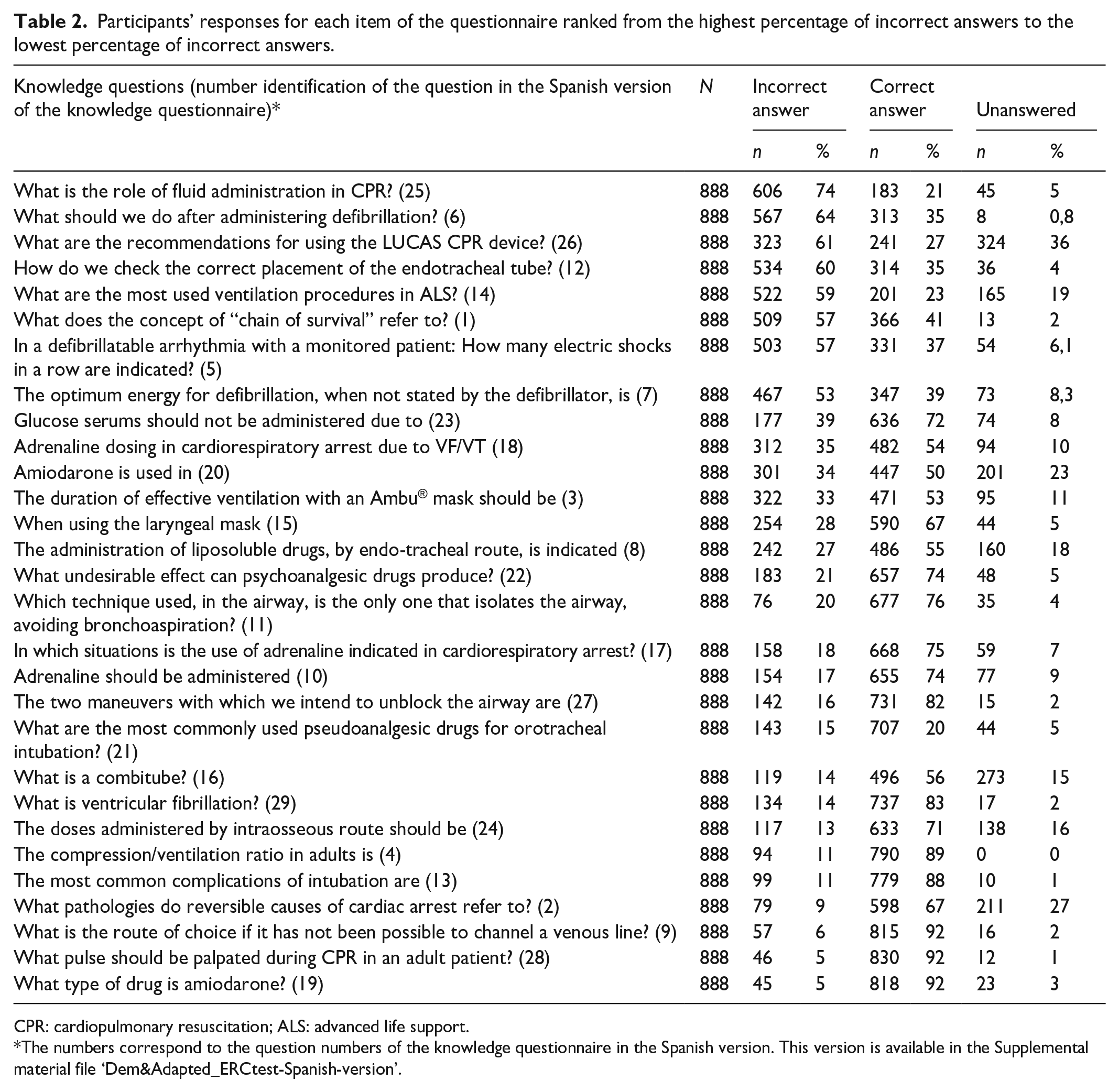
CPR: cardiopulmonary resuscitation; ALS: advanced life support.
The numbers correspond to the question numbers of the knowledge questionnaire in the Spanish version. This version is available in the Supplemental material file ‘Dem&Adapted_ERCtest-Spanish-version’.
Cronbach’s alpha value for each question on the knowledge test on advance life support.

Question number 5, which has a similar Cronbach’s alpha value to another question, is eliminated from the model.
Factors associated with knowledge of nurses toward ALS
The results of the logistic regression analysis indicate that a number of factors are significantly associated with the knowledge of ALS. These factors include gender, possession of a postgraduate degree, professional practice as a nurse in an area with a high incidence of cardiac arrest, and training in advanced cardiac life support history (Table 4). In terms of demographic factors, it has been observed that men are at least twice as likely to pass the ALS knowledge test compared to women. Furthermore, holding a postgraduate degree significantly increases the probability of approval, with the likelihood being at least double for those with a postgraduate qualification and up to three times as high for those with a PhD. In consideration of the impact of occupational factors, it is observed that employment in areas characterized by a high risk of cardiac arrest results in a threefold increase in the probability of achieving a passing grade on the ALS knowledge test. Specifically, nurses engaged in practice within out-of-hospital emergency settings exhibit a sixfold increase in the likelihood of attaining a passing score on the aforementioned test. With regard to the background of ALS training, it was noted that nurses who had received such training were more than twice as likely to pass the ALS knowledge test. Furthermore, the time elapsed since the last training received, more than 5 year, had a significant impact on the probability of obtaining a passing grade in the test, with candidates who had not received training in more than 5 year being less likely to pass.
Logistic regression to identify factors associated with a “pass level” of knowledge among the participating general nurses.

Based on European Resuscitation Council guidelines.
Based on American Heart Association guidelines.
Out-of-hospital emergency care, Hospital emergency service, Intensive care unit, Resuscitation unit, Operating theatre.
Primary care, Hospitalization floor.
Discussion
This study is the first of its kind to be carried out at a national level in Spain, with a particular focus on the levels of knowledge of ALS among general nursing staff at the different levels and care services in the country. The findings of the study align with those of prior research conducted at specific local levels, suggesting that the nurses’ knowledge of ALS is not optimal.14,15
Our research indicates that nurses working in primary care or on hospitalization ward have a low level of knowledge of ALS compared to those working in Out-of-hospital emergency care, Hospital emergency service, Intensive care unit, Resuscitation unit, or Operating theatre. It also shows that hospital staff working in high-risk areas for cardiac arrest have a higher level of knowledge of ALS than those working in low-risk areas, as research conducted in other countries has shown.22,23
Participants demonstrated a poor knowledge toward the role of fluid therapy and the primary medications employed in CPR, conditions for defibrillation, the shockable rhythm algorithm, recommendations for the utilization of the mechanical chest compression device (LUCAS CPR®), the description of the chain of survival, the reversible causes of CPA, and ventilation and airway procedures. It is therefore essential that these subject areas are addressed in the nursing training programs of the country. These educational programs should align with best practices and international guidelines on ALS actions, such as the ERC or AHA guidelines, regarding that evidence-based patient care is related with a substantial improvement of overall survival rates.7,9,24 The lack of resuscitation skills among nurses working at out-of-hospital level correlates with poor health outcomes in cardiac arrest patients.25,26 Furthermore, the study established a positive association between nurses’ performance on ALS knowledge tests and the frequency of their training, with those who had received at least one training session in the last 5 years demonstrating superior performance.
The results of the logistic regression analysis indicate that certain factors have a significant influence on the probability of passing the ALS knowledge test. These factors include gender, educational level, area of work, previous course completion, and type of ALS training course. Other authors have found a significant relationship between the age of nurses and their years of experience with the level of knowledge in ALS.14,23 However, in our case, this relationship was not found. One potential explanation for this discrepancy could be related to the fact that the population studied in the present analysis is at least double the size of the population studied in the other studies.
The finding of a gender-based knowledge gap is striking. It is evident that the composition of the sample reflects the demographic profile of nurses in the country with respect to the sex variable. To the best of our knowledge, previous ALS studies do not report a similar circumstance. Further studies are required, given that this phenomenon of gender difference in knowledge has been observed in other technical areas of nursing.27,28
Our survey indicates that nurses with at least a Master’s degree have a higher level of ALS knowledge. This addresses a limitation of previous research 23 in this area by collecting detailed information on the educational attainment of each participant. The findings indicate that a Master’s degree is a prerequisite for attaining an acceptable level of ALS knowledge. To maintain competence in an evolving healthcare environment, nurses must have access to high-quality continuing professional development. 29 There is a strong correlation between continuing professional development and the retention of nurses in the workplace.2,30 In addition, higher nursing qualifications have been shown to reduce the likelihood of burnout, increase commitment to quality care, positively impact confidence, and prevent moral dilemmas. It is therefore recommended that nurse managers give consideration to the promotion of staff retention and encouragement of continuing education, especially in ALS and postgraduate studies, to improve the working environment and minimize the risk of mental health problems among professionals.31,32
The results of this research may have implications for nursing practice as well as nursing education and research. For example, they can be used to optimize continuing education in ALS, based on ERC certification, taking in account that Spain belongs to the European Community. Health authorities can set minimum standards for the type and frequency of ALS training for general nurses, especially those working in critical areas such as emergency departments, intensive care units, and out-of-hospital emergencies. Furthermore, policies can be developed that require nurses to undertake refresher training in ALS on a regular basis—ideally on an annual basis—to ensure that their knowledge is kept up to date with the latest guidelines and recommended practices. The results corroborate the importance of postgraduate studies for nurses. Therefore, healthcare institutions can encourage nurses to pursue Master’s and doctoral studies by offering scholarships or facilities to enable them to combine work and studies. This approach is expected to result in a re-evaluation of the distribution of human resources, with a view to ensuring that areas experiencing the highest demand for critical services are staffed by highly trained professionals.
The establishment of centers of excellence, specializing in training and ALS practice, can even be considered. Such centers could serve as a model and a source of support for other healthcare institutions. It is hypothesized that these approaches will make a significant contribution to the improvement of the quality of healthcare in emergencies and ensure that nurses are well prepared to manage critical situations effectively. Subsequent studies should aim to investigate the findings of a gender gap in the knowledge of ALS, to determine the possible causes and establish evidence-based training programs to address this knowledge gap.
Limitation of the study
This study has several limitations that should be acknowledged. Firstly, the online administration of the questionnaire may have resulted in a relatively low response rate, but the doubling of the a priori estimated sample size and the fact that participants worked in both primary and hospital services suggest that this limitation had a minimal impact. Secondly, response bias shared was a limitation with regard to the design of the cross-sectional study: some recall bias and non-response bias were found. The former bias particularly affected the variable “Type of provider of CPR training,” where 23% of respondents indicated that they did not remember. The latter is evident in the fact that not all participants responded to all questions, which suggests that the results may have underestimated the number of incorrect answers and lack of resuscitation knowledge.
Finally, it should be noted that the knowledge test used has an acceptable reliability with a Cronbach’s alpha above 0.7. Furthermore, the fact that the individual Cronbach’s alpha values for each question are also above 0.7 means that each item contributes significantly and consistently to the measurement of the construct. This combination of acceptable reliability and adequate internal consistency suggests that the results obtained from the questionnaire are valid and can be considered representative of the phenomenon studied.
Conclusions
This study indicates that the majority of general nurses in Spain require further development in their theoretical knowledge of ALS. It is essential to promote effective, evidence-based practice among nurses, and to facilitate this, continuing education programs should be developed based on best practices and international standards. When designing these programs, it is crucial to consider both positive and negative factors associated with improved ALS knowledge, to ensure their effectiveness. Furthermore, special attention should be paid to the knowledge gaps evidenced in this research when designing the contents of the training offered, as these are basic technical and conceptual aspects of the actions in response to cardiac arrest.
Supplemental Material
sj-pdf-1-smo-10.1177_20503121251326655 – Supplemental material for Level and determinants of advanced life support knowledge among nurses in Spain: A national cross-sectional study
Supplemental material, sj-pdf-1-smo-10.1177_20503121251326655 for Level and determinants of advanced life support knowledge among nurses in Spain: A national cross-sectional study by Rosa Pérez-Ibáñez, Isabel Almodóvar-Fernández, Pasqual Gregori Roig and Paula Sánchez-Thevenet in SAGE Open Medicine
Supplemental Material
sj-pdf-2-smo-10.1177_20503121251326655 – Supplemental material for Level and determinants of advanced life support knowledge among nurses in Spain: A national cross-sectional study
Supplemental material, sj-pdf-2-smo-10.1177_20503121251326655 for Level and determinants of advanced life support knowledge among nurses in Spain: A national cross-sectional study by Rosa Pérez-Ibáñez, Isabel Almodóvar-Fernández, Pasqual Gregori Roig and Paula Sánchez-Thevenet in SAGE Open Medicine
Supplemental Material
sj-pdf-3-smo-10.1177_20503121251326655 – Supplemental material for Level and determinants of advanced life support knowledge among nurses in Spain: A national cross-sectional study
Supplemental material, sj-pdf-3-smo-10.1177_20503121251326655 for Level and determinants of advanced life support knowledge among nurses in Spain: A national cross-sectional study by Rosa Pérez-Ibáñez, Isabel Almodóvar-Fernández, Pasqual Gregori Roig and Paula Sánchez-Thevenet in SAGE Open Medicine
Supplemental Material
sj-pdf-4-smo-10.1177_20503121251326655 – Supplemental material for Level and determinants of advanced life support knowledge among nurses in Spain: A national cross-sectional study
Supplemental material, sj-pdf-4-smo-10.1177_20503121251326655 for Level and determinants of advanced life support knowledge among nurses in Spain: A national cross-sectional study by Rosa Pérez-Ibáñez, Isabel Almodóvar-Fernández, Pasqual Gregori Roig and Paula Sánchez-Thevenet in SAGE Open Medicine
Footnotes
Acknowledgements
The authors would like to acknowledge the nurses who voluntarily participated in the study, the Consejo General de Colegios Oficiales de Enfermería de España for their support in distributing the questionnaire, and Dr Aberto Talaya Peñalver ( ) for his advice on the logistic regression and Cronbach’s alpha analysis.
Statements and Declarations
References
Supplementary Material
Please find the following supplemental material available below.
For Open Access articles published under a Creative Commons License, all supplemental material carries the same license as the article it is associated with.
For non-Open Access articles published, all supplemental material carries a non-exclusive license, and permission requests for re-use of supplemental material or any part of supplemental material shall be sent directly to the copyright owner as specified in the copyright notice associated with the article.
