




Abstract
Introduction:
Birth companionship is one strategy for improving maternal and neonatal quality of care, as well as their outcomes. It is a low-cost and effective care that provide mothers with evidence-based practices throughout labor and delivery in health facilities. WHO has suggested that birth companionship can be given by a family member, spouse, friend, and doula. They support laboring mothers by offering comfort via touch, massage, warm baths, encouraging mobility, promoting fluid intake and output, supplying information about the status of labor and suggestions for coping strategies, and providing a communication channel between mothers and their caregivers that helps to reduce mother and newborn mortality on a globally and regionally. Despite this benefit, no systematic review and meta-analysis studies have been conducted on this topic in study area. Therefore, this study may give the pooled utilization and associated factors of birth companionship among laboring mothers during facility birth in Sub-Saharan Africa.
Methods and materials:
A systematic review and meta-analysis was conducted using preferred reporting items for systematic review and meta-analysis guidelines. Data base such as PubMed with Medline, Cochrane library, direct science, google scholar and different gray works of literature/email were used on the utilization of birth companionship and associated factors of studies from 2010 to 2023 in sub-Saharan Africa. A weighted inverse variance random effect model with DerSimonian–Laird method was used to estimate pooled utilization of birth companionship Cochrane Q-test, I2, and p-value were computed to detect heterogeneity. Egger test and funnel plot were used to detect the evidence of publication bias. We did subgroup analysis, sensitivity analysis, and meta regression to identify source heterogeneity. The protocol has been registered in PROSPERO database “CRD42024503048.”
Results:
In sub-Saharan Africa, laboring mothers giving delivery in a facility utilized birth companionship at a rate of 34% (95% CI: 26–42, I2 = 98.90%, p < 0.01). Subgroup analysis revealed that South Africa had the largest pooled utilization of birth companionship (49%), while Rwanda had the lowest (14.5%). Having ANC (AOR = 2.69, 95% CI: 1.66–3.73, I2 = 10.36%), having an obstetric complication (AOR = 2.55, 95% CI: 1.69–3.4, I2 = 0%), desiring birth companionship (AOR = 2.46, 95% CI: 1.17–3.74, I2 = 38.46%), and being prime para (AOR = 2.51, 95% CI: 1.83–3.19, I2 = 0%) were significantly associated with pooled utilization of birth companionship.
Conclusions:
There is low pooled utilization of birth companionship among laboring mothers giving delivery in an institution in sub-Saharan Africa. Factors linked to the use of birth companionship included being primipara, having antenatal care, having complications during pregnancy, and desiring companionship. The management team and healthcare personnel must take the initiative to educate mothers during antenatal care about the benefits of having a birth companion.
Keywords
Introduction
Birth companionship is a strategy used to improve the quality of maternity care. It is a low-cost, and effective care that offers mothers evidence-based care during their labor and delivery in a facility.1,2 As per the WHO recommendation, birth companionship can be provided by a family member, spouse, friend, doula, or a healthcare provider. 3
The companion of choice at birth supports laboring mothers by offering comfort via touch, massage, warm baths, encouraging mobility, promoting fluid intake and output, supplying information about the status of labor and suggestions for coping strategies, and providing a communication channel between mothers and their caregivers.4,5
The use of birth companionship during childbirth at a healthcare facility has the potential to support health-care-based delivery, which has improved maternal mortality and led to positive experiences with childbirth both regionally and globally. Given that half of women who give birth in health care facilities believe their human rights have been violated while they are alone, it lowers the likelihood that women will give birth there.1,6–8
Around the world, pregnancy- and childbirth-related preventable causes have claimed the lives of 287,000 and 2.4 million women and neonates, respectively.9,10 In sub-Saharan Africa maternal mortality is 545 per 100,000 live births/70% 11 and the highest neonatal mortality rate (27 deaths per 1000 live births). 12 To end these problems, there is an end-preventable maternal mortality program that has been launched since 2015 based to apply a human rights framework to ensure that high-quality maternal and new-born health care is available, accessible, and acceptable to all who need it. 13
Despite the benefits of birth companionship, it has been gotten little attention in generally and particularly in sub-Saharan Africa. Few researches have been undertaken regarding birth companionship and its associated factors during facility birth, with 13.8% use Arba Minch, Ethiopia, 14 20.60% in Tanzania, 15 and 22.1% Nigeria. 16
Although few scattered primary studies were conducted in the countries of sub-Saharan Africa, the overall utilization of birth companionship is unknown. The finding from this review will helps government to give attention to birth companionship during facilities birth, and amend interventions to increase the utilization and to prevent barrier to utilize birth companionship during facilities birth in the country. Therefore, this review aimed to assess the pooled utilization and associated factors of birth companionship of laboring mothers during facility birth using available literature in sub-Saharan Africa.
General objective
To review the utilization of birth companionship and its associated factors among laboring mothers during facilities birth in sub-Saharan Africa from 2010 to 2023.
Specific objectives
To estimate the pooled proportion of companionship of labouring mothers during facilities birth in SSA from 2010 to 2023.
To synthesis factors associated with birth companionship of labouring mothers during facilities birth in SSA from 2010 to 2023.
Methods
Study design and setting
Systematic review and meta-analysis were conducted on utilization and factors associated with birth companionship during facilities birth in sub-Saharan Africa. According to a World Bank projection, the population of sub-Saharan Africa was 1.21 billion in 2022. With limited resources and inadequate health coverage, the current growth rate is 2.3%. 17 It consists of 47 countries which are divided into four regions: Central Africa, South Africa, East Africa, and West Africa. 18
Searching strategy
This review was prepared according to the preferred reporting items for systematic review and meta-analysis guideline (PRISMA). 19 Studies for this study were accessed through electronic and nonelectronic/other relevant sources published in English language in sub-Saharan Africa between 2010 and 2023. We intended to employ standard database PubMed with Medline, Cochrane review, direct science, Google scholar, and different gray works of literature/email were included. The searching engine terms were used using PICO formulating questions.
“Utilization of birth companionship and associated factors among laboring mothers during facility birth in sub-Saharan Africa.” We searched by using Mesh term/subject terms, keywords, citation tract and search string taken from the terms were used search (((((birth companion* OR continuous support OR emotional support OR partner support OR friend support OR relative OR male OR husband support OR doula AND (labor OR delivery OR parturient mother*) AND (determinant OR influence OR barrier OR factors) AND (Facility*) AND (sub-Saharan Africa))))). The protocol has been registered on Prospero “CRD42024503048.”
Eligibility criterion
Inclusion criterion:
Population/study participants: Laboring mothers.
Study area: Only studies conducted in sub-Saharan Africa.
Publication condition: Un/published full text accessible articles from 1 January 2010 to 1 November 2023.
Study design: All observational study designs (i.e., cross-sectional/survey and cohort).
Language: Only articles were published in the English language were considered.
Outcome: This review considered two main outcomes.
The primary outcome variable of this study was utilization of birth companionship among laboring mothers during birth in health facilities.
The second outcome of this study was to identify factors associated with birth companionship among laboring mothers during birth in health facility.
Exclusion criteria: These were not included in the inclusion criteria and were therefore excluded. Conference reports and journals with lack of full text, irrelevant outcomes, and qualitative studies were excluded.
Quality assessment of included studies
After suitable articles were found using a database and a website, they were exported to Endnote and de duplicated using Endnote X20 software. Then, after carefully reading the title and abstract an irrelevant publication were eliminated. Then full text of the included articles was obtained to read and decided with to become a candidate for quality assessment. The quality of the included publications was then critically assessed utilizing the JBI critical appraisal checklist for systematic reviews tools 20 which looks at eight critical aspects. Scores were given for adherence to each of those aspects, a minimum score of 1 and a maximum score of 8 for each separated studies that would signify a well conducted systematic review and meta-analysis. Decisions regarding study eligibility and quality were made by two reviewers (MB and AN) and any disagreements were resolved by discussion. After review has been completed the articles were included into studies by scoring into 3 classifications with high quality (⩽50%), moderate (50%–70%) and low risk (⩾70%).
Data extraction
All necessary data were extracted by two reviewers (MB and AN) using a standardized data extraction form, which was adapted from the JBI data extraction format Appendix III 21 using Microsoft excels word 2016. Any disagreements during data collection were resolved through discussion. For the utilization of birth companionship, primary author, publication year, country where the study was conducted, sample size, study design quality of studies, and utilization of birth companionship were extracted. For the latter outcome, data were extracted in a format of the adjusted odds ratio with 95% confidence interval for each factor was extracted on the reports of original studies.
Operational definition: A companion is an individual who accompanies a woman during labor and birth in the facility either from the family or the social network, such as a spouse/partner, friend or relative, or a community member such as a community leader, community health worker, traditional birth attendant or doula. 22
Strategy of data analysis
The data imported from Microsoft excel to Stata x18 software for management and further analysis. The data were presenting using text, table, forest plot, and funnel plot. I squared test, Cochrane test, and the p-values with 95% confidence interval were used to detect the presence of heterogeneity across the studies. A random effect model with DerSimonian–Laird method was used to estimate pooled utilization and associated factors with birth companionship of laboring mothers during facility birth is sub-Saharan Africa. Meta regression and subgroup analysis were considered to identify the possible source of heterogeneity. Moreover, sensitivity analysis also considered. To identify potential publication bias or influence of small study was also assessed using Egger’s regression test (p-value < 0.05 and funnel plot to visual inspection of symmetry of the plot. Finally, the factors associated with birth companionship were declared with p, 0.05 with 95%.
Results
Articles were accessed using database such as PubMed = 639, Google scholar = 30, science direct = 222, Cochrane library = 43, and ProQuest/gray literature/email = 30. A total of 934 titles and abstracts were searched using previously noted electronic databases and researches were conducted in sub-Saharan Africa. Among these potentially relevant articles, 579studies were excluded due to duplication. Furthermore, 304 studies were excluded after a detailed reviewing of their title and abstract as they did not report the utilization and the associated factors of birth companionship of laboring mother during facilities birth. Therefore, the remaining 51 articles were satisfying the minimum criteria to be included. However, only 16 articles were passed screening and included in systematic review and meta-analysis, and 35 articles were excluded due to the reason of being irrelevant to outcome, study design, and lack of full text. Finally, 16 studies were included in this study (Figure 1).

Flow-chart of studies selection.
Study characteristics
All included studies of 10,393 participants in this review were published between January 2010 and November 2023. All included studies reported utilization of birth companionship mothers to estimate the utilization birth companionship in sub-Saharan Africa. The number of participants in each study varies from 23 226–1549. 6 Regarding the utilization of birth companionship, the smallest and the highest prevalence was 13.8% 24 in Ethiopia and 66.7% 25 which was reported in a study conducted in Kenya. Among the 16 included studies, six of them were accessed from Ethiopia,6,14,24,26–28 three from Kenya,5,25,29 three from Nigeria,30–32 one from Tanzania, 23 one from Uganda, 33 one from South Africa, 34 and one from Rwanda. 35 All articles which were included in the studies were published from 2018 to 2023 (Table 1).
Show the characteristics of 16 studies on utilization and associated factors with birth companionship of laboring mothers during facilities birth in sub-Saharan Africa in 2010–2023.

Concerning factors with pooled utilization birth companionship of laboring mothers during facility birth in sub-Saharan Africa, ten articles among 5279 participants have one or more factors associated with pooled utilization of birth companionship. These factors are having antenatal care, being prim parity, having knowledge toward the benefit of birth companionship, desire toward having birth companionship, and obstetric complication during current pregnancy (Figures 5–8).
Result of individual studies
The pooled utilization of birth companionship among laboring mother during facility birth in sub-Saharan Africa was 34% (95% CI: 26%–42% with (I2 = 98.90%, p < 0.01 (Figure 2).

Forest plot shows the pooled utilization of birth companionship of laboring mothers during facilities birth in sub-Saharan Africa.
Result of synthesis
Among the included studies, the utilization of birth companionship of laboring mothers during facilities birth in sub-Saharan Africa range from 13.8% 24 to 68%. 25 The pooled utilization of birth companionship among laboring mother during facility birth in sub-Saharan Africa was 34 % (95% CI: 25%–43%) with (I2 = 98.90%, p < 0.01. Due to presence of significant heterogeneity between studies, random effect model with DerSimonian–Liard method was used. 36 Then subgroup and meta regression analysis were performed to explore the possible sources of heterogeneity. Moderators with subgroup analysis were countries with the highest in Kenya 44.3% (95% CI: 19–69), Ethiopia 28% (95% CI: 13–42), and Nigeria 27% (95% CI: 17–38), mean sample size (<650 and ⩾650) with p-value = 0.01, qualities of studies, and sampling techniques (Nonrandom and random sampling). Finally, meta regression analysis was performed with moderators such as sample size (p-value > 0.307) with R2 = 10.36% which implies that 10.36% of observed heterogeneity in the effect size was explained by sample size and year of publication (p-value > 0.447) with R2 = 0, but none were found to be statistically significant (Table 3).
To identify the publication bias or small study effect, Egger statistical test was done with (p-value > 0.93), and visual inspection funnel plot was considered to see the asymmetrical distribution of studies (Figure 3).

Funnel plot with 95% confidence limits of the pooled utilization of birth companionship of laboring mothers during health facility birth in sub-Saharan Africa.
Regarding pooled factors with utilization of birth companionship of laboring mothers during facility birth in sub-Saharan Africa of 2010–2023. The factors with birth companionship of 5279 participants during facility birth in sub-Saharan Africa have been assessed in this meta-analysis. The pooled odd ratios of factors associated with birth companionship among participants were having antenatal care followed during current pregnancy was AOR = 2.69 (95% CI: 1.66–3.73, I2 = 10.36%), having obstetric complication 2.55 (95% CI: 1.69–3.4, I2 = 0%), desire to have birth companionship 2.46 (95% CI: 1.17–3.74, I2 = 38.46%), and being prime para 2.51 (95% CI: 1.83–3.19, I2 = 0%) (Figures 5–8).
Heterogeneity and publication bias
Heterogeneity test (I2) was 98.90%, p < 0.01, which shows that there is significant variation across the included studies. To control heterogeneity, a random-effects model, subgroup analysis, met regression, and sensitivity analysis were utilized. Publication bias of the studies was monitored by Egger’s test and visual inspection of the funnel plots. Funnel plot results showed that the selected studies had a symmetrical distribution after inspection and Egger’s test (p = 0.93. This indicates no publication bias (Figure 3).
Sensitivity analysis
Sensitivity analysis was used to see whether a single study had a substantial effect on the pooled utilization of birth companionship. To test for a significant change in the pooled effect, the analysis was performed step by step using the leave one out method. However, none of the studies affected the pooled effect size when the step-by-step sensitivity analysis approach was done (Figure 4).

The sensitivity analysis on utilization of birth companionship of laboring mothers during facilities birth in SSA.
Subgroup analysis with pooled utilization of birth companionship
The above table showed that subgroup analysis was computed by considering the countries of the study were done using mean sample size, qualities of studies, and sampling techniques to assess the possible source of heterogeneity. Subgroup analysis based on the countries of studies were done, the highest pooled utilization of birth companionship was obtained from Kenya 44.3%: 95% CI: 19–69.6, I2 = 99.34%, followed by Ethiopia 27.7%: 95% CI: 13.9–41.4, I2 = 99.09%, and Nigeria 32.6%: 95% CI: 20.5–44.8, I2 = 89.90% which attributed the heterogeneity. Subgroup analysis was done on the non-random sampling techniques 47% (95% CI: 42–51, I2 = 59.10%, p > 0.12) and random sampling 32% (95% CI: 23%–40%, I2 = 98.94% with p < 0.001). Another, subgroup analysis was performed using mean sample size <650 was 28.6% (95% CI: 20.1–37.2, I2 = 98.08%) and the highest from sample size ⩾650 was 45.7% (95% CI: 33.9–57.6). Furthermore, it was performed using quality of studies as low risk was 27.3% (95% CI: 16.1–38.6, I2 = 99.01%) and moderate risk was 45.3 % (95% CI: 40.3–50.1) (Table 2).
Show subgroup analysis by countries, sample size, sampling techniques, and quality of studies.

Metaregression analysis
Metaregression analysis was perforemd based on sample and year of publication to investigate the source of observed heterogenity in the study. The year of publication has not impacted the pooled utilization of birth companionship. However, sample size shared 10.36% of the observed heterogenity in the study (Table 3).
Meta regresion was perfeormed on samplesizeand year of publicatoion to identify the source of heterogeneity.

Factors associated with pooled proportion of birth companionship
To identify the associated factors of birth companionship of laboring mother eight studies were included with four associated factors with pooled proportion birth companionship.
Antenatal care of participants in current pregnancy
Three articles discussed the relationship between a laboring mother’s companionship during delivery and receiving antenatal care5,26,27 with 1949 study participants that were included. Those participants who had antenatal care were about 2.69 times more likely utilized birth companionship than counterparts (Figure 5).

Forest plot shows the association between antenatal care and utilization of birth companionship of laboring mothers during facility birth in sub-Saharan Africa.
Desire to have companion
Six articles suggest that the desire for company during childbirth were associated with the presence of a laboring mother’s companion during childbirth14,24,26,27,33 with 2429 study participants who were included. Those participants who had desire to have companion were about (OR: 2.46; 95% CI: 1.17–3.74) times more likely utilized birth companionship as compared to those that had no desire to have companion (Figure 6).

Forest plot shows the association between desire to have birth companionship with pooled utilization of birth companionship of laboring mothers during facility birth in SSA.
Obstetrics complication during current pregnancy
Six articles were examined to find a correlation between the laboring mother’s birth companionship and the obstetric complication during the present pregnancy14,24,27,23,33,35 with 3022 study participants that were included. As a result, there was a strong correlation between using birth companionship and having obstetric complications. Participants who were currently pregnant or had an obstetric problem were 2.55 times more likely to use birth companionship (OR: 2.46; 95% CI: 1.17–3.74) as compared to those had not obstetric complication in current pregnancy (Figure 7).
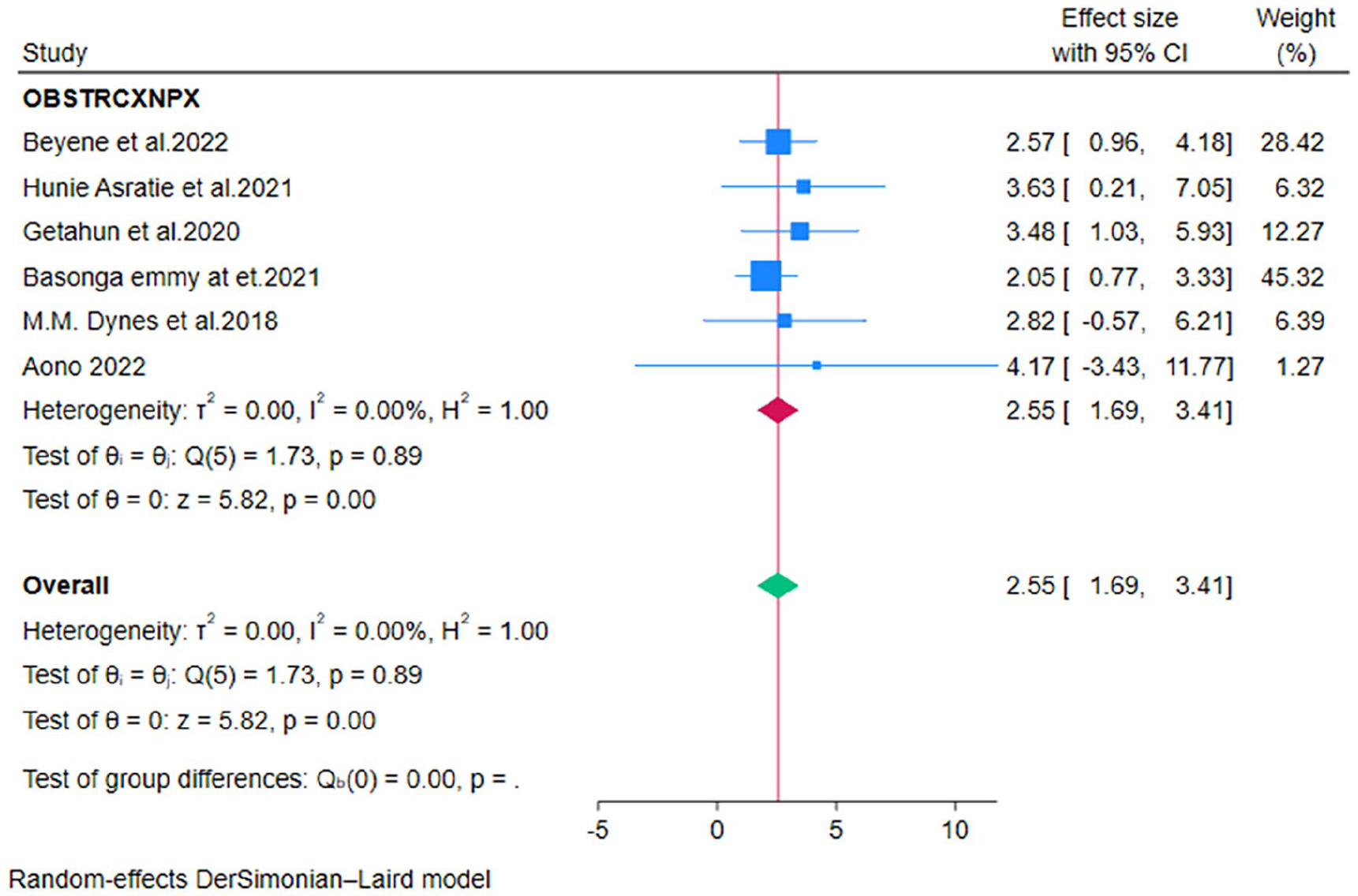
Forest plot shows the association between obstetric complication of current pregnancy and utilization of birth companionship during facility birth in SSA.
Parity of participants
Five articles were being examined in order to ascertain the relationship between the parity and the use of birth companionship by laboring mothers5,14,24,26,27 with 3022 study participants that were included. Therefore, prim parity and the use of birth companionship were significantly correlated. Prim para individuals were about (OR: 2.51; 95% CI: 1.83–3.19) times more likely to use birth accompaniment than multipara participants (Figure 8).

Forest plot shows the association between being prim para and utilization of birth companionship of laboring mothers during facility birth in sub-Saharan Africa.
Discussion
In this study, systematic review and meta-analysis was used to identify the pooled utilization of birth companionship and associated factors of laboring mothers during facility birth in sub-Saharan Africa. Among 10,393 laboring mothers, the overall utilization of birth companionship was 34% (95% CI: 25–43, I2 = 98.90%). The characteristics that were shown to be most associated with birth companionship among the 5279 participants in the pooled estimate were receiving antenatal care 2.69 (1.66, 3.73), being prima para 2.51 (18, 3,3.19), desiring a birth companion 2.46 (1.17, 3.74), and having a pregnancy problem 2.55 (1.69, 3.41).
Pooled utilization of birth companionship
In this review, the overall utilization of birth companionship in sub-Saharan Africa was 34% (95% CI: 25–43) in line with a study done in the southern area of Brazil (39.4%). 37 Nonetheless, this study showed greater results than the 23.5% study conducted in Palestine. 38 This gap could have arisen as a result of the study’s huge sample size and breadth. This suggestion is supported by the study conducted on the relationship between sample size and effect size, which shows that as sample size increases, so does effect sizes. 39
In this systematic review and meta-analysis, the pooled utilization of birth companionship was lower than studies that were conducted, in Hong Kong Chinese, 59.8%, 40 in Rural Bangladesh 68% 41 , and in Brazil, 93.9%. 42 This discrepancy may be the result of mothers’ and healthcare professionals’ lack of awareness of the advantages of having birth companions as well as their negative attitudes toward it. Another possible reason could be the variation across research, as indicated by the high heterogeneity test (I2 = 98.90%). Another possible explanation could be cultural differences as well as a lack of rules and regulations governing the choice of birth companion. This is corroborated by a Cochrane review study on companion choice at birth and implementation hurdles, which found that the absence of guidelines and cultural preferences or social conventions reduce the adoption of birth companions. 43
The high proportion of heterogeneity (I2 = 98.90%) among the original studies included in this review accounted for the statistically significant variation observed in them. Therefore, to look into the cause of the observed heterogeneity or the significance of small studies, we conducted subgroup analysis, met regression, and sensitivity analysis. The study’s subgroup analysis revealed that, in comparison to the countries where the research was done, possible source heterogeneity was seen in Kenya, Ethiopia, and Nigeria. The wide variations in sample sizes, sampling techniques, the small number of studies from each country included in this evaluation, and the unequal distribution of variables could all be contributing factors to this variation.
Factors associated with pooled utilization of birth companionship
According to this review, factors associated with utilization birth companionship across studies were identified. These are being prim para participants are 2.51 more likely to utilize birth companion during facility birth than multipara mothers. It is in line with study conducted in India and Hong Kong Chinese with lower parity more likely to use birth companionship40,44 than multiparous. This is a fact that prim-para women require greater informational and emotional support than multipara women due to fear of labor and delivery. 45 Another potential reason is prim-para more likely to develop postpartum anxiety than multipara which is supported by study was conducted in Spain. 46
Antenatal care is another factor linked to birth companionship. Participants in this study who received antenatal care were 2.69 times more likely to use birth companionship than those who did not. This result is consistent with research done in rural Ghana, Florianopolis, Brazil, and Saudi Arabia.47–49 This could be because the participants were more comfortable with the health facility staff and the environment, which increased their likelihood of asking openly about having a companion during childbirth. Another possibility is that the participant might hear about the benefits of having a birth friend during prenatal care. The World Health Organization’s statistics, which indicates that prenatal care provides opportunities to give pregnant women interventions that might be crucial to both their health and the health of their unborn child, supports this. 50
Obstetric complications during pregnancy, labor, and delivery are other factors that have been linked to companionship during birth. According to the review’s findings, participants with significant obstetric complications during their pregnancies were 2.55 times more likely than counter-participants to use a birth companions during a facility birth. This result is consistent with research carried out in Thailand. 17 In fact, birth companions can observe the best practices used by the healthcare provider to lessen the likelihood of litigation when there are any issues during labor and delivery, and they can even take part in the care.
Another factor associated with birth companionship is the desire for having companionship. In this review, those who desired to have birth companions were 2.46 (1.17, 3.74) times more likely to use birth companionship than their counterparts. It agrees with the mixed systematic review on the mistreatment of women during childbirth in healthcare facilities. 51 This could be related to labor; if a woman wants a birth companion, she should explain her desires to her closest friend or a health care provider. In addition, women who can make their own decisions have comprehensive access to maternity health care and are routinely informed on the benefits of labor companionship. 44
Limitations
✓ The included studies in this review were cross-sectional in design which does not establish a causal temporal relationship due to the snapshot nature of the design.
✓ Articles were restricted to only being published in the English language, which may result in the exclusion of other articles.
✓ The meta-analyses revealed high heterogeneity in the estimated pooled utilization of birth companionship.
✓ The possible source of heterogeneity was not detected despite performing subgroup analysis, meta regression, and sensitivity analysis.
✓ Due to limited studies have been done the topic authors enforced to do meta-analysis on small studies that affect the generalizability of studies.
✓ Despite this limitation, we did a thorough search to reduce possible risks of bias.
✓ We included articles that passed the JBI check with moderate and low risk.
✓ We attempted to examine the influence of small studies on the effect size, and the Egger effect revealed that there was no publication p > 0.93.
Conclusion and recommendations
Birth companionship is an appropriate and cost-effective nonmedical intervention for laboring women in low-income countries such as sub-Saharan Africa. It helps to improve maternal quality care, minimize maternal mortality and morbidity, and promote positive childbirth experiences. However, the pooled utilization of birth companionship by laboring mothers during facility birth in sub-Saharan Africa is low, indicating that the companionship option during facility birth is underutilized. Other characteristics linked with pooled utilization of birth companionship include being primipara, receiving antenatal care, wanting companionship, and experiencing complications during the current pregnancy.
The authors recommend that future researches look into the effects of birth companionship on mother and infant outcomes during facility births.
The management team, policymakers, and healthcare professionals should take the effort to educate pregnant mothers during antenatal care follow-up on the benefits of having a birth companionship during childbirth.
Supplemental Material
sj-doc-1-smo-10.1177_20503121241272572 – Supplemental material for Utilization of birth companionship and its associated factors among laboring mothers during facilities birth in sub-Saharan Africa. Systematic review and meta-analysis
Supplemental material, sj-doc-1-smo-10.1177_20503121241272572 for Utilization of birth companionship and its associated factors among laboring mothers during facilities birth in sub-Saharan Africa. Systematic review and meta-analysis by Mogos Beya Gudeta, Negga Assefa, Yadeta Dessie Bacha, Merhawi Gebremedhin Tekle, Feysel Mohammed Hussen, Astawus Alemayehu, Abraham Negash and Kabtamu Nigussie in SAGE Open Medicine
Footnotes
Acknowledgements
Not applicable.
Authors contributions
Conceptualization: Mogos Beya Gudeta, Negga Assefa, and Yadeta Dessie Bacha. Data extraction and screen: Mogos Beya Gudeta, Negga Assefa, and Astawus Alemaheyu. Methodology: Merhawi Gebremedhin Tekle and Mogos Beya Gudeta. Formal analysis: Yadeta Dessie Bacha, Abraham Negash, and Mogos Beya Gudeta. Visualization: Yadeta Dessie Bacha and Negga Assefa. Writing – original draft: Kabtamu Nigussie and Feysel Mohammed Hussen. Writing – review and editing: Merhawi Gebremedhin Tekle and Mogos Beya Gudeta.
Declaration of conflicting interests
The author(s) declared no potential conflicts of interest with respect to the research, authorship, and/or publication of this article.
Funding
The author(s) received no financial support for the research, authorship, and/or publication of this article.
Ethics approval
Not applicable.
Informed consent
Not applicable.
Consent for publication
Not applicable.

Data availability statement
The data will be available upon request with the corresponding author.
Supplemental material
Supplemental material for this article is available online.
References
Supplementary Material
Please find the following supplemental material available below.
For Open Access articles published under a Creative Commons License, all supplemental material carries the same license as the article it is associated with.
For non-Open Access articles published, all supplemental material carries a non-exclusive license, and permission requests for re-use of supplemental material or any part of supplemental material shall be sent directly to the copyright owner as specified in the copyright notice associated with the article.
