




Abstract
Objective:
To assess the nurses’ knowledge of vascular access devices for patients undergoing hemodialysis programs in the Gaza Strip, Palestine.
Methods:
A descriptive cross-sectional study was conducted to assess the nurses’ knowledge of hemodialysis vascular access using the convenience sampling technique. The assessment tool comprised 60 items related to the nurses’ knowledge and 7 items on demographic characteristics at hemodialysis units in 5 governmental hospitals in the Gaza Strip, between March and June 2023. Statistical analysis of the collected data was performed using SPSS version 22.
Results:
A total of 65 nurses in hemodialysis units were included. Of the majority of study nurses 71% were male, 21.5% of nurses had fair knowledge, and 78.5% had good knowledge about vascular access devices. The overall average score was more than 70% in all dimensions, which revealed good knowledge about vascular access devices. The study indicated that there was a statistically significant association between nurses’ knowledge of vascular access devices and (years of experience in the hemodialysis unit, and received training of nurses).
Conclusions:
The knowledge of hemodialysis nurses toward vascular access devices for patients undergoing hemodialysis was good. The years in the hemodialysis unit and having training have shown significant association with knowledge among hemodialysis nurses on vascular access devices care. Thus, interventions should focus on providing training for nurses about vascular access devices care in hemodialysis units to improve the comprehensive knowledge of nurses and to maintain patient’s health status.
Introduction
Vascular access (VA) is often known as the “lifeline” to hemodialysis (HD). 1 The maintenance of well-functioning VA is a requirement for maintaining and continuing the HD process, and the care of VA directly affects the HD outcomes and the quality of life of HD patients. 2 However, the service life of VA can be affected by a diversity of factors. 2 Venous Access for HD can be achieved in three methods: by arteriovenous fistula (AVF), an arteriovenous graft (AVG), or a cuffed central venous catheter. 3 Globally, HD remains the prevalent dialysis modality for more than 2 million patients who have a prerequisite of well-functioning VA for this technique. 4 In the Occupied Palestinian Territory (Gaza Strip), a total of 990 patients over the age of 15 received HD treatment distributed to five government hospitals in the Gaza Strip (GS) and the total number of devices was 185. 5 The GS is experiencing a continuous increase in the number of dialysis patients, according to the Palestinian Ministry of Health (MOH) annual reports, five adult HD units in governmental hospitals, which serve approximately 720 patients above the age of 15 in 2017, approximately 938 of patients in 2020 receiving HD regularly reached, 6 and around 1110 patients in the first half of 2022. 6 In 2022, approximately 85 nurses were working in the adult HD units of the five government hospitals in GS in 2022. 6 Due to this rise, it is essential for nurses working in HD units to have a comprehensive understanding of Vascular Access Devices (VADs) and the early, late complications that may arise from their use. A knowledge gap in this field can lead to complications such as infections, clotting, and access failure, which can have negative effects on patient outcomes. 7 Furthermore, nurses must be able to recognize early signs of VA dysfunction, identify problems, and promptly repair them to prevent complications. 8
Hemodialysis nurses play a main role in assessing, establishing, maintaining, and controlling VA as well as in providing patient instruction, and their knowledge of VA directly influences its care outcomes. 8 Because the specialized knowledge of VA is affected by its specialty, only simple explanations of VA types are carried out in the teaching process of nursing students in Palestine, and the knowledge of how to evaluate, monitor, and manage VA is less involved. According to the Palestinian MoH annual reports, the past few years have seen limited progress in VA management, advanced technical training events and academic exchanges for Palestinian nurses outside the GS due to the Israeli siege and occupation imposed on the residents of the GS. 5 HD unit nurses are responsible for the improved care for patients undergoing HD has VADs. 9 HD nurses must have a good level of knowledge because they reflect vital features of quality nursing outcomes in HD management, 10 because HD patients with poor personal hygiene behaviors should be educated and provided instruction by nurses on how to improve and maintain their personal hygiene and VA. 11 In addition, there is a higher rate of complications in HD, VA when new or less-experienced HD nurses manipulate the VA. 12 After reviewing previous studies in the GS, it was noted that little is known about the nurses’ knowledge in (GS), on nurses’ knowledge of VAD, existing studies primarily focus on quality-of-life and care of patients undergoing HD program rather than the nurses themselves. 13
The situation is particularly serious in developing countries where complications and other vascular risk factors are increasing clearly and health resources and information are limited. 14 Occupied Palestinian Territory (GS),one of these countries will face the complications of this problem in the future, where the burden of this disease is expected to exhaust its medical and financial system. The awareness of the risk factors and complications of VA devices helps in developing programs and planning preventive measures for nurses. 5 In this study, the nurses’ knowledge levels toward VA devices score 15 was utilized for the first time in Palestine to assess the nurses’ knowledge of VA devices for patients undergoing HD programs in the Gaza Strip, Palestine.
Methods
Study design, setting, and participants
This is a descriptive-analytic cross-sectional study in Palestine that adhered to Strengthening the Reporting of Observational Studies in STROBE checklist. Cross-sectional investigations are conducted over a brief period or at a single moment in time. The study was carried out between 02March and 02 June 2023 among 65 employed nurses who have been working in adult HD units at five governmental hospitals in the GS, Palestine. The sample was chosen using a convenient sampling technique, and an online sample size calculator by using Raosoft (Sample Size Calculator, Raosoft Inc.) 16 with an accepted margin of error of 5%, a confidence interval of 95%, and a response distribution of 50%. The response rate of the questionnaire was 100% among the nurses due to that the sample was collected through convenient techniques and face-to-face interviews, which enabled us to exclude any nurses who refused to participate from the beginning of the data collection process. The study included all employed nurses who have been working in adult HD units at five governmental hospitals, receiving regular monthly salaries, and were eligible and available during the period from the beginning of 02 March to 02 June 2023. They were included in the study upon their acceptance to participate. However, nurses with limited clinical experience of less than 6 months or newly recruited in HD units, those not willing to participate, and did not receive regular monthly salaries, or where unpaid volunteers were excluded.
Data collection and assessment tool
After obtaining approval from the general administration of hospitals at the Palestinian MOH, a face-to-face interview in adult HD units was conducted with the nurses to collect research data. The questionnaire took approximately 15–20 min to complete.
In this study, which measures nurses’ knowledge levels toward VADs, the survey was conducted in English version and had two parts. A well-developed questionnaire adapted from the article “Effectiveness of an Educational Program on Nurses’ Knowledge and Practices Concerning Nursing Management of Patients with VA in Dialysis Centers at Baghdad Teaching Hospitals,” 15 encompassed two parts. Beginning with sociodemographic characteristics of the nurses including gender, age, marital status, education level, years of experience in HD units, and training courses taken in HD units about VA devices 7 items, it proceeded to knowledge assessment comprised 60 items that were concerned with nurses’ knowledge toward VA devices (details in Supplemental Material). Response data were securely managed by the principal investigator Mahmood and Khudur, 15 reported acceptable internal consistency (reliability) using Cronbach’s alpha test, with values of 0.874 for the knowledge. This tool by Mahmood and Khudur, 15 was developed after extensive pertinent literature searches and adopting content from related studies. 17 A pilot study was carried out between the periods, and it was conducted at Al Shifa Medical Hospital (the largest hospital in the GS), during the period from 15 February to 26 February 2023 on 7 nurses (10% of the population). The responses from the pilot study were not included in the final analysis. Following this, a sequence of revisions was undertaken to ensure a strong internal consistency, measured using Cronbach’s alpha. The calculated Cronbach’s alpha coefficient for the questions reached a value of 0.857.
Knowledge assessment
In all, 60 questions were posed to gauge nurses’ knowledge of VA devices. It consisted of several themes, with simple questions, with preferably “Yes” or “No” responses. Dimension one includes 12 items and presents the nurses’ knowledge toward general information about VADs to patients with HD. Dimension two includes 10 items that presented the nurses’ knowledge toward the advantages and disadvantages of a VAD. Dimension three includes 16 items that present the nurses’ knowledge toward the complications of VADs, (AVF and AVG) to patients with HD. Dimension four includes 12 items that present the nurses’ knowledge of providing care to patients with VADs, and the final section includes 10 items that present the nurses’ knowledge about providing instruction to patients with VADs 10 items. A total average score is calculated by summing total item scores and ranging from 70%. The higher participant scores average higher levels of more than 70% and are considered good knowledge and less than 70% is considered fair knowledge. Fair knowledge includes low and moderate levels of knowledge.
Statistical analysis
The SPSS software, version 22 was used for the statistical analysis. Characteristics of the sample were described by using descriptive statistics. Frequencies and percentages were used to describe different categorical variables, whereas means and standard deviations (SD) were used to represent continuous variables. The Chi-square (χ2) test was used for analysis, which average that a score less than or equal to the mean is considered a low and moderate level of knowledge (fair), and a score higher than the mean is considered a high level of knowledge (good). p-values of less than 0.05 were considered significant.
Ethical approval
The study protocol was approved by the Palestinian Health Research Council (Departmental Health Research Unit of Palestinian MOH, GS) (Code No.: MOH 1249427/2023). Additionally, written informed consent was obtained from each HD nurse upon enrolment.
Results
Characteristics of the HD unit nurses
The nurses’ knowledge levels toward VAD items showed a good Cronbach alpha: α = 0.857. Table 1 displays the characteristics of the HD unit nurses. The age of 65 nurses’ Mean ± SD was 32.5 ± 5.3, more than half of the nurses 71% were male, 64.6% were from the age group of 30–39 years, most of the study respondents 86% were married, 60% had a bachelor degree, and 31% of nurses working in Al Shifa Medical Hospital. Most of the nurses 57% had more than 5 years of experience in HD unit, and only 60% of the nurses have received training about VADs.
The sociodemographic character of hemodialysis unit nurses in governmental hospitals.

Data are expressed as means ± SD for continuous variables and as percentages for different categorical variables.
SD: standard deviation; HD: hemodialysis.
Knowledge of VADs dimensions among HD unit nurses for patients on HD program average score
The overall average score of knowledge of VADs dimensions is displayed in Table 2, which shows that for dimension one, the overall average score was 77.57%, which revealed good knowledge about general information of VADs. The overall average score was 78.44%, which revealed good knowledge about the advantages and disadvantages of VADs. The overall average score for dimension two was 78.44%, which revealed good knowledge about the advantages of VADs. The overall average score for dimensions three and four was 82.31%, and 81.02, which indicated good knowledge about complications of central venous devices (CVDs), AVF, and AVG, and providing care to patients with CVDs, AVF, and AVG, respectively. The overall average score for dimension five was 77.54%, which revealed good knowledge about providing instructions to patients with VADs. That means the overall average score of knowledge of VADs for all dimensions is more than 70% and is considered good knowledge.
Knowledge of vascular access device dimensions among HD unit nurses for patients in HD program.

Data are expressed as average scores for continuous variables and as (%) percentages for different categorical variables.
No.: number; HD: hemodialysis; CVDs: central venous devices; VADs: vascular access devices; AVF: arteriovenous fistula; AVG: arteriovenous graft.
Level of knowledge about VADs among HD unit nurses for patients on HD
Table 3 shows that for dimension one 14 (21.5%) of nurses have fair knowledge and 51 (78.5%) have good knowledge about general information on vascular access devices. Dimension two showed that 19 (29.2%) of study participants have fair knowledge and 46 (70.8%) have good knowledge about the advantages and disadvantages of VADs. In addition, dimension three showed that 22 (33.8%) of the study participants have fair knowledge and 43 (66.2%) have good knowledge about complications of CVDs, AVF, and AVG. Dimension four showed that 18 (27.7%) of study participants have fair knowledge and 47 (72.3%) have good knowledge about providing care to patients with VADs. The last dimension showed that 15 (23.1%) of the study participants have fair knowledge and 50 (76.9%) have good knowledge about providing instructions to patients with VADs. All dimensions are relevels to the study participants and had a good level of knowledge about VADs for patients on HD.
Level of knowledge about VADs among HD unit nurses for patients on HD.
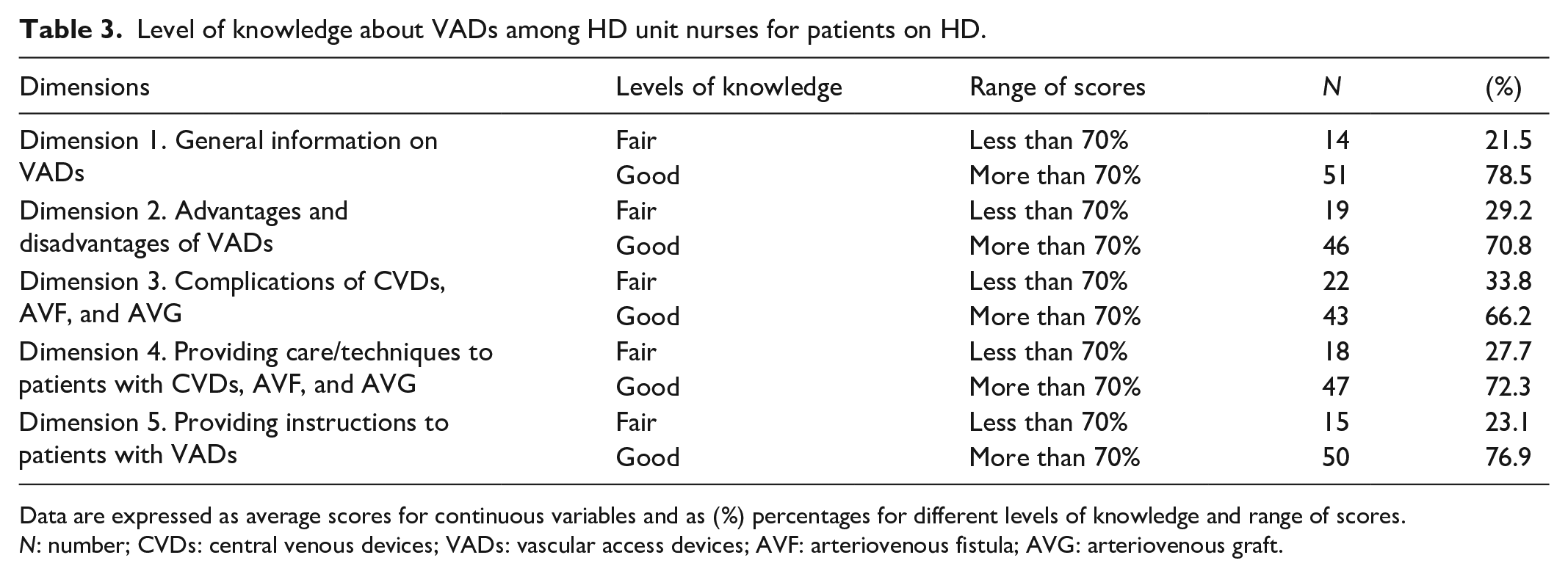
Data are expressed as average scores for continuous variables and as (%) percentages for different levels of knowledge and range of scores.
N: number; CVDs: central venous devices; VADs: vascular access devices; AVF: arteriovenous fistula; AVG: arteriovenous graft.
Characteristics of HD unit nurses concerning a level of knowledge dimensions average scores
Table 4 shows no statistically significant difference between the five dimensions of knowledge about vascular access devices, and the gender of HD unit nurses showed that 4 (44.4%) of nurses from the age group 20 to 29 years, 34 (81%) of nurses from the age group 30 to 39 years, and 13 (93%) of nurses from the age group 40 to 49 years have good knowledge about general information of VADs (p = 0.018) which is statistically significant. This result indicated that older nurses 40–49 years old have significantly higher knowledge compared to younger age HD nurses. No statistically significant association between knowledge about VADs and marital status, between different qualifications, and between different workplaces/hospitals of HD unit nurses. Statistically significant differences were found between five dimensions of knowledge about VADs, and years of experience in HD units showed that 35 (89.7%) of nurses who attended training courses and 16 (61.5%) of nurses who did not attend training courses have good knowledge (p = 0.007) which is statistically significant. This result indicated that nurses who attended training courses had higher knowledge about VADs compared to nurses who did not attend training courses. Statistically significant differences were found between the five dimensions of knowledge about VADs and between the received training of HD unit nurses.
The sociodemographic character of hemodialysis unit nurses in relation to a level of knowledge dimensions average scores.
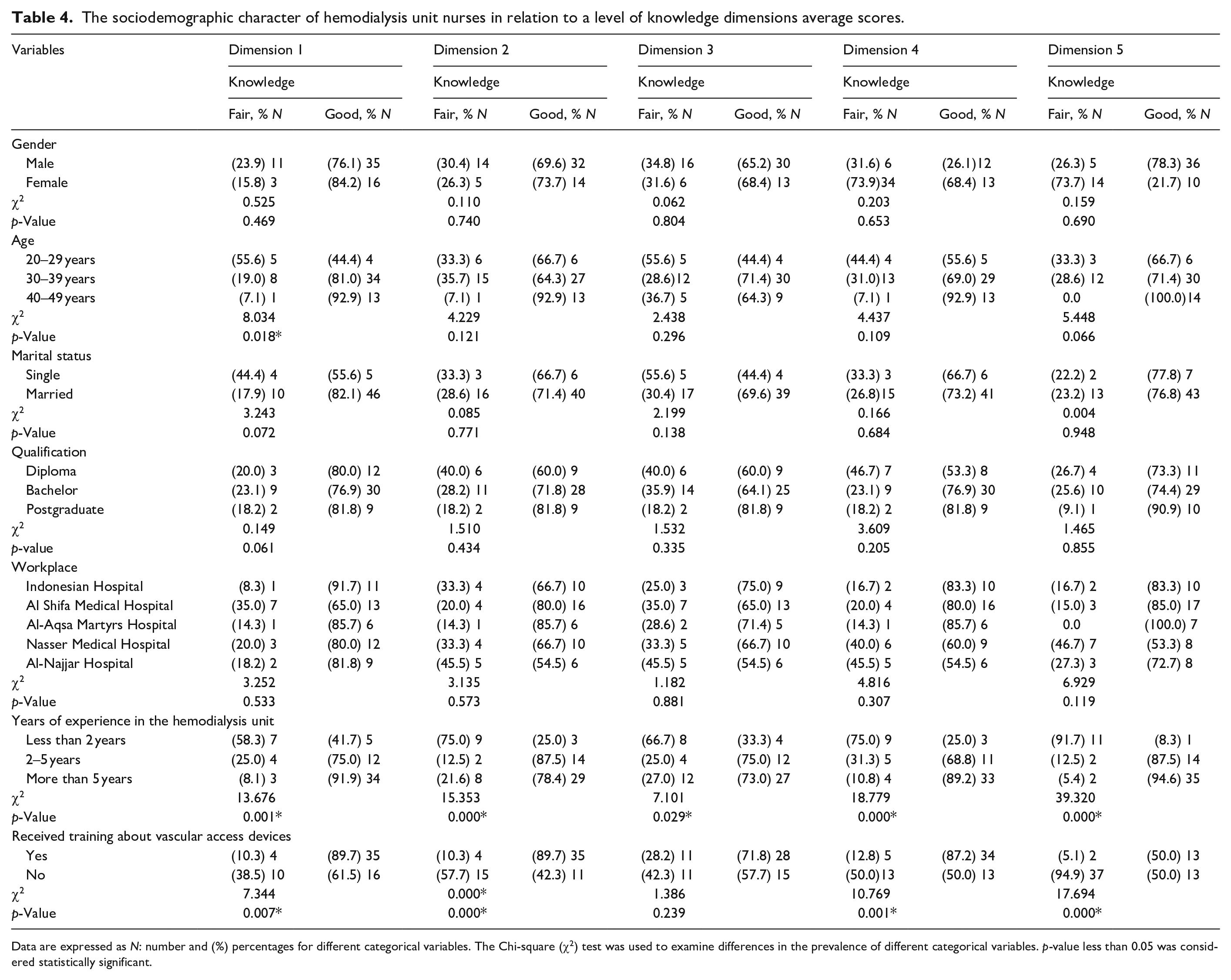
Data are expressed as N: number and (%) percentages for different categorical variables. The Chi-square (χ2) test was used to examine differences in the prevalence of different categorical variables. p-value less than 0.05 was considered statistically significant.
Discussion
Globally, VADs are commonly referred to as the “lifeline” for patients undergoing a HD program. It is essential to maintain a well-functioning VA to confirm the achievement of HD treatment and to directly influence dialysis results and the quality of life for HD patients. Hemodialysis nurses play a vital role in various aspects related to vascular access. Nurses are responsible for assessing, establishing, maintaining, and monitoring VA sites. This facility-based cross-sectional study was conducted to assess the nurses’ knowledge toward VADs for patients undergoing HD programs in the GS, Palestine.
Concerning the total level of knowledge of the participants about VADs, the results of the current study revealed that more than three-quarters of participants had a good level of knowledge regarding all dimensions. From the researcher’s point of view, this could be attributed to participants receiving training, with less than two-thirds of them holding a bachelor’s degree. This finding was higher than studies conducted in Sudan and Nanjing, where about 67.2% of participants had good knowledge. 18 Regarding the knowledge of the participants about general information about VADs for patients undergoing HD, the current study results revealed that more than three-quarters of participants had good knowledge. Additionally, less than three-quarters of participants had good knowledge regarding the advantages and disadvantages of VADs. These findings align with a study conducted in Sichuan Province, West China Hospital, 19 which reported a similarly high level of knowledge among healthcare professionals.
In our current study, it was found that the participants’ knowledge about the complications of VADs was limited, with less than two-thirds demonstrating good knowledge. This could be attributed to the lack of training courses and instructional guidelines providing them with adequate information about vascular access devices and their associated complications. The findings of our study contradicted those of Raynak et al., 20 who reported that the majority of their sample had limited knowledge about these complications. Conversely, a study conducted at Baghdad Teaching Hospital, Iraq, by Mahmood and Mohammed, 15 indicated that nurses working in HD had a fair level of knowledge regarding the complications of CVDs, AVF, and AVG.
Regarding the knowledge of the participants about providing care/techniques to patients with CVDs, AVF, and AVG, the current study results revealed that less than three-quarters of them had good knowledge. More than three-quarters of the participants had good knowledge regarding providing instructions to patients with VADs. These findings agree with studies, 21 which have shown that the training of HD unit nurses on VADs has a positive impact on the quality management of VADs by improving the AVF puncture techniques, decreasing VA complications, and prolonging the patency of VADs. Several publications emphasize the importance of proper assessment of HD VAD complications to reduce morbidity and VAD loss. 22
Regarding the relation between participants’ total knowledge and their demographic characteristics, the finding of this study illustrates a significant association between the years of work experience in the HD unit and all dimensions of nurses’ knowledge, (p = 0.001, 0.000, 0.029, 0.000, 0.000), respectively. This result was supported by previous studies conducted in Addis Ababa, Ethiopia, 10 and Baghdad, Iraq. 15 These show us that the increased years of service and training nurses have in HD care provide better knowledge about it, which is consistent with the findings from a foreign study. 23 This could be due to the familiarity with the procedure thegovernmental hospitals provide and the training about VA for nephrology staff which could provide a higher opportunity for improving their knowledge. While there was no statistically significant relation between participants’ total knowledge and their gender, the current study result was similar to the study conducted in Egypt by Ahmed and Kafl, 24 which illustrated that there was no statistically significant relation between gender and the mean level of knowledge scores. Regarding the relation between participants’ total knowledge and received training about VADs, the finding of this study illustrates that there was a significant association between nurses who received training and dimensions 1, 2, 4, and 5 of their knowledge, while there was no significant association between knowledge about complications of CVDs, AVF, and AVG, and received training courses. This finding was in line with the results of a study done in Jimma by Wolide et al. 25 and in Ethiopia and Kigali, Rwanda, by Dushimiyimana et al. 26 The possible justification for this could be that the trained HD nurses can identify early threatening signs and prevent HD-associated complications in HD patients.
In addition, HD training is highly specialized, and only nurses who have completed a certain number of years of service are allowed to attend specialized training on blood purification, during which nurses will receive systematic training on HD (including knowledge of VA). 27 It is therefore recommended that before performing training on VA for nephrology nurses, their knowledge and skills should be evaluated before developing tailored training and assessment programs for nurses at different levels.
Limitations
Our current study had some limitations. It was a cross-sectional design conducted in the GS in Palestine, as well as, the convenience sampling technique involved a small sample number of HD unit nurses which may affect the generalizability. Despite that, our study provides new results about the level of knowledge among HD unit nurses in the Palestinian context.
Conclusion
In our study, the knowledge of HD nurses toward VADs for patients undergoing HD was good. The years of service in the HD unit and specialized training have shown a significant association with knowledge among HD nurses on VAD care. Thus, interventions should focus on providing training for HD nurses regarding VAD care in HD units to improve the comprehensive knowledge of nurses and to maintain patients’ health status.
Supplemental Material
sj-docx-1-smo-10.1177_20503121241264444 – Supplemental material for Nurses’ knowledge toward hemodialysis vascular access devices: A cross-sectional study in Palestine
Supplemental material, sj-docx-1-smo-10.1177_20503121241264444 for Nurses’ knowledge toward hemodialysis vascular access devices: A cross-sectional study in Palestine by Sae’d Abu El-Kass, Nisreen Ahmed, Tahreer Kannan, Narmean Abu Shediq and Esraa El Dirani in SAGE Open Medicine
Supplemental Material
sj-docx-2-smo-10.1177_20503121241264444 – Supplemental material for Nurses’ knowledge toward hemodialysis vascular access devices: A cross-sectional study in Palestine
Supplemental material, sj-docx-2-smo-10.1177_20503121241264444 for Nurses’ knowledge toward hemodialysis vascular access devices: A cross-sectional study in Palestine by Sae’d Abu El-Kass, Nisreen Ahmed, Tahreer Kannan, Narmean Abu Shediq and Esraa El Dirani in SAGE Open Medicine
Footnotes
Acknowledgements
The authors would like to thank the general director of hospitals at the MOH in the Gaza Strip, Palestine, and the directors of hemodialysis units at the governmental hospitals for paving the way to conduct the study by approving data collection, additionally, the University and College of Applied Sciences, Department of Nursing. We are also thankful to all hemodialysis nurses who have agreed to participate in our study. Special thanks are extended to Dr. Eman Ahmed Elhaweet for her valuable contribution to the well-complemented manuscript.
Authors’ contributions
All the authors contributed to the preparation of this manuscript. SAK and NA: concept and design. TK, NAS, and ED acquisition, analysis, or interpretation of data. SAK wrote the article, final editing, and preparation of the manuscript for submission. SAK, NA, TK, NS, and ED revised the manuscript. All authors read and approved the final article.
Data availability
The data that support the findings of this study are available from the corresponding author upon reasonable request.
Declaration of conflicting interests
The author(s) declared no potential conflicts of interest with respect to the research, authorship, and/or publication of this article.
Funding
The author(s) received no financial support for the research, authorship, and/or publication of this article.
Ethics approval
The study protocol was approved by the Palestinian Health Research Council (Departmental Health Research Unit of Palestinian Ministry of Health, Gaza Strip) (Code No.: MOH 1249427/2023). Additionally, written informed consent was obtained from each hemodialysis nurse before the study.
Informed consent
Written informed consent was obtained before completing the questionnaire. Hemodialysis nurses were informed that participation in the study is voluntary, and the confidentiality and anonymity of the information were confirmed.
Trial registration
Not applicable.

Supplemental material
Supplemental material for this article is available online.
References
Supplementary Material
Please find the following supplemental material available below.
For Open Access articles published under a Creative Commons License, all supplemental material carries the same license as the article it is associated with.
For non-Open Access articles published, all supplemental material carries a non-exclusive license, and permission requests for re-use of supplemental material or any part of supplemental material shall be sent directly to the copyright owner as specified in the copyright notice associated with the article.
