



Abstract
Background:
Postabortion contraception is the initiation and use of postabortion contraceptive methods immediately after an abortion. It is a critical approach for preventing unwanted pregnancy, alleviating its complications, and avoiding repeated abortions by promoting immediate postabortion contraceptives provision.
Objective:
To assess the level of postabortion contraceptives uptake and its associated factors among clients visiting abortion care services in public hospitals in West Shewa Zone, Oromia regional state, Ethiopia.
Methods and materials:
An institutional-based cross-sectional study was conducted in public hospitals in the West Shewa Zone from 1 March 2021 to 30 May 2021, among 227 proportionally allocated clients based on the proportion of the client served in the previous 3 months of the study period. Data were collected through face-to-face interviews using semi-structured and pretested questionnaire from women who received the abortion services. Bivariable and multivariable logistic regression were used to assess the association of independent variables with postabortion contraceptive uptake. Findings with p-value of 0.05 at 95% confidence interval were considered as statistically significant.
Results:
The overall postabortion contraception uptake among abortion service clients in public hospitals was 164 (74%) while about 42% of them used long-term contraceptive methods. Postabortion contraceptive uptake was significantly associated with media exposure to postabortion family planning information (adjusted odds ratio: 3.4 (95% confidence interval: 1.03–11.27)) and counseling on postabortion family planning (adjusted odds ratio: 20.48 (95% confidence interval: 5.02–83.64)).
Conclusion:
Level of postabortion contraceptive method uptake in West Shewa was low as compared to the national target. Greater attention should be given on providing postabortion contraceptive counseling to increase the postabortion contraceptive uptake.
Keywords
Introduction
Postabortion contraception is the initiation and use of postabortion contraceptive methods immediately after an abortion. It is also one element of comprehensive abortion care and critical approach for preventing unwanted pregnancy, alleviating its complications, and avoiding repeated abortions by promoting immediate postabortion contraception provision. 1 Abortion care service may be the first encounter of a woman within the health system, so providers should utilize this opportunity to counsel and provide family planning service to the women or couple. 2
Postabortion family planning program should be offered to all women, regardless of their age, marital status, and ethnicity. Providing information to every woman and/or couple about postponing, spacing, and limiting pregnancy, and initiating methods are the only first steps in preventing unwanted pregnancy, its complications, and subsequent unsafe abortions. When counseling and postabortion contraceptive services are provided immediately after treatment, contraceptive acceptance is increased, resulting in lower costs and more efficient staff time. The Technical and Procedural Guidelines for Safe Abortion Services in Ethiopia recommend that a woman be provided with the choice of contraception services and counseling immediately after abortion care services to women seeking abortion care services prior to being discharged from the treating facility.1,3
The World Health Organization’s guideline recommends that reproductive age groups who experienced an abortion require a minimum intra-pregnancy interval of 6 months so that they should receive contraception immediately after abortion services because fertility returns within 10 days of an abortion procedure and women can be pregnant within inappropriate clinical conditions for the proper development of pregnancy. 4
To achieve a better future for all, sustainable development goals (SDGs), which promote good health and well-being, are targeted to reduce the maternal mortality ratio to less than 70 per 100,000 live births by 2030 by ensuring universal access to sexual and reproductive healthcare services, including family planning. The government of Ethiopia is also committed to meeting the SDGs and strongly believes that family planning is the key strategy for improving maternal health and bringing about development. 5
Since 2015 the government of Ethiopia is committed to achieving SDGs that promised to end all preventable causes of maternal death through increasing the contraceptive prevalence rate and increase the use of long-acting reversible contraceptive as well as reducing the total fertility rate. 6
Globally, more than 40% of pregnancies are unwanted due to a lack of contraception use. Consequently, 303,000 women die worldwide, with a majority (66%) of these maternal deaths occurring in Sub-Saharan African nations. This Abortion-related complication is responsible for 19% of maternal deaths in Eastern Sub-Saharan African countries. Our country, Ethiopia, ranks fourth among the top 10 countries by contributing 59% of the global maternal deaths 7 and 75% of women seeking abortion-related services that need postabortion family planning. 8
Postabortion family planning improves the sustainability and institutionalization of postabortion family planning counseling and services over time. In addition, expanding family planning services is one of the focused areas to reduce maternal, infant, and child morbidity and mortality globally. 12 The analysis of data from 172 countries by WHO showed that 44% of maternal deaths, 10% of infants, and 21% of childhood mortalities could be averted by the use of family planning in general. 7
Moreover, the government of Ethiopia has also implemented the second Health Sector Transformation Plan (HSTPII) that aimed to reduce the maternal death by strengthening postabortion contraceptive services which is one of the good strategies that could reduce maternal death in the country. 13
Aside from the health sector, Ethiopia’s mass media structure is also rapidly developing throughout time which has a great role in spreading healthy behavior to the wider public and enforcing social responsibility so that the Ministry of Health works to increase the production and dissemination of appropriate sexual, reproductive health and family planning information, about the program and interventions on a regular basis. 2
Despite this fact, there is insufficient evidence to indicate the level of postabortion contraceptive service provision and its associated factors in Ethiopia after the implementation of the Health Sector Transformation Plan II (HSTPII), including the study area specifically in public health institutions.
Even though some research has been conducted in different parts of Ethiopia, there is no research conducted on postabortion contraceptives and its associated factors in West Shewa Zone. This makes the research original, which generates postabortion contraception.
Therefore, the purpose of this study is to determine the level of the postabortion contraceptive method uptake and the associated factors among women of reproductive age who seek abortion care services in public hospitals in the West Shewa Zone.
Methods and materials
Study Area: This study was conducted in West Shewa Zone which is in the Western direction of the Oromia regional state, 120 km away from Addis Ababa capital city of Ethiopia. According to the 2007 Ethiopia National Population and Housing census, it has a total population of 2,661,188 of which 588,921 (22.1%) are women in the reproductive age group in 2021. In West Shewa Zone, there are 2 Referral hospitals, 5 Primary hospitals, 1 General hospital, and 92 Governmental health centers. All contraception methods are provided for no cost in all West Shewa Zone’s Public health facilities.
In addition to the governmental commitment, comprehensive abortion care is supported by three Non-Governmental Organizations: Ipas-Ethiopia, Marie Stop-Ethiopia, and Engender-Ethiopia.
Study design and period: An institutional-based cross-sectional study was conducted in the public hospitals of West Shewa Zone from 1 March 2021 to 30 May 2021.
Sources of population: All females of reproductive age groups from 15 to 49 years old seeking abortion care services in the West Shewa Zone.
Study population: All females of reproductive age groups who received abortion care services in public hospitals during the study period.
Inclusion criteria: This study included clients who visited the hospital for postabortion care services during the study period and those who were willing to participate in the study.
Exclusion criteria: This study excluded those who were physically and mentally unable to attend interviews.
Sample size determination: The sample size was calculated using the single population proportion formula based on the following assumptions: 95% confidence interval with a 5% margin of error by considering the prevalence of postabortion contraceptive acceptance, which was 84% (P = 0.84) in Dessie Town. 16
The final sample size was determined by adding 10% of nonresponse rate.
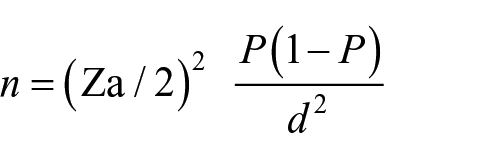
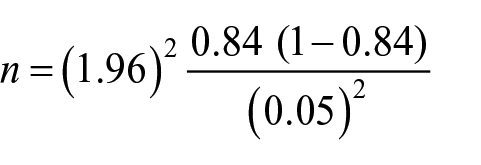


Required sample size was estimated to be = 227.
Sampling techniques: All consecutive Clients seeking abortion care services during exit from the abortion care service unit were included in the study.
The total sample size was determined by using proportional allocation techniques to each selected hospital based on the proportion of average client load served in the previous 3 months of the study period.
Variables of the study
Dependent variable
Postabortion contraceptive uptake
Independent variables
Sociodemographic related: Age, marital status, educational status, ethnicity, residence, occupation, religion, and sources of information.
Reproductive health related: Parity, fertility awareness, history of family planning use, previous history of abortion, and ever used postabortion contraceptive.
Personal related: Decision-making, knowledge, attitude, and future intention.
Operational definitions
Postabortion care is abortion care given to those seeking care after initiation of abortion, including family planning interventions.
Abortion is the termination of the pregnancy before 28 weeks of gestational age.
Postabortion contraception uptake is the initiation of a modern contraceptive method immediately after the abortion procedure is done.
Knowledge is the understanding of postabortion contraceptives at the time of the study gained through postabortion family planning counseling.
Attitude is a favorable or unfavorable thinking toward any postabortion contraception use.
Future intention is the need to use postabortion contraceptive or have pregnancy immediately after abortion care services.
Level of postabortion contraceptive uptake is the proportion of women who accepted postabortion contraceptives among women who were visiting abortion care services in public hospitals.
Data collection tools and methods
Data were collected using a structured questionnaire developed based on a literature review. 18 The questionnaire was initially prepared in English and translated into the Afaan Oromo language, and then translated back to English to check the consistency. Six BSC midwives were selected as data collectors, and one health officer was selected as the supervisor. Then an exit interview was conducted at the point where the service users were ready to be discharged, where questions and answers were not overheard. The filled interviews were checked for their completeness and consistency. In addition, an observational checklist was used to assess the health system related to postabortion contraceptive service provision.
Statistical analysis
Data were cleaned, coded, checked, and entered in EPI-info version 7.2 and exported to SPSS version 23 for further analysis. Descriptive statistics were carried out to see the distribution of independent variables. Both bivariable and multivariable logistic regression analyses were computed. In the bivariable analysis, p-value of less than 0.2 was used to select candidate variables for multivariable analysis. Variables with p-values less than 0.2 were entered into subsequent multivariable models using the backward elimination approach. Finally, the p-value and 95% confidence interval were used to measure the level of significance in the multivariable analysis, and those variables with a p-value of less than 0.05 in the multivariable analysis were considered as statistically significant.
Data quality assurance
One day training was provided by the principal investigator to data collectors and supervisors on data collection tools. Pretest was carried out among 5% of the sample size population at Holeta Primary Hospital. Based on the pretest results, the questionnaires were modified as necessary. The supervisor and principal investigator checked the consistencies, completeness, and correctness of each questionnaire daily.
Results
Sociodemographic characteristics of the respondents among clients who came for postabortion contraceptives at West Shewa Zone, Oromia Regional state, 2021
From a total of 227 study participants, 221 respondents participated in the study which made the response rate 97%. A total of 64 (29%) of the respondents were in the age group 20–24 years, with a mean age of 26.63 years and SD ± 6.07 years. Among the total participants, 163 (74%) were married in their marital status. The predominant ethnic group was Oromo with 192 participants (87%; Table 1).
Sociodemographic characteristics of the respondents among clients who came for postabortion contraceptives at West Shewa Zone, Oromia Regional state, 2021.

Level of the Postabortion contraceptive uptake among clients who came for postabortion contraceptives at West Shewa Zone, Oromia Regional state, 2021
The overall postabortion contraceptive uptake among abortion service clients who visited public hospitals was 164 (74%), while about 26% of those who visited abortion services left hospitals without any form of modern contraceptives.
Among 74% of the respondents who used contraceptive methods after the current abortion service, about 43% of them use long-term contraceptive methods, 27% of them use implants, and 15% of them use Intrauterine devices (Figure 1).
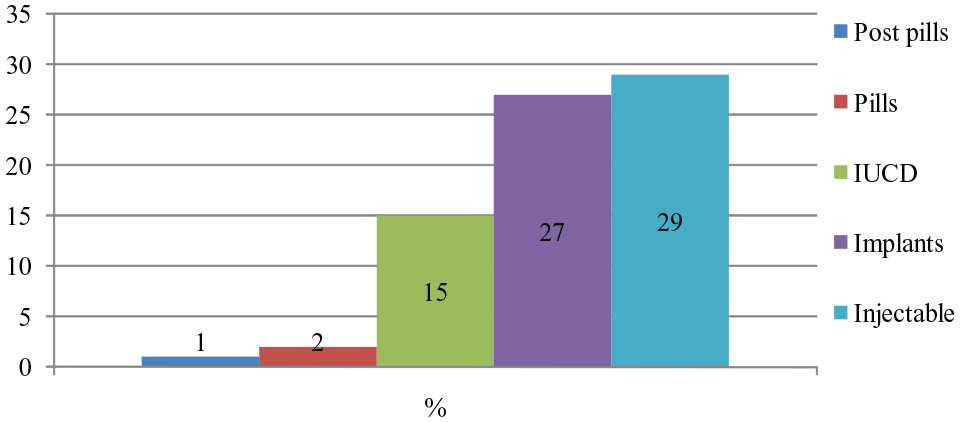
Types of the postabortion contraceptive uptake among clients who get abortion services in public hospitals in West Shewa Zone, Oromia, Ethiopia, 2021.
Reproductive health-related characteristics of the clients who came for postabortion contraceptives at West Shewa Zone, Oromia Regional state, 2021
Among the study participants, 91 (41%) had ever used postabortion family planning. A total of 204 (92%) of the study respondents were counseled about the time that fertility returns following abortion and the importance of postabortion contraceptive. Among the study participants, about 92% (204) were counseled on fertility returns after an abortion and about 8% (17) were not counseled on fertility returns after abortions (Table 2).
Reproductive health-related factors of study respondents in public hospitals in West Shewa Zone, Oromia, Ethiopia, 2021.
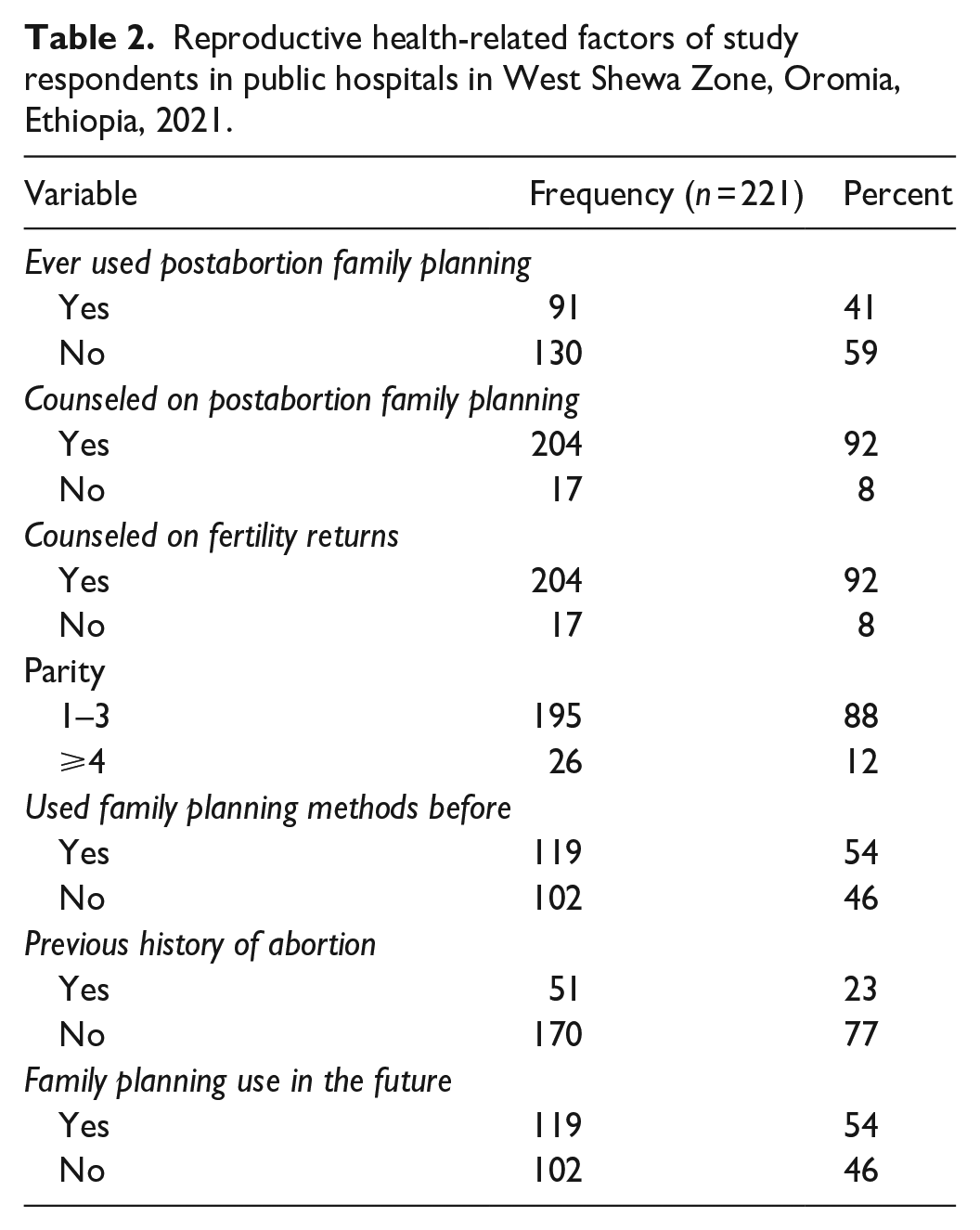
From the total respondents, 173 (78%) planned to use postabortion contraceptives immediately after the abortion procedure. Concerning access to information about postabortion contraceptive methods, 53%, 16%, and 10% of study respondents got information about postabortion contraceptive methods from health providers, the media, and friends, respectively (Table 2).
Associated factors of postabortion contraceptive uptake clients who came for postabortion contraceptives at West Shewa Zone, Oromia regional state, 2021
A significant association was observed between postabortion contraceptive uptakes in bivariable analysis with variables like age of women, educational status of women, parity, counseled about postabortion contraceptive and awareness on fertility returns, ever used postabortion contraceptive methods, and having the opportunity to access media information about postabortion contraceptive methods found to be candidate variables at p-value <0.2 and entered into the final model for multivariable analysis (Table 3).
Factors associated with postabortion contraceptives uptake among women who received abortion care services in public hospitals West Shewa Zone, Oromia, Ethiopia, 2021.

PAFP: postabortion family planning; COR: crude odd ratio; AOR: adjusted odd ratio; CI: confidence interval.
Represents the p value.
In multivariate analysis, educational status, counseled about postabortion contraceptive methods, and information obtained from the media were factors that associated with PAFP uptake at p-value less than 0.05 and 95% confidence interval not including one.
However, educational status was negatively associated with postabortion contraceptive uptake. It was surprising to mention here that those women who attended formal education were less likely to use postabortion contraceptive than women who did not attend formal education (AOR: 0.27 (95% CI: 0.11–0.66)).
The odds of the postabortion contraceptive uptake among women who received postabortion contraceptive uptake counseling were 20 folds higher than those who did not receive postabortion family planning counseling (AOR = 20.48 (95% CI: 5.02–83.64)).
Similarly, postabortion contraceptive uptake was 3.43 times higher among women who got the information about postabortion contraceptive uptake from the media than those who did not get information from mass media (AOR = 3.43 (95%CI: 1.03–11.27); Table 3).
Dissemination of results
The study will be presented to Walagga University, Oromia regional health Berous and Professional conference. Then the result of this study will be communicated to selected public hospitals and the West Shewa Zonal health department. Moreover, it will be published on reputable journals to arrive with further readers.
Discussions
This study revealed that the level of postabortion contraceptive uptake in public hospitals in the West Shewa Zone was low in comparison to the national target. 8 This finding is in line with the previous study conducted in the Nepal where postabortion contraceptive uptake was76%. 14 This could be due to their similarity in the study design and target groups.
However, this finding is higher when compared to the previous studies conducted on postabortion contraceptive uptake in Bahir Dar (61%) and Shire town (61.5%).14,17 This variation might be due to the fact that the number of respondents that were counseled about postabortion family planning in Bahir Dar town was only 69%, while in Shire town, around 50% of respondents were counseled about postabortion contraceptive methods, 17 while this study showed that 92% of respondents were counseled about PAFP before discharge.
The other reason may be due to educational level difference among the study respondents. The study done in Shire town indicated that only 14% of the study respondents attended secondary and above educational level, 14 but the current study indicated that 44% of the study respondents have completed secondary and above educational level. The other possible reasons might be due to study period differences or as healthcare improvements over time.
In addition, this finding is lower than the previous studies conducted in Burayu town, where postabortion contraceptive uptake was 88% 15 and Dessie town where postabortion contraceptive uptake was 84% 16 The disparity could be due to educational level differences, difference in sample size and study setup; the study conducted in both Burayu and Dessie towns included the public and private health facilities. 15
Moreover, this finding is very different from those of the studies conducted in Addis Ababa, where postabortion contraceptive uptake was 90%. 15 This variation might be due to difference in study population, study area, study methods and tools used, cultural differences, and postabortion contraceptive services delivery difference among study settings.
The odds of postabortion contraceptive uptake among women counseled about postabortion family planning were higher than their counterparts. This finding is similar to the previous studies conducted in Bahir Dar and Shire town.14,17 This might be due to counseling, which helps the women make informed decisions about family planning service utilization. 2
This implies that counseling is one of the most important aspects of providing high-quality family planning services; it is a method by which providers assist clients in making and carrying out their own reproductive health and family planning decisions, and postabortion contraceptive counseling is an effective way of increasing the postabortion contraceptive method uptake of a highly effective method of contraception. 16
This might be due to the fact that women who were counseled might have better awareness and understanding of the appropriate timing of the postabortion contraception uptake and benefits of postabortion contraceptive uptake than non-counseled women.
The odds of postabortion contraceptive uptake among women who can access media information about postabortion contraceptive methods were higher compared to women who did not have access to media information about postabortion contraceptives. However, no studies conducted in previous time had identified that media had a statistically significant association with postabortion contraceptive uptake in developed countries and in our country Ethiopia.9–11
This might be due to the fact that mass media outlets could increase the demand and uptake of services by increasing knowledge and awareness of family planning, especially long-term methods, by providing targeted, easily accessible, clear, and accurate information to the population about the types of contraceptive methods and their use. This implies that, demand creation about contraceptives should be understood about sexual, reproductive health and family planning which significantly improves the welfare of the population’s health through the prevention of unintended pregnancies.2,5
Based on the finding of this study the following recommendation was given: Providers should strengthen counseling about the benefits of postabortion contraception use with due emphasis to long-acting reversible contraception, provide immediate postabortion family planning information for all women, and offer a wide range of contraceptive methods.
The hospitals should be availing themselves of all the required contraceptive commodities at service delivery points and tailoring postabortion contraceptive communication materials.
Limitation of the study
It might not give the real utilization of postabortion contraceptives because the information was not gathered whether the women used the contraceptives in other health facilities or not after they were discharged from treated hospitals.
There is also no follow-up to see if they continued to use the contraceptive methods they chose or if they were able to achieve their sexual and reproductive health objectives.
Conclusion
This study concluded that the level of postabortion contraceptive method uptake in public hospitals in West Shewa Zone was around three-fourths, which was low in comparison to the national target. Moreover, more than a quarter of postabortion clients leave public hospitals without any form of modern contraception method.
Counseling about postabortion contraceptive methods and mass media exposure to postabortion contraceptive information were statistically significant factors associated with postabortion contraceptive uptake.
Supplemental Material
sj-docx-1-smo-10.1177_20503121231187735 – Supplemental material for Postabortion contraceptives uptake and its associated factors among clients visiting abortion care services in public hospitals in West Shewa Zone, Oromia regional state, Ethiopia, 2021
Supplemental material, sj-docx-1-smo-10.1177_20503121231187735 for Postabortion contraceptives uptake and its associated factors among clients visiting abortion care services in public hospitals in West Shewa Zone, Oromia regional state, Ethiopia, 2021 by Leta Hinkosa, Mekonnen Deti, Tariku Tesfaye, Daniel Bekele and Amenu Diriba in SAGE Open Medicine
Footnotes
Acknowledgements
I would like to thank Wollega University Institute of Health Science, Department of Public Health for making me well equipped for my study program. Then, I would like to thank my respected advisors, and others who are indirectly participating and helping me in completing my research.
Authors’ contributions
Conceptualizations: Leta Hinkosa and Mekonnen Deti. Formal analysis: Leta Hinkosa, Mekonnen Deti, Tariku Tesfaye, Daniel Bekele, and Amenu Diriba. Funding acquisitions: Leta Hinkosa, Mekonnen Deti, and Tariku Tesfaye. Investigations: Leta Hinkosa. Methodology: Leta Hinkosa, Mekonnen Deti, Tariku Tesfaye, Daniel Bekele, and Amenu Diriba. Software: Leta Hinkosa, Mekonnen Deti, and Tariku Tesfaye. Supervision: Leta Hinkosa and Tariku Tesfaye. Validation: Tariku Tesfaye. Writing: Original draft: Leta Hinkosa, Mekonnen Deti, and Tariku Tesfaye. Writing: Review & editing: Leta Hinkosa, Tariku Tesfaye, and Daniel Bekele.
Availability of data and materials
The data sets used and analyzed during the current study are available from the corresponding author on reasonable request.
Declaration of conflicting interests
The author(s) declared no potential conflicts of interest with respect to the research, authorship, and/or publication of this article.
Ethical approval and consent to participate
An ethical clearance letter was obtained from Wollega University, Institute of Health Science Institutional Research Ethics Review Committee with ref No of 0416/CHRT/2019. Formal letter was given to the West Shewa Zonal health department, and an official letter was received from the West Shewa Zonal health department and communicated to the respective public hospitals to get their permission.
Funding
The author(s) received no financial support for the research, authorship, and/or publication of this article.
Informed consent
Written informed consent was obtained from all subjects before the study was conducted during data collection.
Trial registration
Not applicable.

Supplemental material
Supplemental material for this article is available online.
References
Supplementary Material
Please find the following supplemental material available below.
For Open Access articles published under a Creative Commons License, all supplemental material carries the same license as the article it is associated with.
For non-Open Access articles published, all supplemental material carries a non-exclusive license, and permission requests for re-use of supplemental material or any part of supplemental material shall be sent directly to the copyright owner as specified in the copyright notice associated with the article.
