



Abstract
Background:
Health improvements are considered one of the most important fields of research. Since the coronavirus disease 2019 was declared a pandemic, it might have impacted clinical and public health research in various forms.
Objectives:
The goal of this study is to explore health research approaches in the era of coronavirus disease 2019.
Methods:
In this scoping review, we reviewed published medical full-text studies and identified potential areas of interest of health research in the era the coronavirus disease 2019 pandemic during the last 3 years within a higher educational setting. A bibliometric analysis was used to compare among published works.
Results:
Among the 93 studies that met the inclusion criteria, most focused on mental health (n = 23; 24.7%). Twenty-one publications targeted coronavirus disease 2019 and its consequences on general health. Other studies have described hemato-oncological, cardiovascular, respiratory, and endocrinological diseases. 42 studies were cross-sectional or cohort studies and most of them published in Q1 journals. Almost half of them belonged to the Faculty of Medicine (49.5%) followed by the School of Arts, Sciences, and Psychology (26.9%).
Conclusions:
Health research has been demonstrated to be important, at all times, especially during crises. Therefore, researchers need to invest more efforts into seeking new medical updates in various health-related fields, regardless of their correlation with coronavirus disease 2019.
Introduction
Health has been defined as “a state of complete physical, mental, and social well-being and not merely the absence of disease.” 1 It is not surprising, therefore, that good health becomes the priority of many researchers’ aspirations around the world. In addition, global policy-makers have a fundamental responsibility to protect and promote individuals’ health. Until recently, health improvements were mostly associated with beneficial outcomes ranging from decreasing poverty to better educational level and healthy lifestyle. Thus, it became widely accepted that better health is necessary for economic growth and development. 2 Hence, health policy and systems research, including an inter-disciplinary blend of science and public health, became an emerging field that seeks to understand and improve how societies organize themselves to achieve collective health goals and implement processes that contribute to policy outcomes. 3 Since its outbreak in Wuhan at the end of 2019, the novel severe acute respiratory syndrome coronavirus 2 (SARS-CoV-2) has rapidly spread and led to the declaration of a pandemic which had an impact on clinical and public health research in various forms.4,5 On one hand, the pandemic has placed scientific researchers at the forefront of coronavirus disease 2019 (COVID-19) research. On the other hand, maintaining reliable and credible research studies in general, even if not related to COVID-19, was considerably impeded by safety measures and restrictions.6,7 In addition, interruption of supply chains and monitoring of clinical studies were additional obstacles to medical research during COVID-19 pandemic. One of the research priorities in the era of COVID-19 was the consequences of this infection on the general health of affected patients and healthcare professionals.8–10 However, maintaining an appropriate health research system, regardless of its association with the direct consequences of COVID-19, was still considered essential. In the Middle-east and North-Africa (MENA), health research still suffers from lack of investment and there is a paucity of studies on perceptions of the health research system concept and importance. 11 Lebanon, which is the focus of our study, has one of the largest numbers of health publications and researchers per capita among countries in the MENA region. However, health research continues to be neglected across most of the developing countries including Lebanon and studies that address the value of this type of research is still limited, especially in the era of COVID-19.12–14 Moreover, in the study conducted by El Achi et al., 15 the authors pointed out that the lack of sustainable and sufficient funding for research was the main challenge facing researchers in Lebanon. Additionally, Lebanon was among the countries that were severely affected by COVID-19 especially when it has been dealing with major political unrest and economic crisis. Therefore, it is necessary to review and summarize the contributions to health research in the era of COVID-19, especially at the academic level. Previous research identified a number of potential benefits of universities participating in global research. 16 These benefits include gains in science interest which will help in building a better understanding between the public and higher education. 17 Lebanon’s universities represent some of the most concentrated communities of scholars engaged in educational and research activities. In fact, in an incredibly short period of time after the identification of COVID-19, Lebanese universities, namely the Lebanese American University (LAU), emerged as the most credible and reliable source of information with highly qualified personnel capable of addressing the pandemic and its economic, political, and health consequences. 18 For this purpose, this paper sheds light on most of the medical and clinical research topics that were published in peer-reviewed journals using research data from LAU despite all the challenges imposed by COVID-19. Moreover, a detailed description of the studies will follow in order to indicate which type of research was the most prevalent in the era of COVID-19. Consequently, the following research questions were addressed:
What are the study designs of the different publications included?
What type of authorship and contribution is the most prevalent?
What type of journals were chosen by scholars to publish relevant health-related papers?
What are the different health topics that continued to gain the interest of healthcare professionals despite the spread of COVID-19?
Methods
Search strategy
We conducted a scoping review to identify the different areas of health research in the era of COVID-19 and to provide an overview of a broad range of medical studies within the LAU. The study summarizes health publications during the last 3 years (since the beginning of COVID-19 in Lebanon in March 2020)—March 2020 till December 2022 (time when less COVID-19 restrictions were applied)—as a sample of institutional research center. The data set was extracted from Scopus (2004) and Web of Science (1997) databases. To do this, search was filtered by the keywords “Health,” “Medical” or “Clinical” in the “subject” with the idea of knowing how many papers have been published to date. Almost all published research in the pre-mentioned years were included in the current study. Boolean operators “AND” and “OR” were used to combine search terms where relevant. The search strategy was limited to English-language publications. A bibliometric analysis was done to compare among published studies. Only published articles between years 2020 and 2022 were included in our review which restricts research to only peer-reviewed journals. Publications prior to March 2020, corrections to erratum, letters to editors, conference proceedings and book series were excluded from this review.
Since the majority of the included studies were observational and heterogenic, it was not possible to conduct a systematic review or meta-analysis. It was instead decided to conduct a narrative scoping review, giving priority to the observational and qualitative studies available.
Data screening and extraction
A data extraction template was created in Microsoft excel to coordinate article screening and remove duplicate entries, erratum, and corrections. In a two-stage process, two coders first reviewed article abstracts and then full-text manuscripts for eligibility. They also completed a data extraction template for each article screened for inclusion. This template included fields for: (1) article title, (2) author names, (3) author count, (4) citations count, (5) journal name, (6) study location, period, design, target population, sample size, measurement tools, outcomes, and (7) keywords. Search was continued to include more relevant data such as: (1) quartile of the journal, (2) authors’ characteristics such as gender, work status, tenure-track and faculty affiliation, and (3) type of the collaboration whether institutional, national (co-authors don’t belong to the same institution but to same region of residence), or international (co-authors don’t share the same country of residence). Quality assessment of the included studies was completed according to the Grading of Recommendations, Assessment, Development and Evaluation (GRADE) tool, Evidence-based Medicine toolkit[. 19 We graded each level of evidence as very low, low, intermediate, high, or unclear, according to the respective study design: randomized trials, downgraded or upgraded observational studies, case series/reports (very low). GRADE quality assessment was done by two independent evaluators in order to minimize errors and reduce introduction of potential biases by review authors. If a disagreement was faced, the intervention of the principal investigator was warranted and further agreement was reached by consensus and additional discussion. Data was then transferred to SPSS version 23 (IBM SPSS Software, Chicago, IL, USA) to manage citations for all articles included in the manuscript. This review was written according to Preferred Reporting Items for Systematic Revies and Meta-analyses (PRISMA) guidelines for scoping reviews. 20
Statistical analysis
Analysis using bibliometric data was applied to disclose emerging trends in the included studies and uncover journal performance, collaboration patterns, and research constituents. Continuous measures were summarized by means and standard deviation or by medians and interquartile range where appropriate; categorical measures were summarized by numbers and percentages.
Patient and public involvement
There were no human participants in this review and informed consent is not applicable.
Results
Study selection
After removing duplicates, a total of 1996 LAU publications were identified through initial search, of which 252 studies focused on health research. Following screening by title and abstract, 124 papers were included in the full-text review after removing duplicates and studies that have already started before the start of COVID-19. Ultimately, 93 studies were found to meet inclusion criteria. The most common reasons for excluding articles after full text review were that some of the articles were only a description of an adverse event or a prognosis (i.e. case reports or case-series) and others were either abstracts only with no full text or redundant works. A PRISMA flow-diagram is presented in Figure 1 to illustrate the study selection process.
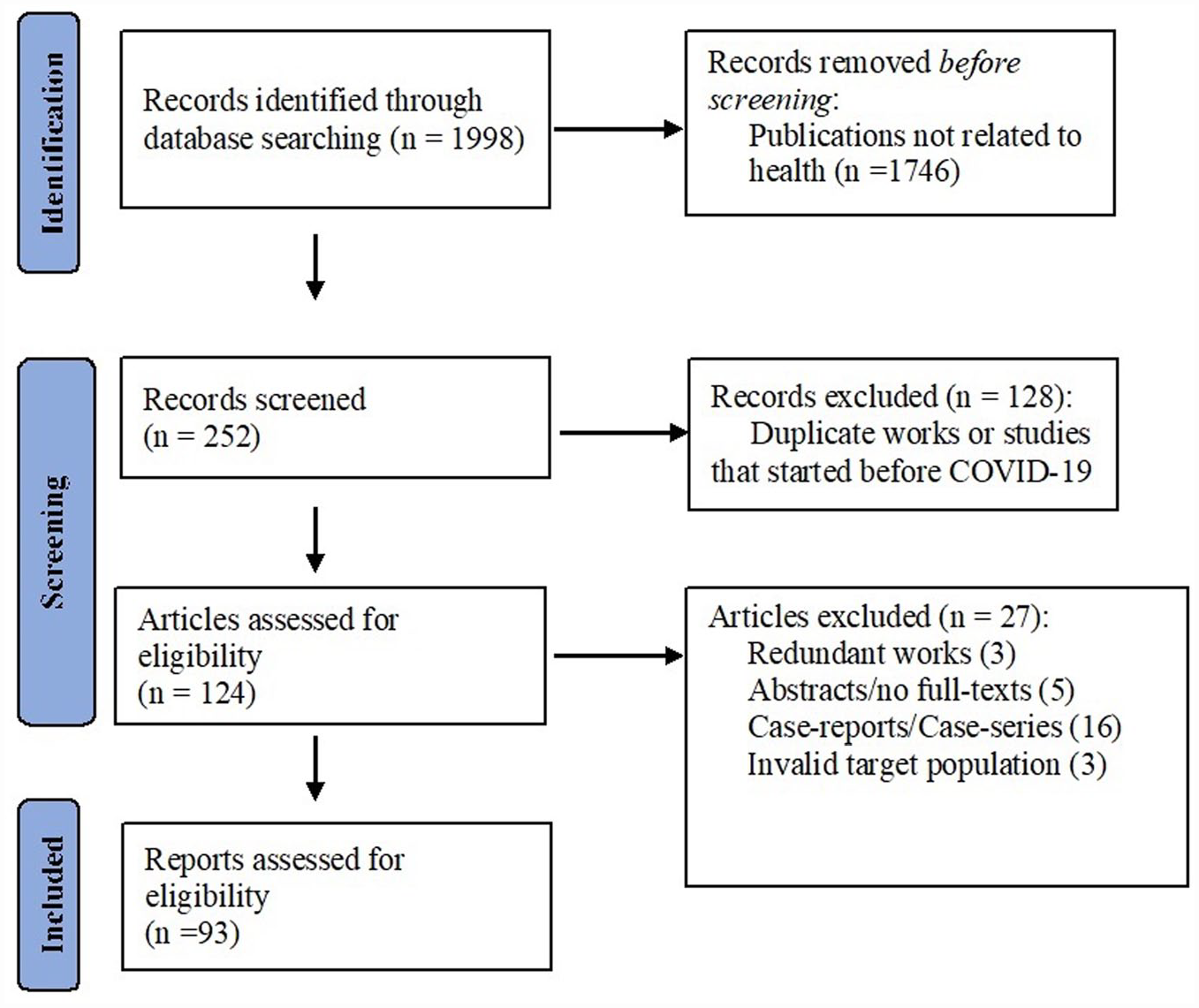
PRISMA flow diagram of studies’ selection process.
Characteristics of the included studies and quality assessment
Most of the studies conducted during the pandemic focused on mental health (n = 23; 24.7%). Thirteen out of these studies were associated with COVID-19 whereas the rest didn’t have any relationship with the disease. Twenty-one publications focused on COVID-19 in their main objectives (22.6%) including its consequences on the general health. Eighteen hemato-oncological studies (19.4%) were screened followed by 12 studies targeting Type 2 Diabetes Mellitus (T2DM) and its adverse events (12.9%). Other various publications were also screened such as those focusing on cardiovascular events and respiratory diseases, etc.
Forty-two of the 93 studies were cross-sectional or cohort studies (45.2%) followed by 31 literature reviews (33.3%). Eleven studies were either systematic reviews or meta-analyses, four were randomized controlled trials, and two studies adopted the simulation modeling methods (Figure 2). Most of the studies were published in Scimago Journal Rank (SJR) Quartile (Q1) journals whereas only three publications belonged to Q4 journals. The repartition of the published studies according to different journal quartiles are more detailed in Supplemental Appendix A. An adaption of GRADE evaluation was used for primary outcomes of included studies and classified the quality of evidence of interventional studies as high, and observational studies as medium-to-low whereas the quality of evidence of literature reviews was considered very low.

Percentage of study types according to the different therapeutic research categories.
Authors characteristics
Most of the studies had multiple authorships. Only seven (7.5%) were written by two authors. None of the studies were single-authored papers. Female primary authors were more than males (51.6% versus 48.4%). Eighty-three of LAU authors who contributed to health research studies were associate professors (61.5%) and almost half of them belonged to the Faculty of Medicine (n = 46; 49.5%) followed by the School of Arts, Sciences, and Psychology (n = 28; 26.9%). More details on authors’ characteristics are summarized in Table 1.
Characteristics of included studies.

Detailed summary of health research studies
Studies that focused on COVID-19 disease
Several health studies described COVID-19 prevalence, its mechanism of action, and pathophysiology while others focused on the diagnosis of the disease, its treatment, and different complications (Table 2).
Description of different COVID-19 studies according to different subjects of interest.

Mechanism of action and pathophysiology
Many studies described the mechanism of spread and the pathophysiology of the virus21,22 while other publications described the mechanism of action of promising treatment medications.23–25 To add, few papers focused on the different circulating strains of the SARS-CoV-2 virus along with their mutations26,27 while others described the worldwide prevalence and incidence of the disease with foreseen preventive measures for mitigation purposes of the disease spread such as preparedness and international flights’ limitations.28,29
COVID-19 diagnosis
Many publications focused on the diagnosis of the disease 30 while others investigated measurement techniques for its detection in cough sounds. In fact, the study conducted by Mouawad et al. (2021) investigated the use of symbolic recurrence quantification measures for the automatic detection of COVID-19 in cough sounds of healthy and sick individuals. A final evaluation revealed that the symbolic dynamics measures capture the complex dynamics in the vocal sounds and are highly effective at discriminating between sick and healthy cough. 31
COVID-19 complications
Some research studies described COVID-19 future complications such as cardiovascular, 32 hematological33,34 and nephrological manifestations. 35 Moreover, a cross-sectional survey raised a major concern regarding immunocompromised children that may be at risk for an unfavorable course of COVID-19 infection due to their weakened immunity 36 while another study assessed the changes in lifestyle along with weight fluctuations during the COVID-19 lockdown where it was shown that there was no net weight variation during the lockdown whereas increasing physical activity and initiating diet were associated with weight loss rather than weight gain. 37
Treatment, available therapies, and vaccination
Recent publications described possible treatment options of the disease including vitamins and minerals supplementation especially vitamins C and D, Zinc, and Selenium and concluded that these supplements might possess immunoregulatory and antiviral properties.38–40 Later on and with the development of vaccines against SARS-CoV-2, a new publication from the LAU concluded that organizations should influence leaders to enhance proper behaviors and attitudes to create a healthy, safe, and ethical culture that consequently increases employees’ commitment to COVID-19 vaccination. 41
Studies that focused on other respiratory diseases (not related to SARS-CoV-2 infections)
Different studies focused on respiratory diseases such as asthma and chronic obstructive pulmonary disease (COPD) regardless of their association with SARS-CoV-2 infections. To mention a few, a small-scale observational study investigated the feasibility and pre-tested the effectiveness of an educational Telemonitoring program in a sample of Lebanese COPD patients and gave insights into the different obstacles and facilitating factors for implementing such a project to allow a large-scale work on the adaptation of the COPD patient to this disease in Lebanon. 42 In addition, another study discussed the recommendations for the management of asthma along with regional adaptations of international guidelines for the MENA. 43 Patients with both types of diseases were interviewed to assess the technical use of pressurized metered dose inhalers and it was shown that many patients with respiratory diseases were not properly using their medications which requires intervention of their healthcare professionals. 44
Studies that focused on mental/psychological health
COVID-19 restriction measures, such as social isolation, have affected the mental and psychological wellbeing of millions of people worldwide. For this sake, many authors were interested in studying the association between SARS-CoV2 infection and mental health deterioration. Most of the publications concluded that several psychosocial problems have risen, specifically during the fast spread of the COVID-19 disease45–48 including sleep deprivation, work fatigue, and stress.49,50 In addition, they examined the role of perceived social support and psychological coping mechanisms among individuals undergoing social isolation.51,52 The quality of life was also shown to be negatively affected among patients with schizophrenia, bipolar disorder,53,54 cancer 55 as well as college students who showed a higher level of depression and anxiety during the early stages of the pandemic.56,57 On the other hand, more studies examined the role of positive thinking and trait emotional intelligence on the overall wellbeing and assessed the role of sociodemographic factors such as religious coping, experiences in life, and the economic burden that are usually associated with positivity on COVID-19 impact on daily activities.58–62 In fact, trait emotional intelligence was positively associated with the patients’ self-esteem, maintenance of hope, and responsibility during the current crisis. Moreover, taking into account that social distancing was a requirement, many psychotherapists relied on online consultations to provide continuity of care to patients with psychological deterioration.63,64 An additional study assessed the psychological burden among elderly population in primary care settings regardless of its correlation with COVID-19 65 and highlighted the importance of offering intensive counseling and targeted treatment in delaying the onset or progression of mild cognitive impairment to Alzheimer’s disease. Prevalence of depression and mental deterioration was also assessed in nursing students where it was concluded that self-efficacy among nursing students in a context of high political uncertainty, regardless of the pandemic, is often associated with health-promoting behaviors such as physical activity.66,67
Studies that focused on hemato-oncological diseases
Cancer studies continued to take place during COVID-19 pandemic knowing that cancer is still considered to be the top leading cause of deaths worldwide that needs crucial and permanent assessment.68,69 Some studies described the possible treatment options of pediatric cancers such as brain tumors, leukemia, fetal and placental cancers and reported the importance of collecting cases from multiple institutions using a standardized case report form in increasing awareness of the occurrence of metastases and the role of systemic therapies.70–75 Other researchers were interested in other types of cancers that were reviewed thoroughly along with their pathogenesis and possible treatment pathways. Other types of cancers that were of interest to LAU researchers were ovarian, 76 rectal, 77 cervical, 78 and gastroesophageal. 79 Moreover, different reviews provided insight into the potential of novel cancer therapies such as immunotherapy, CAR-T cells, and CDk-7 inhibitors in the treatment of oncological diseases.80–83 As for hematological diseases, one retrospective multicenter observational study confirmed that Eltrombopag, a medication used to treat thrombocytopenia and severe aplastic anemia may be used as second- or third-line therapy in pediatric patients with chronic and refractory idiopathic thrombocytopenia. 84 Another phase 2 trial confirmed that, a new hemoglobin oxygen-affinity modulator, improves Hemoglobin levels and markers of hemolysis in pediatric patients with sickle cell disease and has the potential to mitigate sickle cell disease-related complications in patients aged ⩾4 years. 85
Studies that focused on cardiovascular diseases
Cardiovascular diseases (CVDs) are still considered the leading cause of death globally. For this reason, different studies published updates concerning CVDs’ prognosis and treatment in the era of COVID-19. For instance, observational studies investigated the association of clinical, demographic, and genetic factors with severe coronary artery stenosis phenotypes, namely hyperlipidemia86,87 while another narrative review reported the accuracy of a new intravascular optical coherence tomography in the evaluation of stent implantation and post-stent tissue coverage. 88 Moreover, one published study documented the in-hospital discharge trends for patients with acute heart failure and highlighted the need for enlisting complete education as part of the discharge process, in addition to abidance to the guidelines in prescribing medication 89 while another study summarized common etiologies for post-orthostatic tachycardia syndrome such as infections, especially viral, pregnancy, and stress. 90
Studies that focused on Diabetes Mellitus
Despite the spread of COVID-19, researchers were still interested in chronic diseases research such as T2DM. Some of them focused on the assessment of the social determinants of health and their impact on clinical outcomes in adults with T2DM 91 and others tested the effect of culturally tailored education targeting diabetes selfcare on hypoglycemia side-effect.92,93 Other reviews and meta-analyses described T2DM complications, reported mortality rates, 94 and compared surgical versus non-surgical treatment options for the treatment of diabetic foot ulcers. These studies concluded that neuropathic plantar ulcers are difficult-to-heal wounds and chronicity is associated with frequent hospitalizations, higher rates of amputation, and mortality. They also underlined the fact that early removal of the indirect causal agent, the resection of the metatarsal head, after failure of a well-conducted conservative standard of care could be a needed solution for wound healing and consequently a potential for reducing complications and costs.95–98 Furthermore, researchers assessed the evidence behind the use of Telemedicine in treating diabetic foot ulcers since it has been advanced as an effective approach to wound care management during COVID-19 pandemic and showed that it could be a valuable alternative in times where clinic visits are reduced or not possible such as during this COVID-19 pandemic. 99 To add, other neuropathic complications were also described and some studies investigated the role of some vitamins, such as vitamins B and D, in the healing process of neurological consequences.100–102
Other fields of medical research
Different types of health studies continued to take place during the pandemic regardless of their association with COVID-19 infection. Some of them focused on the description of the pathophysiology and the treatment options of neurological problems such as migraine. For instance, a case-control study concluded that arterial stiffness is worse in patients who suffer from migraine and this is associated with an increase in markers of vitamin K2 deficiency. 103 To add, another randomized phase 3 trial proved that Erenumab, a new monoclonal antibody targeting the calcitonin gene-related peptide pathway that is involved in the pathogenesis of migraine, is safe and effective in the treatment of episodic migraine originating from Asia, the Middle East, and Latin America. 104 Furthermore, a recently published study described a rare neurological disease and detailed its underlying etiologies such as multiple sclerosis and connective tissue disease. 105 Few studies described Anorexia Nervosa and investigated the beneficial effect of physical activity on this eating disorder.106,107 As healthcare improvement measures, some studies estimated the differences in clinical and economic outcomes of antibiotic resistance among hospitalized patients108,109 while another publication highlighted the increase in the prevalence of adverse drug events among Lebanese patients with polypharmacy and shed light on the importance of counseling. 110 Furthermore, contemporary gynecologists have described the positive role of aspirin in in-vitro fertilization (IVF) techniques and success rates 111 while other scientists demonstrated the beneficial effects of Plasma-rich protein on the healing of venous leg ulcers in hospitalized patients. 112 To add, some researchers focused on the epidemiology of pediatric injuries, their characteristics, contributing risk factors, and outcomes and showed that the factors associated with hospital admission were fractures, concussions, and organ system injuries. 113
Discussion
Principal findings
Although COVID-19 has disrupted the quality of life of many individuals around the world, most of the healthcare professionals continued to play a major role in consultancy, education, and disease prevention. In order to manage health needs and fill knowledge gaps, permanent research efforts in sciences, public health, and policy studies are always needed. This was highlighted in our scoping review by proving that authors were involved in different types of health research regardless of their association with COVID-19. In addition to that, there was an important research requirement to manage the adverse events and the psychological burden imposed by COVID-19 itself to be able to find solutions for this unexpected pandemic. In fact, the need for new paradigms and models of resilient and efficient research has always been highlighted in the literature.12,114 The importance of research in times of crises was proven by showing that many researchers were interested in acquiring more knowledge regarding this novel virus, its mutations, pathophysiological characteristics, and consequences. In fact, health research, especially at times of crises, provides the basis for every researcher, scientist, and health provider to pave the way for the assessment, evaluation, and management of the emerging problems. Through research, many professionals will gain knowledge of unknown situations and update their knowledge in order to come up with the best recommendations to a specific problem. With the pandemic, many of these transformative efforts, as well as the push for more research and innovation have been accelerated to ensure rapid integration of innovative therapies. The Middle Eastern region, especially Lebanon, should not be an exception to this trend. In fact, extensive sector reforms to achieve better care should start to be applied in many of the region’s healthcare systems. 115
In our scoping review, we summarized the findings of 93 health-research studies that took place concomitantly with the spread of COVID-19 and were considered part of LAU’s contribution to research during this pandemic. Although there was a swift reallocation of research efforts to cope with the COVID-19 pandemic, it was clearly shown that all aspects of healthcare were still studied during all stages of the pandemic despite the continuation of the severe socioeconomic crisis in Lebanon.12,27 If we analyze all the research topics that were of importance, we can find that papers describing the mental health deterioration and psychological burden were the most common, followed by studies that focused on the impact of COVID-19 on the both physical and psychological health. This finding was also highlighted by other international publications knowing that this outbreak has imposed a situation of socio-economic crisis and national restrictions that ended-up with profound psychological distress and various mental problems including stress, anxiety, depression, and frustration.116,117 Similarly, changes in existing mental health may be in part explained by the imposed restrictions of the Lebanese government that provided a more structured daily routine and increased exposure to external stressors such as the major political and economic crisis. Mental health problems were observed across most population sub-groups (e.g. general population, university students, healthcare workers, etc.) and even in younger age groups or adolescents. However, the lack of studies reporting pre-COVID comparative data makes it difficult to determine the extent to which mental health has been affected among these subgroups when compared to studies post-COVID-19.
From the research productivity point of view, our results have shown that the faculties with the greatest number of health research publications during the last 3 years were the School of Medicine followed by the School of Arts and Sciences, then the School of Pharmacy. These findings are consistent with the findings of Puuska et al. 118 where it was shown that researchers in the Medical Sciences field have higher productivity and tend to publish more than their peers. Furthermore, it is noteworthy to indicate that studies focusing on oncological and CVDs continued to occur despite the spread of COVID-19 which emphasizes the fact that these diseases will always remain major topics of interest for research knowing that they are among the top leading cause of mortality worldwide. 119 The better researchers understand chronic diseases and their treatment/prevention methods, the more progress they will make toward diminishing their tremendous consequences on patients’ health. Moreover, our results have shown that primary researchers involved in health research were associate professors. This is in line with the findings of Aksnes et al. 120 suggesting that faculty of lower rank publish fewer papers per year. Therefore, faculty with a higher academic position tend to have better research outcomes especially in emergency situations where the chance of having more publications/citations increases even more. To add, our review has shown that most of the health research studies have been published in SJR Q1 and Q2 journals. 121 This is especially remarkable in an academic environment since these journals are highly valued because of their wide recognition and the impact on one’s academic career such as contract renewal and promotion. Having said that, most of the researchers, especially healthcare professionals are usually eager to publish in such journals to promote their social and professional desirability and increase their chance of increasing their citation rate. 122 Furthermore, international collaboration among authors was shown to be the most abundant when compared to local or national collaborations. This is consistent with other prior publications confirming that research collaboration adds benefits for both the researchers and the organizations. It actually enhances the quality of research resulting in higher numbers of scholarly output and encourage researchers to combine mutual efforts.123,124 The current pandemic has also evidenced the importance of research collaboration between clinical researchers, internal medicine, and emergency departments to successfully develop, update, and implement care guidelines for different types of emerging diseases. 125
Observational studies with a moderate to low GRADE quality of evidence were the most prevalent in our review. This was consistent with our expectations since this type of studies is usually easier and more convenient to be conducted despite having a lower level of evidence when compared to interventional ones. 126 For this reason, there would be a necessity to conduct more experimental human studies since these are known to have a higher level of evidence. 127
Meaning of the study and future implications for policy and practice
The interest in COVID-19 research has led to delays in the outputs from non-COVID research that may affect negatively the progress in the fields of health research but nonetheless take a significant toll on human health. 128 Therefore, future strategies for planning and implementing health research need to incorporate the possibility of potential disruptions especially in pandemics. For instance, e-medicine, of which the use has increased during the pandemic, may be essential in making a leap in digital communication and participation in research. To add, research that generates evidence about the combination of digital and traditional methods will be needed to accompany the new research norms. Moreover, more research will be required to ensure acceptance, over/under-representation of different groups, and usability in different settings and for different topics. 129 In fact, research funders should consider granting extensions to projects if some delays are faced due to the pandemic, and allow for adjustments in research design and research questions. 130 In summary, health research should never be stopped since it is considered to be the most reliable source in generating and communicating knowledge and thus contributing, directly or indirectly, to equitable health development in the country. The scientific community at large will have to deal with results of research that have taken place under different circumstances, and maybe with methodological compromises. Ultimately, some building blocks and operational components need to be adopted in order to improve the status of health research post-COVID-19. These building blocks include: (1) Stewardship which defines a future vision for a health research system, identifies appropriate health research priorities, and coordinates adherence to them; (2) Financing which secures research funds and allocates them in an accountable way; (3) Creating and sustaining resources which strengthens the human capacity to conduct and utilize health research; and (4) Producing more research which enhances the production of more scientifically valid research output and communicates research to inform health policy, strategies, practices, and public opinion. 131
Strengths and limitations
To our knowledge, this review is among few reviews that describe the different health research fields that continued in the era of COVID-19. One of the strengths of this review is that we aimed at selecting studies that were conducted not only during the early stages of the pandemic but 1 year later. Given that there have been second waves of the pandemic in many countries, it was important to have an idea about different health research that was occurring at the same time of the pandemic. However, few limitations are to be mentioned. First, there is always a continuous update of both WoS and Scopus databases at LAU libraries. Although they are quite representative to date, it should be noted that other health-related studies might have been published but were not included in our review. Due to the rapid dynamics of COVID-19 pandemic, it would be therefore helpful to repeat this review at different time intervals in order to reflect a better impact on ongoing research projects and capture lessons learnt by research investigators. Second, most of the included papers are either observational or literature reviews that usually show preliminary findings or present a short article. One possible explanation could be the lack of funding for such studies in low-income countries as Lebanon. In fact, funding may increase the publication rate and open the doors for researchers to conduct more experimental human trials. To add, given the heterogeneity of studies included, it was impossible to conduct a meta-analysis that summarizes the overall findings in a quantitative manner. Last but not least, the sample studied included only one site of evaluation initiatives, therefore caution should be taken when trying to generalize the findings of this study to other types of relevant evaluations conducted in other academic institutions that might be of importance.
Conclusion
Our paper contributes to the literature by identifying the areas of biomedical research that were considered of importance to the scientific researchers in a higher education setting of a politically unstable environment. The impact of the COVID-19 pandemic once again highlights the importance of research, challenges of research particularly during pandemics and disasters, and opportunities and resources for making research more efficient and cost effective. Therefore, researchers need to put more effort to seek new biomedical updates in various health-related fields and not solely those related to COVID-19. Researchers will be required to continue finding new approaches, assess their usefulness, and share their insights. Indeed, the pandemic has changed the way in which scientific knowledge is produced, and some of the changes may be permanent; however, researchers should not forget about co-existing medical conditions and must do more to defend an environment conducive to research that is beneficial for the population worldwide, not restricted to one field of research nor an element of economic policy making.
Supplemental Material
sj-docx-1-smo-10.1177_20503121231180030 – Supplemental material for Identifying health research in the era of COVID-19: A scoping review
Supplemental material, sj-docx-1-smo-10.1177_20503121231180030 for Identifying health research in the era of COVID-19: A scoping review by Tawil Samah in SAGE Open Medicine
Supplemental Material
sj-docx-2-smo-10.1177_20503121231180030 – Supplemental material for Identifying health research in the era of COVID-19: A scoping review
Supplemental material, sj-docx-2-smo-10.1177_20503121231180030 for Identifying health research in the era of COVID-19: A scoping review by Tawil Samah in SAGE Open Medicine
Footnotes
Acknowledgements
We want to thank the Dean of the Graduate studies department at the Lebanese American University as well as LAU writing center for the review of the manuscript, valuable amendments, and final proofreading.
Author contributions
ST collected and analyzed data, drafted and critically revised the manuscript, and gave final approval of the version to be published.
Declaration of conflicting interests
The author declared no potential conflicts of interest with respect to the research, authorship, and/or publication of this article.
Funding
The author received no financial support for the research, authorship, and/or publication of this article.
Ethics/Consent Statement
Our study did not require an ethical board approval nor a signed informed consent since there were no human participants involved.
Informed consent
Not applicable.

Supplemental material
Supplemental material for this article is available online.
References
Supplementary Material
Please find the following supplemental material available below.
For Open Access articles published under a Creative Commons License, all supplemental material carries the same license as the article it is associated with.
For non-Open Access articles published, all supplemental material carries a non-exclusive license, and permission requests for re-use of supplemental material or any part of supplemental material shall be sent directly to the copyright owner as specified in the copyright notice associated with the article.
