



Abstract
Peripheral artery disease is a manifestation of systemic atherosclerosis, and these patients often have claudication pain in the legs during activity. This leads to generally adopting an inactive lifestyle; hence, even small changes in physical activity could reduce the risk of an adverse cardiovascular event. For patients with peripheral artery disease compliance with non-invasive interventions like assistive devices and long-term exercise therapy is important for improved health outcomes. Benefits to patients can only be measured if patients with peripheral artery disease adhere to the intervention and barriers are identified with improved solutions. The effect of mobile health including pedometers and smartphone technological applications in motivating the patient to continue adhering to the intervention and persist in physical activity is a new venture to be explored.
Keywords
Highlights
An ankle–foot orthosis may improve the distance patients with peripheral artery disease (PAD) can walk.
Chronic PAD causes muscle weakness that impairs walking.
Adherence to ankle–foot orthosis and interventions is an issue in PAD.
Telehealth may improve adherence to the interventions in PAD.
Introduction
Peripheral artery disease (PAD) is associated with claudication (pain in the legs) during activity and significant deficits in gait biomechanics stemming from insufficient blood flow and myopathy preventing normal leg function.1,2 Claudicating patients experience reduced mobility and physical functioning, poor health outcomes, and an increased risk for falls.2,3 Studies have consistently shown patients with PAD are an extremely sedentary group, so even small changes in activity could reduce the risk of adverse cardiovascular events like stroke or myocardial infarction (MI).1,2
Treatment strategies include lifestyle modification, conservative interventions, medical management, endovascular therapies, and surgical interventions.3,4 Exercise therapy, including lifestyle modification and medical therapy, is the first line of treatment for PAD.1,3,4 Studies show that adherence to these interventions not only benefits patients by avoiding surgery in the first place, but patients who underwent exercise therapy also have lower readmissions, MI, and postoperative risk.1,3,4
Conservative or non-invasive interventions for PAD patients including ankle assistive devices (ADs) like ankle-foot orthosis (AFO), exoskeleton footwear, orthopedic shoes, and so on, help patients suffering from PAD walk better.5–9 Home-based exercise therapy (HBET) and supervised exercise therapy (SET) are highly recommended for the long-term daily management of PAD patients. Physical activity (PA) improves walking ability, overall functional status, and health-related quality of life in patients with symptomatic PAD.1–4 Studies ongoing in our laboratory have shown that 6 months of SET produced increases in walking distances and quality of life that coincide with improvements in muscle strength and gait biomechanics.8–10 In addition, incorporating a device to support an active lifestyle pattern that prolongs disease progression appears to be desirable and beneficial.5–9
Overview
This viewpoint aims at highlighting the barriers to conservative intervention and at the same time proposing solutions. ADs such as carbon fiber AFO have been used to improve functional outcomes while continuing community-based walking exercises in patients with calf claudication.5–7 However, compliance with the intervention remains an issue with the patient as well as adherence to SET and HBET.9,11–14
Barriers and solutions
There is underutilization of SET due to a lack of access to appropriate facilities for SET and pain associated with beginning a PA program.11,13,14 HBET seems to be a good way to make sure the patients are getting their daily dose of PA. Mobile health may be viewed as a hybrid between on-site supervised exercise and home-based exercise. Low enrollment rates for supervised exercise and low adherence rates for home exercise point toward a great need for new PAD-specific strategies to increase exercise and deliver it in a more accessible manner. Exercise at home ensures the patient does not have to attend an exercise session at a facility two to three times per week, which eliminates barriers such as co-pays, transportation issues, and conflicts with occupational commitments and family responsibilities.14,15 HBET combined with mHealth also offers an objective means by which to monitor a patient remotely for PA adherence. By doing so, it allows the provider to increase the exercise prescription if the patient is doing well or contact the patient for education and motivation if consecutive weeks demonstrate a decline in PA. Thus, the program engages patients in their own healthcare and increases awareness of their PA and health behavior.
Discussion
Walking at home takes place in real-life conditions as opposed to treadmill walking. It is considered to be engaging more muscles for balance since patients are not holding on to treadmill railings, adjusting to uneven surfaces, performing lateral movements, and walking up increased inclines. 14 The patient does not have to complete the exercise session once a day and can spread it out daily depending on their schedule and health condition. Monitoring through the use of accelerometers, smartphone applications, and patient education tools can help in motivating the patient (Figure 1) to pursue PA.14–16 Generally, the patients with PAD are above 40, and many studies are using smartphone technology for cardiac rehabilitation and PAD PA monitoring,13,14 These studies suggest the initial feasibility of smartphone-based intervention for cardiac rehab and activity purposes, in particular among older and technology naïve populations including veterans.8,13,14
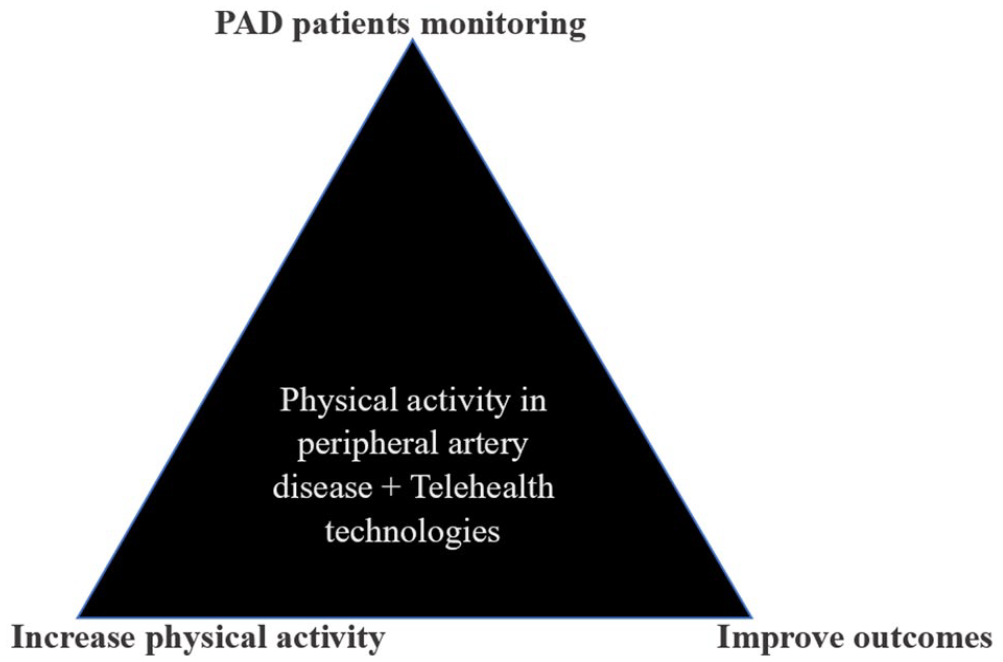
Using technology to monitor physical activity in peripheral artery disease patients.
Incorporating PA with ADs that are safe and help PAD patients walk better is important.17–21 Telemonitoring, tele-coaching, and teleconsultation can be potentially beneficial tools in monitoring interventions and improving the quality of life of patients suffering from PAD13,14 by being interactive with the healthcare professionals in the following manner (Figure 1):
1) Send daily reminders to wear the device.
2) Ask questions about barriers and recommend solutions—orthotic adjustments, socks, padding, and other measures to increase comfort. 9
3) The AD can be combined with support to fulfill PA recommendations.
Feedback from questionnaires, semi-structured interviews, and qualitative and quantitative mixed-method research help in shedding light on the efficacy and safety of an AD intervention.20,21
Limitations
Studies show some subjects immediately decide whether to wear or not to wear ADs as a feasible intervention.5,9 Previous research has found dissatisfaction with the ADs, poor adherence, and compliance issues to wearing orthotic/ADs due to reasons such as they were not effective in improving outcomes of interest to the patient.6,9,19–20
Conclusion
To improve health, quality of life, and cost-effective outcomes, there is a need for ADs that are more comfortable, are easy to put on and take off, and help decrease the pain experienced by patients with PAD, at the same time adherence to these devices is important. Strategies are needed to better engage PAD patients to increase walking capacity for the long-term management of the condition; the most effective treatment for intermittent claudication is adherence to a supervised exercise program. HBET monitored at home with mobile health ventures is a safe option that can help the continuation of the SET program at home as well as keep the PAD patients motivated to continue PA and activities of daily living.
Footnotes
Acknowledgements
The author would like to thank the Department of Biomechanics, the University of Nebraska, and Team Myers for their help and support.
Declaration of conflicting interests
The author declared no potential conflicts of interest with respect to the research, authorship, and/or publication of this article.
Funding
The author disclosed receipt of the following financial support for the research, authorship, and/or publication of this article: This research was supported by NIH grants (RO1AG034995 and RO1HD090333), a VA Merit grant (I01 RX003266), and a UNO GRACA 2020-2021 grant.
