



Abstract
Objective:
This systematic review aimed to provide a global picture of information-seeking behavior, source information used, and its associated factors.
Methods:
This systematic review followed the Preferred Reporting Items for Systematic Reviews and Meta-Analyses steps. Databases such as PubMed/MEDLINE, Web of Science, Scopus, EMBASE, World Health Organization libraries, and Google Scholar were used to search all published articles. Articles on COVID-19 information-seeking behavior published until November 04, 2021, and the use of the English language was included. Two independent reviewers did the article selection and quality check.
Results:
For this systematic review, twenty articles were included in the final report. Information-seeking behavior was associated with digital health literacy, online information sources, and socio-demographic factors. The major sources of health information during the COVID-19 pandemic were digital media, television, public health portals like the world health organization, and center for communicable disease and prevention websites.
Conclusion:
This systematic review provides a valuable overview of available information on information-seeking behavior regarding COVID-19 globally. The studies used a heterogeneous study population, various research techniques, and various research questions. Digital literacy and online information sources play a vital role in information-seeking behavior.
Introduction
Coronavirus disease 2019 (COVID-19) was declared a pandemic by the World Health Organization (WHO), and this pandemic has resulted in a significant crisis in the world. 1 Due to this disease, more than 663 million people have been affected by this pandemic, and 6.7 million have died due to the disease throughout the globe. 2 Currently, there are more than dozens of vaccines under development and implementation throughout the world to tackle the spread of the disease and minimize the associated morbidity and mortality. 3
According to the WHO, health information is considered as one of the building blocks of the healthcare system. 4 Information is vital for making evidence-based practice and improving the knowledge of the community in certain contexts. 5 Information could be sought through various platforms; it could be through online sources, paper-based, family, and colleagues. 6
Information-seeking behavior (ISB) means the modality of how people pursue information about their interests including health-related, economic-related, and social-related. Health information-seeking signifies how people sought health and health-related information. During pandemics, people need accurate and timely information from different sources about the pandemic and its prevention methods.7,8
According to evidence, ISB was significantly influenced by the source of information, the provider’s intention, and the literacy level of the community, digital infrastructure, and economic well-being.7,9
Studies showed that television, online websites, radio, social platforms, and health professionals serve as sources of information in healthcare settings.
Health professionals and people use different types of health information from the internet besides traditional sources of information.10,11
Digital media plays a vital role in disseminating information quickly for a large population without any geographical limitation, which has a significant impact on health information dissemination in the healthcare sector.12,13
Evidence indicates that information-seeking practice increased during pandemics and public health emergencies, and at these times health professionals and people need updated and accurate information for tackling the pandemic and protecting themselves. 14 Public health emergencies and pandemics increased the need for timely and trustworthy health information globally; 15 although there are some pieces of evidence regarding ISB during COVID-19, to the best of our knowledge, no systematic reviews have yet been done on COVID-19 ISB. A summary of evidence on people’s ISB is needed to acquire suggestions for best evidence-based practice and future research to tackle the spread of the disease and promote the health of the community via updated and accurate information-sharing practice.
Therefore, this systematic review aimed to provide a global picture of ISB, source information used, and its associated factors.
Research question
What was the information-seeking behavior during COVID-19 globally?
What are the factors associated with information-seeking behavior toward COVID-19?
What are the sources of health information during COVID-19?
Method
This systematic review followed the Preferred Reporting Items for Systematic Reviews and Meta-Analyses (PRISMA) procedure.
Search strategy
We have used online databases such as PubMed/MEDLINE, EMBASE, Web of Science, Google Scholar, WHO libraries, and African Journals to retrieve articles on the information-seeking behavior of COVID-19. The search term was developed by using the following key terms: COVID-19, Information seeking behavior, and Boolean operators “AND” and “OR” used for this purpose.
Inclusion and exclusion
This systematic review includes all publications, which fulfill the following parameters: publications studying COVID-19 ISB were included, whereas publications in a language other than English, short reports, letters to editors, and discussions were excluded in the present systematic review.
Eligibility criteria
Included articles in this systematic review were all articles published in English, articles published until October 20, 2021, and all cross-sectional studies. We excluded articles based on the following criteria: articles with poor quality, study protocols, systematic reviews, unpublished articles, and letters for editors.
Data extraction
Articles extracted from databases were exported to Endnote software version 8 after removing the replicates; all articles were exported to a Microsoft Excel spreadsheet. Studies retrieved by using search terms from all databases and additional sources were screened for inclusion criteria. Then, articles that fulfilled the inclusion criteria were undertaken for full-text review for admissibility and extraction. PRISMA flowchart was used throughout all steps. Quality assessment was done by using the Newcastle-Ottawa Scale (NOS) criteria to include in this systematic review. 16 This tool has ten points in the three domains of modified NOS components for observational studies. The studies which have scored ⩾5 points were included.
Data analysis
Descriptive statistics were used to summarize the study’s features. Characteristics of all the studies were summarized in textual and tabular methods including study population, study design, sample size, and data collection period. ISB of study participants and associated factors were clearly stated. The main outcome variable ISBs on COVID-19 have been explained textually.
Result
A total of 136 articles were retrieved from all sources after the removal of 65 duplicated articles and 71 articles were assessed by using titles/abstracts from the 41-article excluded due to not evaluating the outcome of interest (ISB). Thirty articles also underwent full-text review and finally, 20 were included in this review (Figure 1).

PRISMA flow chart of the study selection process on ISB on COVID-19 globally: a systematic review.
Characteristics of articles included in this review
This systematic review included studies on ISB and associated factors during COVID-19, studies published up to November 4, 2021, and 20 articles 20 that were published globally included in this review. The study design of all articles was cross-sectional. Five studies were done in the United States,17–21 three studies were done in China,22–24 and two studies were done in Germany 25,26 (Table 1).
Characteristics of articles included in the present systematic review on ISB during COVID-19 epidemic globally.
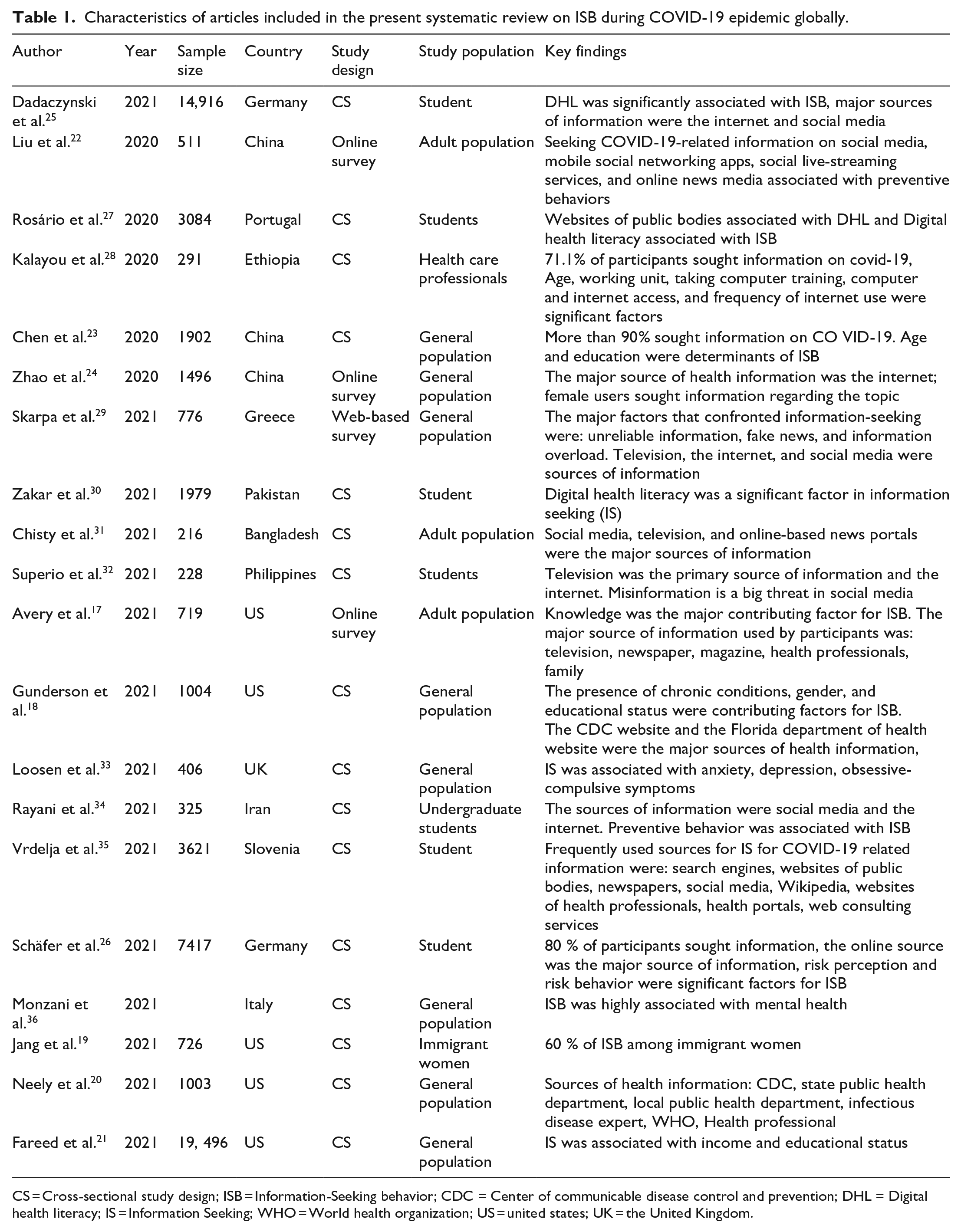
CS = Cross-sectional study design; ISB = Information-Seeking behavior; CDC = Center of communicable disease control and prevention; DHL = Digital health literacy; IS = Information Seeking; WHO = World health organization; US = united states; UK = the United Kingdom.
Factors affecting ISB toward COVID-19
Distinct populations and nations exhibit different ISBs. ISB in the general population of China was highest (90%) and lowest among immigrant women in the United States at only 60%. Of 20 studies included in this systematic review, most of the studies reported that digital literacy was the major contributing factor to ISB. This review included studies that reported the following factors as the most contributing such as perceived behaviors, mental status, practicing preventive behavior, presence of chronic conditions and risk behavior, internet access, computer training, digital health literacy, source of information, educational status, income level, sex, age, and knowledge (Table 2).
Determinants of COVID-19 ISB globally, a systematic review.

Discussion
This systematic review focused on articles done on ISB toward COVID-19 diseases worldwide. Information is one of the building blocks of the healthcare system as defined by the WHO. People need updated, accurate, and comprehensive health information to protect themselves from pandemics and public health emergencies. As indicated by evidence, IS was considered one aspect of preparing and responding to health-related emergencies. This is due to that having information on a specific area/related to the disease makes the communities have awareness of that issue.
Most studies reported that digital literacy is a contributing factor to ISB;25,27,30 this might be because knowing, using, managing, and analyzing digital media could be an advantage for seeking information on the internet.
Online health information such as search engines, websites, and different portals was considered as vital sources of information during pandemics/public health emergencies;24–26,31,34,35 this might be due to the reason that internet and different online portals provide timely information, given the opportunity to access various types of information and opportunity for discussion. Source of health information was one of the factors for information-seeing behavior by various pieces of evidence; this might be because accessing various information sources help to find out triangulated information on the subject/COVID-19 and help to make timely decisions.
Risk perception, risk behavior, and practiced preventive behavior were major significant determinants of ISB across different countries.26,34 This might be because individuals who understand their risk level and risk behavior were eager to take measurements by getting information from different sources to avoid their risk and also those who practice preventive behaviors of COVID-19 want the information to know the right recommended preventive practice from their country policy and WHO recommendations.
The presence of a chronic condition and mental health problems (anxiety, depression, and obsessive-compulsive disorder) were the determinant factors significantly associated with ISB across the globe.18,33,36 The possible explanation might be that having a chronic condition increases their level of risk of acquiring COVID-19 infection and might develop fear as a motivation factor; so to prevent COVID-19 infection these individuals are more likely to seek information on different preventive behaviors recommended by different concerned bodies.
Educational status and income level as also socio-demographic factors significantly contributed to the ISBs of individuals with COVID-19 disease across the globe.18,21,23 These might be those who are educated and can read and understand the importance of having information to improve their health status and to protect themselves from outbreaks and higher income levels might be related to having different sources of information including the use of social media, internet access, and television, which directly determine ISB.
In this systematic review, knowledge is identified as a contributing factor, which determines ISB. 17 The reason could be that those who were knowledgeable desired to know current facts about epidemics and novel approaches to halting their spread and minimizing their effects.
The study’s limitations are largely due to the research studies included in this review, which were cross-sectional studies that could be viewed as snapshots of ISBs in each country or region. Different sampling strategies may partly explain the differences in information-seeking levels reported in various studies from a single country. Thus, the results should be interpreted with extreme caution since they cannot predict future changes in ISB. The results of this study can be used as an initial motivation and guide for future studies and ISB. Finally, due to the heterogeneity of the study population, we were unable to conduct a meta-analysis.
Conclusion
There are a limited number of studies investigating ISB toward COVID-19 disease, throughout the world, with heterogeneity in the study population, method, and research questions. ISB was associated with digital literacy, online health information sources, socio-demographics, and the presence of chronic condition-related factors. Digitally literate and having online information access prefer to seek information about COVID-19. There is a need to consider comprehensive digital literacy training packages for all population groups and provide updated information using public portals.
Footnotes
Author contributions
Both authors made a significant contribution to the conception and design, acquisition of data, or analysis and interpretation of data; took part in drafting, revising, or critically reviewing the article; gave final approval of the version to be published, and agree to be accountable for all aspects of the work.
Declaration of conflicting interests
The author(s) declared no potential conflicts of interest with respect to the research, authorship, and/or publication of this article.
Funding
The author(s) received no financial support for the research, authorship, and/or publication of this article.
Institutional review board statement
Ethical approval is not applicable for this systematic review since data from previously published studies in which informed consent was obtained by primary investigators was analyzed.

Data availability statement
Data supporting this systematic review are available in the reference section. In addition, the analyzed data that were used during the current systematic review is available from the corresponding author upon reasonable request.