



Abstract
The purpose of this study was to use the Altmetric Attention Score to determine the 50 most impactful medial ulnar collateral ligament articles in online media and compare their characteristics to the most-cited medial ulnar collateral ligament articles in the scientific literature. The Altmetric database was queried to identify all published articles about the medial ulnar collateral ligament, and this list was stratified by the Altmetric Attention Score to identify the 50 highest scoring articles. Several data elements were extracted, including article topic, article type, journal name, and the number of online mentions on Facebook, Twitter, news, and other platforms. Each article’s geographic origin was determined based on the institutional affiliation of the first author. Our index search yielded 1283 articles published between 1987 and 2020, from which the 50 articles with the highest Altmetric Attention Scores were included for analysis. Altmetric Attention Scores of the top 50 medial ulnar collateral ligament articles ranged from 20 to 482 (median: 32, interquartile range: 20–62). The most common article type was original research (72%), and the most common topic was epidemiology/risk factors (26%). A majority of studies were Level 3 (36%) or Level 4 evidence (36%). Of the top 50 medial ulnar collateral ligament articles, 94% originated from the United States. A few articles had a high Altmetric Attention Score, suggesting that medial ulnar collateral ligament research does not generate consistently high online attention. The lack of Level 1 studies suggests the need for high-level studies on the medial ulnar collateral ligament. Most studies originated in the United States and were published in the American Orthopaedic Society for Sports Medicine–affiliated journals. The medial ulnar collateral ligament articles included in this study differed substantially from a previous report of the most-cited medial ulnar collateral ligament articles in the literature, suggesting that alternative metrics add a unique dimension to understanding the overall impact of published research on the medial ulnar collateral ligament.
Keywords
Introduction
The medial ulnar collateral ligament (MUCL) is a commonly injured elbow ligament with a particularly high prevalence in overhead-throwing athletes. The incidence of MUCL injury and surgical reconstruction/repair has risen in the United States, where overuse elbow injuries are observed with increasing frequency across the athletic spectrum from youth to professional sports.1,2 In elite overhead athletes, MUCL injury can greatly impact individual on-field performance, career longevity, and overall team success. As a result, conversation about the MUCL within the sphere of high-level athletics often extends beyond healthcare providers to include the mainstream media and the general public.3,4 Moreover, social media platforms such as Twitter, Instagram, and Facebook are increasingly utilized by journals, physicians, and non-physicians to distribute scientific research.5,6 Furthermore, social media mentions were associated with greater citation counts with respect to the current sports medicine literature. 7 A prior study has reported the most impactful MUCL articles based on citation density, but this article does not take into account the distribution of MUCL research beyond scientific journals occurring in online media. 8
In recent years, alternative metrics have gained popularity to supplement the conventional tools for assessing article impact. Altmetric (London, United Kingdom) is a database that tracks the online attention generated by a scientific article and calculates a quantitative Altmetric Attention Score (AAS) that is continuously updated. The AAS is a weighted score that assesses and quantifies the online impact of an article across various platforms including social media, mainstream news, blogs, and forums. 9 Previous studies have used the AAS to identify the most impactful articles in online media that relate to a variety of medical subspecialties.10–13
AAS is determined by the volume of mentions, the source of each mention, and the authors who mention the article. 14 The AAS factors the source of the mentions, with certain online platforms such as Facebook carrying a different weight than a news mention. Similarly, different news outlet sources are tiered when determining their contribution toward AAS as well (e.g. New York Times vs 2 Minute Medicine). Finally, certain sources do not contribute at all toward AAS, such as Mendeley Readers. AAS seeks to capture attention generated online and is highly dependent on the date that the Altmetric database is queried.14,15 AAS can range from 0, indicating no generation of online attention, to 367,741, the highest AAS score of 2020.15,16 A higher AAS correlates to a greater degree of online dissemination.
Despite the emergence of altmetrics in other fields of medicine and the adoption of the AAS by many prominent journals, only a few studies in orthopedic surgery have utilized alternative metrics.5,6 Civilette et al. 17 reported the most impactful articles in online media pertaining to the anterior cruciate ligament (ACL) and noted several important differences between these articles and the most-cited ACL articles in the literature. The purpose of this study was to utilize AAS scores to determine the 50 most impactful articles in online media concerning the MUCL and compare their characteristics to the 50 most-cited MUCL articles in the literature.
Methods
On 5 August 2020, the Altmetric database (Digital Science, Holtzbrinck Publishing) was searched for articles pertaining to the MUCL. The PubMed MeSH terms “medial ulnar collateral ligament,” “ulnar collateral ligament,” and “medial collateral ligament” were entered into the Altmetric Explorer. After stratification by descending AAS, articles were screened to exclude other orthopedic topics unrelated to the MUCL of the elbow. The 50 articles with the highest scores that were most relevant to the MUCL were included for analysis. The nature of this study was a review of the literature using AAS to report the top 50 MUCL articles generating the most online attention.
Several data elements were extracted from each article, including title, article type, article topic, level of evidence, year of publication, journal name, authors, institutional affiliations, sport (population of interest participation in baseball, javelin throwing, etc.), and online mentions (number of times the article was mentioned in news, blog, Twitter, Facebook, and Wikipedia).
Article type was identified from the article abstract and classified as original research (further subclassified into prospective cohort, retrospective cohort, case–control, case series, case report, randomized controlled trial (RCT), or laboratory study), systematic review/meta-analysis, review article (non-systematic review), editorial/expert opinion, or other. Article topics were anatomy, biomechanics, diagnostics, epidemiology/risk factors, injury prevention, rehabilitation/return to play, treatment, and other. The institutional affiliation of the first author was utilized to categorize the geographic origin of the article as American (originating from the United States), European (originating from Europe), or other. The level of evidence was determined by the Center for Evidence-Based Medicine, with RCTs and systematic review/meta-analysis of RCTs constituting level I while editorial/expert opinion or other constituting level V. 18
Statistical analysis
All calculations and statistical analysis were performed using STATA v.15.1 (StataCorp, College Station, TX), with significance defined as p < 0.05. Median and quartiles were calculated for AAS scores. Spearman correlation and logarithmic regression were used to determine the relationships between online mentions and AAS.
Results
This study utilized AAS to identify the top 50 most impactful MUCL articles generating online attention, the authors found that AAS scores ranged from 20 to 482 with a median of 32 (interquartile range (IQR): 24–62). The index search yielded 1283 articles published between 1987 and 2020, and after excluding articles that did not fit our inclusion criteria, the top 50 articles by AAS pertaining to the MUCL were identified. The included articles were published between 2006 and 2020 in 22 journals, with 36 of 50 articles (72%) attributed to three journals: American Journal of Sports Medicine (AJSM; 44%, 22 out of 50), the official publication of the American Orthopaedic Society for Sports Medicine (AOSSM), Orthopaedic Journal of Sports Medicine (OJSM; 14%, 7 out of 50), the open-access journal of the AOSSM, and the Journal of Shoulder and Elbow Surgery (JSES; 14%, 7 out of 50), the official publication of the American Shoulder and Elbow Surgeons (ASES; Table 1). A large proportion of studies were Level 3 (36%; 18 out of 50) and Level 4 evidence (36%; 18 out of 50), followed by Level 5 (18%; 9 out of 50), and Level 2 (10%; 5 out of 50; Figure 1). A majority of the top 50 MUCL articles in online media were specifically related to baseball (52%; 26 out of 50).
The top 50 MUCL articles by AAS with included AAS score and mention statistics.
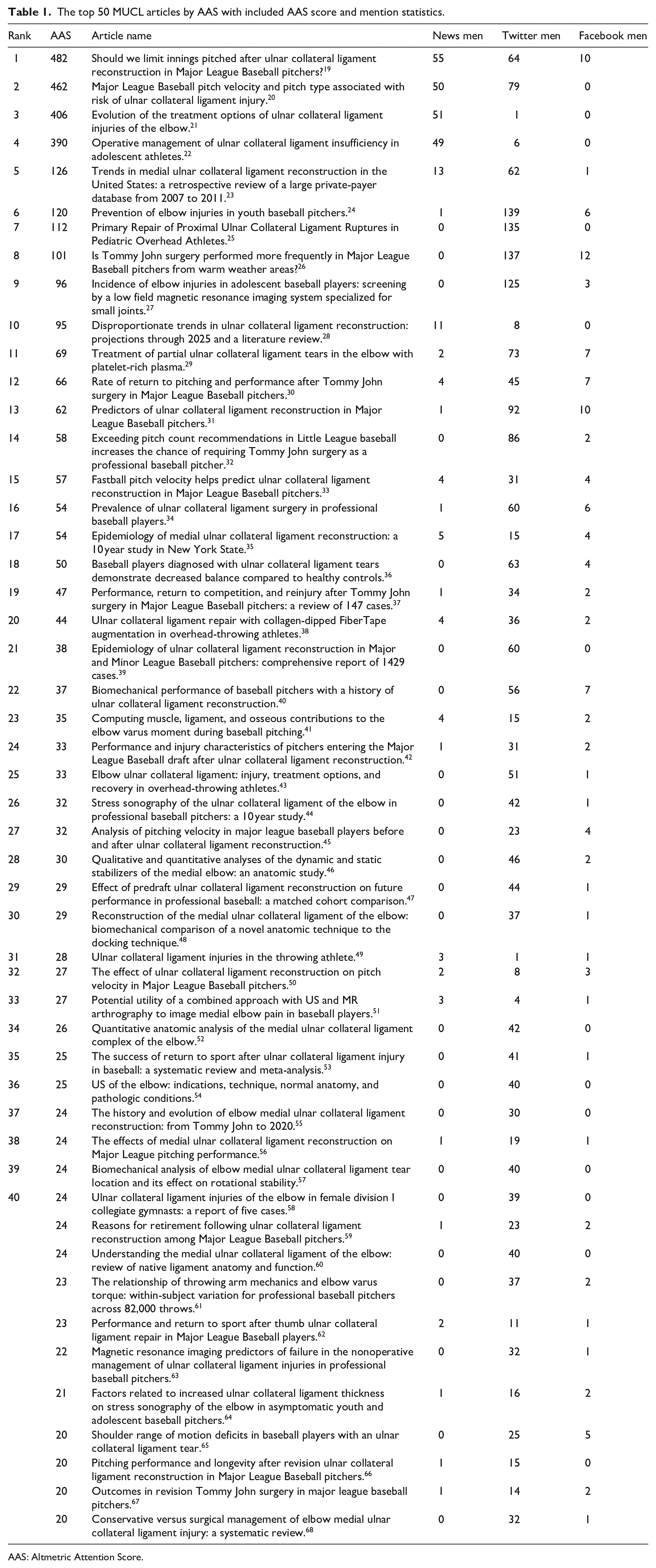
AAS: Altmetric Attention Score.

Level of evidence of studies comprising the top 50 MUCL articles by AAS.
The top four articles identified in this study had AAS scores that were substantially higher (AAS ⩾ 390) than all other included articles, which were substantially lower (AAS ⩽ 126; Table 1). The four articles with the highest AAS focused on epidemiology/risk factors of MUCL injury and treatment of MUCL injury.19–22 Two of the articles were published in AJSM, one in JSES, and the other in British Journal of Sports Medicine.19–22 The four MUCL articles with the highest AAS constituted Level 3 (25%; 1 out of 4), Level 4 (50%; 2 out of 4), and Level 5 (25%; 1 out of 4) Evidence.19–22 All four of these articles originated from within the United States.
The most common article type was original research (74%; 37 out of 50), with the most common subgroup being retrospective cohort study (30%; 11 out of 37). The next most common article type was narrative (non-systematic) review (14%; 7 out of 50; Figure 2). The most common article topics were epidemiology/risk factors (26%), rehabilitation/return to play after MUCL reconstruction (20%), and treatment of MUCL injuries (18%) (Figure 3). Of the included articles, 94% originated from within the United States, 4% originated from Europe, and 2% were published outside of the United States and Europe. Article topic, article type, and geographic origin did not demonstrate any significant association with AAS.

Article types comprising the top 50 MUCL articles by AAS.

Article topics comprising the top 50 MUCL articles by AAS.
Among all included articles, there were a total of 2205 Twitter mentions (median: 38, IQR: 19–60), 124 Facebook mentions (median: 1.5, IQR: 0–4), and 272 mentions in online news outlets (median: 1, IQR: 0–3). Online news mentions correlated strongly with AAS (r = 0.97, R 2 = 0.94), whereas the other online media sources did not demonstrate a significant association with AAS (blog mentions: r = 0.19, R2 = 0.039; Twitter mentions: r = 0.14, R2 = 0.021).
Discussion
In this study of the 50 most impactful articles relating to the MUCL in online media, AAS was utilized to determine which studies pertaining to the MUCL in this literature are generating the most online attention. Traditional citation-based metrics fail to account for MUCL literature through online media platforms, which increase the accessibility to sports medicine literature beyond academia. As communications and social media platforms continue to evolve, the study highlights the need to supplement traditional citation counts with AAS when evaluating the global impact of MUCL research.
From the 50 MUCL articles with the highest AAS, the most common article type was original research articles, specifically retrospective cohort studies; and the most common article topics were treatment of MUCL injuries, epidemiology/risk factors, and rehabilitation/return to play. Nearly all of the top 50 MUCL articles originated from the United States. Neither geographic origin, article type, or article topic was significantly associated with AAS. Nearly three-fourths of the top 50 MUCL articles were published in AJSM, OJSM, and JSES. The overwhelming majority of these studies constituted Level 3 or 4 evidence, and no study constituted Level 1 evidence. Our findings indicate that the most impactful MUCL articles in online media are relatively low level-of-evidence original research studies performed in the United States that are published in AOSSM- and ASES-affiliated journals and pertain to epidemiology, treatment, and return to competition. Of the top 50 MUCL articles in online media, four had substantially greater AAS than the other articles identified in this study. None of these four articles with exceptionally high AAS scores appeared in the 50 most-cited MUCL articles identified by Jack et al. 8 although four articles were identified by both studies.30,37,45,66 The discrepancy between the two studies highlights the difference in characteristics assessed by Altmetrics and traditional bibliometrics in the determination of article impact.
There was a substantial difference in online impact when comparing the AAS of the top 50 MUCL articles to the top 100 ACL articles identified by Civilette et al., 17 whereas the most impactful ACL articles in online media had a median AAS of 172 (IQR: 137–271); the MUCL articles in this study had a median AAS of only 32 (IQR: 24–62). This relationship is consistent with traditional bibliometric studies, which have reported the mean number of citations of the top 50 most-cited ACL articles to be 326, compared to a mean of just 71 citations among the 50 most-cited MUCL articles.8,69 This finding suggests that research pertaining to the MUCL are not as impactful among both medical professionals as well as the public, in comparison to other highly researched sports medicine topics, such as the ACL.
The most common topics among the most impactful MUCL articles in online media were epidemiology/risk factors and rehabilitation/return to play associated with MUCL injuries, which together accounted for nearly half of all included studies. Although a previous study examining the most-cited MUCL articles did not report article topic, a recent investigation of the most impactful ACL articles in online media also reported that the most common topics were rehabilitation/return to play and epidemiology/risk factors.8,17 This finding seems to highlight the general public’s interest in sports medicine research explaining the factors that directly impact an athlete’s ability to return to play and compete at a high level following a major injury.
The most impactful MUCL articles in online media differed with regard to level of evidence when compared to the most impactful MUCL articles by citation density. Half of the most-cited MUCL articles were categorized as Level 4 case series, while just over one-third of MUCL articles with the highest AAS in this study were Level 4 case series. 8 Furthermore, just 12% of the 50 most-cited MUCL articles constituted Level 3 evidence or greater, as compared to 46% of the 50 MUCL articles with the highest AAS. 8 This disparity may reflect the fact that many of the highly cited MUCL articles were seminal studies published several decades ago by the pioneers of MUCL surgery, whereas the MUCL articles with the highest AAS have largely been published within the last decade. More recent studies with higher evidence level appear to be generating more online attention than classic studies with lower evidence level. However, none of the studies in either group constituted Level 1 evidence. The findings of this study and those of citation-based impact suggest a lack of impactful high level-of-evidence studies in the MUCL literature overall. 8
In terms of geographic origin, this study demonstrates a strong predominance of articles published in the United States, similar to that in a study of most-cited MUCL articles. 8 These findings contrast with the results of a previous study, which reported that nearly one-half of the highest AAS articles pertaining to the ACL originated outside the United States. 17 Although ACL injuries are commonly sustained in a wide variety of sports, the disproportionately high incidence of medial elbow instability in the United States is expected, given the popularity of baseball and softball.1,69 This notion is further supported by the fact that over half of the MUCL articles in this study were specifically relevant to the sport of baseball, suggesting a much higher level of interest in MUCL injuries among American sports medicine providers and the general public in the United States compared to other geographic regions of the world where baseball is not as popular.
Over half of the articles in this study were published in the AOSSM-affiliated journals AJSM and OJSM. This finding is consistent with a previous study that assessed the 50 most-cited MUCL articles (58% published in AJSM) and a previous study that assessed the 100 ACL articles with the highest AAS scores (34% published in AJSM).8,17 Overall, more than three-fourth of the highest AAS articles pertaining to the MUCL were published in specialty-specific journals, as opposed to general orthopedic journals. This finding is consistent with previous reports of the most-cited MUCL articles and the ACL articles with the highest AAS.8,17 The higher proportion of MUCL articles published in specialty journals underscores the unique importance of MUCL injury among physician and non-physician members of the sports medicine community, as opposed to the general orthopedic community.8,17 These findings also suggest that specialty-specific journals are actively and effectively disseminating sports medicine research in online media.
Among all online media sources, the amount of attention generated in mainstream news correlated most strongly with AAS in this group of MUCL articles. This finding differs from a previous study on the ACL, which reported that YouTube, blogs, and Twitter mentions were most strongly correlated with AAS. 17 Ligamentous injuries of the knee are ubiquitous across a wide range of sports at various levels of competition. In contrast, medial elbow instability is especially relevant in professional baseball pitchers. These studies appear to be of interest to digital sporting news outlets (e.g. ESPN, Fox Sports), and therefore mainstream news represents a highly impactful mode of dissemination of relevant MUCL research online.
Limitations
There are several limitations inherent to Altmetric that may have affected the findings of this study. Altmetric is updated daily, and therefore it is possible to generate a different list of top 50 articles depending upon the specific date on which the search was performed. In addition, if journals or individual researchers were so inclined, they could inflate the AAS of their own articles via self-promotion through online journal clubs or other social media outlets.5,70 Jabaley et al. 71 discussed the value of Twitter in progressing scientific discussion, although a small fraction of tweets pertaining to scientific discussion contains meaningful content. Moreover, Altmetric does not account for context and is solely dependent upon the volume of online mentions. Thus, both negative and positive discussion equally impact AAS, and a high AAS may not necessarily reflect a high-quality study.2,70,72–74 While Altmetrics currently does not analyze the sentiment generated by an article, there are efforts in exploring how to incorporate this data toward the AAS. 75 Finally AAS is also dependent on social media platforms for the dissemination of scientific articles online and would have been limited to news outlet or academic journal websites as the means of generating attention. Articles published after 2004 would be more likely to have higher AAS because this was when Facebook was founded, and subsequently would provide a greater platform for disseminating scientific research.
Conclusion
A small number of articles had a high AAS score, suggesting that MUCL research does not generate consistently high online attention. The lack of Level 1 studies and the large proportion of Levels 3 and 4 studies suggest the need for high-level studies on the MUCL. Most studies originated in the United States and were published in the AOSSM-affiliated journals. The MUCL articles included in this study differed substantially from a previous report of the most-cited MUCL articles in the literature, suggesting that alternative metrics add a unique dimension to understanding the overall impact of published research on the MUCL.
Footnotes
Author contributions
K.M.K. was involved in the writing, original draft preparation, and revisions. M.D.C., B.D.H., S.K.N., B.M.B contributed to writing, review, and editing the article. W.R.R. did the formal analysis. A.S.C. contributed to data curation following identification of the top 50 MUCL articles. H.P.G. was involved in the conceptualization, review, writing, and editing the article.
Declaration of conflicting interests
The author(s) declared no potential conflicts of interest with respect to the research, authorship, and/or publication of this article.
Funding
The author(s) received no financial support for the research, authorship, and/or publication of this article.
