



Abstract
Background:
Bibliometric studies are increasingly being used for research assessments. Bibliometric indicators involve the application of statistical methods to scientific publications to obtain the bibliographics for each journal. The main objective of this study was to conduct a bibliometric evaluation of Human & Experimental Toxicology retrieved from the Scopus database.
Methods:
This study obtained data from Scopus published from 1 January 2003 till 31 December 2012. The keywords entered in Scopus to accomplish the objective of this study were ‘Human’, ‘Experimental’ and ‘Toxicology’ as ‘Source Title’. Research productivity was evaluated based on a methodology developed and used in other bibliometric studies by analysing (a) total and trends in Human & Experimental Toxicology contributions in research between 2003 and 2012; (b) Human & Experimental Toxicology authorship patterns and productivity; (c) collaboration patterns; and (d) the citations received by the publications.
Results:
There were 1229 research articles published in Human & Experimental Toxicology. Of the articles included, 947 (77.1%) were original articles and 104 (8.5%) were review articles. The Hirsch-index of the retrieved documents was 35. The largest number of publications in Human & Experimental Toxicology was from the United States (19.6%), followed by India (12.8%) and Turkey (10.9%). The total number of citations was 9119, with a median (interquartile range) of 3 (1–9) in 6797 documents. The highest median (interquartile range) number of citations was 8 (2.7–12.7) for France, followed by 7.5 (2–22.5) for Iran and 6 (3–13.5) for the United Kingdom. The country most often citing articles that were published in Human & Experimental Toxicology was the United States, which made citations in 1508 documents, followed by India with citations in 792 documents.
Conclusion:
The documents in Human & Experimental Toxicology focus principally on original data, with very few review articles. Review articles tend to have higher citation rates than original articles, and hence, the editors and authors of Human & Experimental Toxicology might usefully promote the submission of reviews in the future to improve the impact of the journal.
Background
Human & Experimental Toxicology (HET) is a fully peer-reviewed international journal that publishes preclinical and clinical pharmacology and toxicology original research and review articles on experimental and clinical studies of functional, biochemical, and structural disorders. 1 It was established in 1981 as Human Toxicology and obtained its current name in 1990. It is published by SAGE Publications and the Editor-in-Chief is Kai Savolainen. HET is abstracted and indexed in Science Citation Index and Scopus. It is searchable from PubMed but not from PubMed Central. 1
Toxicology has greatly changed its fields of knowledge and application in relation to scientific evolution and the requirements of society. Toxicologists participate in fundamental and applied research into the toxic effects of chemicals, their mechanisms of action, toxicodynamics, toxicokinetics, and education in toxicology. 2 Toxicology, as a multidisciplinary field, offers career opportunities for graduates with different areas of interest including pharmacology and pharmaceutics, environmental science, agricultural and biological sciences, medicine, biochemistry, genetics and molecular biology, neuroscience, chemistry, social sciences and epidemiology, planetary sciences, immunology, and veterinary.2–5
Bibliometric analysis is a useful tool to obtain information about the current state of scientific production in particular areas and allows researchers to identify and undertake new lines of research. 6 Bibliometric indicators involve the application of statistical methods to scientific publications to obtain the bibliographics for each journal, particularly in scientific productivity-related information, which are necessary to the evaluation, planning, and management of a given scientific journal. These methods are mainly quantitative, and are also used to make pronouncements about qualitative pictures of scientific activities.7,8 Based on the considerations above, bibliometric analysis describing publication trends may give an indication of the progress of the toxicology profession, as reflected in the peer-reviewed record in toxicological journals.
The objectives of this study were to analyse research output from HET and to examine the authorship pattern and citations retrieved from the Scopus database. Such a study will lead to a better understanding of the current and future status of research in HET. Furthermore, the results of the study will help editors and authors to shape HET research in the next decade.
Methods
This study relied on data from Scopus published from 1 January 2003 to 31 December 2012. It is assumed that the most recent decade would project the best picture of the pattern of publications and the citations received. A comprehensive online search was performed using SciVerse, Scopus, which is one of the world’s largest abstract and citation databases of peer-reviewed literature. Scopus contains 41 million records and covers nearly 18,000 titles from 5000 publishers worldwide, and provides 100% MEDLINE coverage. 9
The Scopus database was developed by Elsevier and combines the characteristics of both Web of Science and PubMed. These characteristics allow for enhanced service for educational and academic needs, medical literature research, and bibliometric analysis. Scopus offers a basic search, or an advanced search. In the basic search, the results for the chosen keywords can be limited by the date of publication, by addition to Scopus, by subject area, and by document type.10,11 The search output from Scopus can be presented as a list of 20–200 items per page, and extracted documents can be exported to Microsoft Office Excel®. The results can be refined by document type, author name, source title, publications per year, and/or subject area, and a new search can be initiated within the results.10,11
The keywords entered in Scopus to accomplish the objective of this study were ‘Human’, ‘Experimental’, and ‘Toxicology’ as ‘Source Title’. The subject areas selected for this research were health sciences, life sciences, social sciences, and physical sciences during a 10-year period (2003–2012). The resultant search was as follows: your query: (SRCTITLE(human) AND SRCTITLE(experimental) AND SRCTITLE(toxicology)) AND PUBYEAR > 2002 AND PUBYEAR < 2013.
The collated data were used to generate the following information: (a) total and trends in HET contributions in research between 2003 and 2012; (b) HET authorship patterns and productivity; (c) collaboration patterns; and (d) the citations received by the publications.
Ethical approval
The Institutional Review Board (IRB) at An-Najah National University does not require submission of an IRB application for such study. The IRB considered that there is no risk for human subjects in such publications since the data are based on published literature and secondary data, and did not involve any interactions with human subjects. In addition, the Editor-in-Chief of HET gave us the right to submit our manuscript in SAGE Open Medicine.
Statistical analysis
Data from Scopus were exported to Excel and then to the Statistical Package for Social Sciences (SPSS; SPSS Inc., Chicago, IL, USA) program version 15 for analysis. Categorical data are expressed as numbers with percentages. Variables that are not normally distributed are expressed as median (Q1–Q3: interquartile range). The Hirsch-index (h-index) for the data collected from Scopus is presented. The h-index represents the number of citations received for each of the documents in descending order, while the h-graph measures the impact of a set of documents and displays the number of citations per document. The journal’s impact factors (IFs) were evaluated using the Journal Citation Report (JCR; Web of Knowledge) 2012 science edition by Thomson Reuters (New York, USA).
Results
There were 1229 research documents published in HET during the period from 2003 to 2012. Of the documents included, 947 (77.1%) were original journal articles, 104 (8.5%) were review articles, 71 (5.8%) were meeting/conference articles, 25 (2.0%) were letters, and 82 (6.6%) were other types of publications, with an average of 123 documents per year. The average number of included documents published per year was 123, with a range from 85 to 232. A nonlinear, bimodal distribution of documents published per year was observed, with peak publications in 2011 (Figure 1).

Total articles included in the bibliometric analysis by publication year.
In Table 1, a list of 20 countries is presented whose researchers published the largest number of articles in HET during the period from 2003 to 2012. When the data were analysed by country, the largest number of publications in HET was from the United States (19.6%), followed by India (12.8%) and Turkey (10.9%) (Table 1). The total number of citations at the time of data analysis (8 September 2013) was 9119, with a median (interquartile range) of 3 (1–9) in 6797 documents. The highest median (interquartile range) number of citations was 8 (2.7–12.7) for France, followed by 7.5 (2–22.5) for Iran, and 6 (3–13.5) for the United Kingdom. Of the 1229 documents considered for the h-index, 35 had been cited at least 35 times at the time of data analysis (8 September 2013). The highest h-index was 22 for the United States, followed by 21 for the India, and 20 for Iran. Furthermore, the highest number of collaborations with international authors for each country was held by the United States, with 26 countries, followed by 12 countries for the United Kingdom (Table 1).
The top 20 ranking of the most productive countries that published the largest number of articles in Human & Experimental Toxicology during the period from 2003 to 2012.

SCR: Standard Competition Ranking; Articles (%): the number of articles and percentages from the total of 1229; Cit: the number of citations; CitArt: the number of citing articles; H: Hirsch-index; Q1–Q3: interquartile range.
Equal countries have the same ranking number, and then a gap is left in the ranking numbers.
Table 2 shows the top 20 most productive institutions in HET. The most productive institution was Tehran University of Medical Sciences (3.5% of total publications), followed by University of Massachusetts Amherst (2.1%), Indian Institute of Toxicology Research (1.7%), and Texas Department of State Health Services (1.5%). Table 3 presents a list of the 21 most productive authors of HET, who have published at least seven documents in it during the last 10 years. In Table 4, a list of the most cited documents from 2003 to 2012 is shown. The most cited research area in the list of the most cited documents from HET was molecular biology (13 documents out of 20). Four authors who were represented as productive authors had articles among the top citations (Table 4).
The top 20 ranking of the most productive institutions during the study period.

SCR: Standard Competition Ranking.
Equal institutes have the same ranking number, and then a gap is left in the ranking numbers.
Percentage of publications for each institute from the total number of documents.
The top 20 ranking of prolific authors who published most frequently in Human & Experimental Toxicology, 2003 to 2012, with their affiliations and publication patterns.

SCR: Standard Competition Ranking.
Equal authors have the same ranking number, and then a gap is left in the ranking numbers.
Percentage of publications for each author out of the total number of documents.
Percentage of publications for prolific author as first author from the total number of documents for each author.
Percentage of publications for prolific author as corresponding author from the total number of documents for each author.
The top 20 ranking of cited articles from Human & Experimental Toxicology during the period from 2003 to 2012.

SCR: Standard Competition Ranking.
Equal articles have the same ranking number, and then a gap is left in the ranking numbers.
Table 5 reveals year-wise journal citations. It is noted that 2012 had the largest number of citations, with 1.3 citations per article. A perusal of citation patterns shows that a majority of citations pertain to journal articles 6415 (94.3%). A total of 59 (0.8%) citations are from books and 131 (1.9%) citations pertain to proceedings, while 192 (2.9%) citations pertain to other sources. From this study, it is clear that most of the authors used journal articles. Table 6 shows the frequency and percentage of journals citing HET articles. The most common citations were from HET itself. The remaining journals in the top 20 were also closely related to the interface of Toxicology. It is important to note, however, that these 20 journals account for less than one-fifth (19.2%) of total citations of the documents in our sample. All top 20 journal titles had their IFs listed in the JCR 2012. Table 7 shows the top 20 ranking of prolific authors most often citing documents that were published in HET during the period of study. The most prolific authors most often citing documents that were published in HET were M. Abdollahi from Iran who made citations in 122 documents, followed by K. Kuca from the Czech Republic who made citations in 35 documents, T. Hartung from the United States who made citations in 33 documents, and S. Shadnia from Iran who made citations in 30 documents. Furthermore, Table 8 shows the top 20 ranking of countries of authors most often citing documents that were published in HET. Authors from 117 different countries cited HET articles once or more. The top countries for citing documents that were published in HET were the United States, with citations in 1508 documents, followed by India with citations in 792 articles, China with citations in 442 documents, and Iran with citations in 371 documents.
Distribution of documents that cited 1229 articles from Human & Experimental Toxicology during the period from 2003 to 2012.

The top 20 ranking of journals most often citing articles that were published in Human & Experimental Toxicology during the period from 2003 to 2012 with their impact factors.

SCR: Standard Competition Ranking; IF: impact factor; ISI: Institute for Scientific Information; JCR: Journal Citation Report.
Equal journals have the same ranking number, and then a gap is left in the ranking numbers.
The impact factor was reported according to ISI JCR 2012.
The top 20 ranking of prolific authors most often citing articles that were published in Human &Experimental Toxicology during the period from 2003 to 2012.

SCR: Standard Competition Ranking.
Equal authors have the same ranking number, and then a gap is left in the ranking numbers.
The top 20 ranking of countries most often citing articles that were published in Human & Experimental Toxicology during the period from 2003 to 2012.
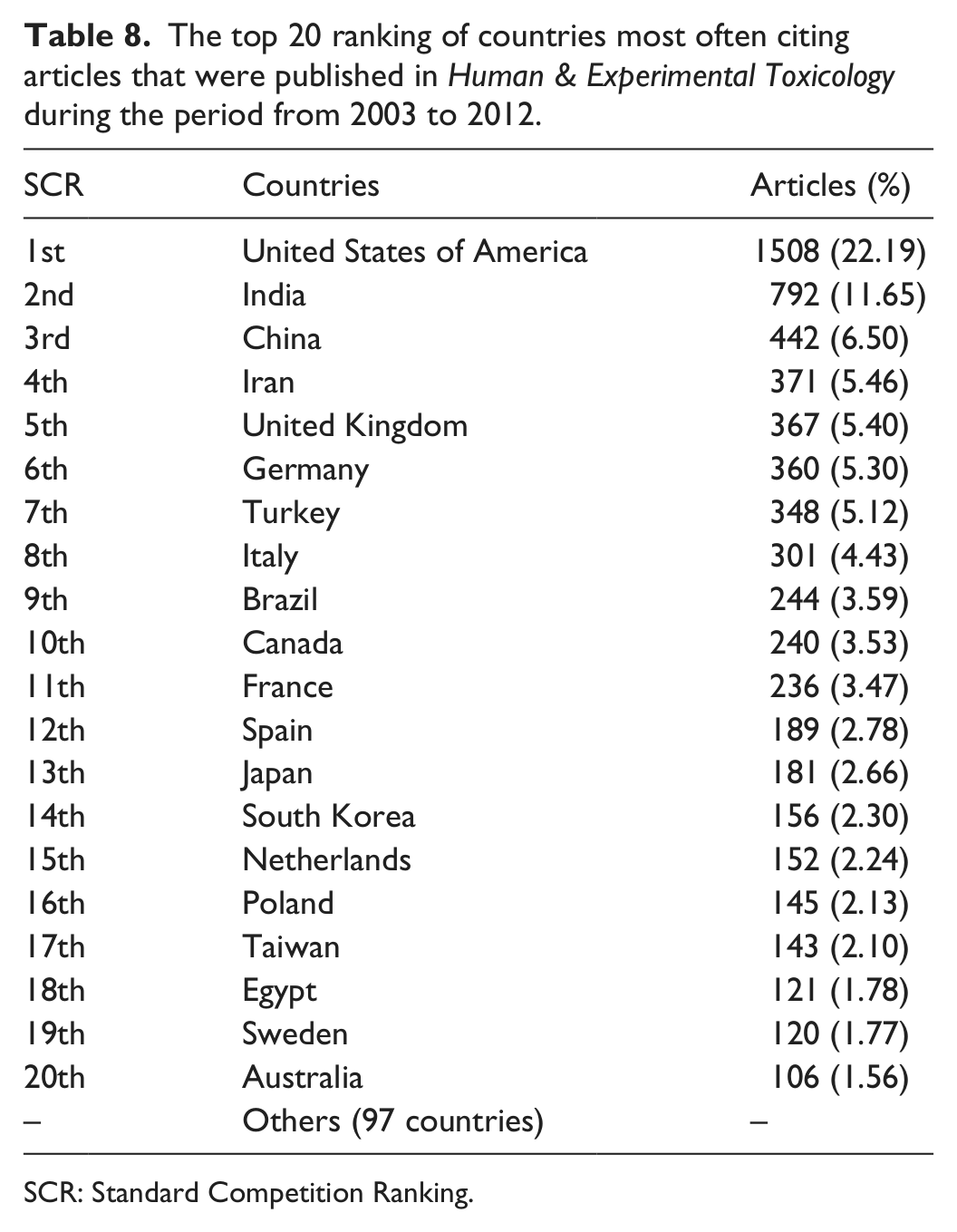
SCR: Standard Competition Ranking.
Discussion
Previous bibliometric studies of publications in toxicology have been studied at the international or national level, highlighting toxicology research in general without any specific interest being paid to individual journals or to the citations concerned by certain toxicology journals.12–18 Here, we have complemented the previous bibliometric studies with a detailed analysis of publications in, and citations to, the HET. We have provided a comprehensive analysis of articles published in HET during the past 10 years. We see this bibliometric analysis as reasonably summarizing data of a journal that is one of the most familiar and cited toxicology research peer-reviewed journals. Interpretation of publication trend data potentially provides an indirect indication of the progress of the toxicology profession, as reflected by the peer-reviewed record in toxicological journals. 16
As expected, the United States was the most productive country with its researchers being the corresponding authors or co-authors of 19.6% of all documents. These documents also amassed the largest number of citations (Citations = 1800). Furthermore, the United States also collected the largest number of citations for documents that were published in HET during the period of study.
We accounted that contributions from the ‘rest of the world’ (outside of the United States) showed to increase steadily during the period of study. Particularly, the bibliometric data indicated that Turkey and Iran have been the major research contributors from the Middle East, whereas India and China produced the most research articles from the Asia-Pacific region. The 20 most productive countries that were published in HET include many nations familiar from any other scientific productivity ranking. 19 Toxicology in Turkey and Iran has experienced a rapid development and showed a great progress in education and research in conjunction with the economic development in these countries over the past two decades.14,20–22 Based on the SCImago Journal & Country Rank, which is a portal that includes the journals and country-scientific indicators developed from the information contained in the Scopus database (Elsevier B.V.), Turkey has the first rank in the scientific productivity in the field of ‘Toxicology’ among Middle East countries by publishing 1488 articles from 1996 to 2012, while Iran has published 873 articles at the same time and is ranked the second in the Middle East. 23 These results are similar to the findings of our study.
The average citation rate for documents from HET was 7.4 citations per document. This is slightly less than the average citation rate for most journals in other scientific disciplines.16,24 Overall, toxicology journals as a group have low citation numbers compared to other scientific disciplines.17,18,24 This is likely endorsed to several factors. First, the number of researchers of toxicology is small, which means relatively fewer documents have been published in peer-reviewed toxicology journals compared with other disciplines. Second, the apparent narrow focus of toxicology journals may encourage researchers who have some connection to the field of toxicology to publish their results in journals that may have a larger audience than that of toxicology journals.16,25 This exact situation was demonstrated in the emergency medicine literature by Callaham et al.; 26 they reported that publications in emergency medicine journals were cited more than 3 times as often when published in non-emergency medicine journals. Comparing toxicology to areas such as molecular biology and genetics, where new discoveries are made almost every day, human toxicology is a more slowly advancing science. This can result in wide disparities between the citations of journals in different fields in comparison to a journal with a narrow field. 24 This may be one reason why journals like the New England Journal of Medicine, Lancet, JAMA, Science, and Nature, whose content encompasses the entire scope of general medicine, are always among the journals with the highest citations, which in turn leads to high IF. Since human toxicology is a very constricted field with a very small readership, it should not be astonishing that toxicology journals have small numbers of citations, which leads to average IFs.16,27
On the other hand, according to the JCR 2012, HET IF is 1.453, and it is ranked the 65th out of 85 peer-reviewed toxicology journals listed in the category of Toxicology. Compared to other journals in the Toxicology category, the highest IF was for Annual Review of Pharmacology and Toxicology (21.543), and the lowest IF was for Archiv fur Lebensmittelhygiene (0.267). In addition, according to the JCR 2012, HET articles number during the year 2012 is 138, and it is ranked the 23rd out of 85 regarding the number of articles published in that year. The highest articles number in year 2012 was for Food and Chemical Toxicology (690), and the lowest articles number was for Journal of Health Science, and it was 0. Furthermore, HET 2012 total cites was 2506, and it is ranked the 43rd out of 85. Compared to other journals in the Toxicology category, the highest total cites was for Toxicology and Applied Pharmacology (15,852), while the lowest total cites was for Toxin Reviews, and it was 118 (analysis of data not shown in result). 28
It was observed that most countries such as the United States, India, China, and Iran demonstrate a high country citation rate: researchers from these countries are disproportionably more likely to cite documents that were produced by their own country rather than representative by any other nation. 29 Furthermore, a strong cooperative ‘ingroup’ network slants researchers to probe the same research questions and use similar methodology and data interpretations, the result of which leads to share document citations. 30 However, these country links are visibly overshadowed by a larger international network operating within HET. It is not surprising that many prolific authors who cited documents that were published in HET are also among the most productive authors such as M. Abdollahi; T. Hartung; S. Shadnia; E. J. Calabrese; and C. R. Jan. It was also interesting to see authors who have the highly cited documents from HET are also among the most prolific authors, such as M. Abdollahi; S. Shadnia; and E. J. Calabrese.
The most cited documents from HET were review articles. In general, journals that publish a large number of reviews tend to have higher citation rates than original articles.31–34 Furthermore, reviews are among the most cited articles because reviews often cite previously published works from the same journal. This exact scenario was demonstrated by Jang and Rusyniak; 24 they found that most journals ranked in the top 20 by Institute for Scientific Information (ISI) were devoted solely to reviews.
To the best of our knowledge, this study is the first of its kind to obtain initial data regarding bibliometric analysis of articles published in one of the most leading toxicology journals. This study is not without limitations, most of which are the same as those of bibliometric studies performed in other biomedical fields. This study was limited to citations extracted from Scopus, bearing HET in the references and, therefore, cannot be generalized to the literature covered by other databases such as Google Scholar. However, the study does give a clear picture about the characteristics of the documents from HET published in foreign channels, especially those indexed by Scopus. Although the number of citations for each publication might differ from one search engine to another, the Scopus search engine remains one of the best available tools for analysing and tracking citations, and comparing citations among different research groups and different institutions.11,35 A study that compared PubMed, Scopus, Web of Knowledge, and Google Scholar has found that PubMed remains an important resource for clinicians and researchers, while Scopus covers a wider journal range and offers the capability to do citation analysis.10,35–37
Conclusion
The documents in HET focus principally on original data, with very few review articles. Review articles tend to have higher citation rates than original articles, and hence, the editors and authors of HET might usefully promote the submission of reviews in the future to improve the impact of the journal. Furthermore, they need to encourage authors to cite their own literature, which would further help to increase the impact of the journal.
Footnotes
Acknowledgements
The authors would like to thank An-Najah National University for giving the opportunities to access most recent information sources such as Scopus database.
All authors were involved in drafting the article, and all authors approved the final version to be submitted for publication. S.Z. conceived of the study conception and design, organized and supervised the data collection, and provided analysis, interpretation, and writing. S.A. and W.S. participated in the study design, and provided critical revision of manuscript for important intellectual content. R.A. was involved in the concept and editing of the manuscript.
Declaration of conflicting interests
The authors declare that they have no competing interests.
Funding
No funding was received for this article.