



Abstract
Objective:
Unsafe drinking water has a significant health impact all over the world especially, in developing countries. Household water treatments become more affordable than conventional ones for many reasons. Photovoltaic concentrator is environmentally sound and effective inactivation method by converting light energy to electricity. This study aimed to assess the inactivation potential of photovoltaic concentrator on drinking water quality indicator microorganisms at different solar exposure times.
Methods:
A laboratory-based experimental study was conducted at Jimma University’s environmental microbiology laboratory to measure the disinfection potential of the photovoltaic concentrator for months in uneven weather conditions. A membrane filtration, a pour plate count method, and a calibrated clear sky calculator were used.
Results:
Among indicator microorganisms, Escherichia coli was completely inactivated (standard deviation = 11.3°C, R2 = 0.80) at 2 h of solar exposure whereas heterotrophic plate count was measured as (SD = 12.2°C, R2 = 0.82) at 35°C for 48 h in the sample that contains 2.81 NTU.
Conclusion:
Based on the findings, photovoltaic concentrator was one of the most effective inactivation technologies for E. coli and total coliform.
Introduction
Safe water is an essential element for the normal physiology of human beings. Following the fast growth of the world population, trends of urbanization, and industrialization, drinking water quality has been deteriorating more than ever.1,2 The presence of toxic metals, pathogenic microorganisms, and chemical ions are causing serious health problems in poor communities. Therefore, determination of the level of minerals, microbial load, and heavy metal contents of drinking water at the source prior to distribution is important to take further treatment actions.1,2
Water is fragile and susceptible to external pressure. It collects inorganic contaminants throughout the cycle that arises from the geological strata of the groundwater, particulate matter, and some gases from the rain and other precipitations. At the flow course, surface water is subject to anthropogenic-derived pollutants like microorganisms and chemicals enter to the water. 2
Faecal pollution-based water-borne diseases are a major cause of diarrheal diseases in developing countries. Especially, under 5 years children are the most vulnerable to coliform and Escherichia coli-related diarrheal diseases than other community groups. Under-five children get these pollutants through direct consumption of contaminated water and ingestion of milk formula which is prepared by this water. 3
Solar disinfection is one of the point of use small-scale water treatment systems. It is a simple, environmentally sound, and low-cost drinking water treatment system. The solar energy emanates from ultraviolet (UV) – light (wavelength 320–400 nm) and infrared (700 nm) heat synergized to disinfect pathogenic microorganisms. 4 Synergized effect damages appear largely due to their formation of pyrimidine dimers, thus interfering with the nitrogen base sequences of the DNA strands in microbial cells. UV damage of cellular membrane or inhibition of RNA synthesis has been also reported.5,6
Due to the abundant availability of sunlight, the photovoltaic panel produces a reliable amount of electricity for UV water purification. 6 The comparison of inactivation rate of heterotrophic species with other common drinking water quality indicator microorganisms using photovoltaic concentrator has brought a new view on the radiation susceptibly potential of indicator microorganisms. Therefore, this study aimed to compare the inactivation potential of photovoltaic concentrator on water quality indicator microorganisms.
The objectives of this study were as follows:
To determine the inactivation potential of photovoltaic concentrator on drinking water quality indicator microorganisms.
To examine the role of physical parameters on drinking water quality indicator microorganisms inactivation rate.
To compare the inactivation rate of drinking water indicator microorganisms.
Methods
A laboratory-based experimental study was conducted at Jimma University’s environmental microbiology laboratory room. The experiment was carried out from May to July 2020 in an average daily room temperature of 26–30°C. Three different turbid water samples (2.81, 3.41, and 6.9 Nephelometric Turbidity Unit (NTU)) were taken from Ginjo gudura surface water.
Major microbial and physical drinking water quality indicators like water temperature, dissolved oxygen and solar intensity were analysed in line with Lamore et al. 7 and Dejung et al. 8 Next to measuring the initial content of physical parameters and microbial load, the raw surface water sample was exposed to solar radiance. The sample was taken every 30-min interval to culture bacteria and to measure the physical parameters until the end of the disinfection. Sample water was tested in triplicated experiments including a control sample.
As indicated in Figure 1, an acrylic glass panel with a light transparency potential of 92%–98% was used to concentrate the light energy at the bottom of the concentrator and the semiconductor photocatalyst titanium dioxide (TiO2)-coated layer converts light energy to electricity.7,9–11
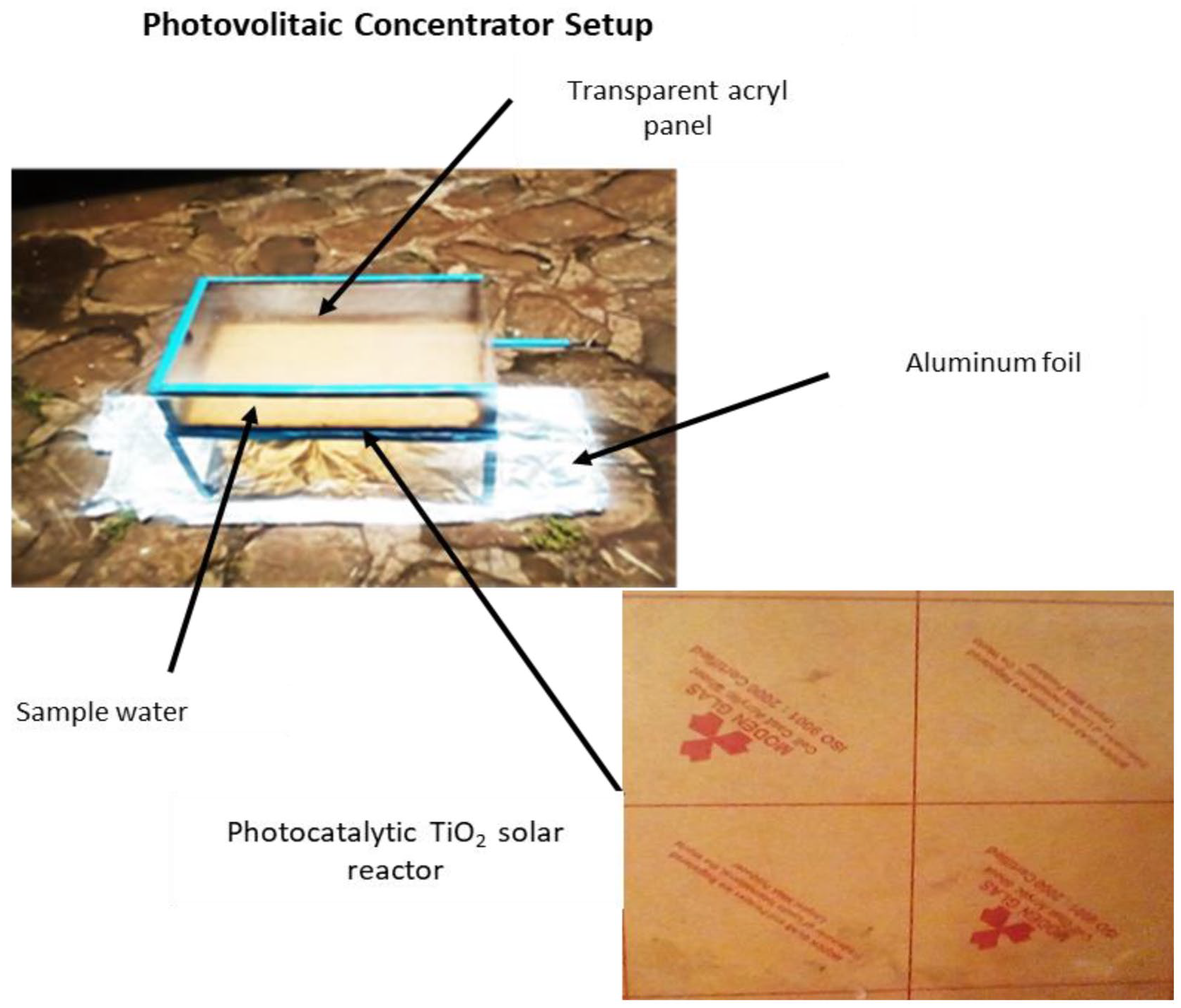
Photovoltaic concentrator image taken at experimental period.
Membrane lauryl sulphate broth was used for membrane filtration method in E. coli and total coliform culture, while plate count agar was used for pour plate count method in heterotrophic plate counts and fungal culture. 12 The microbial load was determined using the first-order Chick’s law reaction and a number of microorganisms inactivated per unit of time which is proportional to the number of organisms in the form of log inactivation

where Nt is the count of microbes in CFU/mL, t is the time, and NO is the initial count of microbes in CFU/mL. 9
Experiment supporting laboratory equipment, instruments, and chemical reagents were used in this experiment in Jimma University environmental microbiology laboratory room and at field solar exposure experiments (Table 1).
List of the laboratory equipment’s and chemical reagents used in experiments.

Statistical analysis
SPSS™ Version 20 and Microsoft™ Excel tool 2013 were used for data analysis. The linear regression coefficient of determination and descriptive statistics of standard deviation were used to summarize the data. Log inactivation test was conducted to compare inactivation rate of each indicator organisms under a photovoltaic concentrator. 9
Results
Solar intensity
Depending on the variability of the local weather conditions, a range of solar radiance was measured between 715 and 1297 WUV/m2 (Figure 2).

Solar radiation measured at experimental period.
Water temperature
As indicated in Figure 3, different water temperature results were measured depending on the turbidity level of a water sample.
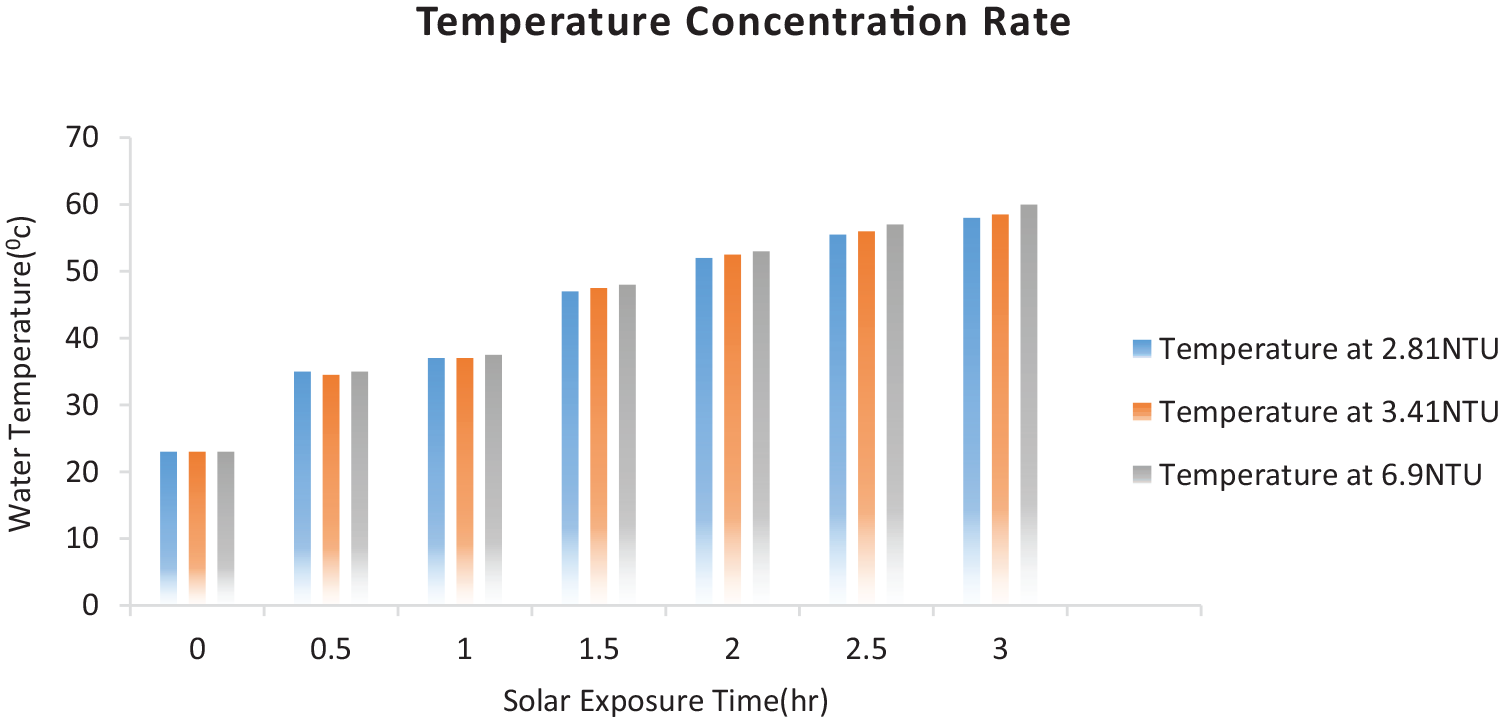
Water temperature concentrating potential of photovoltaic box.
The availability of dissolved oxygen showed irregular results with inverse relation to water temperature which means when the temperature was raised, the dissolved oxygen depleted during the experimental period (Figure 4).

The availability of dissolved oxygen during experiments.
As indicated in Figure 5, the inactivation rate of drinking water quality indicator microorganisms was slightly different in photovoltaic concentrator solar disinfection even keeping all factors at the same condition.

Indicator microorganism inactivation potential of photovoltaic concentrator at three different turbidity levels.
Discussion
In this study, solar irradiance was one of the major parameters to evaluate the inactivation potential of photovoltaic concentrator on drinking water quality indicator microorganisms. During the experiments, there were uneven weather conditions which affected the inactivation potential of the concentrator. 5
The solar intensity was measured every 30-min interval in line with Murugan and Ram 13 and Reed. 14 In this study, throughout the experiment, 715 WUV/m2 was recorded as the minimum solar intensity while 1297 W/m2 was a maximum measure likely with a result of Burgess et al. 10 Unlike this result, a study conducted in Adelaide showed slightly different solar intensity at optimal angle solar radiation of 841–1062 W/m2; 10 the difference might be because of geographic and seasonal variation at the time of experiment.15,16
Different studies17,18 have revealed that the drinking water quality indicator microorganism inactivation rate was achieved through the synergistic effect of optical and thermal energy when the water temperature reaches 45°C and above in line with this study. Water temperature was measured regularly at every 30-min interval to compare inactivation potential of the photovoltaic concentrator at different water temperatures. In this experiment, the water temperature was measured between 58°C at 2.81 NTU and 60°C at 6.9 NTU at 3 h solar exposure. According to this result, the measured water temperature was capable to make a synergistic effect with UV light for fast microbial inactivation.11,19
Photovoltaic concentrator potential for E. coli log inactivation rate at 2.81 NTU turbidity level was measured as (standard deviation (SD) = 11.3°C, R2 = 0.80) similar to total coliform. However, the heterotrophic plate count at 35°C for 48 h and the heterotrophic plate count at 20–28°C for 5–7 days were inactivated at (SD = 13.4°C, R2 = 0.76) and (SD = 12.7°C, R2 = 0.87), respectively, at 6.9 NTU turbidity level. 12
The availability of dissolved oxygen causes fatal damage to microorganisms by disruption of the cell membrane or by attacking DNA and RNA. Dissolved oxygen was one of the determining factors of microbial inactivation rate and its availability was measured at every 30-min interval to evaluate its effect on inactivation potential of photovoltaic concentrator.12,19,20 This experimental study stayed for not less than 3 months, and during this period, the irregularity of weather conditions was the major limitation of this experiment.
Conclusion
The photovoltaic concentrator had a high solar concentrating potential of 60°C at maximum solar exposure time of 3 h. In the process of microbial inactivation, high consumption of dissolved oxygen has been observed; consequently, its content was slowly depleted along the solar exposure time. Based on the results of this study, the water quality indicator microorganisms inactivated at different exposure time. The findings showed that E. coli and total coliform were the more sensitive water quality indicator microorganisms than the rest. Further research works need to compare the different household water treatment technologies with photovoltaic concentrator to examine the disinfection potentials of treatment systems.
Footnotes
Acknowledgements
The authors are grateful to Jimma University for supporting and funding this study. Foremost thanks to Professor Pammla Petrucka University of Saskatchewan and Saskatoon, Canada, and Zelalem Bahilu (PhD fellow) at Arba Minch University, Ethiopia, for language edition.
Author contributions
The authors have equal contributions to the manuscript. Both authors critically reviewed the manuscript, read and approved the final manuscript.
Availability of data and materials
Data and materials will be available upon reasonable request through the corresponding author.
Declaration of conflicting interests
The author(s) declared no potential conflicts of interest with respect to the research, authorship, and/or publication of this article.
Ethical approval
This laboratory-based experimental study was conducted after obtaining an ethical consent from Jimma University Ethical Clearance Committee. This manuscript has never been submitted and deliberated for publication to any other journal. Ethical approval for this study was obtained from the internal review board (IRB) of Jimma University, College of Health Sciences (RFGC/427/2020).
Funding
The author(s) disclosed receipt of the following financial support for the research, authorship, and/or publication of this article: This study was funded by Jimma University, Ethiopia. The University supported this study financially and technically during study design, data collection, data analysis, data interpretation, and writing the manuscript.
