



Abstract
Background:
Cervical cancer is one of the major noncommunicable public health problems among women globally. About 500,000 women develop cervical cancer each year, with an estimated 85% or more occurring in developing countries, including Ethiopia.
Objective:
The main objective of the study was to assess the knowledge of cervical cancer screening and its associated factors among women attending maternal health services at Aira hospital, West Wollega, Ethiopia.
Methods:
An institutional-based cross-sectional study design was conducted among 421 reproductive-age women. A systematic sampling method was used for the study. Data were collected using a pretested and structured questionnaire. Data analysis included descriptive statistics and the statistical association between the outcome variable and the explanatory variables tested by the binary logistic regression. Multivariable logistic regression was used to control confounding factors, the magnitude of the association between the different independent and dependent variable was measured using 95% confidence interval, and p values below 0.05 were considered as statistically significant.
Results:
A total of 421 women were responded with 100% response rate and with the mean age of 26.0 ± 5.15 (M ± SD) years. About 95.0% of the respondents ever heard of cervical cancer and 46.8% of the respondents had good knowledge about cervical cancer screening. Age, occupation, educational level, and monthly income were predictors associated with knowledge about cervical cancer screening.
Conclusion:
The study revealed 46.8% of study participants had knowledge about cervical cancer screening. The age of the participant, occupation, level of education, and monthly income were determinants of knowledge about cervical cancer screening. Prevention programs should focus on cervical cancer screening according to identified factors in the study.
Introduction
Cervical cancer is one of the major noncommunicable public health problems among women globally and is an extremely preventable and curable disease with early detection and treatment.1,2 Approximately half a million women develop cervical cancer each year, with an estimated 85% or more occurs in developing countries, including Ethiopia.2,3
Cervical cancer is mainly preventable ensuring the introduction of effective cervical cancer screening, providing vaccination, early detection, and reducing cervical cancer. 4 The problem of cervical cancer is extremely high among the developing countries where 85% of the estimated 500,000 new cases and 273,000 deaths happen in resource-limited countries among women yearly.5,6
Ethiopia is one of the countries in Sub-Saharan Africa (SSA) with the highest incidence and mortality rates for cervical cancer and hospital records show that there are more than 150,000 cancer cases per year and currently cancer accounts for 4% of all deaths according to 2015. 5 Organized screening programs can most effectively control cervical cancer among all cancers.7,8 Screening is a commonly accepted early detection approach that can lead to treatment of precancerous lesions before they grow to invasive cancer. 9
Cervical cancer is the second most common cancer in women aged 15–44 years in Ethiopia. The most frequent form and leading cause of cancer mortality among Ethiopian women, cervical cancer is often at an advanced stage by the time they seek screening services. 6 According to World Health Organization (WHO), screening of cervical cancer should be started at the age of 30 years and beyond that scientists and public health advances have made cervical cancer one of the most preventable and treatable malignancies.4–6 Cervical cancer is prevented primarily with a screening test known as the Pap smear, which has significantly reduced cervical cancer incidence and mortality in developing countries, including Ethiopia. Pap smear is a quick, easy, and commonly used screening test that detects precancerous cells before they advance to cancer in Ethiopia. Nevertheless, it has had limited success in Ethiopia and other resource-poor countries, as it requires repeated testing, laboratory analysis, and proper diagnostic, treatment, and follow-up protocols. Ethiopia has invested little in the infrastructure, training, and laboratory capacity required for successful Pap smear screening. 10
The most prevalent cancers in Ethiopia among the entire adult population are breast cancer (30.2%), cancer of the cervix (13.4%), and colorectal cancer (5.7%). About two-thirds of annual cancer deaths occur among women. 11 In Ethiopia, multiple factors contribute to the development of cervical cancer, such as competing health interests, lack of awareness, unavailability of cervical cancer screening, and treatment services, among others. 12
Ethiopian mothers are losing their lives to preventable disease. To produce a substantial decrease in incidence and mortality, barriers should be addressed, awareness should be created, and there must be an effective screening and prevention services that facilitate early detection and treatment. To the best of the researcher’s knowledge, there are limited data on women’s knowledge of cervical cancer screening and associated factors in the study area.
Having knowledge on early cervical cancer screening for cervical cancer is a key intervention in reduction of maternal deaths globally and specifically in the study area. Cervical cancer screening knowledge is not well documented in the study setting in particular. The significance of this study addressed early screening for cervical cancer in the study area. Therefore, the main objective of the study was to assess cervical cancer screening knowledge and associated factors among women attending maternal health services at Aira Hospital, West Wollega, Ethiopia. The cervical cancer screening knowledge findings of the study informed policy to design targeted and tailored strategies to surge and potentially increase cervical cancer screening uptake among women in the study area.
Materials and methods
An institutional-based quantitative cross-sectional study was conducted in Aira town, West Wollega, Ethiopia, from 7 February to 30 March 2018. All women in the catchment area and all women of reproductive-age group attending maternal health services at outpatients clinic at Aira hospital, West Wollega, Ethiopia, were included. Inclusion criteria were all women who were attending maternal health services (family planning clinic, antenatal care unit, postnatal unit, gynecologic ward, and immunization unit) at outpatient clinics during the data collection period, who were in the reproductive-age group (18–49 years), and who were willing to participate in the study. Critically ill mothers during data collection to participate were excluded.
Sample size determination
The sample size calculation for the first objective was based on a single population proportion formula. The sample size was calculated taking prevalence of knowledge to be 53.7%. Assuming a 95% confidence level and a 5% margin of error, the minimum sample size required for the study was 421 women (adding nonresponse rate of 10%)

where Za/2 = 95% confidence interval (CI) (1.96), d = margin of error (5%), n = sample size, P = estimated population (53.7%)

Sampling technique
Systematic sampling technique was used to select the eligible study participants from each clinic during the data collection period. The total number of clients came to obtain maternal health services at the Aira Hospital from 1 September to 30 November 2017 were 1263. Hence, the Kth value was 1263/421. Therefore, every third client visiting the maternal health services (family planning clinic, antenatal care unit, postnatal unit, gynecologic ward, and immunization unit) at outpatients clinic during the data collection period was included in the study.
Data collection tool and procedure
Data were collected using a pretested and structured questionnaire administered by face to face and they responded to the options provided to the questions on the structured questionnaires. The questionnaire was adapted from other similar studies. 13 The questionnaire was originally developed in English and then translated into the local language (Afan Oromo) and back into English to ensure its accuracy by bilingual experts. The questionnaire included sociodemographic characteristics, reproductive health characteristics, and questions regarding the knowledge about different aspects of cervical cancer. Authors checked all completed data for completeness and consistency before analysis.
Quality assurance
The questionnaire was adapted from previous studies based on research objectives. The questionnaire pretested at 10% in another nearby hospital and rearrangement of some questions were simplified before the actual data collection.
Operational definition
Knowledge
Knowledge about cervical cancer screening measured by a 12-item knowledge questionnaire adapted from previous studies. 13 The scale for assessing knowledge was from 0 to 12 scores. Correct answers given a score of 1 and incorrect answers 0. Those who had scored less than the mean was considered to have poor knowledge while those who have had scored greater than or equal to the mean value was considered as having good knowledge.
Data processing and analysis
After data collection, filled questionnaires were coded, checked, cleaned, and entered into Epi data version 3.1 software; duplicated; validated; and then exported to SPSS version 22.0 software for analysis. Data analysis includes descriptive statistics, including frequency, percentage, mean, and standard deviations.
Both bivariate and multivariate logistic regression analysis were employed. Bivariate logistic regression was run to determine the crude odds ratio (COR) and variables with p < 0.25 were run a multivariate logistic regression model. Those variables with p < 0.05 at 95% CI were considered as statistically significant factors associated with knowledge about cervical cancer screening.
Results
Sociodemographic characteristics of the study population
A total of 421 women were responded with 100% of a response rate. The mean age of the study participants was 26.05 (±5.15 SD) years. Most of the respondents (92.2%) were married and 45.6% had more than one child (Table 1).
Sociodemographic characteristics of respondents, Aira town, Ethiopia, 2018.
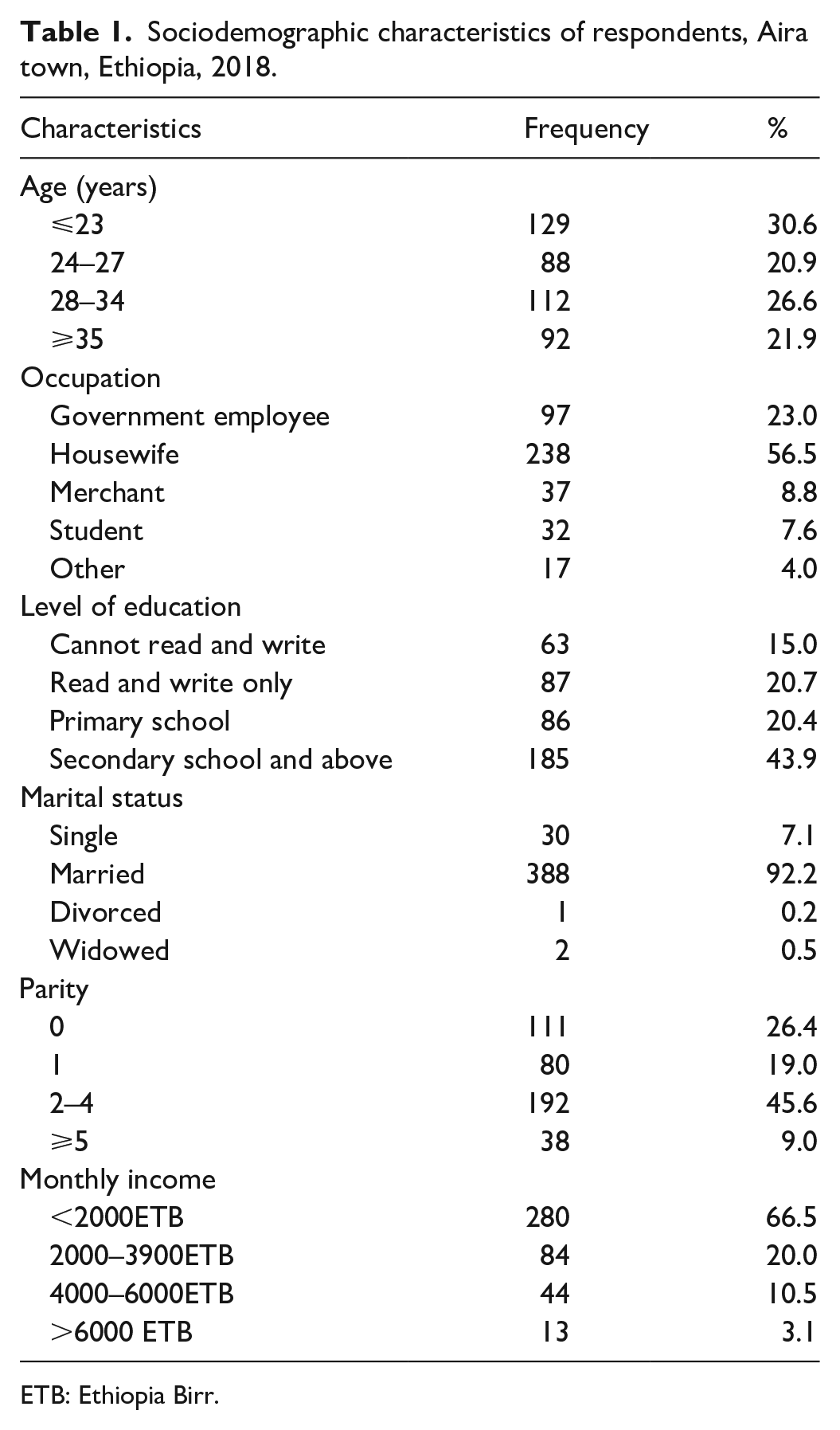
ETB: Ethiopia Birr.
Awareness and knowledge of women about cervical cancer
Although about 400 (95.0%) of the respondents ever heard of cervical cancer, the source of information for the majority of them (56.5%) was family, friend, neighbors, and colleagues but only 26 (6.2%) of the participants were heard from religious leaders. The data were checked for their normal distribution in which about 197 (46.8%) of the respondents had good knowledge on cervical cancer screening and scored at or above the average mean. Regarding prevention of cervical cancer, participants responded as follows: avoid multiple sexual intercourse (61.3%), avoid early sexual intercourse (33.7%), quit smoking cigarette (22.8%), HBV vaccination (22.8%), and don’t know (29.7%). About 334 (79.3%) have showed interest to be tested if cytological examination is available in their facility. About 257 (61.0%) responded age for cytological examination as 26–59 years. Almost all participants responded that after sexual initiation, women should undergo cytological examination less than 1 year and about 387 (91.9%) reported every 1 year for cytological examination. Overall, almost three-fourths (73.9%) of the respondents ever heard about cervical cancer screening and 86.5% of them were responded as this case can be cured while treated at an early stage (Table 2).
Awareness and knowledge about risk factors, presenting symptoms, and treatment options of cervical cancer among women attending maternal health services in Aira Hospital, Ethiopia 2018.

HIV: human immunodeficiency virus.
Responses doesn’t add up to 100% due to multiple responses.
Factors associated with knowledge about cervical cancer screening
On bivariate analysis, the majority of the sociodemographic characteristics were found to be significantly associated with having knowledge about cervical cancer screening. These variables include age, occupation, educational level, marital status, parity, and monthly income. After controlling for confounding factors in multivariate logistic regression, age, occupation, education, and monthly income were found to have a significant association with the level of knowledge about cervical cancer screening. For women whose age was less than or equal to 23 years old (adjusted odds ratio (AOR): 2.104; 95% CI: 1.207–3.667), the odds of having good knowledge about cervical cancer screening increases 2 times higher than those women whose age is ⩾35 years old. Study participants who reported being a housewife by their occupation (AOR: 2.761; 95% CI: 1.561–4.883) were about 3 times more likely to have knowledge about cervical cancer screening. Similarly, for women who didn’t have formal education (AOR: 2.312; 95% CI: 1.107–4.827) and who only can read and write (AOR: 3.344; 95% CI: 1.724–6.487), the odds of having good knowledge about cervical cancer screening increases about 2 and 3 times, respectively, higher than those participants who studied primary school. Women who reported their monthly income as less than 2000 Ethiopian Birr (ETB) (~72 US dollars (USD)) (AOR: 2.476; 95% CI: 1.158–5.296) were 2 times more likely to have knowledge about cervical cancer screening than those women whose monthly income is higher than 2000ETB (Table 3).
Factors associated with knowledge about cervical cancer screening among women attending maternal health services in Aira Hospital, Ethiopia 2018.

COR: crude odds ratio; CI: confidence interval; AOR: adjusted odds ratio; ETB: Ethiopia Birr.
Statistically significant at p < 0.05.
Discussion
The study was conducted to determine the level of knowledge about cervical cancer screening among women attending maternal health services in Aira Hospital, Ethiopia. The study also sought to determine the sociodemographic factors affecting women’s knowledge of cervical cancer screening. About 400 (95.0%) of the study participants ever heard of cervical cancer, which is consistent with the study result found in Uganda (99.0%). 14 This is because the Hospital has its own activity with respect to the cervical cancer awareness campaign in the community. A study conducted among 415 women in Saudi Riyadh city indicated that 18% know when to undergo Pap smear. 13 But results of this study demonstrate that 46.8% of women had good knowledge of risk factors, signs and symptoms, preventive methods, and treatment options of cervical cancer screening, which is in line with the result found in Hosanna and Tanzania which was 46.3% and less than 50%, respectively. 15 However, the results of this study are much lower than those in Hawassa, southern Ethiopia, and Yogyakarta Province, Indonesia, at 86.9% and 68.0% respectively.16,17 This difference result may be due to the study population of the study in Hawassa was only female health care workers and that of Indonesia might be due to educational background. After adjusting for covariates, study participants’ age, occupation, educational level, and monthly income were found statistically significant predictors, which affected their knowledge about cervical cancer screening. The age of the study participants is a statistically significant factor in this study which is consistent with the study result among university students in Cyprus that identified older students achieved higher scores compared with younger students, and with the study conducted in Mekelle, North Ethiopia, and Korea.5,18,19 This study found that participants who indicated their occupation status as housewives were statistically significant which is comparable with the study conducted in Ethiopia and Iran.20,21 This might be because the majority of housewives have access to information about cervical cancer screening service from maternal health service institutions, family, and media. Similarly, this study showed that level of education is a predictor of knowledge about cervical cancer screening while other studies identified sociodemographic variables have shown an influence on knowledge of cervical cancer screening.7,21 This may be because knowledge about cervical cancer clears rumors about cervical cancer and increases their awareness about the advantage of undergoing screening. Finally, women with a higher monthly household income were more likely to have knowledge about cervical cancer screening than women with their counterparts. It is possible that increased socioeconomic status places the women in a better position economically and knowledge wise and studies have also reported monthly income to significantly determine knowledge of cervical cancer screening.7,22,23 The study had methodological limitation about generalizability due to only one study setting and quantitative method. The clinical implication of educational level on cervical screening knowledge among the respondents in this study was supported by results found in Nigeria. Again, a study in Kenya also agreed with this study result regarding the clinical implication of age and monthly income.
Conclusion
This study showed about 197 (46.8%) of the respondents had good knowledge on cervical cancer screening. Age, occupation, level of education, and income were factors associated with knowledge about cervical cancer screening in this study. Prevention programs should focus on cervical cancer educational resources on women with less education, according to their occupation and age. As a recommendation, since this institution is a nongovernmental, it is important to use proven approaches in implementation of health extension programs to encourage knowledge on screening of cervical cancer with that of government institutions.
Supplemental Material
sj-docx-1-smo-10.1177_20503121211047063 – Supplemental material for Knowledge of cervical cancer screening and associated factors among women attending maternal health services at Aira Hospital, West Wollega, Ethiopia
Supplemental material, sj-docx-1-smo-10.1177_20503121211047063 for Knowledge of cervical cancer screening and associated factors among women attending maternal health services at Aira Hospital, West Wollega, Ethiopia by Megersa Argaw Aredo, Endalew Gemechu Sendo and Jembere Tesfaye Deressa in SAGE Open Medicine
Footnotes
Acknowledgements
The authors acknowledged Haramaya University, study participants, research assistants, and Ethiopian Evangelical Church Mekane Yesus Birbir Dilla Synod for their small financial support during data collection.
Availability of data and materials
All analyzed and published data were included in the manuscript and available from the corresponding author on reasonable request.
Declaration of conflicting interests
The author(s) declared no potential conflicts of interest with respect to the research, authorship, and/or publication of this article.
Ethical approval
The Institutional Review Board (IRB) approved the study by the Protocol No. 02/02/18/SNM. The purpose and importance of the study were explained to the head of the hospital and participants. Written informed consent was obtained from all participants prior to the study initiation that their participation was voluntary and that they could withdraw from the study at any time if they wish to do so and this would not affect any service that they will get from the institution. All the information given by the respondents has been used for research purpose only. Participants’ privacy and confidentiality of the information were maintained by the declaration of Helsinki.
Funding
The author(s) received no financial support for the research, authorship, and/or publication of this article.

Supplemental material
Supplemental material for this article is available online.
References
Supplementary Material
Please find the following supplemental material available below.
For Open Access articles published under a Creative Commons License, all supplemental material carries the same license as the article it is associated with.
For non-Open Access articles published, all supplemental material carries a non-exclusive license, and permission requests for re-use of supplemental material or any part of supplemental material shall be sent directly to the copyright owner as specified in the copyright notice associated with the article.
