



Abstract
Objectives:
To assess the implementation and evaluation phases of strategic plans in selected hospitals.
Methods:
We conducted a cross-sectional study of implementation and evaluation of strategic plan in 24 hospitals in 2015, using a questionnaire which consisted of two separate sections for strategic implementation and strategic evaluation. Data were analyzed with SPSS version 18.
Results:
Nearly one-third of hospitals claimed that they allocate their budget based on priorities and strategic goals. However, it turned out that although goals had been set, no formal announcements had been made. Most of the hospitals stated that they used measures when evaluating the plan. For hospital staff, clarifying the hospital’s priorities was the most important advantage of a strategic plan.
Conclusion:
There is no clear definition for strategic management in Iranian hospitals, which results in chaotic implementation and control of strategic planning.
Introduction
Today, organizations face many challenges. Changes are fast, complicated, confusing, and unpredictable. In such changing conditions, managers need tools and techniques that can help them respond appropriately to unpredictable events and be able to survive in a competitive environment.1,2 In this respect, a strategic plan can help to identify internal and external environments and analyze every situation carefully and extensively. This, in turn, can help to adopt appropriate approaches and improve organizational performance. 3
The objective in strategic planning is to decide on the best approaches in favor of organizational advancement. Two reasons can explain the importance of this objective: first, no organization has unlimited resources, and second, a wrong strategy may put the whole organization in a whirlpool of problems from which it may never recover. Strategic management has been welcome by various managers and experts since it well defines the interactions between an organization and its surrounding environment.4,5
Medical centers and hospitals are pillars of healthcare systems in every country, so that a significant part of governments’ health concerns are manifested in these centers. Nearly 50%–80% of all resources in health sector are allocated to hospitals. 6 It is hardly possible to improve a healthcare system without improving the hospitals. 7 Today, there is general agreement that strategic planning can significantly improve organizational performance 8 by adjusting financial, structural, and technological operations. 9 Thus, developing a strategic plan is a pre-requisite of success in medical centers. 10 A good understanding of strategic management—its concept, language, and process—will give hospital managers a competitive edge. 2
Strategic planning plays a critical role in achieving organizational goals; however, there might also be serious barriers in the way of strategic implementation. 11 In Iran’s hospital settings, there is general agreement that strategic planning is necessary for every hospital. There is even a specific budget section for strategic planning in hospitals in Iran’s Ministry of Health (MOH). This can be considered strength of Iran’s healthcare system. What is more important here, however, is the quality of formulation, implementation, and evaluation of hospitals’ strategic plans. In other words, a strategic plan is an effective control tool only when (1) it is correctly formulated, (2) it is implemented at all organizational levels, and (3) it is evaluated appropriately and systematically so that any deviations are recognized and modified in a timely manner. Hospitals in Iran tend to develop a good strategic plan, while they ignore the importance of implementation and evaluation phases. It seems they believe that only developing a strategic plan suffices. This is also observable in budgeting, where the quality of the plan, implementation details, and evaluation are neglected. In assessments made by the MOH, implementation and evaluation of a strategic plan receive the least attention. 12 Hospital managers should remember that a strategic plan by itself does not guarantee successful achievement of strategic goals. An organization will not achieve its goals unless it carefully implements and evaluates its strategies. 13
This study is the first in Iran to seek an answer to the following objectives: to assess the implementation and evaluation phases of strategic plans in Iranian hospitals and to investigate the advantages and effects of such a plan in the selected hospitals.
Method
Study design
This cross-sectional study was conducted in 2015.
Study setting
The setting was all of the educational hospitals of Iran University of Medical Sciences (n = 10) and Tehran University of Medical Sciences (n = 17). All of these hospitals offer their professional and specialist services in Tehran (a city with a population of 12 million). From a total of 27, 3 hospitals refrained from participating. From the remaining 24 hospitals, 8 were general and 16 were single-specialty hospitals. Research population consisted of managers of strategic planning committees and knowledgeable individuals in strategic planning in these hospitals. In general, it consisted of all key people who were the most involved in or aware of the strategic plan of their hospital.
Survey instrument
We gathered data using a questionnaire that we developed based on Kaissi and Begun 14 and Poister and Streib. 15 The first part of the questionnaire covered all items related to the implementation phase of a strategic plan. These items were further divided into two parts: “budget allocation according to strategic priorities” (6 items) and “acting based on the strategic plan” (7 items). The second part covered the items related to the evaluation phase and consisted of 15 items about “using goal achievement measures.” Content and form validity were confirmed by five experts in strategic planning. To check the reliability of the tool, we selected five of the hospitals through simple random sampling and ran a pilot study in them. Cronbach’s alpha (α = 0.77) confirmed the questionnaire’s reliability. We used a 5-degree Likert scale (from 5 as ‘very good’ to 1 as ‘very poor’) and analyzed the answers in three ranges labeled as: weak (0–2.50), average (2.51–4), and good (4.01–5).
Data collection
We gathered the data by going to each hospital in person and filled the questionnaires by interviewing each participant. Their organizational roles were as follows: quality improvement manager (13 hospitals), hospital affairs expert (4 hospitals), head of clinical governance (2 hospitals), head of excellence office, clinical supervisor, head of research and development (R&D), hospital manager, and manager of systems and methods. The objectives were completely explained for the participants. We also examined hospital documents on request, by doing so the answers have been validated.
Data processing and analysis
Data analysis was performed using the program SPSS version 18 (SPSS Inc, Chicago, IL, USA). Descriptive statistics (means, standard deviations, and percentages) were calculated.
Ethics approval and informed consent
Ethical approval for this study was obtained from Ethics Committee of Iran University of Medical Sciences (Approval Number/IUMS/SHMIS-2012/527). Written informed consent was obtained from legally authorized representatives before the study. Verbal informed consent also was obtained from all subjects before the study.
Findings
All the hospitals we studied here were teaching hospitals and offered their medical services to the patients and educational services to the students as major nation-wide hospitals in Tehran. They were ranked 1 or higher, and more than two-third of them were specialized hospitals. Of these hospitals, 91.7% had more than 30 years of age, and half had more than 200 active beds. One-third of them had more than 500 employees. Of the managers, 45.8% in these hospitals had a master’s degree in health and medical management. Other demographic information about the hospitals is shown in Table 1.
Demographic information of the selected hospitals.

Ministry of health and medical education in Iran adopt two degrees to evaluate the hospitals: excellent degree is highest degree and A degree which is lower than excellent degree.
The implementation phase of the strategic plan consists of two parts: budget allocation based on strategic priorities and acting based on the strategic plan. Regarding the first part, six items were studied. Only one-third of the hospitals claimed that they allocated the budget based on priorities and strategic goals. According to more than half of the participants, the respective university did not reconsider the hospital’s budget based on the hospital’s strategic plan. However, half of the hospitals claimed that governmental resources, operational budget, and capital budget were allocated in line with goals and priorities of the strategic plan. A significant number of hospitals in the study (41.7%) were in search of new financial resources for their strategic goals (Table 2).
The status of budget allocation based on strategic priorities in hospitals under study.

The second part of strategic implementation is acting based on the strategic plan, that is, how much the hospital acts based on the predefined strategic plan. In most of the hospitals that we studied, objectives set for individuals and heads of departments were in line with hospital’s strategic plan; however, no announcements for them had been made, and even the hospital manager had not received any instructions from the university. In addition, assessment and rewarding systems were not linked to strategic implementation, and hospital manager’s efforts to draw the attention of university authorities to the hospital’s strategic plan had met with limited success (Table 3).
The status of acting based on the strategic plan in hospitals under study.

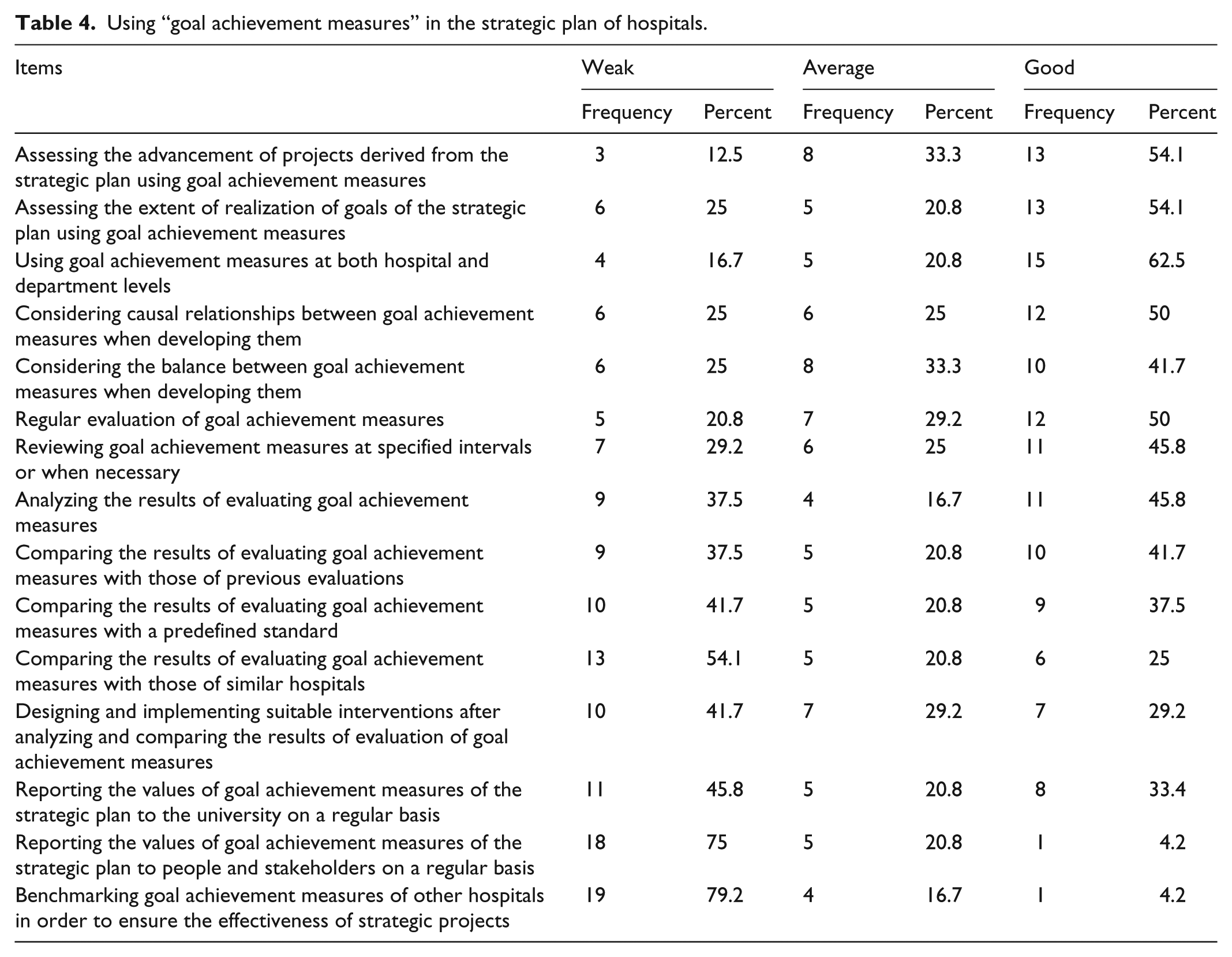
Regarding the evaluation phase of the strategic plan, the findings show that most of the hospitals regularly evaluate the advancement of goal-driven projects based on predefined goal achievement measures. They also review these measures at specified intervals or when necessary. In a limited number of hospitals, relationships between goal achievement measures when developing them has been considered (Table 4).
Using “goal achievement measures” in the strategic plan of hospitals.
Discussion
In this study, we investigated implementation and evaluation of a strategic plan in all educational hospitals of two major universities of medical sciences in Tehran. We considered the implementation phase in two parts: budgeting based on strategic priorities and acting based on the strategic plan. In most of the studied hospitals, neither does the university reconsider hospital budget based on the hospital’s strategic plan nor do hospital managers request the required funds for the strategic plan. In addition, efforts to identify and attract new financial resources for strategic goals are limited, which is in part due to the availability of state budget. A lack of coordination between a hospital and its respective university for budgeting of strategic plan can be a source of serious problems in strategic implementation. The hospitals may adopt goals that imposed financial burden to them which are required funding support. One other study has also argued that limited financial resources, inefficient organizational structure, a weak understanding of the strategies, and weak interpersonal relationships in an organization are barriers to a successful implementation of a strategic plan. 16 However, the lack of coordination between a university and its subordinate hospitals might be a sign of the fact that strategic planning has not yet found its proper place within the healthcare system. Further investigation is, however, needed to confirm this. Although managers and heads of departments in hospitals studied here are responsible for achieving certain strategic plan goals, annual evaluations of their performance does not consider their success in this regard. Furthermore, the hospitals’ annual rewarding system is not adjusted to the level of participation of different departments or employees in the realization of strategic goals. In most of the hospitals, the hospital manager is not formally assigned as the one in charge of the implementation of the strategic plan, and therefore, the annual evaluation of his/her performance is not based on the level of his/her success in achieving the strategic goals. Nevertheless, in a few hospitals, senior management had been successful in drawing the attention of university authorities to the strategic plan.
Regarding the evaluation phase, the findings show that most of the hospitals regularly evaluate the advancement of projects and goals of the strategic plan using goal achievement measures. They also review these measures at specified intervals or when necessary. A few hospitals also consider the causal relationships and the balance between these measures. Goal achievement measures are regularly evaluated; however, evaluation results are not analyzed properly. Comparisons of these results with those of previous analyses, a predefined standard, or those obtained in similar hospitals are carried out weakly. Providing reports on these measures to people and stakeholders, as well as developing appropriate interventions are mostly limited. A limited amount of benchmarking of results obtained in other hospitals is also observable.
The results of this study show that in cases where hospitals have attempted to establish ISO 9001, evaluation status of hospital has been improved due to regular and systematic processes and considering principles of well documentation. Rusjan and Alič 17 in their paper have indicated that implementation of the ISO 9000 has effects on every four category of Balanced Scorecard (BSC) approach. Also, using the BSC approach as a strategic management tool within the European Foundation for Quality Management (EFQM) can improve the establishment and implementation of strategies in healthcare organizations. 18 The composition of BSC and EFQM can be considered as quality management tools, as it proposed in Spanish hospitals. 19 It is necessary to integrate quality management and excellence models appropriately into strategic planning that it can be considered in the future studies of strategic management in Iranian hospitals.
Unfortunately, Iranian hospitals only develop a strategic plan and neglect its implementation. The implementation phase is mostly approached in a traditional way. The findings of this study support this claim. There is no related study in Iran to refer to; however, similar results were reported by Mihic et al. 20 in Serbia, where organizations develop good strategic plans, but monitoring strategic implementation is weak and is not based on sound scientific methods. It seems that instead of relying on traditional methods, hospitals should exploit scientific tools and techniques, so that they are more successful in implementing and evaluating their strategic plans. According to a number of studies, the BSC can play an important role in the implementation of organizational strategies; this is because it provides a framework for developing, implementing, and sharing the strategies in a goal-driven management system. Groene et al. 18 also believes that composition of EFQM and BSC (as a strategic management tool) can improve development and implementation of strategies in healthcare organizations. This study had some potential limitations that may affect the results. The study was limited to hospitals of two universities in a single city. Therefore, generalizability of the results is a limitation of this study.
Conclusion
Strategic management is fruitful when it is thoroughly understood, well developed, appropriately implemented, and evaluated. But in this study, strategic management is not well understood, and there is a lack of systematic strategic implementation and evaluation. The reasons behind this inappropriateness of strategic management can be summarized as follows: lack of awareness about terminology and process of strategic management, ignore enough time for comprehensive participation, weakness in beliefs regarding the strategic management, existence of bureaucratic structure which overlooked the plan, existence of serious flaws in the teamwork culture, distrust of the external environment and existence of centralized structure of MOH which focused on delivering commands and programs that would be disruptive discipline of hospitals programs. To overcome these problems, measures should be done at both short-term and long-term levels. In the long-term level, creating a culture of management based plan at third levels of service delivery should be adopted and implemented. In the short-term level, using National Accreditation Program for hospital and providing adequate training about the concept and process of strategic management and providing financial and non-financial incentives can move hospitals toward plan-driven and strategic thinking. So, according to the literature about BSC and its success, it is recommended that hospitals use this tool to improve implementation and evaluation of their strategic plans. Also, according to the major differences between educational and non-educational hospitals, further studies are required to assess it.
Footnotes
Acknowledgements
This study was part of a PhD thesis supported by Iran University of Medical Sciences.
Declaration of conflicting interests
The author(s) declared no potential conflicts of interest with respect to the research, authorship, and/or publication of this article.
Ethical approval
Ethical approval for this study was obtained from Ethics Committee of Iran University of Medical Sciences (Approval Number/IUMS/SHMIS-2012/527).
Funding
The author(s) disclosed receipt of the following financial support for the research, authorship, and/or publication of this article: This study was funded by the Iran University of Medical Sciences (IUMS; Grant No. IUMS/2012/527).
Informed consent
Written informed consent was obtained from legally authorized representatives before the study. Verbal informed consent also was obtained from all subjects before the study.