




Abstract
As described in the first paper of this two-part series, increasing difficulties in recruitment and retention of dentists and dental care professionals (DCPs) in general dental practice in the UK is affecting delivery of NHS dental services. There is a significant risk to the future dental workforce supply which will affect access to dental care and worsen oral health inequalities. Understanding what factors contribute to job satisfaction and prevent job dissatisfaction of dental professionals would be useful in managing recruitment and retention issues. The aim of this literature review was to identify factors which contribute to job satisfaction of DCPs in general dental practice. Database searching was conducted systematically through PubMed/Medline, Scopus, Ovid, and the National Grey Literature Collection. Eleven relevant articles were identified, which were qualitatively analysed using Herzberg’s motivation-hygiene theory as an analysis tool. Unfair remuneration is a major contributor to dissatisfaction of DCPs, but job satisfaction could be promoted through increased recognition, variety of work, and opportunities to progress. Dental contract reform in the UK should aim to minimise factors contributing to dissatisfaction and increase factors which increase satisfaction, including the development of an acceptable remuneration model for NHS dentistry that facilitates skill mix.
Learning Objectives
To understand the concepts and principles of Herzberg’s motivation-hygiene theory and its application in the context of job satisfaction of dental care professionals
To identify existing factors that contribute to dental care professionals’ job satisfaction according to the motivation-hygiene theory
To synthesise the existing literature to provide a summary of factors for stakeholders to consider in contract reform
Introduction
The widespread reports of issues in recruitment and retention of dental care professionals (DCPs) in general dental practice in the UK is particularly affecting delivery of NHS dentistry.1-3 Similar issues to those discussed around recruitment and retention of dentists have also been reported for DCPs, a term which covers a group of professionals who are qualified to provide certain aspects of dental care.4,5 This group of professionals includes dental hygienists and therapists, dental nurses, dental technicians and clinical dental technicians. There has been an increase in the number of General Dental Council (GDC) registrants in all groups of DCPs, except dental technicians, since 2019.6-8 A limitation of registrant reporting data is that these data do not show the number of registrants who are actively working in these roles. There are also individuals who are registered under multiple titles.
Recruitment and retention of individuals within a workforce are associated with job satisfaction.9-13 The Herzberg motivation-hygiene theory (see bullet lists below) explains that job satisfaction and dissatisfaction exist on separate continuums which are affected by different factors.13,14 Two independent processes occur, one where people feel good or satisfied about their work (termed motivators), and another where people feel bad or dissatisfied (hygiene factors).
achievement
recognition
responsibility
work itself
advancement
personal growth
working conditions
co-worker relationships
policies and rules
supervisor quality/supervision
salary
Herzberg’s motivation-hygiene theory is a useful tool in predicting job satisfaction and has previously been applied in other healthcare sectors to understand recruitment and retention of healthcare workers.10,12,15
The aim of this literature review is to identify specific factors which currently contribute to job satisfaction and job dissatisfaction of certain DCP groups in general dental practice. This literature review considers dental hygienists and therapists, dental nurses, dental technicians and clinical dental technicians.
Methods
This literature review was conducted in a narrative literature review format and is described in full in Part 1 of this two-part series (see pages 38–54).16,17 Multiple sources of literature were searched to better understand the issue through a broad range of experiences, values, and perceptions. Electronic searches of databases (PubMed, Scopus, Ovid, and National Grey Literature Collection) and website searches were conducted to identify relevant literature.
Inclusion criteria comprised any published or grey literature discussing job satisfaction, dissatisfaction, retention, or recruitment of DCPs in general dental practice/primary dental care after 1st April 2006. Systematic searches were carried out in June 2022 and updated in May 2023. The full search strategy can be found in Part 1. 16 Each article was assessed for risk of bias using an appraisal instrument appropriate for the type of article. A summary judgement of high, moderate or low risk of bias was given for each included article.
Results
Database searching, carried out in June 2022 and repeated in May 2023, identified 548 records. The Preferred Reporting Items for Systematic Reviews and Meta-Analyses (PRISMA) flowchart is presented in full in Part 1 of this two-part series. 16
Eleven reports were identified as relevant to DCPs and are discussed in this article (Table 1).
Descriptive summary of included studies relating to DCPs
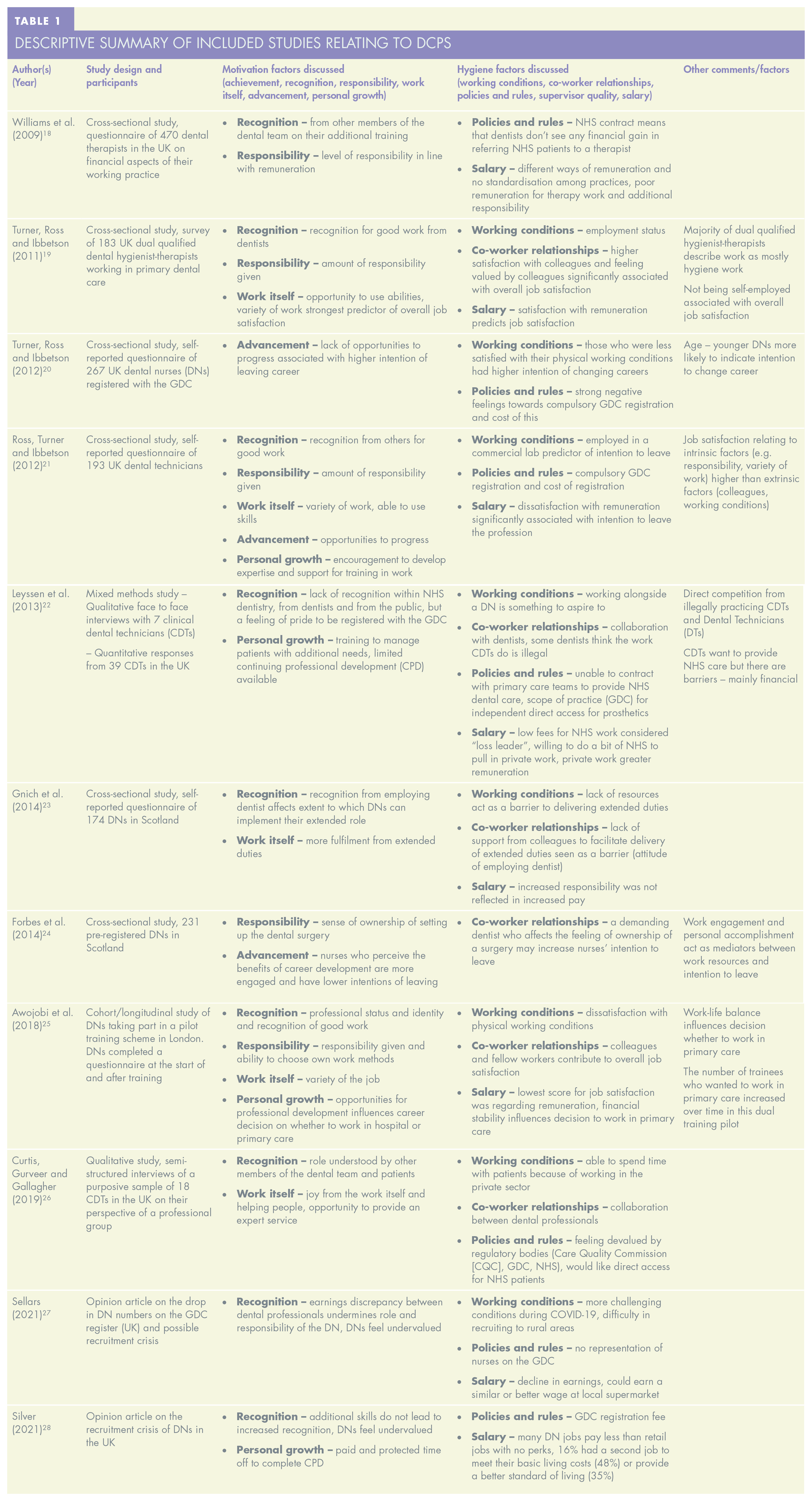
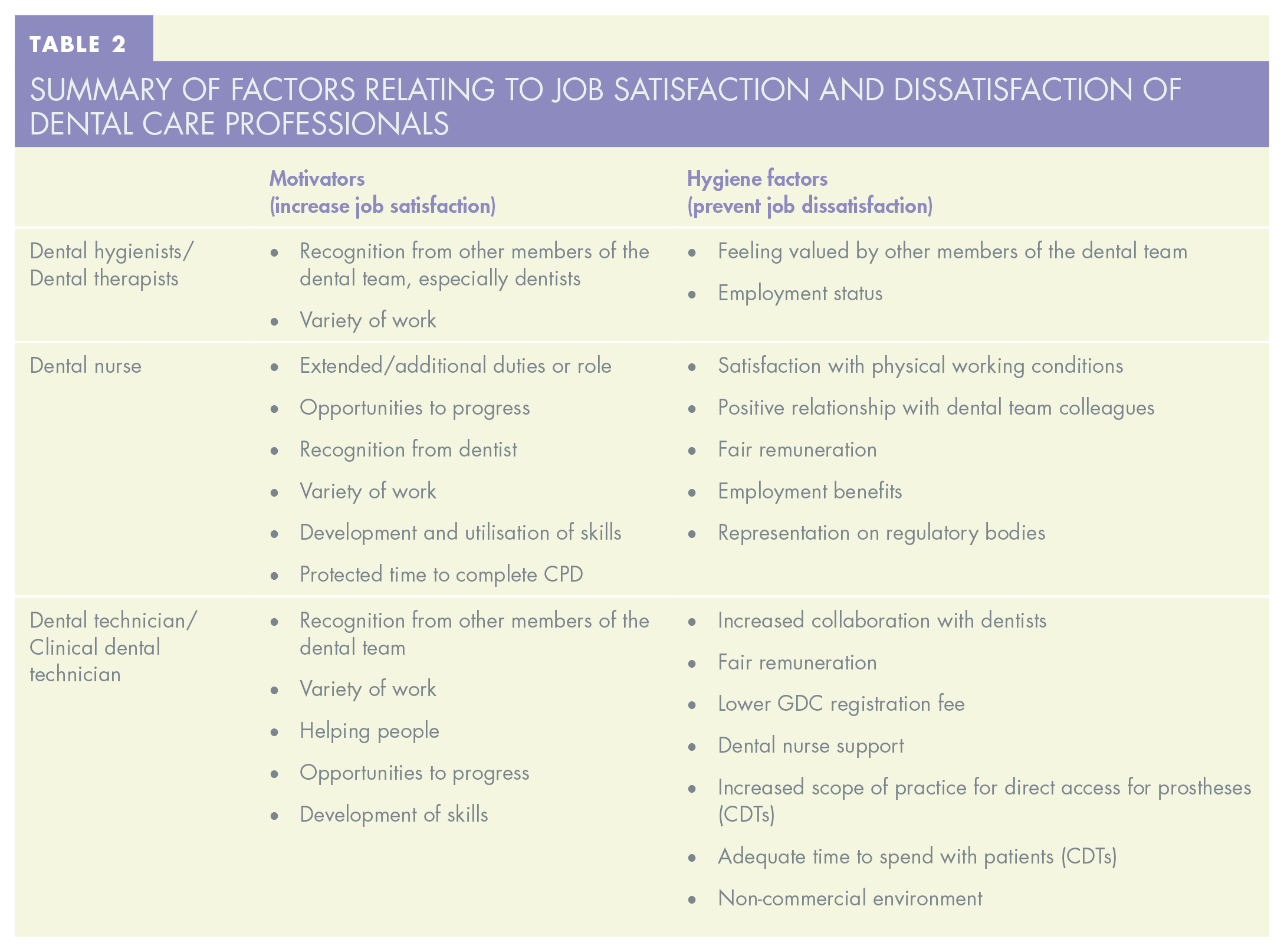
Included reports had high methodological heterogeneity therefore it was not appropriate to attempt any quantitative synthesis or meta-analysis. The papers are presented through a narrative synthesis and discussed for each DCP group. A summary of factors relating to job satisfaction and dissatisfaction of DCPs is presented in Table 2.
Summary of factors relating to job satisfaction and dissatisfaction of dental care professionals
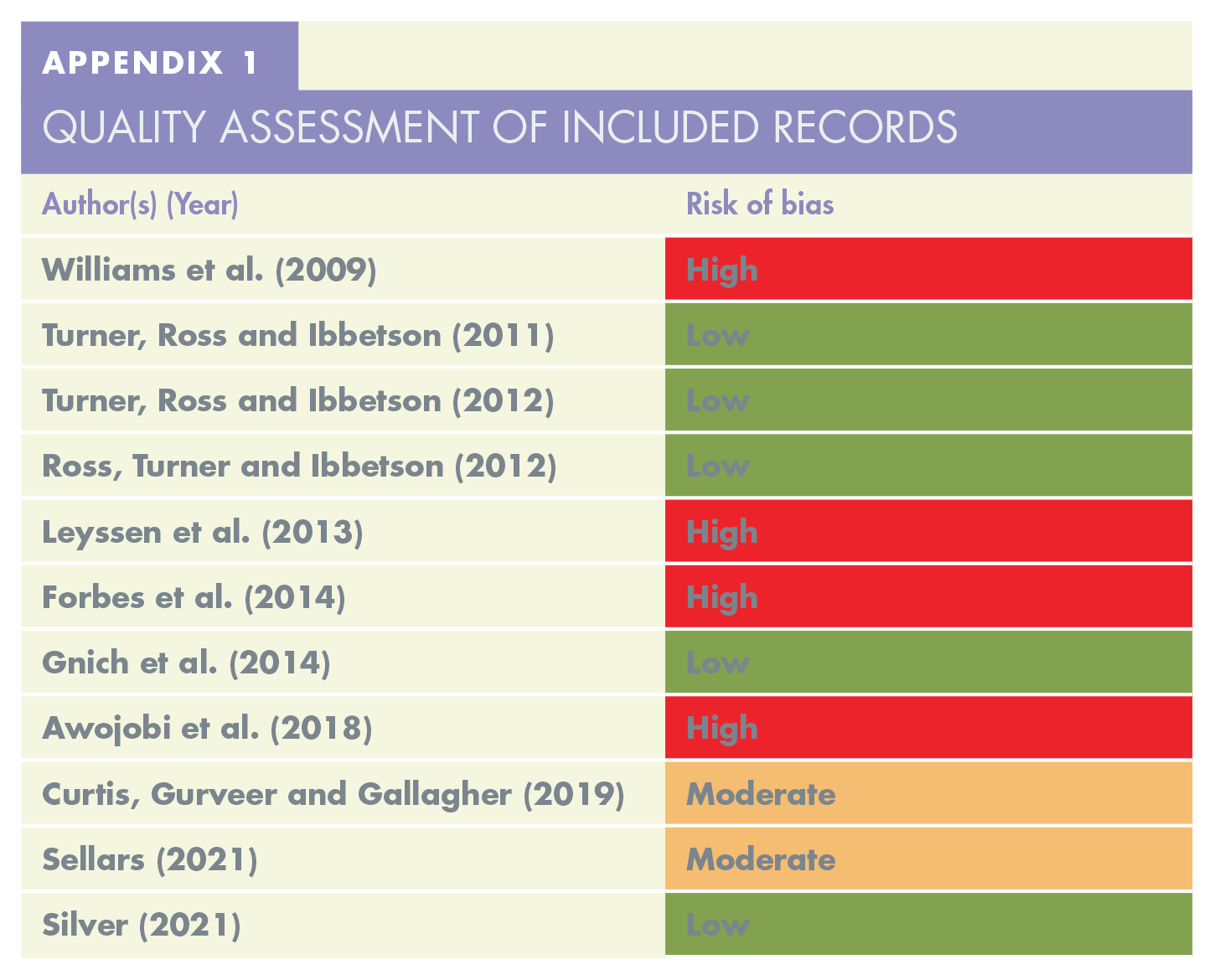
Risk of bias
Judgements of risk of bias (low, moderate or high) in each of the reviewed articles are presented in Appendix 1. Factors which only appeared in articles determined to be high risk of bias were excluded from the summary table (Table 2).
Discussion
Dental hygienists and dental therapists
Most dental care provided in general practice in the UK could be safely carried out by dental therapists and hygienists, but contractual and regulatory restrictions are a barrier to this in the NHS.29-31 Currently, NHS dental contract reform is being considered in all countries of the UK and increasing the use of hygienists and therapists (skill mix) is on the agenda.32-34 Increasing skill mix has previously been reported as having the potential to improve access to dental care, which may reduce inequalities.29,35
This review found that being self-employed in this role was associated with job dissatisfaction, 19 however there has been no recent exploration of attitudes towards employment among this group of dental care professionals. An article by Goldman and D’Cruz describes the different ways in which a hygienist or therapist can be engaged to deliver dental care within general practice, stating that many contracts for “self-employed” hygienists may not withstand legal scrutiny. 36
A finding from the present review was that job satisfaction of hygienists and therapists is highly associated with variety of work, but that those trained in therapy work mostly carry out hygiene work. 19 It has been reported previously that there are expectations from dental practices who engage a therapist that they will spend most of their time completing hygiene work.37,38
Recognition from other members of the dental team and feeling valued were associated with increased job satisfaction.18,19 Previous studies have reported on therapists feeling that they are valued members of the team within general dental practice, 37 yet a lack of understanding from dentists on their scope can affect this, so this may vary between practices where the dentist does understand the role and scope of therapists. 39
Only two papers included in this review concerned this group of DCPs and the most recent of these was from 2013; caution should therefore be taken when considering the findings as there is anecdotal evidence of changing attitudes to those found in this review.
Dental nurses
Job satisfaction of dental nurses is increased when there are opportunities for extended or additional duties, but there are a lack of opportunities or recognition of nurses with additional training within general dental practice.20,23,24,40
Previous studies have reported the potential for dental nurses to play a bigger role in provision of dental care, and the barriers to their increased utilisation, including professional attitudes towards delegation of work, indemnity, and remuneration.41-43 Dental practices operate as businesses and the current NHS contractual arrangements do not incentivise skill mix. 43 A report in 2020 found that despite regulatory changes which allow nurses to perform additional tasks, only around 20% of dental nurses have completed training enabling them to do so. 44 This could be due to the fact that pay of dental nurses with additional duties or skills in general practice rarely reflects increased responsibility. 28 It has been suggested that the average salary of a dental nurse is equivalent to or less than a supermarket retail position, with no benefits or perks.27,28 Dental nurses who provide NHS dental care in general practice are not eligible to receive NHS employment benefits or contribute to the NHS pension scheme. The present review also found that some nurses have a second job to maintain a basic standard of living. 28 The subject of dental nurse pay has been described as taboo, and poor remuneration and conditions of employment have been previously stated as reasons why dental nurses leave the dental workforce.45-47
Recognition, particularly from dentists, increases job satisfaction of dental nurses.24,25 Positive relationships with other dental team members prevents job dissatisfaction. 25 These findings agree with previous research on the impact of positive professional relationships between dental nurses and their colleagues on job satisfaction. 48 This literature review noted that the majority of dental nurses do not feel that compulsory registration with the GDC has positively affected their career. 20
This review found that younger dental nurses had higher intentions of leaving the profession, 20 which has previously been shown to be predictive of actually leaving the job. 49 This could indicate that younger dental nurses are less satisfied with their career prospects due to the factors identified in this review, such as a lack of opportunities for progression and poor remuneration.
Additional skills and greater variety of work can increase job satisfaction of dental nurses, but this may be counteracted by dissatisfaction caused by poor remuneration and poor professional relationships with other members of the dental team. Access to NHS employment benefits and clear paths for progression within general practice are currently not present in general dental practice but have the potential to impact on satisfaction of dental nurses, which could attract and retain dental nurses in the workforce.
Clinical dental technicians and dental technicians
Similarly, to other dental care professional groups, a factor that contributes to job satisfaction for this group of dental professionals is recognition, principally from dentists.22,26 A study in 2019 reported that clinical dental technicians were not yet fully accepted as part of the dental team, but younger dentists are more accepting of the role. 50 Furthermore, increased collaboration may prevent dissatisfaction.22,26 A recent insight into the work carried out by this group of dental professionals is that collaboration and respect is lacking, and there is poor communication between dentists and their technicians. 51 The average age of a technician is reported to be 56, which could indicate that this role is less attractive to younger people. A gradual decline has been seen in the number of dental technicians, which could lead to a lack of trained professionals able to carry out this work in the future. 4
Dissatisfaction from working under NHS contractual arrangements was a theme also seen with this group.22,26 Clinical dental technicians have additional training that enables them to complete the clinical work associated with the provision of dentures, but there have been mixed opinions regarding providing this work as part of the NHS reported previously. 50 Dissatisfaction with remuneration has been seen with other dental professional groups in this review and has been reported previously in relation to dental technicians providing work as part of the NHS.50,52
This review identified that a factor which contributes to increased satisfaction of dental technicians is the variety of work and opportunities to progress. 21 It has been suggested that a funded and supported pathway from dental technician to clinical dental technician could improve satisfaction of this group of dental professionals. 40
Registration with the GDC is compulsory for dental technicians and clinical dental technicians, and this review found that there is a feeling of pride to be registered, 22 but dissatisfaction regarding the cost of the annual fee. 21
Interestingly, this review found that being employed within a non-commercial laboratory was associated with higher job satisfaction. 21 This could be because commercial environments are geared towards profit over quality, and being able to provide good quality work is a factor relating to job satisfaction for this group. 21
Similarly to other groups, there is scarcity of literature on the views of dental technicians and clinical dental technicians on this topic.
Conclusion
The publicly funded NHS dental service must have “the right number of people with the right skills in the right place at the right time to provide the right services to the right people”. 53 Common themes for the majority of groups examined in both parts of this literature review 16 was remuneration, however, this is not the only factor that was identified in the literature as related to job satisfaction and dissatisfaction of dental professionals in general practice. Dental policy makers should consider the factors identified in this review and aim to design dental contracts which minimise those factors that lead to dissatisfaction and increase factors relating to satisfaction, in order to retain and recruit to the NHS dental workforce.
Footnotes
Appendix
Quality Assessment of included records
|