




Abstract
While older adults are often overlooked as active participants in economic life, their ways of earning and earmarking money demonstrate their agency, creativity, and efforts to maintain social relations and financial autonomy. This paper draws on participant observation and interview data collected from five communities in Shanghai to explore why older adults (aged 60 or above) are highly attracted to money-earning apps. These apps offer monetary rewards or free goods through gamified and social activities such as mini games, video consumption, friend referrals, and physical exercise.
The paper argues that gamified money-earning apps fulfill multiple aims of older adults by combining their desires for passing the time, entertainment, financial reward, and social interaction. Gamified money-earning apps are deeply embedded in the social lives of older adults in Shanghai. Through daily use of apps, they redefine and categorize their existing intimate relationships, build connections with new social networks, and shape their social practices.
Introduction
14:30, Community Center X, Shanghai, China. I walk into the community center classroom where weekly smartphone lessons for older adults are held. The “students” are all nearby residents aged 60 or above, most eager to learn how to use their smartphones or deepen their skills. The majority enjoy favorable economic status, with plenty of free time to participate in community activities. It was here that I met Auntie Wei and many others. Following Shanghai's local custom, I refer to older adults as “Auntie” and “Uncle” throughout this paper.
On this day, before the start of the class, Auntie Wei (71) sits at a desk with three mobile phones in front of her, each running a different app: Toutiao, Fanqie Novel, and Alipay. Her eyes and fingers move quickly between the screens. As soon as the 30-second ad on Fanqie Novel ends, she clicks “Receive Gold Coins,” and a rushing sound and 1,000 coins appear on the screen. On Fanqie Novel, 33,000 coins equal 1 RMB (about 0.13 EUR). Meanwhile, her other phone is running an ad on the Toutiao app, which also credits her with coins after 30 seconds. Auntie Wei does not waste time while waiting for the ads to finish – on her third phone, she is busy clicking “Get Fertilizer” in Alipay Farm. By playing games, browsing product pages, and sending links to friends, she earns fertilizer to grow a virtual fruit tree. When the tree is fully grown, she receives a box of real fruit from Alipay. She proudly shares that she received a box just last week.
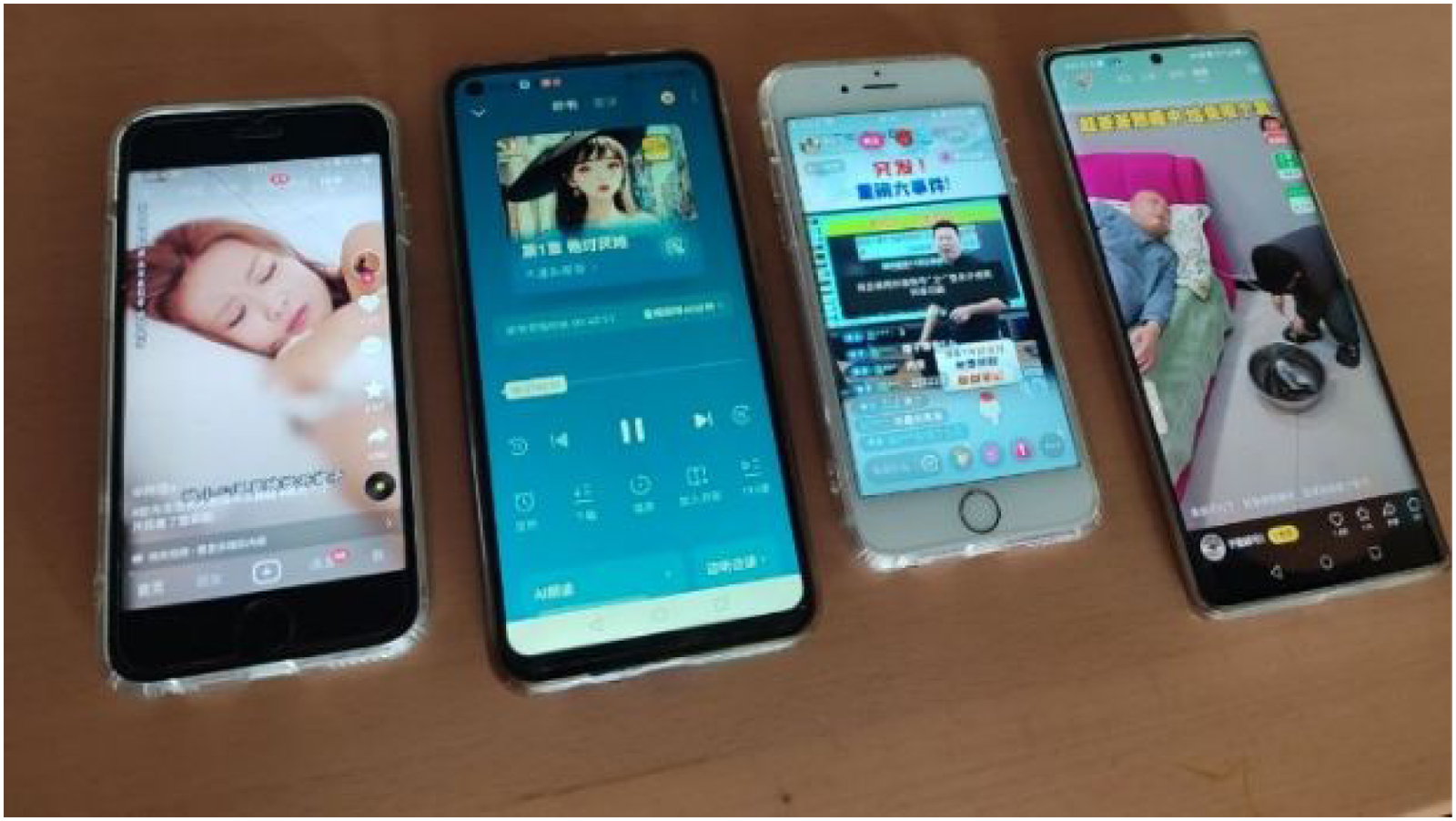
A Shanghai auntie simultaneously plays multiple money-making apps on her four phones.
Auntie Wei's screen time report shows that each of her three phones has an average daily usage of over eight hours, with the top-ranked apps all being ones that earn money. She is not alone. On the popular money-earning app Qutoutiao, users over the age of 60 spend more than an hour daily, significantly exceeding the average usage time (Qutoutiao & The paper, 2020 ). Older adults are enthusiastic about earning money or free goods on a set of apps that, to their understanding, are money-earning apps (Figure 1). They are typically meant for reading, shopping, live streaming, short videos, or making payments, such as TikTok Extreme Edition, Qutoutiao, Fanqie Novel, Pinduoduo, and Alipay. They offer users points or coins for tasks like purchases, watching videos, reading, playing games, friend referrals, or walking a certain number of steps. The points can be converted into virtual money or products (typically fruits). When the virtual money reaches a certain amount (e.g., 15 RMB, about 2 EUR), it can be withdrawn to WeChat or Alipay Wallet. On the very popular Fanqie Novel platform, the exchange rate is roughly 33,000 coins per 1 RMB, and an hour of reading can earn around 1,800 coins, meaning that nearly 18 hours of reading would be required to redeem just 1 RMB. For most of the older adults I met, the “small grocery money (xiao cai qian, 小菜钱)” they earn from the platform is less than 200 yuan monthly (about 25 EUR), raising the following questions: Why do older adults in Shanghai invest so much time and energy in these apps, despite earning only small amounts of money? Why are they so attracted to task-based money-earning practices?
Mobile payments form the foundation of task-based money-earning apps and mark China's profound economic transformation. In 2023, 85% of users used mobile payments daily (Payment & Clearing Association of China, 2024). In first-tier cities like Beijing, nearly 80% of smartphone users aged 60 and above use mobile payment (Beijing Municipal Bureau of Statistics, 2022). Online banking and stock trading apps are increasingly a part of older adults’ lives, enabling them to manage their savings and investments through their smartphones (Jin & Fan, 2022; Wang et al., 2023). Scholarly discussions regarding online financial behaviors have mostly focused on younger populations, while research on older adults’ online financial activities has primarily centered on payment and wealth management platforms (Choudrie et al., 2018; Hu et al., 2022; Wang et al., 2023), highlighting the challenges and opportunities related to digital finance and emphasizing the need for tailored design, education, and support to ensure older adults’ healthy integration into the digital financial landscape (Zeng & Li, 2023). There has been little discussion of older adults’ entertaining and gamified online financial behaviors.
Based on ethnographic data gathered from five Shanghai community centers between March 2023 and May 2024, I examine how Shanghai older adults use gamified money-earning apps in their daily lives. Chumley and Wang (2013) emphasize that in contemporary Chinese society, particularly among older adults in Shanghai, money management is not simply economic behavior; it is a complex practice intertwined with culture, emotions, and concepts of time. Similarly, for many older adults in my fieldwork, money-earning apps become a part of family life, social relationships, and personal emotions, reflecting a strong sense of sociality.
In The Social Meaning of Money, Vivianna Zelizer (1997) argues that people differentiate and categorize money based on its intended use, social context, and emotional significance. “Earmarking” refers to assigning specific meanings and purposes to different amounts or types of money in social and economic contexts. This framing offers an entry point to discuss how Shanghai older adults make sense of and assign meanings to “small money” and the social networks and intimate relationships involved in money-earning practices.
Below, I first explain how older adults in Shanghai engage in money-earning activities and argue that app practices meet multiple needs of these people by intertwining their desires for passing the time, play, financial reward, and social interaction. These combined factors motivate them to invest substantial time and effort into using these apps, through which they not only engage in entertainment and financial activities but also actively renew their social connections.
Theoretical Framework
Earmarking: What's the Social Meaning of “Small Money”?
Zelizer (1997) challenges the widely accepted notion that money is a neutral, universal medium of exchange. Instead, she emphasizes the significance of money within social interactions and relationships. She explores how money is used in different contexts, such as “pin money, paychecks, poor relief, and other currencies,” and shows that each form of money carries distinct social meanings and structures. According to Zelizer, people are constantly earmarking money, assigning specific purposes and meanings to different types of money based on the social context and the individuals involved.
Zelizer focuses on earmarking money within the family, examining how family members define and use various forms of household income. For instance, money earned by husbands is often differentiated from money earned by wives; children's weekly allowances are differentiated from wives’ pin money. “Pin money,” “egg money,” or “butter money” was often used by wives to maintain a sense of financial autonomy and control within the household. These small monies were kept separate from the primary household income and designated for specific purposes, such as personal spending or saving. Zelizer's explanation of these small monies emphasizes the diverse ways in which people use and understand money in their everyday lives, beyond its purely economic functions.
Based on Zelizer's notion of earmarking, scholars have explored the complex social and relational aspects of how individuals and organizations manage different sources of money, with important implications for understanding economic behavior and decision making (Bandelj et al., 2017). Scholars have adopted Zelizer's framework to examine how specific groups earmark money in their everyday lives. Ruckenstein (2010) discusses how Finnish children perceive and earmark their pocket money, Supriya Singh (2017) investigates how transnational money is loaded with meaning, morals, and emotions among Indian migrants in Australia, and Du Rietz (2022) examines how young Swedish adults engage in personal accounting and counter earmarking in the country's beverage can deposit-refund system.
As digital technologies continue to evolve, new forms of digital money – such as credit cards, mobile payments, and digital currencies including Bitcoin – have gradually become part of everyday life. Maurer (2015) examines how people “earmark money for special purposes” by choosing different payment methods. In his study on Bitcoin (2017), he proposes that it represents a “digital version of physical earmarking,” where blockchain technology allows for the digital distinction of monetary resources. Guseva and Rona-Tas (2017) highlight how modern consumer banking enables flexible money management, such as spouses keeping separate accounts to maintain financial boundaries.
Building on previous research, I explore how older Shanghai adults make sense of the money earned from gamified apps in their social relations. Most research surrounding Zelizer's notion of earmarking has been conducted in Western settings rather than how people in the Chinese sociocultural context mark and differentiate money. With the recent rapid development of mobile payments in China, people are encountering new forms of digital currency that they mark, distinguish, and give meaning to. McDonald and Dan (2022) explores how young factory workers in China differentiate between their wages and money earned through online money-earning activities; that research offers comparative support for the present study. Unlike younger groups, older adults are not often seen as actors in economic life, but my ethnographic research details how older adults in Shanghai demonstrate significant agency in their interactions with new forms of money and digital platforms. For many older adults, the phone has essentially become a wallet, but the money in that wallet is not all the same. Monies in older adults’ mobile phones are divided into different streams based on source. For most of my interlocutors, money earned from the apps is considered small money and distinguished from large money, which includes savings in online banks, stock markets, funds, and other investments. As I demonstrate, small money for many of them is for immediate daily expenses such as utilities, cigarettes, and groceries or for pocket money for grandchildren, while large money forms the basis of financial independence, with money that can be mobilized for future medical treatment and general wellbeing.
Data and Methods
The 15-month ethnographic fieldwork was carried out in five community centers across different administrative districts of Shanghai. Before fieldwork began, both community center staff and participants were thoroughly briefed about the study and provided informed consent to participate. I entered the field as a smartphone teacher at some of these community centers, which allowed me to engage directly with older adults who either used smartphones or were interested in learning how to use them. These older adults, active and eager to learn new things, do not represent all older adults in Shanghai but rather more privileged smartphone users.
The fieldwork consisted of two core phases. The first focused on participant observation during smartphone classes to gain an overview of knowledge of older adults’ smartphone usage and their daily lives. Casual conversations with older adults took place regarding their smartphone usage and other daily activities. I typically asked them to open their phones so we could go through every app on each screen, ensuring that no important apps were overlooked (see Miller et al., 2021). The observational data was recorded as part of my fieldwork notes. As I continually organized and reviewed my notes, I learned that online economic practices stood out prominently. I realized that researching uses of these financial-related apps would be crucial for understanding the digital lives of older adults in Shanghai.
I then began the second phase of fieldwork, which involved continuing my participant observation while conducting semi-structured in-depth interviews on the use of financial apps with both participants and their peers and relatives. In the participant observation part, I often sat with older adults and watched how they used these apps – paying attention to which apps they preferred, how much time they spent using them, how they completed tasks across different apps, how they managed money earned on their phones, and so on. These observations gave me a clear understanding of what money-earning practices are and how older adults engage with them. Interviews focused primarily on older adults’ use of financially related applications and their daily lives, allowing me to go beyond the apps themselves and gain deeper insights into how online money-related practices are intertwined with their family relationships, social networks, and personal life histories. The interviews began in the latter half of the fieldwork, by which time I had established enough trust with the interviewees for them to provide more reliable and thoughtful answers when discussing sensitive topics such as economic life (Wang, 2023). Most interviews were conducted at the community center, providing a familiar and reassuring environment for the older adults.
The senior participants in this study are all retirees aged 60 or above. The majority are Shanghai locals, either born and raised or having spent most of their lives there, with a smaller proportion having relocated to Shanghai with their children or spouses. Since fieldwork was primarily conducted in community centers – where older women are typically more active – the representation of women in this study is notably high. Throughout the fieldwork, I conducted semi-structured in-depth interviews with a total of 54 older adults (45 women, 9 men). Among them, 22 individuals (19 women, 3 men) used money-earning apps. This paper focuses specifically on money-earning activities, so the data largely comes from interviews with these 22 participants. Most interviewees were from the five community centers where I taught smartphone classes. Additionally, snowball sampling was used, as some participants introduced me to their relatives and friends living in other districts of Shanghai (Parker et al., 2019).
Most interviewees in this study are in good or even favorable economic conditions: they own property, have savings, and receive stable pensions. They have additional funds available for investments, such as stocks and other financial management options. Additionally, they do not rely on financial support from their children. Most of them live alone or with a partner, rather than together with their children, leading to limited intergenerational communication. Overall, the older adults in Shanghai discussed in this paper comprise an economically stable group, with their use of money-earning applications closely tied to their socioeconomic status.
As in earlier ethnographic research, fieldnotes, audio recordings, and photos support this study's findings (see Miller et al., 2021; Wang, 2023). While repeatedly reading and organizing the field materials, especially the in-depth interview data, I paid attention to the repetitive discourse and narratives. These centered on how older adults talked about passing time, leisure and entertainment, making money through apps, the contexts and situations in which they used these apps, and stories of using them together with friends and family. The recurrence of these narratives made me realize that they were not merely individual cases but rather shared and collective practices, which led me to take these perspectives as entry points for analysis.
After identifying what appears to be most important to my interlocuters in terms of money-earning apps, I examined the qualitative data by means of thematic analysis, a classic approach for systematically identifying, organizing, and offering insights into shared patterns across a data set (Braun and Clarke, 2006). The analysis process included familiarizing myself with the data; generating initial codes; and searching for, reviewing, defining, and naming themes. Once preliminary themes had been identified, I shared the research progress and initial findings with my supervisor and colleagues, receiving feedback and suggestions. Focusing on Shanghai older adults’ use of money-earning apps, the following three final themes were identified: the playfulness of money-earning apps, older adults’ money-earning practices, and the sociality of these apps. Below, interview excerpts were translated from Chinese while preserving meaning and tone.
Findings
What Shanghai Older Adults Are Using Money-Earning Applications For
Building on previous literature and empirical insights from the fieldwork, I categorize the money-earning applications discussed in this study into three core types based on their underlying business models. While these apps vary in design, they share a common goal: attracting new users and extending user engagement time, with advertising commissions often serving as a primary source of revenue (Hu et al., 2019; Song, 2022). The first type is discount-based systems, which offer cash back or coupons to attract users. The second is micro-labor platforms, which convert everyday activities – such as watching videos, reading news, or tracking walking steps – into monetized tasks with small financial rewards. The third is rewarded referral systems, which reward users for inviting new participants by sharing referral links.
These strategies are often wrapped in gamified features. Apps attract users through gamified activities like planting trees in online orchards and raising chickens on online farms, blending playful design with monetary rewards (Adam et al., 2023). For older adults, this creates the sense of engaging in entertainment rather than earning money through labor. In the following section, I explore how gamification and monetary incentives align seamlessly with the needs of older adults and how using these apps is tailored to fit into daily lives.
Playing on Apps: Passing Time, Entertaining, and Seeking Meaning
Compared to younger people, most retirees have ample disposable time, which allows them to spend long periods completing money-earning tasks. For many, time feels sometimes so abundant that they need these tasks to pass it. Most interviewees have a busy and tight morning schedule – after breakfast, they need to go to the grocery stores, do housework, and prepare lunch. However, their afternoons and evenings are generally free and unstructured. While some might attend community classes in the afternoon, most stay at home alone. Some games or gamified activities make time feel like it passes quickly (Wood & Griffiths, 2007). Tasks on money-earning apps – such as watching live streams, playing puzzle games, or planting virtual trees – help users pass time almost effortlessly. Auntie Sun, aged 61, spent more than 64 hours on Toutiao (jin ri tou tiao, 今日头条) over a seven-day period, averaging over nine hours a day. She is especially hooked on shopping livestreams and is easily influenced by their promotions, leading her to continually place orders and make unplanned purchases. On average, she earns about 3 yuan (approximately 0.4 EUR) per day from the Toutiao tasks, but the money she spends on shopping through these videos far exceeds what she earns. In her view, the most important thing for someone living alone, with her children overseas, is that live streams are a way to pass the long stretches of time alone. Her close friend Auntie Lin expressed strong agreement: “Playing on these apps keeps me busy, and I get some money too. It's quite nice.”
Based on fieldwork in a factory in southeast China, McDonald and Dan (2022) discusses how “pulling the sheep's wool” (haoyangmao, a reference to online money-earning practices) has become a crucial means for young migrant workers to supplement incomes and support their families back in the countryside. In contrast to those young factory workers, the older adults in Shanghai do not engage in money-earning practices primarily to earn money. This difference reflects the socioeconomic differences between Shanghai older adults and young factory workers. Most of my interviewees are financially stable, owning their own property and receiving reliable pensions, with grown-up children who are already settled. Moreover, unlike the factory workers who are busy with hard work, they have ample free time. The money earned from apps is seen as “nice to have” rather than a necessity. Earlier studies show that entertainment is the primary motivation for engaging in games or gamified activities (Alsawaier, 2018). What they truly enjoy is the combination of earning money while having fun. As 70-year-old Auntie Wu puts it, “I know that earning money on Toutiao is the fastest – you can earn one yuan a day just by watching a few videos. But I enjoy reading novels, so I use Fanqie Novel the most. Even though it earns money slowly, that's not what's most important to me.”
Older adults may feel a decline in their social contributions after retirement (Heaven et al., 2013). Some money-earning apps incorporate elements of meaningful play (Salen & Zimmerman, 2005), making older adults feel that they are doing something that contributes to society (De Schutter & Vandenabeele, 2008). For example, Alipay offers a “Walking Donation” initiative where users can convert their daily steps into “exercise coins” that can be used as discount vouchers for shopping on the Alipay platform or donated to various charitable projects (the amount is typically less than one yuan per donation). Auntie Zhou, 65, walks about 5,000 steps daily and converts her steps into exercise coins every evening to donate to multiple educational aid projects for elementary schools in remote areas. She has never used them for shopping: “I think this (donation) is a very good and meaningful thing to do, and I’m always happy doing that.” Many older adults participate every day in the Walking Donation initiative to support charity projects. For them, these activities are not about financial gain but about doing something helpful for others. By introducing charitable donations, money-earning apps have transformed older adults’ micro labor, such as daily step counting, into a perceived contribution to society. This not only fosters a sense of social contribution among users but also effectively increases user engagement with the platform.
Earning Money on Apps
Money as a medium of care
Auntie Fang, aged 75, spends nearly 10 hours a day using money-earning apps. At first, she said it was just “for fun,” but then she began using them more as she realized she was earning more money: “When you see there's money to be made, you have to go for it.”
Auntie Fang now has 24 money-earning apps on her smartphone. She enjoys sitting on her large balcony on sunny afternoons, listening to audiobooks on Fanqie Novel FM while knitting sweaters for her granddaughters. Auntie Fang likes Fanqie Novel FM because it plays automatically and accumulates listening time for coins, allowing her to multitask, whether she's sleeping, walking, or knitting. Despite using these apps so heavily, they don’t disrupt her routine. Other older adults also mentioned enjoying tasks that “free up their hands,” like listening to audiobooks or watching videos while they are doing other things.
Auntie Fang showed me the total amount she earned from the apps between June and December 2023: approximately 1,200 RMB (about 150 EUR). She deposited this money into WeChat Minifund, a flexible financial product with a low interest rate, earmarked for a specific purpose: New Year's money for her two granddaughters. This is a very common practice among my interlocutors. After successfully earning money, they typically store and manage it in WeChat or Alipay rather than transferring it to their online bank accounts. One reason is that the amounts are usually small, and older adults are not willing to go through the additional step of transferring money from WeChat or Alipay to their bank accounts. For them, the fewer steps the better, as that reduces the risk of financial loss due to potential mistakes. Additionally, transferring money from WeChat or Alipay to a bank account has a small fee – typically 0.1% of the transfer amount. Even though the sums may be small, older adults are not willing to pay this extra fee. Most of the interviewees were born in the 1950s or early 1960s and experienced shortages during their childhood and youth, which has made them believe that they should seize every opportunity to save a little money.
As Zelizer (1997) notes, money is socially differentiated through earmarking practices that dictate how it should be used or saved. For Auntie Fang, the money from the apps is extra income, separate from her usual finances, including her pension, investments, and savings. She keeps it in her WeChat Wallet, distinct from her bank, stock, and Alipay accounts, and reserves it exclusively for her granddaughters’ New Year's gifts. Since the amount is not enough to be evenly split between her two granddaughters, Auntie Fang will supplement it with pension benefits (she receives 6,000 RMB and her husband 10,000 RMB per month). Gift money is a distinct currency earmarked for friends and kin, reinforcing intimate social ties (Zelizer, 1997). In China, there has long been a tradition of elders giving red envelope money to younger generations as an expression of affection. With WeChat Pay becoming increasingly embedded in people's lives, WeChat red envelopes have gradually replaced physical cash in recent years, becoming a primary form of pocket money (Wu and Ma, 2017). Money, as a medium of care, takes on the nature of a gift. For Auntie Fang, this pocket money is almost equivalent to the clothes she knits for her granddaughters, conveying her affections. On countless afternoons on the balcony, Auntie Fang's hands move seamlessly between her knitting and the Fanqie Novel FM app, gathering expressions of love for her granddaughters. Her powerful desire to express that love motivates her to keep completing tasks and earning money. Though each amount is small, Auntie Fang believes in the principle of “many small drops make a large amount.” While her goal is to make money, she is satisfied with whatever she earns. As earlier research has shown, saving behavior is closely tied to one's lived experiences (Lehtonen and Pantzar, 2002). Having been born in the 1950s and early 1960s, many participants experienced childhoods of scarcity, fostering a lifelong habit of frugality and ensuring that even small amounts are valued (Zhang, 2017). Saving can be seen as a way people prepare for the future, a means of extending their present efforts toward what lies ahead (Lehtonen and Pantzar, 2002; Miller, 1998).
Earning Money and the Sense of Self-Accomplishment
Shanghai older adults’ notions of small money and large money reflect different time scales. The former focuses on their present lives, while the latter involves considerations for the long term. Similarly to how Ruckenstein (2010) describes Finnish children spending their weekly allowances for immediate satisfaction, Shanghai older adults’ immediate consumption of money earned from apps provides them with a sense of achievement. Auntie Fei, 68, who is enthusiastic about earning Taobao coupons, shared with me that “Once I get the coupons, I need to use them right away; waiting too long means I will lose the sense of accomplishment.”
Although the amounts earned are generally small, earning money is closely tied to that sense of achievement. After retirement, older adults largely exit the labor market and are less likely to be seen as active participants in the economic sphere. That disconnect may leave some feeling a sense of loss that has a negative impact on their mental health, and these apps offer a way to showcase their value. In addition, due to concerns about financial risks, some older adults choose not to link their WeChat or Alipay accounts to their bank cards, relying on their children to regularly transfer money to these platforms to facilitate online shopping. In this case, the money earned from these apps enhances their autonomy over financial decisions. This money allows them to make small online purchases without having to rely on help from their children. This explains why many older adults earmark the money earned from apps as part of their daily living expenses.
To some extent, the amount of money earned quantifies older adults’ smartphone usage skills, offering a tangible way to compare themselves with their peers. This comparison often brings a strong sense of achievement to those who earn more. Uncle Ye, aged 68, takes great pride in his ability to earn 2,000 yuan per month. In his view, older adults who use money-earning apps can be categorized into three tiers, based on the amount of money they earn:
“The lowest is less than 10 yuan a day, and the middle is 10 yuan to 20 yuan. I am the highest and can earn at least 50–60 yuan a day.”
Older adults, like Uncle Ye, who are skilled at making money on apps are considered “experts” by many peers in their social networks. As I chatted with Uncle Ye, his neighbor Uncle Zhang, aged 70, joined the conversation, saying, Uncle Ye “is very good at making money and plays better than we do.” Another neighbor, Auntie Song, puts it this way: “He's our teacher; we all learn from him.” It is evident that using apps is deeply intertwined with older adults’ social networks. In the next section, I explore the social aspects of money-earning practices.
Mutually Shaped App Use and Social Networks
It All Started From People They Know
Peer relations play a crucial role in older adults’ adoption and use of smartphones (Hunsaker et al., 2020). This was also observed in my fieldwork, given that many participants complained to me that their children were too busy with work and lacked the patience to teach them how to use their phones. They came to know money-earning apps through conversations with friends, who encouraged them to start using them. Auntie Guo is 75 years old and started using these types of apps in 2020: We have a group of friends who walk in the local park every evening. Sometimes they sit down, take out their phones, and chat about problems with tasks or how to complete them. Since I didn’t use the apps, I didn’t understand and would just listen. Eventually, I asked what they were doing, and realized we had little to talk about without this shared interest. They encouraged me to download the apps and taught me how to complete tasks, which is how I started using them.
Auntie Guo's main reason for downloading and using these apps is to have something in common with her friends, so that she doesn’t feel like an outsider every time she goes for a walk. Her friends have encouraged many people around them to use these apps: “They just pass [the use of] these apps from one to another, and now many of their friends are also using them.”
Even with limited communication, family members can still play a role in helping older adults acquire, share, and experience money-earning apps together. Auntie Ji (68) is now an active user of Toutiao. During a family gathering, she was surprised to find that her 90-year-old aunt was actively completing tasks on the app. Her aunt enthusiastically shared her experience and proudly mentioned that she was earning pocket money. Intrigued, Auntie Ji returned home and immediately asked her son to teach her how to make money on Toutiao, quickly becoming a user herself.
Social networks play a key role in shaping the use of money-earning apps, as information about them is shared and spread through social connections with friends and family. At the same time, driven by financial incentives, the gamification strategies employed by these platforms tap into the competitive nature of older adults, motivating them to find ways to complete tasks faster and earn rewards (Adam et al., 2023). Older adults regularly engage with family and friends who are also users, exchanging tips and improving their skills together. Each evening, Auntie Guo and her friends walk around nearby malls and parks, chatting along the way and completing tasks during breaks on park benches. With new money-earning apps constantly entering the market, tasks regularly being updated, and special missions being launched during holidays, apps provide older adults with an ongoing source of fresh topics for their social lives. Day by day, older adults strengthen their social connectedness, supported by these apps.
Doing Tasks Together
Games can enhance collaboration, leading to improved real-world interactions (Qiu et al., 2009). Similarly, money-earning apps strengthen social ties by encouraging users to invite family and friends to form teams, turning shared participation into a way of reinforcing emotional bonds. Auntie Wang's son-in-law frequently organizes joint planting activities on Alipay Farm and shares the team link in the family WeChat group, which Auntie Wang eagerly joins. Typically, the team consists of Auntie Wang, her daughter, and her son-in-law. At times, Auntie Wang can finish the tasks and harvest in just two weeks. After each round of harvesting, her daughter or son-in-law will initiate a new planting round in the WeChat group, ensuring that the entire family will join in. Auntie Wang does not live with her daughter and son-in-law, and since they are often busy with work, they do not communicate much in person. However, the online fruit-growing activities provide her with an additional way to connect beyond daily greetings, strengthening intergenerational communication and bringing her family closer together.
Many of the older adults I engaged with take on the role of socializers who derive enjoyment from interacting with other players during games (Alsawaier, 2018). Rather than achieving success alone, they prefer teaming up with family and friends to complete tasks. Auntie Shi, 65, explained, “I spend most of my time on Alipay's Ant Village. It doesn’t give many rewards, but that's okay – the interactions with friends there make it really appealing to me.” Another interlocutor, Auntie Zhu (64), finds great joy in co-planting fruits with her close friends in various online orchards. She has teamed up with five of her closest friends and refers to tasks like fertilizing and watering as their “homework.” Each day, she checks whether her co-planting partners have completed their homework and sends reminders in their WeChat group as needed. The group remains lively, with daily greetings, photo sharing, and homework reminders. For older adults like them, doing tasks together enables them to strengthen friendships while having fun.
While completing tasks together, older adults reproduce their social networks. For certain activities, such as Pinduoduo's “Price Chopping,” users have to share a specific link via WeChat, and the reward is only granted after the recipient clicks on the link. Since this is a one-sided request for assistance, older adults carefully select the recipients of their shared links. In some cases, this consideration stems from a desire not to inconvenience others. Auntie Zhang, 67, said, “I only send them to certain selected people because I don’t want to bother anyone.” She organizes her social network into two categories: relationships for sending links and relationships not for sending links. The first group includes family members, close friends, neighbors, and community workers – those with whom she has strong ties. The second group consists of distant WeChat contacts, such as mall salespeople, bank employees, and acquaintances from community events. This distinction is rooted in the closeness of her relationships; she believes that close connections are more willing to help and less likely to feel annoyed. For some older adults, sending links is viewed as a reciprocal act (Gouldner, 1960), so they prefer to send links to friends who also use the app, ensuring mutual support. Apps offer older adults a chance to evaluate and redefine their social networks as they decide whom to share these links with.
Money-earning apps boost user acquisition and engagement by tapping into older adults’ social networks. Beyond ad revenues, these apps rely on investor funding, where growing user bases and longer engagement times create compelling data for fundraising. In this process, as older adults use money-making apps to navigate and reshape their social ties, they become key players in the apps’ growth story – not just as users but as part of a larger ecosystem involving advertisers, investors, and tech companies.
Discussion
With the continual, rapid development of digital societies and the emergence of new forms of digital monies, scholars have increasingly applied Zelizer's insights on money in the American society of a century ago to interpret new phenomena in today's society (Dodd, 2014; Guseva and Rona-Tas, 2017; Maurer, 2015, 2017; McDonald and Dan, 2022). The present study, based on research into older adults in Shanghai using gamified money-earning apps in their daily lives, provides a new case that connects Zelizer's framework on the social meaning of money to new forms of digital currency and their associated social life. The widespread adoption of infrastructures like WeChat and Alipay and the subsequent integration of mobile payment applications into daily life ( Plantin and De Seta, 2019; Shen et al., 2020; Wu and Ma, 2017) make this case non-Western but also distinctly Chinese.
This paper began with the question: Why do older adults in Shanghai invest so much time and effort in money-earning apps despite small financial rewards? I have demonstrated with empirical examples that through a combination of gamified strategies and monetary incentives, these apps address older adults’ needs for passing the time, entertainment, monetary rewards, and social interaction. Time is a central theme in the daily lives of older adults in Shanghai that profoundly shapes online activities. Recognizing this, money-earning platforms skillfully leverage gamified strategies including motivational affordances such as points, progress, and rewards (Hamari et al., 2014), and social features like teamwork and competition, to structure older adults’ time use. The goal is to foster high levels of engagement and prolonged time investment (Hanson, 2018). Extracting users’ time is central to the business model of these apps. Time is exchanged (intentionally or unintentionally) for small monetary rewards, while platforms convert prolonged engagement into behavioral data, which trains algorithms, enhances ad targeting, and attracts investor capital. In this system, older adults’ time is not just spent – it is systematically captured and commodified.
Similarly to research on immersive activities like dance, where participants lose track of time and their surroundings (Krekula, 2022), the present study shows that older adults leisurely engaging with money-earning apps lose their sense of time, as measured by screen time. To balance their app usage with daily routines, some older adults prefer multitasking-friendly apps or scattered tasks that can be seamlessly integrated into fragmented moments of their daily lives. Thus, the use of money-earning apps represents an ongoing negotiation between older adults seeking to pass the time but remaining mindful of not entirely losing control over it.
Time and money are deeply intertwined in older adults’ daily practices, and this study reveals how the small money earned through apps, though distinct from the large money of investments, has significant social, emotional, and temporal meanings. For Shanghai's older adults, the small earnings from these apps, understood as “many small drops make a large amount,” contribute to their daily savings that reflect aspirations for the future. In the process of earmarking small money and large money – where the former is allocated to daily expenses and the latter to healthcare, wellbeing, and inheritance – they separate the present and the future.
Small money is also used as gift money, symbolizing care for family and friends, or like the butter money of American housewives in the early 20th century (Zelizer, 1997). It could be part of daily expenses, reducing the reliance on bank transfers from their children and maintaining a sense of financial autonomy. Moreover, money-earning apps are deeply embedded in the social networks of older adults in Shanghai. In the process of entertainment and earning money, older adults redefine and categorize their existing intimate relationships, establish new social networks, and reshape their social practices.
Conclusions
In public discussions, older adults are often identified as facing inequalities in accessing and using digital technologies. This research provides a clear example of how Chinese older adults manage the intersections of financially related platforms and social networks, positioning themselves as active economic actors and reconsidering the role of older adults in the digital economy and their broader social contexts.
The “dark side” of gamification, especially its potential for manipulation in digital economies, has drawn increasing attention (Nyström, 2021). Digital nudging, which involves shaping user behavior through interface design (Weinmann et al., 2016), is widely employed by money-earning apps. As this study has shown, in the process of using apps, older adults spend time and complete shopping tasks to earn rewards, often purchasing unplanned products. At the same time, the study also highlights how gamification is part of an everyday context where older adults’ economic decisions are influenced by other aspects than those of gamification.
These findings have implications for industry, policymakers, and society. They highlight the importance of design choices that consider older adults’ motivations and vulnerabilities, as well as legal frameworks that strengthen consumer protection, algorithmic transparency, and limits on digital nudging. Digital inclusion, in this sense, should be understood not only as access but also as agency, safety, and dignity. As societies age, it becomes essential to align technological development with social values so that innovations genuinely support the public good.
One potential limitation of this study is its focus on active users of money-earning apps. While non-users could offer insights into adoption or resistance, the study's scope was limited to understanding users’ intertwined experience of social networking, money earning and entertaining on these apps. Future research could extend the scope by comparing users and non-users, helping to understand the challenges of digital inclusion and offering further insights into digital participation and economic agency in today's digital environment.
Footnotes

Ethical Approval and Informed Consent Statements
The research received approval from the University of Helsinki's Ethical Review Board in the Humanities and Social and Behavioral Sciences on March 8th, 2023.
1. Written Informed Consent
All participants provided written informed consent prior to participating, including the consent for publication.
2. Verbal Informed Consent
Informed consent was obtained verbally before participation. The consent was audio-recorded in the presence of an independent witness.
Funding
The author declares financial support was received for the research, authorship, and/or publication of this article. This study was supported by China Scholarship Council (NO. 202207960006).
Declaration of Conflicting Interests
The author declared no potential conflicts of interest with respect to the research, authorship, and/or publication of this article.
Data Availability Statement
Data sharing is not applicable to this article as no datasets were generated or analyzed during the current study.
Author biography
Jingwen Gan is a Doctoral Researcher at the Faculty of Social Sciences at the University of Helsinki. Her ongoing research is centered around financial lives and daily smartphone uses of Chinese older adults, exploring how digital monetary practices intersect with broader socio-political contexts and the intricate rhythms of older adults' daily lives.