




Abstract
This article shows how dominant actors inscribe certain ideas, visions, and predictions of infrastructural futures for international mobile telecommunications through standardization. It argues that standard setting is a key avenue that brings different (and sometimes divergent) interests, groups, concerns, and activities into alignment around a certain vision of social and technological progress. To demonstrate this, two key stages in the 5G standardization process were examined. First, we explored the path to the release of IMT-2020—the standard for 5G networks, devices, and services released by the Radiocommunication Sector of the International Telecommunication Union. Through the standard setting process, two key visions of 5G—one “evolutionary”, the other “revolutionary”—became highly influential ideas of a future worth striving for. Second, we examined how one technical feature of the IMT-2020 standard—the capacity for network slicing—was realized through the work of partner organization the Third Generation Partnership Project (3GPP). In doing so, this article reveals the processes that define the infrastructural conditions that underpin international mobile telecommunications. It also draws attention to how standardization has the potential to redefine the parameters of mobile media and communication in significant ways.
Introduction
Telecommunications companies across the world are upgrading their wireless networks to the “fifth generation” of international mobile telecommunications (IMT) standards (“5G”). The initial upgrade has occurred in many countries, and consumers and enterprises now have access to 5G coverage either through wireless mobile networks or wireless broadband (GSMA, 2023). However, this is just the first stage of a long transition process. While early experiences of 5G largely involve greater network capacity and faster speeds, later iterations promise near-zero latency, increased reliability, and more flexible use of the network (Meese & Wilken, 2023). These characteristics have been viewed as transformative by governments, industry, and telecommunications companies, and underpin bold predictions of technological development and economic prosperity (Deloitte Access Economics, 2017; Littmann et al., 2018). Indeed, some people in these sectors suggest that the adoption of 5G technology could support radical changes to the nature of transportation, energy, agriculture, urban and domestic life, and healthcare (Boccardi et al., 2014; Osseiran et al., 2014).
As a result, discussions about 5G across scholarship and media coverage have been particularly anticipatory (Campbell et al., 2021; Mansell & Plantin, 2020). Media scholar Shannon Mattern (2019) suggests that 5G is infused with “imaginaries”—“visions of what this new network should make possible and who it should serve.” For Mattern and other critical media scholars, a key ethical task for those studying contemporary (mobile) media and communication is to examine how visions of the future become normative goals in search of technical solutions, and to identify who benefits when presumptions and predictions of the future become inscribed in networks, services, and devices (Mager & Katzenbach, 2021; ten Oever, 2023). Given conceptual cladding with concepts from the field of science and technology studies and materialist approaches to media studies, an ongoing challenge for the field is to critically examine how ideas, visions, and predictions of infrastructural futures come to pass, and to determine who benefits from inscribing a certain vision of IMT through standardization.
In this article, we argue that the setting of telecommunications standards is a key avenue that brings different (and sometimes divergent) interests, groups, concerns, and activities into alignment around a certain vision of social and technological progress. These visions become authoritative as they are rearticulated and inscribed in various settings. First, after being developed and disseminated in “vision” documents released by the International Telecommunications Union (ITU), visions for the future of telecommunications then regularly appear in industry reports, are cited in academic papers, presented in conferences and meetings, and adopted by influential global organizations. Second, these visions are embedded in the standardization process, shaping the development of technical standards by the Third Generation Partnership Project (3GPP) and constraining and enabling future visions, possibilities, and scenarios of technology use. To illustrate the importance of this process, we pursued two lines of inquiry. First, we focused on the path to the release of IMT-2020—the standard for 5G networks, devices, and services. This standard was published as Recommendation M.2150-0 by the ITU's Radiocommunication Sector (ITU-R) but followed a roughly decade-long process of study, development, testing, evaluation, and consensus-building by a global consortium of standards bodies comprising industry and academic representatives. Second, we focused on how the official IMT-2020 vision was realized through the technical development work undertaken by standards organizations, specifically those represented in the 3GPP, with emphasis given to a particular technical component of 5G—network slicing.
Historians and sociologists of science and technology have illustrated how the work of consensus-based standard setting is largely opaque to non-expert audiences, yet has a profound impact on the shape technology eventually takes as it goes out into the world (Bowker & Star, 1999; Busch, 2011; Lampland & Star, 2009; Yates & Murphy, 2019). While scholars of mobile media and communication have critically examined how advertisements and media portrayals of 5G normalize fantastical images of a technology-saturated-and-enhanced future (Campbell et al., 2021; Mansell & Plantin, 2020; Mattern, 2019), understanding how assumptions of economic and social progress become inscribed in the development and deployment of communications networks through the process of standard setting is an area of largely overlooked potential (ten Oever & Milan, 2022).
Focusing on 5G, this article examines how standardization first involves forecasting future trends and setting out a shared vision for technological progress before following an established trajectory of development, evaluation, and testing. Engineers and others involved in standardization have mobilized around the vision of IMT-2020, much like they did for visions put forth as “IMT-2000” (“3G”) and “IMT-Advanced” (“4G”). In the case of 5G, visions of dense networks of connected devices transforming society are inscribed as a normative goal in search of technical solutions through standardization. With this in mind, we see the setting of standards as a powerful mechanism by which the infrastructural future of mobile media and communication is conditioned. Through this examination, we explain how these anticipatory logics and imaginaries become realized in standards that go on to materially constitute wireless networks. Understanding the anticipatory logics of infrastructural formation is critical, we argue, as these processes and dynamics have the potential to redefine what the parameters of mobile media and communications could and should be, thereby having ramifications for mobile media and communication as an object of study and field of inquiry.
The article is structured as follows. We first discuss the “infrastructural turn” in media studies and consider the place of standards and standardization within this literature. We then offer a brief history of mobile generations and trace the emergence of the 3GPP consortium as a key player within mobile telecommunications standardization. In the remaining sections of the article, we draw on documents produced by the ITU (particularly the ITU-R) and the 3GPP to explain the current standardization process. We first examine “IMT-2020,” the vision or blueprint for 5G, before tracing how one technical component of this blueprint—network slicing—is established through work undertaken by the 3GPP as a central element in the overall vision for, and realization of, the 5G network system.
Mobile media, standards, and infrastructural futures
The past decade has seen an infrastructural turn among those studying the internet, media, and society (Hesmondhalgh, 2021; Parks & Starosielski, 2015). This has extended to the “third wave” of mobile media and communication research (Horst, 2013; Mukherjee, 2020), with a growing recognition that “there are no smartphones without massive material infrastructures that support communicative networks” (Frith & Özkul, 2019, p. 297). The infrastructural turn in media studies has seen the locus of study shift from the “production and consumption, encoding and decoding, and textual interpretation” of media forms to “the unique materialities of media distribution—the resources, technologies, labor, and relations that are required to shape, energize, and sustain the distribution of audiovisual signal traffic on global, national, and local scales” (Parks & Starosielski, 2015, p. 5). While the prolific usage of infrastructure as a guiding concept in media studies can border on the “vague” and “banal” (Hesmondhalgh, 2021, pp. 138–139), at its best the concept can support a critical assessment of how power is created, sustained, and challenged in and through (often mundane and taken-for-granted) forms of material and social relations. These analyses can in turn reveal how very specific social and organizational processes can go on to inform the design and operation of critical material infrastructures used to distribute media and communication.
Parks and Starosielski (2015, p. 5 [emphasis added]) argue that “critical analysis of infrastructure involves interrogating the standards and formats necessary to route content across these systems.” This argument recognizes the crucial role standards play in the emergence and ongoing operation of infrastructure. By establishing a shared set of norms and requirements, standards facilitate coordination, compatibility, and interoperability among dispersed entities (Frith, 2020). Despite standards being critical to infrastructural formation, the infrastructural turn in mobile media and communication studies often passes over the critical role of standardization in orienting infrastructural development in certain directions (with some rare exceptions, e.g., ten Oever & Milan, 2022). There is an opportunity to use stories of how telecommunications standards are established, negotiated, settled, and maintained to unearth the values and assumptions nestled into the very infrastructures upon which wireless communications depend. Standards are powerful because they “set the rules that others must follow, or … the range of categories from which they may choose” (Busch, 2011, p. 28). Because “the privileges of setting standards are intrinsically linked to social power relations in modern society” (Lengwiler, 2009, p. 96), they constitute politics by other means. As such, paying attention to the relations between different actors involved in the setting of IMT standards may offer insight into how the future of mobile telecommunications is being oriented toward particular ends.
Examining how the new generation of telecommunication standards emerged shows how visions of the future become inscribed in material-discursive forms (whether these are ITU-R reports or the radio interfaces developed by 3GPP and other standards organizations) through the process of standardization. We wish to draw attention to how desirable futures are not only envisaged (i.e., they do not only figure as representations) but are performed, reanimated, and inscribed, as they steadily become taken-for-granted assumptions about how the world should be (Tutton, 2017). In media studies, Jasanoff and Kim's (2009) concept of “sociotechnical imaginaries” has proven influential in investigating the role of visions of desirable futures in orienting technological development. While Jasanoff and Kim's (2009) initial formation of the concept focused on the role of state actors, later work, including by Jasanoff (2015) herself, has acknowledged the role of non-state actors in fostering imaginaries that animate and sustain the development and deployment of technologies, often toward commercial ends (Haupt, 2021; Mager & Katzenbach, 2021). Mager and Katzenbach (2021, p. 226) suggest that sociotechnical imaginaries are therefore not “monolithic, linear visions of future trajectories that are primarily enacted by state actors,” but instead “often appear to be multiple, contested, and commodified.”
These concepts help us illustrate how certain visions are embedded in the very infrastructures upon which wireless communications depend and allow us to contribute to the recent engagement with the concept of sociotechnical imaginaries beyond state actors by attending to the work of the ITU and the 3GPP. Highly influential visions for the future of mobile telecommunications—put forth in M.2320-0 (Future technology trends of terrestrial IMT systems) (ITU-R, 2014) and particularly in M.2083-0 (IMT Vision—Framework and overall objectives of the future development of IMT for 2020 and beyond) (ITU-R, 2015)—“fade into the woodwork” (Bowker & Star, 1999, p. 34) as they come to form the basis for the development and testing of new radio technologies critical to the functioning of 5G. These new technologies, in turn, promise to enact the vision put forth by the ITU-R—a vision commonly described in the industry and technical literature as the “full 5G vision” (Bertenyi, 2021; Frankston, 2019) or simply the “5G vision” (Batalla et al., 2017; Bhandari et al., 2019; Pliatsios et al., 2018; Wang et al., 2015).
Contested visions of mobile generations
Before analyzing the 5G vision itself, it is worthwhile providing some background on mobile generations and their relationship to the standardization process. Indeed, framing technological development in terms of a series of “generations” of technology signals progressive, evolutionary, and conscious associations of technological development that play a key role in the imaginaries associated with the evolution of mobile telecommunications. Advances are framed as progressing along a linear timeline toward being “faster, better, bigger, and more” (ten Oever, 2023, p. 5). As a fundamental starting point, we therefore see the notion of generations as playing a key role in underpinning the anticipatory logic of IMT standard setting, and the mobile internet as a cultural form more broadly.
The ITU-R and 3GPP play critical roles in the current model of setting mobile standards. With its roots in forging international standards and regulations for telegraph networks, the ITU facilitates international cooperation around spectrum allocation and coordinates and develops global telecommunications standards. While not a standards body as such, the 3GPP brings together seven telecommunications standards development organizations to produce reports and specifications that define the operation of mobile technologies (Curwen & Whalley, 2021). To understand how this model emerged (and why its future is strong, but by no means certain), we need to look back to how 2G and 3G came to be associated with fragmentation in, and contestation between, mobile standards. The first generation of cellular systems used analog radio technology and relied on a plethora of standards (Agar, 2003; Ling & Donner, 2009). The “second generation” of mobile, the first to be underpinned by digital technology, is largely associated with the emergence of data services, starting with short message service (SMS) text messages (Acker, 2014). Importantly, 2G is also associated with the emergence of two dominant, competing standards (Code-division Multiple Access [CDMA] and Global System for Mobile Communication [GSM]), with CDMA taking hold in North America and Japan and GSM in Europe.
2G offers a vivid example of the contestation involved in the setting of standards. The emergence of competing standards shows how the contest was not merely technical but reflected and reproduced economic, political, and strategic interests. GSM had the backing of European governments and manufacturers, who saw it as a means to unify the market and assert leadership in mobile technologies. Its roots in Europe are reflected in its design, which sought to provide reception for the relatively densely populated countries of Europe, but had limited capability at greater distances (Goggin, 2006). On the other hand, CDMA, developed by Qualcomm in the USA, was an attempt to commercialize a product with roots in military technology (Agar, 2003). A market-driven approach to standards in North America saw operators able to choose from multiple standards, including CDMA and GSM (Gandal et al., 2003). The result of this contest over standards was that many markets resembled a patchwork of incompatible standards. The struggle also highlights the role of different groups in standardization: governments promoting national interests and industry policy, companies seeking competitive advantage and intellectual property rights, and international bodies attempting to mediate and establish global norms.
By the time 3G emerged, an anticipatory, even utopian, discourse emerged about its properties and potential, particularly around support for mobile data services (Goggin, 2006). These bold visions and predictions associated with 3G were in part underpinned by the promise of a truly global standard for IMT. As Garrard (cited in Agar, 2003, p. 186) notes, “the initial concept for the third generation was very simple: a pocket-sized mobile telephone that could be used anywhere in the world.” Of course, this “very simple” concept required a whole lot of new infrastructural development (base stations, routing facilities) to come to fruition, and hinged on agreement over a global standard, led by the ITU-R (Ling & Donner, 2009). The 3G vision was partially undermined by the splintering of 3G standardization, which saw two technically incompatible proposals emerge from 3GPP and rival standards body 3GPP2, falling along the already familiar lines of GSM in Europe and CDMA in North America.
As the name suggests, the 3GPP emerged in the lead-up to 3G. A consortium of several standards bodies from across China, Europe, India, Japan, South Korea, and the USA, the project was established in December 1998 within the scope of IMT-2000, with the goal of developing a specification for a 3G mobile phone system based on the 2G GSM system, to submit as part of the development of the IMT-2000 standard.1 As hinted at above, this was complicated by the emergence of a rival standards organization, 3GPP2, which sought to develop a standard based on the CDMA system (CDMA2000). This split was largely resolved in the development of IMT-Advanced (4G), though the assemblage of systems that underpin this seemingly singular “standard” were developed by a range of trade groups and standards bodies, particularly the 3GPP, but also the Institute of Electrical and Electronics Engineers.
Those involved in the shaping of these standards (particularly since 3G) often had utopian visions for the technology. As Goggin (2006) notes, the rhapsodic register of the discourse about mobile systems plays an important ideological role by both resolving contradictions and obscuring the messy, incremental, contingent path that technological development and use often take. Less discussed is where these visions emerge from, and how they gain coherence when visions of what mobile technology could be, or should do, differ. To this, we now discuss the 5G vision, and how it became influential as part of the standard setting process itself.
The current standardization process
To develop our account of how a particular vision of 5G became established through standard setting, we analyze a series of documents produced, circulated, and reproduced by actors involved in the standardization process. We also briefly introduce the standardization process itself. The work of ITU (and its various sections and working parties) is organized around a series of meetings, conferences, and plenaries from which—essentially—documents are released, discussed, debated, and refined. Within the ITU, the Working Party 5D (WP 5D) is responsible for “the overall radio system aspects of International Mobile Telecommunications (IMT) systems, comprising IMT-2000 [3G], IMT-Advanced [4G], IMT-2020 [5G] and IMT for 2030 [6G] and beyond” (ITU, 2022). The WP 5D plays a key role in developing mobile standards, which is done in four main phases (see Figure 1). The first involves setting out a “Vision” (formally issued as a “Recommendation”), followed by the minimum (technical) requirements required to fulfill this vision. Along with these requirements, criteria are released upon which technologies will be evaluated, followed by an invitation for “candidate technologies” (or proposals) that meet these requirements. These are tested in trials before being formally approved as meeting “the standard.” All this follows a well-established timeline—in the case of 5G, this was released by the ITU in 2012 following a series of 2011 workshops on “IMT for the next decade” (Rancy, 2011).
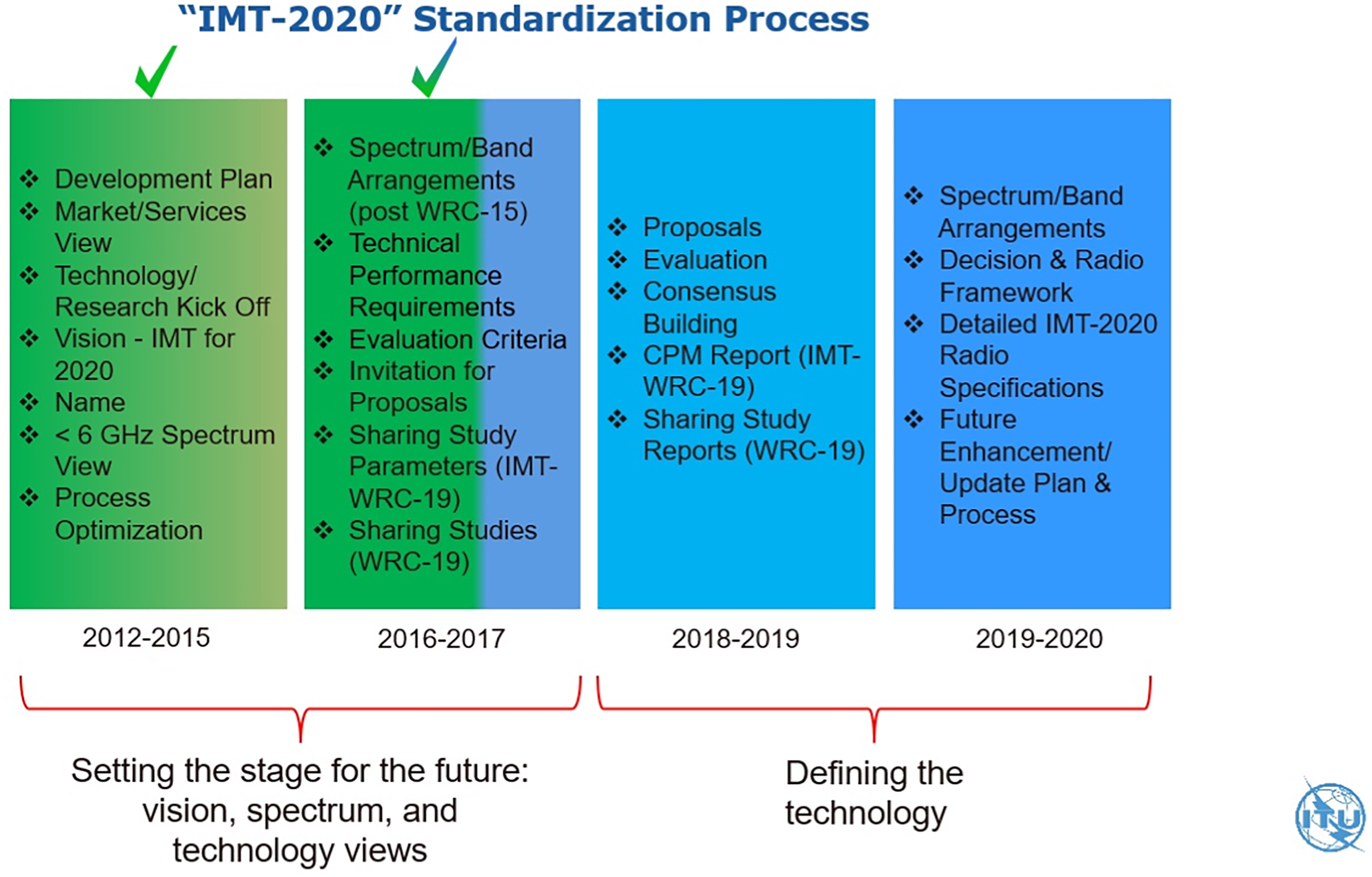
This diagram from the ITU illustrates the specific processes that determine how international mobile telecommunications standards are set. In the case of 5G, this involved “setting the stage for the future” through the 2015 release of the ITU-R's IMT Vision—Framework and overall objectives of the future development of IMT for 2020 and beyond. From here, the minimum performance requirements needed to enact the IMT vision are established before standards bodies develop candidate technologies that are tested in trials before being formally approved as meeting “the standard.” Source: ITU-R (2017).
After the vision for 5G and the minimum requirements required to fulfill this vision were released, the ITU-R invited submissions for radio access technologies (RATs) that met these requirements. In this phase, the 3GPP played a key role, submitting its proposals for RATs—the underlying physical connection method for a radio-based communication network—to the ITU-R. Again, this process followed a familiar timeline, which was grafted onto the timeline for the release of the standard by the ITU-R (see Figure 2). The work of the two bodies was therefore complementary. 3GPP organized its output around a series of “releases.” These releases incorporated hundreds of individual standard documents that underwent a continuous state of revision until they were “frozen.” At this point, functions were deemed “stable,” and no additional functions could be added (Curwen & Whalley, 2021). 5G standards were developed over five consecutive 3GPP releases:
Release 14 in 2017 set the groundwork for and heralded the “start of 5G standardization” (Parkvall, 2015). Release 15 in 2018, defined the first phase of the “5GS”—“the 5G System” (3GPP, 2023g)—“the first full set of 5G standards” (3GPP, 2023f) in preparation for the launch of 5G in 2019. Release 16 in 2020 made improvements to the 5GS and established it as “a communication-enabling platform suitable for a wide range of industries” or “verticals” (3GPP, 2023g). Here the 3GPP begins to realize the “full 5G vision.” Release 17 in 2022 consolidated and enhanced functionalities introduced in previous releases (3GPP, 2023g). Release 18, since designated by the 3GPP as a 5G-related (and still open) release, represents the first step in the development of “5G-Advanced” (3GPP, 2023h), promising “enhanced capabilities” (including integration of artificial intelligence and machine learning capacities) claimed to enable “a wider set” of emergent enterprise use cases (Nokia, 2023).
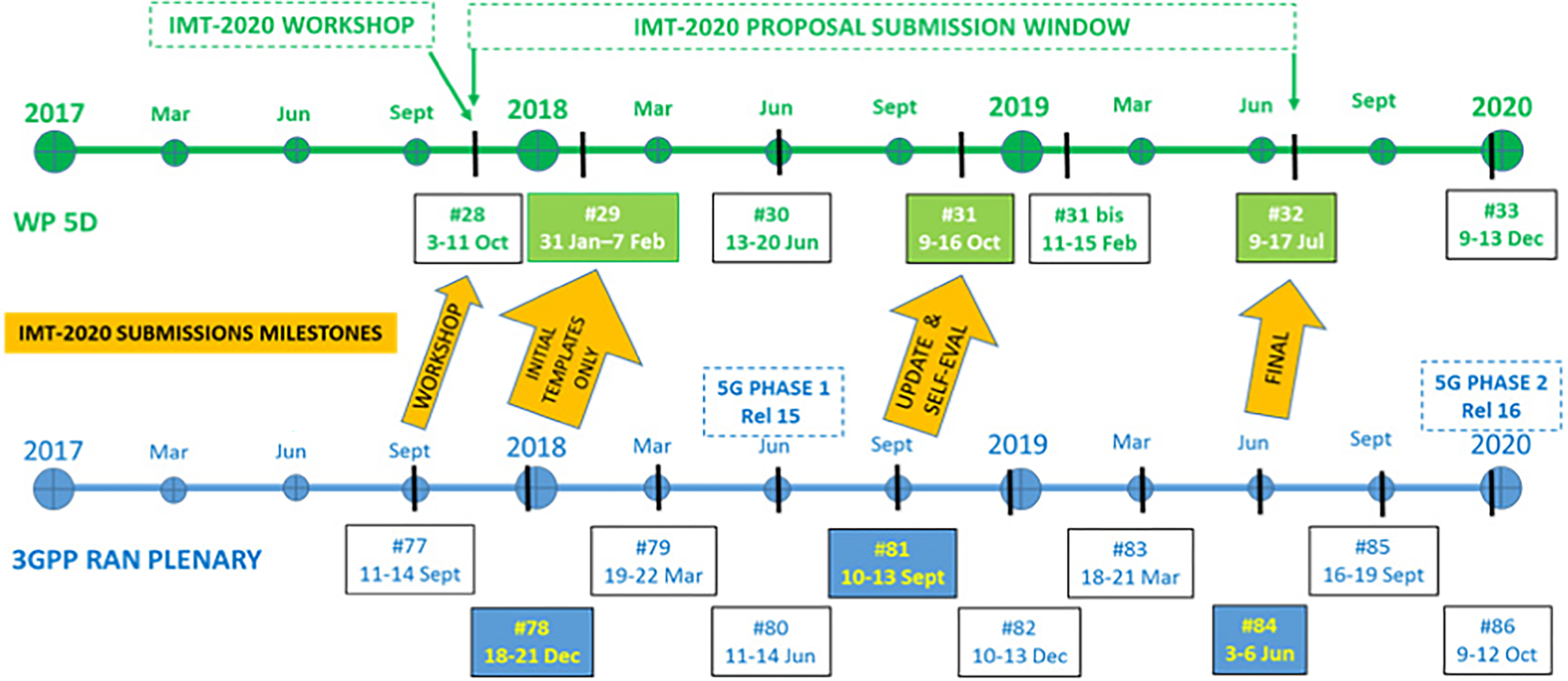
This set of timelines illustrates the complementary work of the ITU-R (through its Working Party 5D [WP 5D]) and the 3GPP, an international consortium of seven telecommunications standards bodies, in the standard setting process. The timeline on the bottom shows the plan for 3GPP to submit candidate technologies to be evaluated by the WP 5D against IMT-2020 requirements. The path of technological development is organized around a series of 3GPP “Releases,” which incorporate hundreds of individual standards documents that specify the new radio technologies used in 5G-compliant devices, networks, and services. Source: 3GPP (2023g).
Figure 2 illustrates the close relationship between WP 5D's work (organized around meetings) and that of the 3GPP, as the latter developed the core technologies that met the requirements set by the former.
IMT-2020: a vision for IMT in “2020 and beyond”
How were particular visions of 5G realized through the process described above? In 2011, the WP 5D held a series of workshops on IMT for the next decade. The workshops related to “refreshing the vision and market forecasts for IMT,” developed in 2003 and 2005, and on “assessing [the] future needs of mobile broadband wireless to be supported by IMT” for 2012–2022 (Rancy, 2011). The invitation to participants welcomed the views of industry, “the ITU membership, application developers, end-users, industry forecasters, academic and research institutions and visionaries” (Rancy, 2011, p. 1). Themes to be discussed in the workshops included changing user behavior, a “futuristic view” of services and products, the types of devices and applications fueling growing demands on mobile broadband wireless, and—crucially—how the IMT can accommodate and facilitate the growth over the next decade. On the back of these workshops, the ITU-R released its Assessment of the global mobile broadband deployments and forecasts for International Mobile Telecommunications, which reviews market and traffic forecasts and trends and assesses “current perspectives and future needs of mobile broadband that would be supported by IMT over the next decade (2012–2022)” (ITU-R, 2011, p. 3).
This forecasting work by the ITU-R saw previous predictions amended, considering a large growth in the data traffic driven by smartphone use. Other future requirements are assessed through scenario planning. As Selin (2008, p. 1888) notes, these “future-oriented inquiries inevitably have a normative angle of projecting desirable (or undesirable) futures and thus are practices that both deconstruct and construct futures.” Previous developments are reassessed and made to relate to desirable futures. For example, generations of mobile standards development were put on a timeline moving from 1G (“the foundation of mobile telephony”), 2G (“mobile telephony for everyone”), 3G (“the foundation of mobile broadband”), 4G (“mobile broadband for everyone”), and then 5G (“the networked society”) (Skold, 2014). This final stage, according to a presentation by an industry representative from Ericsson, would see “unlimited access to information and sharing of data available anywhere and anything to anyone” and “making the extremes possible,” including “extreme user data-rates, extreme capacity and density, extreme mobility, extreme energy efficiency, extreme number of devices, extreme reliability, extremely low latency [and] extreme bandwidth” (Skold, 2014).
The critical question, though, is where these visions come from. The 5G standardization process brings together a range of actors, each bringing specific priorities, resources, and influence that seek to orient standardization toward their own geopolitical and commercial interests (Becker et al., 2024). For example, major telecommunications operators and equipment manufacturers such as Huawei, Ericsson, Nokia, Samsung, and Qualcomm invest heavily in research and development for 5G technologies and have a vested interest in shaping standards that align with their proprietary technologies and market strategies. Meanwhile, national governments actively participate in the standardization process to not only promote their national industries but to ensure that the resultant standards accommodate their own objectives and orientations, such as economic competitiveness, national security, and technological sovereignty (Becker et al., 2024). It is also worth considering who is less represented in the process, such as everyday users or civil society organizations (ten Oever, 2023). The distinctive constellation of actors involved in the setting of 5G standards influences the anticipated use cases that technological development is oriented toward, thereby shaping key technological features.
In the imaginary of 5G, three anticipated use cases have emerged: “enhanced mobile broadband” (eMBB), “massive machine type communications” (mMTC), and “ultra-reliable and low latency communication” (URLLC) (see Figure 3). Their roots are in the ITU-R's vision for IMT in 2020 and beyond (ITU-R, 2015). These visions are authoritative in that they are featured in industry reports, cited in academic papers, have been presented in conferences and meetings, and adopted by influential global organizations (e.g., Deloitte Access Economics, 2017, p. 12; Department of Communications and the Arts (Australia), 2017, p. 5; Information Technology Industry Council (ITI), 2020, p. 14; OECD, 2019, p. 12; Samsung & Tech Research Asia, 2019, p. 14).2 These imaginaries, framed as usage scenarios, are described in ITU-R's M.2083-0 (IMT Vision—Framework and overall objectives of the future development of IMT for 2020 and beyond) and establish the path of technological 5G development that has followed.
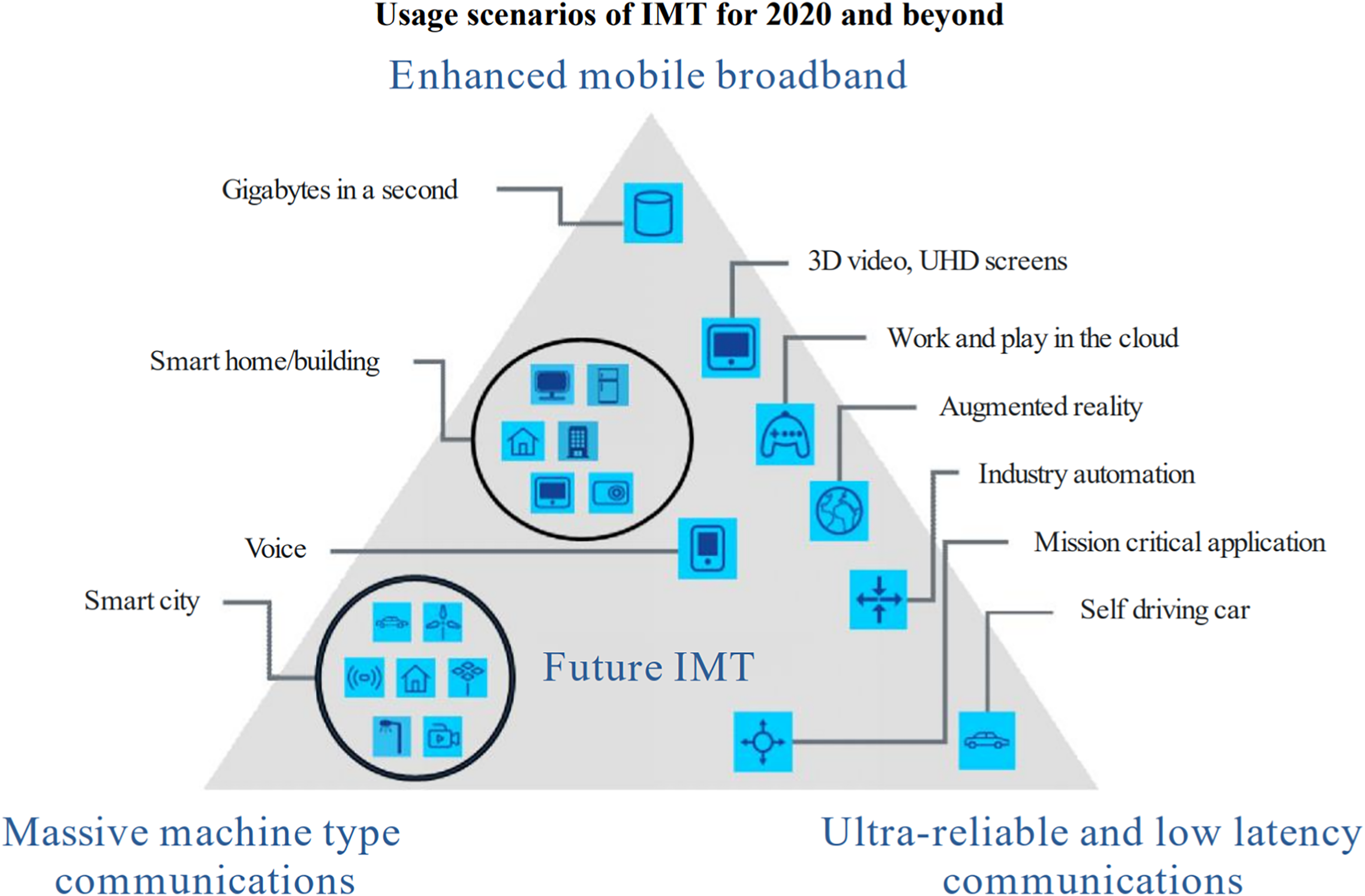
An illustration of “envisaged usage scenarios for IMT for 2020 and beyond” from the ITU-R's IMT Vision—Framework and overall objectives of the future development of IMT for 2020 and beyond. “Enhanced mobile broadband” is seen as evolutionary, whereas “ultra-reliable and low latency communications” and “massive machine type communications” are seen as enabling the “future development of new applications” that rely on “machine-to-machine communication,” such as “[d]riverless cars, enhanced mobile cloud services, real-time traffic control optimization, emergency and disaster response, smart grid, e-health.” Source: ITU-R (2015, p. 4).
eMBB underpins what Cave calls a “qualified” version of 5G: basically, a faster and more efficient version of 4G, or 4G-LTE (Cave, 2018, p. 655). This functionality is enabled by non-standalone 5G and implemented with software upgrades to existing 4G networks. In this “evolutionary” scenario, 5G is envisaged as a linear progression from previous generations, optimizing existing investments to enhance network capacity and speed within the confines of current market structures. This path would see incumbent mobile operators as “leading players” that pursue a path of relatively stable and predictable changes to existing services (Lemstra, 2018, p. 601).
mMTC and URLLC underpin a more “expansive” or “disruptive” vision of 5G (Boccardi et al., 2014; Cave, 2018, p. 655)—what is referred to in technical literature as the “full 5G vision” (Bertenyi, 2021; Frankston, 2019), which requires standalone 5G. This vision would see: [The] move to millimeter wave (mmWave) spectrum, new market-driven ways of allocating and re-allocating bandwidth, a major ongoing virtualization in the core network that might progressively spread to the edges, the possibility of an “Internet of Things” comprised of billions of miscellaneous devices, and the increasing integration of past and current cellular and Wi-Fi standards to provide a ubiquitous high-rate, low-latency experience for network users (Andrews et al., 2014, p. 1065).
In this “revolutionary” scenario, 5G is seen as unlocking new business opportunities through network virtualization, where specialized services are offered to specific industries (“verticals”) or economic sectors. As Lemstra (2018) notes, the revolutionary scenario would see many industry-specific markets emerge and the present dominance of the consumer market reduced to just one of many such “verticals.” These two outlooks, particularly the more expansive vision, play a key role in the imaginary of 5G. What is being put forward here is the idea of a “connected society,” where “every object that can benefit from being connected will be connected through wired or wireless internet technologies” (ITU-R, 2015, pp. 4–5). Technology is at the center of this vision, describing a future where communication is increasingly “machine-centric” (ITU-R, 2015, p. 4). Accordingly, “IMT-2020 will realize the Internet of Things by connecting a vast range of smart appliances, machines and other objects without human intervention” (ITU-R, 2015, p. 13). Crucially, these visions frame the path of technological development to come, setting forth ideas of what mobile media and communication and associated infrastructure could and should be.
Yet, as 5G starts to be rolled out globally, these visions of dense networks of connected devices seamlessly underpinning economic and social life are complicated by continuing and compounding global and local inequalities. As Goggin and Villanueva-Mansilla (2024, p. 39) note in their account of 5G in Indonesia and Peru, “the dominant ways in which 5G has been imagined, planned, and deployed have been significantly shaped by interests and geopolitical forces that exclude many countries, and many of the putative beneficiaries of the emergent technology.” While policies that underpin advances in telecommunications infrastructure are “premised on a shared interest and shared benefits … the outcomes are remote for the majority of citizens, especially in ways that matter for daily lives” (Goggin & Villanueva-Mansilla, 2024, p. 39). This pattern is being revealed in a range of contexts (Featherstone et al., 2024; Horst & Foster, 2024), illustrating how sociotechnical imaginaries associated with 5G, such as those espoused by the ITU-R, are complicated, contested, and undermined as developments in mobile technologies are implemented unevenly and take hold in distinctive ways, just as they have for previous generations of mobile standards and mobile technologies (Wilken et al., 2019).
However, as ITU-R's visions for “the future development of IMT for 2020 and beyond” become realized through the latter stages of the standard setting process, they do play a significant role in framing the development of key 5G technologies. To illustrate how these visions are concretized, we next examine a series of “description and summary of work items” documents produced by the 3GPP. These documents provide digestible overviews for non-specialists of the contents of 3GPP releases once they are frozen. We examined these documents for each of the 3GPP's 5G-related releases to trace the development of one core technology that is central to the “full 5G vision”: network slicing. Network slicing technology holds special significance and warrants examination for several reasons: it has the potential to dramatically reshape how mobile network access is managed; it has implications for bandwidth and spectrum allocation; and it poses important questions for network provision and telecommunications policy more broadly (such as whether 5G, and future mobile generations, will be developed principally as enterprise services, and the implications for consumers).
Enacting 5G visions: 3GPP releases and the development of network slicing
One of the innovations of 5G is that providers can offer “private networks” or “slice” up their network. The former is a self-contained network with its own spectrum (Jansons, 2022). The latter uses network virtualization to “slice” a network connection into multiple distinct “virtual connections” that each provide distinct resources to different types of traffic. Network slicing allows providers to set aside segments of their networks for specific use cases, such as autonomous vehicles or automated machines supporting “smart” agriculture (SDxCentral Studios, 2018).
While the concept of network slicing has been around since at least the late 1960s (Afolabi et al., 2018), it has come to form a central component of the technical visions for 5G. The idea of applying slicing to 5G networks was introduced by the Next Generation Mobile Network, a “Market Representation Partner” of the 3GPP (3GPP, 2023e), in a white paper on possible enterprise applications of 5G (Afolabi et al., 2018).
The incorporation of network slicing into 3GPP workflows began with Release 15, where it is described as “a major characteristic of the 5G system” (3GPP, 2023g). In the summary of this release (3GPP, 2023g), it is noted that there are to be “three types of predefined slices” built into the 5G architecture: one dedicated to supporting eMBB; one associated with URLLC, such as would be required for remote diagnosis/surgery, emergency response, or autonomous vehicles; and one to support large-scale Internet of Things initiatives, known as mMTC or “massive IoT” (MIoT), aligning with the 5G vision put forth in IMT-2020 (Trivisonno et al., 2018).
The network slicing related work items contained in Release 16 undertake two core tasks: addressing technical system improvements (providing “network slicing interworking support”); and incorporating features that facilitate network slice specific authentication and authorization processes (3GPP, 2023g). This tranche of work is summarized as “enhancements to meet demand from verticals [new industries and markets]” (3GPP, 2023d). Only through these enhancements will 5G be able to move beyond eMBB to establish use cases central to the “full vision” of 5G inscribed by the ITU-R, specifically in supporting use cases associated with and requiring mMTC and URLLC.
Release 17 contains technical enhancements that seek to sharpen the functioning of network slicing (such as controlling the data rates for each slice) (3GPP, 2023g), and introduces a series of strengthened security measures (3GPP, 2023d). This package of work also incorporates several technical studies, including one, led by staff from US-based Matrixx Software, on how best to manage network slicing charging (monetization) (Matrixx Software, n.d.; 3GPP, 2023b, 2022b, 2023g). This would allow multiple tiers of 5G service to be established and marketed by telecommunications companies, enabling them to advance their interests through the standardization of infrastructural forms. Finally, the work package for the still “open” Release 18 contains a report from a study entitled “Study on Enhanced Access to and Support of Network Slice” (3GPP, 2023g) that aims to examine “various use cases and scenarios using network slices, in order to identify potential service requirements for the 5G system,” that the 3GPP can then address (3GPP, 2023g).
Here we have isolated a specific technical component of the 5G system—network slicing—and traced how it has been developed over the course of 3GPP Releases 15–18 (see 3GPP, 2023a, for a more comprehensive summary). While network slicing is one of many network technologies addressed in these releases—and necessarily so given that standards are “nested inside one another” (Bowker & Star, 1999, p. 14) —the 3GPP (2022a) does single it out as a technology that is central to their implementation of 5G systems that fulfill visions laid out in IMT-2020 and promoted by the ITU-R. This examination of network slicing is valuable in that it draws out how telecommunications standard setting processes set out to realize and concretize a certain vision of “the networked society” (Skold, 2014), where ever more aspects of life involve networked devices. 3GPP mobilized around the idea that it is only through features such as enhancement to network slicing that 5G will move from being “evolutionary” to “revolutionary”—that is, the “full 5G vision” put forth in the IMT vision for 2020 and beyond (Bertenyi, 2021; Cave, 2018).
This move toward the “full 5G vision” set out by the IMT is an iterative process, with the introduction of the standard followed by enhancements to the standard. Both these processes (vision and technical realization) work in tandem to frame the path of technological development to come, and subsequently shape possible or likely futures for mobile media and communication technologies and their use. What becomes clearer, for instance, from looking at network slicing is what this network technology is likely to make possible and who it is likely to serve. The technical work undertaken to incorporate slicing capabilities within 5GS is evidently geared toward, and proceeds principally in response to (as well as anticipating), industry demand rather than consumer need. Yet, with 5G largely promoted to consumers as an enhanced mobile data service in line with the “evolutionary” vision, more work needs to be done to examine how 5G is being adopted and whether new use cases are emerging that complicate the visions put forward by standards bodies, telecommunications companies, and state actors.
Conclusion
This article has highlighted the critical role of standard setting in shaping the future of mobile communications, focusing on how ITU's vision for 5G has been realized through the efforts of the 3GPP consortium. Our investigation of 5G standard setting carries two significant implications for the field of mobile media and communication. First, we issue a (renewed) call for mobile media and communication scholars to be more sensitive to the processes in which values and aspirations are inscribed in technology, of which standardization is a key example. This is particularly critical given that standards have the potential to redefine the parameters of mobile media and communication. We have shown how the setting of IMT standards followed a clear four-part, decade-long process that first involved establishing a vision of what IMT should be in the long term. This vision operated as a platform for action, helping to establish the minimum technological requirements needed to enact this vision. From here, standards bodies (dominated by the 3GPP, from 3G onwards) submitted proposals for candidate technologies that were evaluated against the IMT-2020 requirements. These technologies were crucial to enabling the dominant usage scenarios put forth in the vision to be realized. With the ITU having adopted the “IMT-2030 Framework” (ITU-R, 2023), which frames the development of what will eventually become “6G,” mobile media and communication scholars would do well to pay close attention to this standardization process, as these processes can help establish the parameters of what mobile media and communication could and should be and for whom.
Second, we examined dominant visions for 5G inscribed by the ITU-R in their vision for IMT in the year 2020 and beyond, and how these visions frame technological development. Three usage scenarios—eMBB, mMTC, and URLLC—have become influential visions of what mobile communications should be in 2020 and beyond. To understand the origins of visions of dense networks of connected devices seamlessly enabling unforeseen applications, we should not limit our focus to media portrayals or advertisements (Campbell et al., 2021; Mansell & Plantin, 2020). We should also consider the role of the standardization process itself. This process gives these visions authority in two distinct but interrelated ways. First, through the take-up and dissemination of vision documents, which are regularly featured in industry reports, cited in academic papers, presented in conferences and meetings, and adopted by influential global organizations. Second, through the setting of standards, where the work undertaken by the 3GPP, and captured in their various releases, shapes future visions, possibilities, and scenarios of technology use. Framing the development of the technologies that underpin and help define 5G are sociotechnical imaginaries—presumptions and predictions of the future that influential actors seek to inscribe in the telecommunications networks, services, and devices—that are shaped by commercial and political interests.
Finally, as mentioned earlier, the visions discussed in this article are not the only sociotechnical imaginaries associated with 5G. As 5G is deployed, it evokes different imaginaries according to local cultures and politics. Indeed, the vast array of imaginaries that the deployment of mobile telecommunications can evoke illustrates the inherently “multiple” and “contested” nature of sociotechnical imaginaries (Mager & Katzenbach, 2021)—from 5G's association with conspiracy theories (Meese et al., 2020), to its role in provoking debates over what role local governments should play in regulating the telecommunications infrastructure (Ali, 2024; Meese et al., forthcoming) and social and economic priorities in developing economies (Goggin & Villanueva-Mansilla, 2024; Horst & Foster, 2024). These examples illustrate the potency of 5G to evoke contestation among actors with diverse (and often divergent) ideas of what role telecommunications could or should play in a variety of local settings and who controls the infrastructures upon which communications depend. Paying greater attention to these imaginaries will be critical as 5G becomes entangled in new settings beyond the key actors involved in standardization. Therefore, while visions of dense networks of connected devices are not the only imaginaries associated with 5G, they are the ones that frame the development of the core technologies that underpin telecommunications, and thus demand our attention.
Footnotes
Declaration of conflicting interests
The authors declared no potential conflicts of interest with respect to the research, authorship, and/or publication of this article.
Funding
This work was supported by the Australian Research Council Discovery Grant (grant no. DP210100386).

Notes
Author Biographies
Kieran Hegarty is a research fellow in the ARC Centre of Excellence for Automated Decision-Making & Society (ADM+S) at RMIT University.
Rowan Wilken is an associate professor in the School of Media and Communication at RMIT University and an Associate Investigator in the ADM+S.
James Meese is an associate professor in the School of Media and Communication at RMIT University and an associate investigator in the ADM+S.
Catherine Middleton is a professor and the director of the Ted Rogers School of Information Technology Management at Toronto Metropolitan University.