



Abstract
This article explores the ways in which 5G networks are imagined in the Pacific Islands nations of Fiji and Papua New Guinea. What promises, anxieties and futures have the prospects of 5G provoked, and for whom in particular? To answer this question, we consider how current mobile network users, corporate techno-elites and state actors such as regulators and politicians imagine 5G futures. We argue that 5G deployment is challenged by the cosmological orientations of those who do not share the vision of a modern, secular state driven by economic development. In addition, any attempt by national governments and mobile network operators to build the infrastructure necessary for 5G are subject to the geopolitics of China and the US and its allies. Reflecting upon the tensions between cosmopolitics and geopolitics, this article demonstrates how both sociocultural and political economic forces have come together to frame digital imaginations of 5G networks.
Introduction
In a suggestive article based on ethnographic research in rural China and Myanmar, one of the last countries to open its telecommunications sector to competition, Elisa Oreglia and Richard Ling (2018) ask how people imagine mobile phones before they actually have access to them. They propose the concept of the ‘digital imagination’ to capture the ways in which non-techno-elites anticipate the potentials and limitations of a technology that is not yet part of the lives of users. They further argue that the digital imagination is: “shaped by aspirations, the organisation of the society in which people live (e.g., families, social networks, institutions), and by depictions of digital media in the surrounding environment. Individuals draw on their personal and social understandings to imagine how digital technologies can be made part of their lives, and such imaginings are shared with or challenged by the views of others in their communities”. (2018: 575)
In this article, we take up the idea of a digital imagination in relation to 5G networks that are anticipated but do not yet exist in two Pacific Islands nations, Fiji and Papua New Guinea (PNG). Following Oreglia and Ling (2018), we ask how current users of digital technologies in Fiji and PNG, often affluent and well educated, imagine 5G before it has been launched. What promises, anxieties and futures have the prospects of 5G provoked, and for whom in particular? Moreover, how do we conceptualise the relationship between the technological specificity of 5G and the sociocultural attitudes of diverse current and potential users towards new technologies such as 5G?
Unlike Oregilia and Ling (2018), however, we do not restrict our discussion to the digital imaginations of marginalised not-yet users and non-techno-elites. Instead, we also attend to the ways in which both corporate techno-elites and state actors such as regulators and politicians are imagining a 5G future. In this regard, we join a larger conversation among media and communication researchers about how the ‘social imaginary’ (Taylor, 2002) of 5G is being shaped in places such as China, the US and the EU before 5G is widely available (Campbell et al., 2021; Mansell and Plantin, 2022). These scholars have rightly emphasised how the social imaginary of 5G – what philosopher Charles Taylor (2002:106) defines as ‘that common understanding that makes possible common practices and a widely shared sense of legitimacy’ – is disproportionately shaped through corporate advertising (Campbell et al., 2021) and government and industry reports (Mansell and Plantin, 2022). Mansell and Plantin (2022:4834) have thus identified a ‘dominant social imaginary of digital innovation’ that is informed by neoliberal values and connects the value of 5G with economic growth in a competitive digital marketplace. This dominant social imaginary elevates commercial values over public values and minimises potential risks to citizens’ rights to privacy and freedom from surveillance.
In order to understand how the digital imagination of 5G is taking shape in Fiji and PNG, we draw upon long-term ethnographic and archival research on the moral economy of mobile phones (see Foster and Horst, 2018; Foster, In press). Our initial ‘on the ground’ fieldwork regarding the changing telecommunications landscape took place between 2014 and 2018 in urban Papua New Guinea (Port Moresby and Goroka) and between 2016 and 2019 in urban Fiji (Suva); Horst also returned to Fiji in 2022 and 2023. During this period, we interviewed company representatives (including CEOs, marketing managers, legal officers, and Corporate Social Responsibility (CSR) specialists), government officials, state regulators, and a range of ‘everyday’ users about mobile phone practices and perceptions. Over the course of interviews and fieldwork, we documented early discussions of 5G's development and associated infrastructures. The emergence of COVID-19 in early 2020 and attendant border closures meant that fieldwork in country was no longer possible. However, we monitored talk about 5G and changing views of 5G, especially in response to the pandemic, through online sites such as Facebook. Whilst this was very much an ongoing live discussion as we stayed in touch with friends, colleagues, and research participants, for the purposes of this article we ground our insights in material from social media sites, newspaper articles and published reports. In this sense, our study did not begin online with fixed start and end dates; instead, it reflects the continuity and contingency common in many approaches to long-term ethnographic research in anthropology and digital ethnography (Halstead et al., 2008; Pink et al., 2016).
Throughout this article we demonstrate how the moral economy of mobile phones implies a field of shifting relations among consumers, companies and state agents, all of whom have their own ideas about what is good, proper and just. These ideas inform the ways in which, for example: consumers acquire and use mobile phones; companies market and price services; and state agents regulate both the everyday use of mobile phones and the market activity of licensed competitors. Ambiguity, disagreement and ongoing negotiation about who owes what to whom are thus integral features of the moral economy of mobile phones. Accordingly, our goal in this article is to offer a broad sense of how consumers, companies and state agents have addressed and responded to each other regarding the matter of 5G. We aim to demonstrate how concerns about a connection between 5G and COVID-19 generated alternative narratives to the dominant social imaginary that construes 5G as a positive sign and necessary instrument of progress and modernity.
We begin by outlining the actual state of mobile coverage in each country and the anticipation of 5G on the part of government and corporate officials just before the outbreak of COVID-19 in early 2020. We use representative media accounts from newspapers and social media posts to illustrate how a range of actors thought differently about 5G and reacted to each other's concerns and provocations. Our general goal here is to trace the contours of an emergent and unstable social imaginary in which no ‘widely shared sense of legitimacy’ has been settled once and for all. More specifically, we consider how what we term ‘cosmopolitics’ and ‘geopolitics’ have shaped this imaginary. For instance, we chronicle conspiratorial concerns and anxieties about the health consequences of 5G towers and associated infrastructures expressed on social media during the COVID-19 pandemic in 2020. We also document subsequent responses by both telecommunications companies such as Vodafone in Fiji and national regulators such as the National Information and Communication Technology Authority (NICTA) in PNG who sought to debunk what was viewed as troublesome ‘misinformation’. We then shift to a consideration of the role that ‘geopolitics’ played in this moment in order to demonstrate how the future of 5G in Fiji and PNG was further being conditioned by the digital imaginations of both subnational and extranational actors. For example, the prominence of Chinese-owned company Huawei Marine (now HMN Tech) in the construction of 5G infrastructure spurred interventions by the national governments of Australia and the US to mitigate perceived security risks to global telecommunications networks (Burkitt-Gray, 2020).
In short, we aim to show how competing digital imaginations of 5G are co-produced by state agents, corporate actors, citizens and consumers all entangled within a moral economy of mobile phones (see Mukherjee, 2018). Specifically, we contend that the deployment of 5G technologies is challenged by cosmologies that do not share the assumptions of corporate techno-elites and the vision of a modern, secular state driven by economic development. By the same token, we argue that the attempts of national governments and mobile network operators to build the infrastructure necessary for 5G are subject to the strategies and contingencies of a new cold war between China and the US and its allies. We conclude by reflecting upon the ways in which both sociocultural and political economic forces come together to frame and reframe the digital imagination of 5G.
Actual mobile coverage in PNG and Fiji: from promise to pandemic interruptus
As two of the largest countries by population in the South Pacific, Fiji and PNG are important examples of the wide spectrum of mobile communication across the region. Both countries experienced liberalisation of their telecommunications sectors in the mid noughties which resulted in the entrée of global telecommunications company Digicel Group Ltd (Foster and Horst, 2018). Liberalisation reduced the cost of mobile handsets and pre-paid airtime and increased the number of mobile towers in each country. Yet, the similarities in the stories of Fiji and PNG end there due to a range of factors, including a major difference in population distribution between urban and rural areas. Perhaps most significantly, substantively different economic conditions and distinctive regulatory environments shaped the availability and affordability of mobile communications services in each country.
To illustrate some of these differences, we begin with Fiji, a country with a relatively small population of 900,000 of which about half of whom live in the urban centres on the main island of Viti Levu. According to the Group Speciale Mobile Association (GSMA) (2019), Fiji had 770,000 unique subscribers and over 1.2 million connections for a population of 900,000, with 75% of these connections being through smartphones. The vast majority of subscriptions are pre-paid and are spread between two companies: the locally owned Vodafone Fiji (and their more affordable subsidiary Innk Mobile) and Digicel Fiji, Ltd By the end of 2019 Vodafone commanded approximately 78% of the mobile market whereas the foreign owned Digicel claimed around 32%. Moreover, Vodafone provided 3G coverage for 95% of Fijians, while 4G coverage extended to almost every major city and town on both Viti Levu and Vanua Levu. Vodafone committed to further investment in Long-Term Evolution (LTE), LTE-A and fibre technologies in 2019, upgrading over 100 towers to 4G to meet the exponential growth in demand for data by consumers using platforms such as Facebook, Instagram, YouTube, WhatsApp and other social media. Coupled with a smartphone adoption rate of 43%, Fiji boasted the highest mobile penetration rate across the Pacific – 84%. Actual mobile penetration rates continue to be uneven throughout the country as most connections are based in urban areas and 2G connectivity continues to dominate rural areas (GSMA, 2019; Silaitoga, 2021).
In contrast to Fiji, PNG commands a much smaller market penetration rate of almost 30% in a population estimated at 7.6 million. According to a 2019 GSMA report (Highet et al., 2019) on the role of mobile technology in PNG, there were 2,525,643 unique subscribers. Almost one million mobile internet unique subscribers yielded a market penetration rate of 11.75%, but the majority of connections by mobile technology were 2G (55.54%), with 3G connections at 22.91% and 4G connections at 21.55%. In other words, the majority of the population was not connected and those with connections only had access to 2G. Highet et al. (2019) put the number of smartphones in 2018 at 600,000, with 22% of connections by smartphone. These statistics reflect a digital divide between urban and rural areas and between data users and voice users; 70% of Internet users reside in the two major cities of Port Moresby and Lae (Highet et al., 2019:24).
Despite these differing conditions, government and corporate officials in both countries approached the possibility of 5G with enthusiasm. In Fiji, for example, landline-dominant Telecom Fiji switched on its 4G/LTE network in 2016. In 2019 Vodafone increased its base stations from 390 to over 600, most of which provided 4G + coverage (Operator Watch Blog, 2022). Indeed, Vodafone argued that their network was ‘ready and waiting’ for the 5G revolution. In addition, Digicel added capacity to the LTE network and upgraded cell sites in main urban centres such as Suva, Nausori, Nadi and Lautoka to 4.5G LTE-Advanced Pro technology (Pre-5G) in 2019. Even during the early days of the pandemic Digicel upgraded its network, adding more capacity in maritime areas and other regions where there was an increased demand for data usage and announced that the company was working to provide LTE/4G in remote areas of Fiji such as the Lau Group, Koro Island, Taveuni and Vanua Levu.
In PNG, the dominant carrier Digicel PNG (with over 90% of the mobile market) planned to cover 80% of the population with 3G and upgrade 173 towers from 3G to 4G. bmobile, a state-owned entity that competes respectably with Digicel in urban areas, aimed to command 20% of the 4G market by 2019, a goal aided by absorbing the 4G services and some 400 base stations in which Telikom PNG, the state-owned provider of fixed-line services, had invested when migrating its short-lived and unsuccessful CDMA Citifon service between 2011 and 2016 (Oxford Business Group, 2019). Plans for 5G trials were also announced at the end of 2019 (e.g. Luma, 2019), with the PNG communication minister claiming ‘From an economic perspective, it is estimated that the introduction of 5G, if rolled out appropriately, will boost domestic mobile technology and services with a potential of contributing an additional 4% to 6% GDP’ (Comms Update, 2019). However, much of this hopeful activity came to a halt when the COVID-19 pandemic began. In April 2020, Fiji's former Prime Minister Vorque ‘Frank’ Bainimarama declared COVID-19 a national disaster and similar declarations were made in PNG. This circumstance, coupled with broader concerns about the cause and spread of the pandemic discussed in the following section, altered public perceptions and perforce the digital imagination of 5G.
The cosmopolitics of 5G in PNG and Fiji
Like other parts of the world before the pandemic (see Meese et al., 2020), mobile telecommunications companies in Fiji and PNG were preparing themselves to welcome 5G services and towers. Whilst the arrival of the pandemic diverted financial resources available to realise aspirations for the next generation of mobile network technology, there were also other factors that tempered public reception of 5G. Indeed, the future of 5G promoted by mobile network operators in 2019 quickly drew sceptical responses from citizens in both Fiji and PNG, despite large differences in the affordability and availability of mobile phones, smartphones and data. In this section, we focus upon the cosmopolitics of 5G, giving particular attention to the ways in which the proposed plans for 5G rubbed uneasily against diverse cultural understandings and religious worldviews in both PNG and Fiji. In this sense, the cosmopolitics of 5G form part of a broader social imaginary that Taylor (2002: 107) defines as ‘that largely unstructured and inarticulate understanding of our whole situation, within which particular features of our world become evident’.
The entanglement of mobile phones in the cosmological concerns of people across PNG has been noted by several ethnographers. Telban and Vávrová (2014), for example, have described how mobile phones are used to communicate with the deceased in an effort to enlist aid in funnelling material resources to the living. Jorgensen (2018) has described how the presence of cell towers has for one individual prompted fears of surveillance by outside state powers and foreshadowed a coming dystopia of one-world government. Similarly, the digital imagination in PNG has linked 5G with unseen forces and effects that threaten the health and wellbeing of ordinary citizens.
These links were clear in the social media discussions of 5G that occurred in 2020 during the outset of the global COVID-19 pandemic (compare with Bruns et al., 2020). As Figure 1 highlights, these discussions reproduced longstanding anxieties in PNG about vaccinations, such as the concerns that surfaced in the 1990s among Seventh-dayAdventists about polio vaccines that ‘the Sabin vaccine contains a metal labelled “666”, meaning children and their families will be under constant satellite surveillance’ (Stackelroth, 2020). But they also partook of globally circulating claims that 5G caused symptoms of COVID-19 and spread the disease, claims that led to the burning of cell towers in Liverpool and Birmingham (Santariano and Alba, 2020) and surfaced in protests against COVID lockdowns in Melbourne (Meese et al., 2020).
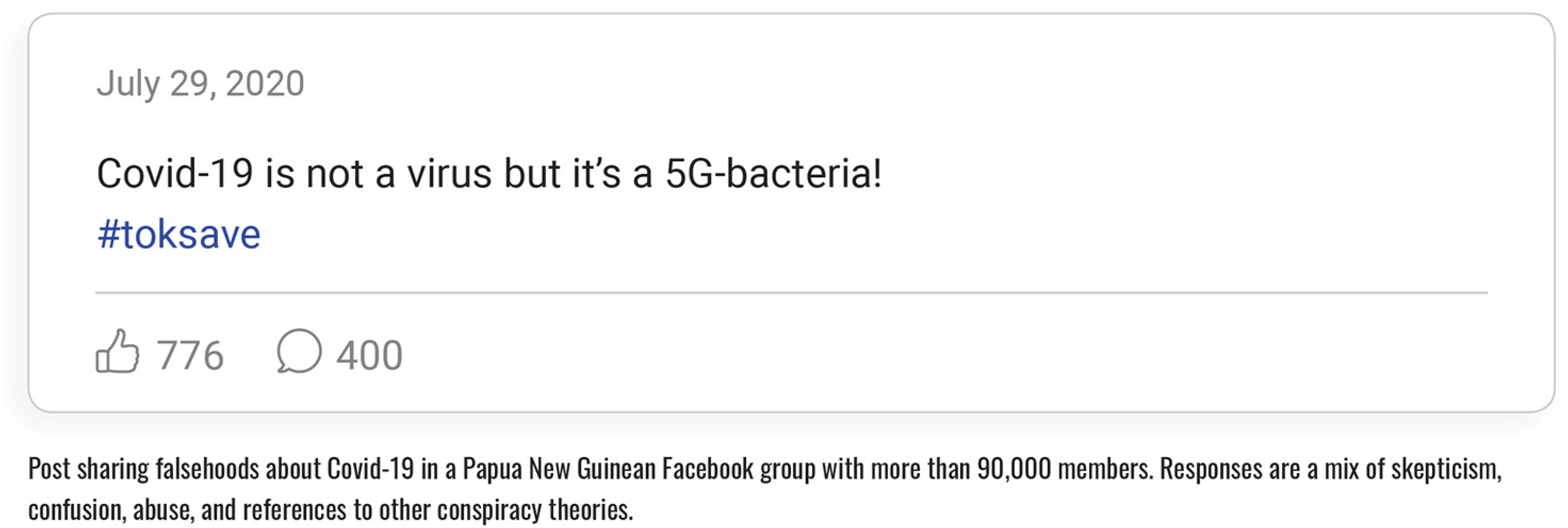
Widespread misconceptions about 5G and COVID prompted the NICTA, the regulator in PNG, to issue a public notice that pointed out that there was no 5G technology deployed in PNG and that vandalising telecommunications equipment was a criminal offence: “We need our telecommunications, including broadcasting services and infrastructure to be secure, fully operational and totally reliable at times like these and to fight Covid-19. For these services and infrastructure to be put at risk because of the circulation of completely irresponsible and false claims is intolerable”. (SOURCE – https://www.nicta.gov.pg/2020/04/gpn-0-21/)
It should be emphasised that many PNG were also actively using social media to dispel misinformation about COVID and 5G (see Dwyer and Minnegal, 2020). For example, the ‘Covid-19 PNG’ Facebook group, with over 16,000 members, officially prohibited conspiracy theories and the moderators attempted to remove false claims about 5G networks (Lokshin, 2020: 23). Nevertheless, the digital imagination in PNG, as elsewhere, is clearly apprehensive about the potential ill health effects of 5G, and this apprehensiveness will shadow any eventual introduction of the new technology.
Like PNG, Fijians expressed a range of responses to the arrival of 5G and the promises that it might deliver to a small island state. Representatives of the major telecommunications programmes were featured in newspapers and other press releases touting the potential of Fiji's participation in cutting edge technologies, such as the internet of things, as well as greater speeds for conducting business and real-time marketing information. Representatives of global agencies such as Satyendra Prasad, Permanent Representative of Fiji to the United Nations, have argued that investment in such technologies would help improve disaster response, medical services, digital identification and a range of other capabilities that countries like Fiji need to develop. Others argued that 5G and associated digital strategies associated with Fiji's Digital Transformation project positioned Fiji as a hub of technology-leadership in the region.
The enthusiasm that company representatives and governments officials expressed about the positive potential of technology and, by extension, the infrastructural commitments to upgrade to 5G, produced counter perspectives. A number of people in Fiji noted the poor quality of the existing digital infrastructure, suggesting that companies like Vodafone and Digicel would be better placed improving their network coverage in remote areas beleaguered by 2G connections – areas that were often left out of this digital future. Others critiqued the cost of upgrading to 5G in a country where basic healthcare or education could be addressed, noting that access to 5G services also required access to 5G devices that were out of the economic reach of most Fijians. The perception that technology was a solution to all social and economic problems was also challenged.
Yet the most vocal and visible adversaries were those that expressed deep reservations about the health implications of 5G. An Asia Foundation report found that the fear of 5G networks exploded in the region in 2020 (Kant et al., 2021). In April 2020, the country saw a notable spike in searches for ‘5G’ and in countries like Fiji a range of anti-5G groups emerged on social media sites. Platforms such as Facebook were used to articulate the perceived harms of 5G. In an article on the use of social media during COVID-19, Kant and Varea (2021:64–65) identify forms of ‘disinformation as shorthand for unreliable information in several forms – all potentially harmful – including false news, click-bait, propaganda, conspiracy theories and unverified rumours’. Many of these concerns coincided with the arrival of the COVID-19 pandemic in Fiji in March 2020.
The apprehension about 5G surfaced in two different but related discourses. First, the introduction of 5G towers were at the front and centre of the anti-5G discourse. In April 2020, images and videos of dead birds in Savusavu (on the second largest island of Vanua Levu) began circulating on anti-5G sites on Facebook and other social media. Coupled with rumours spreading online in Europe in countries such as the Netherlands and the UK, momentum began to grow around the idea that 5G caused the death of the birds and that, in turn, 5G towers also presented a threat to the health of Fijians. Fiji's Department of Environment and Biosecurity Authority of Fiji investigated, and the Minister for Agriculture reported in the media that the cause of death was unrelated to towers; rather, the birds died of ‘blunt trauma’ and not from either the virus or 5G towers (Kant and Varea, 2021; Kant et al., 2021). As public outrage continued to grow, Vodafone's Head of eCommerce & Corporate Affairs Shailendra Prasad made a public statement in May 2020 referring to the WHO's evidence disputing the association between 5G and the COVID-19 pandemic (Rawalai, 2020). He further noted that 5G towers were not responsible precisely because the company had not erected any 5G towers in Fiji (Figure 2).
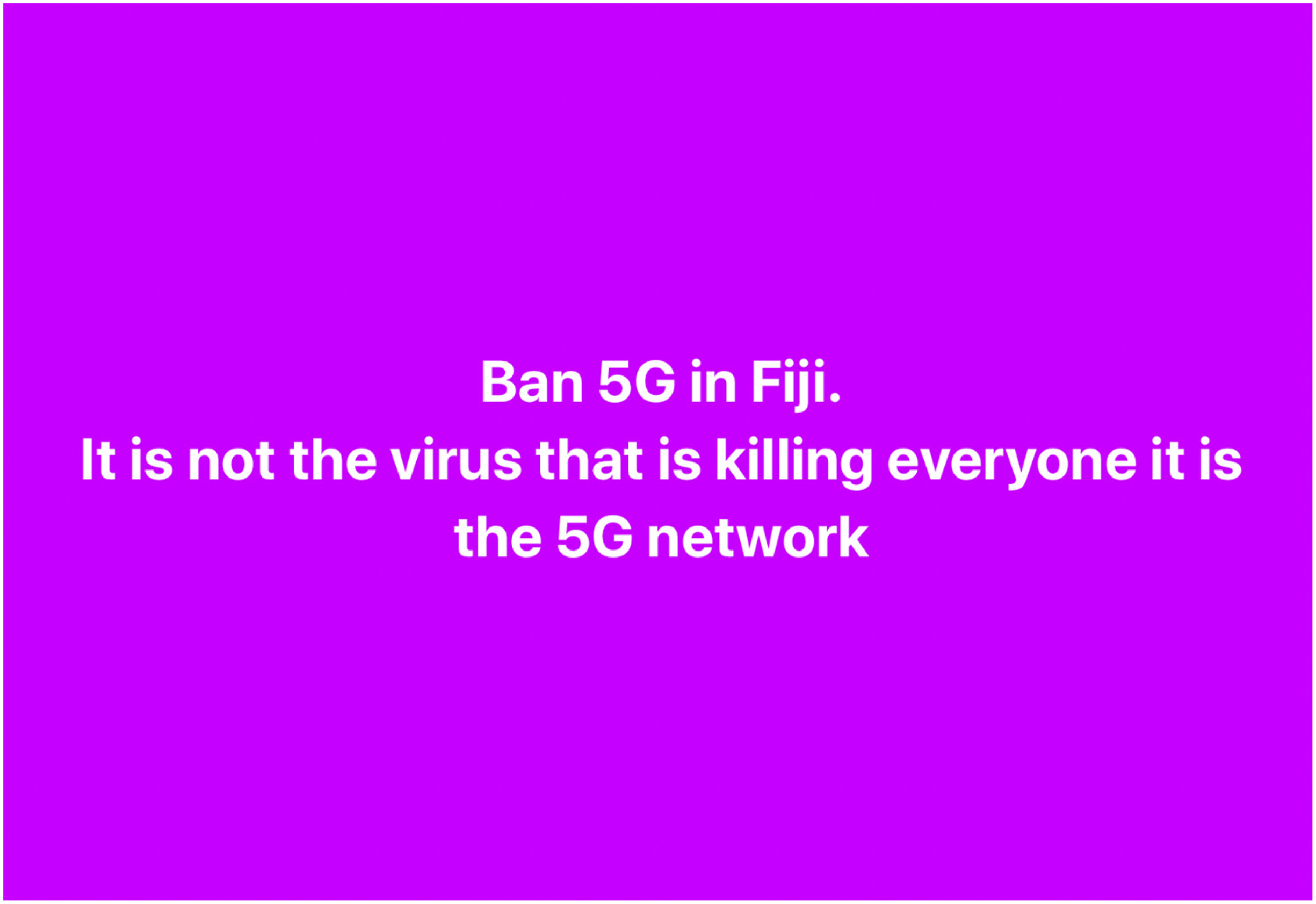
Post in the 5G Facebook group, 6 April 2020 (screenshot by H. Horst, 14 September 2022).
The second discourse was informed by worldviews that drew connections between 5G, the pandemic and a more fundamental religious and political shift. As in PNG, many people in Fiji believed that the pandemic signalled the ‘end of days’ and the coming of the apocalypse. As discussions of researching and disseminating a vaccine gathered momentum, Fijians expressed concerns about the centralisation of the government and the use of the vaccine by entities such as the Freemasons or Illuminati to control the world. Even when the Fijian government issued announcements contesting such perceptions, anti-5G posts highlighted how the government was falling victim to ‘merely another element of a larger conspiracy or as confirmation of their views in the government's ineptitude…[while] around 35 percent of the general community believe that “avoiding mobile phone towers can keep one safe from COVID-19”’ (Kant et al., 2021:78). Although the cosmopolitics of 5G were often dismissed as conspiracy theories or misinformation, they certainly chipped away at the widespread enthusiasm for 5G that existed prior to the arrival of the global pandemic.
The geopolitics of 5G in Fiji and Papua New Guinea
Geopolitical concerns have also shaped the digital imagination regarding 5G and the future of telecommunications in general. By geopolitics we refer to the ways in which the national telecommunication policies of Fiji and PNG are encompassed by broader political agendas. Specifically, China's Belt and Road Initiative has invested in infrastructure in 40 countries to create an overland ‘belt’ of an economic and trade corridor from China to Europe and a maritime road of ports and hubs across the Indo-Pacific. The South Pacific represents the ‘Southern’ leg of the 21st-Century Maritime Silk Road: Memorandum of Understanding (MOU) were signed with nine sovereign states of Oceania (including New Zealand), and with three non-sovereign states in the region (Connolly, 2020; Cuyegkeng, 2021; Sinanan et al., 2022; Tarte, 2021). This initiative made China the third largest donor in the region.
Mansell and Plantin (2022) have argued that the dominant social imaginary of 5G in the US, the UK and the EU depicts any risk of the new technology as originating for the most part in China, with a focus on the Chinese company Huawei. In Fiji, however, this depiction is not passively accepted by Amalgamated Telecom Holdings (ATH), owner of three of the country's main telecommunications operators: Vodafone Fiji, Telecom Fiji and Fiji International Telecommunications Ltd). 1 For Fijian telecommunications companies competing with global players, the prospect of upgrading equipment to 5G has highlighted how much cheaper Huawei and ZTE network equipment is compared to the equipment of competitors such as Samsung and Ericsson. In 2015, for example, Fiji's national telecommunications company Telecom Fiji Limited (TFL) used Huawei in its upgrade to a 4G + network and proposed Huawei for the construction of a new fibre internet network in the country in 2019. Queries started to emerge regarding the vulnerabilities that the use of such technologies posed for access to Fijian users’ information and for other associated security infrastructures. TFL defended its position arguing that security issues in these systems are buffered by equipment made by US carriers Cisco and others.
Other companies noted that issues of privacy and the broader geopolitics of telecommunications did not represent the concerns of their customers. As then head of ATH Ajith Kodagoda commented: “in each of our markets, if there are certain regulatory compliance requirements, then our operating companies obviously have to comply. For the ATH group, what is important for us to get the best value for our shareholders and customers. Hence the international politics have little play. We will work with the best vendor irrespective of the country of origin as long as the equipment is of high technical standards and at the right price and good after sales service and training”. (Vula, 2019)
In the case of PNG, the government's financial relationship with China and its contracts with Huawei have become increasingly central to the future of telecommunications in the region. On the one hand, China has been accused of practising a form of debt-trap diplomacy in which its largesse to developing Pacific Islands nations including PNG becomes an instrument of resource extraction. On the other hand, Huawei's extensive involvement in building critical digital infrastructure has aroused national security concerns and has even led to charges that the company serves as an agent of espionage for the Chinese government. These geopolitical considerations have prompted Australia and the US to assert their power and influence in shaping the telecommunications infrastructural assemblage in PNG.
As early as 2010, concerns were raised in both PNG and Australia about Huawei's involvement in an Integrated Government Information Systems (IGIS) project. These concerns were voiced again in 2013 about Huawei's contract for the National Broadband Network, especially given that only a year earlier Australia had blocked Huawei from bidding on contracts in Australia's own USD38 billion National Broadband Network due to cybersecurity issues. In 2018, Australia, Japan and the US exerted pressure on the PNG government to drop Huawei from the domestic Kumul Submarine Cable Network project with an unsuccessful counteroffer. Minister for Public Enterprise and State Investment William Duma refused to undo the deal with Huawei, observing that the counteroffer was ‘a bit patronizing’ and that Huawei has already completed about 60% of the project (Frederick, 2019; Westbrook, 2018).
By 2020, concerns about cybersecurity and debt-trap diplomacy had converged, heightened by a report that the data centre built by Huawei as part of the IGIS and opened in 2018 presented clear and dangerous security risks. These risks were mitigated to some extent by the fact that the data centre had fallen quickly into disrepair due to a lack of funds for basic maintenance including the renewal of software licenses and the replacement of batteries (Grigg, 2020). But 2020 also saw the completion of one major project that signified both the success of Australia in limiting China's growing presence in the Pacific and the way in which a vision of the future of telecommunications in PNG was being shaped by present-day geopolitical rivalries: The Coral Sea Cable System.
The 4700 km, 40 Tbps capacity Coral Sea fibre optic cable connects Port Moresby and Honiara (Solomon Islands) with Sydney. It replaced the recycled Australia Papua New Guinea (APNG)-2 cable, which was decommissioned in February 2021. Alcatel Submarine Networks laid the cable, for which an AUD136.6 million contract was awarded to Vocus Communications of Australia. The project also involved the construction of a domestic submarine network for Solomon Islands. About two-thirds of the funding for the Coral Sea cable came from the Australian government, with PNG and the Solomons contributing the remainder. The Australian government's generosity was prompted by the announcement in July 2017 that Huawei Marine had signed a no-bid contract with the Solomon Islands Submarine Cable Company to build a fibre optic connection between Sydney and Honiara, with a further domestic extension. This contract aroused the same security concerns that led to the ban of Huawei from bidding for the Australian National Broadband Network (NBN) as well as from a desire to assert Australia's presence in a region more and more open to Chinese influence.
In 2022, Australia's infrastructural intervention continued when a subsidiary of Telstra Corporation Ltd completed its acquisition of Digicel's operations in the Pacific Islands (Digicel Pacific Ltd), including Digicel's markets in Fiji and PNG. Telstra, an Australian telecommunications company, contributed USD270 million to the deal, while the Australian government contributed USD1.33 billion. The Financial Review, like many other commentators, noted that the Australian taxpayers were effectively assuming the risks involved in the purchase, but observed that ‘this is because of fears that Digicel, which came under immense pressure when mobile phone traffic plunged in the tourist-dependent Pacific region at the height of the pandemic, may have been used to spy on Australia's neighbours if it fell into Beijing's hands’ (Baird and Tillett, 2022). Other commentators similarly admitted that Telstra benefitted handsomely from the Australian Government's huge subsidy, but also wondered whether the deal would prove beneficial for the people of PNG (Howes, 2021; Sora and Pryke, 2021). Would Telstra operate its mobile network in PNG in such a way as to include more of the population by reducing prices and expanding access to rural areas?
In December 2021, the Japanese government announced that it would cooperate with Australia and the US to fund development of 5G networks in the Pacific Islands ‘in an effort to hedge against China seizing control of critical infrastructure in the region’ (Kyodo News, 2021). According to a report from the Kyodo news agency, ‘Japanese firms such as NEC, Fujtisu [sic], NTT DoCoMo and Rakuten will offer 5G equipment and expertise – including Open RAN’ to Digicel Pacific Ltd, subsequently acquired by Telstra (Clark, 2021). Telstra International Chief Executive Oliver Champlin-Warner indicated that the company would eventually tear out its Huawei-built equipment when updating its mobile infrastructure: ‘In terms of any refreshes or upgrades in future dates, then that's when we’ll look to fall in line with the standards we have here in Australia’ (Islands Business, 2022).
Conclusion
The digital imaginations of consumers, corporate and state actors are shaping the future of 5G in PNG and Fiji despite and because of the absence of 5G networks in these two Pacific Islands countries. Consumer or user discourse around 5G engages concerns about potential health effects and, in PNG especially, eschatological concerns about the coming of a dystopic world order that augurs the end times or final events of human history. Both state and corporate actors have been compelled to respond to rumours and anxieties that spread on social media, sometimes globally. That is, the global digital imagination of 5G runs right through places like Fiji and PNG as well as the UK and Australia, although of course following locally distinctive channels.
Corporate plans and national policies in Fiji and PNG are being influenced not only by the health concerns and conspiracy theories of ordinary citizens, but also by the security concerns of powerful state actors within and outside the Pacific region. Mounting anxiety on the part of the governments of Australia and the US (and other members of the so-called Five Eyes alliance) about the growing influence of China in Pacific affairs has targeted telecommunication infrastructure as a key site for intervention. These interventions, including most significantly the purchase of Digicel Pacific by Telstra, have substantially affected the future of 5G infrastructure in Fiji and PNG. Yet they have been motivated by fears for which there is in some cases seemingly as little public evidence as there is for the link between 5G and COVID-19. For example, it is unclear whether China Mobile ever expressed interest in acquiring Digicel Pacific, a report that Digicel itself denied in 2020 (Needham, 2020). Some observers speculated that the overheated imagination of certain Australian government officials might have led to making ‘the wrong call’ over Digicel (McLeod, 2020; Power, 2021).
National level policy and corporate strategy about 5G in both Fiji and PNG also bear the mark of concerns about the existing urban/rural digital divide, which 5G might widen. In other words, imagining 5G is inseparable from imagining inequality. In PNG, a trial of 5G was announced after Huawei PNG and bmobile signed an agreement in December 2019. However, PNG's Minister for ICT, Timothy Masiu, halted the initiative, expressing concerns that more research was required, including research into the potential health effects of 5G. Masiu added: ‘What I would like to see is Bemobile and Digicel and these other service providers is to improve services to the rural areas of Papua New Guinea…I think that is the first and foremost responsibility we have in making sure that the mass population in the country receive basic services in telecommunications’ (RNZ News, 2019).
Masiu's comments were echoed in 2022 by the remarks of Vodafone Fiji's CTO Vikash Prasad: ‘Fiji is a developing country, so the average user may not spend up to a thousand dollars to get a 5G phone; a normal, basic phone would meet their requirements’. (Gibson, 2022) Prasad's concern about the affordability of 5G devices reflects a broader commitment to making use of existing assets to deliver connectivity to the ‘digitally poor’ (Gibson, 2022). Nonetheless, following the announcement in April 2023 by Fiji's Deputy Prime Minister that the government had begun the regulatory process for rolling out 5G, Vodafone Fiji released a press statement that reaffirmed its readiness ‘to embrace the next generation of mobile network Technology’: ‘Since we began testing Pre5G in 2017, our team has worked diligently to ensure a seamless transition to this advanced network to provide 5G services to our valued customers’ (Azeemah, 2023). Rival Digicel Fiji, which received its license to test 5G technology in April 2023, proclaimed its ‘leadership in telecommunications’ by becoming in May the first mobile operator in Fiji to officially launch 5G testing (Digicel Pacific, 2023).
The rhetoric accompanying the testing of 5G technology in Fiji recalled the enthusiasm that prevailed on the eve of the pandemic and rehearsed many of the claims about economic growth familiar from the dominant social imaginary of 5G in the US, the UK and elsewhere (Campbell et al., 2021; Mansell and Plantin, 2022). Deputy Prime Minister Manoa Kamikamica said that his government's aim was to make Fiji the technological hub of the region (Vakasukawaqa, 2023). Digicel Fiji heralded the business benefits of 5G while Vodafone Fiji pointed toward the ‘immense potential of 5G in unlocking the power of the Internet of Things’ and ‘empowering businesses and individuals to leverage the full capabilities of this transformative technology’ (Azeemah, 2023). All this talk accords with the vision projected by GSMA (2023, 3) in its report on the Pacific Islands mobile economy: ‘Digital connectivity – with 5G at the core – is set to shape the way people live and businesses operate, accelerating socioeconomic advancement across areas such as healthcare, education, digital commerce, transport and tourism’.
It remains an open question, however, whether ‘alternative imaginaries’ (Mansell and Plantin, 2022) might emerge to challenge such confident predictions of digital transformation (which make no mention off any risks associated with 5G). As we have shown in this article, a variety of concerns shadow the imagination of 5G in Fiji and PNG – concerns about threats to personal health and existential wellbeing; about widening digital divides; and about the autonomy of national governments and business enterprises to make their own purchasing decisions. In sum, the digital imaginations of consumers, companies and state actors in Fiji and PNG and beyond – given they do not always have compatible interests – suggest a future for 5G that must negotiate a variety of hurdles before any legitimate and common understanding is firmly established.
Footnotes
Declaration of conflicting interests
The authors declared no potential conflicts of interest with respect to the research, authorship, and/or publication of this article.
Funding
The authors received financial support for the research, authorship and/or publication of this article. This article extends the conceptual framework of a collaborative research project funded by the Australian Research Council (DP140103773, The Moral and Cultural Economy of Mobile Phones in the Pacific). The project involved historical and ethnographic research in Papua New Guinea and Fiji between 2014 and 2019 organised in terms of a comparative study of relations between and among companies, state actors and consumers.
