




Abstract
In response to the growing public concern about digital well-being, many tools have been developed for individuals to reduce their screen time. An understudied but promising self-nudge intervention is turning off smartphone screen colors (i.e., grayscaling). Since a grayscale setting is available on all smartphones, it has the potential to be an easily implemented intervention. The main aim of the current study was to assess the efficacy of a grayscale intervention by addressing its effects on both objective smartphone behavior as well as on daily subjective indicators of digital well-being. Participants’ smartphone use was tracked for 2 weeks (N = 84). The first week served as a baseline measure, followed by a 1-week grayscale intervention. Findings indicate that daily screen time was significantly reduced by 20 min, yet the daily number of phone unlocks did not change, suggesting deep-rooted checking habits. Moreover, grayscaling improved perceived control over one's smartphone use, and reduced perceived overuse, online vigilance, and stress, but did not affect productivity or sleep quality. Overall, findings indicate that grayscaling is an effective strategy to reduce screen time and improve digital well-being.
Keywords
As mobile connectivity has become ubiquitous, a challenge has arisen for users: balancing the positive and negative experiences of using digital devices (Faber et al., 2022; Schneider et al., 2022; Vanden Abeele, 2021). Central to this quest for digital well-being is the paradoxical experience of mobile technology both boosting and inhibiting individual autonomy (Vanden Abeele, 2021). While technologies create a sense of freedom to do anything at any time and place, they can simultaneously constrain freedom by controlling thoughts and behaviors in such a way that users lack the self-control to disconnect at times (Faber et al., 2022; Vanden Abeele, 2021). Consequently, devices like smartphones can be a source of distraction, interfering with daily tasks and (social) activities (e.g., Monge Roffarello & De Russis, 2021; Ward et al., 2017).
A variety of strategies have been suggested for individuals to feel more in control of their smartphone use. One proposed solution is to alter the tempting smartphone cues that trigger habitual use. This strategy is commonly referred to as a form of self-nudging. Self-nudging involves self-imposed interventions in one's digital environment, such as changes in smartphone settings, without restricting the usage itself (Anderson & Wood, 2020; Kozyreva et al., 2020). Well-known self-nudge strategies are, for example, using the silent mode or managing the amount of notifications one receives. A relatively understudied but promising self-nudge intervention is turning off smartphone screen colors, called grayscaling (Holte & Ferraro, 2020). Since this setting is readily available on all smartphones, it has the potential to be an easily implemented intervention to improve digital well-being. However, as research into the effectiveness of grayscaling is limited, important questions still remain.
Previous research has shown that having a smartphone screen in grayscale for 1 week or longer results in significantly less objectively assessed screen time, ranging from 22 (N = 133; Holte et al., 2023) to 50 min less per day (N = 112; Zimmermann & Sobolev, 2022). Two studies also specifically examined screen time reductions for different app categories (e.g., social media, games, internet browsing) but found somewhat conflicting results. These discrepancies are likely to be due to an inconsistent categorization of apps. For instance, social media use was reduced in one study (Holte & Ferraro, 2020) but not in another (Holte et al., 2023), but the latter included WhatsApp while the former did not. These findings hint at the general assumption that grayscaling mostly hinders the use of apps that require colors. Therefore, in our study, we examined the effects of grayscaling on two broader app categories, namely image-based apps (e.g., Netflix, Snapchat) versus text- or audio-based apps (e.g., WhatsApp, Spotify). Only two studies have considered reductions in the number of unlocks as a result of grayscaling, yet, again, findings were inconsistent as one found a significant decrease (Montgomery, 2020) and one found no effect (Holte et al., 2023).
Furthermore, although prior work has shown that grayscaling reduces screen time, it is as yet unclear whether a full-time grayscale intervention will also affect day-to-day indicators of digital well-being, such as perceived control over one's smartphone use, perceived overuse, and online vigilance. Popular news media further suggest that grayscaling is effective in increasing productivity, reducing stress, and improving sleep quality (e.g., Efrem, 2021), yet empirical evidence is lacking. It is important to investigate these effects on subjective experiences, since reductions in screen time do not necessarily lead to improvements in subjective well-being (e.g., van Wezel et al., 2021).
The current study addressed these research gaps by examining the efficacy of grayscaling in terms of smartphone behavior (screen time and phone unlocks) and subjective experiences. To this end, we employed a multi-method approach to test the effectiveness of a 1-week grayscaling intervention, combining both daily subjective measures and smartphone log data. In addition, the intervention was evaluated based on user experiences. If grayscaling turned out to be both effective and accepted by users, this would offer a simple strategy to improve digital well-being.
The Dynamic System Model of Digital Well-Being
Although there is no single definition of digital well-being (e.g., Büchi, 2021; Lyngs, 2019), the recently proposed Dynamic System Model of Digital Well-Being (Vanden Abeele, 2021) provides a useful theoretical framework. This model acknowledges the ambivalence of using digital technologies and assumes that the drawbacks are an inherent and inescapable downside of the benefits (Vanden Abeele, 2021). Based on this assumption of ambivalence, Vanden Abeele (2021) conceptualizes digital well-being as a perceived optimal balance between the positive and negative aspects of digital connectivity (i.e., a dynamic equilibrium). As such, digital well-being refers to a subjective experiential state that can fluctuate over time (Vanden Abeele, 2021).
The experience of digital well-being thereby depends on smartphone use, but also on person-, context-, and device-specific factors. For example, person-specific factors denote personality traits as well as momentary states (e.g., mood) that may cause an individual to use their phone in a certain way. Contextual factors refer to one's social context (e.g., the pressure to be available) as well as other goals and obligations (e.g., work or study). Device-specific factors are, for example, technological features of digital devices (e.g., settings). The model argues that these factors are dynamically related to digital well-being (Vanden Abeele, 2021).
Although digital well-being extends beyond the smartphone, this device is the archetype of permanent online connectedness as its mobility ensures constant access to the online sphere. A crucial device-specific factor that may pose a threat to digital well-being can be found in the design of smartphone technologies (Fasoli, 2021; Vanden Abeele, 2021). Smartphone applications are designed to keep users “hooked.” While engaging design features contribute to the product appeal, they also promote distraction and automaticity of use (Anderson & Wood, 2020; Flayelle et al., 2023).
To improve digital well-being, it has been suggested that a promising intervention entry point is to change device-specific factors (Vanden Abeele, 2021). Given the role of the phone's design architecture in influencing digital well-being experiences, several studies have investigated interventions employing theoretically motivated changes to that architecture, in the form of apps or changes in settings. Some of these focus on screen time monitoring tools or screen time limiting options for specific apps or app categories. However, it was found that solely self-monitoring screen time does not result in changes in smartphone behavior (Zimmermann, 2021; Zimmermann & Sobolev, 2022). Similarly, multiple studies demonstrate that self-imposed time limits are often not respected by users (Kim et al., 2019; Nguyen, 2021).
A plausible explanation for self-awareness and self-imposed limits not being effective is that these strategies still require active self-control (Brevers & Turel, 2019; Dennis, 2021). That is, users are responsible for constantly adhering to their self-defined interventions, such as respecting a time limit prompt. Considering the deep-rootedness of smartphone habits (Heitmayer & Lahlou, 2021; Monge Roffarello & De Russis, 2019; Oulasvirta et al., 2012), it comes as no surprise that self-control strategies are often difficult to maintain (Brevers & Turel, 2019). Therefore, another approach to regulating one's smartphone use is suggested, which does not require constant self-control: reducing the temptation to use one's smartphone by altering smartphone cues that trigger habits (Anderson & Wood, 2020; Olson et al., 2022; Zimmermann, 2021). Examples of such an approach include turning off notifications and rearranging one's smartphone home screen (Kozyreva et al., 2020). These types of interventions are called self-nudges, as they initially require some effort to set up (i.e., changing one's digital environment) but then generally operate outside of a user's awareness (i.e., reducing interruptions and triggers; Kozyreva et al., 2020).
The impact of grayscaling
A widely accessible digital self-nudge tool that alters the smartphone design is the grayscale mode (i.e., turning off smartphone screen colors). It was originally developed for colorblind people, but recently it has been suggested as an effective tool to, for instance, limit smartphone use (Bowles, 2018), reduce stress (De Jong, 2020), and improve productivity (Efrem, 2021) and sleep quality (Cipriani, 2019). While all basic functionality is preserved, the grayscale mode reduces the aesthetic appeal of the smartphone.
Smartphone application interfaces and app icons are typically designed with engaging colors, adding both pragmatic and hedonic value for users. For example, when people process visual information, colors can guide attention (Wolfe & Horowitz, 2004). Moreover, bright and saturated colors are more stimulating and pleasurable than grayscales (e.g., Guilford & Smith, 1959; Valdez & Mehrabian, 1994; Wright & Rainwater, 1962). For smartphone applications specifically, one study found that, for both pragmatic (i.e., public transport) and hedonic (i.e., gaming) apps, the colored app versions resulted in significantly more stimulation, liking, perceived attractiveness, and a more positive overall user experience, compared to the grayscaled versions (Silvennoinen et al., 2014). It can thus be assumed that using a grayscaled phone is less enjoyable and gratifying than using a colored phone. For instance, scrolling on Instagram or TikTok probably becomes less enjoyable when all photos and videos are in black and white. One study assessed qualitative user evaluations of grayscaling, and users indeed reported a lack of enjoyment, as well as a decline in the desire to use their phones (Holte & Ferraro, 2020). Thus, by making phone use less rewarding, the grayscale mode nudges individuals to use their phones less (Kozyreva et al., 2020).
Grayscaling and smartphone behavior
According to the Dynamic System Model of Digital Well-Being, changing device-specific factors may affect subsequent device use (Vanden Abeele, 2021). In the case of a grayscaled phone, users will find less gratification than when normally using their phone, as the colorless screen offers a less enjoyable experience (Holte & Ferraro, 2020). Consequently, having a phone on grayscale is likely to result in less overall phone usage.
Correspondingly, previous research has shown that 1-week (Holte et al., 2023; Holte & Ferraro, 2020) and 2-week grayscale interventions (Zimmermann & Sobolev, 2022) resulted in significant reductions in objective daily screen time. One of those studies also compared the grayscale intervention with an active self-control intervention in which participants were instructed to monitor their smartphone use and set time limits (Zimmermann & Sobolev, 2022). Grayscaling resulted in a higher screen time reduction than both the control condition and the active self-control intervention, although the latter difference was only marginally significant. It must be noted here, however, that participants in the grayscale condition indicated that they had their phone on grayscale mode for approximately half of the time during the intervention, suggesting that a full-time grayscale intervention may yield even stronger results (Zimmermann & Sobolev, 2022). In another smartphone intervention study, participants could choose from multiple strategies, including grayscaling (Olson et al., 2022). This intervention resulted in a reduction of objective daily screen time, although it cannot be determined to what extent the effects can be attributed to grayscaling due to the multiple-strategies-at-once intervention (Olson et al., 2022).
Although grayscaling thus seems to affect overall screen time, it is also evident that specific apps differ in whether they provide information mainly based on images or text. For instance, social media are designed with striking colors that attract users (Giraldo-Luque et al., 2020) and are often used for sharing videos and photos (Schreiber, 2017). Likewise, online shopping, watching movies, playing games, and swiping on a dating app all require image-based information. More generally, apps in which image-based content is crucial for enjoyment or comprehension of what one sees are more dependent on appealing designs and colorful content than apps that are focused on text or sound (e.g., WhatsApp, Gmail, Spotify). Consequently, grayscaling is likely to affect the use of image-based apps more strongly than that of text- or audio-based apps.
The two existing studies comparing screen time reductions of app categories found mixed results (Holte et al., 2023; Holte & Ferraro, 2020). In one study, participants spent less time on internet browsing and social media when grayscaled, but, surprisingly, no reduction was found in video screen time (Holte & Ferraro, 2020). In the other study, participants spent less time on games, but no differences were found in entertainment or social media use (Holte et al., 2023). Although the findings of these studies are somewhat conflicting, they provide initial evidence for app categories being differently affected by grayscaling. In the present study, different app categories under the umbrella distinctions of image-based and text-/audio-based were examined to test the assumption that grayscaling mainly affects image-based apps. It was hypothesized that:
In addition to screen time, phone unlocking frequency is seen as an indicator of potentially disruptive, habit-driven smartphone use (Heitmayer & Lahlou, 2021; Oulasvirta et al., 2012). However, habits may be countered by reducing the reward related to the habitual behavior (Bayer & LaRose, 2018; Pinder et al., 2018). Since unlocking a phone and the subsequent phone use are less rewarding when the phone is grayscaled, it is likely that the habitual unlocking of the phone will decrease over time. Moreover, grayscaling affects the color of notification badges (i.e., the red circle on the upper right corner of an app icon displaying the number of unread notifications), of which the red color normally evokes a sense of urgency to act upon the notification (Bartoli & Benedetto, 2022; Kozyreva et al., 2020). To date, however, empirical evidence for the impact of grayscaling on unlocking frequency is limited. One study found a significant decrease in the daily number of unlocks (Montgomery, 2020), and one study did not find such an effect, yet participants reported feeling less inclined to check their phones (Holte et al., 2023). It was therefore proposed that:
Grayscaling and subjective indicators of digital well-being
Based on the Dynamic System Model of Digital Well-Being it can be argued that device-specific factors will not only affect objective smartphone behavior but also subjective appraisals of one's smartphone use. The model proposes that, although objective smartphone behavior is one factor that affects digital well-being, they are partly independent. Digital well-being is thereby directly influenced by affective and cognitive appraisals of one's smartphone use. Three central cognitive appraisals that are directly related to digital well-being are perceived control, perceived overuse, and online vigilance (e.g., Büchi, 2021; Fasoli, 2021; Lyngs, 2019; Nguyen et al., 2022; Vanden Abeele, 2021).
First, perceived control over one’s smartphone use is seen as a crucial indicator of digital well-being (Lyngs, 2019; Vanden Abeele, 2021). Many individuals find it difficult to regulate their usage and feel that their smartphone use is out of control. For instance, people associate scrolling passively on social media with a lack of control (Lukoff et al., 2018). When on grayscale, users are not restricted in their usage and can access the same functionalities, yet it may be easier to discontinue certain use types as they are likely to be less enjoyable. Grayscaling could thus help users to feel more in control of the way they use their phones.
Second, people may perceive their device use as too high. This perception of smartphone overuse has been described as screen time being “non-meaningful and dissatisfactory a posteriori” (Fasoli, 2021, p. 1410). Although grayscaling does not restrict screen time directly, users are likely to find it easier to reduce non-meaningful and dissatisfactory use of their phones (e.g., mindlessly scrolling on social media; Lukoff et al., 2018) and, as a result, will perceive less smartphone overuse.
Third, another direct effect of permanent mobile connectedness refers to its psychological internalization, which has been termed online vigilance (Klimmt et al., 2017; Reinecke et al., 2018). Online vigilance consists of three dimensions: salience, reactibility, and monitoring. In the context of smartphones, salience refers to the cognitive state of constantly thinking about what is happening on the smartphone. Reactibility refers to the sensitivity and responsiveness to smartphone cues such as notifications. Monitoring describes the tendency to proactively use one's smartphone to keep track of what is happening, without necessarily being triggered by a notification (Johannes et al., 2021).
In general, self-reported daily screen time has been found to correlate with online vigilance (Le Roux & Parry, 2022), which suggests lower online vigilance when screen time is reduced. More specifically, grayscaling could affect all three dimensions of online vigilance. By making smartphone use less appealing and rewarding, one might be less inclined to constantly think about one's smartphone (i.e., salience) and to actively monitor what is happening on the device (i.e., monitoring). Likewise, reactibility may decrease as a result of the intervention, as grayscaling of red notification badges might lower their perceived urgency (Kozyreva et al., 2020).
Regarding the three indicators of digital well-being, it was expected that:
Next to these direct, cognitive appraisals resulting from mobile connectivity, we focused on three person-specific consequences, relating to daily functioning and general subjective well-being, which have been frequently discussed as problematic: perceived productivity, stress, and sleep quality. Grayscaling is hailed by popular news media as an effective tool to increase productivity, reduce stress, and improve sleep (e.g., Efrem, 2021), yet these postulations have not been tested by prior studies.
Smartphone screen time has been found to negatively correlate with productivity (Elhai et al., 2021), and even the mere presence of one's smartphone can cause distraction (Ward et al., 2017). Furthermore, a literature review indicated that academic media multitasking (e.g., frequently checking one's phone while studying) interferes with multiple productivity outcomes, such as attention, performance, and efficiency (May & Elder, 2018). In sum, smartphone behavior may interfere with everyday tasks and goals. Since a grayscaled phone is less appealing and nudges the user to self-regulate, users will be able to concentrate more easily and use their time more efficiently. It was therefore hypothesized that individuals would be more productive with a grayscaled phone.
Past research has also demonstrated the smartphone's potential to elicit stress (e.g., Reinecke et al., 2017; Vahedi & Saiphoo, 2018). Specifically, behavior patterns like checking behavior (Kushlev & Dunn, 2015) and media multitasking, but also the cognitive salience of the online sphere, have been found to predict stress (Freytag et al., 2021; Gilbert et al., 2023). In contrast, mindful smartphone use is related to lower levels of stress (Apaolaza et al., 2019; Bauer et al., 2017). Grayscaling could reduce stress by lowering screen time, but also by stimulating more mindful use, as design changes are theorized to disrupt automatic behavior and foster mindful smartphone interaction (Cox et al., 2016). One prior study investigated the effect of grayscaling on stress but found no significant results (Zimmermann & Sobolev, 2022). However, as noted before, in this study participants had their phones grayscaled for only half the time during the intervention. Thus, based on theoretical reasoning, a full-time grayscale intervention was predicted to reduce daily stress levels.
Healthy sleep is crucial for everyday functioning and well-being (e.g., Ridner et al., 2016). Although smartphone use may help individuals to wind down in the evening, it can also contribute to sleep deficit (Brautsch et al., 2023). Late-night smartphone use (e.g., Lanaj et al., 2014), as well as the inability to regulate use (e.g., Demirci et al., 2015), have been associated with decreased sleep quality. Moreover, the bright colors and blue-light technology can delay natural sleep onset by suppressing melatonin production (Guarana et al., 2021). Accordingly, grayscaling may improve sleep quality not only because it helps users to self-regulate, but also because a grayscaled display is calmer to watch due to the lack of bright colors (Almourad et al., 2021; Cipriani, 2019; Holte et al., 2023). However, only one study has examined the potential effects of grayscaling on sleep. Interestingly, Zimmermann and Sobolev (2022) found no significant effect of grayscaling on sleep quality, yet compliance rates were rather low in this study. It might thus still be that when participants adhere more to the grayscale instructions, sleep quality is positively affected by the intervention.
Most smartphone intervention studies compare an intervention-absent period to an intervention period, thereby comparing two data points. However, these comparisons do not provide detailed insights as to when the effects occur during the intervention period. It may be that the effects occur directly from the moment the intervention starts, but it could also be that they appear gradually over time. Alternatively, particularly in the case of smartphone design changes, people may get used to the reduced appeal of their smartphone. Consequently, any intervention effects might gradually fade over time, which would make the intervention less useful to implement. We therefore aimed to explore this time component of the intervention effects:
Method
Procedure
The study was preregistered on the Open Science Framework (OSF) and was approved by the Ethics Review Board of the University of Amsterdam. Participants were recruited through the online lab facilities of the university and through the personal network of the first author. Participants had to be at least 18 years old, Android smartphone users, and not already frequently using the grayscale mode. Participants could choose to be compensated for their 2-week participation with research credits or €10.
Upon entering the study, participants completed an online baseline survey (T0), after which they were instructed to install the research app on their smartphones. From the next day onwards, the app tracked participants’ smartphone behavior for 13 days and sent short daily surveys in the evening at 8:00 p.m. for the participants to complete before going to bed. After completing the daily survey of Day 7, participants were redirected to another online survey (T1), which, at the end, instructed participants to set their smartphone to grayscale and keep it on grayscale for the rest of the study (i.e., 1 week). At the end of the study, on Day 14, participants completed an online exit survey (T2). Only the days on which smartphone behavior was tracked for the full day (i.e., not the onboarding and offboarding days) were included in the analyses. This resulted in a total of 12 days (6 days baseline, 6 days intervention). On average, participants completed 11.93 daily surveys (SD = 0.26) over the course of 12 days. Data collection took place over the course of 2.5 months, during which participants could onboard on any day, thus the specific baseline and intervention weeks were not the same calendar weeks for all participants. As data collection took place during the winter months, we stopped data collection during the 2-week Christmas holidays.
Sample
Of the 118 participants who completed the intake survey and installed the research app, 26 participants ended their participation prior to the end of the study. An additional eight participants were excluded because of not completing the T1 survey and thus not receiving the grayscale instructions. The final sample consisted of 84 participants (65% female, Mage = 21.95, SDage = 3.55). Most participants had never used grayscaling before (73%), while others had tried it at some point in the past (17%). Nearly all participants (85%) indicated having the intention to reduce their smartphone use.
Measures
For all measures, the means, standard deviations, and medians of both weeks are presented in Table 1.
Overview of Means, Standard Deviations, and Medians.
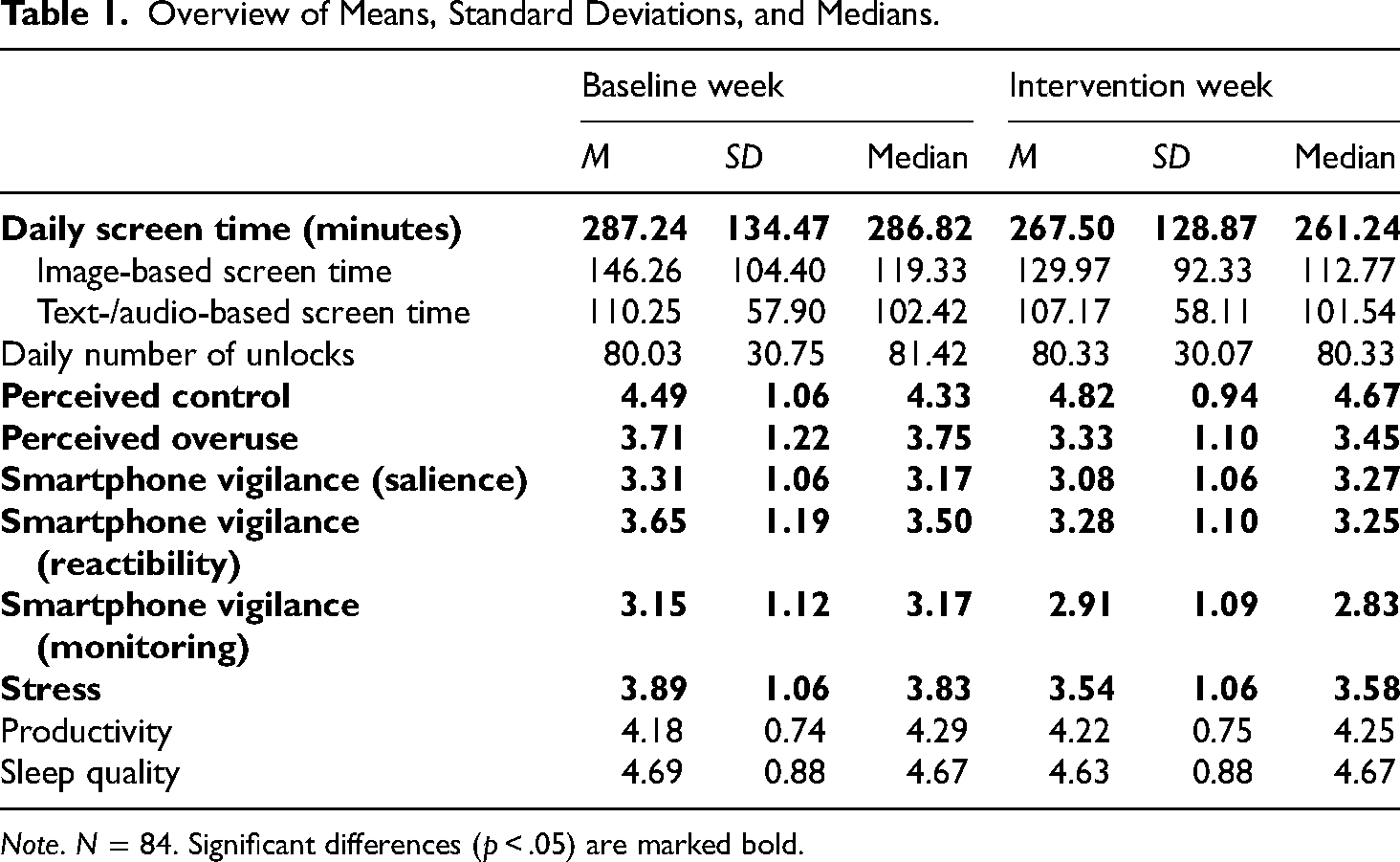
Note. N = 84. Significant differences (p < .05) are marked bold.
Smartphone behavior
Participants’ daily screen time in minutes and daily number of phone unlocks were passively logged. The data also included app-specific screen time. All apps were categorized according to the Google Play Store categorization, after which these categories were manually labeled as either image-based or text-/audio-based. App categories were considered image-based when they contained a lot of visual content (e.g., social media, video players, games). Apps were considered text-/audio-based when their content was predominantly textual (e.g., email), including informative (e.g., news) and functional apps (e.g., banking), or predominantly auditory (e.g., music players). Less straightforward categories were labeled unknown. An overview of the categorizations can be found on OSF.
Daily subjective measures
Participants’ daily experiences were assessed in the daily surveys, as these provided more detailed and accurate estimations of their daily experiences than assessing them retrospectively once a week. All items in the daily surveys thus referred to experiences of that same day, and all items, except for the sleep quality item, were evaluated on a 7-point Likert scale from 1 (not at all) to 7 (very much). The daily survey first included the three measures related to general subjective well-being and daily functioning to ensure participants reflected on these items without specifically thinking about their smartphone-related experiences. To assess daily productivity, two items were adapted from Fitz et al. (2019): “I was productive” and “It was easy for me to concentrate on what I was doing.” The two items were strongly correlated (rSB = .75), hence a mean scale was computed. Perceived stress was measured with the item “I felt stressed.” Perceived sleep quality was assessed with “How would you rate the quality of your sleep last night?” (1 = very bad to 7 = very good; Lydon et al., 2016). In the second part of the daily survey, the three direct indicators of digital well-being were assessed. Perceived control was assessed with one item: “I felt in control of my own smartphone use”. Perceived overuse was assessed with “I ended up using my smartphone longer than I had intended”. Online vigilance was measured with one item per dimension (Reinecke et al., 2018). The three items were rephrased to specifically measure smartphone-related online vigilance (e.g., “I constantly monitored on my smartphone what was happening online”).
Intervention evaluation
In the final survey, participants reflected on their experiences during the intervention week. To assess compliance, participants were asked to estimate the proportion of time during the past week that they had kept their phone on grayscale. To assess intervention experiences, participants evaluated whether the grayscaling mode was “helpful,” “annoying,” and/or “easy to use.” In addition, participants evaluated five items about whether grayscaling had reduced their screen time, made them feel better, improved their sleep quality, helped them to focus more on other tasks, and/or improved their general well-being. Furthermore, as lower smartphone use might result in the increased use of other digital devices, participants evaluated the item “Due to the grayscaling on my phone, I used other media devices (e.g., laptop, iPad) more than I normally do.” All items were rated on scales ranging from 1 (strongly disagree) to 7 (strongly agree). Finally, participants were asked how often they would use the grayscale mode in their daily lives in the future (never, rarely, sometimes, often, always, I don’t know yet).
Analytical strategy
The data and analysis script are available on OSF. The hypotheses were tested using repeated measures analyses with a linear mixed models approach (R, version 4.2.2) with the packages lme4 (version 1.1–31) and lmerTest (version 3.1–3) for significance testing, using maximum likelihood estimation. As we wanted to compare daily experiences during the baseline week with those during the intervention week, the daily outcome measures were collapsed into week means. In all analyses testing the hypotheses, week (baseline vs intervention) was included as the predictor, and the week means of the daily survey outcomes were included separately as dependent variables. To answer RQ1, we ran two separate models for each significant intervention effect, in which the first 3 days and the last 3 days, respectively, of the intervention week were compared to the baseline week.
Results
Objective outcomes
The effect of grayscaling on average daily screen time was found to be significant, t(84) = –2.34, p = .022, d = 0.51 (see Table 1 for all means, SDs, and medians). In the intervention week screen time was reduced by approximately 20 min per day, supporting H1a. To assess whether app category (image-based vs text-/audio-based) moderates the effect of grayscaling on screen time, an interaction effect was tested. The results indicated no significant interaction, t(252) = –0.93, p = .356, d = 0.05. Thus, no support was found for H1b. Regarding daily number of phone unlocks, no significant difference between the baseline and intervention week was found, t(84) = 0.18, p = .860, d = 0.04. Therefore, H2 was not supported.
Subjective outcomes
Confirming H3a, daily perceived control over one's smartphone was significantly higher in the intervention week compared to the baseline week, t(84) = 3.64, p < .001, d = 0.79. Supporting H3b, participants reported lower perceived overuse during the intervention week, t(84) = –3.72, p < .001, d = 0.81. Furthermore, all three dimensions of online vigilance were significantly reduced during the intervention week: smartphone salience, t(84) = –2.00, p = .049, d = 0.44; smartphone reactibility, t(84) = –3.18, p = .002, d = 0.69; and smartphone monitoring, t(84) = –2.33, p = .022, d = 0.51. Overall, these findings support H3c. Further, in line with hypothesis H4b, a significant decrease in self-reported stress levels was found, t(84) = –3.13, p = .002, d = 0.68. Self-reported productivity did not change as a result of the intervention, t(84) = 0.41, p = .686, d = 0.09. Therefore, H4a was not supported. Perceived sleep quality was also not affected by the grayscale intervention, t(84) = –0.63, p = .529, d = 0.14. Thus, H4c was not supported.
Timing of intervention effects
To answer RQ1, we initially compared the first 3 days and the last 3 days of the intervention week to the baseline week, which was preregistered. For all significant intervention effects except for stress, the effects seemed to have become stronger in the second half of the intervention week, indicating an increasing effectiveness of the intervention over time. Because these results suggest a gradual increase of the effects, we exploratively tested whether the six daily values in the intervention week followed a linear pattern (non-preregistered). For perceived control, t(415.12) = 2.69, 95% CI [0.02, 0.13], perceived overuse, t(415.07) = −2.43, 95% CI [ − 0.13, − 0.01], and the reactibility dimension of online vigilance, t(415.05) = −3.80, 95% CI [ − 0.18, − 0.06], these effects were significant, indicating that those effects became linearly stronger over time. For all other outcomes, no linear effects were found (see OSF for more details).
Evaluation of the intervention
Self-reported compliance with the intervention was high (M = 89.73%, SD = 19.29). Participants indicated that they did not use other devices more than normally because of the grayscale mode (M = 3.76, SD = 1.96). However, participants did not perceive the grayscaling mode as particularly “helpful” (M = 3.66, SD = 1.81), but rather as “annoying” (M = 5.39, SD = 1.63) yet “easy to use” (M = 4.70, SD = 1.72). Interestingly, although grayscaling reduced participants’ objective screen time, they did not seem to be aware of that effect when asked whether grayscaling had reduced their screen time (M = 4.24, SD = 1.82). They also did not believe that grayscaling had made them feel better (M = 2.89, SD = 1.59), improved their sleep quality (M = 3.08, SD = 1.52), helped them to focus more on other tasks (M = 3.55, SD = 1.81), or improved their general well-being (M = 3.49, SD = 1.54). The large standard deviations for all of these evaluation measures suggest varied evaluations among the participants. This is also reflected in the answers regarding the intention to use grayscaling in the future. Half of the sample would never (31.3%) or rarely (20.0%) use it again, whereas a considerable proportion would use it always (2.5%), often (12.5%), or sometimes (27.5%). The remaining 6.3% did not know yet.
Discussion
Following the Dynamic System Model of Digital Well-Being, one approach to improve digital well-being is to intervene in device-specific factors (Vanden Abeele, 2021). Informed by limited yet promising previous research, this study aimed to comprehensively assess the effectiveness of a grayscale smartphone intervention by examining both objective smartphone behavior and subjective indicators of digital well-being. Replicating prior studies (Holte et al., 2023; Holte & Ferraro, 2020; Zimmermann & Sobolev, 2022), grayscaling reduced daily screen time by approximately 20 min. Interestingly, the daily number of unlocks was unaffected by the intervention. Regarding the subjective outcomes, we found that the three direct indicators of digital well-being (perceived control, perceived overuse, and online vigilance) significantly improved as a result of grayscaling. While popular press also claims that grayscaling would increase productivity, improve sleep quality, and reduce stress, our study found empirical support only for the latter effect. Taken together, these findings suggest that grayscaling is an effective strategy to reduce screen time and enhance digital well-being.
The finding that screen time was reduced indicates that reducing the appeal of one's smartphone makes people spend less time on their phones. However, contrary to our expectations, the number of daily phone unlocks did not change as a result of the intervention, which means that individuals checked their phones as frequently as in the baseline week, but subsequently used their phones for a shorter duration of time. These findings seem to support the idea that grayscaling makes phone use less enjoyable and thus renders it easier to discontinue use (Holte & Ferraro, 2020). Surprisingly, however, we did not find that the proposed app category distinction (image-based vs text-/audio-based) functioned as a moderator of screen time reduction. Nevertheless, although we did not find a significant interaction effect, the mean differences do suggest that the use of image-based apps was more strongly reduced (Mdiff = −16.29) than the use of text-/audio-based apps (Mdiff = −3.08). However, regarding the effects on screen time in general, it should be noted that, despite the medium effect size (d = 0.51), a reduction of 20 min may not be considered substantial when the average daily screen time is still over 4 hr per day.
In line with the predictions of the Dynamic System Model of Digital Well-Being (Vanden Abeele, 2021), changing device-specific factors led to improvements in cognitive appraisals about one's smartphone use. Specifically, as hypothesized, grayscaling both decreased perceptions of smartphone overuse and increased perceptions of control over one's smartphone use. Thus, the findings support the idea that simple changes in the device can provide users with increased autonomy over their smartphone use. Similarly, grayscaling also decreased online vigilance. This demonstrates that participants found it easier to mentally disengage from their phones, were less responsive to notifications, and were less busy monitoring the online sphere via their smartphones. These findings are particularly interesting considering that phone checking frequency did not change. This seems to corroborate that checking behavior often happens subconsciously, and oftentimes not even as a result of an external cue such as a notification, which underlines its known habituality (Heitmayer & Lahlou, 2021; Oulasvirta et al., 2012). Nevertheless, once individuals check their phone in the grayscale mode they might feel that they have more control over disengaging again.
The finding that checking habits did not change over the course of 1 week might indicate the persisting nature of once-established habits, which may suggest that these habits do not fade over the course of 1 week. The grayscale intervention might thus initially only affect the duration of phone sessions, as using one's phone is less appealing, and might only over time affect use frequency. To establish such long-term effects, studies with longer intervention periods are needed.
Next to the cognitive appraisals of smartphone use, we examined three additional person-specific consequences of digital connectivity, specifically those that were previously deemed to improve as a result of grayscaling (Bowles, 2018; Cipriani, 2019; De Jong, 2020; Efrem, 2021). We found that stress levels decreased as a result of the intervention. This is in line with expectations, as it has been previously shown that smartphone use (Reinecke et al., 2017; Vahedi & Saiphoo, 2018) and the salience dimension of online vigilance (Freytag et al., 2021; Gilbert et al., 2023) predict stress. Although earlier work also found media multitasking (Freytag et al., 2021) and checking behavior (Kushlev & Dunn, 2015) to be predictors of stress, we did not observe a reduction in the number of unlocks, indicating that the reduction in stress may be attributed to a reduction in screen time or the reductions in online vigilance. It is interesting to note that one study found that perceived autonomy moderates the relationship between media multitasking and stress, such that media multitasking leads to more stress in the case of less perceived autonomy (Gilbert et al., 2023). This suggests that, in our study, the increase in perceived control may also have played a role in reducing stress. Relatedly, the effect of grayscaling on stress might be explained by a potential increase in mindful smartphone use (Hefner & Freytag, 2023), as this is argued to be evoked by grayscaling (Cox et al., 2016; Zimmermann, 2021). Future studies are needed to examine the underlying mechanisms of the link between smartphone use and stress in more detail.
Contrary to expectations, participants did not feel more productive during the intervention, nor did grayscaling improve self-reported sleep quality. This is surprising as objective screen time has been found to be inversely correlated with self-reported productivity in previous research (Elhai et al., 2021). While grayscaling reduced screen time in the present study, this did not result in higher perceived productivity. Perhaps this could also be explained by the fact that participants still checked their phones as frequently as before, which might interrupt their workflow and thus interfere with their productivity. This potential explanation is in line with recent work showing that checking habit strength predicts study-related procrastination (Meier, 2022). Similarly, for sleep quality, it might be that grayscaling may not be as effective in reducing late-night usage (Lanaj et al., 2014) or curbing bedtime procrastination (Liu et al., 2021), and thus does not affect sleep.
Finally, besides providing insights into intervention outcomes, the present study addressed user experiences because they might predict whether individuals will implement an intervention in their daily lives (Almourad et al., 2021). These insights should be considered both in future research and by developers of apps, smartphones, or related interventions. On average, participants experienced the grayscale mode as rather annoying, and did not believe it had reduced their screen time, or improved their sleep quality, focus, or well-being. Thus, when participants were asked to reflect specifically on the effects of grayscaling, they were not aware of the effectiveness of the intervention. However, responses also indicated a high variety in intervention evaluations, which suggests that the intervention was appreciated by some participants but not by others. A similar pattern was detected when looking at the implementation intentions, as one-third of the sample would never use the grayscale mode again, but approximately half of the sample would use it at least sometimes in the future. Providing personalized feedback about the effectiveness of the intervention to users might increase their willingness to implement such an intervention in their daily lives. Generally, the varied evaluations underline the idea that there is no one-size-fits-all solution to digital well-being (Vanden Abeele, 2021).
A few study limitations need to be considered. The first limitation relates to a potential self-selection bias, given that participants were fully aware of participating in an experimental study testing a smartphone intervention. Participants also expressed high pre-existing intentions to reduce smartphone usage. However, the high motivation of participants to reduce smartphone usage could also be considered a strength of this study. Motivation to change behavior in a given direction is crucial for interventions such as self-nudges to be effective (Pinder et al., 2018). Furthermore, intrinsic motivation is almost certainly required for participants to implement interventions in their daily lives. The importance of motivation is further underlined by the low compliance rates in previous studies (Olson et al., 2022; Zimmermann & Sobolev, 2022). In contrast, in our study, participants were highly motivated, and overall they adhered well to the intervention.
Second, the intervention period in our study only lasted 1 week. This may be too short to demonstrate the effects to their full potential, as it seems that some intervention effects became stronger during the intervention period. Thus, although one might expect that individuals get used to the grayscaling after a few days, this did not seem to be the case. Instead, the effects occurred immediately from the start or became more pronounced over time. This suggests that a long-term intervention may yield even stronger results, highlighting the need to investigate longer intervention periods.
Third, due to the availability of the research app, only Android users could participate in our study, although we see no reason to expect that grayscaling would differently affect iOS users. However, depending on the phone brand, the grayscale setting is diversely accessible. For instance, on Google Pixel and Samsung phones, grayscaling is one of the options in the bedtime mode settings, while on iPhones the grayscale mode can initially only be turned on or off in one of the submenus of the phone's settings, but via Shortcuts users can choose to turn on grayscale automatically at certain times or for certain apps. These options may affect the perceived usability of the grayscale mode, as people are likely to prefer easy accessibility.
There are some additional open questions that could guide future research. For instance, instead of app-specific screen time, one could investigate the effects of grayscaling on behavior-specific (e.g., active vs passive use) or motivation-specific (e.g., escapism, boredom) smartphone use, as they might relate differently to intervention outcomes (e.g., Lukoff et al., 2018; Panova & Lleras, 2016). In addition, it stands to reason that trait self-control is a predictor of successful self-regulation of daily smartphone use and subsequent well-being outcomes (Meier et al., 2016; Reinecke & Hofmann, 2016; Schneider et al., 2022). Therefore, it would be interesting to examine its role in the effectiveness of a grayscale intervention.
Furthermore, the Dynamic System Model of Digital Well-Being proposes that all factors in the model are dynamically interrelated (Vanden Abeele, 2021). However, we altered one device-specific factor and examined the effects on smartphone use, three direct indicators of digital well-being, and three additional person-specific consequences. As such, we only focused on a subset of constructs and only tested the direct effects of the intervention. It seems plausible that, for instance, reductions in screen time would lead to improved digital well-being or lower stress, or that increased digital well-being would result in lower screen time use or stress, or that these effects might occur in both ways. It was beyond the scope of the current study to investigate such mediated effects, but we encourage future researchers to further dive into these dynamics.
Finally, it should be noted that, based on the Dynamic System Model of Digital Well-Being, design interventions are not the only way to improve digital well-being (Vanden Abeele, 2021). Aside from intervening in device factors and device use (e.g., digital detox), person- as well as context-specific factors might be manipulated. For example, considering person-specific factors, recent work indicates the importance of mindfulness (Bauer et al., 2017; Schneider et al., 2022) and stress coping mechanisms (Wolfers et al., 2023). Regarding intervening into context-specific factors, interesting work has been done on group-level interventions (Ko et al., 2015). However, the advantage of manipulating device-specific factors is that it does require the least active commitment and awareness from participants, in comparison to improving, for example, self-regulation. In addition, these studies might help to find easily implementable technological solutions for overuse. For instance, if one strategy turns out to be particularly successful in empirical studies, it might be easier to apply pressure on tech companies to implement these techniques. In the case of grayscaling, for example, it would be in the users’ interest to have easily customizable options on Android phones (e.g., grayscaling for specific apps).
In sum, the present study found that removing the colors from one's smartphone for a week significantly reduced screen time, improved cognitive appraisals of one's smartphone use, and reduced stress, although it did not improve productivity or sleep quality. These findings support the idea that by changing the appealing nature of digital devices, users can retain or regain control over using the device. Given its wide availability, the grayscale setting on smartphones offers a simple solution to improve digital well-being.
Footnotes

Funding
The authors disclosed receipt of the following financial support for the research, authorship, and/or publication of this article: This work was supported by the Research Priority Area Communication: Digital Communication Methods Lab (University of Amsterdam)