




Abstract
This six-wave longitudinal survey study investigated associations between perceived smartphone overuse and the use of technology-based disconnection strategies. The sample was representative of the Dutch population regarding age, gender, and education level (N = 1674). Linear mixed models showed that perceived overuse was positively related to self-reported screen time and motivations to reduce screen time. People with higher perceived overuse were more likely to adopt disconnection strategies in the following 2 months. Yet, surprisingly, at the within-person level, we found that when someone experienced more overuse than they normally do, they were not more likely to adopt disconnection strategies. Moreover, using disconnection strategies in the previous 2 months was related to higher perceived overuse and self-reported screen time. Together, these findings suggest that people do not always take action when unsatisfied with their smartphone use, and when they do, technology-based disconnection strategies are not effective in reducing perceived smartphone overuse.
Keywords
Over the past years, smartphones have become deeply integrated into people’s daily routines, and the time individuals spend on their phones has highly increased (Statista, 2023). Globally, the average smartphone screen time is over 4 hours per day (Kantar, 2022). Importantly, individuals have also become more concerned about their excessive smartphone use. For instance, more than half of the US adult population report spending too much time on their phones (Saad, 2022). This perception of smartphone overuse is even more prevalent among younger adult populations, with 81% of American 18- to 29-year-olds expressing smartphone overuse (Saad, 2022).
The prevalence of perceived smartphone overuse has prompted a growing interest in digital disconnection strategies. Digital disconnection has been defined as a “deliberate form of non-use of devices, platforms, features, interactions and/or messages that varies in frequency and duration with the aim of restoring or improving one’s perceived overuse, social interactions, psychological well-being, productivity, privacy and/or perceived usefulness” (Nassen et al., 2023: 1). Interview studies show that people who disconnect indeed mention perceived overuse as a reason for doing so (e.g. Nguyen, 2021) and cross-sectional research has shown that people with higher perceived overuse are more likely to practice disconnection (Vanden Abeele and Nguyen, 2024).
Interestingly, people often make use of the technology itself to restrain their use, for instance, by turning off smartphone notifications or monitoring screen time (Vanden Abeele and Nguyen, 2024). However, despite growing public (e.g. Cohen, 2023) as well as academic interest (e.g. Vanden Abeele et al., 2024) in the use and effectiveness of such technology-based disconnection strategies, we have a limited understanding of the relationship between perceived smartphone overuse and technology-based disconnection strategy use over time. This is due to at least two shortcomings in the existing body of literature.
First, as existing qualitative studies focused on people who already employ disconnection strategies (e.g. Nguyen, 2021), it remains uncertain to what extent heightened perceived overuse predicts the adoption of disconnection strategies among the general population. It seems likely that people with higher perceived smartphone overuse also have a higher intention to reduce their smartphone screen time and thus actively attempt to do so by adopting commonly recommended disconnection strategies, yet this has not been systematically tested.
Second, it is unclear whether technology-based disconnection strategies are effective in reducing perceived overuse when people employ them in their daily lives. Experimental studies testing disconnection strategies found mixed evidence for their effectiveness (e.g. Dekker et al., 2024). Moreover, these studies provide limited conclusions on the effects of self-initiated disconnection strategies in individuals’ daily lives (i.e. when not participating in an intervention study; e.g. Vanden Abeele et al., 2024).
The present study will, therefore, investigate how perceptions of smartphone overuse are linked to the intention to reduce screen time and to the employment of technology-based disconnection strategies over time. In addition, the study sets out to examine the effectiveness of these self-initiated disconnection strategies in reducing perceived overuse. To shed light on how these factors are linked over time, we employ a six-wave longitudinal survey design among an adult sample, representative of the Dutch population in terms of age, gender, and education level. This design provides insights into perceived overuse as a predictor and outcome of disconnection strategy use in everyday life: the context in which individuals initiate disconnection strategies voluntarily, as opposed to intervention contexts where disconnection strategies are rather forced.
Perceived smartphone overuse, screen time, and the intention to reduce screen time
Perceived smartphone overuse is understood as a “perceived excess of time” spent on one’s smartphone (Büchi et al., 2019: 2), and it is seen as one of the central harms that people may experience from using digital devices (Vanden Abeele et al., 2024). Perceptions of overuse are most pronounced in individuals’ evaluations of their smartphone use as a “waste of time” (Baym et al., 2020; Syvertsen and Enli, 2020; Vanden Abeele and Mohr, 2021), and in the idea that smartphone use replaces time spent on more valuable activities (i.e. time displacement; Vanden Abeele et al., 2024). For instance, individuals often find themselves using their phones as a way to procrastinate going to bed (e.g. Chung et al., 2020) or tasks such as studying (e.g. Aalbers et al., 2022). Such unplanned or undesired usage can be partly attributed to the design choices embedded in smartphone technologies, as they are known for triggering and prolonging usage (Fasoli, 2021; Vanden Abeele, 2021). For example, notifications draw attention to the smartphone and distract from ongoing activities (Bayer et al., 2016). It can thus become difficult for users to regulate their smartphone use, resulting in dissatisfaction with their screen time.
Notably, perceived overuse is not directly related to one’s objective screen time, as it denotes an individual’s qualitative and relative reflection on their usage amount (Büchi et al., 2019; Fasoli, 2021). That is, individuals can have a different understanding of what amount of smartphone use is excessive, both compared to other people and compared to other moments in their lives. This means that people who use their smartphones for the same amount of time may have different levels of perceived overuse. Similarly, perceived overuse might change across time points within individuals, as life events or transitions may shape not only the way an individual uses their smartphone but also their perspective on their use (Nguyen, 2023; Vanden Abeele, 2021; Ytre-Arne, 2023). Time spent on the smartphone may be seen as more or less problematic due to, for example, a career change (e.g. having to commute, working more or fewer hours, needing one’s phone for work tasks), a vacation, a new relationship, or periods of illness (Nguyen, 2023; Ytre-Arne, 2019; Ytre-Arne et al., 2020). Considering the nature of such life changes, we reason that our longitudinal design with 2 months between waves can reveal within-person fluctuations in perceived overuse. So even when someone’s screen time has not changed in 2 months, they may experience different levels of perceived overuse than before.
The same between- and within-person variability may apply to people’s estimations of their own screen time. Research shows that self-reported screen time is rarely accurate, as people tend to over- or underestimate their objective screen time (for a meta-analysis, see Parry et al., 2021). This implies that people are prone to biases (e.g. recall; social desirability) when making or reporting these estimations (Parry et al., 2021)—biases that may vary between people and over time. Given this subjectivity, it can be said that, similar to perceptions of overuse, self-reported screen time is not accurately tied to specific objective usage amounts.
Despite their subjectivity, self-perceptions of screen time and overuse seem to be more important for explaining the negative impact of smartphone use than objective usage measures. For example, studies demonstrated that self-report measures of screen time have a comparable (Johannes et al., 2021; Verbeij et al., 2022) or even stronger validity (Sewall et al., 2020) in predicting subjective well-being outcomes than objective metrics. Perceived overuse has also been found to negatively correlate with subjective well-being (Büchi et al., 2019). Moreover, recent work highlights the importance of subjective perceptions by showing that users’ negative mindsets toward their social media use (e.g. believing social media are harmful) partly explain the negative effects of social media use on their well-being (Lee and Hancock, 2024).
Research thus demonstrates the relevance of self-perceptions of screen time as well as overuse for understanding the negative impact of smartphone use on well-being. Yet, the relationship between the two perceptions has not been examined. Although they are conceptually and practically distinct, it seems likely that perceived overuse and self-reported screen time are positively correlated at the between-person level. For instance, based on a cross-sectional survey in Belgium, Vanden Abeele and Nguyen (2024) identified four clusters of digital media users and found that the cluster of individuals with the highest perceived overuse also reported the highest estimations of screen time compared to the other clusters.
We do not only lack an understanding of the relationship between perceived overuse and perceived screen time at the between-person level (i.e. individuals with higher perceived overuse use have higher screen time estimations than individuals with lower perceived overuse), it is also unclear whether this relationship holds at the within-person level over time. If an individual’s perceived screen time is higher than usual (i.e. their own average), is their perceived overuse also higher than usual? Although this has never been empirically estimated, we believe that the relationship between perceived smartphone overuse and perceived smartphone screen time holds on both the between- and the within-person level. We thus predict that:
H1: People who report higher screen time also report higher perceived overuse, both at (a) the between-person and (b) the within-person level.
Given that perceived overuse describes a negative, dissatisfactory experience, people likely want to avoid or reduce it (Fasoli, 2021). This may be explained by cognitive dissonance theory (CDT; Festinger, 1957), which argues that when someone experiences dissonant cognitions, this causes a psychological discomfort that one desires to reduce. Cognitions are dissonant when they are logically obverse, for instance, when one’s belief about a certain behavior (e.g. “the behavior is bad”) does not align with one’s actual behavior (e.g. continuation of the behavior). In the case of perceived overuse, there is a discrepancy between one’s desired amount of usage (i.e. desired behavior) and one’s perceived amount of usage (i.e. perceived behavior). This discrepancy can be solved by aligning the actual behavior with the desired behavior (Festinger, 1957; McGrath, 2017), although this may not be easy considering the profound integration of smartphone use into daily tasks and activities (e.g. Van Bruyssel et al., 2026). Nevertheless, it is reasonable to assume that perceived overuse serves as a motivational force to reduce one’s smartphone use to the point where one is satisfied with the amount. Thus, we hypothesize that:
H2: People who report higher perceived overuse also report a higher intention to reduce their smartphone screen time, both at (a) the between-person and (b) the within-person level.
Disconnecting to reduce smartphone overuse
People can actively attempt to reduce their smartphone screen time by adopting the so-called disconnection strategies (Nassen et al., 2023). Recent typologies show that disconnection strategies differ with regard to the level of disconnection (e.g., disconnecting from the device or a specific app; Nassen et al., 2023; Nguyen, 2021), and the temporality of disconnection (e.g., taking a break or quitting permanently; Franks et al., 2023; Nassen et al., 2023).
Interestingly, many strategies take place within the smartphone itself. These technology-based strategies include the use of tools (e.g., digital well-being apps, time limits) or smartphone settings (e.g., turning off notifications). Such strategies are often recommended by popular press as a way to curb smartphone use at the source by mitigating the engaging design architecture of the phone (e.g., Cohen, 2023). Many people indeed employ one or more technology-based disconnection strategies. For example, 45% of the Belgian population reports having turned off notifications, more than half have removed an app that was too time-consuming, and 20% have used screen time monitoring apps (Vanden Abeele and Nguyen, 2023).
Vanden Abeele et al. (2024) assume that “digital disconnection is a motivated choice that individuals make, based on the perceived harms of digital media” (p. 2). Qualitative and cross-sectional research have shown that individuals who turn to disconnection strategies describe perceived overuse as one of their main reasons—or harms—for doing so (e.g. Nguyen, 2023; Nguyen et al., 2024). In addition, people disconnect to improve their productivity, improve their mental or physical well-being, protect their privacy, reduce exposure to undesirable content, or feel more mindful (Nassen et al., 2023; Nguyen, 2023; Nguyen et al., 2024; Syvertsen and Ytre-Arne, 2021; Vanden Abeele et al., 2024).
The disconnection literature thus provides comprehensive accounts of the motives of people who already employ disconnection strategies. However, it remains speculative whether perceived overuse among general smartphone users drives them to employ disconnection strategies. By focusing on the general population, the present study investigates to what extent heightened perceived overuse and the intention to reduce smartphone screen time predict the adoption of technology-based disconnection strategies.
Considering the popularity of technology-based disconnection strategies, both in terms of news coverage and in terms of adoption rates, it seems logical that if someone thinks they overuse their phone and wants to reduce their use, they would try one or more of those commonly suggested strategies. Moreover, cross-sectional research has shown that people who experience more overuse are more likely to employ disconnection strategies (Vanden Abeele and Nguyen, 2024). The number of employed disconnection strategies may thus reflect individuals’ level of commitment to changing their overuse. We predict that people experiencing more overuse than others, and people having a higher intention to reduce their smartphone screen time than others, will adopt more disconnection strategies than others. These patterns have not been tested in a longitudinal design, leaving questions regarding the within-person effects. We will, therefore, test the assumption that individuals who experience more overuse than they do on average, and a higher reduction intention, would start using (more) disconnection strategies in the following 2 months.
H3: People who report higher perceived overuse will also use more disconnection strategies in the following 2 months, both at (a) the between-person and (b) the within-person level.
H4: People who report a higher intention to reduce their smartphone screen time will also use more disconnection strategies in the following 2 months, both at (a) the between-person and (b) the within-person level.
When it comes to the effectiveness of technology-based disconnection strategies, we can turn to a relatively large body of intervention research (for reviews, see Nassen et al., 2023; Radtke et al., 2022). Yet, these studies provide only limited support for the effectiveness of such strategies, as only some found reductions in perceived overuse and (self-reported) screen time (e.g. Dekker and Baumgartner, 2024; Zimmermann and Sobolev, 2023), and other studies found null effects (e.g. Dekker et al., 2024; Zimmermann, 2021).
It should, however, also be noted that intervention studies have limited ecological validity (e.g. Vanden Abeele et al., 2024). That is, the intervention context of these studies implies that people may have different motivations to adopt the disconnection strategies than they would have when voluntarily adopting them outside of an intervention context. This may impact the level of compliance with the intervention in two opposite ways. On the one hand, participants may not adhere to the imposed disconnection strategy (i.e. low compliance) because they are not intrinsically motivated to disconnect, yet on the other hand, it may be that participants fully comply but only because this is required for the study reward (i.e. extrinsic motivation).
In contrast, it can be assumed that people who try to disconnect in their daily lives have an intrinsic motivation to do so, which may positively impact both their strategy adherence and the effectiveness of the strategy. At the same time, however, we also know from qualitative work that people find it difficult to successfully implement disconnection strategies, for instance, because of practical or social challenges (e.g. Nguyen, 2023). It thus remains unclear how effective disconnection strategies are when voluntarily employed in one’s daily life (e.g. Vanden Abeele et al., 2024). The present study, therefore, examines the effectiveness of disconnection strategies among the general population. Moreover, by examining the number of strategies employed, we account for the potential cumulative effectiveness of using multiple strategies. Based on the considerations above, we pose the following research questions:
RQ1: Is the use of more disconnection strategies in the past 2 months related to lower perceived overuse, both at (a) the between-person and (b) the within-person level?
RQ2: Is the use of more disconnection strategies in the past 2 months related to lower self-reported screen time, both at (a) the between-person and (b) the within-person level?
A schematic overview of the hypotheses and research questions can be found in Figure 1.
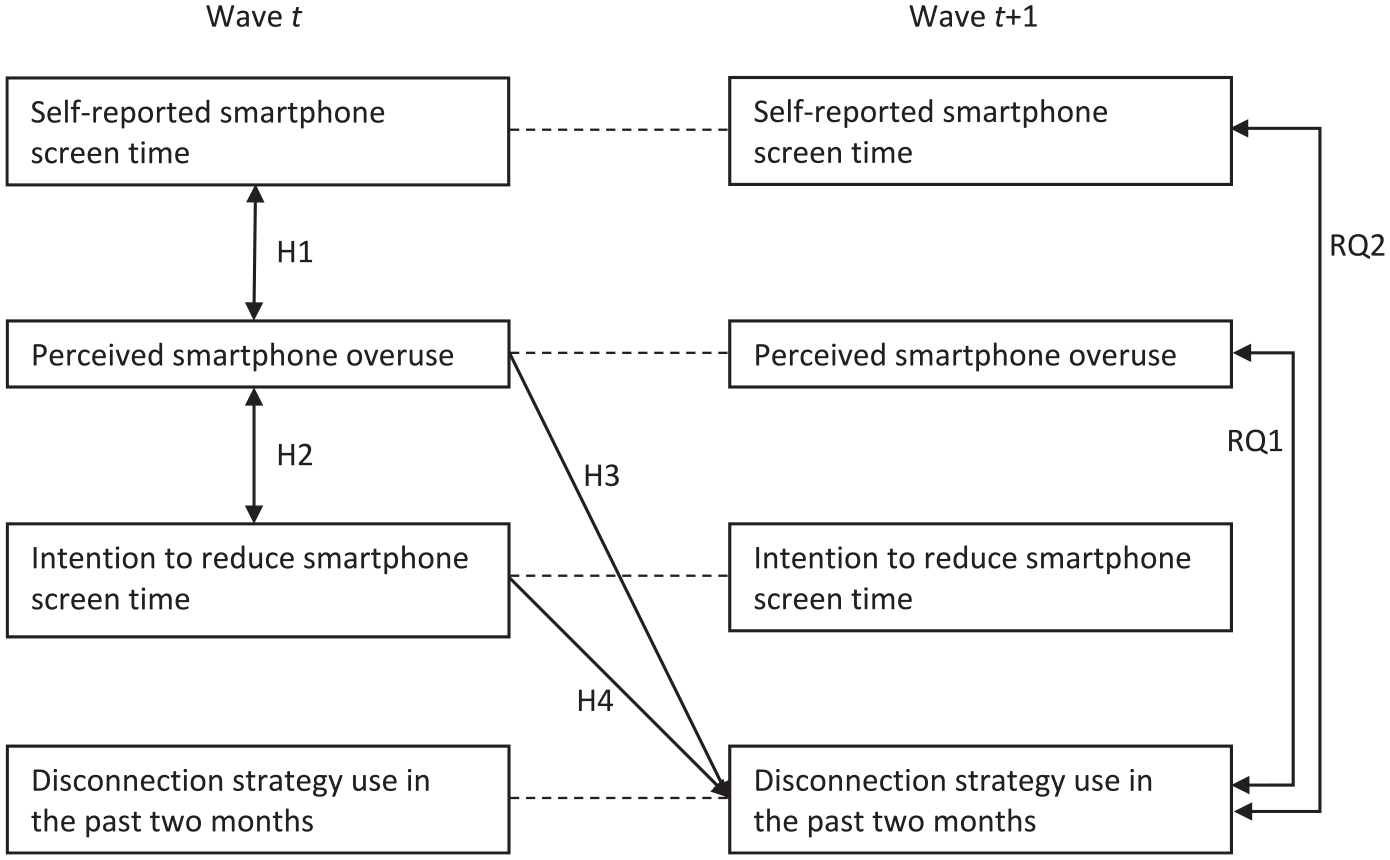
Conceptual model visualizing the proposed relationships across the six waves.
Method
Sample
We conducted a six-wave longitudinal survey among Dutch adult participants who were recruited via a panel company, I&O Research. Quotas were used to obtain a sample representative of the Dutch population in terms of gender, age, and education level. Over the course of 1 year (December 2022–December 2023), participants completed six waves with approximately 2 months in between. The study, which is part of a larger collaborative project, was approved by the Ethics Review Board of the University of Amsterdam. The larger project (https://osf.io/d958h/) as well as the specific predictions and analysis plan for the current study (https://osf.io/nj96f/) were preregistered on the Open Science Framework (OSF). The data are publicly available (Azrout et al., 2023).
The initial sample consisted of 2216 participants, but participants were removed from the data if they did not pass all attention checks (n = 491) and if they did not own a smartphone at all waves (n = 51). This resulted in a final sample of N = 1674 participants in Wave 1 (Nwave2 = 1350; Nwave3 = 1061; Nwave4 = 1049; Nwave5 = 834; Nwave6 = 741), together providing 6709 observations. Participants’ mean age was 51.96 (SD = 16.19, min = 18, max = 88) and the sample consisted of 52.9% men, 46.9% women, and 0.18% third-gender individuals. Participants’ education levels were comparable to the distribution of education levels in the Netherlands (Pleijers and De Vries, 2021): 18.9% completed a form of lower education, 39.3% completed middle-level education, and 42.0% completed higher education. For more sample descriptives, see OSF (https://osf.io/5zvab/).
Study context
As a nation-state in the North-West of Europe, the Netherlands can be described as a highly digitized society. In 2022, 95% of Dutch citizens owned a smartphone (Borgeaud, 2023). At the macro level, disconnection-related regulations are often discussed, resulting in governmental advice directed at schools (e.g. phone bans; Otto, 2023) and employers (e.g. the right to disconnect outside working hours; Van Schie, 2024) but so far no laws have been enacted. When it comes to the micro level, knowledge about overuse perceptions or disconnection strategy use within the general Dutch population is lacking. Still, we can turn to insights from reports about neighboring nation-state Belgium. Over one-third of the Dutch-speaking adult population in Belgium report spending too much time on their phones (De Marez et al., 2023), and 73% of the Belgian population employs technology-based disconnection strategies (Vanden Abeele and Nguyen, 2024). Together, these data underscore the relevance of the Dutch context, with overuse and disconnection being pressing concerns in the digitized society.
Measures
Perceived overuse
Perceived overuse was assessed with one item: “In general, the time I spend on my smartphone is . . .” (1 = too little to 7 = too much, M = 4.82, SD = 1.13), adapted from Jiang (2018).
Intention to reduce smartphone screen time
Intention to reduce smartphone screen time was measured with one item: “I want to spend less time on my smartphone” (1 = strongly disagree to 7 = strongly agree, M = 3.47, SD = 1.97).
Self-reported screen time
Self-reported screen time was measured with “How long do you use your smartphone per day on average?.” Participants could estimate their screen time in hours, optionally including one decimal (M = 2.55, SD = 1.77).
Disconnection strategy use
Disconnection strategy use was assessed by asking participants: “In the past two months, have you used any of the strategies below to reduce your smartphone use?” Participants could select one or more strategies from a list of five technology-based strategies that were derived from recommendations by the Center for Humane Technology (2023), namely using a digital well-being app; monitoring screen time, setting time limits on an app, turning off notifications from an app, removing an app. 1 In an open text box, participants could indicate strategies that were not listed. From these responses (n = 234 across waves), 141 were not counted because they were not relevant (e.g. “not necessary for me”) or not technology-based (e.g. “leave the smartphone at home”). Participants could also indicate not having used any strategies. The number of employed technology-based strategies was counted per participant (M = 0.49, SD = 0.87).
Analytical strategy
Analyses were performed with R (v4.3.2; R Core Team, 2024), using lme4 (v1.1-35.1; Bates et al., 2015) and lmerTest (v3.1-3; Kuznetsova et al., 2017). For all hypotheses and RQs, we ran linear mixed models with a centering approach to disaggregate the predictors at the within- and between-person level (Curran and Bauer, 2011; Wang and Maxwell, 2015). The intraclass correlation coefficients (ICCs) of the variables ranged between .64 and .76, indicating that 36% to 24% of the variance occurred at the within-person level. Within-person predictors were centered by calculating the difference between each score and the mean of the scores from all waves per participant (CWC), and between-person predictors were centered by calculating the difference between the mean of the scores from all waves per participant and the grand mean (CMC). Variables were also z-standardized to ease the interpretation of coefficients. Both standardized and unstandardized coefficients are reported.
All models included two predictors (i.e. the within-person and between-person centered variable) and a random intercept per participant. In the models testing H3 and H4, the predicting variables were lagged (i.e. scores from the wave before) as the outcome variable was measured retrospectively. The models thus tested whether participants’ perceived overuse and intention to reduce their smartphone screen time at t predicted participants’ disconnection strategy use at t + 1. In these models, we also controlled for disconnection strategy use in the wave before (t) by including the lagged outcome variable as a predictor. In addition, age, gender, and education level were added as control variables in all models, because they correlated with most variables in Wave 1 (see Table 1). Gender was first dichotomized (0 = man, 1 = woman). Consequently, people who indicated not identifying as a woman or man were excluded from the analyses. On OSF, we report the average scores on the key variables for these participants (n = 3).
Zero-order correlations in Wave 1.

p < .05; **p < .01; ***p < .001.
Missing data were possible due to people not participating in all waves. 2 The analyses disregarded missing data pairwise per wave. For H1, H2, RQ1, and RQ2, all 1674 participants and their waves were thus included (Nobservations = 6709). For H3 and H4, only participants participating in multiple waves could be included due to the lagged predictors (N = 1350; Nobservations = 5035).
Results
Descriptives and correlations
We first examined the prevalence of the main variables in Wave 1. For perceived overuse, 4.5% of the participants indicated that they used their phone too little (scores 1–3), 40.3% indicated that they used their phone the right amount of time (score 4), and 55.3% indicated that they used their phone too much (scores 5–7). For reduction intention, 45.4% of the sample did not intend to reduce their smartphone screen time (scores 1–3), 19.1% answered neutrally (score 4), and 35.5% intended to reduce their smartphone screen time (scores 5–7). Of the people who reported overuse, 58.6% also reported having the intention to reduce their screen time.
Regarding screen time, 55.4% of all participants reported a daily screen time of 2 hours or lower, 20.8% reported a screen time between (but not including) 2 and 4 hours per day, and 23.8% reported a daily screen time of 4 hours or higher.
For the use of disconnection strategies, most participants (80.5%) reported having used a strategy at least in one of the waves they had participated in. Across waves, turning off notifications from an app and monitoring screen time were the most prevalent strategies, as 30.3% and 27.7% of participants, respectively, reported employing them at least in one wave. The least prevalent was the use of digital well-being apps, as only 3.2% of participants reported this in at least one wave. More information on the prevalence of the specific strategies in our data can be found on OSF.
A correlation matrix with Pearson’s correlation coefficients between demographic factors and key variables in Wave 1 can be found in Table 1.
Confirmatory analyses
For the confirmatory analyses, we first tested a model with self-reported screen time as predictor of perceived overuse in the same wave. In support of H1a and H1b, significant positive coefficients were found between self-reported screen time and perceived overuse, both at the between-person level, b = 0.29, β = 0.41, p < .001, and the within-person level, b = 0.11, β = 0.08, p < .001 (see Table 2). These findings indicate that, when someone estimates their screen time higher compared to other people, or higher than they usually do, they also report higher perceived overuse.
Fixed effects parameters of multilevel models testing H1 and H2.

Nparticipants = 1671, Nobservations = 6699. All coefficients were significant at the p < .001 level, except for those superscripted a(p < .05) and those superscripted ns(not significant). In all models, age, gender (0 = man, 1 = woman), and education level were included as non-standardized control variables.
Second, we tested a model with perceived overuse as predictor of intention to reduce smartphone screen time in the same wave. We found significant positive coefficients at the between-person level, b = 1.09, β = 0.55, p < .001, and the within-person level, b = 0.46, β = 0.13, p < .001, supporting H2a and H2b (see Table 2). Thus, when experiencing higher overuse than other people, or than normally, one also has a higher intention to reduce their screen time.
To test our third hypothesis, we tested whether perceived overuse predicted disconnection strategy use, while controlling for disconnection strategy use in the previous wave. H3a was supported, as between-person-centered perceived overuse significantly predicted strategy use, b = 0.20, β = 0.22, p < .001. H3b was not supported, as within-person-centered perceived overuse did not predict strategy use, b = 0.02, β = 0.01, p = .179 (see Table 3).
Fixed effects parameters of multilevel models testing H3 and H4.

Nparticipants = 1348, Nobservations = 5028. All coefficients were significant at the p < .001 level, except for those superscripted ns(not significant). In all models, age, gender (0 = man, 1 = woman), and education level were included as non-standardized control variables.
For our fourth hypothesis, we tested whether the intention to reduce smartphone screen time predicted disconnection strategy use, while controlling for disconnection strategy use in the previous wave. Again, support was only found for the between-person level, b = 0.16, β = 0.32, p < .001, in line with H4a. H4b was not supported, b = 0.00, β = 0.00, p = .924 (see Table 3). Together, these findings suggest that people with higher perceived overuse or a higher reduction intention than other people adopt more strategies, but people who experience higher overuse or a higher reduction intention than they normally do are not more likely to adopt disconnection strategies in the following 2 months.
Fifth, in answering RQ1a and RQ1b, we tested whether the use of disconnection strategies reduced perceived overuse. At the between-person level, we found a significant positive coefficient, b = 0.33, β = 0.21, 95% confidence interval (CI): [0.17, 0.25] (see Table 4). These results suggest that people who have employed more strategies in the past 2 months report higher perceived overuse. At the within-person level, we found no significant effect, b = 0.03, β = 0.01, 95% CI: [−0.00, 0.03].
Fixed effects parameters of multilevel models testing RQ1 and RQ2.

Nparticipants = 1671, Nobservations = 6699. All coefficients were significant at the p < .001 level, except for those superscripted a(p < .05) and those superscripted ns(not significant). In all models, age, gender (0 = man, 1 = woman), and education level were included as non-standardized control variables.
Finally, for RQ2a and RQ2b, we looked at self-reported screen time as an outcome. We found significant positive coefficients, both at the between-person level, b = 0.27, β = 0.11, 95% CI: [0.07, 0.16], and the within-person level, b = 0.05, β = 0.01, 95% CI: [0.00, 0.03] (see Table 4). These findings indicate that people who have used more strategies than other people, or than they normally do, report higher screen time.
Additional analyses
In addition to the preregistered analyses, we reran the models for H3, H4, RQ1, and RQ2, where we included disconnection strategy use as a binary variable (i.e. whether or not a participant had used any strategies) instead of the number of used strategies. However, these analyses did not yield different findings compared to the preregistered analyses. The results can be found on OSF.
Discussion
This six-wave longitudinal survey study was the first to investigate within- and between-person associations between perceived overuse, the intention to reduce smartphone screen time, self-reported screen time, and the use of commonly recommended technology-based disconnection strategies. In line with existing reports (e.g. Saad, 2022), we found that perceived smartphone overuse was prevalent, as more than half of our sample felt they overused their phone.
Predictors of disconnection strategy use
As hypothesized, perceived overuse was significantly related to self-reported screen time at the between-person level: People with higher perceived overuse than others also reported higher screen time than others (H1a). This aligns with the finding by Vanden Abeele and Nguyen (2024), who found that people reporting the highest perceived overuse also report the highest screen time. At the within-person level (H1b), this association was rather weak, indicating that individuals’ overuse perceptions are not closely linked to their self-estimations of the time they spend on their phones. Hence, experiencing higher overuse than usual does not necessarily mean that one also estimates their screen time higher than usual. Possibly, other factors in individuals’ lives influence how they view their screen time. For instance, people may have different obligations (e.g. work; social roles) at different moments of the year that demand or permit more or less smartphone use, making people view their (high) screen time through different lenses and labeling it as overuse according to different standards (Vanden Abeele, 2021; Ytre-Arne et al., 2020).
Similarly, we found that people with higher perceived overuse report a higher intention to reduce their screen time, compared to other people (H2a). However, not everyone who experienced overuse was motivated to change their usage. That is, in the first wave, more than half of the sample reported spending too much time on their phone, yet, of these participants, 41.1% did not intend to reduce their use. At the within-person level, the association was again weak (H2b). Experiencing higher overuse than usual thus does not necessarily mean that one has a higher intention to reduce their screen time than usual. Hence, people experiencing cognitive dissonance from perceiving smartphone overuse would not always try to reduce this experience by intending to change their behavior. People may, instead, reduce cognitive dissonance with other cognitive responses, such as by trivializing dissonant cognitions or by adding consonant cognitions (McGrath, 2017). For example, individuals might trivialize the importance of overuse by believing that the benefits of high usage outweigh the drawbacks, or justify their smartphone overuse by additionally believing that this experience is normal.
In addition to examining the relationship between perceived overuse and the intention to reduce one’s screen time at the same time point, we investigated to what extent these factors predicted the adoption of technology-based disconnection strategies. In line with existing work identifying perceived overuse as a motive to disconnect (e.g. Nguyen, 2023), we found that people with higher perceived overuse than other people were more likely than other people to adopt strategies in the following 2 months (H3a). This pattern was stronger when including the intention to reduce smartphone screen time as the predictor (H4a). However, the effect sizes of both effects are rather small. Moreover, both within-person associations were not significant. When someone experiences more overuse (H3b) or a higher intention to reduce their smartphone screen time than they usually do (H4b), they will not employ more strategies in the two following months than they usually do. Our findings thus suggest that even people who intend to reduce their smartphone use do not always take action.
To grasp this seemingly paradoxical tendency, it is crucial to acknowledge the contextual factors that play a role in daily digitized life. Considering the integration of smartphones into daily routines and their permanent readiness to serve numerous purposes throughout the day, people may view disconnection as undesirable, challenging, or even impossible (e.g. Nguyen, 2023). For example, the smartphone must be kept nearby if logging into a work account requires two-factor authentication (Van Bruyssel et al., 2026).
Moreover, reluctance toward disconnection can be strongly determined by one’s social context, as (perceived) expectations can demand to stay connected (Bayer et al., 2016). Interestingly, a recent study showed that people perceive conflicting social norms around connectivity. On the one hand, people feel pressured to disconnect and be fully present in moments with offline contacts, but, on the other hand, they feel that they need to be available for digital contacts (Geber et al., 2024). Similarly, people may not want to disconnect out of fear of missing out (Nguyen, 2023). Disconnection does thus not take place in an individual vacuum. Future research should therefore consider the role of these practical and social contexts in predicting disconnection.
In addition, the gap between people’s reduction intention and their disconnection behavior may be the result of other beliefs they hold. Notably, behavior change models assume the importance of self-efficacy and outcome expectations in behavior change attempts (e.g. Bandura, 1977). This means that people need to believe in their capacity to employ disconnection strategies, as well as that the behavior will result in the desired outcome. When it comes to perceived overuse, people may lack self-efficacy beliefs, for instance, due to previous failed attempts to disconnect or anticipated struggles (Baym et al., 2020; Nguyen, 2023; Van Bruyssel et al., 2026). Moreover, it has been found that people tend to question the effectiveness of disconnection strategies. For example, only half of people using digital well-being applications think they are useful for helping them change their behavior (Parry et al., 2023; Zimmermann, 2021). We encourage future researchers to explore the role of self-efficacy and outcome expectations related to disconnection.
Importantly, the idea that one is not able to successfully change their smartphone use may also stem from broader societal discourses. That is, people have, in recent years, become more aware of the ways in which the tech industry commodifies their attention (e.g. Baym et al., 2020). News articles discuss, for instance, how online platforms are designed to grab and prolong users’ attention (e.g. manipulative design, algorithmic curation; e.g. Richtel, 2023) as well as new legislation around these practices. As such, the discourse underlines the accountability of the industry in causing smartphone overuse (Vanden Abeele and Mohr, 2021). People may, therefore, take a rather deterministic perspective of how their behavior is influenced by technology, and thus lack faith in strategies to resist these pulls. As a result, some individuals may, despite their dissatisfaction with their screen time, refrain from technology-based disconnection attempts.
Furthermore, disconnection motivations and practices seem to be different across segments of the population. For example, motivations to disconnect as well as preferred disconnection strategy types have been found to differ per generation (Nguyen et al., 2024). Notably, our zero-order correlations showed that younger people and highly educated people experience more overuse and use more disconnection strategies. Thus, while we controlled for these sociodemographic variables in our analyses, they may provide relevant nuances in understanding perceived overuse and disconnection practices. Importantly, recent work also highlights that individuals’ varying sociodemographic backgrounds as well as digital resources and skills create different needs, opportunities, and abilities for practicing disconnection—presenting a new form of digital inequality, or “disconnection privilege” (Nguyen and Hargittai, 2023). As our study focused on the broader population, zooming in on such differences across sociodemographic or socio-digital groups seems like a fruitful endeavor for future research.
Effectiveness of disconnection strategies
As existing evidence about the effectiveness of voluntarily employed disconnection strategies in reducing perceived smartphone overuse and screen time was limited, we posed two research questions to assess these effects. Our findings showed that, only at the between-person level, meaningful associations between the use of disconnection strategies in the past 2 months and perceived overuse (RQ1a) and self-reported screen time (RQ2a) were found. Notably, these associations were positive, indicating that people who had used more strategies in the past 2 months than other people reported higher overuse and screen time. The negligibility of the within-person associations suggests that people who had used more strategies than they did on average did not experience higher or lower overuse (RQ1b) or estimate higher or lower screen time (RQ2b).
These results provide evidence for technology-based disconnection strategies being ineffective or even counter-effective in reducing perceived overuse or screen time. This finding is in line with earlier work that found no difference between self-reported screen time of users and non-users of digital well-being applications (Parry et al., 2023), although our study included strategies beyond the use of such applications (e.g. turning off notifications). It could be that people who use disconnection strategies become even more aware of their lack of self-regulation, especially when failing to consistently adhere to their self-imposed strategies.
This finding raises the question of whether disconnection strategies do, in fact, more harm than good. However, it should be noted that we only looked at technology-based strategies. While the strategies included in our measure are reasoned to be effective in reducing time spent (Vanden Abeele et al., 2024), other types of strategies may be more effective (e.g. leaving the device in another room; Vanden Abeele and Nguyen, 2024). Moreover, given that motives for disconnection practices extend beyond merely wanting to reduce time spent, it could be that the examined technology-based strategies are effective in addressing other motives (e.g. improving productivity or sleep). In addition, the effectiveness of disconnection strategies is likely dependent on individual (e.g. self-control) and situational differences (e.g. goal conflict; Vanden Abeele et al., 2024). It is vital to look into these factors, as they may help us understand when and for whom disconnection strategies are effective.
Limitations
The present study faces at least five limitations, partly due to practical restrictions and agreements within our collaborative data collection. First, we made use of single-item measures. Although singe-item measures have been criticized, recent work has shown that they can be valid and appropriate for unidimensional constructs such as perceived overuse (e.g. Matthews et al., 2022).
Second, our measure for disconnection strategy use lacked depth, as we only asked participants which of the listed strategies they had used. As such, we lack information on the intensity and frequency of use. Moreover, the measure did not list all technology-based disconnection strategies identified in previous research (e.g. Nassen et al., 2023).
Third, our measure for self-reported screen time did not specify whether participants should or should not look up their screen time metrics on their phones. Thus, despite our interest in perceptions of screen time, it remains unclear to what extent participants’ responses were self-estimated. Future research interested in perceptions may explicitly formulate this in a self-report measure. In addition, it could be that answering questions about smartphone use inadvertently prompted participants to be more aware and critical of their smartphone use.
A fourth limitation concerns the time intervals between waves. The 2-month interval enabled us to detect changes in potentially stable factors such as perceived smartphone overuse, as confirmed by the ICCs that showed substantial amounts of variations across waves. Although the longitudinal design thus provided valuable insights into patterns over time, the patterns revealed depend on this interval. It could, for instance, be that a 2-month time frame is too long to detect effects of short-lived strategies, or that disconnection strategies are more or less effective when employed consistently for longer than 2 months. Future research is needed to explore the timeline of disconnection strategy effectiveness.
Finally, in longitudinal studies, dropouts can be a risk. We found that participants who only participated in one wave differed from participants who participated in multiple waves. Specifically, they were slightly younger, and they reported higher overuse and higher disconnection strategy use in Wave 1. However, these differences were small, and less than 20% of the sample participated only in Wave 1. The remaining sample was still large with a total of more than 6000 observations and more than 1000 participants participating in at least four waves. We thus believe that these dropouts did not substantially affect the findings of this study.
Conclusion and practical implications
By employing a longitudinal design among a Dutch sample, this study revealed how perceptions of smartphone overuse and screen time are, over time, linked to the use of technology-based disconnection strategies and vice versa. We found that perceived smartphone overuse was prevalent among our sample. However, our findings suggest that people do not always take action when unsatisfied with their smartphone use amount, and when they do, these technology-based disconnection strategies do not seem to be effective in reducing perceived smartphone overuse. Understanding the individual and situational boundary conditions for the adoption and effectiveness of disconnection strategies thus remains an important avenue for future research.
Our findings underline the need for evidence-based recommendations when it comes to reducing perceived smartphone overuse, as the strategies that are often promoted in the popular press appear to be less effective than suggested. Thus, technology-based disconnection strategies do not seem to be the answer to perceived smartphone overuse. However, this does not mean that the answer should not be found in the technology itself. Tech companies’ deliberate design choices make smartphones inherently difficult to disconnect from (e.g. Fasoli, 2021). Although they additionally offer users solutions for digital well-being, their effectiveness remains debated. Furthermore, these solutions are opt-in functionalities that still require active engagement or self-control (Jorge et al., 2022). As such, they reinforce the idea that users are responsible for maintaining their own digital well-being (Jorge et al., 2022; Syvertsen and Enli, 2020). We, therefore, believe that legislative calls to hold the industry accountable for protecting their users’ digital well-being are a way forward, even if it comes at the expense of company profits (European Parliament, 2023). As systematic change takes time, individual disconnection strategies may, in the meantime, still prove useful. Empirical research can facilitate these endeavors in two ways: by identifying technological features that require legislation as they drive overuse and by providing validated, user-focused recommendations for digital well-being.
Footnotes
Data availability statement

Funding
The author(s) disclosed receipt of the following financial support for the research, authorship, and/or publication of this article: This study was funded by the Amsterdam School of Communication Research (ASCoR).