



Abstract
Previous studies have examined the benefits and challenges of using mobile phones to support people experiencing homelessness. However, few studies have considered how mobile Wi-Fi hotspots support unhoused individuals and couples through public library lending programs. This paper seeks to address a gap in mobile communication scholarship by contributing insights from a qualitative study of library patrons who checked out mobile hotspots from the Boston Public Library in Massachusetts, USA. The findings show that although mobile hotspots provided many benefits for public library patrons in general, these devices facilitated mobile communication with a different sense of urgency for six people experiencing homelessness who also happened to be in romantic relationships. More concretely, the study found that mobile Wi-Fi hotspots reduced stress and anxiety for unhoused patrons because without the devices, patrons without fixed residences worried they could not be found; that hotspots kept unhoused patrons more connected, and therefore safer, in their tents despite the cold weather and a lack of electricity; and that unhoused patrons were concerned about their devices getting stolen because of their precarious situation. Although the unhoused patrons who participated in this study also shared their recommendations regarding how mobile hotspot lending programs in public libraries could be improved, they also mentioned that the benefits of hotspot availability far outweighed their challenges. The findings have implications for those working to address homelessness, including community-based organizations, government agencies, and policymakers who seek further insights into the positive role that mobile hotspot devices can play in supporting positive health outcomes for individuals and couples experiencing homelessness.
Introduction
Homelessness continues to be a crisis in the United States. Although obtaining accurate counts of people experiencing homelessness remains a challenge, existing public data begin to paint a picture of the situation. Often measured by taking a snapshot of individuals experiencing homelessness on a single night, the federal government reported that “more than 326,000 people were experiencing sheltered homelessness” in 2022 and “six in ten were individuals—that is, people in households with only adults or in households with only children. Four in ten were people in families with children” (U.S. Department of Housing and Urban Development, 2022). Others have reported numbers that are several hundred thousand higher. For example, the National Alliance to End Homelessness (2022) reported that 2022 was the fourth straight year in a row with increases in the number of homeless populations. As the exact numbers continue to be debated, one thing remains clear: homelessness is a serious issue that is often made visible, and is often contested, in public spaces. Public libraries are one of these spaces.
Public libraries in the USA are strongly rooted in ensuring equitable access to information and affirming “the inherent dignity and rights of every person” (American Library Association, 2021). As such, public libraries are considered safe spaces for individuals and families experiencing hardship. Homeless patrons often rely on public libraries for access to technology, educational and employment opportunities, health information, shelter, and other vital community services (Hersberger, 2002–2003, 2005; Kosmicki, 2019; Terrile, 2016). Although previous studies have examined the benefits of public library technology, as well the role of mobile devices to support homeless populations (Eyrich-Garg, 2010; Humphry, 2019, 2021), few have investigated how public libraries support homeless individuals and couples through mobile Wi-Fi device lending programs. The importance of romantic relationships among homeless couples, more broadly, also remains an understudied area (Czechowski et al., 2022).
This paper seeks to address a gap in mobile communication scholarship by contributing insights from a qualitative study of library patrons who checked out mobile Wi-Fi hotspot devices from the Boston Public Library (BPL) in Massachusetts, USA. The findings show that although mobile hotspots provided many benefits for public library patrons in general, these devices facilitated mobile communication with a different sense of urgency for six people experiencing homelessness who also happened to be in romantic relationships. More concretely, the study found that:
Mobile Wi-Fi hotspots reduced stress and anxiety for unhoused patrons because without the devices, patrons without fixed residences worried they could not be found. Hotspots kept unhoused patrons connected, and therefore safer, in their tents despite the cold weather and a lack of electricity. Unhoused patrons were concerned about their devices getting stolen because of their precarious situation.
Although the unhoused patrons who participated in this study shared their recommendations on how mobile hotspot lending programs in public libraries could be improved, particularly for those experiencing homelessness, they also mentioned that the benefits of hotspot availability far outweighed their challenges. The findings have implications for those working to address homelessness, including community-based organizations, government agencies, and policymakers who seek further insights on the positive role that mobile hotspot devices can play in supporting positive health outcomes for couples experiencing homelessness.
Homelessness, mobile technologies, and internet access
Existing research on mobile technologies to support people experiencing homelessness has focused primarily on issues related to mobile technology access, adoption, and use. For example, several studies have focused on the extent to which homeless populations use mobile phones in their everyday lives (Eyrich-Garg, 2010; Reitzes et al., 2017; Rhoades et al., 2017), whereas other studies have centered on mobile device use among specific demographic groups, such as homeless young people (Jennings et al., 2016; Rice et al., 2011; Rice et al., 2012; Winetrobe et al., 2017). Other scholars have investigated how people experiencing homelessness use social media (Calvo & Carbonell, 2019; Marler, 2021; Rice & Barman-Adhikari, 2014), while others have looked at the barriers to healthcare access for rural homeless populations (Easterday et al., 2019). Sala and Mignone (2014) reviewed the existing literature to examine “(1) the ways in which individuals experiencing homelessness utilize ICTs; and (2) how the use of ICTs influences the health and social outcomes of individuals experiencing homelessness.” Through their study, the authors found three primary ways that homeless people used information communication technologies (ICTs), which included for social connectedness, identity management, and instrumental purposes, such as searching for jobs and making appointments (p. 57).
Because people experiencing homelessness are a vulnerable population in the USA, much of the existing literature has focused on how “digital inequalities” (Robinson et al., 2015) impact the ability of homeless populations to access the information, resources, and services they need to stay safe, healthy, and connected. In this context, scholars have argued that socio-spatial characteristics matter when it comes not only to understanding varying levels of connectivity, but also for understanding how homeless populations are impacted by and learn to navigate geographies of access to socio-technical infrastructures (Humphry, 2021). For example, Galperin et al. (2021) examined the barriers that homeless populations in Los Angeles' Skid Row faced as they sought to use mobile phones for digital connectivity. In addition to housing instability, the authors introduced the concept of “access instability” to describe the precarious conditions among people experiencing homelessness in Skid Row due to a lack of consistent electrical power. In another study, Humphry (2021) looked at how homeless young people were able to overcome barriers to Wi-Fi access in urban spaces, and introduced the term “survival infrastructuring” to highlight the agency of young people in negotiating access to reliable digital connections.
Campbell (2013) argued that mobile communication matters because it “tightens the flows of interaction, fills in the gaps between face-to-face meet-ups, and gives rise to new rituals that both signify and strengthen relational bonds” (p. 10). However, the role of mobile technologies in strengthening relational bonds among individuals and couples experiencing homelessness remains an understudied area in mobile communication scholarship. Additionally, although much of the literature on homelessness, mobile technologies, and internet access has focused on the role of intermediary organizations in supporting homeless populations through mobile devices, few have specifically investigated the role of mobile Wi-Fi hotspot devices in providing comfort and support to people experiencing homelessness, including couples, through public library lending programs.
Public libraries, homelessness, and ICTs
In 2019, there were 9,057 public libraries in the USA (American Library Association, 2022). Virtually all public libraries today provide access to “wired and wireless broadband, desktops and increasingly mobile devices, trained and knowledgeable staff, and increasing robust digital content and services” (Clark & Perry, 2015, p. 16) except for many libraries in rural (Real et al., 2014) and tribal (Jorgensen et al., 2014) communities. Because public libraries are often the first and only point of access for people who are unable to afford access to computers and high-speed, or broadband, internet service (Bertot et al., 2016), many people experiencing homelessness often rely on public libraries. Several studies within the field of library and information science have demonstrated how homeless individuals and families benefit from public library services, including access to shelter, information, and other supports (Giesler, 2017; Hersberger, 2005; Terrile, 2016). Because of these services, public libraries have been described as ideal sites for educational programs that train students in the field of social work (Aykanian et al., 2020).
Public libraries have experimented with allowing patrons to check out mobile technologies, much like books, that can be brought outside their walls (Strover, 2019). One of these technologies is mobile Wi-Fi hotspot devices. Only slightly larger and thicker than a credit card, these devices allow people to connect to the internet using the nearest cell phone tower. In their study of mobile Wi-Fi hotspot device lending programs in rural libraries in Kansas and Maine, Strover et al. (2020) found that these devices provided many benefits for public library patrons in rural communities, particularly for those who are able to access mobile connectivity via a nearby cell phone tower. Although studies such as these have helped to document both the benefits and challenges of hotspot lending programs, few studies have investigated how these mobile devices support people experiencing homelessness, including unhoused couples.
Research design
This study sought to address a gap in scholarship through the following research question: How can public libraries support the information and communication technology needs of people experiencing homelessness through mobile Wi-Fi hotspot lending programs? To answer this question, the author analyzed data gathered from a study of public library patrons who checked out mobile Wi-Fi hotspots through a device lending program at the BPL between 2018 and 2019. The purpose of the study was to develop a deeper understanding of the benefits and challenges of using mobile hotspot devices to support people experiencing homelessness.
Mobile hotspot lending program
In 2019, I was invited by directors at the BPL to develop a program evaluation of their mobile Wi-Fi hotspot device lending pilot program, while I was an assistant professor in the Simmons University School of Library and Information Science. The BPL had received a gift from Verizon in 2016 to launch the program (Weidenfeld, 2016). As the BPL's press release explained about the library's program, [h]otspots will be available to borrow at the Central Library and branches throughout the city; if all hotspots are checked out, adult patrons (18+) may place a hold via the online catalog for 21 day loan periods, just like a regular book. Each WiFi hotspot kit contains a hotspot device, Micro USB cable, adapter, and instructions in English, Spanish, Chinese, Vietnamese, and Haitian Creole. (BPL, 2018)
The devices, not much larger than a credit card (see Figure 1), could be checked out by patrons at any branch library and returned to any branch library.
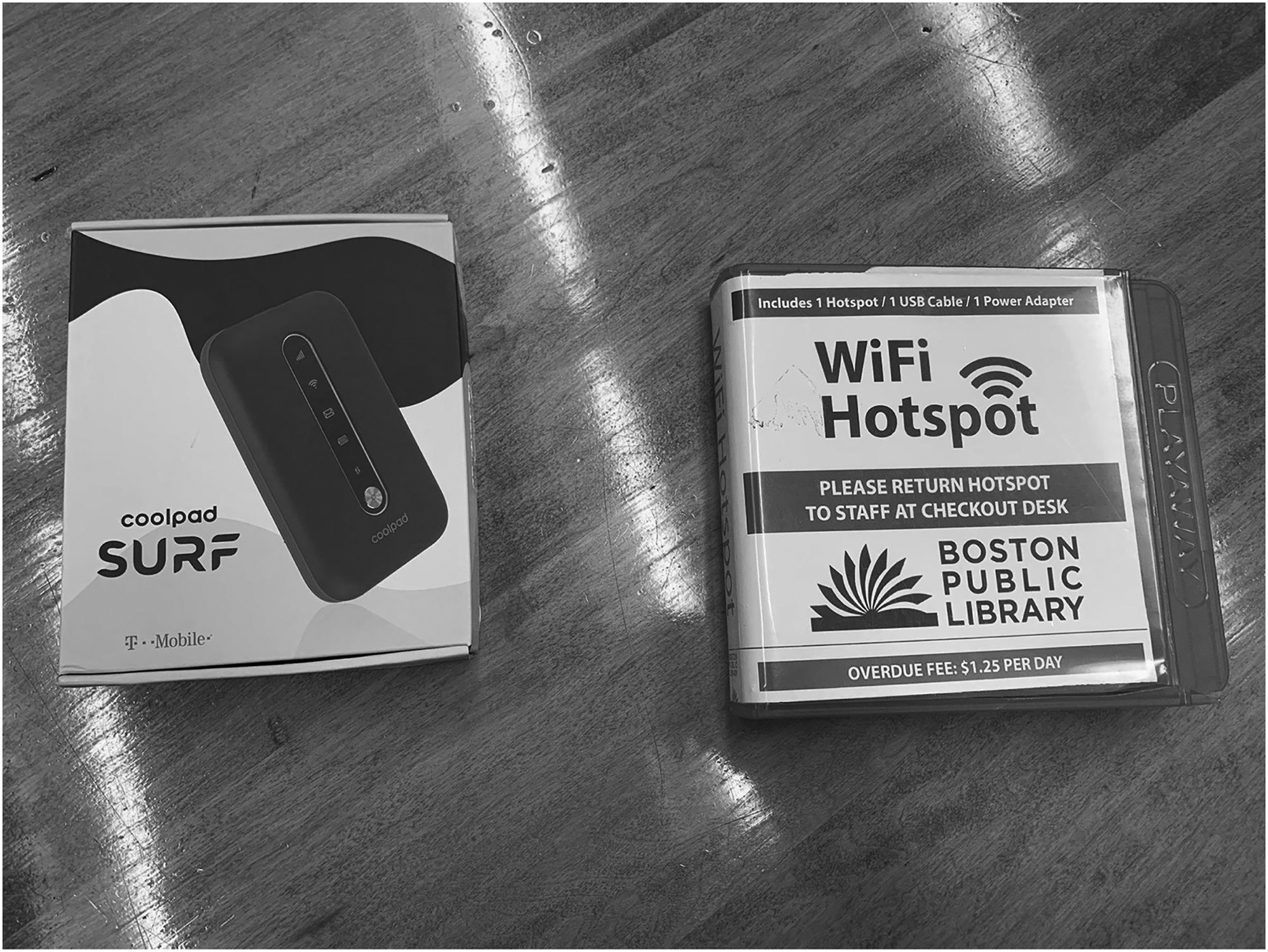
Boston Public Library mobile WiFi hotspot device in 2019.
The BPL directors were interested to learn more about the outcomes from the pilot hotspot program. Our research team decided to lead focus group sessions with library patrons who had checked out the devices to learn more about the benefits and challenges of the pilot program.
Participant recruitment
Although hotspots were available at each of the branch libraries, BPL staff and I chose to select focus groups participants who had checked out these mobile devices from locations around the city that were identified as having low rates of broadband adoption, or internet service at home. We also worked with staff at the City of Boston's Department of Information Technology who provided a map with broadband adoption rates and public library branches, as well as areas with higher rates of poverty. Figure 2 is a map last updated in 2020 that shows all the Boston public library branches with an overlay of areas with families living in poverty. The areas in darker shades of red indicate areas with higher rates of poverty.
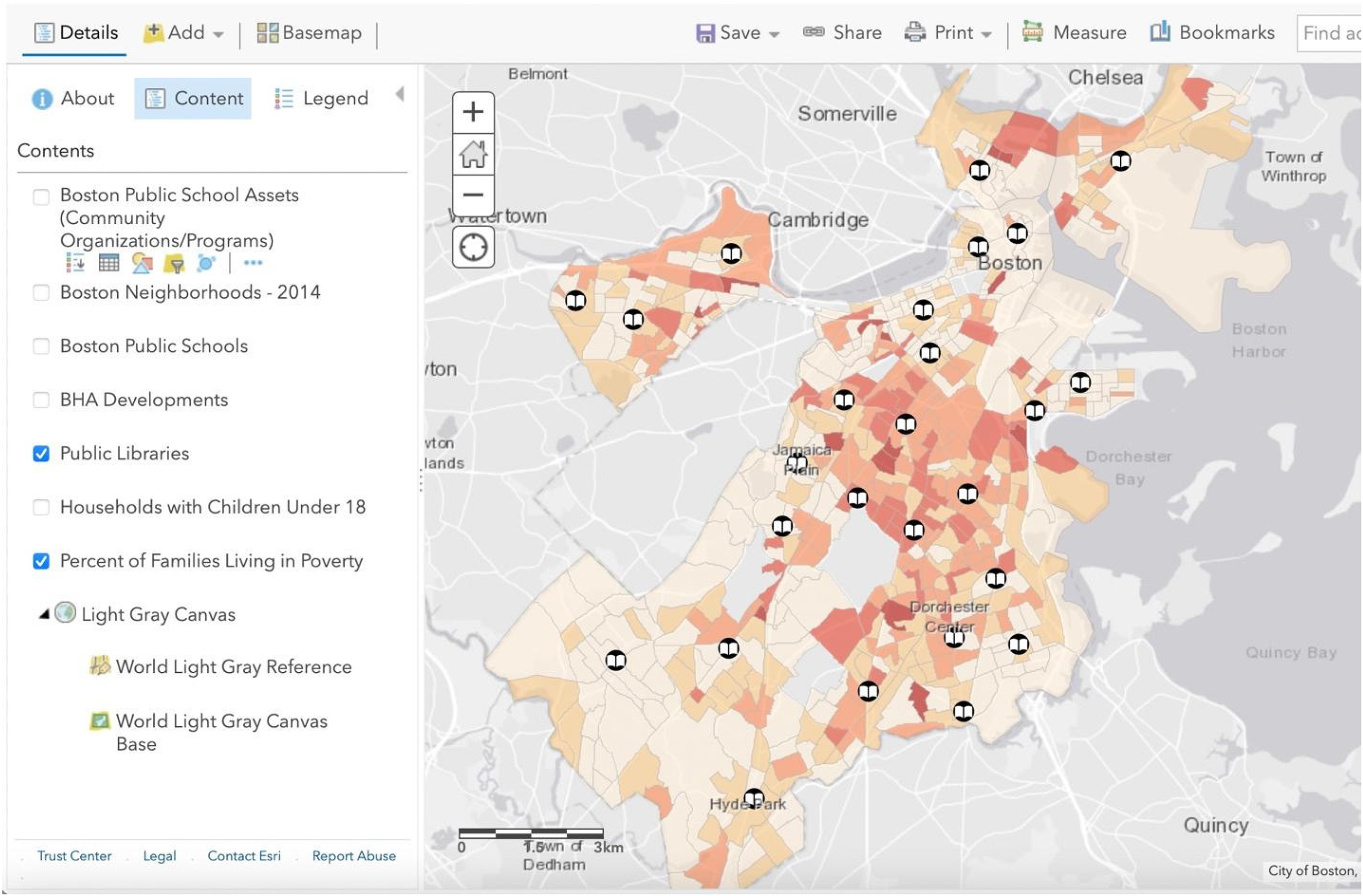
Map of public library branches and families living in poverty in Boston in 2019.
This map helped us determine the library locations where my graduate research assistant, Sarah Arena, and I would conduct our focus groups. After reviewing the maps, I worked closely with BPL staff and directors to focus on the following library branch locations: Grove Hall, North End, South Boston, West End, and Central. The qualitative data that we gathered in these locations would help the BPL directors and staff better understand the quantitative check-out data, which were not utilized as part of this study.
Public library patrons were recruited to participate in the focus group sessions using a recruitment script. We used language from the recruitment script to create flyers that were posted at each of the library branches where the focus group sessions took place. Information about the focus groups was also posted on the library's events calendar online. The first 10 participants who attended received a $20 gift card as a thank you for their participation. The focus groups were led by Sarah and me. The study was approved by the Institutional Review Board at Simmons University. A total of 17 adults participated in the study. The demographic information is included in Table 1.
Age, ethnicity, gender, and education of focus group participants.
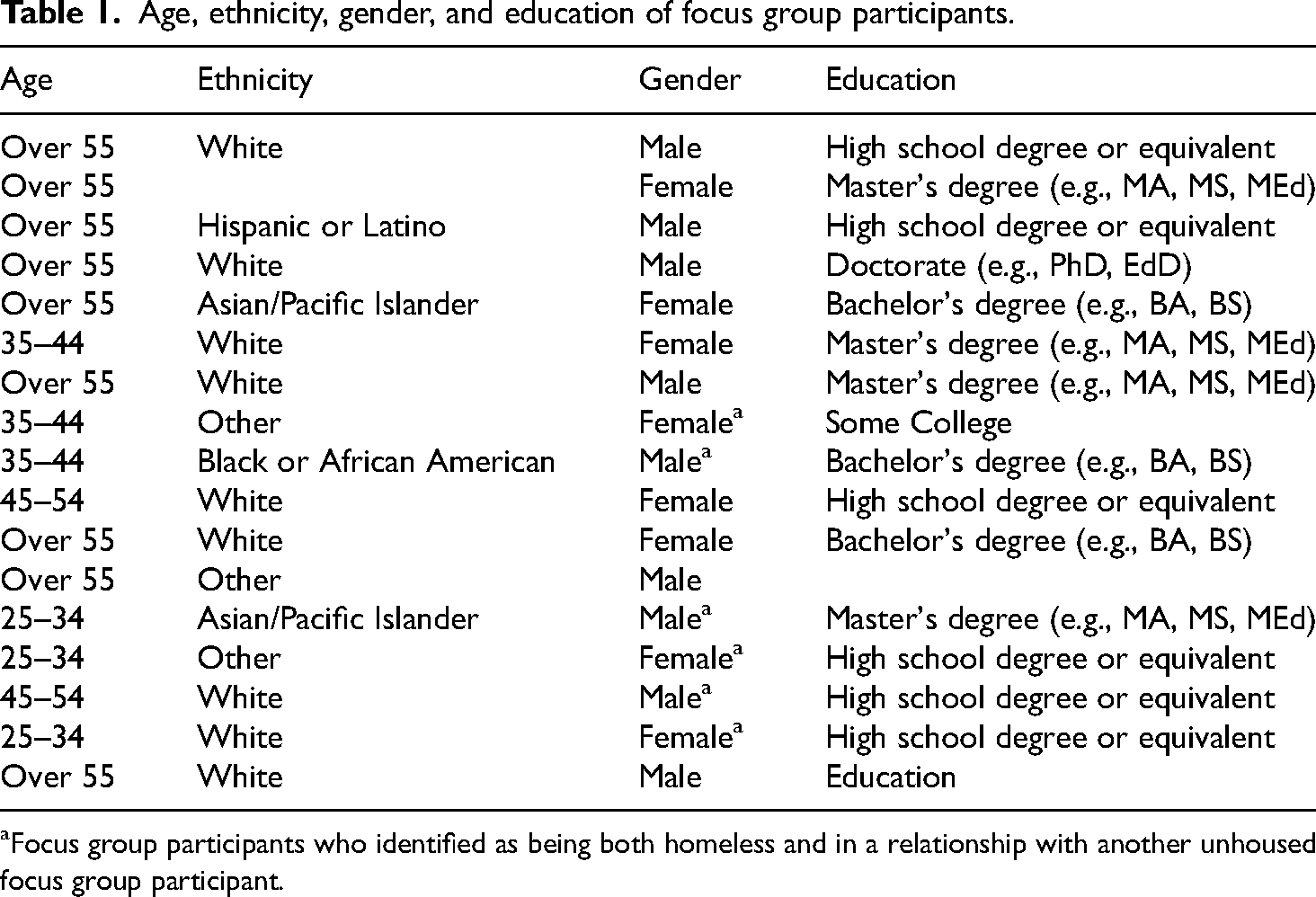
Focus group participants who identified as being both homeless and in a relationship with another unhoused focus group participant.
It is important to note that this study did not set out to investigate people experiencing homelessness, including those in romantic relationships. Rather, the research reported in this paper was similar to Rayburn and Corzine's (2010) study, which did not originally seek to learn about relationships. It had set out to examine how homeless men stay sober from alcohol and drugs. In their study, however, the researchers found that “without probing, the male respondents discussed at length the details of their current relationships. In a similar fashion, we were conducting focus groups at the Women's Residential and Counseling Center (WRCC) about general services when we learned about their relationships” (p. 761). It was only after Sarah and I completed our focus group sessions that we discovered that 6 out of the 17 total participants identified themselves not only as homeless, but also as homeless couples. Although this small sample size of only six people, or three couples, may be considered a limitation of the study because the size makes it difficult to generalize the findings beyond the local cultural context, the discovery of the number of overall participants who identified themselves as homeless couples called for greater attention and analysis.
Data collection and analysis
Each of the 5 focus group sessions took place for approximately 90 min at each of the 5 public library branches. During this time, we asked patrons about their experiences with checking out mobile Wi-Fi hotspot devices from the different branch libraries in Boston. More concretely, we asked about the following topics: how they first learned about the program; whether the participants had internet at home; if they experienced barriers to adopting broadband at home; where they had used the mobile hotspot devices; what types of devices they use to connect to the hotspot; how the hotspots had helped them; and what impacts the mobile devices had on their lives. At the end of each focus group session, we asked our participants to complete a short demographic questionnaire which produced the information in Tables 1 and 2. The focus groups were audio-recorded using a portable audio-recording device, and Sarah transcribed the focus group recordings. The transcripts were then uploaded into Dedoose, the qualitative and mixed-methods data analysis software platform.
Age, ethnicity, gender, and education of focus group participants.
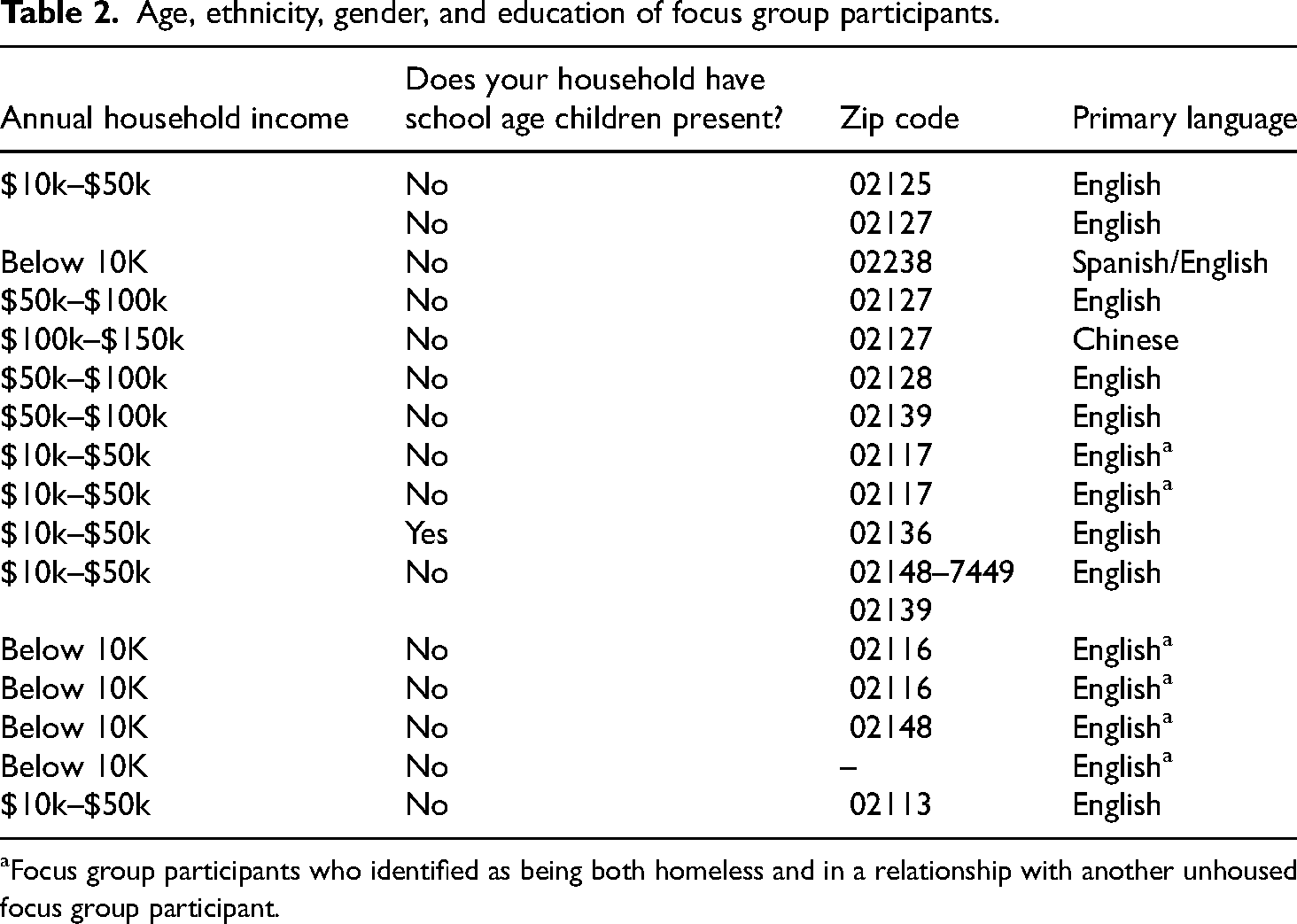
Focus group participants who identified as being both homeless and in a relationship with another unhoused focus group participant.
I used “values coding” (Saldaña, 2016) to analyze the focus group data. Saldaña described values coding as the process of applying “codes onto qualitative data that reflect a participant's values, attitudes, and beliefs, representing his or her perspective or worldview” (p. 11). This approach was helpful as I was concerned with gaining a deeper understanding of how focus group participants ascribed meaning and value to the mobile Wi-Fi devices. Through this analysis of qualitative data, I began to see stark differences between how people who identified as homeless and those who identified as having a home talked about the mobile devices. The mobile devices reflected the everyday experiences and stresses of social exclusion faced by people experiencing homelessness, including unhoused couples.
Findings
The analysis of focus group data shows that although the mobile hotspots provided many benefits for public library patrons in general, these devices facilitated mobile communication with a different sense of urgency for the six people experiencing homelessness, who also happened to be in romantic relationships. More concretely, the study found that:
Mobile Wi-Fi hotspots reduced stress and anxiety for unhoused patrons because without the devices, patrons without fixed residences worried they could not be found. Hotspots kept unhoused patrons connected, and therefore safer, in their tents despite the cold weather and a lack of electricity. Unhoused patrons were concerned about their devices getting stolen because of their precarious situation.
Although the unhoused patrons who participated in this study shared their recommendations regarding how mobile hotspot lending programs in public libraries could be improved, particularly for those experiencing homelessness, they also mentioned that the benefits of hotspot availability far outweighed their challenges. This section provides further details on each of these areas and concludes with recommendations offered by the homeless patrons who participated in two of the five focus group sessions.
Mobile Wi-Fi devices reduce stress and anxiety
Nearly all the focus group participants mentioned the benefits of using the hotspots while in transit. For example, the usefulness of the hotspots while traveling inside and outside the city was a recurring theme across all focus group sessions. Several housed focus group participants became animated when describing how effective the hotspots were, often more so than their own mobile phones, while traveling on the subway in Boston. Other participants remarked on how the hotspots allowed them to remain connected while on vacation with family. Overall, participants were extremely satisfied with the consistent level of connectivity while using the library's mobile devices across various locations. The reliability of mobile connectivity also helped the unhoused patrons to relax and unwind both inside (for example, in a tent) and outside. Two of the unhoused male patrons, each in a separate relationship with two of the other unhoused female partners, in our North End focus group explained: We rely on them because we don’t have phone service, so all you have to do is use the internet to make phone calls, appointments, and everything. Even watch a movie or something, just whatever, just relaxing, music, movies, you know, everything. Everything. Like I said, my phone don’t even work, and I use the Wi-Fi for it, just to have.
When the unhoused library patrons spoke about the benefits of the mobile devices, particularly for all three couples who participated in the focus groups, there was a heightened sense of urgency in how they communicated about the hotspots in their everyday lives. One of the couples in the North End branch focus group explained: For like the homeless community, which have experience in that—it's really important because we wouldn’t have any connection to anyone, other than each other. No one can find us. No one can call us. No one can contact us on Facebook, email, nothing, if we don’t have that. So it's really— It's very important. It is.
The hotspots helped reduce stress and anxiety among unhoused patrons because the mobile devices facilitated connection to people who would not be able to find them otherwise, including their partners. The same couple further described the importance of the devices: Also being able to stay connected with each other, because that's really important. Yeah. I mean, being homeless and worried about your significant other being out somewhere and how they’re doing or where they’re at, if they’re safe or something, you know, and vice versa. It works both ways, you know? So you have a device, have the hotspot where you can stay connected that way, Messenger or something, just whatever, you know, with anybody. Stay connected. It's good, yeah. It's important to us. It's one of the most important things we carry for us.
Mobile Wi-Fi devices keep homeless patrons safe
All the focus group participants talked about how they used the mobile devices to access health information, employment opportunities, and other vital community resources. For example, several housed participants talked about how they used the hotspot to check their email daily and to work on resumes in the process of finding employment. As one of the South Boston focus group participants mentioned, “If I’m not good with my English—as I am not, obviously—I do some research looking for a dictionary online to help me compose my resume or cover letter, that kind of stuff. So it's been helpful.” Another female patron in the South Boston focus group talked about how the hotspot supported her during her family caregiving activities.
The two homeless couples during our North End focus group also mentioned how the hotspots helped them to apply for jobs, schedule health care appointments, and access other local services. The couple explained: “There's so many resources throughout the community that we found online using the hotspot. And without the hotspot, we wouldn’t have been able to do it.”
For the library patrons experiencing homelessness, the hotspot devices played an additional role in helping them to stay safe while living on the streets without access to electricity. The male partner in the Grove Hall focus group explained: Right. Even when we come to the library, because I bring it to the library to help, you know, there's no electricity in the tent, so we charge it, right? And so because if there's a lot of people on the library, it’ll slow it down. And then using Amazon Prime, we download the movies so I don't have to use it, you know, to save the electricity. And it's quick.
This library patron and his female partner also talked about how well the hotspots worked in their tent–even when the weather was cold: Right. And the plus, because it's so cold outside, it doesn’t lose—it doesn’t drain the battery life with it being cold. Because we’re in a tent, so like under the covers, we’re warm, but in terms of like our devices and stuff like that, they are cold. And they don’t drain the battery life in it at all, which is awesome. Yeah, because we found—I didn’t know that. I didn’t know that when it gets hot, it gets overheated, it’ll pull—or if it's cold—it’ll pull. I didn’t know that and everything, but with this, it lasts for a long time. There’d be days where like it could go at least go two or three days. Right, until it gets to the red, because it tells you, right? And it’ll even flash. Like this thing is so awesome. It’ll be on green right, and then it will about to hit yellow, so it’ll flash yellow. But it's green though, but it's telling you, “Look, I’m getting down now.” And yellow is going to last for about umpteenth hours and everything. And then you will get down to red. And even red is going to last for some hours. This thing, come on, you need more. Get more.
The unhoused library patrons used the hotspots not only to keep themselves safe, but they also used the devices to keep others safe, as well. In one case, the mobile hotspot device played a life-saving role as one of the unhoused couples found themselves with a friend in a serious medical situation. One of the couples explained during our North End focus group: Yeah, we had an emergency. We had one of our friends, he had an allergic reaction, and he just completely passed out. And the Wi-Fi made it just easier to call and have a better connection when speaking with the operator, telling them what was going on, and so like it can honestly help save someone's life.
Homeless patrons worried about losing their mobile devices
For most focus group participants, both housed and unhoused, having access to the internet when the library was closed was a key benefit of the mobile hotspot lending program. As one housed woman mentioned during our West End branch focus group, I was able to do some critical documentation over a long weekend so that I appreciate. But it's the … three weeks is not long enough at all. I appreciate that timeframe when it was available, so that's my concern. But the benefit of doing something over a long holiday weekend when the library is closed, that I appreciate.
Another older gentleman who lived in affordable housing in the North End added: “Yeah. Weekends, like when the library is closed and that, I don’t have access, it's like you get a little isolated.” One of the unhoused couples during the North End focus group also talked about the benefits of having the hotspot when the library was closed: So we constantly have it on. We’re constantly using it between Facebook—and when the library's closed, you know, because we come here and the library's closed. Yeah, it's not even open like on the weekends, it's— Yeah, we’re still able to use the Wi-Fi. So that's the best thing. That's great. Yeah. Yeah, jobs, everything you need to do. Search. Search for everything. I mean, you can’t even go in to apply for a job anymore. They say, “Go online.” There's so many resources throughout the community that we found online using the hotspot. And without the hotspot, we wouldn’t have been able to do it.
Although everyone appreciated being able to use the hotspots anytime and anywhere, the unhoused patrons expressed a unique concern about their mobile devices getting stolen due to the precarity of their situations. Both unhoused couples in the North End focus group expressed their concerns, as recorded during this following exchange: Because of the homeless, a lot of the stuff gets stolen. So like a GPS [Global Positioning System] in it where the person can end up tracking it. So that way they can see where it's located, because no one's just going to take it and not use it, so if it's running. Because that's fine, the fee and everything, the stolen fees and everything, that's understandable. But that doesn’t stop from people stealing. Yeah. People are going to do anyways no matter what, because you taking care of it. You just blinked your eye for a minute. And if you checked it out, then it's … Right, then it would be your fault. It gets stolen. Yes. Or you’re sleeping, like you’re just sleeping— Yeah, there should be a way to track it. —and someone comes by and just snags your stuff, then you don’t have it anymore. And then you can’t get another one of these, because you don’t—you can’t afford to pay the fee. Because you didn’t pay the fees. How much is the fee? If it gets stolen? Thirty-five.
The cost was not the only concern with regard to losing the devices. All the unhoused patrons talked about how important the devices were in helping to keep them connected and safe, which in turn reduced the stress and anxiety of being homeless. The unhoused couple in the Grove Hall focus group explained: See, my thing is people's appreciation for it. Like we truly appreciate this hotspot and Wi-Fi. And it's free. And like we were telling you about even with the homelessness how like some of the people are ungrateful and don’t appreciate the resources that they have. This is a resource, even for people who are homeless, you know what I’m saying? And unfortunately, some people don’t take things and take care of it. And if these things start getting messed up and more and more people start destroying them because it's such a—it's on demand, basically, you know, that's the thing that I more so am concerned about. Like with more people comes more problems sometimes, you know? Especially if people take things for granted. She don’t like people. Be quiet. You know, people take things for granted, and it's a blessing that they don’t charge us for this.
Challenges and recommendations
The BPL’s mobile Wi-Fi hotspot lending program also had its challenges. At the beginning of the program, patrons experienced issues using the hotspots. As one of the South End branch library focus group participants mentioned, [t]hey had to re-calibrate them or something. And there was one time, maybe the 3rd or 4th time that I did the cycle [of powering the device down and then back up] and it was a dud. I took it home, tried to power it up, and it just wouldn’t work. So I came back and they were nice enough to put me at the head of the queue instead of going back 180 or something like that. I was able to get a fresh one fairly quickly.
One woman who participated in the Grove Hall branch library focus group described her experience: “In the beginning, we definitely had an issue. The other model was that if you held the power button down too long, it actually was resetting, so it was no longer feeding for BPL.” She added that after they recalled the devices and sent out new ones, the issue was resolved. As she explained, “So now all you get is that power on, power off. There's no way to screw it up.” The biggest challenge with the program, however, was the shortage of mobile devices available for check-out from the BPL branch libraries.
Although public libraries might consider a waiting list to be a measure of success, because of how it provides evidence to show the popularity of lending programs, it was a frustrating reality for most of our focus group participants, particularly for those who relied on the devices as their sole source of internet access.
The homeless patrons who participated in our research also shared their recommendations regarding how the BPL could improve the mobile Wi-Fi device lending program and the overall lending experience, particularly for patrons experiencing homelessness. Their recommendations included the following:
Mobile hotspot passwords should be connected to a patron's library card number to prevent others from using the device. Hotspots should include GPS tracking in case they get stolen. The large boxes that house the mobile devices should be smaller to make it easier for unhoused patrons to transport. I think it should be like connected to your library card. It does the library card number of something so you can change the password so nobody else can use it because since the Wi-Fi's on your name, if somebody else us it, then somebody else does something that is not supposed to be done, it’ll be under your name. You’re responsible for it? You’re responsible for it. Also, I did notice that before I got my own and I was using his, a lot of people were using it, it was a little slower than we—and anyone who can like go on it, so I couldn’t really kick anyone off. And if you have a group of people, everybody knows it's the same password for everybody, yeah. Yeah. But I would say there should be a hard reset button [for] the password so once I get it, once I check out the hotspot from here, I change the password, put [in] my own password. And then three weeks are over, I give it back. They should have that [facility] of doing the factory reset or the hard reset on the password so my password gets erased, and they can put their own password. So the person that is getting next can put his own password and use it for his own purpose.
Because the unhoused library patrons were concerned about someone else using their mobile hotspot, two couples provided an insightful recommendation:
As mentioned earlier, unhoused library patrons are often concerned about their personal items getting stolen. Therefore, in addition to the passwords being connected to a patron's library card, one of the unhoused focus group participants recommended that the mobile devices should have GPS tracking, particularly if the library did not already have a way to find the loaned devices.
Lastly, the unhoused focus group participants recommended that the library use smaller boxes to house the Wi-Fi devices upon check-out. This would make it easier to transport the devices and keep them more discreet, as the following exchange between two unhoused couples at our North End library branch focus group session revealed: Again, being homeless, you’ve got to carry all your stuff around with you. The box. Yeah. It would be great if they could somehow make it a smaller package. A smaller box for the devices? Yeah. Or maybe have the option of leaving the box at the library. I was thinking about that. That would be great. So that way if it needs to be returned like wherever they send it back, the box can just be left here at the library, and you just take the charger and the hotspot with you.
Discussion
This paper contributes novel insights into the benefits of mobile Wi-Fi hotspots by highlighting the experiences of people experiencing homelessness, as an underrepresented population within mobile communication scholarship. Although previous research has detailed the benefits of mobile phones for homeless individuals, few have looked at how mobile Wi-Fi hotspot devices support homeless populations, including those in romantic relationships. Several studies have looked at the potential benefits of social support networks in promoting better health outcomes among people experiencing homelessness and the role of mobile phones in this process (see, e.g., Eyrich-Garg, 2010). However, the findings in the present study contribute new understanding of how mobile hotspot lending programs help keep homeless people safe and connected to one another, particularly when public libraries and other homeless support organizations in a community are out of reach. This paper also helps to address recommendations in previous studies that have called for additional research “on the relationships between individuals and acknowledging their benefits,” which may yield important insights not only for “homeless shelters but other agencies that offer similar services, such as alcohol treatment programs, or provide aid to various groups” (Rayburn & Corzine, 2010, p. 770).
This paper also adds to the digital inequality research by showing how mobile hotspot lending programs help address issues of “access instability” among homeless populations, which Galperin et al. (2021) described as challenges to maintaining mobile connectivity and frequent interruptions in access (p. 34). The findings above show how the mobile Wi-Fi hotspots helped address issues of access instability because the level of connectivity was often stronger and more reliable than other options, including inside the public library building itself. Similarly, public libraries as an intermediary organization can also help address issues of “survival infrastructuring,” which Humphry (2021) described as the “as the media and spatial practices used by homeless young people to negotiate their connectivity barriers to maintain a reliable digital connection” (p. 1010). An important aspect of this study is the role of geography in shaping digital connectivity. This paper shows how a metropolitan library system with several branch libraries, each with mobile Wi-Fi lending programs, can help to address how homeless populations, including couples, navigate and maintain digital access across urban spaces.
Policymakers and others working to address homelessness should consider the role of mobile Wi-Fi devices in supporting homeless patrons, including those in romantic relationships, through public library programs. Local, state, and federal programs that support people experiencing homelessness should develop new grant programs for public libraries and other community-based organizations to support mobile Wi-Fi device lending programs. Based on the findings from studies of the benefits of romantic relationships among homeless individuals (Czechowski et al., 2022; Rayburn & Corzine, 2010; Stevenson & Neale, 2012), there may also be advantages to developing new partnerships between public libraries and human services organizations that serve homeless couples. As Rayburn & Corzine (2010) recommended, “[t]here may be potential advantages of working with couples instead of individuals within homeless shelters” to increase the chances of positive health and life outcomes for those who experience homelessness (p. 770). Therefore, it may be beneficial for public libraries and their community partners to consider programs and services specifically for homeless couples that employ mobile devices to help ensure their safety, connectedness, access to resources, and as an important source of social support.
Conclusion
This paper sought to address a gap in mobile communication scholarship by contributing insights from a qualitative study which highlighted people experiencing homelessness as an underrepresented group in the literature, and their use of mobile Wi-Fi hotspot devices. The qualitative analysis of focus group sessions with BPL patrons who checked out mobile Wi-Fi hotspot devices showed that although mobile hotspots provided many benefits for public library patrons in general, these devices facilitated mobile communication with a different sense of urgency for people experiencing homelessness. More concretely, the study found:
Mobile Wi-Fi hotspots reduced stress and anxiety for unhoused patrons because without the devices patrons without fixed residences worried they couldn’t be found Hotspots kept unhoused patrons connected, and therefore safer, in their tents despite the cold weather and a lack of electricity. Unhoused patrons were concerned about their devices getting stolen because of their precarious situation.
Although the unhoused patrons who participated in this study shared their recommendations regarding how mobile Wi-Fi device lending programs in public libraries could be improved, particularly for those experiencing homelessness, they also mentioned that the benefits of hotspot availability far outweighed their challenges. The paper concluded with a brief discussion of the implications for those working to address homelessness, including community-based organizations, government agencies, and policymakers who seek further insights on the positive role that mobile media and communication can play in supporting positive health outcomes for couples experiencing homelessness.
Footnotes
Declaration of conflicting interests
The author declared no potential conflicts of interest with respect to the research, authorship, and/or publication of this article.
Funding
The author disclosed receipt of the following financial support for the research, authorship, and/or publication of this article: This work was supported by a grant to Simmons University from the Boston Public Library in 2019.

Author biography
Colin Rhinesmith is the Founder and Director of the Digital Equity Research Center at the Metropolitan New York Library Council. He is also a Research Fellow with the Quello Center for Media and Information Policy at Michigan State University. His research examines the role of community informatics projects in creating and sustaining healthy digital equity ecosystems.