




Abstract
Digital media profoundly shape modern life, offering benefits while also prompting concerns that lead many to seek disconnection. This study investigates r/NoSurf, a large online community paradoxically dedicated to digital disconnection. Through computational and qualitative analysis of discussions from over 26,000 active members, we study users’ complex and often ambivalent relationships with technology and their pursuit of digital well-being. The findings show that people see digital technology as both an escape and a source of distress. Motivated by desires to mitigate perceived negative impacts like distraction and diminished well-being, and faced with the difficulty of full withdrawal, members actively develop and share a sophisticated repertoire of strategies to manage their digital technology use. This research characterizes digital disconnection not as mere avoidance, but as a dynamic, skillful, and individually negotiated practice, or literacy, aimed at fostering well-being and intentionality in the face of pervasive connectivity.
Despite the ubiquity of digital media and the undoubted benefits that such tools, services, or platforms can provide, there are many who feel compelled to disconnect, disengage, or abstain from using these technologies (Nassen et al., 2023). Reflecting this, a growing body of research now focuses on the practices, motivations for, and effects of deliberate non-use of digital media (Nassen et al., 2023; Ross et al., 2024). While the specific individual and collective drivers for digital disconnection may differ from earlier forms of media resistance, Syvertsen and Enli (2020) argue that digital disconnection is simply the latest in a long tradition of media and technology resistance.
Unlike earlier resistance movements that drew on collective moral or cultural concerns (Syvertsen, 2017), contemporary disconnection is rooted at both individual and collective levels (Kaun and Trere, 2018; Ross et al., 2024). From a mediatization perspective, this shift reflects the deep integration of media in everyday life, prompting individual motivations for disconnection, like self-optimization and mindfulness, as responses to the pressures of constant connectivity (Syvertsen and Enli, 2020). At a collective level, concerns about digital capitalism, surveillance, and the inauthenticity of mediated experience are often interpreted through (re)domestication theory, as people and communities (re)negotiate the place of digital technologies in their lives (Karlsen, 2023; Kaun and Trere, 2018).
This study contributes to the literature on digital disconnection by analysing user-generated content from a public online community focused on digital disengagement, r/NoSurf. This community provides a rich, self-organized setting where members share their struggles, strategies, and successes in disconnecting from digital technologies, making it particularly interesting because it not only reflects individual attempts to manage digital technology use, but it also embodies a collective effort to foster a culture of mindful technology use. Methodologically, the study represents a unique integration of computational and qualitative methods within this area of research. Acknowledging the often-paradoxical nature of disconnection (Kuntsman and Miyake, 2019; Natale and Treré, 2020), the findings of this study provide insight into the ways in which people negotiate and construct their digital well-being in a hyper-connected world (Vanden Abeele, 2021).
Digital disconnection as a continuum
Digital media can both empower and undermine individual autonomy. Recognizing this tension, Vanden Abeele (2021) theorizes digital well-being as a subjective balancing act between positive and negative effects associated with digital technologies. People experience digital well-being when they maximize controlled pleasure and functional support while minimizing loss of control and impairment (Vanden Abeele, 2021: 13). This framing resonates with broader neoliberal discourses that emphasize personal responsibility, casting users as individually accountable for managing their own digital experiences (Beattie, 2020; Valasek, 2022). Within this logic, digital disconnection can be seen as a personal response to perceived imbalances between the benefits and harms of digital media use.
In earlier work, Kuntsman and Miyake (2019) argue that digital disconnection 1 should be viewed not as a binary but as a continuum. This continuum captures the multidirectional and multidimensional nature of disconnection practices, motivations, and outcomes. Baumer et al. (2013), for instance, highlight four key practices: resisting, leaving, relapsing, and limiting. Similarly, Light and Cassidy (2014) describe disconnection as cyclical and multifaceted. From a domestication perspective, these practices reflect people’s ongoing negotiations with digital media in daily life (Karlsen, 2023).
Like disconnection itself, motivations for disconnection are also multidimensional (Kuntsman and Miyake, 2019). Qualitative data suggest that they range from personal well-being to political resistance, from time management to critiques of digital surveillance or inauthentic communication (Kaun and Trere, 2018; Ross et al., 2024). These motivations often shape the specific disconnection strategies that individuals adopt (Kuntsman and Miyake, 2019). For example, temporary breaks or moderate adjustments in digital behaviour are typically linked to well-being-related concerns (Nguyen, 2023), whereas more radical rejections of technology are often motivated by escapism or resistance to digital culture (Magalhães, 2022).
Digital well-being, disconnection, and proactive self-control
Maintaining digital well-being amid these tensions often requires more than reactive decisions, it calls for proactive self-regulation. The process model of self-control (Duckworth et al., 2016) offers a useful lens for understanding how individuals proactively manage their impulses and behaviours to align with long-term goals, particularly when faced with immediate temptations or distractions, such as those presented by digital technologies. This model posits that successful self-control is not merely a matter of effortful inhibition during moments of temptation. Instead, it emphasizes proactive strategies employed before encountering potent cues.
Duckworth et al. (2016) outline several categories of such strategies, with three being particularly relevant to digital disconnection. Situation selection involves choosing to enter or avoid situations based on their likely impact on goal pursuit. In the context of disconnection, this might involve deliberately avoiding environments or tools that trigger unwanted digital technology use. Situation modification involves altering one’s current environment to reduce the allure of temptations or to make desired behaviours easier. For digital disconnection, this could mean changing device settings, using blocking software, or physically altering access to technology. Cognitive change involves re-appraising a situation or temptation to alter its subjective meaning or emotional impact. This could involve reframing the value of disconnection, focusing on the benefits of offline activities, or deploying attentional strategies to resist digital temptations. Through this perspective, we can view digital disconnection not just as a state of non-use, but as an active, strategic process of self-regulation, where individuals employ strategies to manage their relationship with technology and pursue digital well-being (Le Roux and Parry, 2022).
Paradoxes of digital disconnection
Digital disconnection is not only multidimensional, it is deeply paradoxical (Beattie and Cassidy, 2021; Hesselberth, 2018). A central paradox is the challenge of achieving complete ‘disconnection’, which is rarely feasible due to the pervasive role of digital technologies in contemporary life. As Kuntsman and Miyake (2019: 9) note, ‘the very digital and material architectures of our networked society and devices ensure that we remain embedded within its structure, becoming the mediators of on- and off-line synchronisation between the Internet and its “smart” devices’. Indeed, those who write about and advance the virtues of digital disconnection tend to promote their ideas through the very media that they ostensibly spurn. This contradiction is evident in public announcements of temporary disconnections or ‘detoxes’ on social media (Jorge, 2019).
Natale and Treré (2020) describe a related paradox, disconnection-through-engagement, where people must deeply engage with digital tools in order to withdraw from them. Disconnection apps, for example, are themselves digital tools used to limit digital media use (Parry et al., 2023). Beattie (2020) refers to this as a ‘giant contradiction’, emblematic of our ambivalent relationship with digital technologies. Tools designed for digital self-control (e.g. website blockers, app timers, or minimalist phone interfaces) seek to curtail usage by offering users more granular control over their habits. Yet, as Lyngs et al. (2019) point out, these tools often reflect a form of technologically mediated self-discipline, where users outsource willpower to design. They simultaneously promise freedom from distraction while reinforcing individual responsibility for self-regulation, reflecting the paradoxical nature of seeking disconnection through the very systems that enable constant connectivity.
This ambivalence is also visible in mediated disconnection communities. From digital detox retreats to minimalist living forums, online and offline initiatives promote intentional disconnection while relying on digital platforms for outreach and interaction. Even ostensibly anti-tech groups like the Centre for Humane Technology leverage digital media to critique its harms. Digital minimalist communities, inspired by figures like Cal Newport, rely heavily on online forums or social media to promote disconnection practices (e.g. the ‘Offline Club’ movement).
Such communities often blur the line between connection and disconnection. Members report their disconnection journeys, remain in contact through digital means, and co-create a culture of mindful use. As Kuntsman and Miyake (2019) argue, this represents a form of active self-production, a reflexive process through which individuals shape their identities, and construct and reinforce their own motivations for disconnecting. Interaction with the community, while mediated, provides an outlet through which individuals can express their needs, receive advice, or simply feel part of a collective whole, irrespective of whether they actually disconnect from digital media more generally.
These paradoxes suggest that, rather than viewing connection and disconnection as binary, we should understand disconnection as one way in which users deal with and negotiate their constant connectivity (Kuntsman and Miyake, 2019; Light, 2015; Syvertsen, 2023) in support of their digital well-being (Vanden Abeele, 2021). Online communities of disconnection can provide a unique opportunity to understand how people manage digital well-being (Vanden Abeele, 2021) in a time of ubiquitous connectivity.
The present study
This study investigates one such paradox: an online community dedicated to digital disconnection, r/NoSurf (https://www.reddit.com/r/nosurf/). NoSurf is an open online community centred around a subreddit on the popular community forum platform Reddit. Established in 2011, this community has grown from 10,000 members in 2018 to over 229,000 in early 2024. Within this forum, members openly discuss motivations for disconnection, experiences of disconnecting from the Internet and other technologies, and the techniques and strategies that they have used to support their disconnection practices. The discussions are replete with vivid accounts of disconnection and the struggles, failures, and successes that characterize its members’ experiences.
Because disconnection is best appreciated as a multidimensional continuum shaped by diverse individual experiences, a fruitful approach to understand this phenomenon lies in the analysis of individual experiences of disconnection. Previous research typically relies on two approaches to do so: in-depth qualitative approaches likes interviews and ethnographies (e.g. Nguyen, 2023; Ytre-Arne et al., 2020), or critical analysis of public discourses (e.g. Syvertsen and Enli, 2020; Van Bruyssel et al., 2023; Vanden Abeele and Mohr, 2021).
This study combines elements of both by applying computational and qualitative methods to a large corpus of user-generated text. In doing so, it explores how individuals articulate and negotiate their digital disconnection practices within a shared, paradoxically mediated, community. The NoSurf subreddit offers a unique and underexplored context for this investigation. As a grassroots, peer-led community explicitly dedicated to resisting problematic forms of digital technology use and supporting digital well-being, NoSurf provides access to a rich, organically generated dataset of firsthand reflections, advice, and personal narratives. This allows us to observe how disconnection is discussed, supported, and problematized in real time and in users’ own words, something that prior studies using more traditional qualitative or discursive methods often cannot capture at this scale.
By integrating computational techniques (to identify broader patterns and recurring themes) with close qualitative analysis (to unpack the rich complexity in these themes), this study contributes new insight into the motivations, practices, and challenges associated with voluntary disconnection from digital technologies. In doing so, it builds on and extends previous qualitative research by foregrounding both the communal dynamics and individual experiences within a self-organized space of digital resistance. The analysis is guided by the following research questions:
Methods
This study used a mixed-methods approach to analyse user discussions in the r/NoSurf subreddit. The analysis proceeded in two phases: (1) a computational phase, in which we used structural topic modelling to analyse the large dataset efficiently and (2) a qualitative phase, in which we manually labelled and interpreted the resulting topics through qualitative reading of relevant posts and comments to generate more complete interpretations of the identified themes.
Prior to data collection, the study received ethics approval from the relevant institutional ethics board (REC: SBE:28627). All data processing and analysis procedures were conducted using the R programming language. The scripts can be viewed at the OSF repository (https://osf.io/n3y69/) but, despite the data being in the public domain, due to the data sharing restrictions imposed by Reddit (see Davidson et al., 2023), and the need to maintain user privacy, the data used in the study cannot be publicly shared.
Data collection
To collect the discussion data, we queried the PushShift API (Baumgartner et al., 2020) to extract all posts and comments published in the open r/NoSurf subreddit between 1 January 2019 and 31 December 2021. Prior to the API closing in mid-2023, 2021 was the last year for which data were available for a full year for this community. The 3-year period between 2019 and 2021 represents the most active period in the history of the subreddit, with substantial growth occurring in this period. On Reddit, discussions are organized into threads, with each thread containing a post that initiated the discussion. These threads contain comments that are submitted by users in response to either the post or other comments in the thread. For this study, the data included the full text of all posts and comments for all threads in the community during the targeted period, as well as the timestamps and usernames associated with these observations. This initial dataset contained 112,398 observations, with 7993 posts and 104,405 comments.
Data processing
A series of processing steps were conducted to prepare the data for analysis. First, we excluded all data from users with deleted accounts (712 observations). Second, using relevant keywords we detected all accounts that were clearly bots (i.e. the username contained bot, Bot, or a variation on these terms). After manually inspecting all accounts and posts associated with these terms (and other common patterns indicative of bot activity like repeated posting of the exact same content), 1311 observations were removed. We inspected all terms that appeared rarely in the dataset to identify and correct miss-spelled words particularly relevant to the study (e.g. Instagram, smarthphone, etc.). Next, because topic models tend to perform poorly when documents are short (i.e. when there are too few words in the posts/comments) due to the absence of word co-occurrence information (Laureate et al., 2023), we filtered the dataset to include only those observations that contained 10 or more words. This reduced the dataset to 94,523 observations, with 7932 posts and 86,591 comments. Following this, we replaced all URLs with the term ‘URL’. This ensured that the grammatical structure of each sentence remained unchanged, while removing the actual URLs which were not able to be meaningfully analysed with the techniques used in this study. At this stage, posts contained a median of 116 words (M = 177.72, SD = 214.86) and comments a median of 39 words (M = 62.05, SD = 75.99).
We used the udpipe package (Wijffels, 2023) to tokenize the dataset into unigrams, perform parts-of-speech tagging, and lemmatize each term to its root form. Lemmatization and building a topic model on a corpus containing terms from particularly relevant parts of speech have been shown to improve topic coherence (Lau et al., 2014; Martin and Johnson, 2015). While many studies only use nouns, because this study aimed to identify distinct themes in member’s experiences, reflections, and behaviours related to digital disconnection, we retained all nouns, verbs, and adjectives for the topic modelling. This choice was intended to capture not only the subjects and objects of discussion (nouns), but also the actions members described taking (verbs) and the emotional and evaluative language that coloured their posts (adjectives). Although an English-language model was used in the parts of speech tagging procedure, many misspelt and non-English terms remained. Using a vector of English language words, we identified all non-English terms and manually determined whether they pertained to legitimate entities (e.g. brands), whether they were miss-spellings of eligible words, or whether they should be removed. We corrected common self-censored words (e.g. sh*t) and any other miss-spelled terms. We determined that no legitimate words longer than 18 characters existed in the dataset and set a maximum length of 17 characters. We also removed any terms that contained repetitions of the same character three or more times.
Following these processing steps the dataset included 94,358 observations (posts: 7926; comments: 86,432). These observations contributed 2,439,370 tokens, with a dictionary of 33,687 unique lemmas. However, many lemmas were used only a single time. Therefore, we followed conventional practices and trimmed all ubiquitous terms (i.e. those that occur in more than 40% of observations), as well as all extremely rare terms (i.e. those that occur in less than 1% of observations) to reduce the sparsity of, and noise in, the dataset. This reduced the dataset to 2,105,307 tokens, with a dictionary of 2188 terms.
Data analysis
To identify latent ‘topics’ in the text we used topic modelling as an initial clustering step before performing an in-depth thematic analysis of the observations within each topic. A topic model is a probabilistic model that represents each document in the corpus as a member of several latent clusters or topics. Each topic can be represented as a probability distribution of the words associated with the underlying topic. As a fuzzy clustering method that produces mixture models, each word belongs to multiple clusters, with the probability of a word falling within a specific topic represented by β. Just as each topic consists of words with a given probability, each document consists of a combination of topics, each occurring with a different prevalence in the document (represented by γ).
Building on the latent Dirichlet allocation approach to topic modelling (Blei et al., 2003), we used structural topic modelling to fit a model such that the prevalence of the topics over documents is optimized to best represent the data, while accounting for relevant covariates. In this case, we expected that some degree of variation in the content of communication in the community would occur depending on (1) whether a document is a post or a comment and (2) the date that the document was posted. These covariates were allowed to affect the topic prevalence within documents, but not the probabilities of words within topics.
This modelling process involves three high-level steps, all implemented using the stm package (Roberts et al., 2019). First, as described above, we specified the model to be fitted to the data. Second, we optimized the model by selecting a suitable value for K (the number of topics in the model). Third, using the outputs of the model, we manually assigned qualitative labels to each topic. For the second step, we trained 10 different versions of the model, each using a different value for K (5–50, with steps of 5) and inspected key diagnostic metrics describing various properties of the models (i.e. held out likelihood, residual dispersion, exclusivity, and semantic coherence). These metrics indicated that the optimal value for K was between 10 and 20. When plotting exclusivity versus semantic coherence, 10 or 15 topics provided the best balance (see the online supplementary materials on the OSF repository for this plot). We examined the top observations associated with each topic for each model and based on the relative coherence of the terms associated with the topics, we decided to fit a topic model with K = 10 topics (see the OSF repository for a plot indicating the distribution of topics across the dataset). Thereafter, we assigned a single topic to each observation by allocating the topic with the highest γ value for each observation.
To label the topics, we first inspected the top terms for each of the key model metrics provided by the stm package (see the online supplementary materials on the OSF repository for a text file with this model output). Next, we conducted a qualitative reading of the posts and comments most strongly associated with each topic (i.e. those with the highest γ values) to refine our labels and develop rich descriptions. For each topic, we retrieved the top 1000 documents (including both posts and comments). When analysing comments, we took care to ensure contextual understanding by retrieving the original post or comment to which the entry was responding. If necessary, we also retrieved replies to capture the full thread.
We then read through the material for each topic systematically, making interpretive notes on recurring themes. While we did not undertake formal coding, we treated the data as a coherent thematic set, with the goal of capturing the shared experiences, motivations, and meanings that characterized each topic. After developing initial thematic summaries, we revisited the associated posts and comments to ensure that the themes accurately reflected the perspectives within each topic cluster.
Findings
Overview of topic modelling results
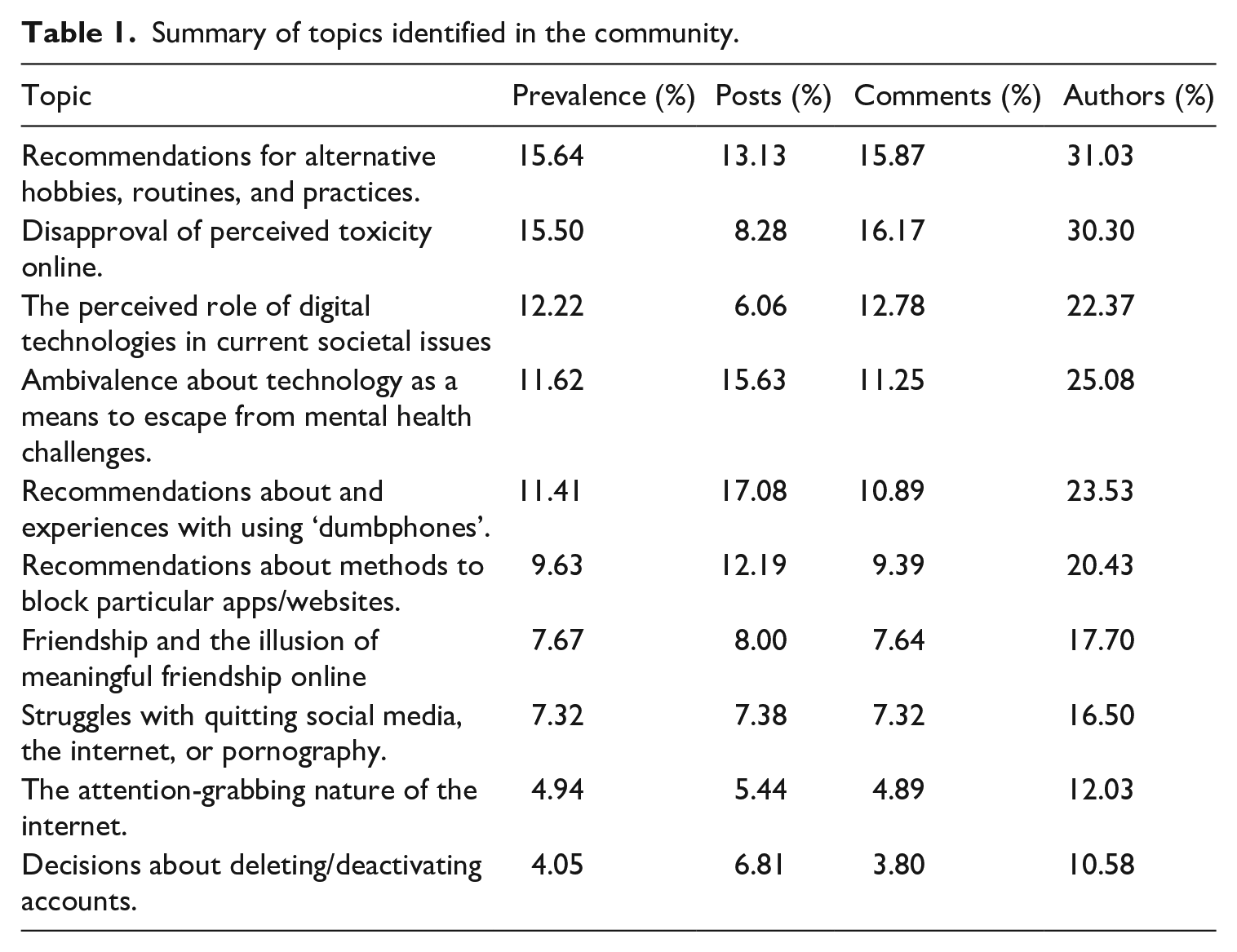
Table 1 summarizes the results of the topic modelling procedure, depicting the topic labels, the prevalence of the topic across all observations, the proportion of posts and comments that include the topic, and the proportion of members in the dataset that made a post/comment characterized by the topic (see the supplementary materials for a summary of the top ten words for each topic by highest beta, FREX, lift, and score). The four most popular topics collectively account for just under 55% of all observations. These topics account for 56.07% of comments, but only 43.1% of posts. While the NoSurf community has approximately 200,000 members, the dataset includes contributions from only 26,174 members. This indicates that the majority of users may engage passively (e.g. reading but not posting or commenting). Examining the proportion of contributing members per topic provides additional insight into which themes resonated broadly enough to elicit active participation. For instance, approximately 31% of these active members contributed to the most prevalent topic concerning hobby recommendations, whereas only 11% engaged with the least prevalent topic on account deactivation deliberations. These figures help contextualize the salience and reach of different themes within the community’s active user base.
Summary of topics identified in the community.
Discussions within the r/nosurf community
To provide rich descriptions of the discussions within the community, we group the topics into three high-level categories, with the first pertaining to members’ motivations for disconnection (RQ1), the second covering topics in which members discuss their experiences with disconnection, with particular reference to the practices that they recommend (RQ2), and the third including discussions of challenges experienced when disconnecting (RQ3).
Motivations for digital disconnection
Disapproval of perceived toxicity online
A common topic of discussion within the community concerned a general disapproval of perceived ‘toxic’ online cultures. Although this label was often cast on the Internet in general, many specific platforms were singled out as being particularly toxic. Some members referred to more niche platforms like 4Chan, while others called-out mainstream platforms like Twitter, and many also remarked on the toxicity present in large subreddits like r/all, r/worldnews, and r/jobs. Complaints concerned, among other things, the general negativity of content, the presence of echo chambers and misinformation, the politicalization of many spaces, the low quality of comments on Reddit and YouTube, and the ways in which anonymity drove trolling, ‘toxicity’, and ‘fights’ on these platforms.
Members’ disapproval of these toxic online cultures often stemmed not only from content concerns, but also from a desire to escape platforms that were perceived as fostering hostility, superficiality, or compulsive use. They associated toxicity with emotional drain, unproductive conflict, and the algorithmic amplification of outrage. Disconnection was thus framed as both an attempt to regain control over time and attention, and also as a way to reclaim emotional well-being by avoiding exposure to what they considered dysfunctional digital environments.
Acknowledging the relative value of different platforms, it is apparent that many did not seek to disconnect from the Internet entirely. Rather, members sought a ‘safe’ space, a community of people with shared beliefs and opinions. Although many contended that r/nosurf is a ‘safe’ place in which people are ‘real’ and willing to help others, some members of the community bemoaned ‘new people’ asking the same questions ‘over and over again’. These members felt that these ‘senseless posts’ cluttered the subreddit and did not contribute meaningfully to the community. Such critiques reflect an underlying tension between openness and exclusivity; between cultivating an inclusive support space and preserving the subreddit’s perceived quality and shared norms. In this way, it is evident that to some degree members tried to ‘police’ the community. In most cases, these comments received no engagement, but in others, members countered, encouraging new people to ignore such comments and to seek help from the community.
The perceived role of digital technologies in current societal issues
Members of the community frequently voiced their concerns about broader (often US-centric) societal issues (e.g. political polarization, systemic racism, the declining middle class, gender-based violence, economic precarity, and the erosion of social institutions). Technology companies were frequently cast as not just complicit in these issues, but as active contributors due to their profit-driven models that incentivize manipulation, surveillance, and polarization.
These discussions often served to rationalize or contextualize members’ decisions to reduce or avoid certain forms of technology. For example, one commenter reflected that ‘efficient systems and algorithms have been instituted which turn our psychology against us for the sake of profit’, suggesting a foundational concern that the digital environment is structurally harmful. Similarly, others argued that ‘humane tech will never fix the problems caused by the tech industry [. . .] the master’s tools will never dismantle the master’s house’, echoing anti-techno-solutionist attitudes and likening tech companies to fossil fuel giants in their unwillingness to enact meaningful reform. These perspectives implied that, for some, disconnecting was a form of resistance or self-preservation in the face of systemic harm.
Some members made this link more direct, suggesting that withdrawal from digital media was necessary for psychological or moral survival. For example, one user described disconnection not just as a lifestyle choice, but as part of ‘relearning how to be human’. Another questioned whether growing Internet fatigue could ‘disrupt our current understanding of what the future looks like’, positioning disconnection as a societal rather than purely personal response.
At the same time, full rejection of digital technology was rare. While a small minority called for ‘neo-Luddite’ movements, most members viewed such proposals as unrealistic. Instead, the dominant position was more ambivalent: technology was acknowledged as unavoidable and, at times, beneficial, but needed to be used more intentionally. As one member put it, digital well-being means ‘avoiding [an] abusive relationship with tech and using it purposefully’.
Ambivalence about technology as a means to escape from mental health challenges
Many discussions within the community concerned members’ experiences with loneliness, anxiety, or depression. While some related these to the Internet, many situated these experiences more broadly, often in relation to trauma, isolation, or ongoing life challenges. In these discussions, the ambivalence in members’ relationships with digital technologies became readily apparent. On one hand, many reported using the Internet (especially social media for ‘mindless scrolling’) for mood management, as a way to escape or distract themselves. One member, for instance, shared how they found it scary to ‘be with yourself and experience feelings’, while another described how ‘staring into a never-ending feed’ numbed their pain.
On the other hand, members also frequently acknowledged that ‘surfing’ did not solve their problems. Some recognized that it exacerbated their symptoms or led to additional consequences. One member, for example, acknowledged that while they used the Internet to escape, they felt guilty about this and that they are ‘missing their children’s lives go by’, or that they had ‘lost’ years of their children’s lives. For some, this ambivalence gave rise to a negative cycle of guilt about time spent online. One member, for instance, shared about the ‘pain of a life wasted’ and how they would then distract themselves with the Internet even more. It seems, therefore, that for some, this ambivalence contributed to a negative feedback loop: using the Internet to cope, feeling worse afterward, and then returning online to escape those worsening feelings.
While not always framed as deliberate motivations for disconnection, many users articulated a desire for change that implied such motivation. Disconnection – whether partial, temporary, or imagined as a long-term goal – was discussed aspirationally. Several users shared that they were ‘almost ready to return to real life’, to ‘really FEEL all of your emotions’, or to be ‘present in the moment’. Others offered support by encouraging them to sit with uncomfortable feelings, suggesting that facing rather than avoiding emotions was ultimately more healing. In these moments, disconnection was framed as a difficult but necessary step towards emotional growth or recovery.
Thus, while members rarely described disconnection in explicitly goal-directed terms, their reflections often contained implicit motivations: to live more fully, to be present, to reconnect with their own lives, and to stop feeling regret or shame. The community’s discussions reflected an understanding that Internet use was often not the root cause of their suffering but a coping mechanism that sometimes turned into a trap – an ambivalent tool that both shielded and separated them from the lives they wanted to reclaim.
Friendship and the illusion of meaningful friendship online
Many discussions in the community centred on connection, friendship, and the ways in which social media facilitated various forms of interpersonal relationships. While several users shared how they had found online communities, a recurring theme was the sense that digital friendships lacked depth, reciprocity, and authenticity. Members often described social media as fostering the ‘illusion’ of connection; where one feels surrounded by people but remains emotionally or socially isolated.
Online friendships were seen as ‘inauthentic’ because they were frequently one-sided, low-effort, and passive. For many, being ‘friends the easy way’ meant replacing active communication and mutual investment with the frictionless, ambient awareness afforded by timelines and feeds. ‘Facebook is where relationships go to die’, one user wrote, lamenting the way direct contact with friends gave way to occasional likes and scroll-by surveillance. Users reflected on how social media had made it easier to feel connected without actually being close. ‘You will miss nothing and they will not miss you’, one member observed. In hindsight, many came to see that they had allowed meaningful relationships to atrophy. The term inauthentic thus captured not just a preference for in-person contact, but a broader critique of the structural incentives of platforms that reduce relationships to interactions and visibility rather than sustained mutual care.
The attention-grabbing nature of the Internet
With reference to ‘constant novel stimulation’, community members frequently expressed concerns that the Internet had ‘destroyed’ their attention spans, eroding their ability to concentrate. Many described once loving to read but now struggling to finish even a paragraph without self-interrupting. Ironically, a common occurrence in these discussions was the recommendation of popular books—‘The Shallows’ (Nicholas Carr), ‘Digital Minimalism’ (Cal Newport), ‘Your Brain on Porn’ (Gary Wilson), ‘Dopamine Nation’ (Anna Lembke)—as resources to understand and reverse these effects. With reference to these books to explain their inability to concentrate, members frequently referred to dopamine, arguing that the Internet ‘rewires your brain’ and ‘messes up’ their dopaminergic systems. Specifically, they argued that ‘surfing’ – frequent hops between platforms, threads, videos, and so on – makes one ‘addicted to instant gratification’. In addition to being able to learn from the information in the books, reading itself – despite the difficulties recounted – was touted as a meaningful way to ‘rewire’ and improve one’s attention span. Reading books – especially paper-books – members believed ‘retrains’ the brain to delay gratification and re-develop the ability to sustain attention. Therefore, disconnection from the Internet was not only about escape, but also about recovery and regaining the cognitive capacities that they felt had been eroded.
Digital disconnection practices
Alternative hobbies, routines, and practices
The most prominent topic of discussion within the community concerned various hobbies, routines, or practices that could be used as replacements for time spent online. Common examples included: meditation, yoga, gardening, painting, hiking, and other forms of exercise, creative expression, and household activities. These recommendations were typically offered in response to people asking about what they should do if they were not online. Most of those seeking advice indicated that they did not have any hobbies and that they did not know how to spend their time other than ‘mindlessly’ surfing. Their comments suggested a shared sense that their time was not well spent, yet they struggled to identify meaningful alternatives and expressed concern that disconnecting would lead to boredom. In contrast, the recommended hobbies, which were frequently labelled as ‘old-fashioned’, were seen as ‘time well spent’. 2 Some suggestions were merely aimed at providing members with ideas of other things that they could do to occupy themselves, while others provided methods that could be used to help members to manage their attention and energy to support their self-regulation more generally. These included practices like yoga or meditation, as well as the use of morning or evening routines.
Methods to block apps/websites
The community also frequently discussed techniques that could be used to block access to particular apps or websites. These discussions were primarily oriented around desires to stay focused while working. Many of those involved in these conversations needed to use their computers and the Internet for their work, so they could not disconnect entirely. Rather, they were seeking advice about systems or tools that they could use to restrict their access to particularly distracting apps or websites. It was evident that members were cognisant that willpower alone was insufficient to regulate their behaviour in-light of the draw of off-task online content. In response, members provided suggestions for various digital self-control tools (e.g. browser plugins, apps, system features, block lists) that could be used to pre-emptively regulate behaviour and block access to particularly distracting apps or websites for specific periods or indefinitely. Some members also shared custom programmes that they had developed to remove, for example, recommended videos from YouTube or to block specific subreddits deemed personally toxic or distracting.
Recommendations about and experiences with ‘dumbphones’
Beyond limiting access to distracting apps or websites, another common disconnection strategy involved the use of so-called ‘dumbphones’ (i.e. basic mobile phones with only limited computing or Internet capabilities). It appears that those who used and/or recommended this strategy felt that if they had a smartphone (either in general or on them most of the time) they would not be able to resist ‘mindlessly’ using apps or that they would be constantly distracted by notifications. For them, ‘downgrading’ to a dumbphone functioned as a pre-emptive self-regulation strategy and, by removing the temptation of distracting or negative apps, they did not need to rely on willpower to resist the device. While proponents of dumbphones contended that they were still able to communicate through calls/texts, others expressed concern that, without instant messaging features, they would be ‘cut-off’ and unable to communicate effectively.
It is clear that members were also aware that only using a dumbphone was infeasible because for some common tasks (e.g. banking) a smartphone was required. Those that used dumbphones for their day-to-day communication tended to keep a smartphone stored away to use when they needed to access particular apps/services that required a smartphone. Others indicated that, instead of using a different, less-capable phone, they would use other appliances or tools as replacements for functions that they would formerly use their smartphone for. For example, instead of a smartphone by their bed, they would use a physical alarm clock so as not to be tempted to use the phone during the night or first thing in the morning. This replacement enabled them to put their phone in a different room and only use it much later in the morning.
Disconnection challenges
Decisions about deleting/deactivating accounts
Members frequently expressed desires to delete or deactivate their social media accounts due to the negative influence that they perceived these platforms to have. However, they were also concerned that, in doing so, they would be ‘cut off’ from their friends/family. To alleviate these concerns, they would ask about the experiences of those who had already left some (or all) social media about the ways that they could retain communication features (e.g. messaging) but remove all other features (newsfeeds, etc.). Messaging features were generally regarded to contribute positively to peoples’ lives, enabling them to connect with others, while other features were deemed to be largely devoid of utility.
These discussions led to comparisons between platforms and recommendations for which to quit and which to keep. These conversations revealed that many participants held mixed feelings about Reddit itself. It was generally acknowledged that Reddit was an ‘attention trap’ but that, relative to other so-called ‘comparison platforms’ like TikTok, Instagram, Twitter, and Facebook, it was less toxic and narcissistic, while also affording access to positive communities and useful information.
Other members sought advice about how to stay in contact with friends/family without any social media. A common concern was the inability to share photos and other life moments, or that others would share these on social media and that they would miss out. Some wondered, half-jokingly, if people would even notice that they had left the platform. Echoing the ideas discussed previously about the illusion of friendship online, this self-deprecating tone pervaded much of the conversation, revealing many of the anxieties and negative self-perceptions recounted by a portion of the community. In general, despite considering mediated relations to be inferior to in-person connections, because many members’ felt like their relationships had been eroded by social media, they were reluctant to give up even the semblance of connection that social media offers.
Struggles with quitting social media, the Internet, or pornography
Alongside recommendations of disconnection practices, the forum also provided members with a ‘safe space’ to share their experiences and struggles with quitting social media, the Internet or, in some cases, pornography. Here, members frequently compared trying to quit these technologies with trying to quit smoking, commenting on the similarly ‘strong pull’ that they experienced. In these conversations, ‘addiction’ was not used as merely a metaphor. In the minds of those who shared their experiences, they were addicted to digital technologies.
As noted earlier, a common meme in the forum was the idea that technology was ‘rewiring’ our brains and altering the functioning of our dopaminergic systems. Through comparisons with chemical substances like amphetamines and opioids, members indicated that they believed that technology was comparably addictive. This perspective is also apparent in the language used to refer to some digital disconnection practices (e.g. going ‘cold turkey’ to refer to completely quitting social media). Interestingly, while blame for these perceived addictions was firmly placed on social media platforms and the design features ( ‘dark patterns’) and algorithms that they employ, there is some acknowledgement that there may be other problems underlying potential addictions to digital media and that these underlying issues need to be addressed first. Members were encouraged to identify and ‘work on’ these underlying causes, rather than simply disconnecting from technology.
Discussion
Drawing on a mixed-methods analysis of over 26,000 active contributors to the r/NoSurf community, this study provides insight into the motivations, experiences, and particularly the practices characterizing digital disconnection. The findings illuminate a community grappling with the pervasive nature of digital technologies and actively seeking ways to manage their engagement for improved well-being. This research complements existing qualitative work (Nguyen, 2023; Ytre-Arne et al., 2020) and discourse analyses (Syvertsen and Enli, 2020; Van Bruyssel et al., 2023; Vanden Abeele and Mohr, 2021) by offering a large-scale, user-generated perspective on these struggles and solutions.
A central theme is the ambivalence in members’ relationships with digital technologies, leading to a constant, subjective calculus of benefits versus drawbacks (Vanden Abeele, 2021). Digital well-being was often implicitly linked to a sense of agency, focus, and alignment with personally meaningful values or priorities and, while members acknowledge many ways in which digital technologies can benefit their lives, the forum was characterized by stories of technology eroding control and negatively impacting their wellbeing and ability to function effectively in work, school, family, or social contexts.
Motivations for disconnection were varied, stemming from concerns about online content (toxicity, negativity) and perceived negative effects on well-being (distraction, mental health, social well-being). Aligning with Ross et al. (2024)’s continuum of digital disconnection, which recognizes the presence of individual and collective motivations for digital disconnection, our data emphasizes the collective articulation of how these individual issues are intertwined with platform design and societal anxieties.
Technology was often described as an ambivalent escape, potentially worsening existing internalizing symptoms and creating cycles of guilt (Lee et al., 2021). The prevalent medicalized discourse in which everyday behaviours are pathologized (Billieux et al., 2015; Vanden Abeele and Mohr, 2021) framed these struggles in terms of ‘addiction’ and ‘rewired brains’, placing strong emphasis on individual responsibility for ‘fixing’ their own overuse or problematic use of social media (Valasek, 2022; Vanden Abeele and Mohr, 2021). Rather than calling for structural change or collective action, users generally expressed scepticism towards platform or governmental solutions and turned to self-regulation strategies, mirroring a wider cultural shift in which digital well-being is treated as a matter of personal discipline.
Most members did not seek total withdrawal – deeming it largely impossible – but rather a more controlled, intentional engagement. Individuals tended to engage in a calculus, evaluating what they would gain or lose by disconnecting from a particular platform, community, or app. This pragmatic negotiation highlights how for these users the ‘paradox’ of using digital tools to disconnect is less a theoretical novelty and more a lived, practical necessity. Irrespective of their actual ability to go through with these intentions, it is clear that people hoped to remove distractions, extract themselves from toxic content, be more present and, ultimately, to enact greater agency (Karsay and Vandenbosch, 2021) over their lives through disconnection. This sense of agency has been associated with better psychological well-being in recent research (Lee and Hancock, 2024; Parry and Coetzee, 2025).
Supporting the notion of ‘disconnection-through-engagement’, the findings highlighted how disconnection often requires deep knowledge of platforms, technologies, and digital media (Hesselberth, 2018; Natale and Treré, 2020) to enact self-regulation strategies to support digital well-being. This is evident in comments detailing how to disable algorithmic recommendations, configure browser extensions to block or limit access, use built-in screen time tools strategically, or create layered routines involving multiple apps and devices to support their disconnection goals.
Deliberate self-regulation strategies for disconnection
The findings detailed a range of user-devised disconnection practices, including the adoption of alternative hobbies, the use of blocking mechanisms, and switching to ‘dumbphones’. These empirically identified strategies, while emerging organically from the community’s discussions, can be understood through the process model of self-control (Duckworth et al., 2016), introduced earlier. This model helps to illuminate the proactive and deliberate nature of these self-regulatory efforts beyond mere willpower, which was widely recognized as being insufficient for effectively fostering digital well-being. The draw of digital technologies – which many perceive to be facilitated by persuasive design techniques motivated by profit-driven incentives – was regarded as being too much to resist through effortful inhibition alone.
The adoption of alternative hobbies and routines (e.g. meditation, creative pursuits, exercise, reading) can be understood as cognitive change strategies. Members consciously engage in these activities not just as distractions, but to cultivate mindfulness, ‘retrain’ attention, and find ‘time well spent’, thereby altering their cognitive appraisal of offline versus online engagements. The prevalent use of methods to block apps/websites directly corresponds to situation modification strategies (Le Roux and Parry, 2022). By employing digital self-control tools, rather than wholesale disconnection, members actively alter their digital environments to reduce the allure of temptations, making it easier to stay focused on work or avoid problematic platforms. The recommendation and use of ‘dumbphones’, or strategically placing smartphones out of reach, exemplifies situation selection strategies. Members chose to shape environments (or use tools) that inherently limited unwanted digital engagement, preemptively removing the primary source of temptation. These situation selection strategies make it clear that entirely discarding a smartphone was not considered feasible by most members in the community. They are also indicative of the anti-techno-solutionist attitude that some members of the community hold. While many use digital self-control tools to facilitate disconnection, others oppose these tools and any solutions provided by technology companies.
The key understanding emerging from this synthesis is the sophistication and deliberateness with which this community collectively develops and shares these self-regulation tactics to support digital well-being. This modifies our understanding of disconnection not just as an act of refusal, but as an active, ongoing process of skillful self-management in a challenging digital landscape, where users recognize the insufficiency of willpower alone.
Limitations and future work
This study is not without limitations. First, due to the anonymous nature of Reddit, the demographic composition of the NoSurf community remains unknown. While Reddit users are generally young, male, and based in the United States (Statista, 2024), we cannot confirm the extent to which these characteristics apply to members of this particular subreddit. Although these demographics may reflect broader patterns of Reddit use, they likely do not capture the full diversity of individuals engaged in digital disconnection practices. This lack of demographic transparency limits the generalizability of our findings but also presents opportunities for future research. Comparative analyses across disconnection communities – spanning different platforms, regions, and social contexts – could help determine whether the motivations, challenges, and strategies identified here are broadly shared or unique to this community.
Second, although the community includes over 200,000 members, only approximately 26,000 actively contributed to the discussions. For this reason, it remains unknown whether the posts/comments represent the experiences and perspectives of the full community or just a vocal minority. Third, while topic modelling enabled the analysis to scale to the large number of observations, because the study lacked any direct engagement with the members of the community, there remain many aspects of the community that require further study. For this, we recommend further ethnographic and interview-based research be conducted.
Fourth, although the topic modelling was primarily used as a thematic clustering technique prior to more in-depth qualitative analysis, other modelling approaches leveraging word embeddings or transformers may produce more fruitful results that may reveal other more nuanced topics in this corpus for further qualitative refinement. Fifth, given the nature of the community, analysing how the community dynamics shape disconnection practices could provide valuable insights into the relationship between online community dynamics and digital disconnection practice. Finally, it is likely that the topics within this community, first, evolve over time and, second, relate to each other and discourses in other contexts (e.g. news media, other social networks) in important ways. These were not considered in this study and future work should look to adopt a longitudinal lens, network analysis techniques, and methods that bring together data from multiple sources to advance our understanding of these discourses.
Conclusion
This study has offered unique insight into the lived experience of digital disconnection, highlighting it as a dynamic and individually negotiated process aimed at enhancing digital well-being (Vanden Abeele and Nguyen, 2022). By interpreting the empirically identified disconnection practices through the lens of the process model of self-control (Duckworth et al., 2016), we gain an appreciation for the proactive and strategic efforts users undertake. While the narrative findings offer a detailed perspective on digital disconnection, three key points merit highlighting. First, people are not naïve to the ‘disconnection paradox’ but practically navigate it by employing concrete strategies, as full disconnection is often viewed as untenable. Their focus is on managing the implications of pervasive technology. Second, the diverse practices – from cultivating offline hobbies (cognitive change) to using blockers (situation modification) and dumbphones (situation selection) – demonstrate a sophisticated application of self-control principles. This reframes disconnection as an active skill set or literacy strategically employed to counter environmental temptations. Third, while users demonstrate agency in their strategies, the motivations are often embedded within a medicalized discourse that emphasizes individual responsibility for managing perceived impacts of digital technologies, potentially limiting focus on broader systemic issues and platform or governmental responsibilities.
Ultimately, this research shows that digital well-being, for many, is achieved through persistent, adaptive self-regulation. The community of r/NoSurf serves as a crucible for developing and sharing these coping mechanisms. Future scholarship should continue to use mixed-methods approaches in which qualitative and quantitative methods contribute to advancing our understanding of digital disconnection (Ross et al., 2024).
Footnotes
Author contributions
DAP: Conceptualization, Methodology, Software, Formal analysis, Investigation, Data Curation, Writing – Original Draft, Writing – Review & Editing, Supervision; CK: Software, Formal analysis, Writing – Original Draft; AM: Software, Formal analysis, Writing – Original Draft; AvdW: Software, Formal analysis, Writing – Original Draft.
Data availability statement

Declaration of conflicting interests
The author(s) declared no potential conflicts of interest with respect to the research, authorship, and/or publication of this article.
Funding
The author(s) received no financial support for the research, authorship, and/or publication of this article.
Ethical approval
Prior to data collection the study received ethics approval from the relevant institutional ethics board (REC: SBE:28627).
Supplemental material
Supplemental material for this article is available online.